Feeds:
Posts
Comments

Archive for the ‘Photography early 20th century’ Category

I’ve written before about my great-great-grandmother’s sister, Carrie Paak Waruf, and her husband Henry Waruf: Who Was Hank Waruf, Kalamazoo Gunsmith, Tennyson’s Words for Henry Waruf’s Funeral, and All the Peek Girls (note that Paak can be spelled Peek, Paake, etc.).

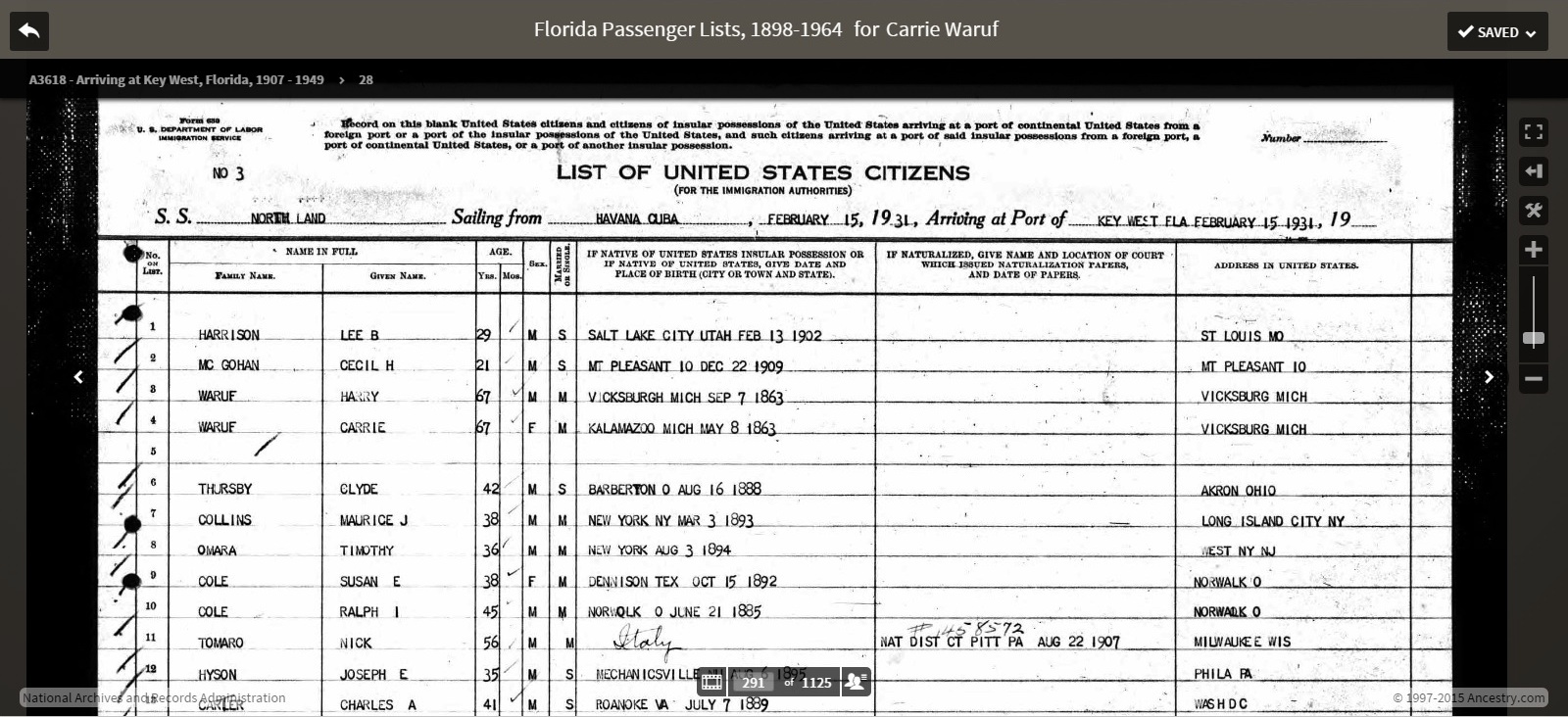
The other day I received one of those little Ancesty leaves on Carrie’s profile. The leaf led me to a Florida Passenger List for 1931. It shows that Carrie and “Harry” Waruf traveled on the S. S. North Land from Havana, Cuba, to Key West, Florida. They arrived on February 15, 1931.

Warufs come back from Cuba 1931 print screen

I started thinking about this trip. Undoubtedly this means that they vacationed in Cuba, to get away from the Michigan winter. Beginning in the late 1920s (or earlier), the twenty-seven-year-old 3,282-ton North Land, owned by Eastern Steamship Corporation, ran between Key West and Havana in the winter (and Boston and Yarmouth NS by summer). The North Land was a steamship and just short (in overall size) of the new luxury cruise ship that had recently become available (over 3,700 tons) that shipped out of Miami.

I wonder how long they vacationed in Cuba, where they stayed, and what they did there.

In 1930 the brand new Hotel Nacional de Cuba was built, so it’s very likely that they stayed there.

Poolside . . . . Trying to imagine Carrie and Henry/Hank/Harry by the pool with rum drinks.

This is what the Paseo de Prado looked like in the Warufs’ time:

Did Henry Waruf bring back boxes of cigars when they sailed into the Port at Key West?

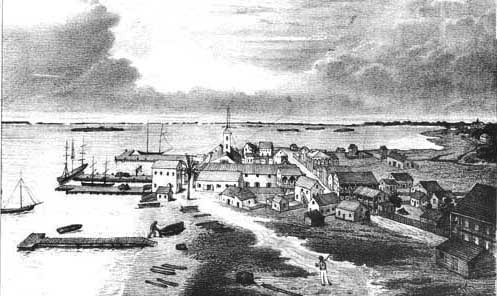
This photo is how they would have seen Key West in those days. Did they pay a duty on the cigars? Was there a limit on how many he could bring home? Remember that this was barely a year after the Stock Market Crash. Cigar factories were hurting in Cuba, just as companies and workers were hurting everywhere.

Did Henry and Carrie sneak back rum? It was still Prohibition when the Warufs traveled to Cuba!

It’s hard to imagine what an exciting place Cuba must have been for a couple from Kalamazoo in 1931.


Read Full Post »

Looking through my computer files (such a mess!), I found an old Word document I thought I’d share with you.

When my daughter was 10 she wanted to be a paperdoll centerfold for American Girl magazine. One of the requirements was to interview female living relatives about their childhoods. Her oldest female relative that we knew of (my daughter was adopted) was her great-grandmother, Lucille Edna Mulder (Zuidweg), who was born April 17, 1912. She passed away in 2000, just two years after my daughter interviewed her.

Here are the interview results.

Edna Mulder never wanted to be called Lucille, especially by her older sister, Dorothy, or her younger sister, Alvena.  They were called Dot and Vena, so she wanted to be called Edna.   Edna also had two younger brothers, Peter and Charles.  Her parents owned a farm in Caledonia, Michigan.  Her father came from a Dutch-American family and her mother from a German-American family.
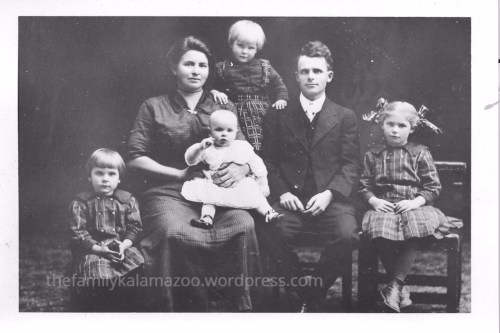
 

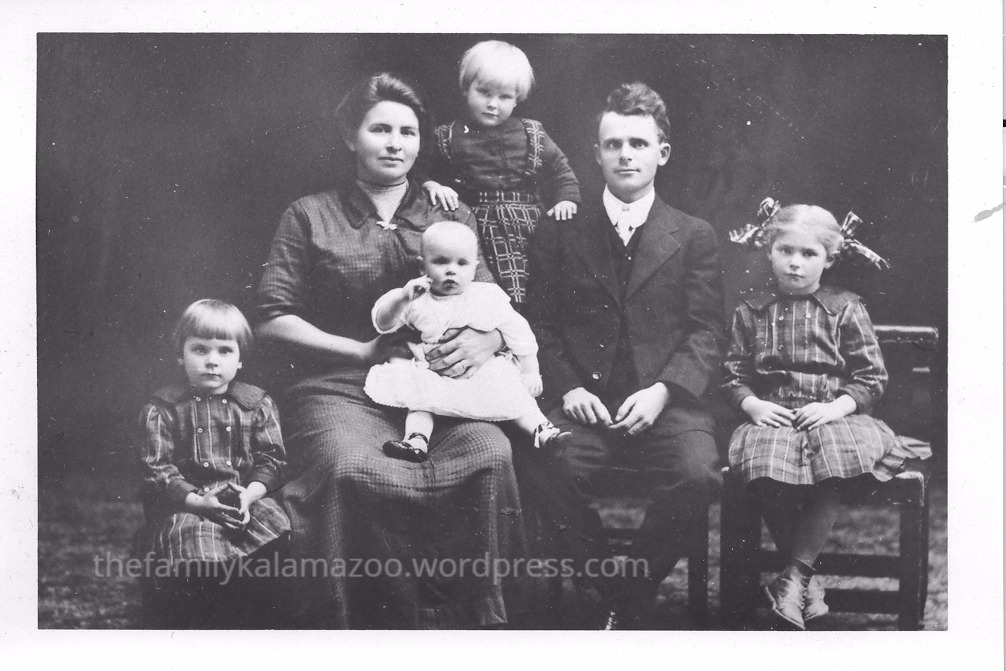
Edna, Clara (holding Pete), Vena, Charles, and Dot

The farmhouse had a big dining room in the middle of the first floor.  The kitchen was out in back and had a coal-burning stove/oven.  The front room was tiny, with barely enough room for the big wood-burning stove and her father’s rocking chair.  He sat and smoked his pipes and cigars in the evening.  He played cribbage with a friend with a small chair pulled up to the fire.  All the downstairs had linoleum laid on it after Edna grew up and moved away from home; while she was home, it was a wooden floor.  The upstairs was two rooms:  a bedroom for her parents and one big bedroom for the five children.  They slept five to one bed, with the boys sleeping across the width at the girls’ feet.  It was COLD up there in the Michigan winters–with no heat.  Edna’s father had built the house; most of the furniture was handmade, too, some of it quite old.

Edna’s farm had a big family of cats, but they weren’t house pets.  They were kept to kill the mice in the barn.  Edna’s job was to put food and water out on the back porch for them.  The farm had lots of corn fields, cows, pigs, and an apple orchard.  It even had a small stream for fishing, but you had to drive the wagon down there, it was so far away.

But Edna and her siblings were used to long walks.  The three girls walked three miles to school everyday and three miles back home.  They kept each other warm by cuddling together as they walked.  Once in a great while, during the worst weather, Edna’s mother drove all the children to school in a tiny black Amish buggy.

Sometimes the girls were naughty.  For instance, they knew their parents had a store charge at the grocery store in Caledonia.  A couple of times the girls couldn’t resist and charged a giant candy bar or a banana.  (Fruit was a big treat; Edna only saw oranges at Christmastime).  When their parents found out later, they would “get bawled out.”

Edna’s family didn’t have much money, except for owning the farm, but her father collected a few hundred books.  He had several series of books for children which offered moral and religious instruction, as well as some adventure books.  Edna had plenty to read while she was growing up.  But she didn’t have a lot of time to read because she always had a lot of chores.  Farms need a lot of care!  Edna learned to cook basic meat, potato, and vegetable dishes while she lived at home with her family.  She also became a good baker, making delicious cookies, pies, and cakes.  She wanted to be a teacher or a writer when she grew up, but she also wanted to have a home and a family and to take good care of them.

###

I’ve posted photos of the farm where Edna grew up before:

Final note: This turned out to be a great project for my daughter and for me because it was about our shared knowledge–some of what my grandmother taught my mother was taught to me and taught, in turn, to my daughter–and we both learned about history through the life of an ordinary girl. And, yes, my daughter did get to be an American Girl paperdoll. You can read the story and see the photos here: An American Girl’s Family Tree


Read Full Post »
In a post called “Who Was Hank Waruf, Kalamazoo Gunsmith?” I wrote about the husband of my great-great-grandmother’s sister, Carrie (Paak) Waruf. The couple owned the resort Ramona Palace and Ramona Park, as well as many cottages and their own home, at Long Lake in Portage, Michigan.

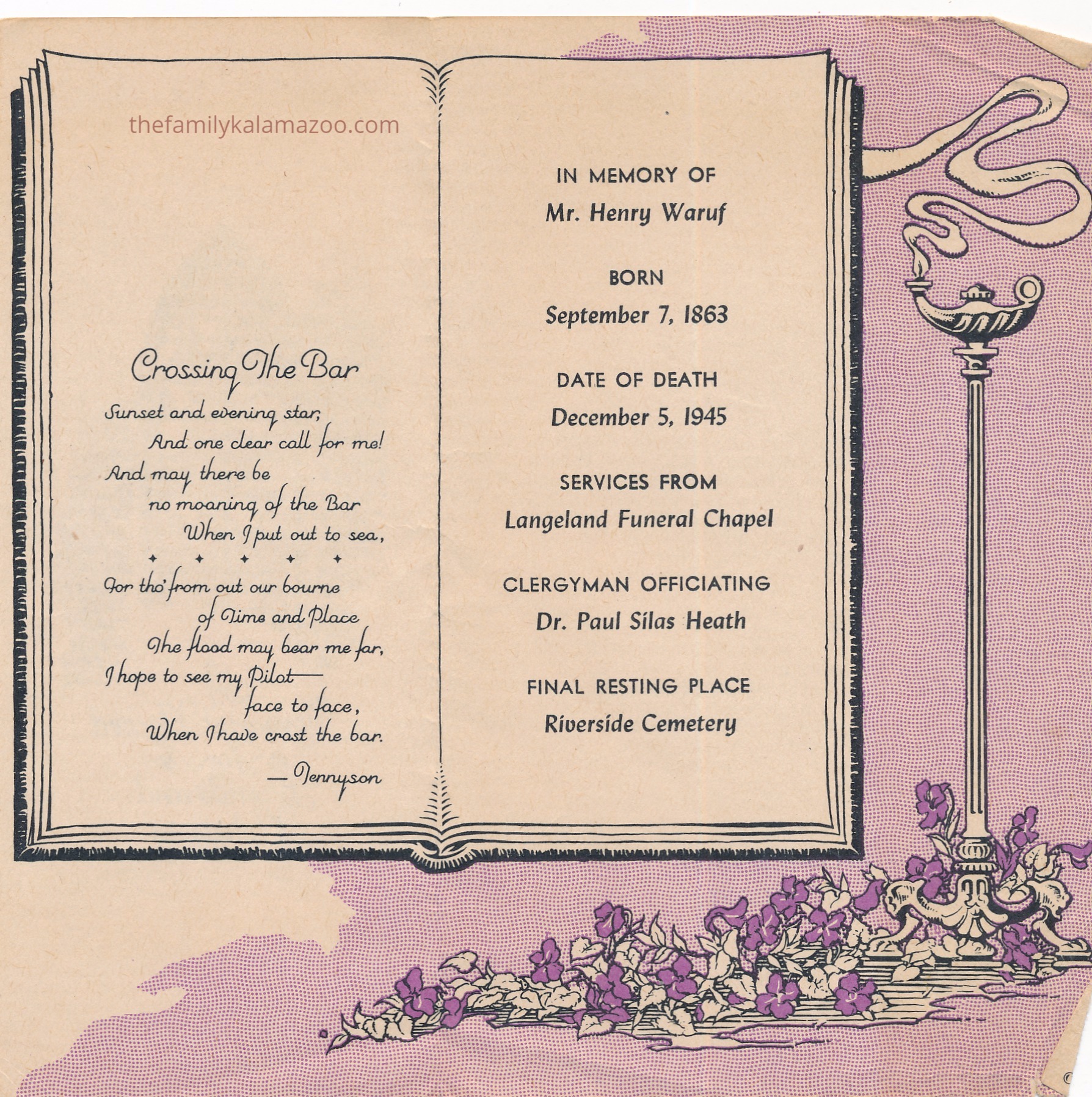
In my files I found the brochure for Henry Waruf’s (Walraven) funeral.


Henry Waruf’s wife Carrie and my GGGrandmother Alice Paak DeKorn had a sister named Mary. One of Mary’s daughters was Genevieve. She was married to Frank Tazalaar. Here are Henry and Frank together (with a little dog).


I get the impression from some of our photos that Hank Waruf was a man other men wanted to hang around .

Read Full Post »

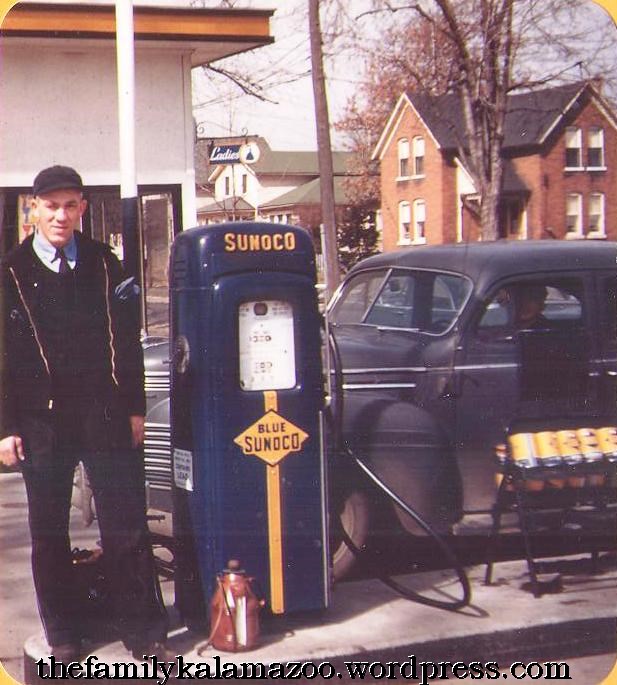
I like to talk about Grandpa Adrian Zuidweg’s Sunoco gas station because it seemed a little magical when I was a kid. Here is how it looked 20 years before my time–in 1939:

I don’t know who lived in the house on each side in 1939, but I did 20 years later. Maybe it was the same people. The man who lived in the house on the left of the photo (to the right of the station) was Willie Dunn. When I was newly married and he was moving, he let me have an antique oak library desk from the house. I’m looking at it right now. Simple Queen Anne legs and two drawers without pulls.

Here’s a photo I’ve posted before–the view is different, so here you can see a sampling of the houses across the street on Balch Street. Any ideas on the date of this photo? The pump looks different than the ones in the 1939 photo, and then there is the car to help. I bet Uncle Don would know!

Grandpa by the pump at his Sunoco station

Grandpa by the pump at his Sunoco station

The pumps in the first photo have globes on the top of them. Does anybody know if the globes lit up like lighted signs? I found a photo of a vintage pump that looks like that type:

There is something to be said for such a fancy model, but it was probably more expensive to build and to maintain. In case you’re wondering, yes, people collect old gas station memorabilia–anything with a brand name and a logo!

Here is what Grandpa’s gas station looks like today. Or shall I say the site of the station. You see that white house? You can see all the way to that house because Willie Dunn’s house is gone.

When you were a kid, did you enjoy visiting or playing at or working at a small business in your family?

Read Full Post »

I lost my oldest cat, Mac. He passed away a week ago last Sunday. His actual name was Macavity, and he was named after T.S. Eliot’s “Mystery Cat” (in the poem and the Broadway musical). I’m a dedicated animal lover, so I always like to see evidence of animals in the lives of my ancestors. I wrote a post called Dogs in the Family that showcases some photos of pets from 100 years ago, as well as my own four cats.

I found a postcard from 105 years ago that features a type of tabby cat. My cat Mac was an orange and white tabby, so this caught my attention. It’s part of a collection of cards received by Alice Leeuwenhoek.

This card was mailed from Grand Rapids, Michigan, in 1910. Alice was my grandfather’s first cousin–their mothers were sisters–and she was born in Kalamazoo in 1897.

I wish I knew what the inside joke about eating well means! Alice was a very slender woman.

Notice that the postcard isn’t signed. So frustrating! Does it sound like a good friend or a relative?  Does the handwriting give a clue? Alice was 13 years old when she received this card.

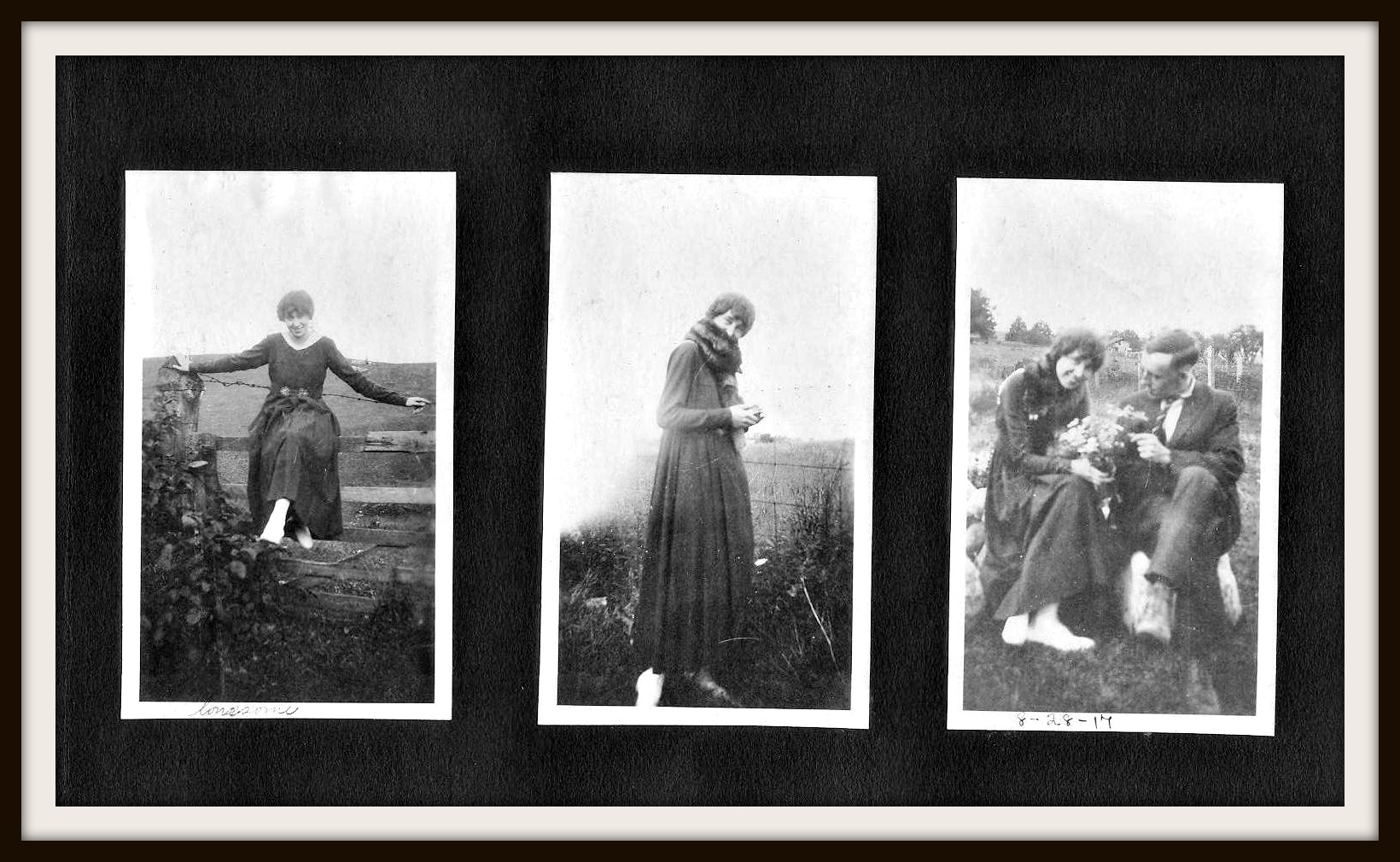
Here she is seven years later (age 20)–dressing fashionably, posing, and with a young man!

Alice wouldn’t marry until 1923, at age 26, and it wasn’t to the man in this photo.

If you go to Dogs in the Family, you will see a photo of Alice as a child with her aunt, my great-grandmother Cora DeKorn Zuidweg, and my grandfather, Adrian Zuidweg–with the family dogs.

I’ll leave you with photo of Alice and moi when I was 3 years old. Alice was 61. I knew Alice quite well when I was a child. She passed away when I was 8 years old, in 1963.

Read Full Post »

I recently found this photograph in a group of photos. Because of a clue on one of the other pix, I narrowed the date to between 1928 and 1931.

I know who the man is because he has a very distinctive look. This is my great-grandfather, born Adriaan Zuijdweg and called Adrian Zuidweg in the United States. I’ve written about him many times, but the best posts would be My Great-Grandfather Reinvented Himself as a Business Owner in the U.S. and My Grandfather’s Story, Part V and Back to the Dutch-American Newspaper.

Adrian died in 1929, according to my grandfather–of kidney disease. But I have not been able to find a death certificate or a grave. Maybe it’s because his name was mangled, but keeping that in mind, I still haven’t found him yet. It is so frustrating. Also, the newspapers from that year are not on Genealogy Bank. Nevertheless, I would put this photo at 1928 or 1929. Because other photos show him more fit than in his photo, I think he might have been ill (or close to it) by the time this photograph was taken.

But who are the women in this photo?

Adriaan Zuijdweg

Could the woman on the left be my Great-Grandmother Cora DeKorn Zuidweg? She looks a lot taller than he does, but maybe she was taller. I will post a known photo of her so you can compare.

Cora DeKorn at her father Richard DeKorn's cottage on Long Lake

Cora DeKorn at her father Richard DeKorn’s cottage on Long Lake

Similar hats, for sure! If that is Cora in the first photo, then she would have been about 53 years old. She herself passed away in 1932 from cancer.

Do you think that is Cora in the photo with Adrian?

Who is the shorter woman? Is this another photo of her?

The only child of Adrian and Cora was my grandfather. Cora’s only sister was Jennie–and this is not Jennie. However, she had two younger step-sisters, Marion and Marge Sootsman. They would have been in their 30s at this time. This woman does not look like one of them. She actually looks more like one of the Culver sisters, but we figured out that they moved to Seattle before this period.

The only thing is . . . there are a lot of photos of this woman. Was she a girlfriend of my grandfather?


Kinda looks like it. After a series of these photos, there is a series of him with my grandmother.

Do any family members know the answer to this mystery?


Read Full Post »

Remember the Culver family: my great-great grandfather’s sister, Jenny DeKorn Culver, and her daughters, Lela and Rhea, who moved from Kalamazoo to Seattle 100 years ago.

In the scrapbook which I received from a blog reader I found this photograph. Any ideas on the type of uniform? Since this would have been around the time of the end of WWI, does the uniform have to do with the war?

I don’t know who the man is. Most of the Culver photos are of women.

But the clues would leave me to believe the photo was taken in Seattle in or around 1918. But did Seattle have old elegant buildings like this at that time?


What about the building? My first inclination was a church, but I don’t see any crosses. Are those rosettes for ornamentation?


Related articles

Read Full Post »

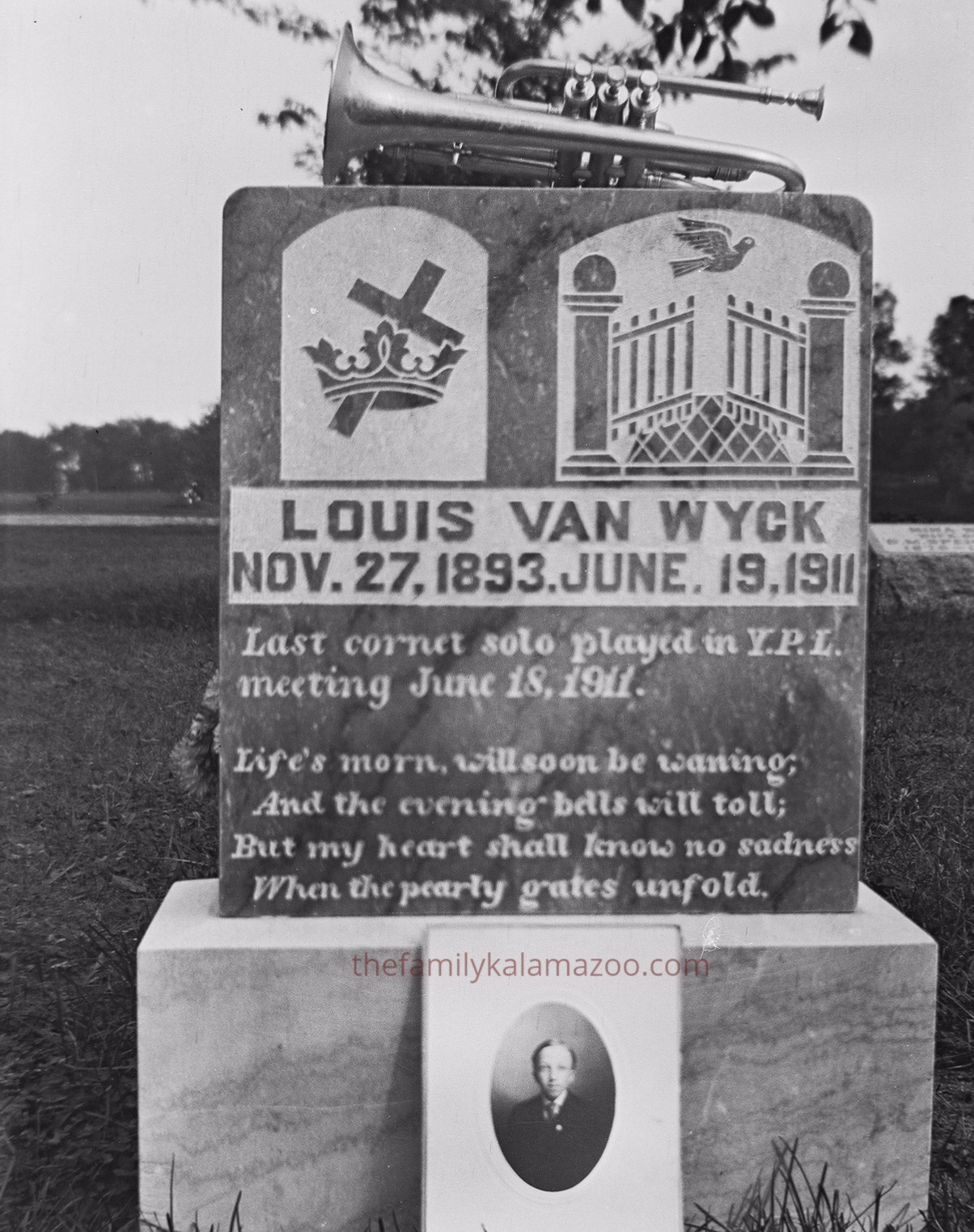
In the box of glass negatives from photographs taken by Joseph DeKorn there is an image that I wonder about. It seems to be an elaborate headstone for a man named Louis Van Wyck. Placed on top of the headstone is a cornet. The inscription reads, in part, “Last cornet solo played in Y.P.L. meeting June 18, 1911.”

His birth and death dates are also engraved on the headstone. He died the day after the cornet solo, on June 19, 1911. He was 17 years old–not a man, but a boy!

A photograph leans against the marblebase. He looks young and blond. The stone is further engraved with images and a poem.

Although I have his dates, I can’t find Louis through Ancestry’s search function–or Find-a-Grave either. So I turned to Genealogy Bank where I found one article about his memorial service.

Read it here: Louis Van Wyck memorial service.  Note that the passage about the funeral is at the VERY END of this article.

I didn’t know what Y.P.L. on the headstone meant, but after reading about the Salvation Army hosting Louis’ memorial service, I looked it up online. It seems to mean Young People’s League. Now I have to admit I don’t know much of anything about the Salvation Army except that it is a Christian denomination and a charity, I sometimes donate furniture or clothing to them, and they (or volunteers like my family and friends) ring bells at Christmas outside shopping malls. I think Sarah in the musical Guys and Dolls belongs to a fictional representation of the Salvation Army.

That is kind of fitting because I just read up a bit and discovered that music has been important to the Salvation Army from the beginning. How fitting this headstone was, then, for poor Louis. But how did he die at such a young age? And how was he connected with Joseph DeKorn or my family? He would have been about 12 years younger than Joseph.

And why can’t I find him in documents in my initial search?

Read Full Post »

Henry (Hank) Waruf and his wife Carrie (Paak) Waruf owned the resort Ramona Palace and Ramona Park, as well as many cottages and their own home, at Long Lake in Portage, Michigan.

Since Carrie is one of the Paak sisters, and her sister Alice Paak DeKorn was my great-great-grandmother, I’ve focused more on the Paaks. But Henry Waruf is a very interesting character in Kalamazoo’s early history.

Adri van Gessel was so kind to do some research on the Waruf family. Henry himself appeared to be a bit of a dead end because the name Waruf seemed to come out of nowhere. But Adri broke through that brick wall and discovered Henry’s origins.

Who Was Hank?

Henry was born Hendrik Walraven on September 7, 1863 at Kloetinge, the Netherlands. Apparently Koetinge is part of Goes. Big shock there since the majority of my mom’s ancestors seem to have come from Goes.

He was married on June 2, 1882 at Kalamazoo (MI) to Cornelia Peek (Carrie Paak), daughter of Teunis Peek and Jacoba Bassa.  Cornelia was born on May 8, 1862 at Lexmond and died in January 1957 at Kalamazoo (MI).  Henry died on November 29, 1945 at Orlando (FL).

I don’t know if Henry was on vacation in Florida, living there part of the year, or if the couple (who had no children) had moved there and Carrie went back to Kalamazoo after his death. I could try to research this through city directories, phone books, etc. The research I have done was mainly through newspapers, and I discovered that, although Henry (or Hank) usually spelled his last name “Waruf,” sometimes it shows up as “Warruf.” Still, it looks to me as if Joseph is the one who changed the family surname to Warruf/Waruf in the United States from the original Walraven.

Henry had one sister,  Maria Walraven, born March 3, 1866 at Goes, but she died before 1870 in the Netherlands.

Henry and Maria were born to Joseph Walraven (Joseph Warruf), son of Hendrikus Walraven and Elisabetha Resch, who was born on October 13, 1837 at Goes, died on December 11, 1910 at Kalamazoo (MI).

Joseph was married on May 21, 1863 at Goes to Melanie de Munck (Mary), daughter of Jan de Munck and Maria Joseph Bataille.  Melanie was born on October 16, 1840 at Goes and died on March 18, 1914 at Kalamazoo (MI). Joseph, Melanie, and Henry immigrated to the U.S. in 1868, when Henry was 5 years old.

A Bataille Connection

Notice the name Bataille. I’ve previously written about a Bataille ancestor in these posts:

An Update on the Bataille Family

A Familial Occupation

How Did Etaples, France, Show Up in My Family Tree?

Hank Went into Business

As I mentioned, “Hank” (Henry) and Carrie (Cornelia) were married in 1882, when he was 19 and she was 20. By 1885, he was advertising a business selling guns in the Kalamazoo Gazette, where it’s noted that he took over the gun shop of W. Blanchard.

Sept 17, 1885 Click the link and scroll to the bottom for the ad. By September 1886, Hank added “gunsmith” to his name on the ads.

I was astonished to discover, in an 1897 Polk Directory, that Henry Waruf owned the gun shop in partnership with Richard “Ro-mine” who I take to be Richard Remine. Richard “Dick” Remine was Hank’s brother-in-law. He was married to Carrie’s sister, Mary, another sister of my great-great-grandmother. Richard was born in 1857 and so was six years older than Hank. I’ve written before that the person who inherited the Long Lake resort was Therese Remine, Richard’s daughter. So there might have been another reason that she was the sole inheritor of that property–because her father had been in business with Waruf. How long were they partners? I am going to guess that Waruf was the true businessman of the two–and an ambitious man.


Richard Remine

Hank Was a Man of Many Talents

Hank shows up often in the Gazette, and I was able to see that he became a talented shooter, a prize-winning breeder of English Spaniels (no wonder my grandfather’s family always had this breed of dogs), and a collector of real estate. He reported regularly to the State Board of Fish Commissioners on the fish in Long Lake.

Here is an article where he literally won all the prizes at a shoot. Sept 7, 1899. There are many articles about the shoots he attended and referreed. He also represented Kalamazoo at a state shoot in Bay City.

The award-winning dogs owned by Henry show up in publications by the American Kennel Club, The Field Dog Stud Book, and The Fanciers’ Journal. I traced the beginnings of this sideline to a Gazette article that mentions that Hank was going into the business of raising hunting dogs and had brought in a fine pointer from Lowell with a pedigree going “way back.”  Click the link for the article–right side about 1/3 down.Feb 28, 1899.

In 1919, there is a newspaper article about the houses that Waruf was selling. These houses were all on the north side of Kalamazoo. I know that he also owned all the cottages near the resort at Long Lake, so he was used to being a landlord. I wonder if he had been renting out all these houses or if he was flipping them. I suspect he had been renting the houses. Here is the article. April 2, 1919

Finally, on August 30, 1904, Kalamazoo Gazette published a cute story. A Gazette reporter climbed the water tower at the asylum. This is the tower that my great-great-grandfather Richard DeKorn built (click here). From that vantage point he was able to see all the way to Gull Lake in one direction and Long Lake in another. He mentions a great many notable people and what he claims he saw them doing at the time. About Waruf, he wrote, “‘Hank’ Waruf shining up his guns at Long Lake for the duck season.” The details in the article conjure up a Breughel painting, so I find it a little impossible, but definitely amusing. Here is the article: Aug 30, 1904


***

Here are some images I have previously published on The Family Kalamazoo:

Carrie (Paak) and Henry Waruf

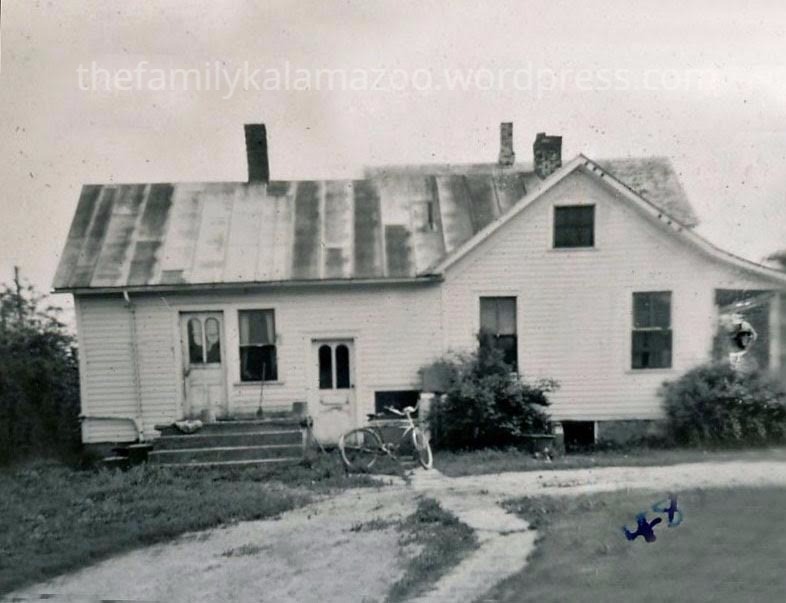
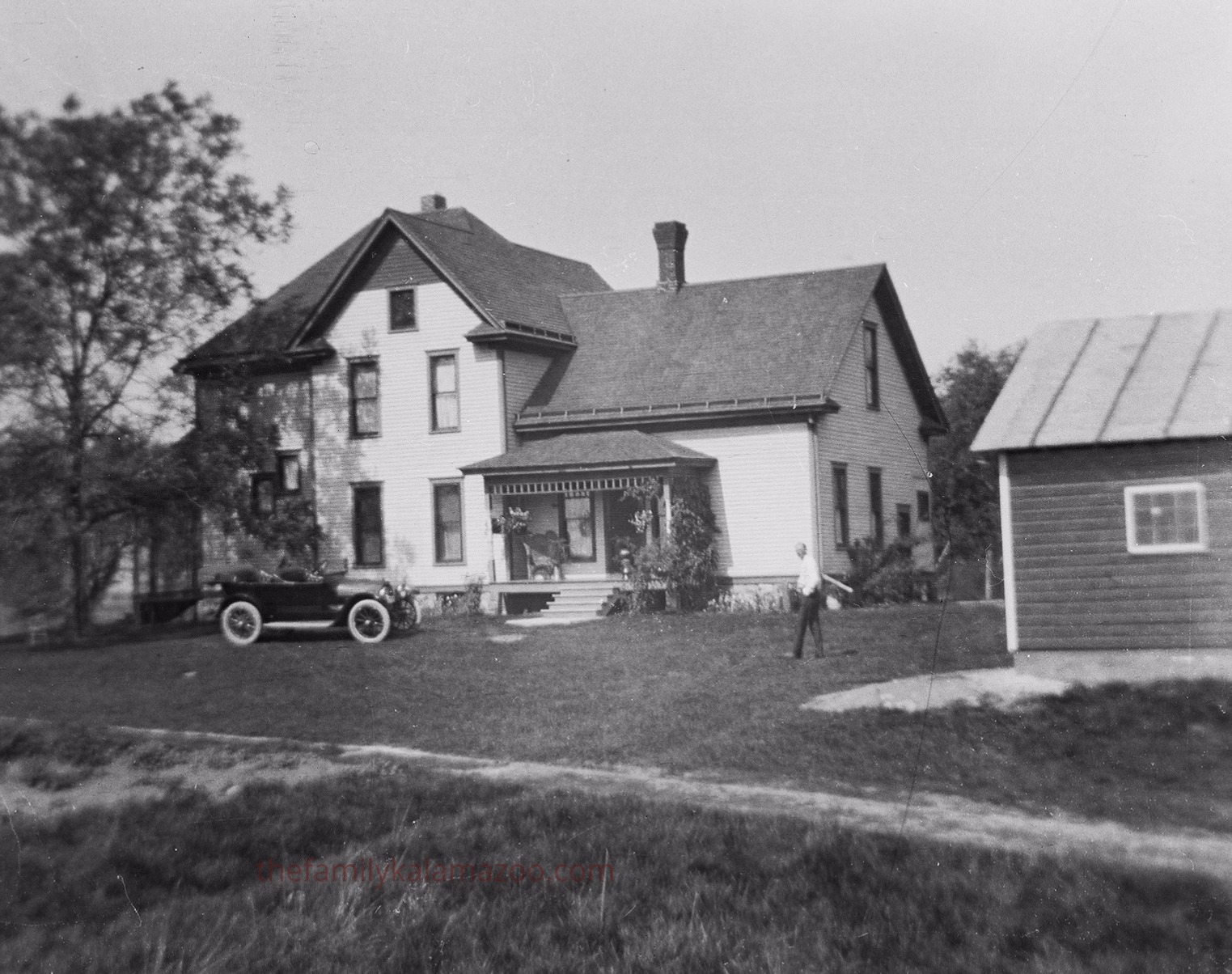
Home of Hank and Carrie Waruf, Sprinkle Road

Home of Hank and Carrie Waruf, Sprinkle Road

I’ve written about the place and the people here:

Read Full Post »

I am not a car expert by any means. I hope I never have to identify a getaway car, for instance. I can give a description of details, but I can’t identify the make or year of a vehicle. My husband can. I am amazed sometimes at how he can tell me a year of a car when it sees it way down the street. But I am not asking him the questions I have because the answers lie in the early history of the American automobile–and I doubt he knows much about those first cars.

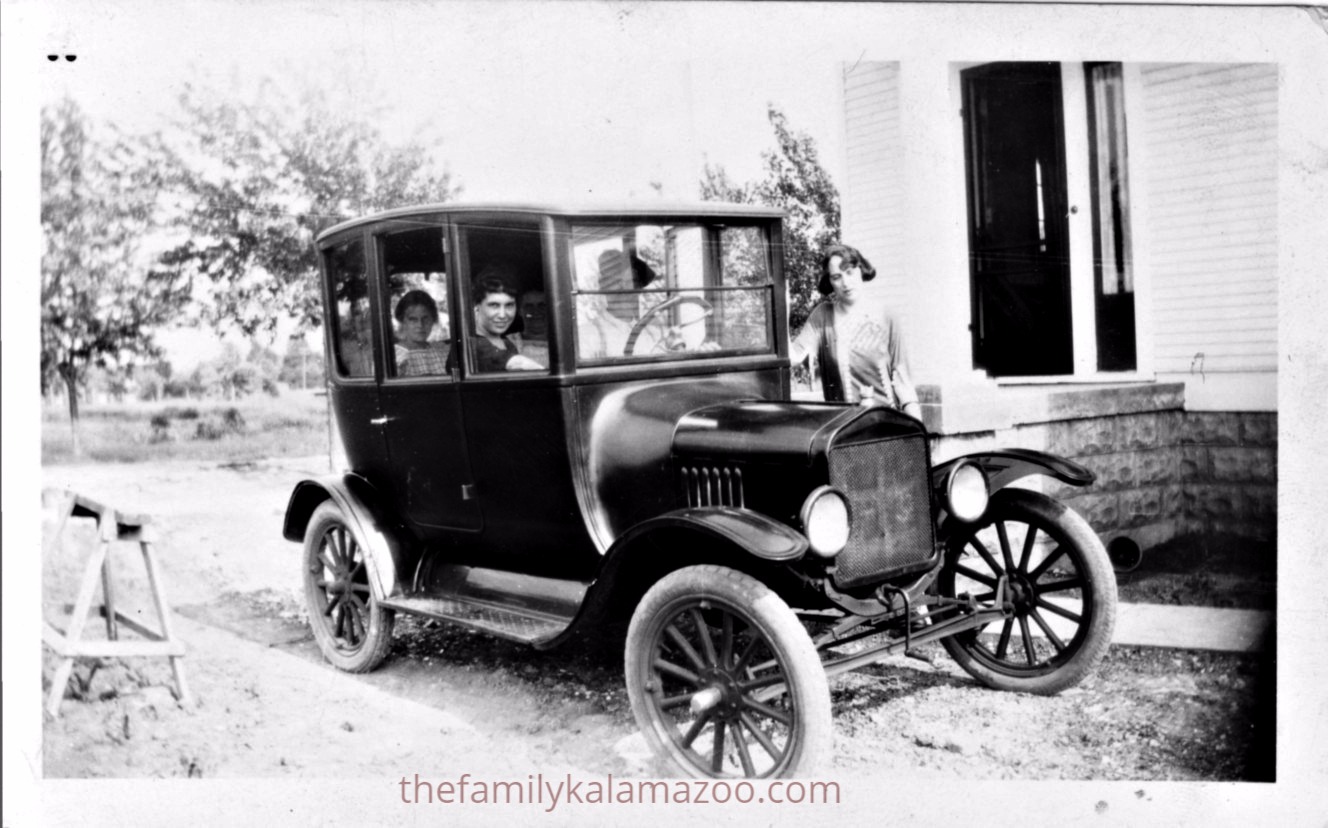
So I ask you: is this first one a Model T car? Or is it something else? And what year might it be? Sometime in the 20s, I believe.


The car is driven by my great-grandfather, Frank Klein. That’s my grandmother sitting shotgun. In the back is her sister Helen and her mother, my great-grandmother. Their house in Elmhurst, Illinois, is behind the car. That looks like a sawhorse on the left. I wonder what is underneath and why it’s there.

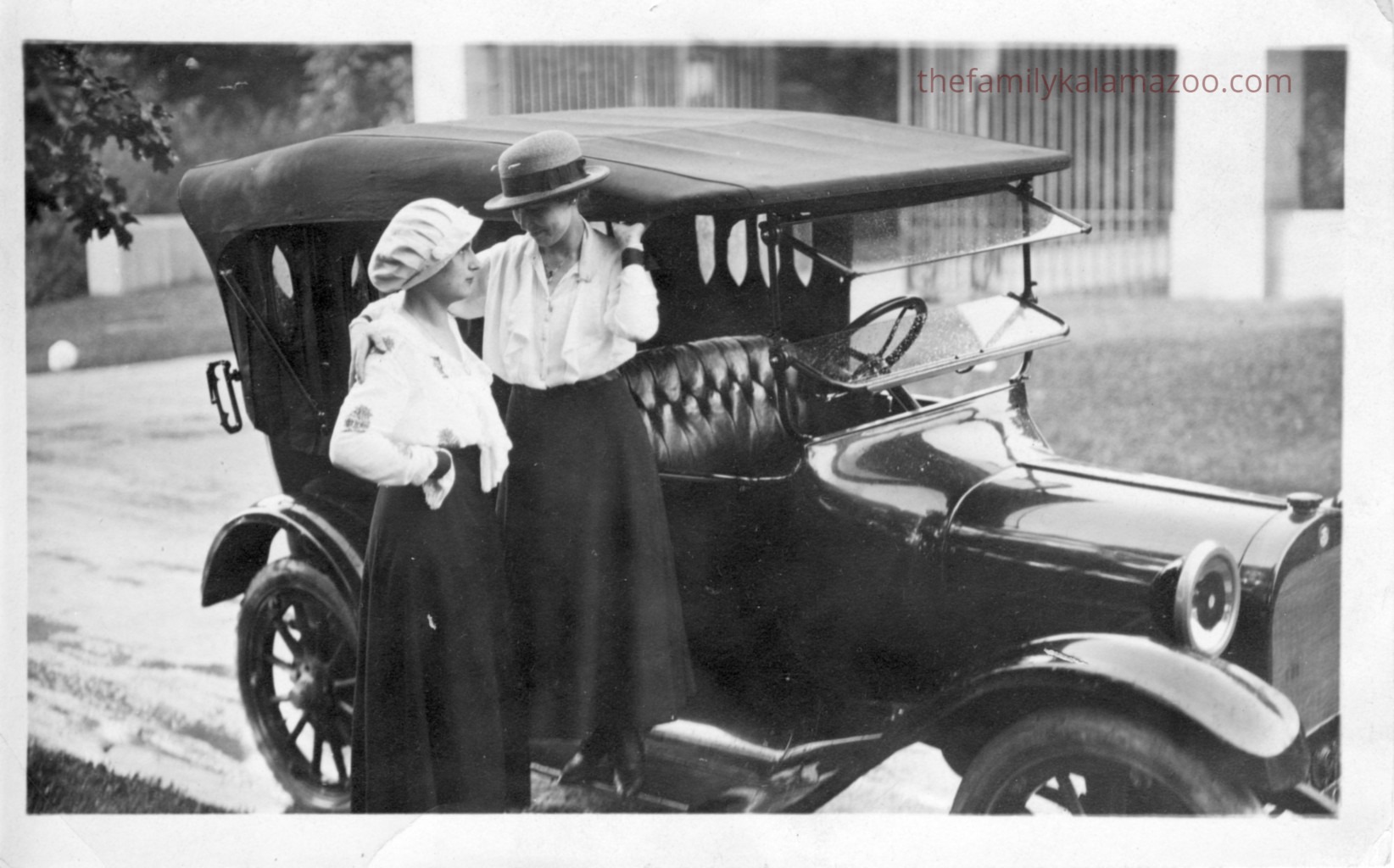
Here’s a photo of what I think is a different car. Notice the different roof, headlamps, etc. Do they both have the same double windshield? I can’t figure out the background/setting at all. I love these “motoring” outfits. What kind of car is this?Do you have old photos with cars in them? How did you determine what kind of car?


Read Full Post »

« Newer Posts - Older Posts »