Feeds:
Posts
Comments

Archive for the ‘DeKorn’ Category

Thank you so much for responding so enthusiastically to Kin Types. My new chapbook is an offshoot of The Family Kalamazoo, in a way.

The cover of the book is from an old tintype belonging to my family. I have posted it twice before on this blog. The woman featured on it seems to have come from the Remine branch of the family and, based on the tintype and the dress she wears, I thought it was possible that she could be my great-great-great grandmother Johanna Remine DeKorn. This was a guess I had fairly early on, but I had no proof.

But I knew she was someone close to us. For one thing, this is an expensive painted tintype and our family owns it. We wouldn’t have possession of such an image if it wasn’t someone from the family. For another, there is too great a similarity. For instance, my daughter thinks that the woman looks remarkably like my mother in the eyes and mouth. Other people say they can see her in my face.

I thought it unlikely I would learn much more about the photo, but never gave up hope because much amazing information has flowed to me, mainly through this blog.

When I visited my mother recently, she gave me a gorgeous antique photo album from my uncle for me to scan and disseminate. Imagine my surprise when I opened the album and found this tiny tintype inside.

I had so many questions: Were the photos taken at the same time or is the woman younger in the couple’s photo? Same hairdo, same earrings . . . . We don’t really know about the dress and its neck accessory because the lace collar on the painted tintype is, just that, painted on. But she’s definitely younger. Is the new find a wedding photo? Are they siblings?

So I focused on the man. I want to say boy. They both look so young. If the woman is Johanna Remine DeKorn, the man most likely would have to be Boudewyn (Boudewijn) DeKorn. Here is a photo my grandfather identified as Boudewyn, my 3xgreat grandfather.

Boudewijn de Korne

So, what do you think? Are they two different men? The hair is the same–very wavy dark brown hair–, but the hairline has changed. That’s possible. In the upper photo, the man has very defined cheekbones, and I don’t see this in the boy. The man has a very wide mouth. Would that change over time? I doubt it. It was unlikely then that the woman was Johanna, but who was she?

I did what I had to do. I scheduled an appointment with photogenealogist Maureen Taylor. When I only had the painted tintype, I didn’t feel I had enough to go through the process with Maureen. But now that I had a second tintype, I wanted to give it a try.

When Maureen and I began our conversation, I felt a letdown. Johanna Remine was too old to be in this photo. The tintype of the two people had to be between 1869 and 1875, according to Maureen. Johanna was born in 1817 and DIED in 1864. The woman could not be Johanna.

The woman had to be a generation younger than Johanna.

This was disappointing because I felt that I know the other branches or “lines” of the family, and that if she wasn’t Johanna, she couldn’t be a direct ancestor.

And yet, as I told Maureen, I had a strong feeling that she was closely related. And her looks are too reminiscent of the family features to discount her. Maureen agreed with this and pointed me in a different direction.

The Remine family, where I felt the painted tintype came from, began in the U.S. with a marriage between Richard Remine and Mary Paak. Mary Paak is my great-great-grandmother Alice Paak DeKorn’s sister. I am related to the Remines two ways. One is by blood, Johanna Remine being my 3x great grandmother, married to Boudewyn DeKorn (and the mother of Richard DeKorn). The other is by marriage where Richard married Mary. Mary and Carrie Paak, two of the four Paak sisters, had a similar look. Alice and Annie had a different look altogether.

ALICE PAAK DEKORN

Maureen wanted to see a photo of Alice. I sent her the image above–a very clear headshot of Alice from the 1890s (so 20 years older than the woman in the tintype) and Annie (the sister who looked like Alice but is a body shot and not as clear). Maureen examined the photos and proclaimed Alice a match. She asked for the dates on the sisters: birth, immigration, marriage. She was sure the tintype of the beautiful girl on the cover of Kin Types was Alice who happens to be featured in a poem in my book: “An Account of a Poor Oil Stove Bought off Dutch Pete.”

I asked Maureen about the man in the photo and said it did not look like Alice’s husband, Richard DeKorn.

And then I learned something that is counterintuitive, but smart.

Ignore him for now.

She thought it could be her brother or even a beau she had in the Netherlands that she never married. In the tintype of both of them, they are very very young, maybe teenagers. And Alice immigrated to the United States when she was 17 years old. Maureen told me to ignore the man for the purposes of identifying the woman. I will try to identify him later, if it is even possible.

The more I thought about Maureen’s assessment, the more I realized how blind I’d been not to notice the resemblance between the women in the tintype and my 2xgreat grandmother Alice. Alice also happens to be the mother of Cora, the woman my grandparents told me that I look like.

Just for fun, I ran the two images through twinsornot.net. This is the result, although they photos are of a very young woman and a woman twenty years older.

Then I pulled out the other photo that Grandpa had identified Alice. In this alternative photo, Alice is younger than in the 1890s photo, but not nearly as young as the tintype. I had never been sure that this photo even was Alice, although Grandpa had been (and she was his grandmother). So I ran both Grandpa-identified Alice photos against each other on the site. 100% match! Grandpa was right.

Next I ran the tinted tintype against this alternative photo of Alice.

100%!


SO THERE YOU HAVE IT! THE MYSTERY IS SOLVED. THE WOMAN ON THE COVER OF KIN TYPES IS MOST LIKELY ALICE PAAK DEKORN.

I learned a lot of lessons through this process, but one that really stands out in my mind is that people look different in different photographs–and when you are comparing people of different ages, it really gets dicey. I think about photos of me . . .

If you click the Amazon link , the book can be ordered for $14.99. To order through Barnes & Noble, try this link.

If you like what you read, please leave a little review at one or more of the following sites:


Read Full Post »

A deeply grateful thank you to Amy at Brotman Blog for this beautiful review of Kin Types.

Most of us who engage in family history research probably try in some way to put ourselves in the shoes of our ancestors. We try to imagine—what were they really like? How did they cope with the failures and successes, the heartbreak and the joys that colored their lives? We want to get beyond the […]

via Kin Types by Luanne Castle: A Review — Brotmanblog: A Family Journey

Read Full Post »

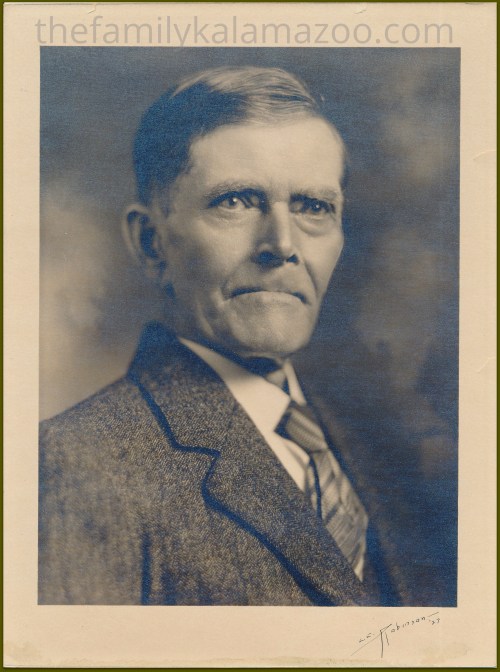
This is the best image I have ever seen of my great-great grandfather Richard DeKorn, Kalamazoo mason and building contractor.

Notice that this portrait is signed. It seems to say L. C. Robinson ’27.

So who was L. C. Robinson? From a directory of early Michigan photographers:

Robinson, Leo Carey
Dowagiac student …………………………………………………………………………………………………………………………………….1900
Grand Rapids student ……………………………………………………………………………………………………………………………….1910
Grand Rapids manufacturer of studio furniture for photographers ………………………………………………………… 1910-1911
Grand Rapids photographer for Carey B. Robinson ……………………………………………………………………………………..1912
Grand Rapids PHOTOGRAPHER at 115 ½ Monroe av ……………………………………………………………………… 1913-1921
Kalamazoo PHOTOGRAPHER at 414 Main st west ………………………………………………………………………….. 1923-1925
Kalamazoo PHOTOGRAPHER at 426 Main st west ………………………………………………………………………….. 1926-1927
Kalamazoo PHOTOGRAPHER at 426 Michigan av west …………………………………………………………………… 1929-1931
Kalamazoo PHOTOGRAPHER at 346 Burdick st south …………………………………………………………………….. 1939-1942
Leo was the elder son of photographer Carey B. Robinson and Lettie Alena (Lewis) Robinson, was born on February
25, 1893, at Delton, Michigan, and became a tall man with light brown eyes and brown hair. Her father came from
Indiana and Alta was born at Plainwell, Michigan, in June of 1893, sixth of the nine children of Charles C. and Frances
Ardella (Nichols) West. She grew up on an Allegan County farm, and she married Leo in 1914. Their children were
born in Michigan: Chester in 1915, Doris in 1916, Rueben (later Richard) in July of 1919, Jack about 1924, Avis in
May of 1926, and Eileen in February of 1928. The furniture manufactured by C. B. Robinson & Sons was sold across
the nation and in several other countries. Though Leo, along with his brother Ralph and his father, was a principal of
this company through 1911, Leo and his mother operated the photograph studio while his father supervised the
furniture factory. Leo became the nominal proprietor of the Grand Rapids studio about 1913, though his mother and
father still were involved with its operation and finances. He called it Robinson’s Art Loft in 1917. Late in 1923 he
purchased the Spaeth Studio, located in its own building on West Main Street, and within a couple of years had
developed one of the largest portrait trades in Kalamazoo. Leo died at Kalamazoo in 1942.

This photograph has a strange sheen to it and a pattern that overlays it all–visible in certain formats on my computer screen. This must be a certain type of photography, but I don’t know what it is.

I do know that I am grateful for this photograph dated three years before Richard’s death.

Dated. But taken? Richard was born in 1851 in Kapelle, Zeeland, Netherlands. In 1927, he would have been 76 years old.

Did he dye his hair? Could those moderate “living lines” be from 76 years of living? I find this photo a little confusing if it’s meant to be from 1927.

What do YOU think?

Read Full Post »

Although I started this blog five years ago next month, and that sounds like a long time, I’ve been working (on and off–mainly off while raising my kids and teaching) on family history, family photos, and genealogy since I was just out of college and beginning a master’s in history (which I did not complete and ultimately switched to English and creative writing).

I was blessed with many antique and vintage photographs and a grandfather with a great memory and a talent for storytelling.

But it wasn’t until a couple of years ago that I got the idea of putting my research and knowledge of our family history together with my creative writing. Then I began to write lyric poems, prose poems, and a few pieces in a genre that was new to me–flash nonfiction, which is a form of very short prose–based on individuals from my family’s past.

Ultimately, I pulled these pieces together into a chapbook (44 pages) which has been published by Finishing Line Press and is now available, not only on their website, but also on Amazon and Barnes & Noble websites.

Kin Types looks at what the lives of my ancestors were like. The locales are mainly Kalamazoo (and other towns in southwestern Michigan), Elmhurst (Illinois), and the Netherlands. Using the fruits of my research, which included studying newspaper articles, documents, and the details of antique photos, I tried to “inhabit” the lives of some of the people who have come before me.

If you click through the link to the Amazon page, the book can be ordered for $14.99. To order through Barnes & Noble, try this link.

Here is a sample poem from the collection:

Genealogy


Tigers die and leave their skins;

people die and leave their names.  ~Japanese Proverb


The more relatives I unearthed,

the more Franks rose to the surface

like deer bones after a storm.

On the trails I could follow,

I found seven named Frank,

three Franz, three Francis.

Frans, Francois, and Franciscus.

Frances and Francisca,

the women peeking out

from under their fathers’ names.

The name passed forward

like a cross polished by many hands.

The verb frank means to allow free passage

for man or post. But these Franks

and Franciskas paid with their labor

and their babes buried along the way.

If you read this blog, some of the characters of the book might be familiar to you. And because the project is quite unique I think people passionate about family history, genealogy, history, and local history will probably be particularly interested. Some of the pieces have been published in literary magazines. Combined together, they tell a story of the history of “forgotten” women.

So what are you waiting for? 😉 Go to one of the links and place your order!  And thank you very much.


Read Full Post »

This past week I was back in Michigan for a visit with Mom who was having surgery. Surgery went very well, and Mom is doing great!

I came home with some vintage and antique photos. Eventually I will share some of them.

For now, I have to go through the process I use for all these photos.

  1. Scan each photo, using the scanner attached to my computer. I originally bought it for business, but it’s just a simple home scanner. I scan them into .tiff so that the best quality is preserved.
  2. The originals are then put into acid-free clear (plastic) sleeves and sometimes then into acid-free photo boxes for storage, preferably in a fire safe (locked file cabinet that can withstand fire up to a certain temperature).
  3. Then I use my zamzar.com account to convert the .tiff files into .jpg. Jpeg is easier to use as I wish because it’s a very accepted file type. Each new jpeg has to be downloaded to my computer individually. This takes a bit of time. Zamzar is the best program I have found for file type conversions, and it is well worth the subscription.
  4. I create appropriate folders and store the .tiffs and the .jpgs together in the folders.
  5. Photos from the 60s and 70s sometimes need a little TLC as they are already turning yellow or even brown. I use Picmonkey not because it’s better than photoshop (it isn’t), but because it is extremely user friendly and doesn’t take up too much time.
  6. I create another folder for each new folder. These use the same folder names, but add the term “watermarked.”
  7. Then I use Water Marquee to create a watermark for thefamilykalamazoo.com and watermark one full set from each “watermarked” folder.
  8. At this point, I have both watermarked and unwatermarked jpegs for sharing.

That’s it! Then I’m done. What is your process for saving old photos?

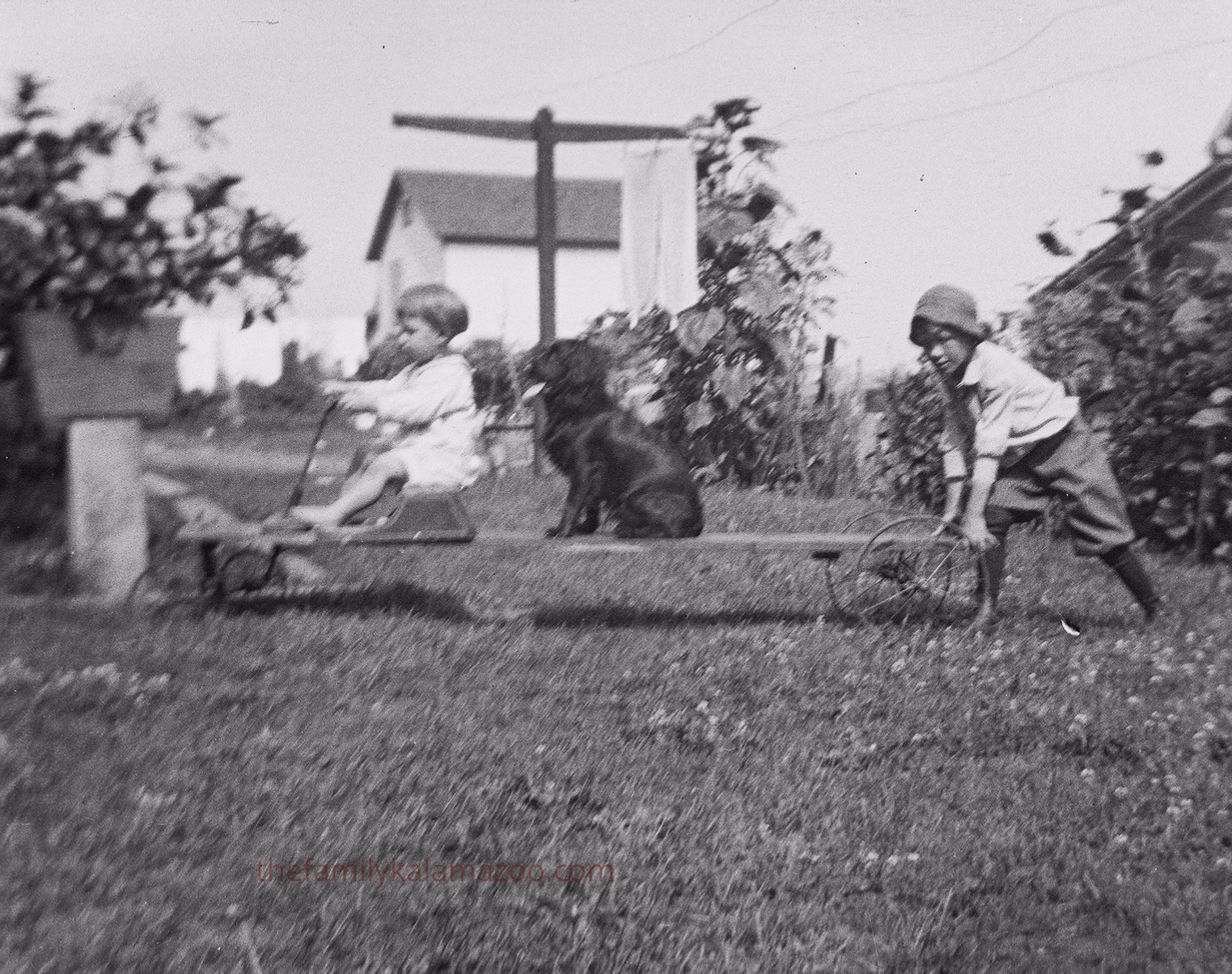
From a Joseph DeKorn glass negative

Adrian Zuidweg (Grandpa) on the right

The dog is Bobby

Read Full Post »

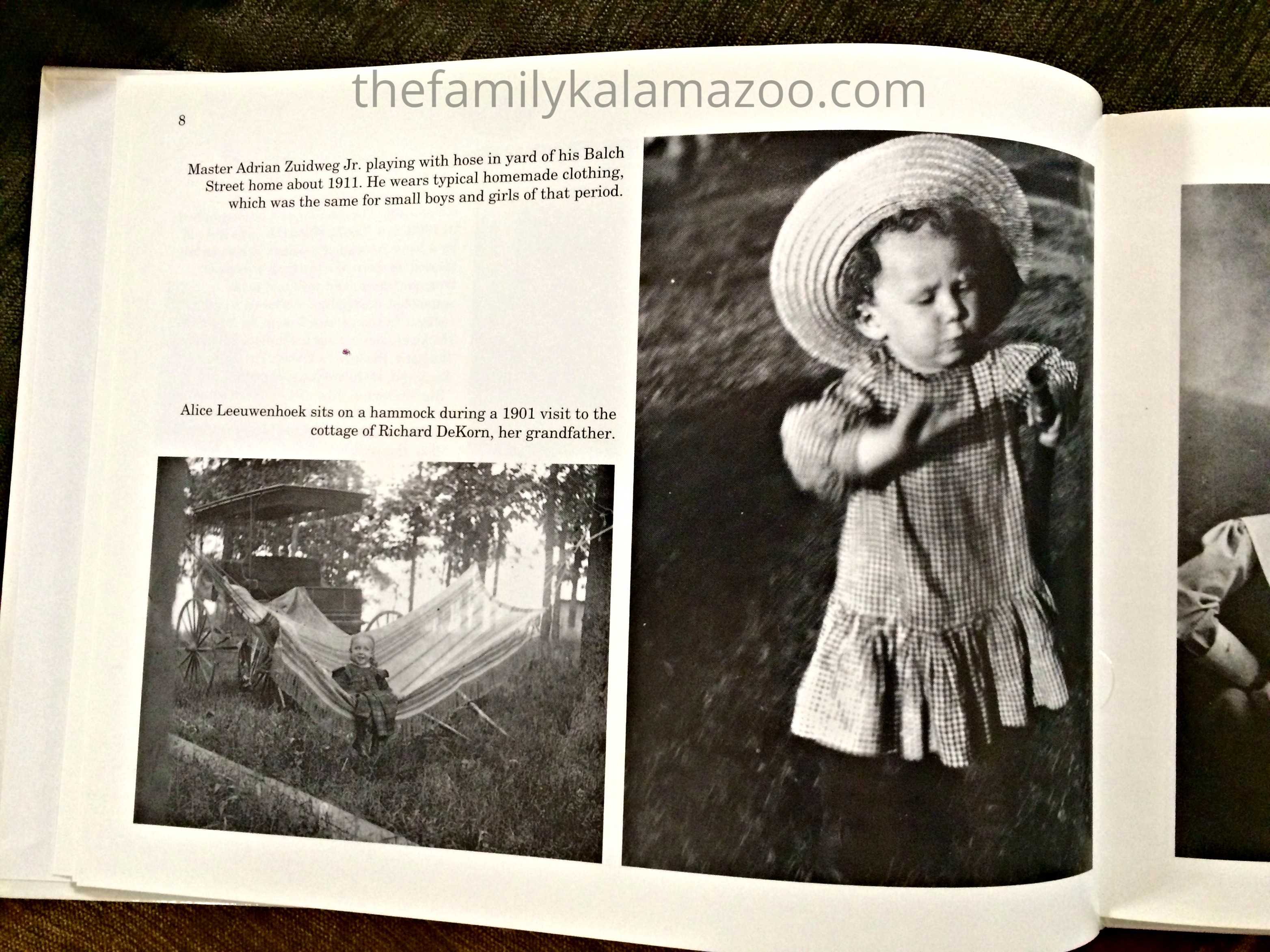
I dug into the bottom of a file drawer and pulled out a book I forgot that I had. It was put together by the Kalamazoo Gazette and featured photographs sent in by individuals of Kalamazoo from the past up to the early 1960s.

My grandfather, Adrian Zuidweg, is listed as one of the contributors, so I went through and tried to find the photos he might have sent in.

Definitely these two photos. The little boy in the check dress and straw hat is grandpa himself. And the little girl on the hammock is his cousin Alice Leeuwenhoek.

Those are the relatives sitting on the front porch. Gosh, I own that photo! I didn’t realize that was Richard Remine (though I can see right now that it is, of course, him)–or his children Therese, Harold, and Jane either. It would fit that the two little girls are Alice (next to her grandma Alice Paak) and Therese. With Harold behind the children. But Jane doesn’t really look old enough in this photo. According to my records, Jane was 14 years older than Therese. Something is off here. That big gap in age between Jane and Therese bothers me, and it always has. And if you recall when I wrote about Frank and Jane Tazelaar, I had been confused for awhile about if there had been 4 Remine children and 2 girls of similar names.  This photo must be somewhere around 1901, based on the assumed aged of the 3 little children. Jane was born in 1881 and is not 20 here!

The known people: back row is Aunt Jen DeKorn Leeuwenhoek, Richard DeKorn, Richard Remine. Front row is Lambertus (Lou) Leeuwenhoek, Alice Paak DeKorn, and then the little girl next to Alice definitely looks like Alice Leeuwenhoek, Jen and Lou’s daughter. It would seem plausible that the three other children belong to Richard Remine, but Jane could not have been that small.

What else? Here is Harold Remine big enough to go fishing at Long Lake. The other photo is not from my family, but it does show off a great collection of hats!

This is the Ladies Library building that Richard DeKorn was the mason contractor for.

But I don’t think that is one of our family photos.

One of these photos could have been taken by Joseph DeKorn and been submitted by Grandpa. It is very similar to the ones that I own.

Take a look at the captions for the downtown views. Does it make sense? It doesn’t make sense to me for some reason.

Most importantly, Grandpa autographed this book!

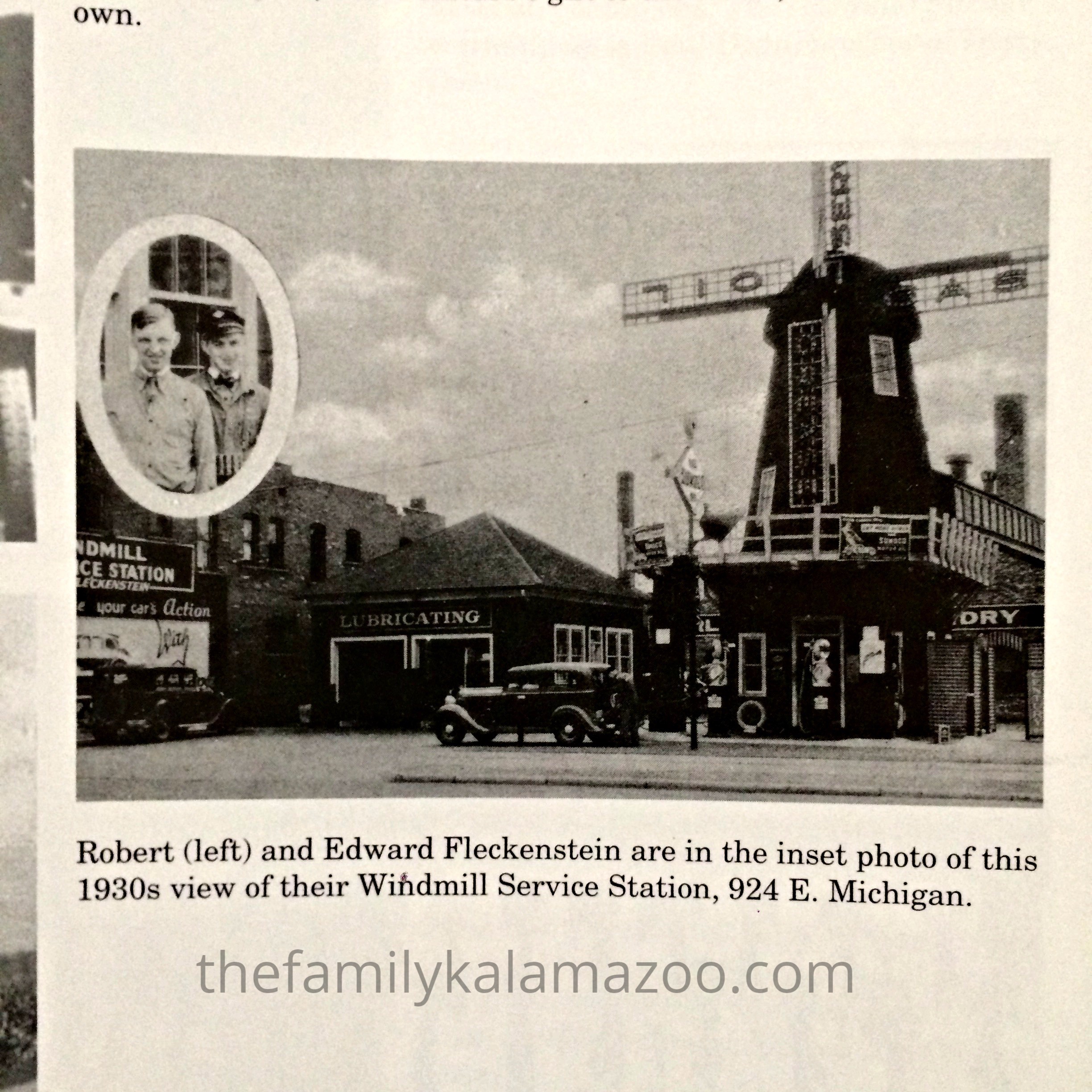
Here is a bonus photo. It isn’t from my family, but isn’t it a cool reminder of the kitschy business architecture popular in those days?

Read Full Post »

Here’s a lovely mention in a great post about genealogy and researching family history. It’s from February, but somehow I missed seeing it.


Cheri Lucas Rowlands blog


Read Full Post »

My 3rd great grandmother, Johanna Remijnse de Korne had a brother named Gerrit Remine. He was born Geerard Remijnse, and like his sister and other siblings, was born in Kapelle, Netherlands. Gerrit’s birthdate was 21 February 1825.

Gerrit was married to Janna Kakebeeke (Kakebeke). They had three children (that I know of). Adriana, called Johanna, who gained the surname Bosman (I’ve written about Bosmans in the past), Jennie who married Carlos Meijer (Meyer), and Richard Remine. Richard was Frank Tazelaar’s father-in-law, the father of Genevieve.

I never noticed that the deaths of both Gerrit and Janna were in the same year–1910–and even if I had, they were 3 months apart, so I wouldn’t have drawn any conclusions.

Imagine my surprise to find a newspaper article explaining what happened to Gerrit in 1910 and giving a hint about Janna. The Kalamazoo Gazette article was dated 7 January 1910.

Coal gas poisoning appears to be different than carbon monoxide poisoning. I will quote from the beginning of the following article only to give you a flavor of the 1896 explanation:

JOURNAL ARTICLE

A Discussion On The Pathology Of Coal Gas Poisoning

John Haldane, John R. Davison, Alexander Scott, Stewart Lockie, J. Lorrain Smith and T. W. Parry
The British Medical Journal
Vol. 2, No. 1866 (Oct. 3, 1896), pp. 903-910
Published by: BMJ
Page Count: 8

The coal gas could have come from cooking, lighting, heating, or even a broken pipe.

No death certificate yet for Janna, but when I do find that it should confirm that she died belatedly from the coal gas tragedy.

UPDATE: Well, never assume that once these people changed the spelling of their names that they stayed put. Although Gerrit’s death article used the spelling “Remine,” Janna’s did not. In fact, even her first name changed

In this article, Janna becomes Jennie, which to my understanding makes less sense in Dutch than it does in English. And Remine is now Reminse. And look at her daughter, Jennie (Adriana) is “Mrs. C. Myers.” So Meijer that became Meyer is also Myers. Whew. And Richard Remine is now Richard Reminse. Good grief. You don’t even want to know how many ways I’ve seen Gerrit spelled!

Read Full Post »

I have written about the Flipse family in Kalamazoo and my connection to them. My great-great-grandfather Richard DeKorn’s niece Frances DeSmit married Jacob Flipse. Now it looks to me as if there are least two connections between the Flipse family and the Kallewaard family, so when I use the name Kallewaard in the future know that I mean Kallewaard/Flipse.

Jan Denkers from the Netherlands contacted me with some information about the Kallewaard/Flipse family that lived in the Burdick and Balch neighborhood in Kalamazoo near my family. His father had carefully kept information about the family.

I will be writing another post or two about the family before too long.

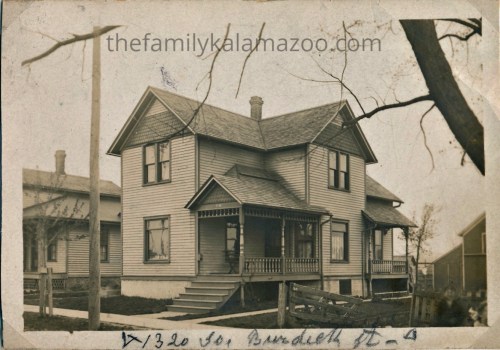
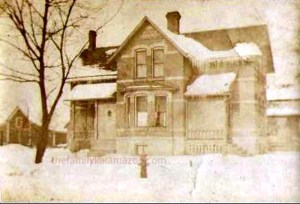
In the documents that Jan shared with me was the above photograph. This house was probably the 3rd house north from my great-great-grandfather’s house on the corner of Burdick and Balch. Inside it lived the Kallewaard family: Cornelius, Mary (Flipse), and their children.

The next photo is my great-great-grandfather’s house at the corner. You can see the variety in styles of homes, although each is special in its own right.


Wouldn’t it be wonderful if I could find a photo of each house in the neighborhood and put them together to see the neighborhood in its heyday?

Although the DeKorn house is still standing, the Kallewaard house is not, unfortunately. Thank you, Google Maps.


Read Full Post »

Over a year ago, I wrote a series of posts about Theresa (Tracy) Paak, the daughter of my great-great-grandmother’s only brother. Theresa was the mother of Professor Lawrence, who has been kind enough to send me photographs and information about his branch of the family. If you’ve been following along here for some time, you might remember my posts about Theresa Pake, the middle child (of five) of my great-great-grandmother’s brother, George.

You might remember that after the disastrous fire that destroyed the family home, Theresa went to live with Oliver and Una Pickard. Mrs. Pickard was Theresa’s Sunday School teacher. I wrote about the Pickards in George Paak’s Legacy, Part VI: Who Were the Pickards? What I discovered in my research was that the Pickards were married young, remained childless, and began their careers as nurses, both living and working at the State Hospital (psychiatric hospital).  Eventually Una became a private duty nurse and Oliver a postman.

I really tried to imagine this couple and what they were like because they proved to be so important to Theresa’s life. The other day I got my wish to see what they looked like when Professor Lawrence sent me photographs.

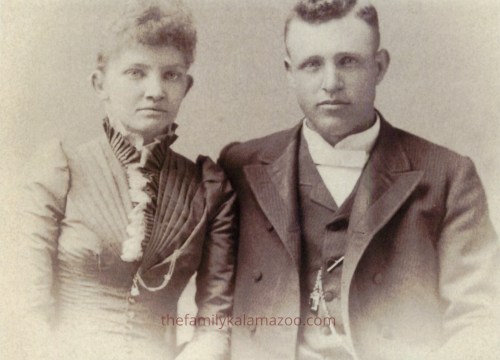
Una was 18 and Oliver 23 when they married. Could this be their wedding portrait?

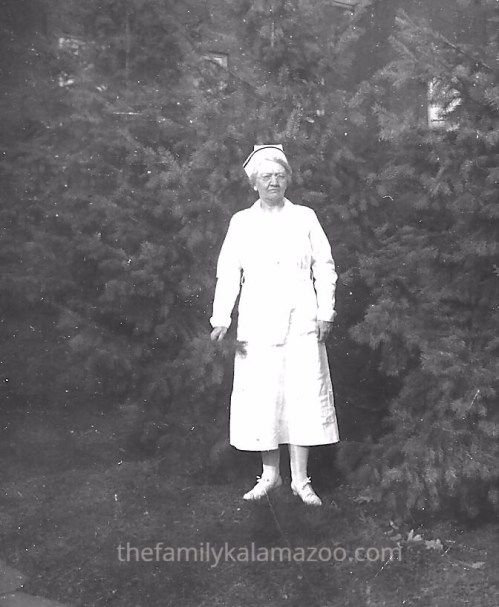
Here is Auntie Pick, as she was called, in uniform.

And Oliver, or “Uncle Bob,”  in the classic “man walking down the sidewalk pose” (yes, we’ve seen it a couple of times already with other people in other photos).

Here is a photograph of Theresa herself taking a photograph of her foster parents.


Here is “Uncle Bob” with Theresa’s son Richard, or Dick, in Wisconsin. This is Professor Lawrence’s brother.

There was some confusion in the censuses over the address of the Pickards, but I think they lived in the same house for years at 1846 Oakland Drive.

And many years later. The house is no longer there.

As a bonus, here are photographs of Una’s parents and of Una as a baby.

She looks the same as a baby as at eighteen!

Here are the other Pake/Paake/Paak/Peek posts:

A Series of Disasters

The Children After the Fire, 1902

Paak-a-boo

Saved from the Fire

Who is George Paake, Sr.?

Curious about George

George Paake’s Legacy, Part I

George Paake’s Legacy, Part II: Theresa’s Pre-Professional Education

George Paake’s Legacy, Part III: Theresa’s Professional Education

George Paake’s Legacy, Part IV: A Letter to His Daughter

George Paake’s Legacy, Part V: Theresa Gets Married


Read Full Post »

« Newer Posts - Older Posts »