Feeds:
Posts
Comments

Posts Tagged ‘history of Kalamazoo’

When my grandparents, Adrian and L. Edna (Mulder) Zuidweg got married on 21 May 1932, Grandpa’s mother, Cora DeKorn Zuidweg, was dying of cancer. He was staying home to take care of her because his father had died in 1929 and he was an only child.

In 1931, Grandpa had asked Grandma to marry him as he drove her in  the car from Kalamazoo to her parents’ farm in Caledonia. But Grandma had to wait a year to teach and give the money to her family who were struggling financially because of the Great Depression.

So there was no big celebration for my grandparents. Aunt Jen, Cora’s sister stayed with Cora while they got married. They drove to South Bend, Indiana, although Grandpa was from Kalamazoo and Grandma from Caledonia, two southwestern Michigan towns. They could get a marriage license and marry immediately in South Bend.

Traveling with them were Grandma’s sister Vena and her boyfriend Al Stimson’s cousin, Herb Thorpe. They had forgotten to get flowers, so they plucked spirea along the way.

On the way back, they ate dinner at a restaurant in Cassopolis.

Grandma immediately moved into the house at 1520 S. Burdick Street. She helped take care of her mother-in-law who died on 16 September 1932.

When the school year began, Grandma continued to teach that first year and would come home on the weekend. So that Grandpa wouldn’t be alone, Al Stimson moved in with him. Al was a student at WMU. His job was to help Grandpa with the housework. His way of handling the dishes was to load the dirty ones under the sink all week and then just before Grandma was due home for the weekend he would wash them all.

I imagine Grandma was happy to quit teaching and get rid of living in the “frat boy” atmosphere haha.

I’m happy they managed to send out some engraved wedding announcements.

And their portrait, too.

Read Full Post »

A huge thank you to Sue Vincent who featured KIN TYPES on her blog today! I’m so grateful to you, Sue! And another poem from the collection revealed.

Sue Vincent's avatarSue Vincent's Daily Echo

Jennie Bomhoff Zuidweg

The poems and flash prose in Kin Types were begun as I accumulated family stories and information over the years. My grandfather had an excellent memory and was an enthusiastic storyteller, so over time I came to feel that I knew his parents, grandparents, aunts, and uncles, although they died decades before I was born.

When my grandfather got older, he gave me a collection of glass plate negatives that had belonged to his uncle, as well as antique photographs. As my family noticed my interest, they began to send me other heirlooms, including documents and more photographs. I started to research my family history, using online websites. Then I started a WordPress blog called thefamilykalamazoo.com, and readers from around the world contacted me, sending me yet more information.

As I became more knowledgeable about my family, the stories I heard at my grandfather’s knee were enhanced…

View original post 550 more words

Read Full Post »

Thank you so much for responding so enthusiastically to Kin Types. My new chapbook is an offshoot of The Family Kalamazoo, in a way.

The cover of the book is from an old tintype belonging to my family. I have posted it twice before on this blog. The woman featured on it seems to have come from the Remine branch of the family and, based on the tintype and the dress she wears, I thought it was possible that she could be my great-great-great grandmother Johanna Remine DeKorn. This was a guess I had fairly early on, but I had no proof.

But I knew she was someone close to us. For one thing, this is an expensive painted tintype and our family owns it. We wouldn’t have possession of such an image if it wasn’t someone from the family. For another, there is too great a similarity. For instance, my daughter thinks that the woman looks remarkably like my mother in the eyes and mouth. Other people say they can see her in my face.

I thought it unlikely I would learn much more about the photo, but never gave up hope because much amazing information has flowed to me, mainly through this blog.

When I visited my mother recently, she gave me a gorgeous antique photo album from my uncle for me to scan and disseminate. Imagine my surprise when I opened the album and found this tiny tintype inside.

I had so many questions: Were the photos taken at the same time or is the woman younger in the couple’s photo? Same hairdo, same earrings . . . . We don’t really know about the dress and its neck accessory because the lace collar on the painted tintype is, just that, painted on. But she’s definitely younger. Is the new find a wedding photo? Are they siblings?

So I focused on the man. I want to say boy. They both look so young. If the woman is Johanna Remine DeKorn, the man most likely would have to be Boudewyn (Boudewijn) DeKorn. Here is a photo my grandfather identified as Boudewyn, my 3xgreat grandfather.

Boudewijn de Korne

So, what do you think? Are they two different men? The hair is the same–very wavy dark brown hair–, but the hairline has changed. That’s possible. In the upper photo, the man has very defined cheekbones, and I don’t see this in the boy. The man has a very wide mouth. Would that change over time? I doubt it. It was unlikely then that the woman was Johanna, but who was she?

I did what I had to do. I scheduled an appointment with photogenealogist Maureen Taylor. When I only had the painted tintype, I didn’t feel I had enough to go through the process with Maureen. But now that I had a second tintype, I wanted to give it a try.

When Maureen and I began our conversation, I felt a letdown. Johanna Remine was too old to be in this photo. The tintype of the two people had to be between 1869 and 1875, according to Maureen. Johanna was born in 1817 and DIED in 1864. The woman could not be Johanna.

The woman had to be a generation younger than Johanna.

This was disappointing because I felt that I know the other branches or “lines” of the family, and that if she wasn’t Johanna, she couldn’t be a direct ancestor.

And yet, as I told Maureen, I had a strong feeling that she was closely related. And her looks are too reminiscent of the family features to discount her. Maureen agreed with this and pointed me in a different direction.

The Remine family, where I felt the painted tintype came from, began in the U.S. with a marriage between Richard Remine and Mary Paak. Mary Paak is my great-great-grandmother Alice Paak DeKorn’s sister. I am related to the Remines two ways. One is by blood, Johanna Remine being my 3x great grandmother, married to Boudewyn DeKorn (and the mother of Richard DeKorn). The other is by marriage where Richard married Mary. Mary and Carrie Paak, two of the four Paak sisters, had a similar look. Alice and Annie had a different look altogether.

ALICE PAAK DEKORN

Maureen wanted to see a photo of Alice. I sent her the image above–a very clear headshot of Alice from the 1890s (so 20 years older than the woman in the tintype) and Annie (the sister who looked like Alice but is a body shot and not as clear). Maureen examined the photos and proclaimed Alice a match. She asked for the dates on the sisters: birth, immigration, marriage. She was sure the tintype of the beautiful girl on the cover of Kin Types was Alice who happens to be featured in a poem in my book: “An Account of a Poor Oil Stove Bought off Dutch Pete.”

I asked Maureen about the man in the photo and said it did not look like Alice’s husband, Richard DeKorn.

And then I learned something that is counterintuitive, but smart.

Ignore him for now.

She thought it could be her brother or even a beau she had in the Netherlands that she never married. In the tintype of both of them, they are very very young, maybe teenagers. And Alice immigrated to the United States when she was 17 years old. Maureen told me to ignore the man for the purposes of identifying the woman. I will try to identify him later, if it is even possible.

The more I thought about Maureen’s assessment, the more I realized how blind I’d been not to notice the resemblance between the women in the tintype and my 2xgreat grandmother Alice. Alice also happens to be the mother of Cora, the woman my grandparents told me that I look like.

Just for fun, I ran the two images through twinsornot.net. This is the result, although they photos are of a very young woman and a woman twenty years older.

Then I pulled out the other photo that Grandpa had identified Alice. In this alternative photo, Alice is younger than in the 1890s photo, but not nearly as young as the tintype. I had never been sure that this photo even was Alice, although Grandpa had been (and she was his grandmother). So I ran both Grandpa-identified Alice photos against each other on the site. 100% match! Grandpa was right.

Next I ran the tinted tintype against this alternative photo of Alice.

100%!


SO THERE YOU HAVE IT! THE MYSTERY IS SOLVED. THE WOMAN ON THE COVER OF KIN TYPES IS MOST LIKELY ALICE PAAK DEKORN.

I learned a lot of lessons through this process, but one that really stands out in my mind is that people look different in different photographs–and when you are comparing people of different ages, it really gets dicey. I think about photos of me . . .

If you click the Amazon link , the book can be ordered for $14.99. To order through Barnes & Noble, try this link.

If you like what you read, please leave a little review at one or more of the following sites:


Read Full Post »

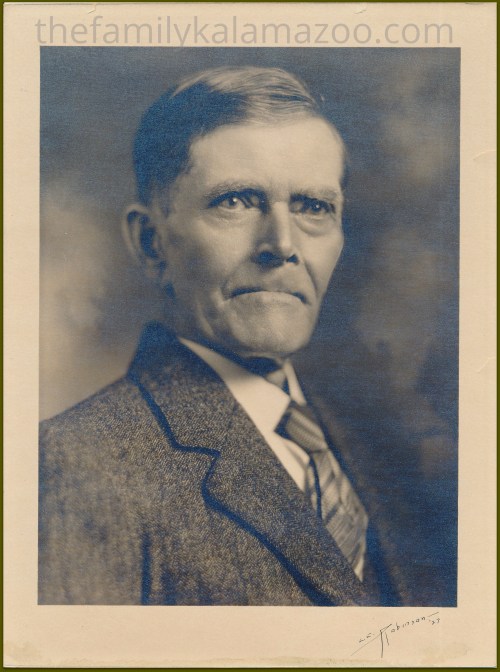
This is the best image I have ever seen of my great-great grandfather Richard DeKorn, Kalamazoo mason and building contractor.

Notice that this portrait is signed. It seems to say L. C. Robinson ’27.

So who was L. C. Robinson? From a directory of early Michigan photographers:

Robinson, Leo Carey
Dowagiac student …………………………………………………………………………………………………………………………………….1900
Grand Rapids student ……………………………………………………………………………………………………………………………….1910
Grand Rapids manufacturer of studio furniture for photographers ………………………………………………………… 1910-1911
Grand Rapids photographer for Carey B. Robinson ……………………………………………………………………………………..1912
Grand Rapids PHOTOGRAPHER at 115 ½ Monroe av ……………………………………………………………………… 1913-1921
Kalamazoo PHOTOGRAPHER at 414 Main st west ………………………………………………………………………….. 1923-1925
Kalamazoo PHOTOGRAPHER at 426 Main st west ………………………………………………………………………….. 1926-1927
Kalamazoo PHOTOGRAPHER at 426 Michigan av west …………………………………………………………………… 1929-1931
Kalamazoo PHOTOGRAPHER at 346 Burdick st south …………………………………………………………………….. 1939-1942
Leo was the elder son of photographer Carey B. Robinson and Lettie Alena (Lewis) Robinson, was born on February
25, 1893, at Delton, Michigan, and became a tall man with light brown eyes and brown hair. Her father came from
Indiana and Alta was born at Plainwell, Michigan, in June of 1893, sixth of the nine children of Charles C. and Frances
Ardella (Nichols) West. She grew up on an Allegan County farm, and she married Leo in 1914. Their children were
born in Michigan: Chester in 1915, Doris in 1916, Rueben (later Richard) in July of 1919, Jack about 1924, Avis in
May of 1926, and Eileen in February of 1928. The furniture manufactured by C. B. Robinson & Sons was sold across
the nation and in several other countries. Though Leo, along with his brother Ralph and his father, was a principal of
this company through 1911, Leo and his mother operated the photograph studio while his father supervised the
furniture factory. Leo became the nominal proprietor of the Grand Rapids studio about 1913, though his mother and
father still were involved with its operation and finances. He called it Robinson’s Art Loft in 1917. Late in 1923 he
purchased the Spaeth Studio, located in its own building on West Main Street, and within a couple of years had
developed one of the largest portrait trades in Kalamazoo. Leo died at Kalamazoo in 1942.

This photograph has a strange sheen to it and a pattern that overlays it all–visible in certain formats on my computer screen. This must be a certain type of photography, but I don’t know what it is.

I do know that I am grateful for this photograph dated three years before Richard’s death.

Dated. But taken? Richard was born in 1851 in Kapelle, Zeeland, Netherlands. In 1927, he would have been 76 years old.

Did he dye his hair? Could those moderate “living lines” be from 76 years of living? I find this photo a little confusing if it’s meant to be from 1927.

What do YOU think?

Read Full Post »

Although I started this blog five years ago next month, and that sounds like a long time, I’ve been working (on and off–mainly off while raising my kids and teaching) on family history, family photos, and genealogy since I was just out of college and beginning a master’s in history (which I did not complete and ultimately switched to English and creative writing).

I was blessed with many antique and vintage photographs and a grandfather with a great memory and a talent for storytelling.

But it wasn’t until a couple of years ago that I got the idea of putting my research and knowledge of our family history together with my creative writing. Then I began to write lyric poems, prose poems, and a few pieces in a genre that was new to me–flash nonfiction, which is a form of very short prose–based on individuals from my family’s past.

Ultimately, I pulled these pieces together into a chapbook (44 pages) which has been published by Finishing Line Press and is now available, not only on their website, but also on Amazon and Barnes & Noble websites.

Kin Types looks at what the lives of my ancestors were like. The locales are mainly Kalamazoo (and other towns in southwestern Michigan), Elmhurst (Illinois), and the Netherlands. Using the fruits of my research, which included studying newspaper articles, documents, and the details of antique photos, I tried to “inhabit” the lives of some of the people who have come before me.

If you click through the link to the Amazon page, the book can be ordered for $14.99. To order through Barnes & Noble, try this link.

Here is a sample poem from the collection:

Genealogy


Tigers die and leave their skins;

people die and leave their names.  ~Japanese Proverb


The more relatives I unearthed,

the more Franks rose to the surface

like deer bones after a storm.

On the trails I could follow,

I found seven named Frank,

three Franz, three Francis.

Frans, Francois, and Franciscus.

Frances and Francisca,

the women peeking out

from under their fathers’ names.

The name passed forward

like a cross polished by many hands.

The verb frank means to allow free passage

for man or post. But these Franks

and Franciskas paid with their labor

and their babes buried along the way.

If you read this blog, some of the characters of the book might be familiar to you. And because the project is quite unique I think people passionate about family history, genealogy, history, and local history will probably be particularly interested. Some of the pieces have been published in literary magazines. Combined together, they tell a story of the history of “forgotten” women.

So what are you waiting for? 😉 Go to one of the links and place your order!  And thank you very much.


Read Full Post »

Last week I mentioned that both Lambertus and Gerrit Leeuwenhoek were at the orphanage together after their parents died.

I wanted to share with you information that Adriaan Leeuwenhoek discovered and shared with me about Gerrit’s stay. Gerrit was living in an orphanage located in Neerbosch in 1893. Here is the photo I posted last week of the campus.

Various newspaper records show that Gerrit was beaten by teacher Cornelis de Bruin.

Unlike the Dickens’ stories about the abuse of orphans in 19th century England, in this real life 19th century Dutch story, Gerrit went to the police station to report this crime!

gerrit article

unnamed

The articles indicate that the court prosecuted four cases of the mistreatment of children at Neerbosch. Superintendent Leendert Sies abused 9-year-old Willem van Deth, teacher Frans van Geelen assaulted 11-year-old Marie van Deth. Another child was abused, as well, but the Google translation gets murky there.

The 3rd victim listed is our Gerrit. Teacher Cornelis de Bruin was given a 14 day jail sentence for assaulting Gerrit. I hope he fulfilled his time!

With so many teachers abusing children, it appears that abuse was rampant at the orphanage, but that they were prosecuted shows, to me, a determination to try to improve the situation for the children.

Adriaan has informed me that within a half year of registration one child died, as well. I wonder what the statistics were for the entire run of the orphanage regarding child “mortality.” I am sure abuse was rampant in orphanages around the world at that time.

The case was important enough that even De Volksvriend, one of the various Dutch speaking newspaper in the U.S., reported about the lawsuit. Adrian says to refer to page 7 of the attached PDF. Note that this is not the Michigan paper that my relatives worked on, but a paper out of Iowa!

Leeuwenhoek, Gerrit [De Volksvriend (Orange City, Sioux County, Iowa) 1894-03-03 – Pagina 7]

Thanks for Adriaan for this wonderful information (which I would not have found since I don’t read Dutch).

I’ll conclude this 3 part story of Gerrit and Lambertus Leeuwenhoek with a photograph of one of Adriaan Leeuwenhoek’s handsome ancestors, his grandfather Adriaan Leeuwenhoek, born 1896. I love the straw boater hat.


***

I’ve tried to stick to the punctuation rule of not capitalizing “van” and “de,” but the sources list them both capitalized and not, which REALLY confuses me because I had thought that they were not capitalized in the Netherlands and then were capitalized in the United States. Apparently not true!

Read Full Post »

Now for the meat and potatoes of the information I was given by Adriaan Leeuwenhoek (as a reminder, his great-grandfather Cornelis Leeuwenhoek was the cousin of Lambertus and Gerrit Leeuwenhoek who I have written about in earlier posts).  Thank you, Adriaan, for such wonderful information!

According to Adriaan, Lambertus & Gerrit, aged 13 and 9 respectively, became orphans on February 17th, 1886, the day their father Arie Leeuwenhoek passed away. It looks like they had at least 2-3 siblings that survived into adulthood. Two for sure–a brother and a sister–that were born between Lambertus and Gerrit, the youngest child. I hope that Adriaan can clarify that for me.

Gerrit Leeuwenhoek was born in Gouda (the city that gave its name to the cheese) on January 24, 1877. Lambertus (Uncle Lou) was born May 3, 1872, but I am not sure what city he was born in.  Their parents were Arie and, according to Adriaan, Marijtje (or Maria) Hoogendoorn Leeuwenhoek. Marijtje was born August 8, 1842 in Zammerdam and died March 7, 1878 in Gouda. Note that Gerrit was still a baby when his mother passed away.

Arie, the father of the two men, worked as a farmhand (boerenknecht). In 1875, Arie and his family moved to Gouda (which leads me to believe Uncle Lou was not born in Gouda). In 1878, Arie and his family moved to Zwammerdam, his wife’s hometown. In 1879, and later years, Arie ran a boardinghouse/public house (pub, banquet hall, etc.) in Zwammerdam. Arie passed away on February 17, 1886. On May 17th, 1886, his possessions were auctioned off. Lambertus Leeuwenhoek (Willem Leeuwenhoek’s  branch, most likely) acted as guardian. Aries’s son Frederik moved to Rotterdam. Today there’s still an Arie Leeuwenhoek alive (Branch: Arie-Frederik-Frederik-Arie born 1935). Adriaan provided me with information on the branches, but for simplicity’s sake I am not including them here.

Our family had always thought that Uncle Lou was a descendent of the famous inventor of the microscope. Adriaan says, “The members of our Leeuwenhoek branch are not direct descendents of Antony van Leeuwenhoek.” However, it is the same family. “Antony’s only son passed away at a rather young age. ‘We’ share Antony’s (great) grandfather. The family hails from The Hague. The aforementioned (great) grandfather moved around 1575 to Delft. The first and second generation’s profession was basket weaver.

Here is Adriaan’s description of where the surname Leeuwenhoek originated:

It wasn’t a bridge! The Nederduits Gereformeerde Kerk (Nederduits = Dutch, Gereformeerd = Reformed and Kerk = Chuch) records show that in 1601 Thonis Philipsz. lived near “het Oosteinde (street) bijt Leeuwenpoortge (Lions Gate)”. So he lived in a house on the corner (hoek) of the street near the Lions Gate (Leeuwenpoort), hence Leeuwenhoek. . . .  In 2007 there were only 76 persons with the family name Leeuwenhoek registered in the Netherlands.

Thonis Philipsz. had seven children. Five children were still born (the curse). The two surviving children are Philip Thonisz. (Antoni van Leeuwenhoek’s father) and Huijch Thonisz. (Hugo). According to one publication the first time the family name van Leeuwenhoek was officially used was in Huijch’s will dated 1621. Lambertus, Gerrit, Alice [of the postcard from my earlier post]and all living Leeuwenhoeken descended from Huijch.

Uncle Lou's Bijbels

Uncle Lou’s Bijbels

Well over two years ago I posted about Uncle Lou’s Bibles which are still in the family. You can read about them and see the photos here. Adriaan has some insight into one of the Bibles. It links Uncle Lou to an orphanage.

The inscription shows Neerbosch (a borough close to Nijmegen). From this inscription I deduct that Lambertus stayed at this orphanage (Weezen-Inrichting). I guess the bible was part of Lambertus’  Statement of Faith/Creed and First Brethern (Belijdenis des Geloofs en eerste Avondmaalsviering). Gerrit Pieter de Haas (son of Rijkje Cornelia de Haas, father unknown) passed away December 28th, 1886 in Neerbosch aged 13. Gerrit Pieter was sent to the orphanage around May 20th, 1886. As shown by the inscription (Reverent xxxxbulstijn). The inscription on the second page shows that Lambertus kept the bible to remember his friend Gerrit Pieter de Haas by. So I’m sure Lambertus stayed at the orphanage.

More here:

Nijmegen is by bike around 100 km (5 1/2 hr bike ride) to the east of Zwammerdam. Lambertus and Gerrit were separated from their family. Around 1893 the orphanage housed 1.100 children.

The Orphanage at Neerbosch

Gerrit was also at the orphanage with his brother. In the next post read what happened to Gerrit at the orphanage!

Read Full Post »

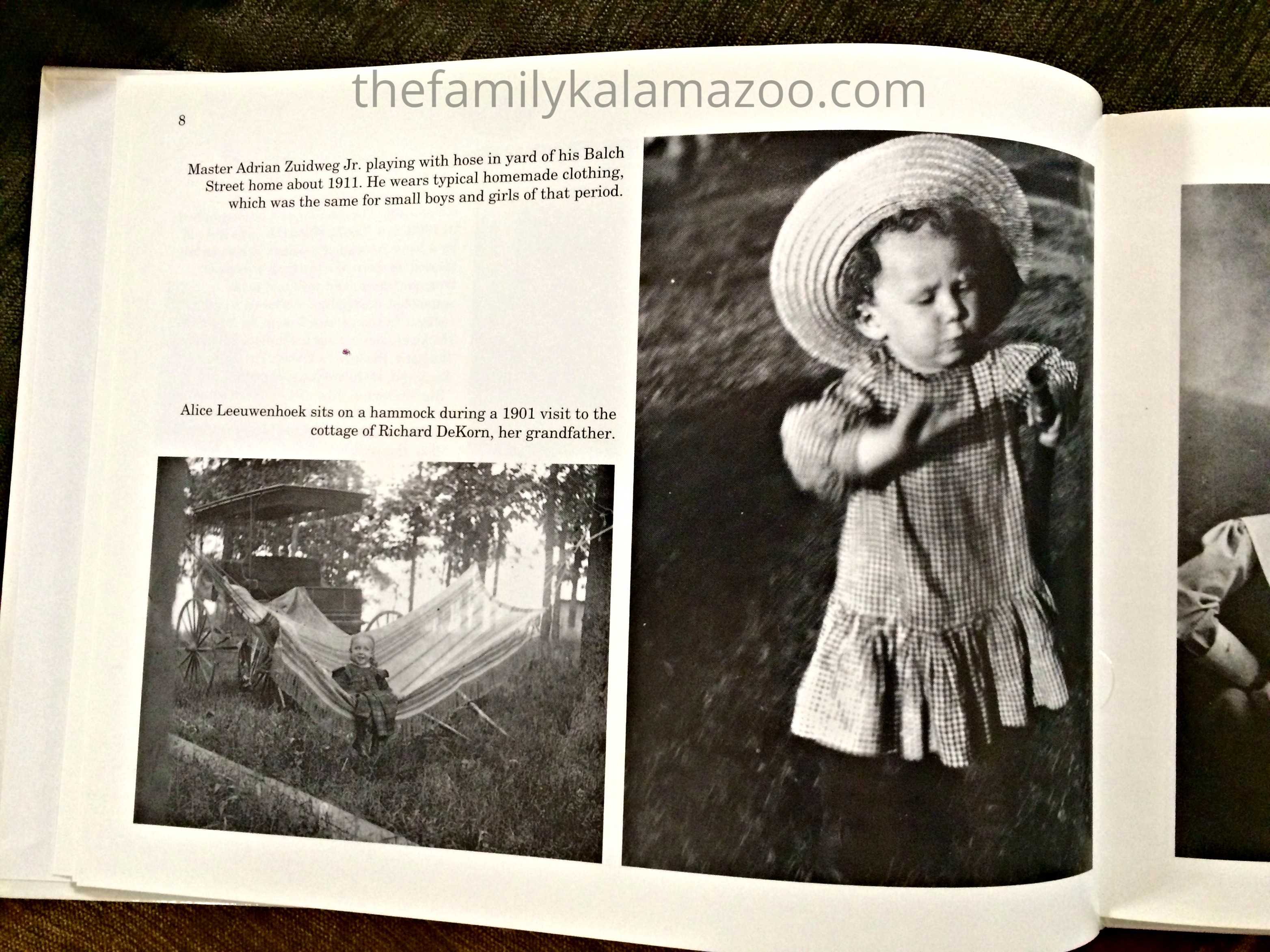
I dug into the bottom of a file drawer and pulled out a book I forgot that I had. It was put together by the Kalamazoo Gazette and featured photographs sent in by individuals of Kalamazoo from the past up to the early 1960s.

My grandfather, Adrian Zuidweg, is listed as one of the contributors, so I went through and tried to find the photos he might have sent in.

Definitely these two photos. The little boy in the check dress and straw hat is grandpa himself. And the little girl on the hammock is his cousin Alice Leeuwenhoek.

Those are the relatives sitting on the front porch. Gosh, I own that photo! I didn’t realize that was Richard Remine (though I can see right now that it is, of course, him)–or his children Therese, Harold, and Jane either. It would fit that the two little girls are Alice (next to her grandma Alice Paak) and Therese. With Harold behind the children. But Jane doesn’t really look old enough in this photo. According to my records, Jane was 14 years older than Therese. Something is off here. That big gap in age between Jane and Therese bothers me, and it always has. And if you recall when I wrote about Frank and Jane Tazelaar, I had been confused for awhile about if there had been 4 Remine children and 2 girls of similar names.  This photo must be somewhere around 1901, based on the assumed aged of the 3 little children. Jane was born in 1881 and is not 20 here!

The known people: back row is Aunt Jen DeKorn Leeuwenhoek, Richard DeKorn, Richard Remine. Front row is Lambertus (Lou) Leeuwenhoek, Alice Paak DeKorn, and then the little girl next to Alice definitely looks like Alice Leeuwenhoek, Jen and Lou’s daughter. It would seem plausible that the three other children belong to Richard Remine, but Jane could not have been that small.

What else? Here is Harold Remine big enough to go fishing at Long Lake. The other photo is not from my family, but it does show off a great collection of hats!

This is the Ladies Library building that Richard DeKorn was the mason contractor for.

But I don’t think that is one of our family photos.

One of these photos could have been taken by Joseph DeKorn and been submitted by Grandpa. It is very similar to the ones that I own.

Take a look at the captions for the downtown views. Does it make sense? It doesn’t make sense to me for some reason.

Most importantly, Grandpa autographed this book!

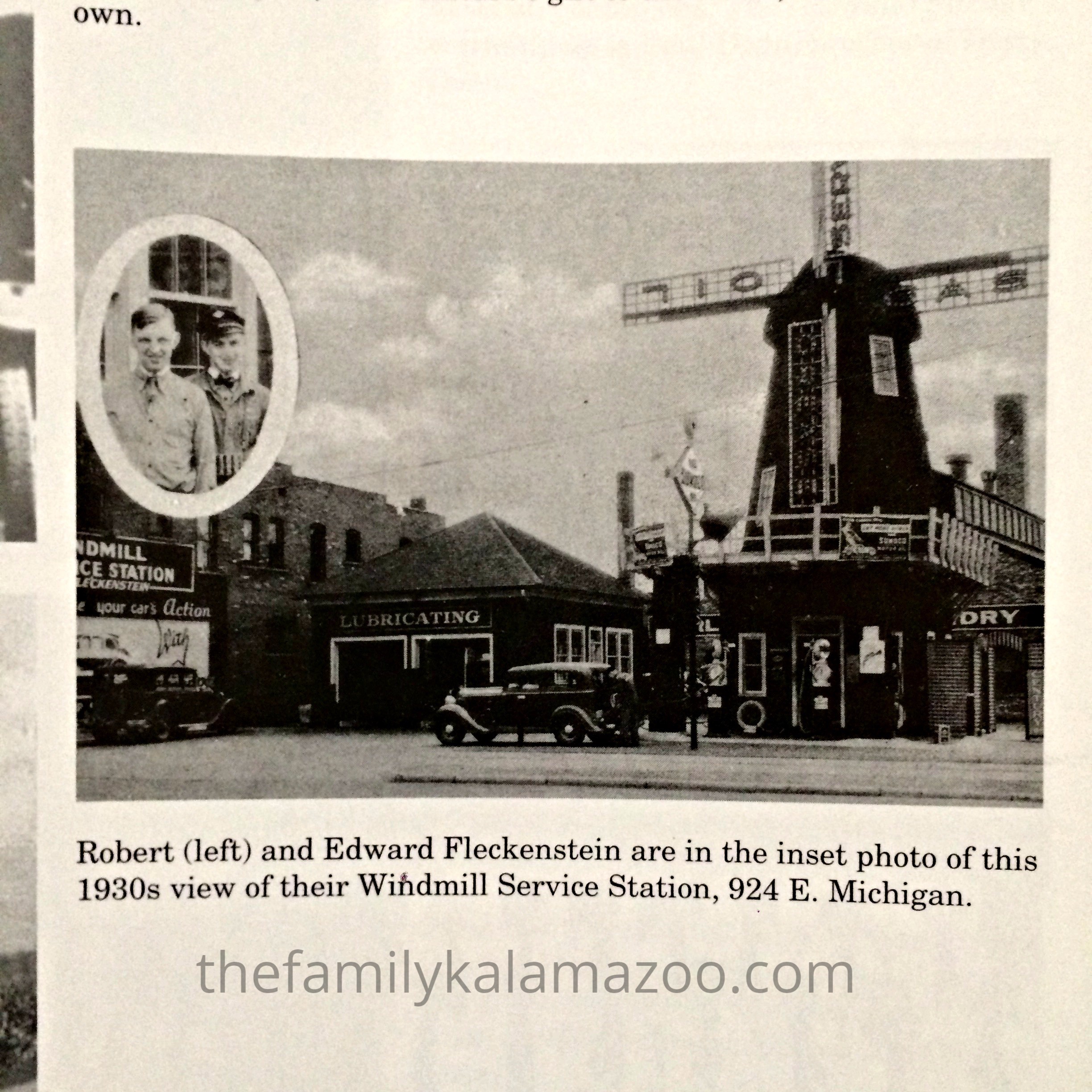
Here is a bonus photo. It isn’t from my family, but isn’t it a cool reminder of the kitschy business architecture popular in those days?

Read Full Post »

This year has been very intense-with both overwhelmingly sad events, especially my father’s illness and eventual passing, and more positive events, including the publication of my first book (of poetry). So I have really let the genealogy slide, although I’ve continued to post occasional photos and story tidbits.

Eventually I hope to get back into working on all branches and with others I have been in contact with, namely the Paak/Pake, Van Liere, Van Gessel, Mulder, as well as information that people have sent me about the DeKorns (deKorne, deKorn, DeKorne). Additionally, I owe information to a couple of people, including Hubert Theuns. Jose from Enhanced News Archive is using his research abilities and newspaper knowhow to help me with a Noffke (surname also known as Neffka) project.  If you don’t see your family branch or name mentioned, feel free to send me an email or comment here reminding me. I would be so grateful, although maybe not any more prompt ;).

This post comes about because of a Dutch connection that is related to my last post about Alice Leeuwenhoek, my grandfather’s first cousin. Alice and I are blood related on Alice’s mother’s side, but Grandpa and the family were very close to Alice’s father, shopkeeper Lambertus (Uncle Lou) Leeuwenhoek. In fact, Grandpa’s father and Uncle Lou were close and even worked on the Dutch-America newspaper together: see this post.

I’ve written before about Uncle Lou’s Bible collection here. Eventually, I would like to write about his retail enterprises. Uncle Lou and his brother Gerrit were orphans who immigrated to the United States. His brother died during the Spanish-American War, which I wrote about in Good Manners and Genuine Dutch Intrepidity in Fierce Battles.

I was contacted by Adriaan Leeuwenhoek, who lives in the Netherlands. Adriaan’s great-grandfather Cornelis Leeuwenhoek was the cousin of Lambertus and Gerrit.

Lambertus (Uncle Lou) was born in 1872 and Gerrit in 1877. Cornelis was born in 1866, so he was about the same amount older than Lou than Lou was than Gerrit, if that makes sense.

Adriaan shared this fabulous photograph from the Leeuwenhoek “family archives.”

Cornelis Leeuwenhoek circa 1917

MORE FROM ADRIAAN IN THE NEXT POST, including the origins of the surname Leeuwenhoek!

Read Full Post »

The other day I posted Richard DeKorn’s death certificate from Kalamazoo and asked for help with the cause of death. Readers were very helpful, and I’m so appreciative.

I mentioned at the time that Richard’s daughter and Grandpa’s mother, Cora DeKorn Zuidweg (Mrs. Adrian Zuidweg), wasn’t in the register of deaths. Two readers kindly sent me Cora’s death certificate that they found on the Seeking Michigan website.

Cora is a particularly intriguing person to me because Grandpa and Grandma used to tell me that I looked a lot like her, especially with my hair pulled back. Cora always wore her hair up. The first time I saw this picture of Cora I was in my 20s and felt as if I was looking into a mirror.

Also, Grandpa’s stories about her included stories of her love for animals and her courage to defend them. I feel a real affinity in the area of love of animals and wish I had her courage.

Here are Cora and Adrian (senior) with Grandpa, Adrian (junior)

What I knew about Cora’s death was that she had cancer that had spread throughout her body and her brain became confused from the disease. I also knew that she was dying when my grandparents got married. That explains why they got married out of town and on their own. My grandmother moved into the house with Grandpa and his mother and took care of her until she died a few months later.

Now take a look at the cause of death on the certificate:

Exhaustion – debility from gen – metastatic sarcoma spindle cell – primary in left thigh, followed injury was removed 9-16-29 – had existed there 5 years.

I believe that it is what it says.

So cancer that started in her left thigh. Cancer that, according to Google, would be treated with chemo today. If caught in time, the results would probably be positive. Spindle cell sarcoma apparently is a connective tissue cancer.

I thought that was a little bit of a coincidence because it seems that Cora had the cancer since she was about 52 and when I was 50 I had a tumor in my foot. While my tumor turned out not to be cancer, it was a giant cell reparative granuloma, which means that it has some characteristics of cancer (possibility of metastasizing and also destruction and replacement of healthy tissue). My tumor is the type that also reacts to injury or pressure, as Cora’s did.

After checking out more on Google, I also learned that Giant Cell tumors can turn into cancer if left untreated–and sometimes into spindle cell. Notice that Cora’s original tumor wasn’t removed until 1929, about two years into her diagnosis.

All very curious. I know that I am lucky that I got 21st century medical care for my foot.

Cora passed away at age 57, never meeting her three grandchildren. My mother would be born less than two years after Cora’s death.


Read Full Post »

« Newer Posts - Older Posts »