Feeds:
Posts
Comments

Posts Tagged ‘genealogy’

Now for the meat and potatoes of the information I was given by Adriaan Leeuwenhoek (as a reminder, his great-grandfather Cornelis Leeuwenhoek was the cousin of Lambertus and Gerrit Leeuwenhoek who I have written about in earlier posts).  Thank you, Adriaan, for such wonderful information!

According to Adriaan, Lambertus & Gerrit, aged 13 and 9 respectively, became orphans on February 17th, 1886, the day their father Arie Leeuwenhoek passed away. It looks like they had at least 2-3 siblings that survived into adulthood. Two for sure–a brother and a sister–that were born between Lambertus and Gerrit, the youngest child. I hope that Adriaan can clarify that for me.

Gerrit Leeuwenhoek was born in Gouda (the city that gave its name to the cheese) on January 24, 1877. Lambertus (Uncle Lou) was born May 3, 1872, but I am not sure what city he was born in.  Their parents were Arie and, according to Adriaan, Marijtje (or Maria) Hoogendoorn Leeuwenhoek. Marijtje was born August 8, 1842 in Zammerdam and died March 7, 1878 in Gouda. Note that Gerrit was still a baby when his mother passed away.

Arie, the father of the two men, worked as a farmhand (boerenknecht). In 1875, Arie and his family moved to Gouda (which leads me to believe Uncle Lou was not born in Gouda). In 1878, Arie and his family moved to Zwammerdam, his wife’s hometown. In 1879, and later years, Arie ran a boardinghouse/public house (pub, banquet hall, etc.) in Zwammerdam. Arie passed away on February 17, 1886. On May 17th, 1886, his possessions were auctioned off. Lambertus Leeuwenhoek (Willem Leeuwenhoek’s  branch, most likely) acted as guardian. Aries’s son Frederik moved to Rotterdam. Today there’s still an Arie Leeuwenhoek alive (Branch: Arie-Frederik-Frederik-Arie born 1935). Adriaan provided me with information on the branches, but for simplicity’s sake I am not including them here.

Our family had always thought that Uncle Lou was a descendent of the famous inventor of the microscope. Adriaan says, “The members of our Leeuwenhoek branch are not direct descendents of Antony van Leeuwenhoek.” However, it is the same family. “Antony’s only son passed away at a rather young age. ‘We’ share Antony’s (great) grandfather. The family hails from The Hague. The aforementioned (great) grandfather moved around 1575 to Delft. The first and second generation’s profession was basket weaver.

Here is Adriaan’s description of where the surname Leeuwenhoek originated:

It wasn’t a bridge! The Nederduits Gereformeerde Kerk (Nederduits = Dutch, Gereformeerd = Reformed and Kerk = Chuch) records show that in 1601 Thonis Philipsz. lived near “het Oosteinde (street) bijt Leeuwenpoortge (Lions Gate)”. So he lived in a house on the corner (hoek) of the street near the Lions Gate (Leeuwenpoort), hence Leeuwenhoek. . . .  In 2007 there were only 76 persons with the family name Leeuwenhoek registered in the Netherlands.

Thonis Philipsz. had seven children. Five children were still born (the curse). The two surviving children are Philip Thonisz. (Antoni van Leeuwenhoek’s father) and Huijch Thonisz. (Hugo). According to one publication the first time the family name van Leeuwenhoek was officially used was in Huijch’s will dated 1621. Lambertus, Gerrit, Alice [of the postcard from my earlier post]and all living Leeuwenhoeken descended from Huijch.

Uncle Lou's Bijbels

Uncle Lou’s Bijbels

Well over two years ago I posted about Uncle Lou’s Bibles which are still in the family. You can read about them and see the photos here. Adriaan has some insight into one of the Bibles. It links Uncle Lou to an orphanage.

The inscription shows Neerbosch (a borough close to Nijmegen). From this inscription I deduct that Lambertus stayed at this orphanage (Weezen-Inrichting). I guess the bible was part of Lambertus’  Statement of Faith/Creed and First Brethern (Belijdenis des Geloofs en eerste Avondmaalsviering). Gerrit Pieter de Haas (son of Rijkje Cornelia de Haas, father unknown) passed away December 28th, 1886 in Neerbosch aged 13. Gerrit Pieter was sent to the orphanage around May 20th, 1886. As shown by the inscription (Reverent xxxxbulstijn). The inscription on the second page shows that Lambertus kept the bible to remember his friend Gerrit Pieter de Haas by. So I’m sure Lambertus stayed at the orphanage.

More here:

Nijmegen is by bike around 100 km (5 1/2 hr bike ride) to the east of Zwammerdam. Lambertus and Gerrit were separated from their family. Around 1893 the orphanage housed 1.100 children.

The Orphanage at Neerbosch

Gerrit was also at the orphanage with his brother. In the next post read what happened to Gerrit at the orphanage!

Read Full Post »

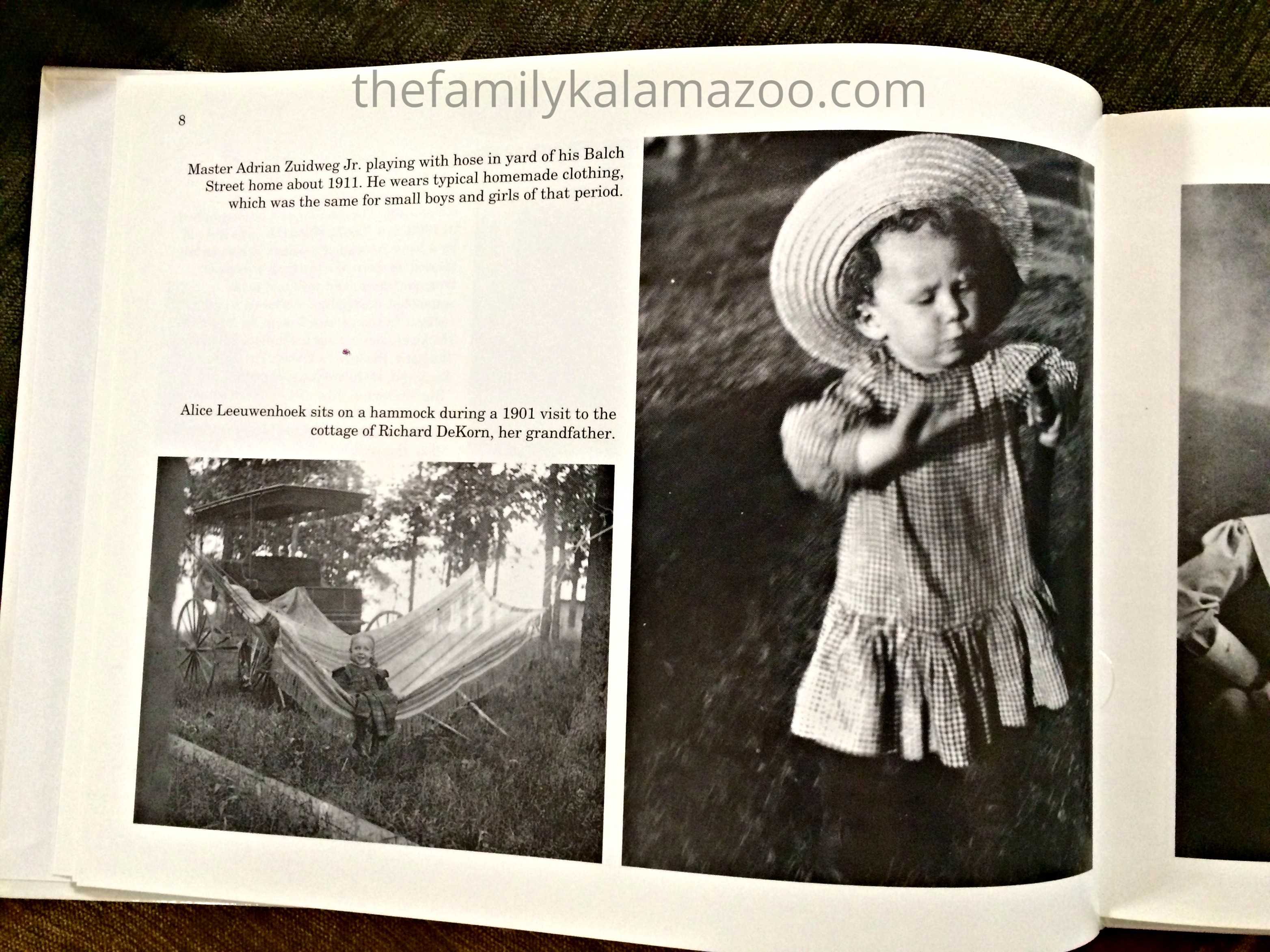
I dug into the bottom of a file drawer and pulled out a book I forgot that I had. It was put together by the Kalamazoo Gazette and featured photographs sent in by individuals of Kalamazoo from the past up to the early 1960s.

My grandfather, Adrian Zuidweg, is listed as one of the contributors, so I went through and tried to find the photos he might have sent in.

Definitely these two photos. The little boy in the check dress and straw hat is grandpa himself. And the little girl on the hammock is his cousin Alice Leeuwenhoek.

Those are the relatives sitting on the front porch. Gosh, I own that photo! I didn’t realize that was Richard Remine (though I can see right now that it is, of course, him)–or his children Therese, Harold, and Jane either. It would fit that the two little girls are Alice (next to her grandma Alice Paak) and Therese. With Harold behind the children. But Jane doesn’t really look old enough in this photo. According to my records, Jane was 14 years older than Therese. Something is off here. That big gap in age between Jane and Therese bothers me, and it always has. And if you recall when I wrote about Frank and Jane Tazelaar, I had been confused for awhile about if there had been 4 Remine children and 2 girls of similar names.  This photo must be somewhere around 1901, based on the assumed aged of the 3 little children. Jane was born in 1881 and is not 20 here!

The known people: back row is Aunt Jen DeKorn Leeuwenhoek, Richard DeKorn, Richard Remine. Front row is Lambertus (Lou) Leeuwenhoek, Alice Paak DeKorn, and then the little girl next to Alice definitely looks like Alice Leeuwenhoek, Jen and Lou’s daughter. It would seem plausible that the three other children belong to Richard Remine, but Jane could not have been that small.

What else? Here is Harold Remine big enough to go fishing at Long Lake. The other photo is not from my family, but it does show off a great collection of hats!

This is the Ladies Library building that Richard DeKorn was the mason contractor for.

But I don’t think that is one of our family photos.

One of these photos could have been taken by Joseph DeKorn and been submitted by Grandpa. It is very similar to the ones that I own.

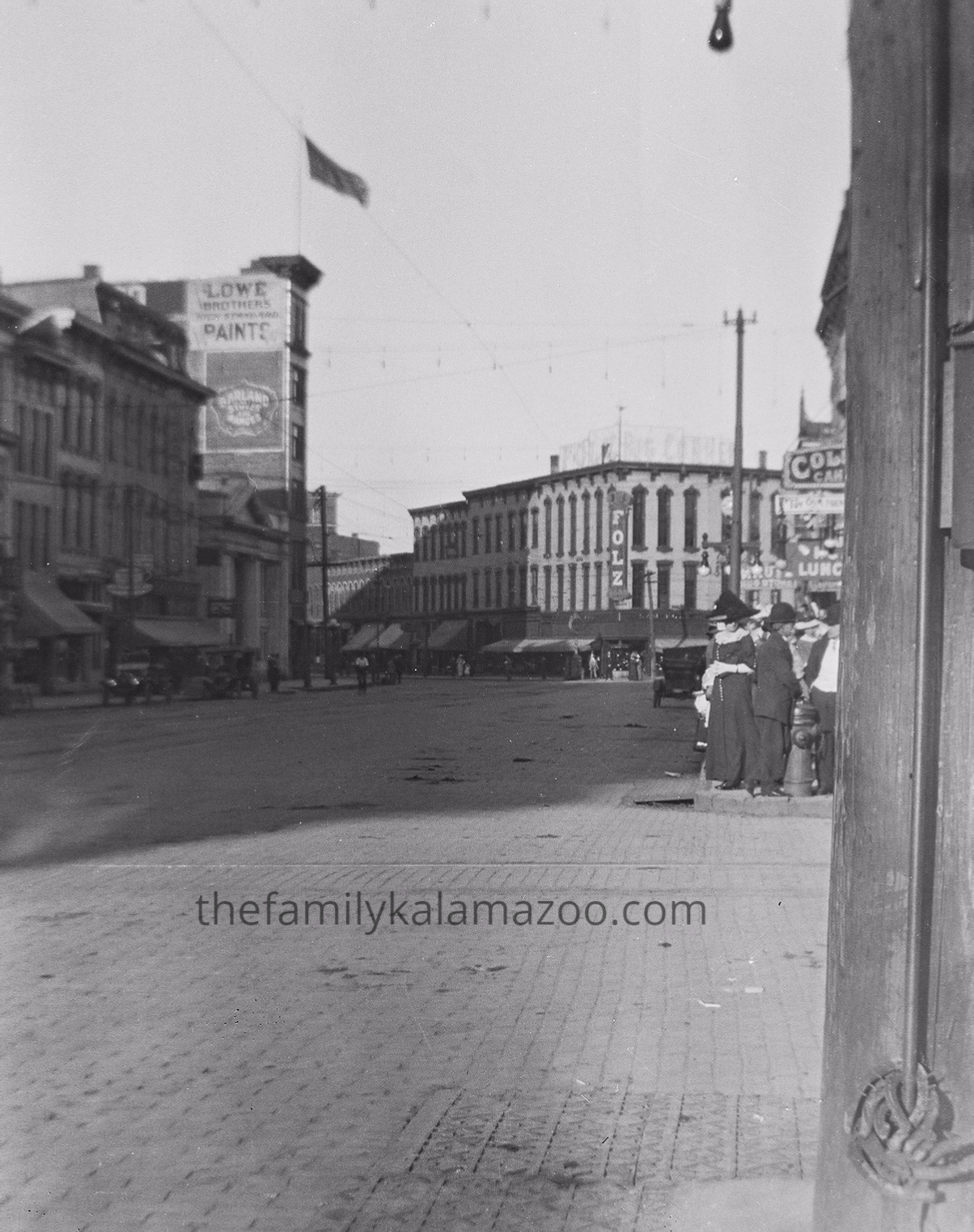
Take a look at the captions for the downtown views. Does it make sense? It doesn’t make sense to me for some reason.

Most importantly, Grandpa autographed this book!

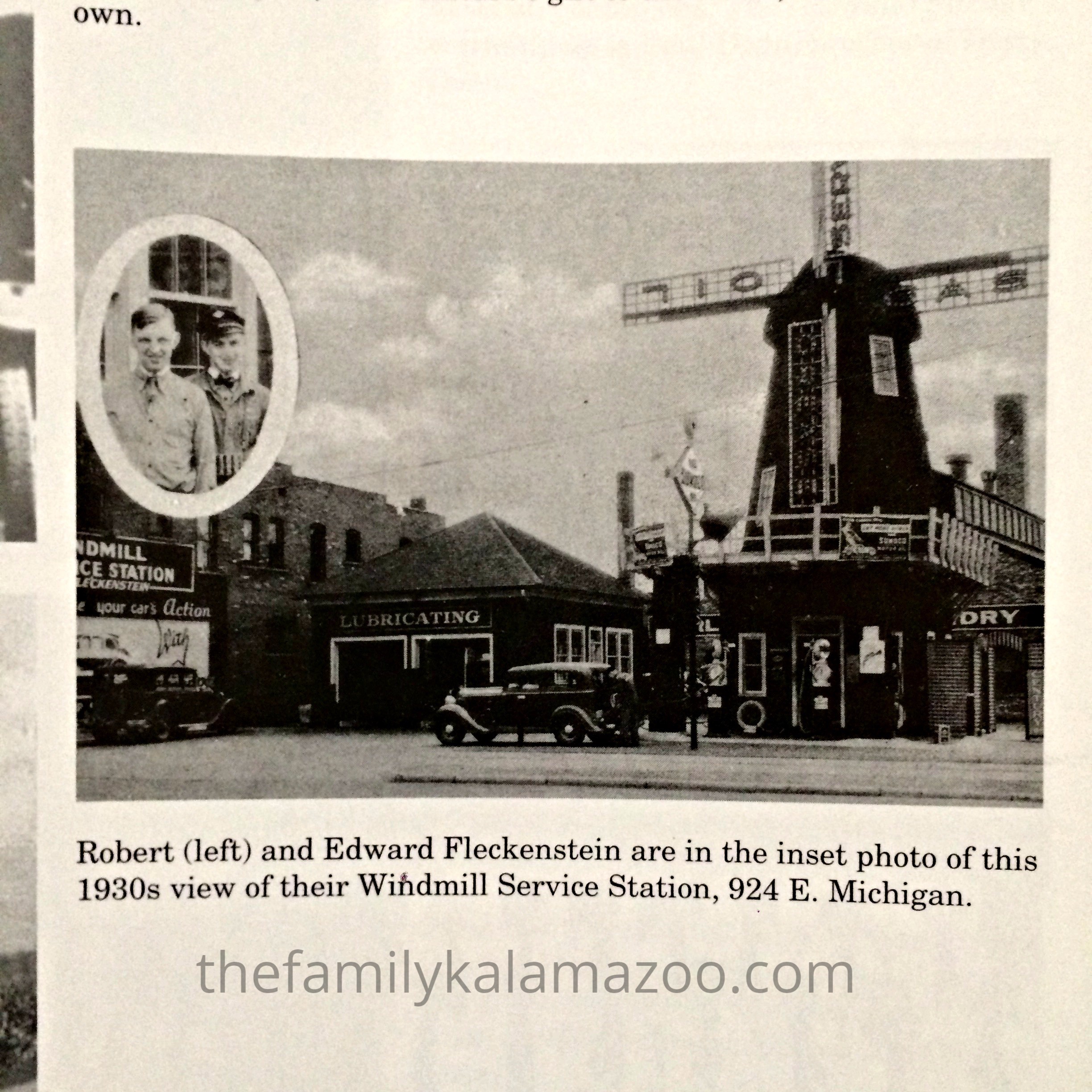
Here is a bonus photo. It isn’t from my family, but isn’t it a cool reminder of the kitschy business architecture popular in those days?

Read Full Post »

This year has been very intense-with both overwhelmingly sad events, especially my father’s illness and eventual passing, and more positive events, including the publication of my first book (of poetry). So I have really let the genealogy slide, although I’ve continued to post occasional photos and story tidbits.

Eventually I hope to get back into working on all branches and with others I have been in contact with, namely the Paak/Pake, Van Liere, Van Gessel, Mulder, as well as information that people have sent me about the DeKorns (deKorne, deKorn, DeKorne). Additionally, I owe information to a couple of people, including Hubert Theuns. Jose from Enhanced News Archive is using his research abilities and newspaper knowhow to help me with a Noffke (surname also known as Neffka) project.  If you don’t see your family branch or name mentioned, feel free to send me an email or comment here reminding me. I would be so grateful, although maybe not any more prompt ;).

This post comes about because of a Dutch connection that is related to my last post about Alice Leeuwenhoek, my grandfather’s first cousin. Alice and I are blood related on Alice’s mother’s side, but Grandpa and the family were very close to Alice’s father, shopkeeper Lambertus (Uncle Lou) Leeuwenhoek. In fact, Grandpa’s father and Uncle Lou were close and even worked on the Dutch-America newspaper together: see this post.

I’ve written before about Uncle Lou’s Bible collection here. Eventually, I would like to write about his retail enterprises. Uncle Lou and his brother Gerrit were orphans who immigrated to the United States. His brother died during the Spanish-American War, which I wrote about in Good Manners and Genuine Dutch Intrepidity in Fierce Battles.

I was contacted by Adriaan Leeuwenhoek, who lives in the Netherlands. Adriaan’s great-grandfather Cornelis Leeuwenhoek was the cousin of Lambertus and Gerrit.

Lambertus (Uncle Lou) was born in 1872 and Gerrit in 1877. Cornelis was born in 1866, so he was about the same amount older than Lou than Lou was than Gerrit, if that makes sense.

Adriaan shared this fabulous photograph from the Leeuwenhoek “family archives.”

Cornelis Leeuwenhoek circa 1917

MORE FROM ADRIAAN IN THE NEXT POST, including the origins of the surname Leeuwenhoek!

Read Full Post »

The other day I posted Richard DeKorn’s death certificate from Kalamazoo and asked for help with the cause of death. Readers were very helpful, and I’m so appreciative.

I mentioned at the time that Richard’s daughter and Grandpa’s mother, Cora DeKorn Zuidweg (Mrs. Adrian Zuidweg), wasn’t in the register of deaths. Two readers kindly sent me Cora’s death certificate that they found on the Seeking Michigan website.

Cora is a particularly intriguing person to me because Grandpa and Grandma used to tell me that I looked a lot like her, especially with my hair pulled back. Cora always wore her hair up. The first time I saw this picture of Cora I was in my 20s and felt as if I was looking into a mirror.

Also, Grandpa’s stories about her included stories of her love for animals and her courage to defend them. I feel a real affinity in the area of love of animals and wish I had her courage.

Here are Cora and Adrian (senior) with Grandpa, Adrian (junior)

What I knew about Cora’s death was that she had cancer that had spread throughout her body and her brain became confused from the disease. I also knew that she was dying when my grandparents got married. That explains why they got married out of town and on their own. My grandmother moved into the house with Grandpa and his mother and took care of her until she died a few months later.

Now take a look at the cause of death on the certificate:

Exhaustion – debility from gen – metastatic sarcoma spindle cell – primary in left thigh, followed injury was removed 9-16-29 – had existed there 5 years.

I believe that it is what it says.

So cancer that started in her left thigh. Cancer that, according to Google, would be treated with chemo today. If caught in time, the results would probably be positive. Spindle cell sarcoma apparently is a connective tissue cancer.

I thought that was a little bit of a coincidence because it seems that Cora had the cancer since she was about 52 and when I was 50 I had a tumor in my foot. While my tumor turned out not to be cancer, it was a giant cell reparative granuloma, which means that it has some characteristics of cancer (possibility of metastasizing and also destruction and replacement of healthy tissue). My tumor is the type that also reacts to injury or pressure, as Cora’s did.

After checking out more on Google, I also learned that Giant Cell tumors can turn into cancer if left untreated–and sometimes into spindle cell. Notice that Cora’s original tumor wasn’t removed until 1929, about two years into her diagnosis.

All very curious. I know that I am lucky that I got 21st century medical care for my foot.

Cora passed away at age 57, never meeting her three grandchildren. My mother would be born less than two years after Cora’s death.


Read Full Post »

The haphazard method of genealogy research that I practice is fun because I follow threads that interest me at the moment, and since I am always juggling a lot at once because I’m a little hyper, it probably works best for me.

Nevertheless, this style has its limitations. I didn’t realize the extent, though, until I went to look up “causes of death” on death certificates for my grandfather’s family. Well, darn. They all lived and died in Kalamazoo–and apparently it is not easy to find death certificates in Kalamazoo. At least not from afar.

Out of 6 people–Grandpa’s parents and both sets of grandparents–I only have one death certificate, that of Richard DeKorn. When I pushed myself, I did find 4 of the other 5 on the death registers online. Then I emailed the County Clerk volunteers to see if someone can find the information for me. Keeping my fingers crossed on this one!

Grandpa’s mother, Cora DeKorn Zuidweg, isn’t even in the register. She passed away near the end of 1932, but I couldn’t find her the last few months of 1932 or even the beginning of 1933. I hope that volunteers can give me some insight into this issue.

Here is Richard DeKorn’s death certificate:

Here are some things I noticed of interest from the 1930 document:

Richard lived at 1440 Maple Street (not too far from Oakland Drive), not at the corner of Burdick and Balch. Does this mean that he had already moved with his second wife, Jennie, from the old neighborhood?

He died at New Borgess Hospital. So Borgess must have had that name at that time.

He had been retired for fifteen years from his occupation as a mason contractor. Since he was 78 when he passed away, he retired at age 63.

What does his cause of death state?

Secondary pneumonia 2 days.

Mucopurulent bronchitis 10 days.

Prostatic hypertrophy [interstial???] cystitis 3 months.

Is that last the same thing as prostatitis?

Does this mean that he had a UTI that eventually led to pneumonia?

If penicillin was first used as an antibiotic in 1928, what was the state of antibiotic usage in 1930? Were they being used yet? Did Richard die because he didn’t have an antibiotic for cystitis?

UPDATE:

Since I posted this earlier this morning, I’ve had some interesting info shared. Amy Cohen of Brotman Blog asked her medical expert about Richard’s cause of death. Here is what he said:

I would say with confidence that the ultimate cause of death was pneumonia–formerly known as the old man’s friend because it caused death quickly and with relatively little discomfort. It sounds as though he initially became ill with either a viral infection or had COPD (Chronic Bronchitis), which progressed to a pneumonia. Cystitis is any inflammation of the bladder, and it does not need to be infectious in nature. A man with an enlarged prostrate could have cystitis from inadequate bladder emptying and bladder distension. If a UTI was the primary factor, then the ultimate cause of death would have most likely been sepsis, not pneumonia.

As for antibiotic treatment at his time of death, none really existed. Sulfa-based antibiotics and penicillin may have been discovered in the late 20’s – early 30’s, but they would not be commercially available for another decade. Sulfa was being used in the 30’s, but Penicillin use didn’t really start until WW2 and probably was not widely prescribed until late 40’s – early 50’s.  People not dying from bacterial infections is just another thing Baby Boomers take for granted.

I sure do! I was born in 1955, and I remember getting a lot of penicillin as a kid because I was sick a lot. It never occurred to me that my parents wouldn’t have had that same advantage.

Also, TAO (who writes a fabulous blog about adoption) shared some specific information about penicillin. According to her, it wasn’t prescribed until 1945, which is corroborated by Amy’s medical expert.

Read Full Post »

Almost two years ago, I posted photos of my grandfather as a very young man with an unidentified female. I hypothesized that she was his girlfriend before my grandmother.

Here they are together–looks like a couple to me.

I was going through some papers and found memory books my grandparents had prepared (one of his memories and one of hers) for the grandchildren. Inside Grandpa’s memory book, the question is asked: WHO IS THE GIRL YOU REMEMBER THE MOST?

This was his answer: (2) Vander Weele and Garthe: Don’t remember first names

So I did a little research on these names. I figured out who I believe at least one of the girls is, based on the census reports and other documents.

Garthe turned out to be Margaret Christine Garthe, born 11 days after my grandfather in 1908. She wasn’t from Kalamazoo, but from northern Michigan. She had come to Kalamazoo to attend Western. I found her in the 1928 Western State Teacher’s College yearbook.

Tell me if this isn’t the girl my grandfather is seen with above. Back row, 3rd from left.


From Ancestry it looks as if Margaret married Hans James Knutson. She passed away in 1997 in Muskegon, Michigan. Grandpa lived until 2000, happily married to the end to Grandma.

Read Full Post »

I was doing a little research for a post I want to write about my grandfather when I discovered this link to a historical photography project in Kalamazoo.

Students are taking old photos from the Kalamazoo Public Library collection and photographing the same scene from the same angle. Very interesting. It’s still a work in progress, and I can’t wait to see more.

Check it out here: KALAMAZOO THEN & NOW

Although I am so disappointed that Western Michigan University’s old campus was allowed to be destroyed for the most part, I do think Kalamazoo has a strong voice for history–in part because of the university and an active library and in part because so many people love Kalamazoo.

How about your community? How does it take care of its history?

downtown Kalamazoo, photo by Joseph DeKorn


Read Full Post »

Here’s a lovely mention in a great post about genealogy and researching family history. It’s from February, but somehow I missed seeing it.


Cheri Lucas Rowlands blog


Read Full Post »

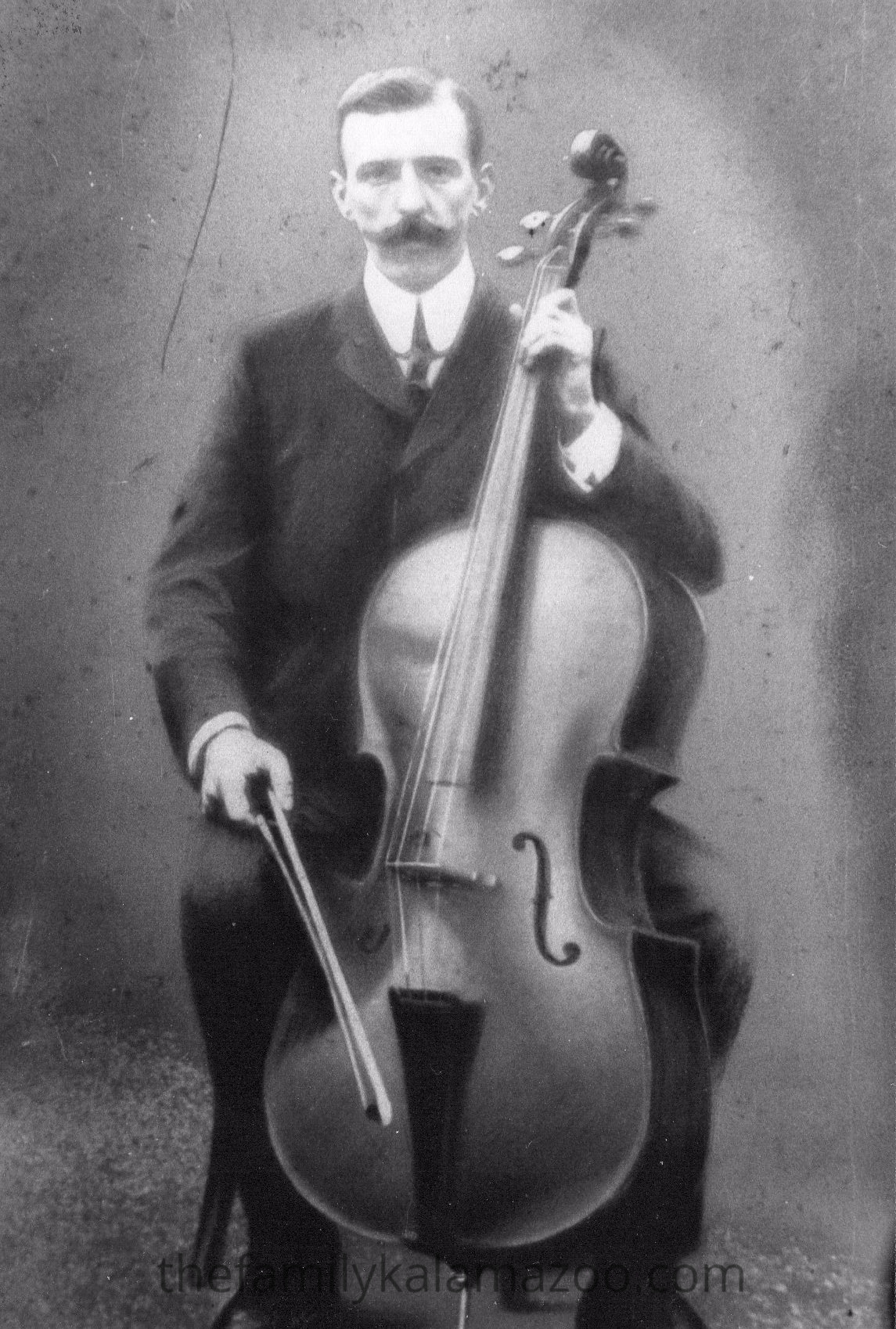
Peter Mulder has discovered more information about his grandfather, Jan Mulder, through the Red Cross war archive. Jan is the Mulder who died in a Japanese prisoner of war camp in WWII. Read about it in The Story of a Mulder in Indonesia.

Jan was my great-great grandfather Peter (Pieter) Mulder’s half-brother and you might remember the heart-breaking letter Peter wrote to Jan after the death of his wife Nellie. You can read it in The Treasure that Arrived in an Email.

According to Peter’s information, Jan was interned in March 1942 in the Ambarawa camp, Central Java number 7. His camp number was 13591. He was detained there until his death on 23 November 1945. You will note that this is a few months after the Japanese surrender, and Jan had wanted to return to Holland. However, his fragile health did not allow him to travel. Although Jan was only 66, heart disease and starvation edema ultimately proved fatal.

The day before Jan passed away, he was baptized as a Catholic as the fulfillment of his last wish. He died quietly in the hospital with Sister Josephine and Reverend John G. Breman at his side. Reverend Breman was also a patient at the hospital.

Jan was buried in the camp, which was considered a privilege at that time.

Jan Mulder with his beloved cello

Read Full Post »

My grandparents lived on Burdick Street in Kalamazoo. In fact, most of the family history on that side seems centered in the Burdick-Balch neighborhood. But as a kid I remember seeing a street sign on the right side when we drove south from Grandma and Grandpa’s house. It said “Remine.” I always thought that was such a funny coincidence because I knew we had Remine relatives. I imagined that it was an extremely common Dutch name.

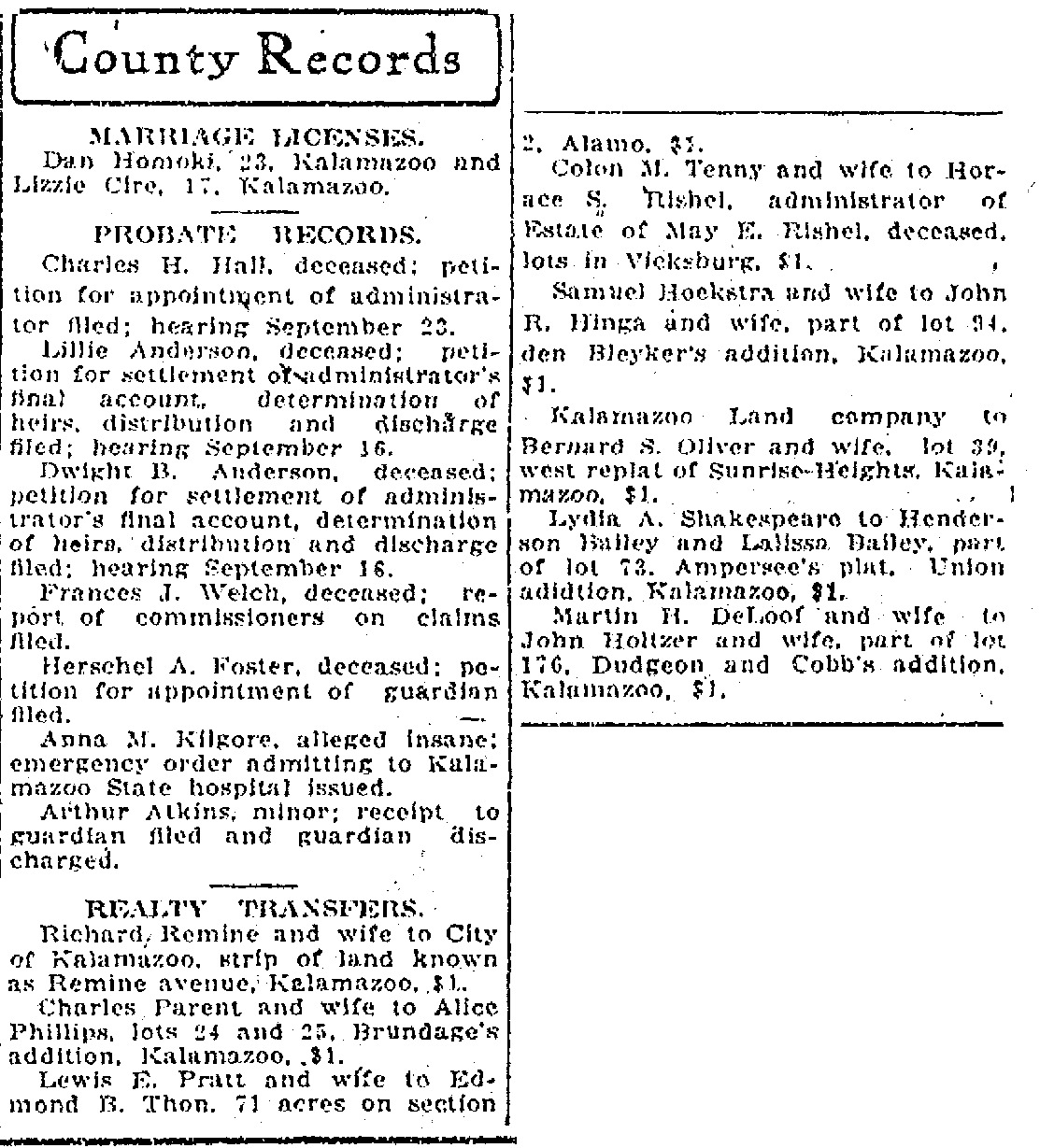
But when I was searching Genealogy Bank for Kalamazoo Gazette articles about the Remine and Tazelaar families, I encountered this little gem from August 22, 1918:

Look at the first item under REALTY TRANSFERS. “Richard Remine and wife to City of Kalamazoo, strip of land known as Remine avenue, Kalamazoo, $1.

Richard Remine is the father of Genevieve (and father-in-law of Frank Tazelaar), of Harold, and of Therese (Theresa, Tracy).

Was this common, to deed a piece of land to the city for the purpose of a road? And would it really have only been $1? Would there have been other parts of the negotiation? A discount on taxes, for instance? Or was it in order to have a way to develop a piece land and sell off lots?

Here is the intersection of Burdick and Remine according to Google Maps.


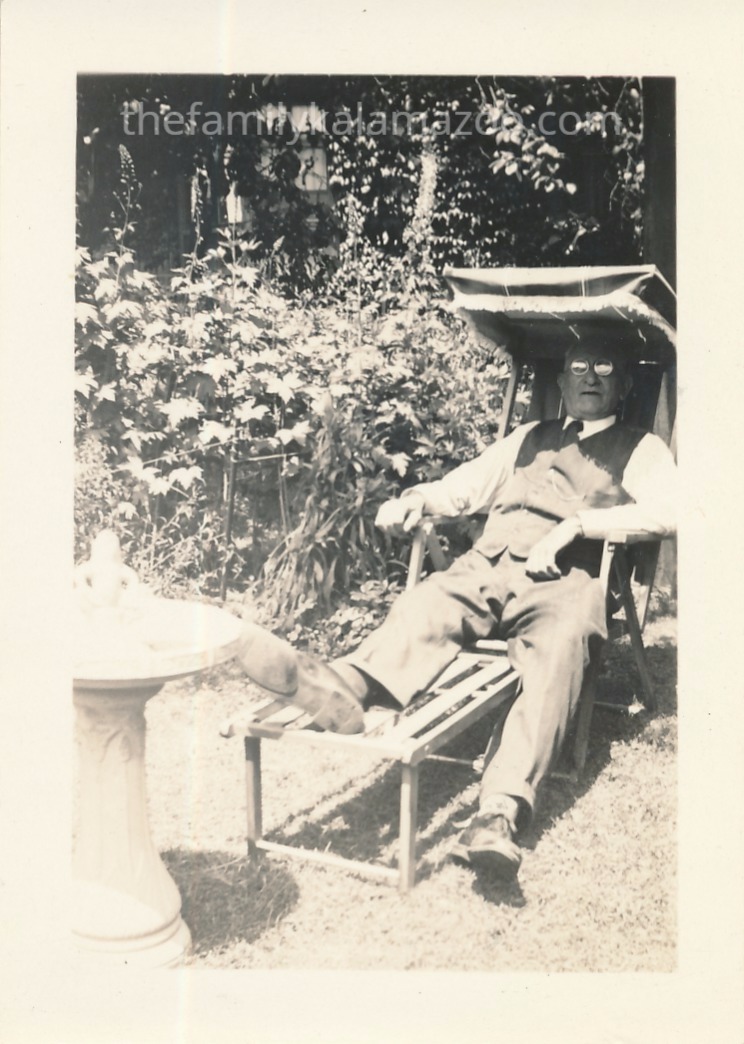
Richard lounging, years after the street was named

Found This Week–What a Treat!

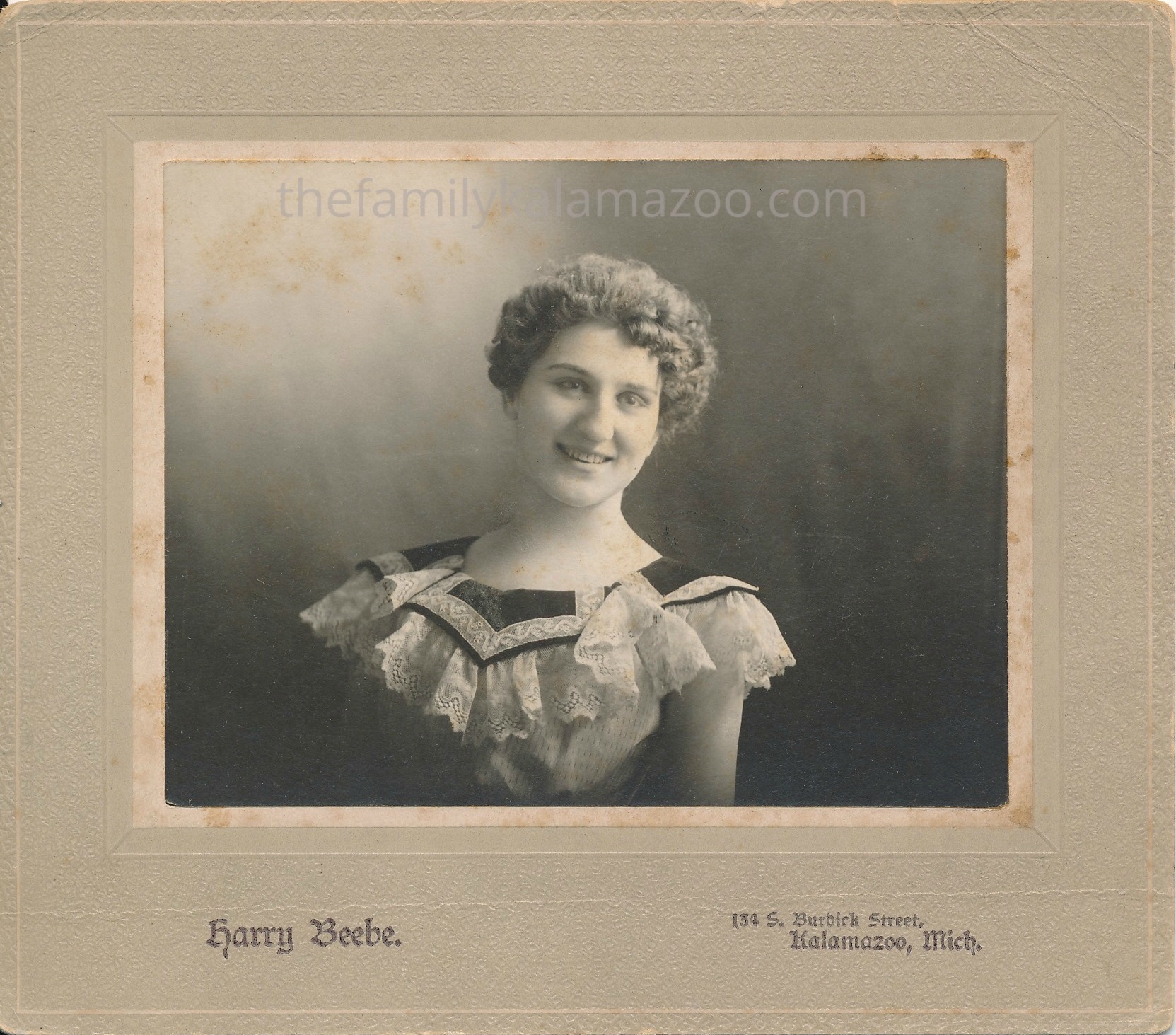
I was looking for a book I can’t find. Instead, I ran across this photo–and it was labelled on the back! “Jane Remine Tazelaar.” So this is Genevieve with a smile on her face. She looks so much prettier smiling so sweetly! It’s easy to see why Frank would want to marry her. This is more proof that the family called her Jane, not Genevieve and not Jennie.

Jane (Genevieve) Remine Tazelaar

Jane Remine Tazelaar

Read Full Post »

« Newer Posts - Older Posts »