Feeds:
Posts
Comments

Posts Tagged ‘DeKorn family’

Thank you so much for responding so enthusiastically to Kin Types. My new chapbook is an offshoot of The Family Kalamazoo, in a way.

The cover of the book is from an old tintype belonging to my family. I have posted it twice before on this blog. The woman featured on it seems to have come from the Remine branch of the family and, based on the tintype and the dress she wears, I thought it was possible that she could be my great-great-great grandmother Johanna Remine DeKorn. This was a guess I had fairly early on, but I had no proof.

But I knew she was someone close to us. For one thing, this is an expensive painted tintype and our family owns it. We wouldn’t have possession of such an image if it wasn’t someone from the family. For another, there is too great a similarity. For instance, my daughter thinks that the woman looks remarkably like my mother in the eyes and mouth. Other people say they can see her in my face.

I thought it unlikely I would learn much more about the photo, but never gave up hope because much amazing information has flowed to me, mainly through this blog.

When I visited my mother recently, she gave me a gorgeous antique photo album from my uncle for me to scan and disseminate. Imagine my surprise when I opened the album and found this tiny tintype inside.

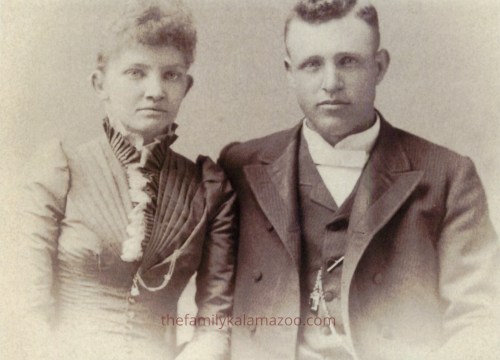
I had so many questions: Were the photos taken at the same time or is the woman younger in the couple’s photo? Same hairdo, same earrings . . . . We don’t really know about the dress and its neck accessory because the lace collar on the painted tintype is, just that, painted on. But she’s definitely younger. Is the new find a wedding photo? Are they siblings?

So I focused on the man. I want to say boy. They both look so young. If the woman is Johanna Remine DeKorn, the man most likely would have to be Boudewyn (Boudewijn) DeKorn. Here is a photo my grandfather identified as Boudewyn, my 3xgreat grandfather.

Boudewijn de Korne

So, what do you think? Are they two different men? The hair is the same–very wavy dark brown hair–, but the hairline has changed. That’s possible. In the upper photo, the man has very defined cheekbones, and I don’t see this in the boy. The man has a very wide mouth. Would that change over time? I doubt it. It was unlikely then that the woman was Johanna, but who was she?

I did what I had to do. I scheduled an appointment with photogenealogist Maureen Taylor. When I only had the painted tintype, I didn’t feel I had enough to go through the process with Maureen. But now that I had a second tintype, I wanted to give it a try.

When Maureen and I began our conversation, I felt a letdown. Johanna Remine was too old to be in this photo. The tintype of the two people had to be between 1869 and 1875, according to Maureen. Johanna was born in 1817 and DIED in 1864. The woman could not be Johanna.

The woman had to be a generation younger than Johanna.

This was disappointing because I felt that I know the other branches or “lines” of the family, and that if she wasn’t Johanna, she couldn’t be a direct ancestor.

And yet, as I told Maureen, I had a strong feeling that she was closely related. And her looks are too reminiscent of the family features to discount her. Maureen agreed with this and pointed me in a different direction.

The Remine family, where I felt the painted tintype came from, began in the U.S. with a marriage between Richard Remine and Mary Paak. Mary Paak is my great-great-grandmother Alice Paak DeKorn’s sister. I am related to the Remines two ways. One is by blood, Johanna Remine being my 3x great grandmother, married to Boudewyn DeKorn (and the mother of Richard DeKorn). The other is by marriage where Richard married Mary. Mary and Carrie Paak, two of the four Paak sisters, had a similar look. Alice and Annie had a different look altogether.

ALICE PAAK DEKORN

Maureen wanted to see a photo of Alice. I sent her the image above–a very clear headshot of Alice from the 1890s (so 20 years older than the woman in the tintype) and Annie (the sister who looked like Alice but is a body shot and not as clear). Maureen examined the photos and proclaimed Alice a match. She asked for the dates on the sisters: birth, immigration, marriage. She was sure the tintype of the beautiful girl on the cover of Kin Types was Alice who happens to be featured in a poem in my book: “An Account of a Poor Oil Stove Bought off Dutch Pete.”

I asked Maureen about the man in the photo and said it did not look like Alice’s husband, Richard DeKorn.

And then I learned something that is counterintuitive, but smart.

Ignore him for now.

She thought it could be her brother or even a beau she had in the Netherlands that she never married. In the tintype of both of them, they are very very young, maybe teenagers. And Alice immigrated to the United States when she was 17 years old. Maureen told me to ignore the man for the purposes of identifying the woman. I will try to identify him later, if it is even possible.

The more I thought about Maureen’s assessment, the more I realized how blind I’d been not to notice the resemblance between the women in the tintype and my 2xgreat grandmother Alice. Alice also happens to be the mother of Cora, the woman my grandparents told me that I look like.

Just for fun, I ran the two images through twinsornot.net. This is the result, although they photos are of a very young woman and a woman twenty years older.

Then I pulled out the other photo that Grandpa had identified Alice. In this alternative photo, Alice is younger than in the 1890s photo, but not nearly as young as the tintype. I had never been sure that this photo even was Alice, although Grandpa had been (and she was his grandmother). So I ran both Grandpa-identified Alice photos against each other on the site. 100% match! Grandpa was right.

Next I ran the tinted tintype against this alternative photo of Alice.

100%!


SO THERE YOU HAVE IT! THE MYSTERY IS SOLVED. THE WOMAN ON THE COVER OF KIN TYPES IS MOST LIKELY ALICE PAAK DEKORN.

I learned a lot of lessons through this process, but one that really stands out in my mind is that people look different in different photographs–and when you are comparing people of different ages, it really gets dicey. I think about photos of me . . .

If you click the Amazon link , the book can be ordered for $14.99. To order through Barnes & Noble, try this link.

If you like what you read, please leave a little review at one or more of the following sites:


Read Full Post »

Although I started this blog five years ago next month, and that sounds like a long time, I’ve been working (on and off–mainly off while raising my kids and teaching) on family history, family photos, and genealogy since I was just out of college and beginning a master’s in history (which I did not complete and ultimately switched to English and creative writing).

I was blessed with many antique and vintage photographs and a grandfather with a great memory and a talent for storytelling.

But it wasn’t until a couple of years ago that I got the idea of putting my research and knowledge of our family history together with my creative writing. Then I began to write lyric poems, prose poems, and a few pieces in a genre that was new to me–flash nonfiction, which is a form of very short prose–based on individuals from my family’s past.

Ultimately, I pulled these pieces together into a chapbook (44 pages) which has been published by Finishing Line Press and is now available, not only on their website, but also on Amazon and Barnes & Noble websites.

Kin Types looks at what the lives of my ancestors were like. The locales are mainly Kalamazoo (and other towns in southwestern Michigan), Elmhurst (Illinois), and the Netherlands. Using the fruits of my research, which included studying newspaper articles, documents, and the details of antique photos, I tried to “inhabit” the lives of some of the people who have come before me.

If you click through the link to the Amazon page, the book can be ordered for $14.99. To order through Barnes & Noble, try this link.

Here is a sample poem from the collection:

Genealogy


Tigers die and leave their skins;

people die and leave their names.  ~Japanese Proverb


The more relatives I unearthed,

the more Franks rose to the surface

like deer bones after a storm.

On the trails I could follow,

I found seven named Frank,

three Franz, three Francis.

Frans, Francois, and Franciscus.

Frances and Francisca,

the women peeking out

from under their fathers’ names.

The name passed forward

like a cross polished by many hands.

The verb frank means to allow free passage

for man or post. But these Franks

and Franciskas paid with their labor

and their babes buried along the way.

If you read this blog, some of the characters of the book might be familiar to you. And because the project is quite unique I think people passionate about family history, genealogy, history, and local history will probably be particularly interested. Some of the pieces have been published in literary magazines. Combined together, they tell a story of the history of “forgotten” women.

So what are you waiting for? 😉 Go to one of the links and place your order!  And thank you very much.


Read Full Post »

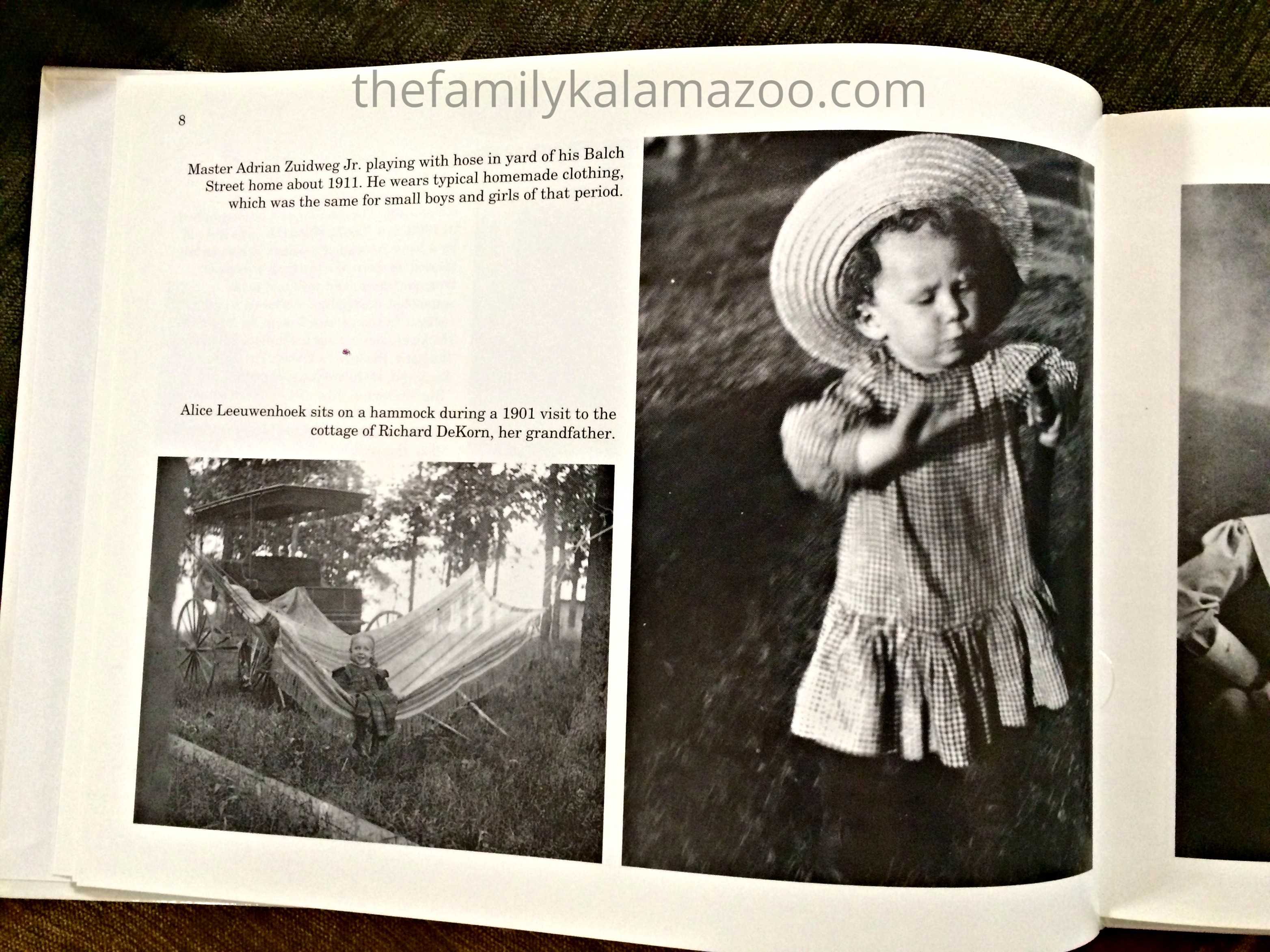
I dug into the bottom of a file drawer and pulled out a book I forgot that I had. It was put together by the Kalamazoo Gazette and featured photographs sent in by individuals of Kalamazoo from the past up to the early 1960s.

My grandfather, Adrian Zuidweg, is listed as one of the contributors, so I went through and tried to find the photos he might have sent in.

Definitely these two photos. The little boy in the check dress and straw hat is grandpa himself. And the little girl on the hammock is his cousin Alice Leeuwenhoek.

Those are the relatives sitting on the front porch. Gosh, I own that photo! I didn’t realize that was Richard Remine (though I can see right now that it is, of course, him)–or his children Therese, Harold, and Jane either. It would fit that the two little girls are Alice (next to her grandma Alice Paak) and Therese. With Harold behind the children. But Jane doesn’t really look old enough in this photo. According to my records, Jane was 14 years older than Therese. Something is off here. That big gap in age between Jane and Therese bothers me, and it always has. And if you recall when I wrote about Frank and Jane Tazelaar, I had been confused for awhile about if there had been 4 Remine children and 2 girls of similar names.  This photo must be somewhere around 1901, based on the assumed aged of the 3 little children. Jane was born in 1881 and is not 20 here!

The known people: back row is Aunt Jen DeKorn Leeuwenhoek, Richard DeKorn, Richard Remine. Front row is Lambertus (Lou) Leeuwenhoek, Alice Paak DeKorn, and then the little girl next to Alice definitely looks like Alice Leeuwenhoek, Jen and Lou’s daughter. It would seem plausible that the three other children belong to Richard Remine, but Jane could not have been that small.

What else? Here is Harold Remine big enough to go fishing at Long Lake. The other photo is not from my family, but it does show off a great collection of hats!

This is the Ladies Library building that Richard DeKorn was the mason contractor for.

But I don’t think that is one of our family photos.

One of these photos could have been taken by Joseph DeKorn and been submitted by Grandpa. It is very similar to the ones that I own.

Take a look at the captions for the downtown views. Does it make sense? It doesn’t make sense to me for some reason.

Most importantly, Grandpa autographed this book!

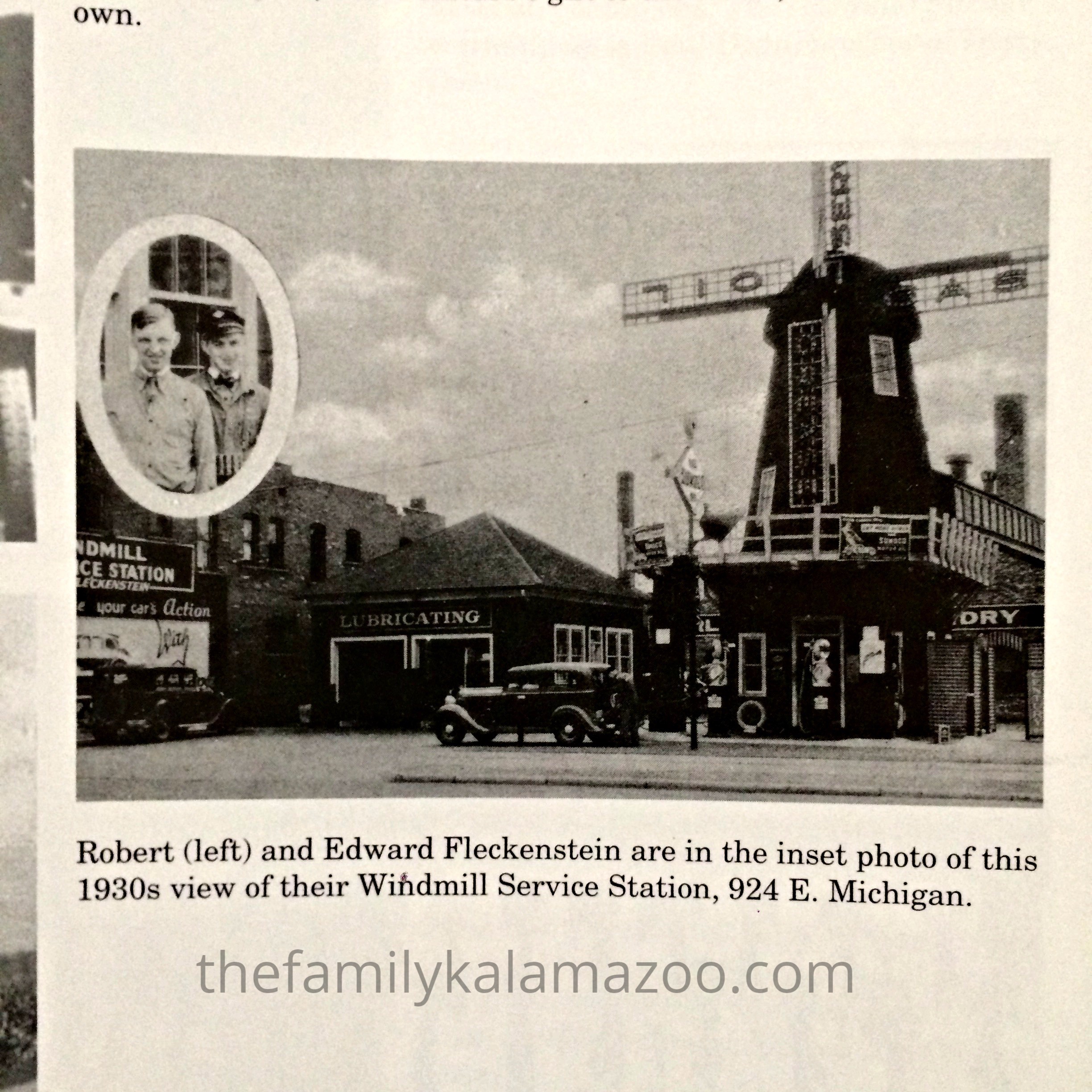
Here is a bonus photo. It isn’t from my family, but isn’t it a cool reminder of the kitschy business architecture popular in those days?

Read Full Post »

The other day I posted Richard DeKorn’s death certificate from Kalamazoo and asked for help with the cause of death. Readers were very helpful, and I’m so appreciative.

I mentioned at the time that Richard’s daughter and Grandpa’s mother, Cora DeKorn Zuidweg (Mrs. Adrian Zuidweg), wasn’t in the register of deaths. Two readers kindly sent me Cora’s death certificate that they found on the Seeking Michigan website.

Cora is a particularly intriguing person to me because Grandpa and Grandma used to tell me that I looked a lot like her, especially with my hair pulled back. Cora always wore her hair up. The first time I saw this picture of Cora I was in my 20s and felt as if I was looking into a mirror.

Also, Grandpa’s stories about her included stories of her love for animals and her courage to defend them. I feel a real affinity in the area of love of animals and wish I had her courage.

Here are Cora and Adrian (senior) with Grandpa, Adrian (junior)

What I knew about Cora’s death was that she had cancer that had spread throughout her body and her brain became confused from the disease. I also knew that she was dying when my grandparents got married. That explains why they got married out of town and on their own. My grandmother moved into the house with Grandpa and his mother and took care of her until she died a few months later.

Now take a look at the cause of death on the certificate:

Exhaustion – debility from gen – metastatic sarcoma spindle cell – primary in left thigh, followed injury was removed 9-16-29 – had existed there 5 years.

I believe that it is what it says.

So cancer that started in her left thigh. Cancer that, according to Google, would be treated with chemo today. If caught in time, the results would probably be positive. Spindle cell sarcoma apparently is a connective tissue cancer.

I thought that was a little bit of a coincidence because it seems that Cora had the cancer since she was about 52 and when I was 50 I had a tumor in my foot. While my tumor turned out not to be cancer, it was a giant cell reparative granuloma, which means that it has some characteristics of cancer (possibility of metastasizing and also destruction and replacement of healthy tissue). My tumor is the type that also reacts to injury or pressure, as Cora’s did.

After checking out more on Google, I also learned that Giant Cell tumors can turn into cancer if left untreated–and sometimes into spindle cell. Notice that Cora’s original tumor wasn’t removed until 1929, about two years into her diagnosis.

All very curious. I know that I am lucky that I got 21st century medical care for my foot.

Cora passed away at age 57, never meeting her three grandchildren. My mother would be born less than two years after Cora’s death.


Read Full Post »

The haphazard method of genealogy research that I practice is fun because I follow threads that interest me at the moment, and since I am always juggling a lot at once because I’m a little hyper, it probably works best for me.

Nevertheless, this style has its limitations. I didn’t realize the extent, though, until I went to look up “causes of death” on death certificates for my grandfather’s family. Well, darn. They all lived and died in Kalamazoo–and apparently it is not easy to find death certificates in Kalamazoo. At least not from afar.

Out of 6 people–Grandpa’s parents and both sets of grandparents–I only have one death certificate, that of Richard DeKorn. When I pushed myself, I did find 4 of the other 5 on the death registers online. Then I emailed the County Clerk volunteers to see if someone can find the information for me. Keeping my fingers crossed on this one!

Grandpa’s mother, Cora DeKorn Zuidweg, isn’t even in the register. She passed away near the end of 1932, but I couldn’t find her the last few months of 1932 or even the beginning of 1933. I hope that volunteers can give me some insight into this issue.

Here is Richard DeKorn’s death certificate:

Here are some things I noticed of interest from the 1930 document:

Richard lived at 1440 Maple Street (not too far from Oakland Drive), not at the corner of Burdick and Balch. Does this mean that he had already moved with his second wife, Jennie, from the old neighborhood?

He died at New Borgess Hospital. So Borgess must have had that name at that time.

He had been retired for fifteen years from his occupation as a mason contractor. Since he was 78 when he passed away, he retired at age 63.

What does his cause of death state?

Secondary pneumonia 2 days.

Mucopurulent bronchitis 10 days.

Prostatic hypertrophy [interstial???] cystitis 3 months.

Is that last the same thing as prostatitis?

Does this mean that he had a UTI that eventually led to pneumonia?

If penicillin was first used as an antibiotic in 1928, what was the state of antibiotic usage in 1930? Were they being used yet? Did Richard die because he didn’t have an antibiotic for cystitis?

UPDATE:

Since I posted this earlier this morning, I’ve had some interesting info shared. Amy Cohen of Brotman Blog asked her medical expert about Richard’s cause of death. Here is what he said:

I would say with confidence that the ultimate cause of death was pneumonia–formerly known as the old man’s friend because it caused death quickly and with relatively little discomfort. It sounds as though he initially became ill with either a viral infection or had COPD (Chronic Bronchitis), which progressed to a pneumonia. Cystitis is any inflammation of the bladder, and it does not need to be infectious in nature. A man with an enlarged prostrate could have cystitis from inadequate bladder emptying and bladder distension. If a UTI was the primary factor, then the ultimate cause of death would have most likely been sepsis, not pneumonia.

As for antibiotic treatment at his time of death, none really existed. Sulfa-based antibiotics and penicillin may have been discovered in the late 20’s – early 30’s, but they would not be commercially available for another decade. Sulfa was being used in the 30’s, but Penicillin use didn’t really start until WW2 and probably was not widely prescribed until late 40’s – early 50’s.  People not dying from bacterial infections is just another thing Baby Boomers take for granted.

I sure do! I was born in 1955, and I remember getting a lot of penicillin as a kid because I was sick a lot. It never occurred to me that my parents wouldn’t have had that same advantage.

Also, TAO (who writes a fabulous blog about adoption) shared some specific information about penicillin. According to her, it wasn’t prescribed until 1945, which is corroborated by Amy’s medical expert.

Read Full Post »

I have written about the Flipse family in Kalamazoo and my connection to them. My great-great-grandfather Richard DeKorn’s niece Frances DeSmit married Jacob Flipse. Now it looks to me as if there are least two connections between the Flipse family and the Kallewaard family, so when I use the name Kallewaard in the future know that I mean Kallewaard/Flipse.

Jan Denkers from the Netherlands contacted me with some information about the Kallewaard/Flipse family that lived in the Burdick and Balch neighborhood in Kalamazoo near my family. His father had carefully kept information about the family.

I will be writing another post or two about the family before too long.

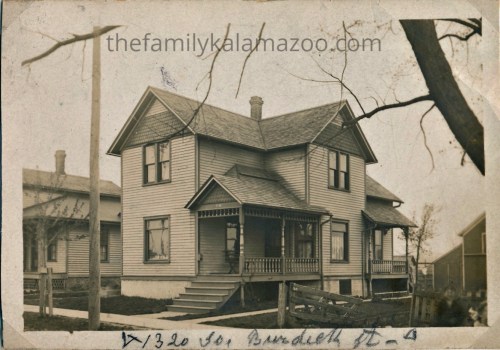
In the documents that Jan shared with me was the above photograph. This house was probably the 3rd house north from my great-great-grandfather’s house on the corner of Burdick and Balch. Inside it lived the Kallewaard family: Cornelius, Mary (Flipse), and their children.

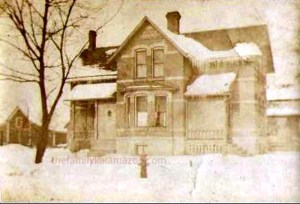
The next photo is my great-great-grandfather’s house at the corner. You can see the variety in styles of homes, although each is special in its own right.


Wouldn’t it be wonderful if I could find a photo of each house in the neighborhood and put them together to see the neighborhood in its heyday?

Although the DeKorn house is still standing, the Kallewaard house is not, unfortunately. Thank you, Google Maps.


Read Full Post »

Over a year ago, I wrote a series of posts about Theresa (Tracy) Paak, the daughter of my great-great-grandmother’s only brother. Theresa was the mother of Professor Lawrence, who has been kind enough to send me photographs and information about his branch of the family. If you’ve been following along here for some time, you might remember my posts about Theresa Pake, the middle child (of five) of my great-great-grandmother’s brother, George.

You might remember that after the disastrous fire that destroyed the family home, Theresa went to live with Oliver and Una Pickard. Mrs. Pickard was Theresa’s Sunday School teacher. I wrote about the Pickards in George Paak’s Legacy, Part VI: Who Were the Pickards? What I discovered in my research was that the Pickards were married young, remained childless, and began their careers as nurses, both living and working at the State Hospital (psychiatric hospital).  Eventually Una became a private duty nurse and Oliver a postman.

I really tried to imagine this couple and what they were like because they proved to be so important to Theresa’s life. The other day I got my wish to see what they looked like when Professor Lawrence sent me photographs.

Una was 18 and Oliver 23 when they married. Could this be their wedding portrait?

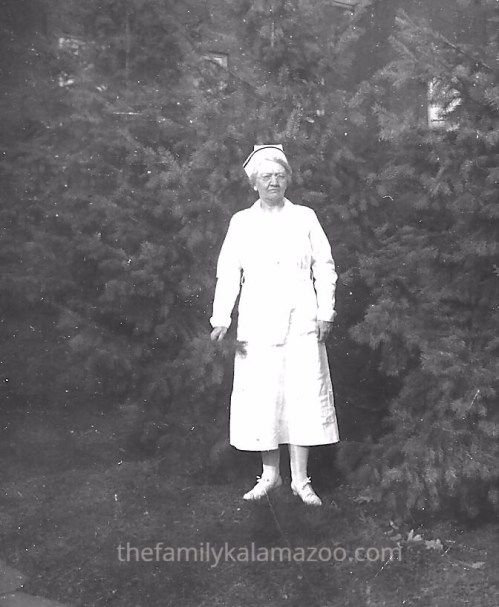
Here is Auntie Pick, as she was called, in uniform.

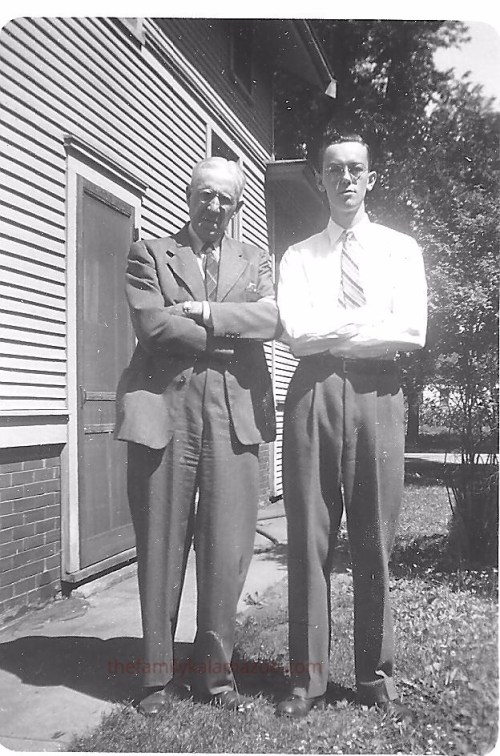
And Oliver, or “Uncle Bob,”  in the classic “man walking down the sidewalk pose” (yes, we’ve seen it a couple of times already with other people in other photos).

Here is a photograph of Theresa herself taking a photograph of her foster parents.


Here is “Uncle Bob” with Theresa’s son Richard, or Dick, in Wisconsin. This is Professor Lawrence’s brother.

There was some confusion in the censuses over the address of the Pickards, but I think they lived in the same house for years at 1846 Oakland Drive.

And many years later. The house is no longer there.

As a bonus, here are photographs of Una’s parents and of Una as a baby.

She looks the same as a baby as at eighteen!

Here are the other Pake/Paake/Paak/Peek posts:

A Series of Disasters

The Children After the Fire, 1902

Paak-a-boo

Saved from the Fire

Who is George Paake, Sr.?

Curious about George

George Paake’s Legacy, Part I

George Paake’s Legacy, Part II: Theresa’s Pre-Professional Education

George Paake’s Legacy, Part III: Theresa’s Professional Education

George Paake’s Legacy, Part IV: A Letter to His Daughter

George Paake’s Legacy, Part V: Theresa Gets Married


Read Full Post »

If you recall my posts about Jennie Culver, and her daughters Rhea and Lela, moving to Seattle, you will see that this photo fits neatly into the move. Try this post if you need a reminder or are new to the story:

Bingo: When Aunt Jennie Left for Seattle

On the back, one of the girls has written “my present domicile” and on the front, the date is 1918, the year other photos showed them at the train station, ready for the move.

I glanced at some of the other unidentified Culver photos to see if this apartment building (I assume it is apartments) shows up. Only one other photo with square brick columns shows up, but it can’t be of the same building. See here:

Notice what confuses me here. The square brick column, the white round column–the same as the first photo, right? But the white siding in the second photo is not in the first photo, right again?

I will say the age seems right for Seattle in this photo. The more I look at the Culver photos, the more Kalamazoo photos I suspect might be in the collection.

So who wrote “my present domicile” on this photograph? It wasn’t Jennie because the scrapbook and its photos clearly belonged to one of the daughters.  My confusion began with information I noticed that I wrote about in this post:Who Went Where When?. According to the newspaper, Rhea, the stenographer, moved to Seattle mid-August 1918. Jennie and Lela were not mentioned. But at some point Jennie and Lela did move to Seattle and lived there the rest of their lives. Somewhere around 1918. And Rhea did, too, except that in 1920 she was “spotted” living in Kalamazoo (see my post).

Can I assume that Rhea did go to Seattle August 20 as the newspaper and photograph verify? And that “my present domicile” was where Rhea lived? If so, can I conclude that the scrapbook belonged to Rhea. And that this photo I posted earlier was, in fact, Rhea in the plaid?

Is the handwriting on the above photo, the same as on the back of the first photograph I posted here?

Barely any letters to compare. They each have a final “le”–in Seattle and domicile. While nobody’s handwriting is completely consistent, are these in the bounds of what could be written by the same person? I will say there is a similarity to MY handwriting, weirdly. Both Miss Culver and I produce the triangular Ts of Emily Dickinson.

As usual, I manage to produce more questions than answers. This is becoming a disturbing trend!

Read Full Post »

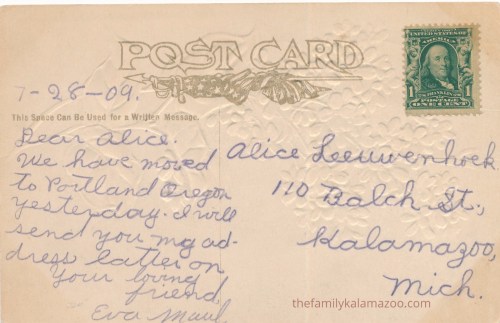
Finding neighbors and friends of my ancestors is always fun. Alice Leeuwenhoek received two postcards from girls who posted them from Portland, Oregon. Luckily, one girl, Eva Maul, signed her entire name so it was easy to look them up.


As Eva’s July 28, 1909, postcard states, the Maul family moved from Kalamazoo to Portland, Oregon.


On the 1910 census they are living in Portland:

Peter and Jennie Maul, with their children: Henry, Gertrude, Maurice, Eva, Jeannette, Garrett, and John. Eva was fourteen, so when she wrote the postcard, she was about thirteen. Gertrude was 17. She wrote the other postcard in 1912, when she was 19.

Notice she complains Alice hasn’t been writing, which makes me wonder how many friends the Maul girls made in their new home.

“Lovingly” seems to indicate that Gertrude and Alice had been very good friends. Alice was born in 1897, so in 1912 she would have been 15, so she was actually closer in age to Eva–even a bit younger.

I started to wonder if these girls had been neighbors of Alice and could be found in my old photographs.  So I did another search. Well well well. In the 1906 Kalamazoo City Directory Peter Maul was a butcher who lived at 112 Balch Street, right next door to Alice’s family! Uncle Lou was a grocer who lived at 110 Balch Street with his family. Alice’s mother’s name was Jennie–and so was the mother of Eva and Gertrude. I guess they all had a lot in common.

But why would Eva have to send Alice a postcard saying that they had moved when they lived next door? How odd.

Although I couldn’t spend too much time on this, a naturalization document popped up from decades later for father Peter Maul in Portland. His history is convoluted. He listed his race as Dutch, but his nationality as British. He emigrated from Calgary, Canada, but was born in Zeeland, Michigan, in 1866. WHAT? It makes no sense. By 1933 he was married to a woman named Blanche who hailed from the western part of the country. Before you think it’s a different Peter, the document lists all his children as well as an additional child.

This would be a fascinating thread to follow, but alas, there is so much to be done in my own branches, I have to stop here for now. For those of you who follow this blog and have been in contact over family branches–and posts you have not seen–I plan to spend a little more time in 2017 on genealogy and share some of the information I’ve been blessed with from all of you!

Read Full Post »

I’ll be taking a blogging break for the holidays, so I’ll leave you with this gift (that I first posted three years ago)  from Alice Paak (Richard) DeKorn to one of her children, possibly her daughter Cora, my great-grandmother. What a family and genealogy treasure–now 109 years old.

1907

Merry Xmas

from

MOTHER

In case you’re wondering about the use of the word “Xmas” instead of “Christmas,” this is what Wikipedia has to say:

There is a common belief that the word Xmas stems from a secular attempt to remove the religious tradition from Christmas by taking the “Christ” out of “Christmas”, but its use dates back to the 16th century.

I’m sure that this was just a way to fit it all on the tiny shell. What a lot of work to paint and letter this shell. I wonder if she made three, one for each of her children.

Happy holidays to you and yours! See you in the new year!

Read Full Post »

« Newer Posts - Older Posts »