Feeds:
Posts
Comments

Archive for the ‘Photography early 20th century’ Category

I have written about the Flipse family in Kalamazoo and my connection to them. My great-great-grandfather Richard DeKorn’s niece Frances DeSmit married Jacob Flipse. Now it looks to me as if there are least two connections between the Flipse family and the Kallewaard family, so when I use the name Kallewaard in the future know that I mean Kallewaard/Flipse.

Jan Denkers from the Netherlands contacted me with some information about the Kallewaard/Flipse family that lived in the Burdick and Balch neighborhood in Kalamazoo near my family. His father had carefully kept information about the family.

I will be writing another post or two about the family before too long.

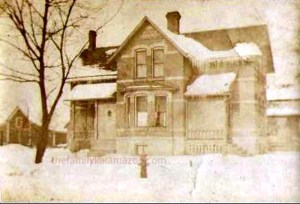
In the documents that Jan shared with me was the above photograph. This house was probably the 3rd house north from my great-great-grandfather’s house on the corner of Burdick and Balch. Inside it lived the Kallewaard family: Cornelius, Mary (Flipse), and their children.

The next photo is my great-great-grandfather’s house at the corner. You can see the variety in styles of homes, although each is special in its own right.


Wouldn’t it be wonderful if I could find a photo of each house in the neighborhood and put them together to see the neighborhood in its heyday?

Although the DeKorn house is still standing, the Kallewaard house is not, unfortunately. Thank you, Google Maps.


Read Full Post »

Sometimes when I am researching family lines from the Netherlands, I wonder: what happened to the descendants of my ancestor’s siblings during the World Wars? I have particularly wondered that about WWII, maybe because my parents were alive during that war and because I know more about it than WWI.

I never expected to discover any information.

Until I was contacted by Peter Mulder from the Netherlands! He has the same name as my mother’s Uncle Pete who I knew as a smiling man and a farmer. He also has the same name as my great-great-grandfather who immigrated to the U.S. I wrote about that Pieter Mulder finding himself an orphan after the death of his father and about his move across the ocean.

This Peter Mulder has graciously supplied me with a story of what happened to my great-great-grandfather’s half-brother, Jan Mulder.

After the death of my Pieter’s mother, Karel Mulder (my 3rd great-grandfather) married Klazina Otte, and had two sons with her: Cornelis and Jan. Actually, there were many children, but sadly the rest died as infants. Karel passed away on 22 April 1881 and his children by my 3rd great-grandmother Johanna were dispersed into jobs and the orphanage.

Klazina was left to care for her two sons. Eventually, in 1904, she moved with her sons to Apeldoorn. She would have been about 63, and she died on 8 November 1922 in Apeldoorn.

Cornelis, who was born 1 September 1872, was a tailor. He married Hendrika Jonker (born 07 May 1876), and they moved their family to Utrecht on 30 July 1928.

Jan, who happens to be the grandfather of Peter Mulder, was born on 20 December 1876.  By profession, he was a hairdresser.

Jan married Petertje van Baak. Interestingly, the witnesses at the wedding were Cornelis Mulder, his brother, and Izaak Mulder, his half-brother (Pieter’s older brother). I believe this shows that the children of Karel Mulder had remained close although the family was torn apart (as far as living arrangements) by his death.


Jan and Petertje wedding photo

6 October 1904

Jan and Petertje had three children:

Klazina Petronella Mulder, born 06 February 1905 and died 28 April 1994

Teunis Jan Mulder, born 20 May 1907

Izaak Mulder, born 23 January 1913 and died 14 December 1980

Izaak is Peter’s father.

Teunis, Nellie, Izaak

On November 1, 1929, Jan immigrated to Soerabaja/Soerabaia, now called Surabaya, which is the capital of Jawa Timur (East Java). Indonesia was part of the Dutch East Indies. Jan left his wife and three children behind. In 1936, the couple divorced, but he kept in contact with his children.

Jan enjoyed his life in Soerabaja. He had his own hairdresser business and played music in an orchestra. He played bass, violin, and flute.

In winter/spring of 1942, the Japanese invaded and took over Java. At that time, it was necessary for all Dutch people to register with the Japanese. After that, Jan was held  in the Ambarawa internment camp for several years. The living conditions were poor and deteriorated as time went on. Peter believes that almost 13,000 people died there during that period–including Jan Mulder, Peter’s grandfather, and the half-brother of my great-great-grandfather. He was 65 years old. I can’t imagine the difficulties he must have endured in his last years.


Read Full Post »

When I was a kid growing up in Kalamazoo, it was known as “The Paper City.” Our fifth grade teacher–a very eccentric personality–told us about the way paper was made and emphasized that the reason we were not to eat paper (a common habit in elementary school) was that the workers in the paper mills would chew tobacco and spit it at random into the vats of liquid paper. That was why we would occasionally see a little burst of tan, like a star or partial star, on a sheet of white paper.

Kalamazoo was home to several paper mills and companies. Here is a little info I found online:

Taking advantage of the area’s bountiful water resources, in 1867 the Kalamazoo Paper Company opened its first mill. According to historian Larry Massie, the company provided a training ground for paper makers and “was one reason for the amazing proliferation of paper mills throughout the Kalamazoo Valley.” The area’s proximity to Chicago, its excellent railroad network and its large labor force further aided the industry’s development. By the early twentieth century, Kalamazoo County was the state’s dominant paper producer. According to 1904 state census figures, its five paper and wood pulp mills (one-sixth of the state’s total) represented 25 percent of the industry’s capital value. By World War I, Kalamazoo was the center of the largest paper-producing area in the United States. The industry employed one-half of the city’s labor force.

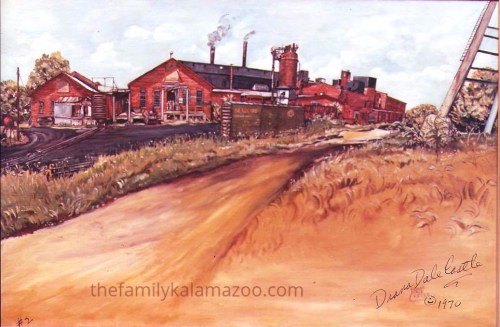
My mother-in-law, Diana Dale Castle, painted one of the mills in 1970. This is the Monarch Paper Mill, owned by Allied Paper Company.


The Kalamazoo Library has a terrible image of the Monarch mill from 1910 here. And this one slightly better.

Here is a photo of the machine room and of the male workers in 1915. There is also a photo of one John Bushouse at the mill in 1915. All this is left now of the Monarch Mill is the pond. In a Facebook group for old Kalamazoo, people talked about swimming at the mill pond. I can’t imagine this because I remember driving past the pond and thinking ICK and SCARY.

A quick search on Ancestry for John Bushouse reveals that it is a somewhat common name in Kalamazoo and that the owners of the name are immigrants from the Netherlands or their children. I could not find the John Bushouse that worked at the mill in 1915.

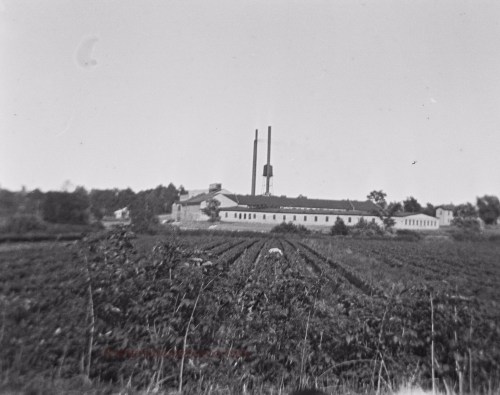
I found an unidentified photograph made from one of Joseph DeKorn’s glass negatives that seems to be from the heyday of paper manufacturing in Kalamazoo. Since it was one of the DeKorn negatives that means that the photograph was probably taken between 1903 and 1918. I suspect that it is an image of a paper mill. If you agree that it is probably a paper mill, do you think it is the Monarch mill or a different one? Before you answer that, you should check the photo in the second library link so that you have enough information.

According to one source, at one time, paper mills were the 5th largest employer in Kalamazoo. According to the source I quoted above, HALF the labor population worked in the paper industry! But that business dried up in the 80s. Obviously, paper is still being made, so why not in Kalamazoo?

Read Full Post »

If you recall my posts about Jennie Culver, and her daughters Rhea and Lela, moving to Seattle, you will see that this photo fits neatly into the move. Try this post if you need a reminder or are new to the story:

Bingo: When Aunt Jennie Left for Seattle

On the back, one of the girls has written “my present domicile” and on the front, the date is 1918, the year other photos showed them at the train station, ready for the move.

I glanced at some of the other unidentified Culver photos to see if this apartment building (I assume it is apartments) shows up. Only one other photo with square brick columns shows up, but it can’t be of the same building. See here:

Notice what confuses me here. The square brick column, the white round column–the same as the first photo, right? But the white siding in the second photo is not in the first photo, right again?

I will say the age seems right for Seattle in this photo. The more I look at the Culver photos, the more Kalamazoo photos I suspect might be in the collection.

So who wrote “my present domicile” on this photograph? It wasn’t Jennie because the scrapbook and its photos clearly belonged to one of the daughters.  My confusion began with information I noticed that I wrote about in this post:Who Went Where When?. According to the newspaper, Rhea, the stenographer, moved to Seattle mid-August 1918. Jennie and Lela were not mentioned. But at some point Jennie and Lela did move to Seattle and lived there the rest of their lives. Somewhere around 1918. And Rhea did, too, except that in 1920 she was “spotted” living in Kalamazoo (see my post).

Can I assume that Rhea did go to Seattle August 20 as the newspaper and photograph verify? And that “my present domicile” was where Rhea lived? If so, can I conclude that the scrapbook belonged to Rhea. And that this photo I posted earlier was, in fact, Rhea in the plaid?

Is the handwriting on the above photo, the same as on the back of the first photograph I posted here?

Barely any letters to compare. They each have a final “le”–in Seattle and domicile. While nobody’s handwriting is completely consistent, are these in the bounds of what could be written by the same person? I will say there is a similarity to MY handwriting, weirdly. Both Miss Culver and I produce the triangular Ts of Emily Dickinson.

As usual, I manage to produce more questions than answers. This is becoming a disturbing trend!

Read Full Post »

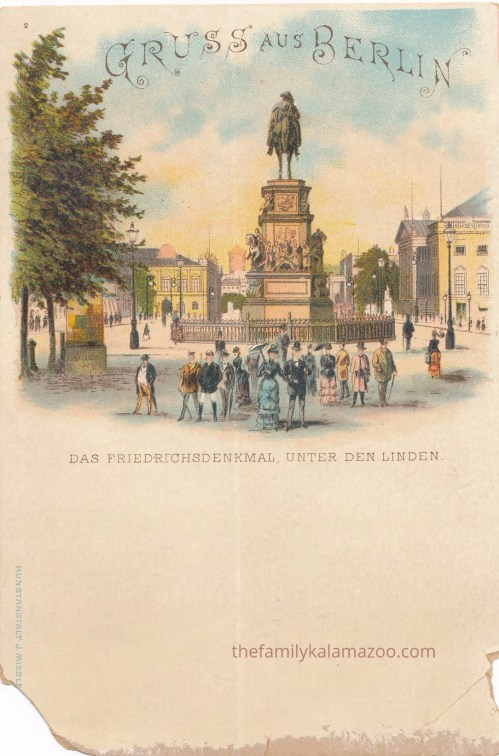
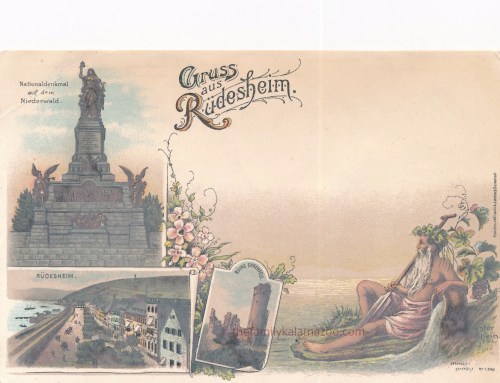
My grandparents had these over 100 year old postcards. Someone must have travelled to Germany, but these were never posted (mailed). Each one is a greeting from a particular German city.

image image

Read Full Post »

I remember my grandfather wearing his Sunoco “uniform” and his Sunday sportcoat, but I never thought of him as at the height of fashion. At least not in his attire.

But take a look at him as a 22 year old in 1930!

At first I saw his sport coat, sweater, shirt, fancy belt, and plaid pants as a spiffy outfit, but didn’t stop to think: why is he wearing bloomers? haha

Well, he’s wearing knickers (no, I don’t mean those kind of knickers), which are short for knickerbockers. Copied from this website:

Knickerbockers, later shortened to knickers, were popular sports wear for wealthy gentleman. Knickers were baggy pants that fit low on the natural waist and tight below the knee, ballooning out around the thighs. For upper class gentlemen wearing white or light striped knickers in summer with a matching Norfolk jacket was the look of the teens and early 1920’s.

Grandpa is not wearing a Norfolk jacket, but one that does look a little preppy over that sweater and shirt collar.


Plaid Plus Fours

Variations of knickers included plus-fours, plus- sixes, plus-eights and plus-tens. The plus is how many inches below the knee they hung. Plus fours came in tweeds, linen, corduroy, and flannel. Many were solid colors but to be really trendy men wore stripes, checks, and plaid patterns.  They were already on trend when the prince of wales went on tour in American wearing plus fours. His approval meant any man NOT wearing plus fours was out of  fashion.

Notice that “to be really trendy men wore stripes, checks, and plaid patterns.” That’s Grandpa–“really trendy”!

Knickers were worn for more than just sports and casual entertainment. They were common among both fashion forward industries such as the movies, but also among working classes who found the sturdier material knickers quite useful on the farm, for making deliveries, and for some factory work. The short legs and light weight clothes made them cool to wear in summer.

Not sure what beach this photo was taken at, but his outfit is sporty for the time period, as befitting a walk on the beach. By today’s standards, he’s a little over-dressed!


Read Full Post »

Some of you might remember the beautiful scrapbook of photographs that I was given by a very kind stranger. It belonged to one of the two adult daughters –Rhea or Lela–of my great-great-grandfather’s sister Jennie DeKorn Culver.

At least one of the three Culvers moved from Kalamazoo to Seattle on August 20, 1918. If only one Culver moved at that time, it wasn’t long before all three were living in the state of Washington. I have not been able to figure out exactly how the move occurred–or why–but it doesn’t stop me from being fascinated with the photos.


Although the majority of the photographs in the album are from 1917 and 1918, this one is marked 9-4-1915. It says it is on Riverside Drive. But what are those initials after the street?

In 1910 Jennie lived with her two daughters at 59 Kalamazoo Avenue in Kalamazoo. She was a seamstress in a corset factory. Rhea was 19 years old and a stenographer in a “paper stock company.” Lela, 21, was a teacher in a public school. I would really love to find out if Lela went to Western Normal School to become a teacher.

So is this Riverside Drive in Kalamazoo or elsewhere? According to Mapquest and Google, there is a Kalamazoo Avenue in Kalamazoo, but not Drive. Both Kalamazoo Avenue and Riverside Avenue are on the east side of Kalamazoo. There’s a famous Riverside Drive in NYC. I’m going to make a guess that those initials say N. Y.–New York City. Do you agree?

And is this one of the sisters? Unfortunately, I would say NO as both sisters had narrow faces. My guess is that this is a friend of the scrapbook owner.

On a slightly related subject, I just wanted to say:

CONGRATULATIONS to the WMU Broncos!!!

They are undefeated this season!!!! This is my alma mater. This is the alma mater of so many of my relatives. YAY!!!!!!!!!!!!!!

If you want to get hyped up, watch the video and ROW THE BOAT!


Related articles

Read Full Post »

In the beautiful scrapbook that belonged to one of the Culver sisters, I discovered a postcard of Western State Normal School (Western Michigan University now) in Kalamazoo. I’ve never seen this view of the campus before. More of my relatives (and moi) have attended Western than any other school. I need to start a list of all the ancestors and relatives who are Western alumni.

I’m not sure of the year the postcard was published because the  back of the postcard indicates it cost 1 cent. Postcards cost that amount over a very large period of time. All it means is that it was not printed during WWI when the price went up to 2 cents. After the war, they went back down to 1 cent.

Because my business school classes were on what eventually became known as “East Campus” (the original site of the school), I remember the long walk up the hill, but it sure didn’t look like this. Neither did the buildings.

I searched online and found a postcard from 1910. If you click through the postcard you will go to site where I found it. It belongs to WMU.

Why do the red brick buildings look white in my postcard? Notice the tennis courts seen from this view. Now I can see that Oakland Drive is not down there. So maybe this is on the other side of Oakland? Apparently not. (Confusing!)

Here is a 1925 map of the campus, and on here it is easy to see where Oakland Drive is. If you want verification click through and go to the WMU website. When you put your mouse over the street it will show up as Oakland Drive.

aerial1925

Why is the same bus or trolley at the bottom of the drive in both photos?

Well, what do you know? That little trolley has its own Wikipedia page!

From Wikipedia:

The Western State Normal Railroad, also known as the Normal Railroad or Western Trolley, was a funicular [a cliff railway] which operated on the campus of Western Michigan University in Kalamazoo, Michigan, in the United States from 1908–1949. It is the only known example of a private railroad operated by a university.

In the early 1900s the primary campus of Western Michigan University, then known as Western State Normal School, was located on Prospect Hill (this area is now known as East Campus). To reach the buildings students and faculty faced a forbidding 150 step-climb, often in inclement weather. In an effort to address this problem, the school constructed a funicular along the northeast corner of the hill. The base of the line was at Davis Street, while the summit lay between East Hall and North Hall. There were two tracks, each with a cable-hauled car.

At its peak the railroad carried 2,280 passengers daily, but rising maintenance costs combined with the growing popularity of the automobile hastened its demise, and it carried its last passenger in 1949.In 2002 four senior engineering majors at WMU embarked on a project to build a replica of one of the trolleys. This proved no easy task: following the closure of the railroad in 1949, no effort was made to preserve the cars. The only physical remnant was a bench saved by a faculty member; while there were sketches and photographs for reference, no actual blueprints had survived. Commenting on the situation a WMU official remarked that “back then was a period in history so intent on the future, that everyone started forgetting about the past.”

Despite these challenges, the students successfully completed their project, which was unveiled April 8, 2003, and currently occupies a prominent place in front of the Bernhard Center on Western’s primary campus. Local residents and Western alumni who had ridden the trolley testified to the authenticity of the restoration.

Because I often get sidetracked in too many directions and because my time has been so limited, I need to make a list of all the projects to tackle in the future. Figuring out “who all” has gone to Western needs to top the list!

###

Originally I thought all the Culver photos were from after they moved to Seattle from Kalamazoo. Then it was discovered that some of the photos were from Kalamazoo. This postcard was in a stack with travel postcards and photos within the scrapbook.

Read Full Post »

I originally started this blog because of the wealth of photographs and glass negatives I had in my possession that once belonged to my grandfather’s uncle, Joseph Peter DeKorn. This post is a revision and update of the 2nd post on this blog.Joseph Peter DeKorn

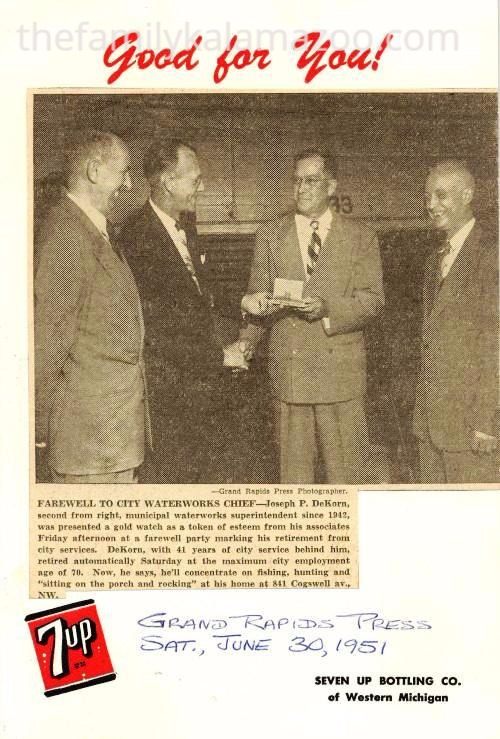
“Uncle Joe” was born to Richard DeKorn, local building contractor and brick mason, and Alice Paak DeKorn June 30, 1981, in Kalamazoo, Michigan. When he lived in Kalamazoo, he was an enthusiastic photographer, capturing scenes and people in Kalamazoo in the very early 1900s. Most of the photographs by Joseph which I have were taken between 1903 and 1918.  His draft registration for WWI is dated September 12, 1918.  He graduated from Kalamazoo College and the University of Michigan Engineering School in 1909.  Joe was a hydraulic engineer and worked for the City of Grand Rapids for over 30 years.  He retired as Superintendent of the Grand Rapids Water and Light Company.

gr-press-sat-6-30-51-joe-dekorn-retiring-city-waterworks-chief-001-1

Here is a commendation letter from the City Manager upon his retirement.

joe-dekorn-commendation-city-mgr-retirement-001-2

Personal life

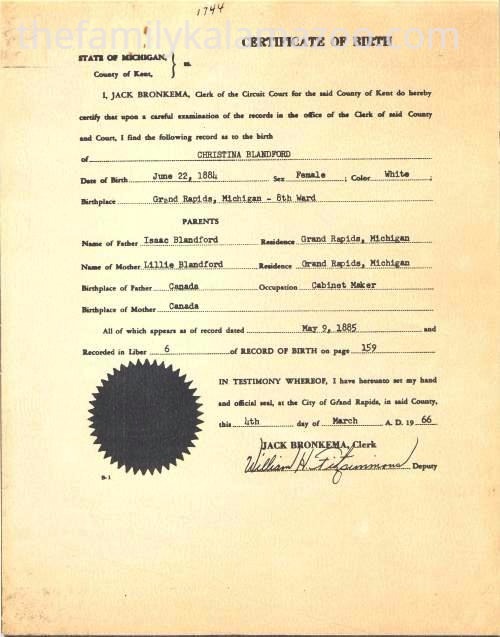
Joe married Christina Blandford on December 9, 1919 in Kalamazoo.  He was 38 and Christina was 35.  She was born June 22, 1884 in Grand Rapids, Michigan.  Christina’s parents were Isaac Blandford and Lily Kemp, both born in Ontario, Canada.   She graduated from Western Michigan Normal College (now Western Michigan University in Kalamazoo).  She was a school teacher and taught at Walker Township School, District #1 (later known as Fairview School) and Godfrey School in Grand Rapids.

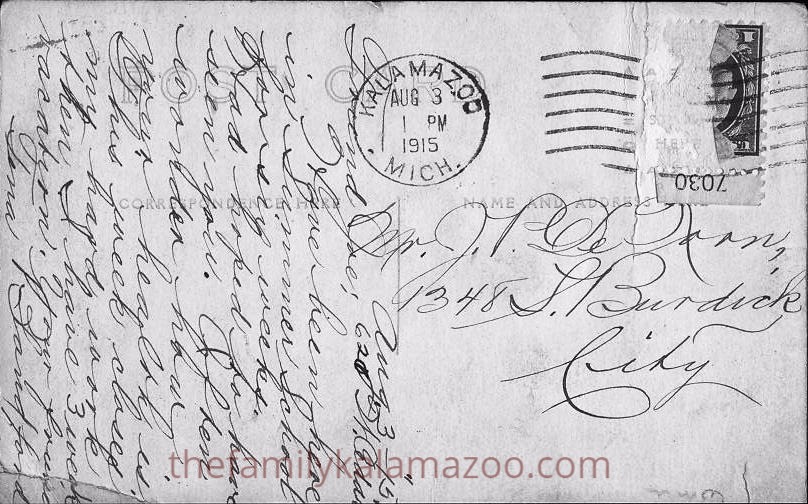
Aunt Tena, when Uncle Joe was still “Friend Joe” to her, wrote him this postcard in 1915:

Tena sent this postcard to Joe on August 3, 1915

Tena sent this postcard to Joe on August 3, 1915

Aunt Tena wrote from summer school in Lansing in her beautiful handwriting

Aunt Tena wrote from summer school in Lansing in her beautiful handwriting

Tena and Joe resided during their lifetime at 841 Cogswell Street, NW, Grand Rapids, Michigan, just three houses from the Blandford family homestead.  The couple raised their two sons, Richard and Phillip in Grand Rapids, Michigan. Richard was born on January 29, 1920, and Philip Eugene was born on August 4, 1922. Joe worked as a hydraulic engineer or filter engineer for the City Water & Light Department, Grand Rapids.  He passed away on March 24, 1962.

Joseph died March 24, 1967 in Grand Rapids and Tena died October 11, 1979 again in Grand Rapids, Michigan.

Unfortunately, I don’t remember Uncle Joe as I was too young, but I remember Aunt Tena as an elderly widow. She was memorable for her intelligence, kindness, fine china teacups, and her elegant and decorative old-fashioned handwriting (see postcard above).


The header photo (above) of the Kalamazoo flood in 1904 and the photos of downtown Kalamazoo from this post are some samples of Uncle Joe’s photographs.


Read Full Post »

I’ve written about the Leeuwenhoeks, and in particular, my great grandmother’s brother-in-law, Lambertus Leeuwenhoek. He was called Uncle Lou by my grandfather, so he’s still called Uncle Lou by me today, although I never met him. I did know his wife, Aunt Jen, who survived him by decades.

Uncle Lou and Aunt Jen owned a general store. They had a store in Kalamazoo for a time and one in Vicksburg for a time, as well. In the 1910 and 1920 censuses, he and Aunt Jen are living at 110 Balch Street in Kalamazoo. His Kalamazoo store sold Gold Medal flour.

may-19-1910-leeuwenhoek-ad


In the 1930 census, they live at 111 East Prairie Street in Vicksburg. In the 1940 census I find them with Lou’s first name mangled into Laonbatius. They are living with their daughter Alice and her husband, Clarence Moerdyk, at 1014 Gerdan Street in Kalamazoo. Could that be GARDEN Street? Because that would be a real house in Kalamazoo. One still existing, most likely.

I looked for city directory entries, and I found these–all date jumbled:

Leeuwenhock Lambertus (Jennie) household 110 Balch, 1926 City Directory: See Page
Leeuwenhoek Alice M, dressrnkr, boards 110 Balch, Kalamazoo City 1915: See Page
Leeuwenhoek Lambertus (Jennie) resides at 1014 Garden, City Directory 1935: See Page
Leeuwenhoek Lambertus (Jennie), grocer 110 Balch, residence same, Kalamazoo City 1915: See Page
Leeuwenhoek Lambertus (Jennie), grocer 110 Balch, residence same, Kalamazoo City, 1905: See Page
Leeuwenhoek Lambertus, compositor, 306 Wall., Kalamazoo City 1895: See Page

Compositor means that Lou was working on the Dutch newspaper. See here. But he had a grocery store in his house?

And if he lived in Vicksburg in 1930, but lived in Kalamazoo in 1926 and 1935, he couldn’t have lived in and owned a store in Vicksburg for very long. Unfortunately, I haven’t found a source for Vicksburg advertising yet.

I found this photo of Uncle Lou standing out in the front of the store, but I’m not sure which city this is:

Any ideas on the years, judging by the cars? Any idea if that looks like Kalamazoo or Vicksburg in the distance?

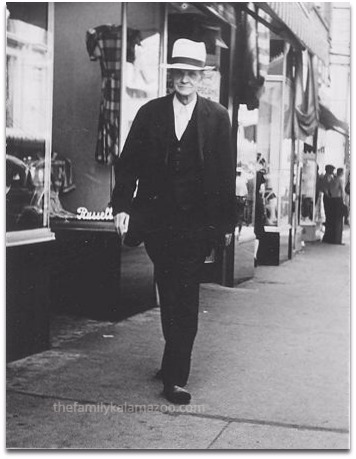
Likewise, I’m not sure which city Uncle Lou is in as he walks down the sidewalk? Does that window say “Russell” on it? In the city directories, there are many Russells, including ones owning businesses. There is one on Burdick Street, for instance, in my family’s neck o’ the woods, that is a variety store.

Here he is on a bench:

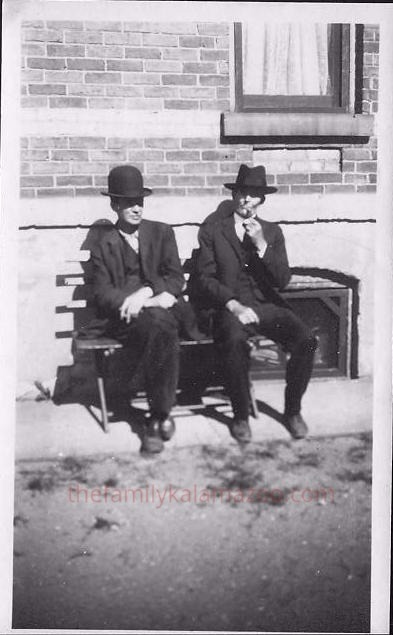
I wouldn’t be surprised to find this bench outside Richard DeKorn’s (his father-in-law) house on the corner of Burdick and Balch, judging by the design of the light colored stripe through the brick.

Here the photo is again–yes, it’s the same house. It’s hard to see Lou’s face up close. Below he is with his father-in-law, Richard DeKorn.
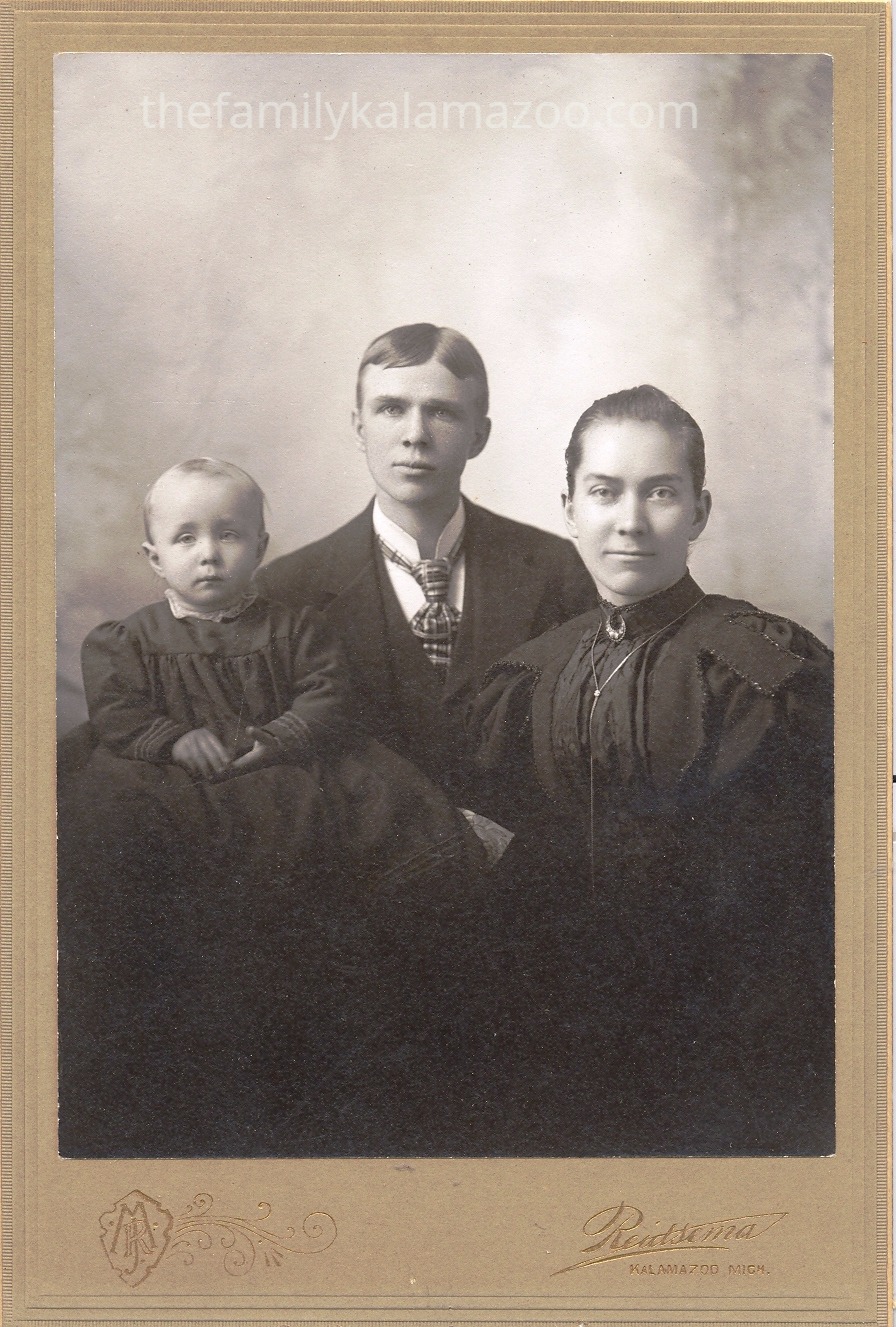
Uncle Lou with Aunt Jen and their only child, Alice:

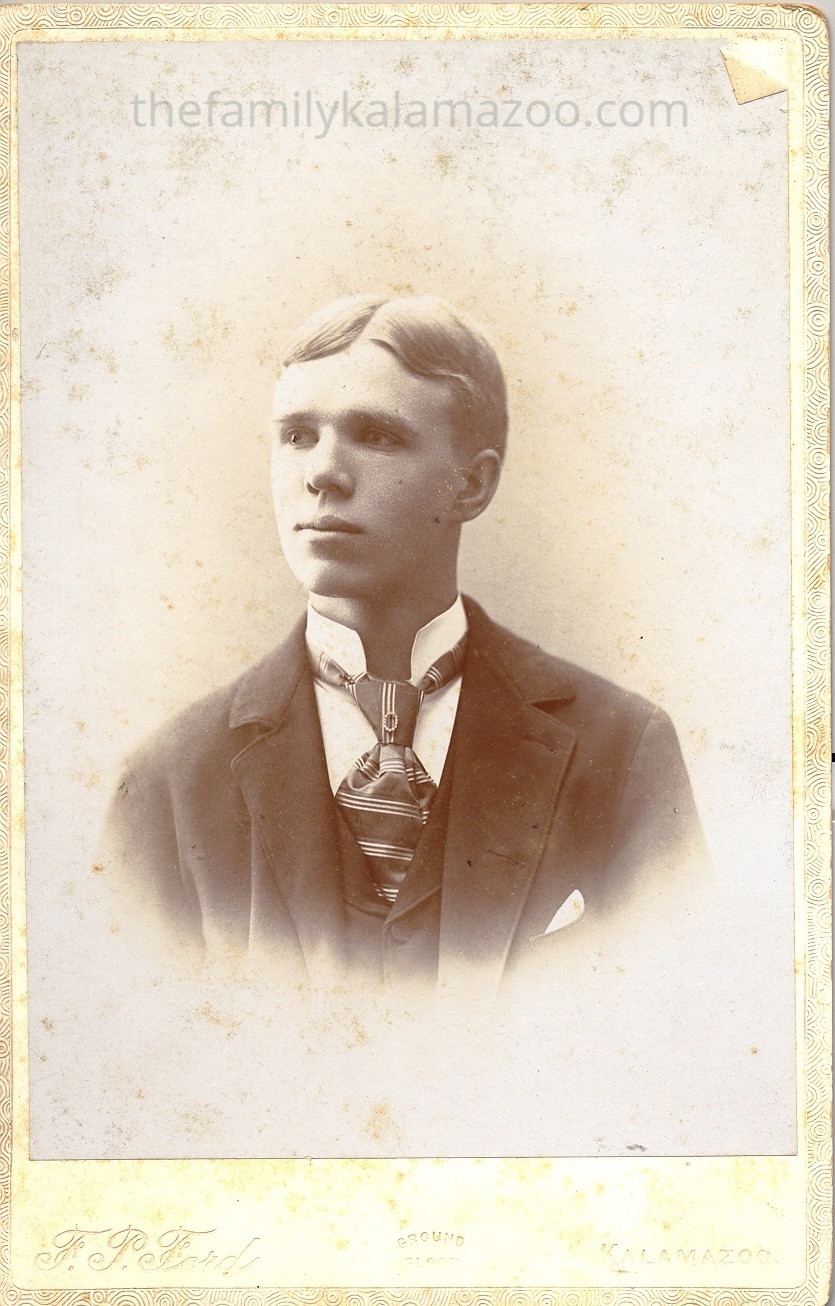
Here is a closeup of young Uncle Lou.

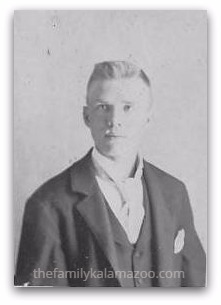
And now this is a curiosity. This photo is labelled Lou Leeuwenhoek by the same person who knew that the man walking down the street was Lou, that that was Lou standing out in front of his store, etc. But IS it Lou?

This is not his brother, for sure. While it’s not the same hairstyle as the photos above, the features seem to be the same–except for the eyes which, in the other photos, seem to be deep-set. Is the difference aging (the style of tie is the same) or lighting?  Or is the photo mislabeled?

***

You can check out the Bibles Uncle Lou brought with him from the Netherlands here.

Read Full Post »
« Newer Posts - Older Posts »