Feeds:
Posts
Comments

Archive for the ‘Michigan history’ Category

On May 6, 2015, I posted about a photograph I found in the box of glass negatives that had been taken by Joseph DeKorn. I’ll copy here what I posted and then give you the information that has come to me since then. If you remember the story, skip to New Information on Louis Van Wyck

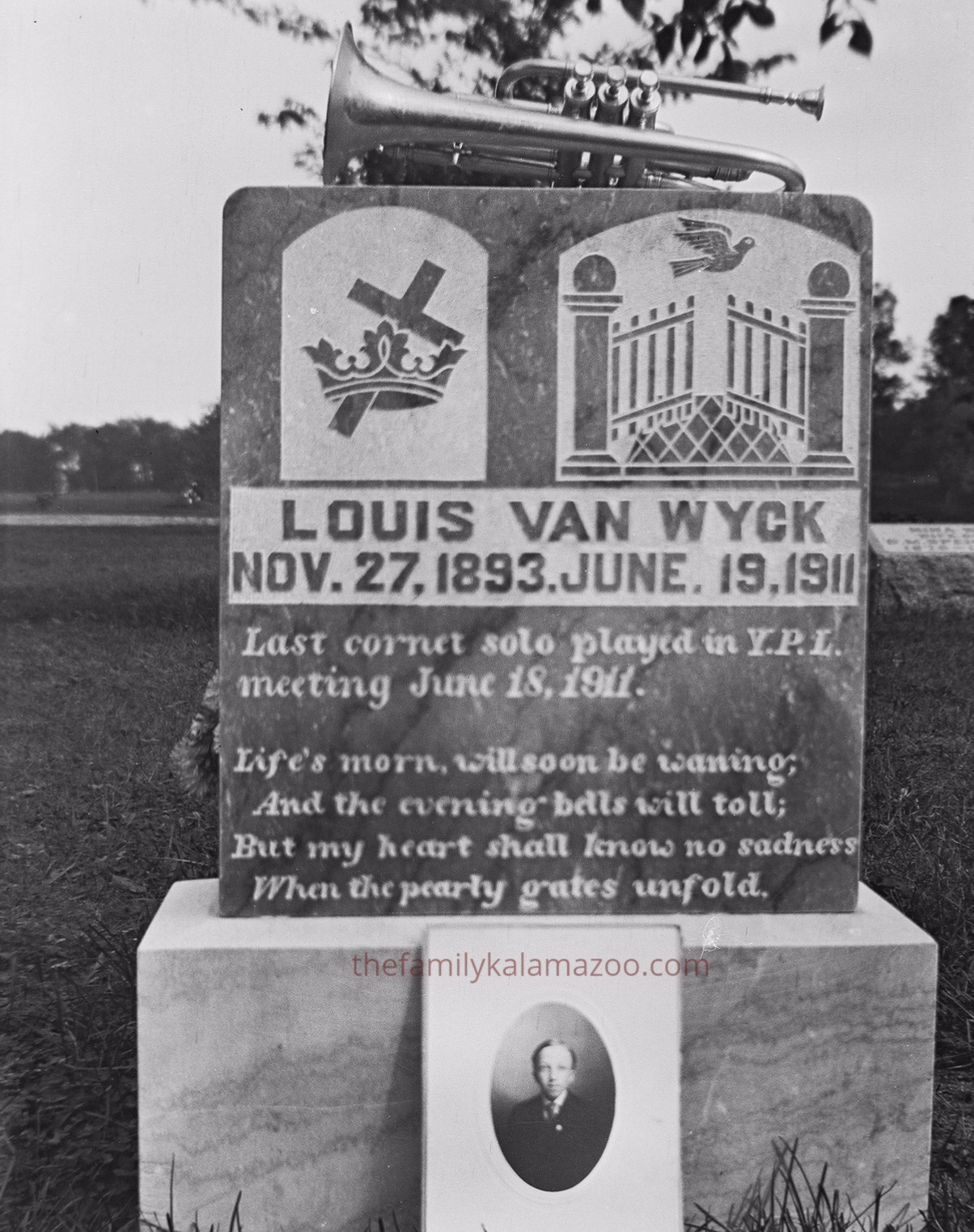
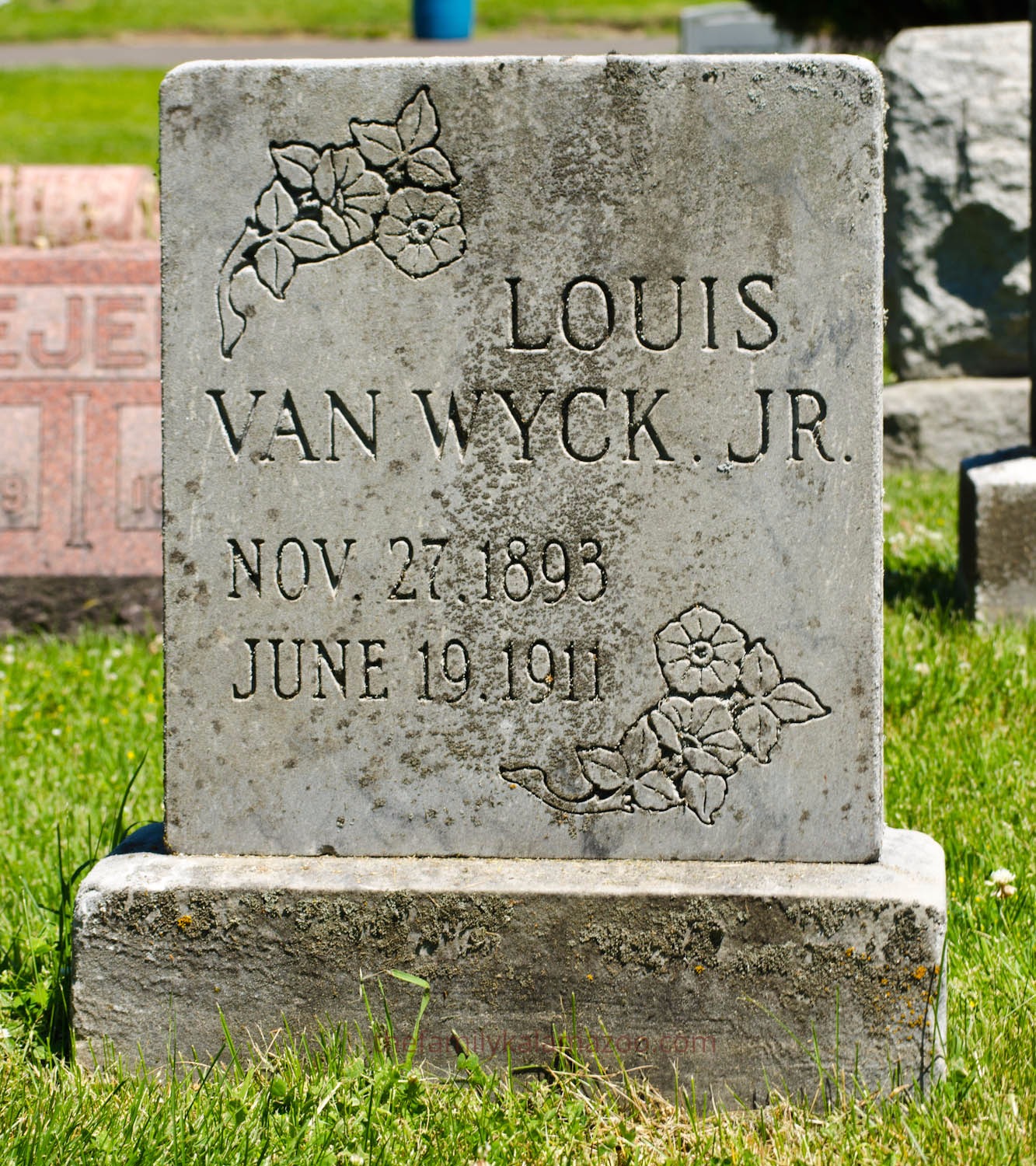
It seems to be an elaborate headstone for a man named Louis Van Wyck. Placed on top of the headstone is a cornet. The inscription reads, in part, “Last cornet solo played in Y.P.L. meeting June 18, 1911.”

His birth and death dates are also engraved on the headstone. He died the day after the cornet solo, on June 19, 1911. He was 17 years old–not a man, but a boy!

A photograph leans against the marble base. He looks young and blond. The stone is further engraved with images and a poem.


Although I have his dates, I can’t find Louis through Ancestry’s search function–or Find-a-Grave either. So I turned to Genealogy Bank where I found one article about his memorial service.

Read it here: Louis Van Wyck memorial service.  Note that the passage about the funeral is at the VERY END of this article.

I didn’t know what Y.P.L. on the headstone meant, but after reading about the Salvation Army hosting Louis’ memorial service, I looked it up online. It seems to mean Young People’s League. Now I have to admit I don’t know much of anything about the Salvation Army except that it is a Christian denomination and a charity, I sometimes donate furniture or clothing to them, and they (or volunteers like my family and friends) ring bells at Christmas outside shopping malls. I think Sarah in the musical Guys and Dolls belongs to a fictional representation of the Salvation Army.

That is kind of fitting because I just read up a bit and discovered that music has been important to the Salvation Army from the beginning. How fitting this headstone was, then, for poor Louis. But how did he die at such a young age? And how was he connected with Joseph DeKorn or my family? He would have been about 12 years younger than Joseph.

New Information on Louis Van Wyck.

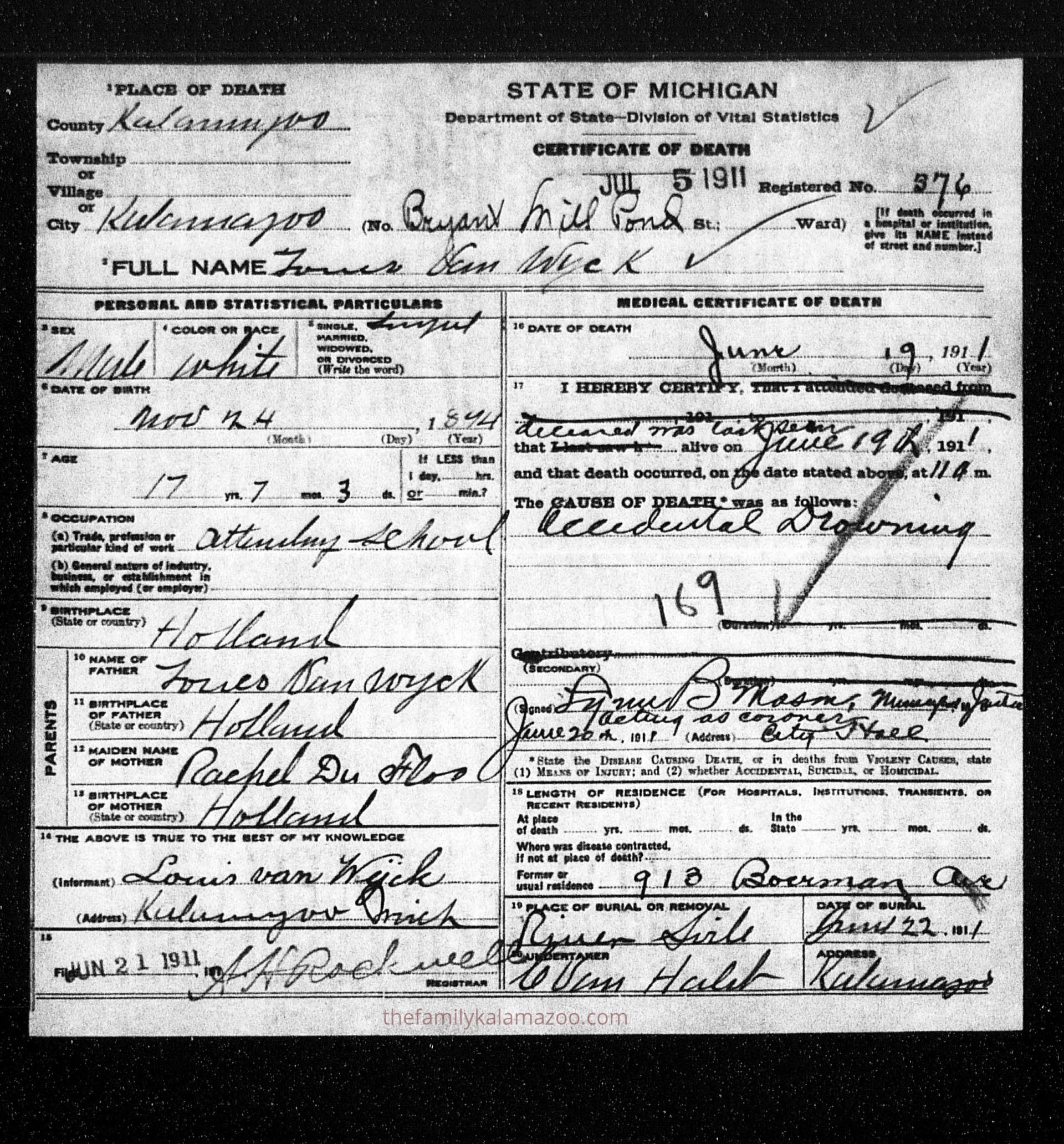
I was frustrated that I knew so little about Louis Van Wyck and yet my grandfather’s uncle had photographed his beautiful headstone with his cornet and photograph adorning it and left it behind for our family. Who was Louis Van Wyck? Many of you offered advice. Pastsmith really went to work on the problem and found Louis’ death certificate and his grave.


Things to notice in this death certificate are that he died of “accidental drowning” at Bryant Mill Pond. I looked up Bryant Mill Pond and discovered it is related to the Bryant (Paper) Mill. There were many operating paper mills at that time in the Kalamazoo area, all along the Kalamazoo River and Portage Creek. You can find quite a lot of information online about the cleanup that has been necessary in this area. I can’t imagine what the pond was like in those days. Was it full of papermill sludge or was it a clean pond that begged a boy to come swimming? Note that he drowned on June 19, 1911, just at the start of summer.

Louis’ parents were both from Holland, his father named Louis also and his mother born Rachel Du Floo. With this information I was able to find the family in the 1910 census, a year before Louis passed away. Louis had two sisters: Mary was 5 years older and his sister Kate was only 5 when Louis died. The senior Louis was a typesetter and worked for a newspaper. I wrote about how some members of my family worked on the Dutch-American newspaper here. Possibly Louis worked with them. In the 1920 census, Louis was listed as a price lister, whatever that is. It’s possible that the newspaper was out of business by then.

The family lived at 913 Boerman Avenue. This does not make them neighbors of my family, but it is within a long walk–the sort of walk my grandmother and I used to make when I was little. The house no longer exists as the area seems to be commercial now.

Since the families did not go to the same church, Joseph was 12 or 13 years older than Louis, and they were not neighbors, the connection could have been the typesetting.  After all, Louis, Sr., was born in the Netherlands and spoke Dutch. It seems that it would have been easier for him to be a typesetter in Dutch than in English.

As the death certificate mentions, Louis was buried at Riverside Cemetery. Through Find-a-Grave, it appears that he has another headstone than the one above.


Two headstones, one very elegant and detailed and the other more simple, certainly does create a mystery. They also share dates of birth and death. However, Louis’ date of birth is different on his death certificate. There it reads November 24, 1894. Since the simple headstone appears to be the one at Riverside Cemetery, where is the other one or what happened to it?

After Pastsmith’s generous help, I was contacted by a reader from Kalamazoo who shared valuable insights. Joel wrote:

YPL stands for Young People’s Legion. As a child I was a member of the YPL. It was a group in The Salvation Army for 12-30 year olds. It was a Christian fellowship group and we had junior worship meetings. It sounds like LVW Jr played a cornet solo that Sunday, 6/18/1911 and drowned the next day. . . . More than 20 years ago I had possession of historic documents from his relatives published by The Salvation Army Chicago which told of his untimely death, or as we say in The Salvation Army, his “promotion to Glory.”

He also said:

LVW’s sister is Mary A (VanWyck) Fortune, 1888-1976, Find a grave #25812816, Riverside Cemetery, Kalamazoo. Her husband gave the books which archived “The Young Soldier” publication of The Salvation Army to my mother-in-law, shortly after Mary’s promotion to Glory in 1976. They came into my possession in the 1980’s. I have since forwarded them on to The Salvation Army Central Territory’s Museum and Archives in Hoffman Estates, IL.
As for LVW’s two headstones; I am more familiar with the one with the cornet on it. I don’t recall where I’ve seen it before. But I knew it before I saw it in your web site. Perhaps it was in this archive book I had, or in local S.A. archive photos. I would like to see the larger headstone. I’ve also seen the more plain headstone before your web site, I have no explanation for two headstones. The photo of Louis himself is the photo I’ve seen published and in the local S.A. archives, as well as others that are of that era.

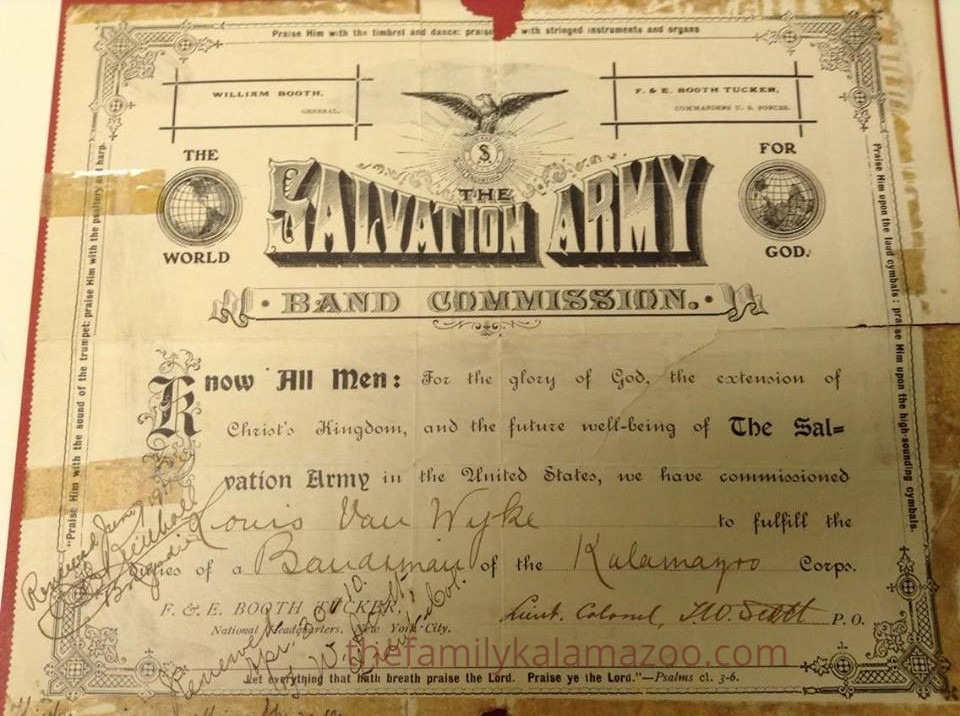
I came across the actual Band Commission for Louis VanWyke Jr.(Wyck is misspelled on the document) in our local SA archives from 1909. I have a picture of it but don’t know how to present it here. It has renewal comments written on it, renewing it until 1910, 1911, and 1912. Also, on the certificate is printed the name of the current General; William Booth. After Booth’s death in 1912 all subsequent SA documents say, “William Booth, Founder”, and would also list the current General.
I also have other anecdotal information regarding Louis’s sister, Mary A. Fortune, from my wife. In the 1960-70’s Mary and Neil Fortune lived next door to my wife’s parents, Richard and Shirley Aukes . . .  in Portage, MI. The Aukes’s and Mary were members of The Salvation Army of Kalamazoo, like Louis VW. Neil helped Richard build a garage. Later after Richard’s death in 1968 and Mary’s death in 1976, Neil gave Shirley Mary’s cedar hope chest. The hope chest was given to my wife, who in turn has given it to our daughter Betsy. Besides the hope chest, Shirley received the books chronicling Louis’s premature death.

At this point it became clear that Joel is the brother-in-law of my junior high classmate, Chris Aukes. We were in almost all our classes together for the three years of junior high school.

Note that Mary Fortune who Joel refers to is Louis’ older sister Mary.

Here is the 1909 Band Commission for Louis Van Wyck that Joel found in the local Salvation Army archives.


What talent Louis must have had. I’m so pleased to know more about Louis and hope to find out even more.

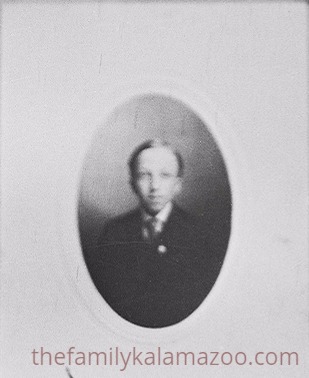
I tried to blow up the photo that rests against the first headstone. Though it is faded, it does give an idea of what Louis looked like.


Although Louis was not my relative, I enjoy finding out more about the history of the people who lived in Kalamazoo over 100 years ago.

Read Full Post »

HAPPY

BIRTHDAY,

MOM!!!i

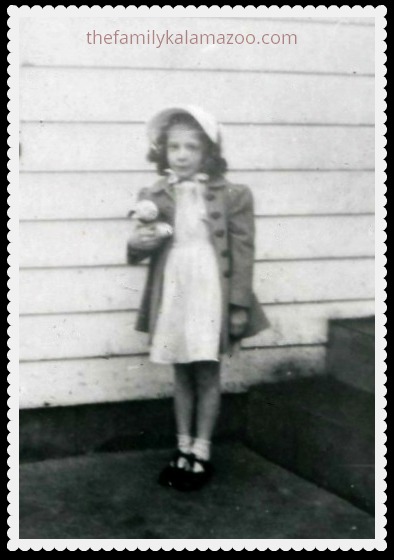
A beautiful lady and mom now and a beautiful girl then. Here she is by her house when she was a little girl:

I can’t help but wonder if this is a little Easter bonnet and an Easter toy in her arm.

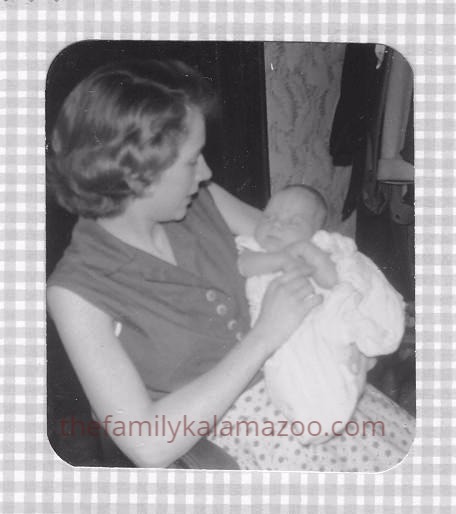
This is when I was a baby.

Have a beautiful day, Mom!!! xoxo

Read Full Post »

As I’ve mentioned before, my great-great-grandfather, Richard DeKorn, was a brick mason who worked on many public buildings in the Kalamazoo area.  He was a brick mason on the beautiful Ladies’ Library Association in 1878-79 and lead brick mason on the Kalamazoo Psychiatric Hospital Water Tower  in 1895. According to his obituary he was the contractor for the Pythian building and the Merchants Publishing Company building.

The asylum water tower was slated for demolition in 1974. Here is the story of how it came to be saved (from http://www.kpl.gov/local-history/health/kph-water-tower.aspx):

In spite of being on the National Register of Historic Buildings and endorsed by the Michigan Historical Commission and the Kalamazoo County Bi-Centennial Commission, the structure was earmarked by the State of Michigan for demolition in 1974. A local committee that called itself the Committee to Save the Tower launched a campaign to raise public funds to restore the building to its original grandeur and save it from the wrecking ball. A year later, Mrs. William John (Penny) Upjohn announced that $208,000 was successfully raised for this purpose. The money came from federal, state, and city contributions to the effort. Contributions also came from such disparate groups as school children, former state hospital patients, current hospital patients and employees, a hospital auxiliary, service clubs and concerned citizens. The campaign to save the structure was not without controversy. Some residents felt that the monies needed to repair the structure could better be spent on local service needs. Sen. Jack R. Welborn, R-Kalamazoo, pointed out, however, that taxpayers would be spending at least $150,000 to tear down the tower.

I recently visited Kalamazoo and went on a tour of Henderson Castle, a mansion built the same year as the water tower.


From a rooftop viewpoint, I was able to see the water tower in the distance.


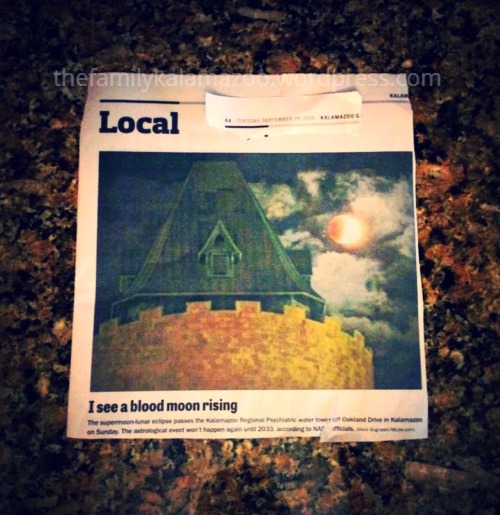
And then my mother showed me a photograph that was in the local newspaper of the blood moon near the tower.


I’m off preparing for a poetry reading this weekend. Have a lovely weekend!

Read Full Post »

I’ve written before about my great-great-grandmother’s sister, Carrie Paak Waruf, and her husband Henry Waruf: Who Was Hank Waruf, Kalamazoo Gunsmith, Tennyson’s Words for Henry Waruf’s Funeral, and All the Peek Girls (note that Paak can be spelled Peek, Paake, etc.).

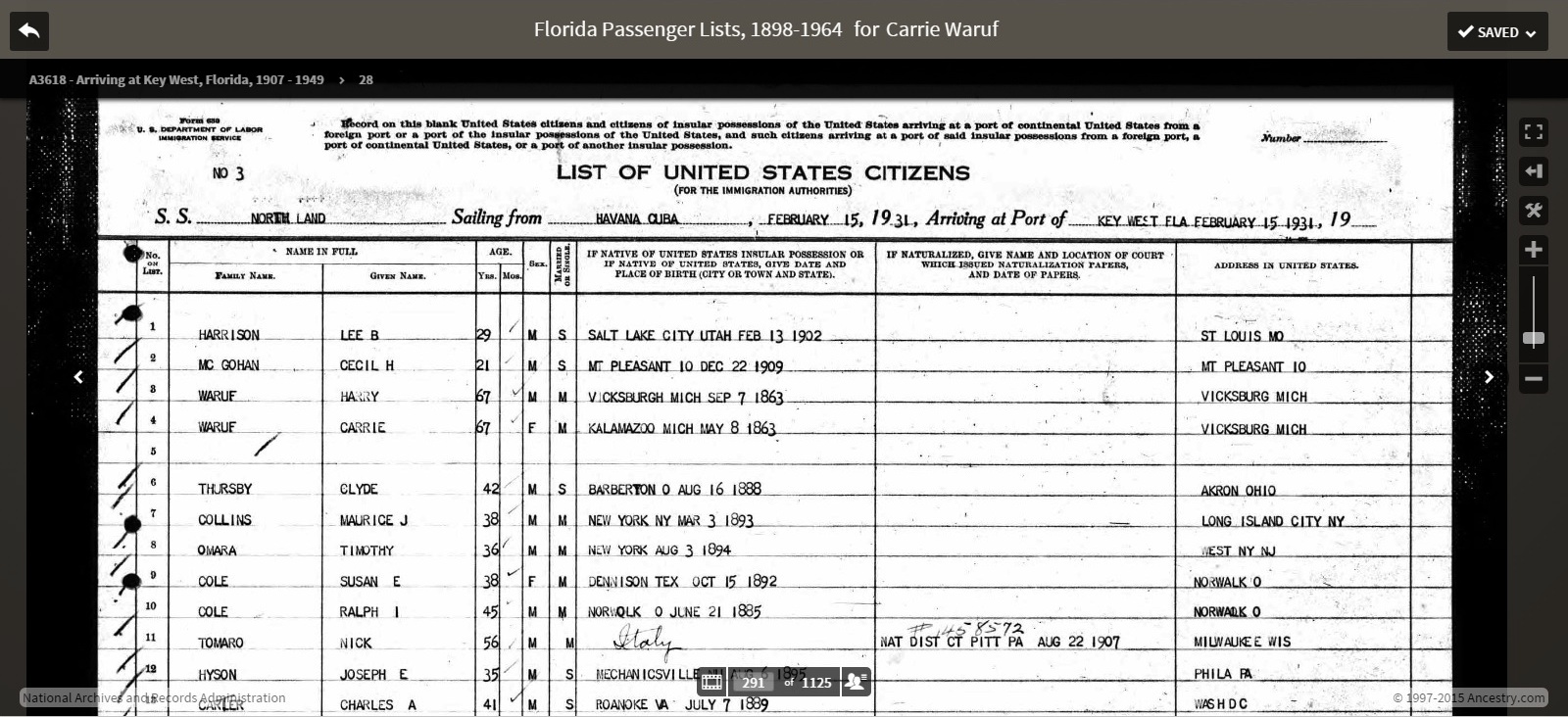
The other day I received one of those little Ancesty leaves on Carrie’s profile. The leaf led me to a Florida Passenger List for 1931. It shows that Carrie and “Harry” Waruf traveled on the S. S. North Land from Havana, Cuba, to Key West, Florida. They arrived on February 15, 1931.

Warufs come back from Cuba 1931 print screen

I started thinking about this trip. Undoubtedly this means that they vacationed in Cuba, to get away from the Michigan winter. Beginning in the late 1920s (or earlier), the twenty-seven-year-old 3,282-ton North Land, owned by Eastern Steamship Corporation, ran between Key West and Havana in the winter (and Boston and Yarmouth NS by summer). The North Land was a steamship and just short (in overall size) of the new luxury cruise ship that had recently become available (over 3,700 tons) that shipped out of Miami.

I wonder how long they vacationed in Cuba, where they stayed, and what they did there.

In 1930 the brand new Hotel Nacional de Cuba was built, so it’s very likely that they stayed there.

Poolside . . . . Trying to imagine Carrie and Henry/Hank/Harry by the pool with rum drinks.

This is what the Paseo de Prado looked like in the Warufs’ time:

Did Henry Waruf bring back boxes of cigars when they sailed into the Port at Key West?

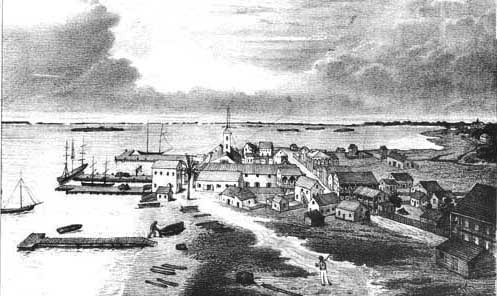
This photo is how they would have seen Key West in those days. Did they pay a duty on the cigars? Was there a limit on how many he could bring home? Remember that this was barely a year after the Stock Market Crash. Cigar factories were hurting in Cuba, just as companies and workers were hurting everywhere.

Did Henry and Carrie sneak back rum? It was still Prohibition when the Warufs traveled to Cuba!

It’s hard to imagine what an exciting place Cuba must have been for a couple from Kalamazoo in 1931.


Read Full Post »

Looking through my computer files (such a mess!), I found an old Word document I thought I’d share with you.

When my daughter was 10 she wanted to be a paperdoll centerfold for American Girl magazine. One of the requirements was to interview female living relatives about their childhoods. Her oldest female relative that we knew of (my daughter was adopted) was her great-grandmother, Lucille Edna Mulder (Zuidweg), who was born April 17, 1912. She passed away in 2000, just two years after my daughter interviewed her.

Here are the interview results.

Edna Mulder never wanted to be called Lucille, especially by her older sister, Dorothy, or her younger sister, Alvena.  They were called Dot and Vena, so she wanted to be called Edna.   Edna also had two younger brothers, Peter and Charles.  Her parents owned a farm in Caledonia, Michigan.  Her father came from a Dutch-American family and her mother from a German-American family.


Edna, Clara (holding Pete), Vena, Charles, and Dot

The farmhouse had a big dining room in the middle of the first floor.  The kitchen was out in back and had a coal-burning stove/oven.  The front room was tiny, with barely enough room for the big wood-burning stove and her father’s rocking chair.  He sat and smoked his pipes and cigars in the evening.  He played cribbage with a friend with a small chair pulled up to the fire.  All the downstairs had linoleum laid on it after Edna grew up and moved away from home; while she was home, it was a wooden floor.  The upstairs was two rooms:  a bedroom for her parents and one big bedroom for the five children.  They slept five to one bed, with the boys sleeping across the width at the girls’ feet.  It was COLD up there in the Michigan winters–with no heat.  Edna’s father had built the house; most of the furniture was handmade, too, some of it quite old.

Edna’s farm had a big family of cats, but they weren’t house pets.  They were kept to kill the mice in the barn.  Edna’s job was to put food and water out on the back porch for them.  The farm had lots of corn fields, cows, pigs, and an apple orchard.  It even had a small stream for fishing, but you had to drive the wagon down there, it was so far away.

But Edna and her siblings were used to long walks.  The three girls walked three miles to school everyday and three miles back home.  They kept each other warm by cuddling together as they walked.  Once in a great while, during the worst weather, Edna’s mother drove all the children to school in a tiny black Amish buggy.

Sometimes the girls were naughty.  For instance, they knew their parents had a store charge at the grocery store in Caledonia.  A couple of times the girls couldn’t resist and charged a giant candy bar or a banana.  (Fruit was a big treat; Edna only saw oranges at Christmastime).  When their parents found out later, they would “get bawled out.”

Edna’s family didn’t have much money, except for owning the farm, but her father collected a few hundred books.  He had several series of books for children which offered moral and religious instruction, as well as some adventure books.  Edna had plenty to read while she was growing up.  But she didn’t have a lot of time to read because she always had a lot of chores.  Farms need a lot of care!  Edna learned to cook basic meat, potato, and vegetable dishes while she lived at home with her family.  She also became a good baker, making delicious cookies, pies, and cakes.  She wanted to be a teacher or a writer when she grew up, but she also wanted to have a home and a family and to take good care of them.

###

I’ve posted photos of the farm where Edna grew up before:

Final note: This turned out to be a great project for my daughter and for me because it was about our shared knowledge–some of what my grandmother taught my mother was taught to me and taught, in turn, to my daughter–and we both learned about history through the life of an ordinary girl. And, yes, my daughter did get to be an American Girl paperdoll. You can read the story and see the photos here: An American Girl’s Family Tree


Read Full Post »

In a post called “Who Was Hank Waruf, Kalamazoo Gunsmith?” I wrote about the husband of my great-great-grandmother’s sister, Carrie (Paak) Waruf. The couple owned the resort Ramona Palace and Ramona Park, as well as many cottages and their own home, at Long Lake in Portage, Michigan.

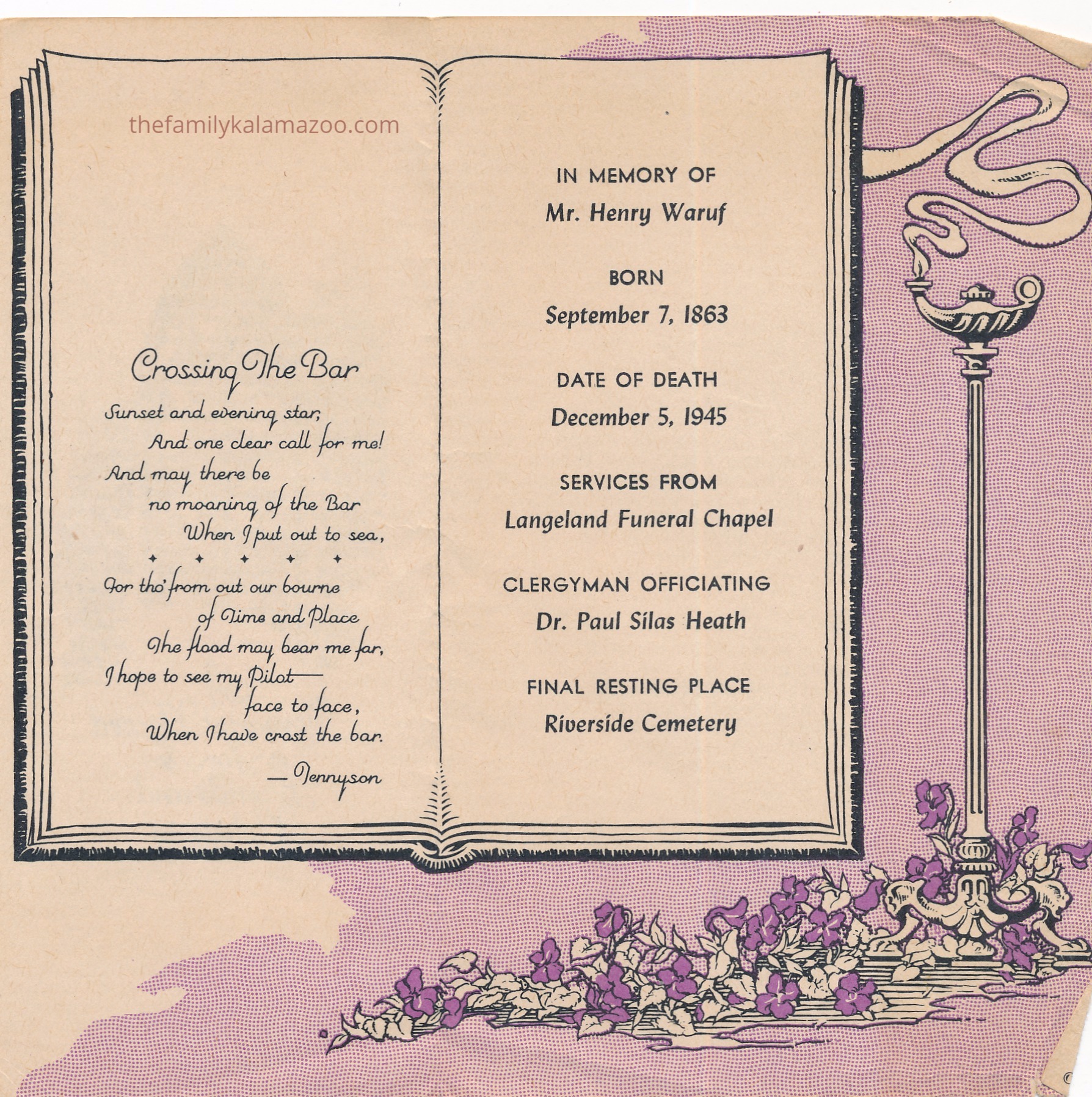
In my files I found the brochure for Henry Waruf’s (Walraven) funeral.


Henry Waruf’s wife Carrie and my GGGrandmother Alice Paak DeKorn had a sister named Mary. One of Mary’s daughters was Genevieve. She was married to Frank Tazalaar. Here are Henry and Frank together (with a little dog).


I get the impression from some of our photos that Hank Waruf was a man other men wanted to hang around .

Read Full Post »

I wrote about my great-grandfather, Charles Mulder, and his farm in Caledonia, Michigan here. That post also lists other links that pertain to Great Grandpa and the Mulders.

At the time I didn’t have a good photograph of the farm, but now I have discovered a good one of the farmhouse, just as I remember it. Facing this way, the apple tree the swing hung from was to the left. The fields were also to the left, the road to the right. Because of the porch, you can see that the front of the house is on the right side.

Look at that! Is it the same swing I swung on or a different one? This is Mom’s cousin Elaine playing at the farm.
Do you have any fond farm memories?

Read Full Post »

As a high school student at Caledonia High School in Michigan in the 1920s, my grandmother, Lucille Edna Mulder, was a good student. As I have written about before, she was Class Historian at graduation–and kept a beautiful graduation scrapbook.

She also kept a meticulous notebook for botany class. Here is a slideshow of the entire book. I will post a few still images below the slideshow.

Did you ever record precise information like this for a homework assignment? If so, do you think you learned from it?

This slideshow requires JavaScript.

These dried flowers look like nature prints! I wish I had been required or encouraged to keep a notebook like this.

Read Full Post »

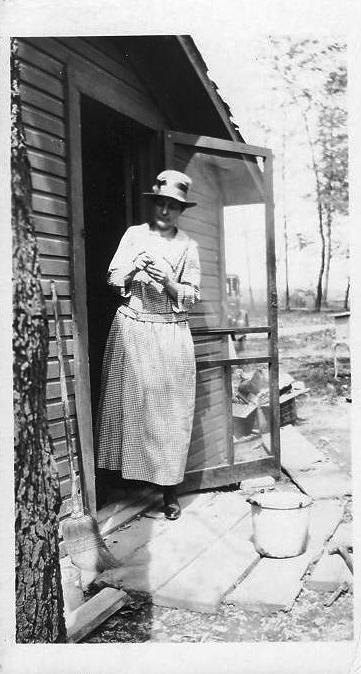
I recently found this photograph in a group of photos. Because of a clue on one of the other pix, I narrowed the date to between 1928 and 1931.

I know who the man is because he has a very distinctive look. This is my great-grandfather, born Adriaan Zuijdweg and called Adrian Zuidweg in the United States. I’ve written about him many times, but the best posts would be My Great-Grandfather Reinvented Himself as a Business Owner in the U.S. and My Grandfather’s Story, Part V and Back to the Dutch-American Newspaper.

Adrian died in 1929, according to my grandfather–of kidney disease. But I have not been able to find a death certificate or a grave. Maybe it’s because his name was mangled, but keeping that in mind, I still haven’t found him yet. It is so frustrating. Also, the newspapers from that year are not on Genealogy Bank. Nevertheless, I would put this photo at 1928 or 1929. Because other photos show him more fit than in his photo, I think he might have been ill (or close to it) by the time this photograph was taken.

But who are the women in this photo?

Adriaan Zuijdweg

Could the woman on the left be my Great-Grandmother Cora DeKorn Zuidweg? She looks a lot taller than he does, but maybe she was taller. I will post a known photo of her so you can compare.

Cora DeKorn at her father Richard DeKorn's cottage on Long Lake

Cora DeKorn at her father Richard DeKorn’s cottage on Long Lake

Similar hats, for sure! If that is Cora in the first photo, then she would have been about 53 years old. She herself passed away in 1932 from cancer.

Do you think that is Cora in the photo with Adrian?

Who is the shorter woman? Is this another photo of her?

The only child of Adrian and Cora was my grandfather. Cora’s only sister was Jennie–and this is not Jennie. However, she had two younger step-sisters, Marion and Marge Sootsman. They would have been in their 30s at this time. This woman does not look like one of them. She actually looks more like one of the Culver sisters, but we figured out that they moved to Seattle before this period.

The only thing is . . . there are a lot of photos of this woman. Was she a girlfriend of my grandfather?


Kinda looks like it. After a series of these photos, there is a series of him with my grandmother.

Do any family members know the answer to this mystery?


Read Full Post »

I am digitizing some photographs for my mother, and I found this picture that I just love. It’s my mother’s mother (in the middle) with her two sisters. They are standing with their children–the ones who were born at this point. By the age of the children here, I would say that the picture was taken around 1939-40. What is a little confusing is that nobody looks pregnant and two of them should have been pregnant around that time, unless there are tiny babies asleep just outside the boundaries of the pic!

The photo would have been taken somewhere in southwestern Michigan. CLICK ON THE PHOTO TO ENLARGE!

From left to right: Vena with her two oldest daughters, then grandma (Lucille Edna Mulder Zuidweg) with my mom (Janet) and Uncle Don, then Dorothy with her two oldest. Each of them had another child after the first two.

I’ve written posts about my grandmother. Dorothy showed up a bit, too, because the girls graduated high school together. You can read about their graduation here and here and here. In this post, Grandma, Dorothy, and Vena are shown as children with their parents and one brother (again, the youngest had not yet been born).  Grandma’s teaching contract from 1931 can be found here.

If you never read my posts about Grandma’s high school scrapbook, check out the links. It’s a gorgeous scrapbook from her graduation in 1929. She was Class Historian and her older sister Dorothy was salutatorian.

If anybody in the family wants me to post the names of the children here, I will add them to the post. Just let me know.

Isn’t my mom, the tallest one here, a cutie in her double-breasted coat?

Read Full Post »

« Newer Posts - Older Posts »