Feeds:
Posts
Comments

Archive for the ‘Michigan history’ Category

Harold Remine, the brother of Therese Remine, married Lillian Heddle on 7 July 1925 in Port Huron, Michigan.


Pretty snazzy outfit and a pretty girl.

What I remember of her was when she was white-haired and living with Harold in a beautiful brownstone in Montreal with fine china and in a lovely lakeside home outside the city. Harold had done quite well for himself (and for her). That was 1967, when I went with my parents to Expo 67, the World’s Fair. (That was a fabulous experience BTW).

In a University of Michigan alumni book (Michigan Alumnus 54 1947) I learned:

Harold H. Remine, ’21, has been promoted from Superintendent of Electrical Distribution to Assistant Chief Engineer of the Quebec Hydro Electrical Commission.

Thank you to Uncle Don for pointing me in the direction to find this.

Harold was a big curling fan. That trip is when I first learned of the existence of the sport.

What do you think of Lillian’s dress? Check out the bottom of the photo . . . .


Read Full Post »

One of the branches of my family from the Netherlands was the Reminse branch.

On 26 August 1810, my 4th great-grandfather, Dirk Reminse, a bread baker, married Adriana Kriger (Krijger) in Kapelle, Zeeland, the Netherlands. Dirk was born 22 November 1786 in Kruiningen, Zeeland, Netherlands. At some point before his marriage he must have relocated to Kapelle, but Adriana also came from a different town. She was born 11 June 1787 in Biggekerke, Zeeland, Netherlands.

Houses on the Kerkplein (church square), Kapelle, Netherlands

The couple had the following children:
Gillis Remijinse 1811–1868

Jan Remijinse 1813–1837

Hendrika Remijinse 1814–1893

Johanna Remijinse 1817–1864

Johannis Remijinse 1819–1846

Adriaan Remijinse 1821–1849

Pieter Remijinse 1822–1830

Frans Remijinse 1823–1860

Gerard Remynse 1825–1910

Marinus Remijinse 1826–1863

Note the difference in the spelling of the surname. It is seen both ways. In this country it became REMINE.

Their daughter Johanna was born 15 July 1817 in Kapelle. She married Boudewijn DeKorne 21 May 1847 in Kapelle. Boudewijn had been born in Kapelle on 11 June 1816.

The couple had one daughter who died as an infant, then a son Richard and daughter Maria were born. Richard, my great-great grandfather, would end up being a well-known brick mason and contractor in Kalamazoo, Michigan, but first the family had to immigrate to the United States.

Johanna’s parents had both died. Dirk died 9 September 1840 in Kapelle. On 14 April 1845, Adriana passed away.

Boudewijn and Johanna arrived in this country in 1856 and first settled in Zeeland, Michigan. The following year their 4th and last child, Jennie was born. Jennie eventually became Jennie Culver who divorced her husband and moved to Seattle with her two teen daughters. I have posted about the magnificent photo album that belonged to one of Jennie’s daughters that a blog reader mailed to me.

Johanna Remijinse DeKorne was my last direct ancestor in the Remine line, although my grandfather stayed close to the family that continued that surname in Michigan.

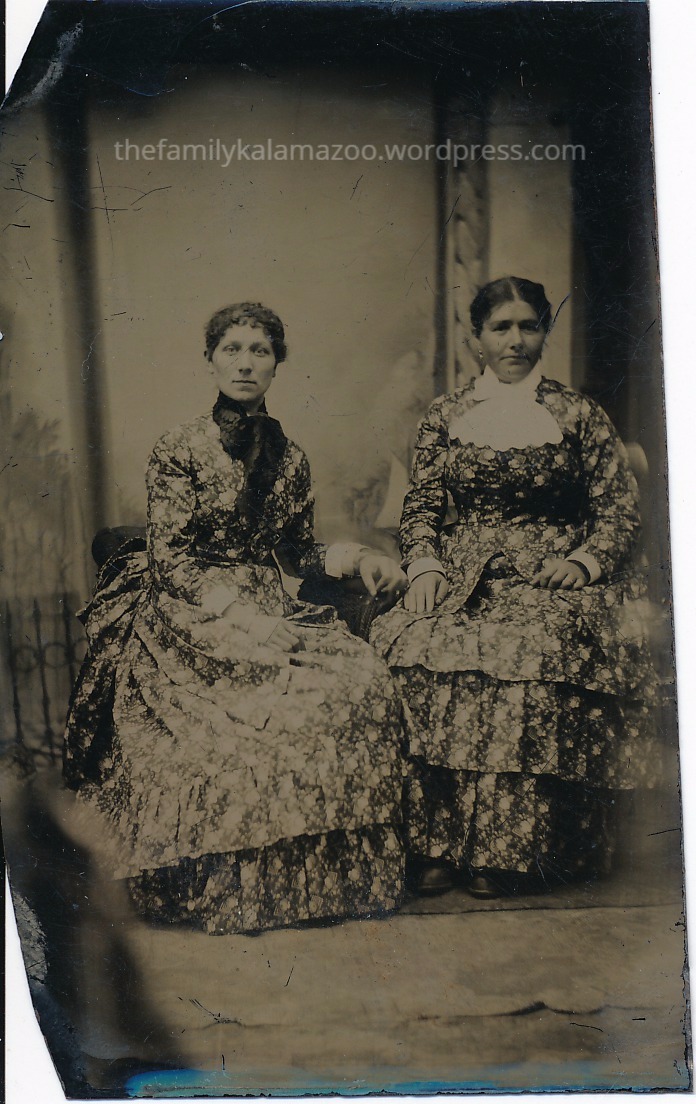
I found a photograph of this branch of the family in the Netherlands. The photograph is not marked with a photography studio or any other identifying information. Someone, possibly my grandmother, wrote on the back “Remine family in Holland.” In order to figure out who is in the photograph I would need to know the approximate date of the photo. Since Johanna immigrated in 1857, this must be from a line of the family that ran parallel to her line. Would it be the family of one of her siblings?

I went back and examined the other Remine cousins in the United States. They stem from Johanna’s brother Gerard.  He seems to have immigrated to the United States between 1855 and 1857. Maybe he and his family even came over with his sister and hers? NOTE TO SELF: CHECK INTO THIS.

Why did the families remain close? Johanna’s son Richard’s wife Alice’s sister Mary married Richard Remine, son of Johanna’s brother Gerard! What does that make them? First cousin’s by marriage?

So the photo can’t be of Gerard’s family. That leaves eight other siblings to check into. And the children of all these siblings . . . . NOTE TO SELF: MORE WORK NEEDED HERE

CAN YOU GUESS A TIME PERIOD FOR THIS PHOTO?


Read Full Post »

This week I discovered a photo from the bunch that Grandpa had identified that I had not yet scanned.

So I scanned it.


And then I scanned the back of it.

Here is what it says:

Bessie Klosterman / Pete DeBoer shot (and killed) her mother

The name Klosterman (Kloosterman) sounded familiar to me, so I looked on the census pages where my family lived. I found her family in the general neighborhood. Then when I went back to look again, I lost them. Now I don’t know which census I found them in–or on what street. This is what happens when I try to “skim” something in the middle of working! So that is going to take more searching.

In the meantime I went to Genealogy Bank, but I couldn’t find any stories relating to a shooting involving a Klosterman or a DeBoer (or denBoer either). I can’t even find Bessie in a search for documents on Ancestry.

This is obviously a very sad (and unknown to me) story, and the fact that Grandpa had her photograph shows that the families were close.

UPDATE:

A friend saw my post on Facebook and said Bessie might have been:

Elizabeth Klosterman born 13 Sept 1883 Kalamazoo died 27 Jun 1962
Husband Henry. Hindrik H Ouding
Parents: Louise Newhouse and Peter Kloosterman

Off to check on that tip!

Better yet: here is the 1900 census showing Bessie and her brother Peter living with their maternal grandfather!

1900 Newhouse censusToday I will update you where the search has taken me. I will post a page of the 1894 Michigan census.
To sum up my findings:

1894 Michigan census

At 1137 South Burdick St. lived:

CORNELIUS DEBOER, 40 years old

Wife MARY DEBOER, 33 years old

Step children (of Cornelius)

1880 Elizabeth, 14

John, 12

Peter, 10

Cornelius, 8

The children were all born in Michigan, the adults in Netherlands.

At same house lived John DeKorte (father, widower). Could be an error in spelling or could be another explanation.

Cornelius was a labor, Mary a housekeeper, Elizabeth “at home,” and the boys at school.

The census indicates that Elizabeth has not attended school that census year, though the boys have.

Cornelius has only been in the US for 6 years (1888 arrival) and Mary for 25 years (since 1869 when she was 8 years old).

1900 federal census:

At 1645 S. Burdick Street lived:

Peter Newhouse, born 1839, 61 years old, an invalid, arrived from Netherlands 1868

Peter Klosterman, grandson, born 1885 so 15 years old, working as “callander man”

1882 Elizabeth Klosterman, granddaughter, born 1882 so 18 years old, can’t read her occupation

Both children born in Michigan

According to Ancestry trees, Elizabeth Klosterman was born 13 Sept 1883 in Kalamazoo and died 27 Jun 1962. Her husband was Henry or Hindrik H Ouding. And her parents were Louise Newhouse and Peter Kloosterman. She could also be Louisa or Louiza.

I wondered if there could be errors involved and if John and Cornelius had died, but I found a Cornelius Kloosterman, born 1889, who died in1973 and is buried at Mount Ever-rest.

Either they are two different families or the children were split between two families. This is a possibility because Grandpa Newhouse was an invalid and maybe two of the kids were there to take care of him.

I have to leave the Klostermans for now as I must return to searches for my own family (not to mention work haha). But I feel that the answers about Bessie’s mother and family will eventually fall into place.

Read Full Post »

My 3rd great uncle, Charles Noffke, married Louisa Rutkofski. This event must have occurred back in the “old country.” Just where the old country was has not yet been determined. All I know is that the Noffkes (and the Waldecks) were some sort of “German.” They might have been from Pomerania, but maybe not. The Waldecks-Noffkes had regular family reunions for years, decades actually, and yet their origins are more murky than my other branches. It would make sense if these people came from an area that is now Poland because I do have Polish DNA, but also it might fit Louisa’s maiden name (which can be German or Polish, according to trusty Google).

Anyway, I am writing about the disturbing story of Louisa’s death. Charles, who was born in 1843, passed away on 26 May 1897 in Caledonia, Michigan, where the family had settled. Louisa, born 24 April 1845, never married again and passed away on 6 July 1920. So she lived alone, presumably, for many of those 23 years. The couple had two children, a son Herman, born 1871 and a daughter, Clara, born 1875. Herman was married in 1900 and Clara may have married soon after.

I had never heard of Louisa until I began to do family history research, particularly on Ancestry.com. That’s when the Noffkes began to populate my family tree. She threatened to remain an enigma because I had little information and, after all, she is not such a very close relative.

But when I plugged the name Noffke into the newspaper database on Genealogy Bank, I was startled to learn the circumstances of Louisa’s death.


Clothing torn from her body? Some articles of clothing missing? Trampled weeds along the lakeshore? Scratches and bruises on the body?

DEATH FROM INDIGESTION?

It sure sounds as if she was murdered.

Clearly this shows that an investigation was opened into her death.

THEN SILENCE. Nothing else appears in the newspaper except information about probate of her estate.

What do you think happened to her?

For a link to a beautiful image of the lake go here.

***

Adding Louisa’s death certificate, thanks to Su Leslie’s comment. Notice that the cause of death is even stranger: that she died by drowning in the lake while ill with acute indigestion. HUH? And notice that there is no DOB, although they seem to know her age in days. There are no parents listed, although her only son gave the information. I can’t tell who signed the certificate because of the spot on the paper.

One more thing. Her daughter Clara died eight years later, at age 53, in bed–dead from the gas from a coal stove.


Read Full Post »

Actually the house was right in the middle of the city, not in the woods, but that sounds nice–very Ingalls-Wilder-ish.

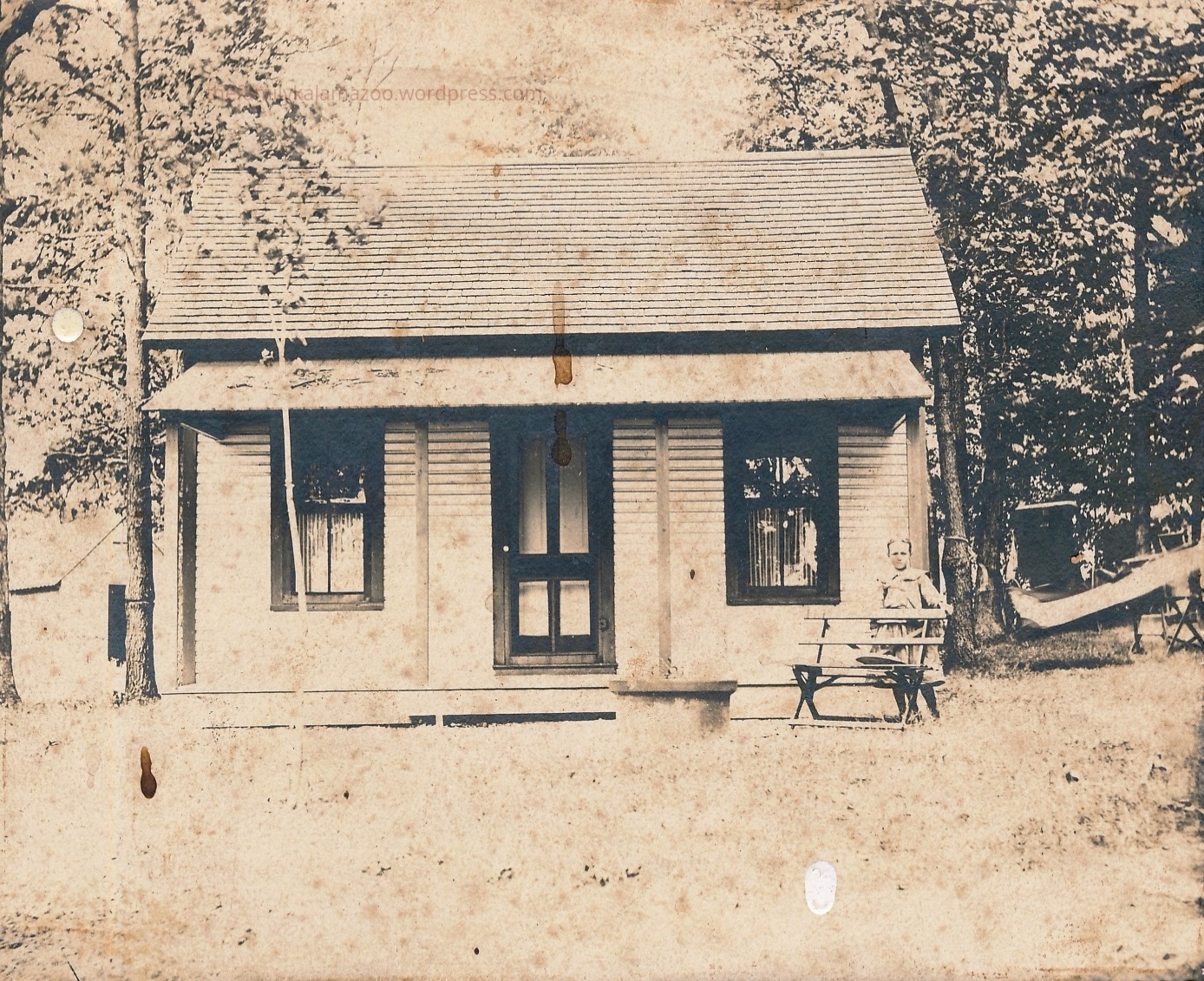
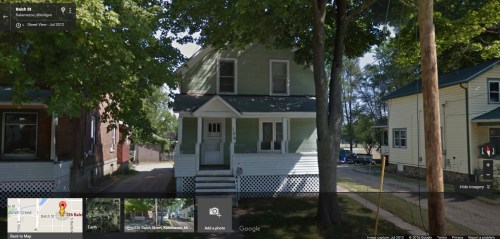
A while back I posted a photo of a house with Alice Leeuwenhoek standing in front of it on Thanksgiving 1907. The address on the back was 126 Balch Street, which didn’t seem to conform to current addresses. I asked a lot of questions about it. Uncle Don explained that were some buildings behind the houses on the street.


126 Balch Street, Kalamazoo, Michigan

Then I heard from Jill-O, a librarian in Kalamazoo. (P.S. You will love her blog so go check it out!)

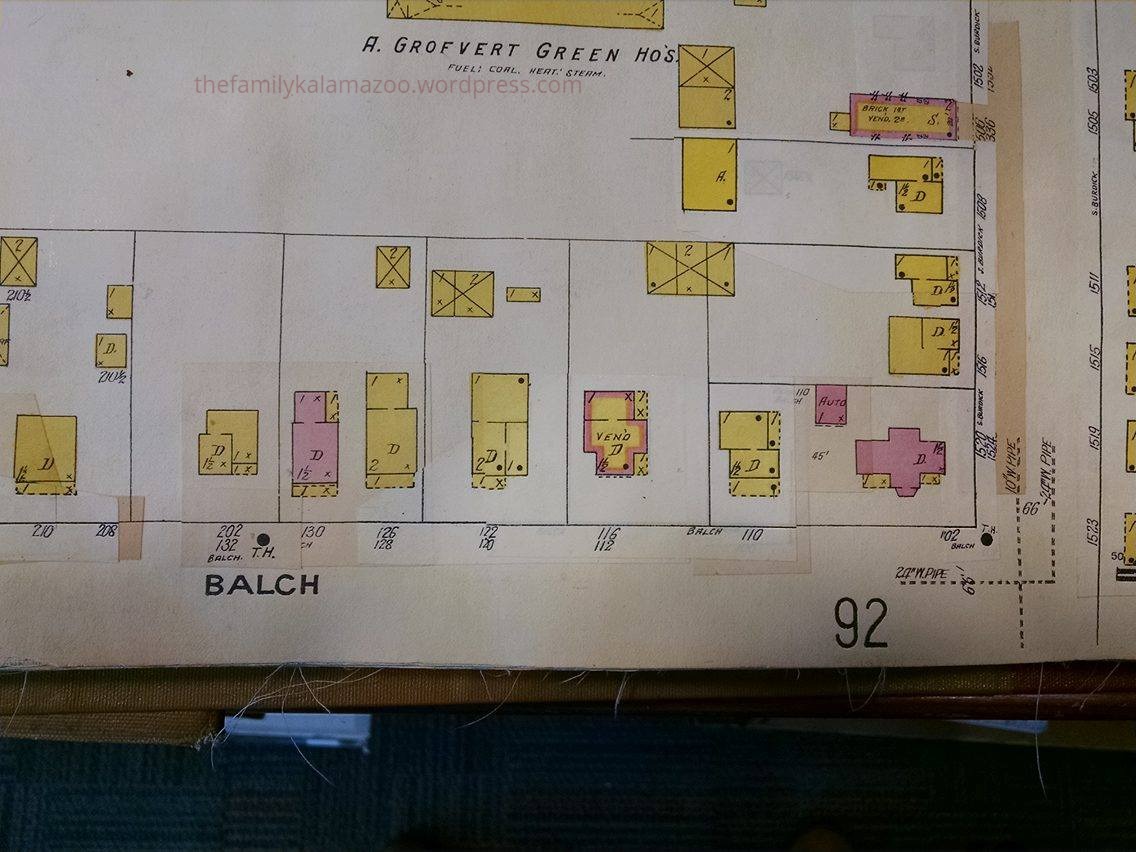
Here are the results of her research in a 1908 insurance street map of Kalamazoo:

Jill-O says:

It looks like the numbers are in the same location as today. There are a couple of outbuildings behind 126, so either the house was torn down and rebuilt, or the one of the outbuildings was used.

Here is the house that  is on the street, numbered 126, today.

Let’s look at the pic and think back to 1907. In the photo you can see an outbuilding behind the house, so it’s unlikely that it’s off the street, behind another building. But if it was 126, wouldn’t the outbuilding be poking out on the other side? And wouldn’t the house be larger? As to the second question, maybe not. The house shows one room and behind it another room, so maybe from the photo we can’t see the depth of the house. As to the first question, what if the photo is reversed? I don’t know too much about the process of taking photos or developing them in those days, and maybe the photo is reversed.

OR. What if this is an outbuilding and that building off to the left is a house on the street from another angle?

The more answers I find, the more questions I have. I think my husband is right: I ask way too many questions.

This map is invaluable to me because so many of my relatives lived in this neighborhood. I am going to use it to plug in the addresses on the census reports–yippee!!!

Thank you, Jill-O!

Read Full Post »

After my last post was published, Elly and I conferred again about our Mulder family. We discovered that of the six children of Adriaan and Johanna (Mulder) Zuijdweg, we had two differences. First of all, Elly didn’t have a record of the first child, Kornelis, born in 1837. And I did not have another child who died at a very young age. Although I had on my tree, Johanna, born 1847, I did not know that there was an earlier Johanna, born in 1845, who died on 5 March, 1847. She passed away two months before her Grandfather Mulder died, and less than two years after her father applied for emigration.

Now we know why the newspaper account said there were 5 children and not 6–or 4. At the time of the application for emigration there were five Zuijdweg children. But afterwards, one died and two more were born.

So it seems likely that there really were seven in total, with one dying as a baby.

But that ain’t all, folks. There are two other exciting discoveries made by Elly.

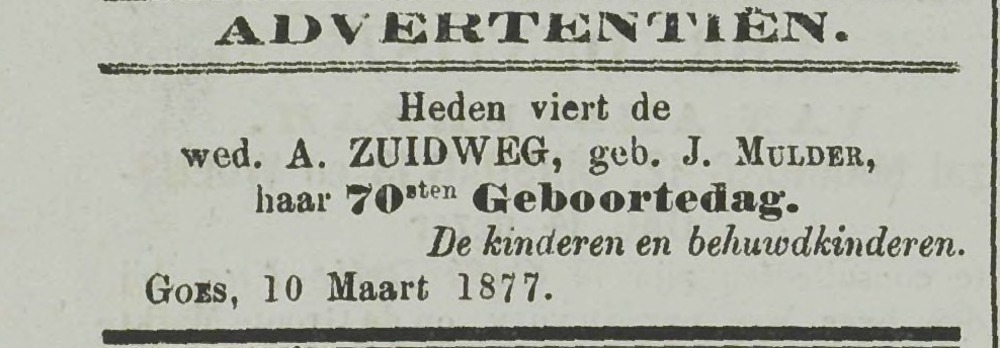
First, she found an advertisement for Johanna Mulder Zuijdweg’s 70th birthday! Johanna’s family must have been proud of her living to that age. Elly says it is customary in the Netherlands, even today for some people, to advertise 50th, 60th, 70th, etc. birthdays. It might mean that her family and friends had a small party for Johanna’s birthday.

Look at that ad. Very very interesting. It says ZUIDWEG. Not Zuijdweg. What is up with that? I thought the boundary between the two spellings was the Atlantic Ocean. But now I see this spelling used in the Netherlands! ***

Second, Elly noticed a “coincidence” when we saw the name Hogesteger in more than one place and she checked it out. I noticed it and just assumed (you know what they say about that word, right?) that it was a coincidence. But it’s no coincidence.

Adriaan Zuijdweg and his wife, Johanna Mulder Zuijdweg, wanted to emigrate to the United States in 1845. He might have been part of the group seceding from the Reformed Church. His wife’s brother, Johannes Mulder was married to Henderika Johanna Hogesteger. Johannes and Henderika emigrated to Holland, Michigan, in 1857 with their three children. But ten years before that, Henderika’s brother Johannes Hogesteger emigrated in 1847 for religious reasons. He actually was one of the leaders of the movement that seceded from the Reformed Church.

In fact, you can read here in Michigan History about how Johannes Hogesteger, a Mulder in-law, figured into the history of Michigan.

The city of Zeeland has a rich history of Christianity, beginning with the first settlers who emigrated from the Netherlands due to persecution from the State Church.

The First Reformed Church of Zeeland was formed before the city of Zeeland was founded; it was organized in the Netherlands before the 457 immigrants sailed to the United States. It is thought that this was the only other group of people besides the Pilgrims that immigrated to the U.S. as an organized church.

Reverend Cornelius Vander Meulen

Reverend Cornelius Vander Meulen

The first church service as a congregation was held three months after the arrival of the settlers, in the home of Jan Steketee. Many Sundays found the settlers worshipping outside, though in inclement weather they held services in one of the larger homes in the village. Rev. Vander Meulen was asked to be the pastor. Jannes Van de Luyster, who played an influential role in facilitating the immigration movement, was elected as elder, along with Johannes Hogesteger. Jan Steketee and Adrian Glerum were elected deacons.

In May 1848 the first church building was dedicated, but by the end of the year so many immigrants had arrived that it was necessary to build a new church. In 1849, the church recorded 175 families in the congregation.


What I get out of this is that my relatives were involved in the only other group besides the Pilgrims that moved an entire church to the United States. It seems that the Mulders (Johannes and Henderika) came ten years later than Henderika’s brother, but their 14-year-old son Karel arrived earlier. And Adriaan and Johanna never did make it to Michigan to join their fellow worshipers.

***

Info on Johanna from Zeeuw Archief

Birtday registers Zeewuws Archief


25.GOE-G-1845 Goes geboorteakten burgerlijke stand

Geboorteakte Johanna Maria Zuidweg, 10-05-1845
Soort akte:
Geboorteakte
Aktedatum:
10-05-1845
Aktenummer:
89
Geboortedatum:
10-05-1845
Geboorteplaats:
Goes
Kind:
Johanna Maria Zuidweg

Geslacht: Vrouwelijk
Vader:
Adriaan Zuidweg
Moeder:
Johanna Mulder
Gemeente:
Goes
Toegangsnummer:
25 Burgerlijke Stand Zeeland (1796) 1811-1980, (1796) 1811-1980
Inventarisnummer:
GOE-G-1845
Owner:
Zeeuws Archief


Death registers Zeeuws Archief


25.GOE-O-1847 Goes overlijdensakten burgerlijke stand
Overlijden Johanna Maria Zuidweg, 5-3-1847
Soort akte:
Overlijdensakte
Aktenummer:
74
Aktedatum:
1847
Gemeente:
Goes
Overlijdensdatum:
5-3-1847
Overlijdensplaats:
Goes
Overledene:
Johanna Maria Zuidweg

Geboorteplaats: Goes
Geslacht: Vrouwelijk
Leeftijd: 2 jaar
Vader:
Adriaan Zuidweg

Leeftijd: 42
Beroep: Kleermaker
Moeder:
Johanna Mulder

Leeftijd: 39
Beroep: Zonder
Toegangsnummer:
25 Burgerlijke Stand Zeeland (1796) 1811-1980, (1796) 1811-1980
Inventarisnummer:
GOE-O-1847
Owner:
Zeeuws Archief

Read Full Post »

My new friend (and Xth Mulder cousin) Elly sent me something she found in the Goes archives that I think is quite special.

Let me give a little context first. My grandfather, Adrian Zuidweg, was the son of Adriaan Zuijdweg who immigrated to the United States in 1893. Adriaan’s father and mother, Johannes and Jennie, also immigrated after their son–in 1901.

Johannes’ father was Adriaan Zuijdweg, 1805-1851. He only lived to be 46 years old.

I also want to “remind” you that both my maternal grandparents are descended from Carel Mulder, the jailer’s hand. So while Elly was researching the Mulders she came across information about not only a descendent of Carel in the form of Johanna, his daughter, but also her husband Adriaan Zuijdweg, my 3rd great-grandfather through my grandfather’s line.

Elly says:
I found a quote in the archives of Goes, that Adriaan Zuidweg (born in 1805 and married [to] Johanna Mulder, daughter of Carel Mulder) made a request at the town-councelors to make it possible ( to emigrate with his family –5 children) to the USA.
Apparently it was denied, because 6 years later he died in Goes.
 !!! He wanted to bring his branch of the family to the United States long before the family actually did come here!
Here is the text:
Landverhuizers
Als gevolg van de misoogst en armoede, maar ook vanwege de tegenwerking van de afgescheidenen van de Hervormde kerk, verlaten de zogenaamde ‘landverhuizers’ ons land en emigreren naar Amerika en Canada. Op de 26e juli 1845 verzoeken twee ingezetenen van de stad om in de gelegenheid gesteld te worden buiten hun kosten te vertrekken naar Noord Amerika omdat ze zich buiten staat bevinden hier in hun levensonderhoud te voorzien. Het betreft de ongehuwde 39-jarige Adriaan Johannes de Wolff, timmerman, metselaar en schilder, en de 40-jarige Adriaan Zuidweg, kleermaker, gehuwd en vijf kinderen.
Elly continues:
It was an article about emigration.
Translated it says:
Because of crop failure and poverty, but also because of the opposition against the members of the separated Reformed church , many people leave the Netherlands and emigrate to the US and Canada.
On 26 July 1845 two citizens of Goes made a request to be enabled to emigrate, with the costs of this emigration paid by the town, because they are not able to support their means of living in this town.
It concerns A.J.de Wolff ( 39 years old, not married), carpenter, bricklayer and painter, and Adriaan Zuidweg, tailor, married and 5 children.
Of course, my mind went off in many directions. I wondered if the family was very poor and if they were even hungry. I thought that Adriaan had absolutely no resources. That he had to essentially beg to leave. That he was denied that opportunity, which seems cruel, like imprisoning someone without food. That here was confirmation that Adriaan was a tailor as I had already learned.
Then it dawned on me that I didn’t know what “separated Reformed church” means. I had vaguely known that most of my Dutch ancestors were adherents to the Reformed religion (a branch of Calvinism), at least until they came to the United States. But what did this “separated” thing mean?
I tried to Google the information, but it got more and more confusing to me, so I asked Elly if she could help. She sent me some sources. A Google translation of a passage from http://encyclopedievanzeeland.nl/Emigratie_van_Afgescheidenen goes this way:

As the Pilgrim Fathers in 1620 as a community have migrated to America, so are also left the secessionists of South Beveland in the spring of 1847 and she settled in Michigan as a congregation.

Apparently for a short time in the mid-19th century, there were people seceding from the Reformed Church–and these people must have included my 3rd great-grandfather, Adriaan Zuijdweg. Apparently they were from Zeeland, and this was not a big “wave” all over the Netherlands.

According to Elly, this period lasted from approximately 1830-1850, and the people were not persecuted but did find a lot of opposition. The movement must have been very small and confined to the region because apparently it is not taught in history classes in the Netherlands.

According to Wikipedia:

During the early nineteenth century, large numbers of Dutch farmers, forced by high taxes and low wages, started immigrating to America. They mainly settled down in the Midwest, especially Michigan, Illinois and Iowa. In the 1840s, Calvinist immigrants desiring more religious freedom immigrated. West Michigan in particular has become associated with Dutch American culture, and the highly conservative influence Dutch Reformed Church, centering on the cities of Holland and (to a lesser extent)Grand Rapids.

Waves of Catholic Dutch emigrants, initially encouraged in the 1840s by Father Theodore J. Van den Broek, emigrated from southern Netherlands to form communities in Wisconsin, primarily to Little Chute, Hollandtown, and the outlying farming communities. Whole families and even neighborhoods left for America. Most of these early emigrants were from villages nearUden, including Zeeland, Boekel, Mill, Oploo and Gemert. By contrast, many Protestant agrarian emigrants to Michigan and Iowa were drawn from Groningen, Friesland, and Zeeland; areas known for their clay soils.[4]

The Dutch economy of the 1840s was stagnant and much of the motivation to emigrate was economic rather than political or religious. The emigrants were not poor, as the cost of passage, expenses and land purchase in America would have been substantial. They were not, however, affluent and many would have been risking most of their wealth on the chance of economic improvement. There were also political pressures at the time that favored mass emigrations of Catholics.[4][5][6] Yda Schreuder, Dutch Catholic Immigrant Settlement in Wisconsin, 1850-1905 (New York: Garland, 1989); and H. A. V. M. van Stekelenburg, Landverhuizing als regionaal verschijnsel: Van Noord-Brabant naar Noord-Amerika 1820-1880 (Tilburg: Stichting Zuidelijk Historisch Contact, 1991).

It’s true that many of my Dutch ancestors did come from Zeeland and perhaps one branch from Groningen, although one branch came from Zwolle. So was Adriaan really that poor or was he rather temporarily economically “flat” because of the worsening economy in his country? I’d say the latter.

I do feel bad that the family had this hardship and wonder how it affected the children, especially Johannes, Grandpa’s grandfather. Although his father Adriaan couldn’t get him to America, apparently his son Adriaan did so.

As an aside, when I was a kid I used to love the folk and fairy tales that featured tailors and shoemakers, so I find it charming when I hear that so many of my ancestors were tailors and shoemakers, as well as merchants.

Here’s another tangent. Why do the men have occupations like that so often, but the women are usually maids or servants? Is that because those were their jobs when they got married and then they generally quit work after getting married? Did the daughters of tailors and shoemakers become maids when they were old enough to work but still unmarried? Or did they remain maids throughout their lives? What did it mean to be a maid in Zeeland in the 1800s? And, most importantly, did they wear white pinafore aprons?

Elly and I both wonder what happened to Johanna after Adriaan’s death. I checked out my family tree to see what chronology I could see.

Johanna was 29 when she married Adriaan. Then she had four children in a row (Kornelis, Karel, Geertrui, Johannes). On 26 July, 1845, when Adriaan made his application for emigration, the children were 8, 7, 5, and 3. That’s quite a handful. Less than two years after the application, Johanna’s father, Carel Mulder, died. He is the one who got sick and his prison guard job was awarded to another son-in-law, NOT to Adriaan. Seven months after Carel’s death, Johanna gave birth to yet another child, Johanna. The sixth child, Willem, was born in 1849.

It’s no wonder that in 1869, when Johanna was 62 years old, she was working as a laborer in Goes. She must have had to go to work after Adriaan’s death, if not before. Did she work when she was pregnant? Who took care of her children? Her own father was undergoing his own problems before his death, so he couldn’t help her. First he was suspended from his job for insubordination, then he became ill and eventually passed away.

What of Adriaan’s parents? The other grandparents of the children . . . .   Adriaan’s father, a fish inspector, passed away in 1841, five years before the application to emigrate was made. His mother died in 1838 after seeing only one of her grandchildren by Adriaan born.

Where does some of this information about Adriaan and Johanna (Mulder) Zuijdweg come from? The Goes archives.  Elly says that this archives is linked to the archives in Zeeland.

Zeeuws Archief


Read Full Post »
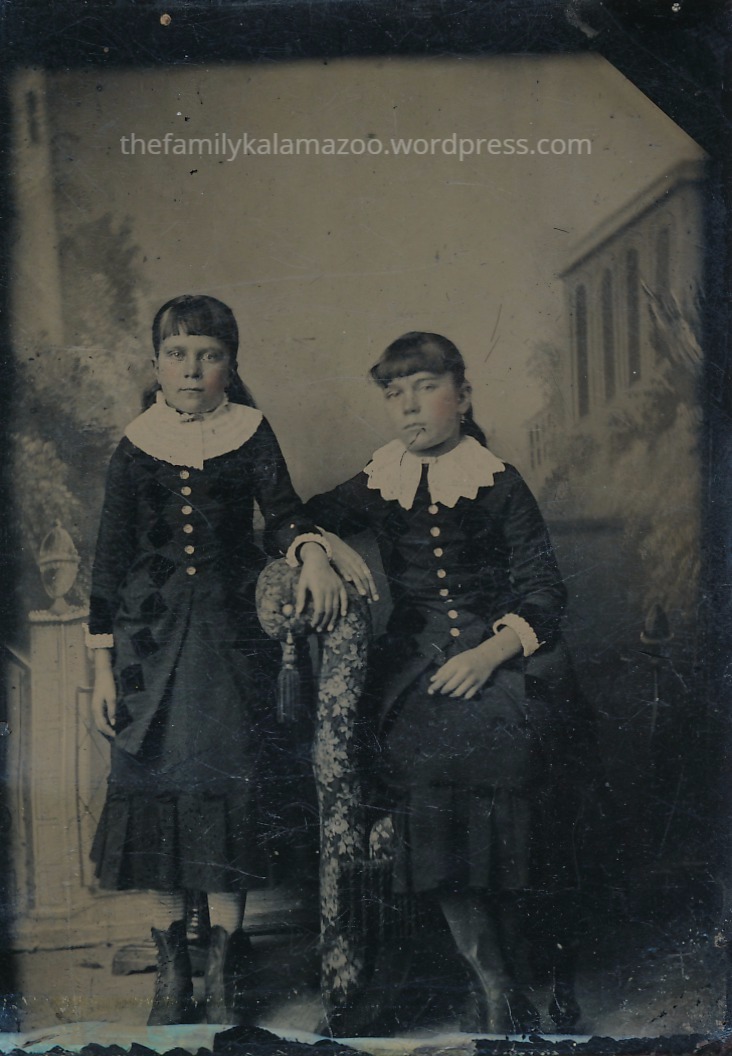
While I am making connections and doing more behind the scenes (haha, sounds important) work on the genealogy, I thought I’d share an uncleaned-up photo from the Joseph DeKorn collection. The spots are just a little extra treat. I’d love to hear ideas about the best way to get rid of them!


126 Balch Street, Kalamazoo, Michigan

The little girl behind the bench is Alice Leeuwenhoek, and the date is Thanksgiving 1907. I trust that this is Alice because Grandpa told me in the late 70s, and he knew Alice. Old writing on the back indicates the date. But is the address correct?

In the 1910 census Lambertus, Jennie, and Alice all lived at 110 Balch Street. The houses are numbered 110, 112, 120, 130, 210, 216. No number 126.

Is this the Leeuwenhoek house or not? I’m going to hazard a guess. The address written on the back of this photo is in my handwriting, which means that Grandpa gave me the address. I already suspect that the numbering was changed at some point on Burdick and Balch because the older numbers do not match to the current addresses. Maybe Grandpa gave me the address that was correct in the late 1970s, but not the address as it was in 1907.

Because of the way Alice is standing behind the bench, near the house, and alone, I think this is her own house.

The placement of this house would have been very near Richard DeKorn’s brick house at the corner of Burdick and Balch. I wrote about it in this post The Richard DeKorn House. Alice was Richard’s granddaughter as her mother Jennie was Richard’s daughter and my grandfather’s aunt. Grandpa and Alice were first cousins.

I looked on Google Maps to see what the area looks like today. 126 Balch is about the 4th house down from the DeKorn house on the corner. So, is it possible that in 1907 they lived in 126 and in 1910 they lived in 110? It’s possible because maybe Richard owned several houses on Balch Street. That would not be inconceivable. Or that he had owned the land and gave or sold parcels to family members.

Maybe all the families living on Balch street are not on the census with the Leeuwenhoeks because they weren’t home when the census taker came. That would further complicate things. All this makes me wish I had some time in Kalamazoo to get my hands on some of the property ownership records!

Still, I do feel confident that this is Alice standing in front of her house on Balch Street in 1907, and that she lived quite near her grandparents. Her grandmother, Alice Paak DeKorn, would die the following year–and Grandpa would be born.

Read Full Post »

Right now I am corresponding with several new people from the Noffke branch of the family, as well as from my dad’s family. The Noffkes are connected with the Waldecks and Kuschs and possibly immigrated from East Prussia. I’ve also got a really busy two months ahead of me, so I can’t share all the information or move very quickly on any of the leads I have.

I’ve met another roadblock, though, in learning the name of the town these people actually came from. I tried to get the death certificates of all the Waldeck kids. By kids I mean my great-grandmother and her siblings. I found Godfrey’s. He is the only one I actually knew. His certificate says he was born in Germany. No help there.

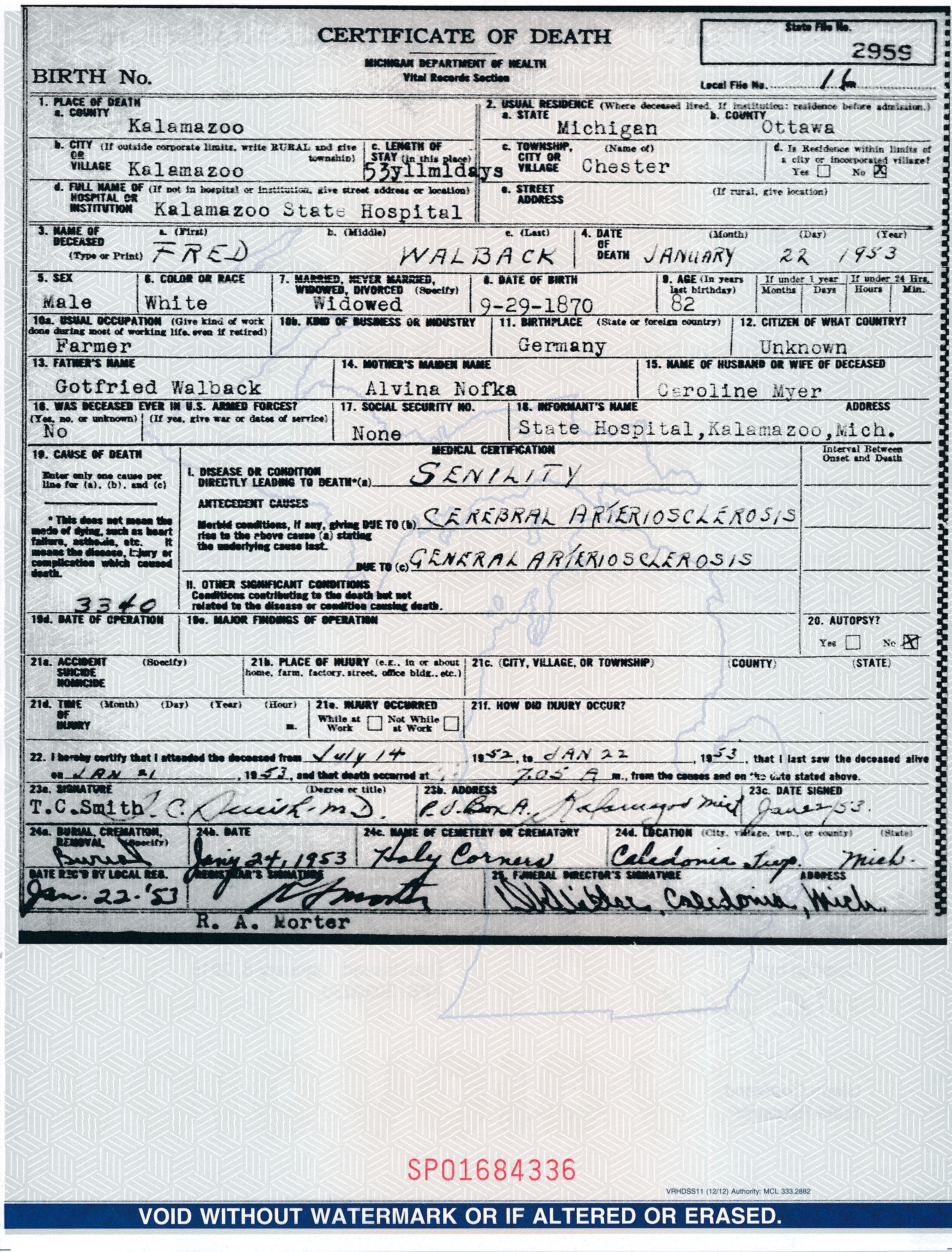
I really wanted to find Fred’s because he is the one who was catastrophically injured in a streetcar and wagon accident and had to live out his life at the State Hospital in Kalamazoo. At first, I thought his certificate was lost, but then I found it under the name Walback, rather than Waldeck. Sadly, it gives the time he lived at the psychiatric hospital. 53 years, 11 months, 1 day. They don’t even know his last name, but they knew how long he was there to a day. Since he died on January 22, 1953. That would mean that he was injured before February 21, 1899. Imagine living in that institution for almost 54 years!

Of course, Fred’s death certificate also says he was born in Germany. No other origin info. For “citizen of what country?” they typed in “Unknown.”


On the 1900 census, his wife Caroline was found living with a farm couple out in the country, working as their servant. Their son Edward (the boy who was hit by the car when he was a young teen) would have been a toddler and probably was living in Grand Rapids with his maternal grandmother while his mother sent money to them. What a tragedy for that young family.

Several Waldeck siblings died while still in Europe, apparently as babies or children. But that leaves my great-grandmother Clara, her sisters Ada and Annie, and brother August. I haven’t been able to find any of their death certificates yet! A lot of the databases only go until 1952 in Kent County, and Clara died in 1953, the same year as Fred. August died during WWI, but I can find no information about him. If I can find these death certificates, maybe, just maybe, somebody will have something more definitive on there for origin than “Germany.”

Apparently, the State Hospital (Kalamazoo Psychiatric Hospital) had several buildings on their campus. Maybe Fred lived in this building, called Edwards, which housed male residents. This photo belongs to the Kalamazoo Public Library and can be found with others on their site. Click through the photo to enter.

Read Full Post »

Two and a half years ago I wrote a post explaining how I didn’t know anything about the Waldeck branch of my family. I’ll quote the post here and then give you an update, such as I have at this point.

Waldeck is a fairly common name.  There are two Castle Waldecks. Lots of places share the name Waldeck.  There are many Waldecks listed on Wikipedia, including the first Waldeck, who was a count, and some Waldeck princesses.  I bet there are a lot of paupers named Waldeck, too.

But so far I can’t find the town or region in Germany where my Waldeck family came from.

Look at the sorry state of the family tree:

Godfrey Waldeck family treeeGodfrey (Gottfried) and his wife Alvena (Alvina) immigrated to the United States with their family and then had more children. I don’t even know if all those children listed on this tree are theirs! Clara is.

And so is Godfrey (junior) because I remember him when I was young. He managed a grain elevator or something like that, but he also farmed his own land. He was blind from glaucoma when I met him, and he still walked down the road each day and drove his tractor in the fields. As an aside, glaucoma runs rampant in their family.

I know that Grandma used to like to go to the Waldeck family reunions, and I went to at least one myself, at a lake (of course).

Look at Alvina Waldeck above. The tree lists her as Alvina Neffka, as if that is her maiden name. But is it? I’ve also seen it listed as Noffke and on her death certificate her father was listed as Louis Koffler. Her mother was listed as Dora Couch.

Noffke is a German name, and so is Koffler.  Neffka is not German.  Neither is Couch.

One person I’ve spoken with has wondered if the family was more Polish than German, but I have no proof of that either.

I need some help with this and hope that somebody reads this blog and gives me some clues about the family!


I am going to take a stab at identifying the people in the photo.

Back row:  Fred (according to a rumor, he was in a terrible accident), Ada Steeby (who had a daughter Ruth), Anna (did she marry a Stewart or Christianson or both), August (died in WWI, a bachelor)

Front row: Gottfried, Clara (my great-grandmother), Alvina, Godfrey

Looking at this photo and the names, can we write off Adolph, Rudolph, Max, Herman? Are they not part of our family?  Or were they older, born in Germany, and already living their own adult lives when this photo was taken?  And why isn’t Fred even on the family tree?!

Here is what I’ve learned. The family names from this branch are WALDECK, NOFFKE, and KUSCH. I believe that Couch was written by a non-German speaker on a document, and that the name is Kusch. I believe this because there are Noffke families and Kusch families in one particular area of what was (sort of) Germany: Pomerania in East Prussia. My ancestors in this branch were most likely ethnic Germans living in East Prussia, a place that would become northern Poland, a change in borders that would result in their exile at the end of WWII in 1945. Because nothing can be tied up neatly in genealogy, Waldecks do not live in the same region as Noffkes and Kuschs.

I did find a Dorothea Kusch from East Prussia who travelled to the United States from Pomerania in the 1880s, but on further analysis believe that she is a different Dorothea Kusch from Dora Kusch Noffke. This info gave me the idea that “Dora’s” name probably was Dorothea because my great-grandmother named her 3 daughters after the Noffke family. She would have named her oldest daughter Dorothea (Dorothy) after her own grandmother, as she named her second daughter Lucille after her own grandfather, Ludwig/Louis.  Her third daughter was named Alvena, after her own mother Alwine Noffke Waldeck.

Fred (born Friedrich and later Frederick), the man above who was in a terrible accident, I found just where my grandmother had warned: the State Hospital in Kalamazoo. He was in a streetcar and wagon accident and was confined to the psychiatric hospital after that. His wife and young son Edward moved in with her mother in Grand Rapids, Michigan. Fred died at the State Hospital, so that is how I found his death certificate.


While Fred was gone from home at the hospital, his 14-year-old son, Edward Waldeck, perhaps while he was working or traveling to school, was hit by a car. I found an article in the paper dated July 6, 1912 about how the driver left the boy and didn’t take him to the hospital. He was lucky to survive after being left alone. Read the description of his injuries in the article and see if you think the driver should have left him!

I have also discovered that Adolph, Rudolph, and Herman passed away while the family still lived in Germany, but I have not found death records for them. Max passed away shortly after the family moved to Michigan. August died during the time of WWI.

One more thing. Late last night I got an Ancestry “hint” on Aunt Vena and Uncle Al’s wedding–that is Clara Waldeck Mulder’s daughter Alvena. Their marriage license was now available online. I noticed that they were married in the Portland Baptist Church by Pastor E. A. Waldeck. How odd that the name was Waldeck! And E.A. Like Edward? Could he be the right age? And was the A correct? Yes, it was. Edward Waldeck, son of Fred, and Aunt Vena and Grandma’s first cousin. The boy hit by the car had married a young lady named Cora. In the 1930 census, he was an accountant for an auto shop and she was a music teacher. But in the 1940 census, he was now a minister with the Baptist church! Another click of a puzzle piece snapping into place!

Read Full Post »

« Newer Posts - Older Posts »