Feeds:
Posts
Comments

Archive for the ‘Kalamazoo mid 20th century’ Category

Frank Tazelaar was married to one of the daughters of my great-great-grandmother’s sister. He’s the husband of my first cousin 3x removed. Yup, that is easy to remember, right? Remember the Paak/Peek sisters and brother? Mary Peek (the spelling she used) married Richard Remine. For decades I thought there were four Remine children: Jenny, Genevieve, Therese (Tracy), and Harold. I had information for all four. But after more work, I finally found a very important divorce record and now know that Jenny and Genevieve were the same person.

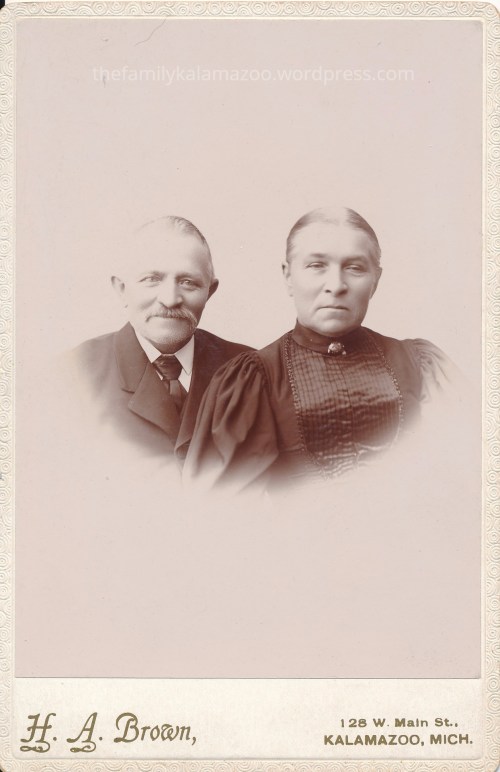
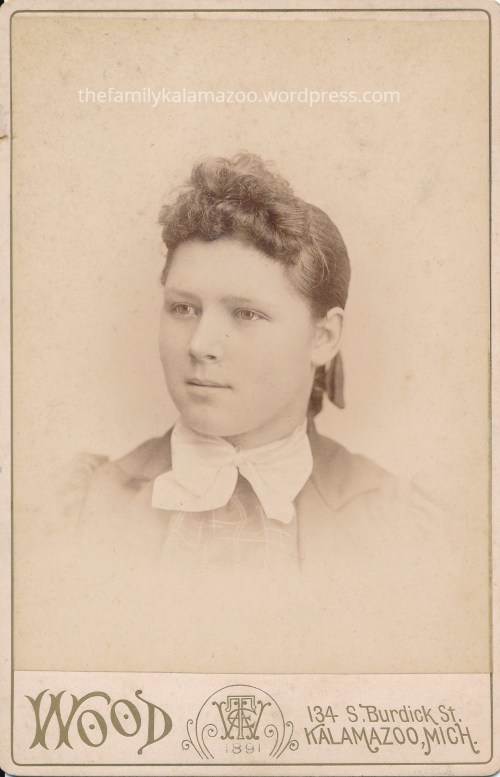
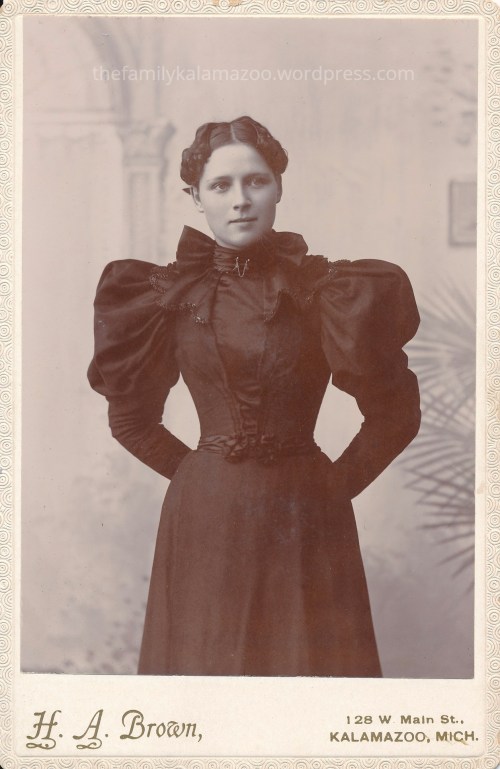
This is Jenny (when she was younger) or Genevieve (once she was married to Frank Tazelaar). My grandfather identified her as Jane, so she might have used that name when she was young also. Her grandmother’s name had been Jana. I will refer to her as Genevieve because that is the name she ended up using for decades.

Here is Frank:
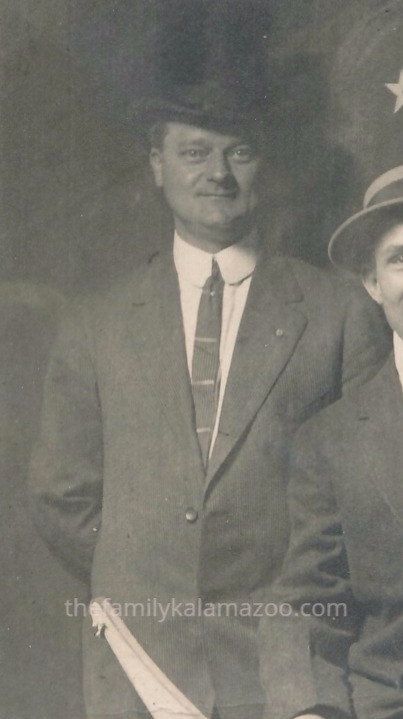
But why am I writing about Frank Tazelaar now? Because Sharon Ferraro is researching the effects of the influenza pandemic in 1918 in Kalamazoo. And Frank’s name is on the list as someone who contracted the illness and survived. It does not appear that he was treated at a hospital. He was ill and off work for ten days and then was able to go back to “his store.” In the 1920 census he was listed as a salesman/buyer in a clothing shop (same entry in the 1930 census). On the influenza document, his wife is listed as Genevieve and they lived at 124 N. West. Although I have verified that this information is correct, I have never heard of that street in Kalamazoo.

Genevieve was born 24 June 1881 in Kalamazoo, the first child of her parents, Richard and Mary. She was first married to a man she might have met in Chicago. His name was Harry Cohn. They were married in Paw Paw, Michigan, on 29 January 1903, when she was 21 years old. Three years later, on 23 June, 1906, they were divorced. The grounds were listed as “desertion,” but who deserted whom? If that was really what happened. Apparently, though, they had not been together for quite some time because about two weeks later, on 9 July 1906, Genevieve and Frank married in Chicago.

Frank was born in Wissenkerke, Netherlands, on 18 January 1876, to Peter Tazelaar and Adriana Bek Tazelaar. When he was a boy, his family moved from Holland to Kalamazoo, Michigan. He was a few years older than Genevieve. His native tongue was Dutch, whereas Genevieve was American-born. It’s hard to imagine what happened with Genevieve’s first marriage or how she happened to marry Frank–and what the Chicago connection was between Genevieve, Frank, and Harry. In fact, unless she went away to Chicago to school, I can’t imagine her leaving her parents’ home by the age of 21. Was she sent away for some reason? Since she never had any children, it’s less likely that she was pregnant, although always possible. 

Genevieve did not have children with either Harry or with Frank. When Genevieve passed away on 17 September 1930 of appendicitis (leading to gangrene and peritonitis), the couple was living at 423 S. Westnedge with her parents, Mary and Richard. That must have been awkward because on 21 March 1932 he married Bernice Dayton, the manager of “Lerner Shop.” Could this be the same Lerner store (part of the nationwide chain) that I grew up with? It’s likely because the Lerner Shops were first opened in 1918. (As a cool aside, the uncle of lyricist Alan Jay Lerner was one of the two founders).

Here is another photo of Frank Tazelaar, at the Whistle Stop in Kalamazoo, on 15 February 2014, four years before he contracted the flu.

Frank Tazelaar
near Whistle Stop
Kalamazoo

As with most of my other blog posts, this story is ripe for more research. In particular, I’d like to search City Directories for addresses and businesses, as well as the local newspaper for articles about the couple and, possibly, “his” store.

OK, I peeked. There are many Kalamazoo Gazette articles about Frank. In fact, there are over 50 articles! Let’s see what we can find . . . next time.

But it won’t be ready until after my son’s wedding, so I will post Frank’s shenanigans on May 1!

Read Full Post »

In “honor” of the weather some of the United States has been having this week, I am posting photographs from the Burdick and Balch neighborhood in Kalamazoo during the blizzard of 1978.The yellow house was my grandparents’ house at the corner of Burdick and Emerson.The white building was my grandfather’s Sunoco station.The other houses are from the neighborhood. As befitting a 1970s camera and film, the color is poor–yellowy and faded.

I’ve posted the house and gas station in the past. Here is the house from 1947:

Grandma and Grandpa’s house on Burdick Street

You can find the station at Down at the Station.

Meanwhile, Phoenix was about 90 degrees yesterday :).

Read Full Post »

When I was a kid growing up in Kalamazoo, it was known as “The Paper City.” Our fifth grade teacher–a very eccentric personality–told us about the way paper was made and emphasized that the reason we were not to eat paper (a common habit in elementary school) was that the workers in the paper mills would chew tobacco and spit it at random into the vats of liquid paper. That was why we would occasionally see a little burst of tan, like a star or partial star, on a sheet of white paper.

Kalamazoo was home to several paper mills and companies. Here is a little info I found online:

Taking advantage of the area’s bountiful water resources, in 1867 the Kalamazoo Paper Company opened its first mill. According to historian Larry Massie, the company provided a training ground for paper makers and “was one reason for the amazing proliferation of paper mills throughout the Kalamazoo Valley.” The area’s proximity to Chicago, its excellent railroad network and its large labor force further aided the industry’s development. By the early twentieth century, Kalamazoo County was the state’s dominant paper producer. According to 1904 state census figures, its five paper and wood pulp mills (one-sixth of the state’s total) represented 25 percent of the industry’s capital value. By World War I, Kalamazoo was the center of the largest paper-producing area in the United States. The industry employed one-half of the city’s labor force.

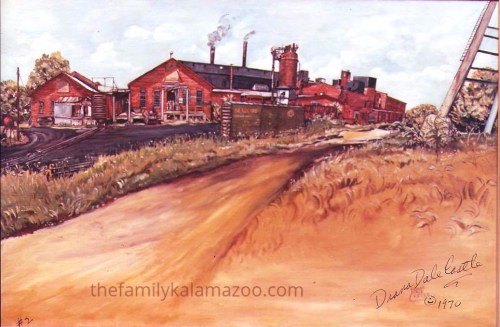
My mother-in-law, Diana Dale Castle, painted one of the mills in 1970. This is the Monarch Paper Mill, owned by Allied Paper Company.


The Kalamazoo Library has a terrible image of the Monarch mill from 1910 here. And this one slightly better.

Here is a photo of the machine room and of the male workers in 1915. There is also a photo of one John Bushouse at the mill in 1915. All this is left now of the Monarch Mill is the pond. In a Facebook group for old Kalamazoo, people talked about swimming at the mill pond. I can’t imagine this because I remember driving past the pond and thinking ICK and SCARY.

A quick search on Ancestry for John Bushouse reveals that it is a somewhat common name in Kalamazoo and that the owners of the name are immigrants from the Netherlands or their children. I could not find the John Bushouse that worked at the mill in 1915.

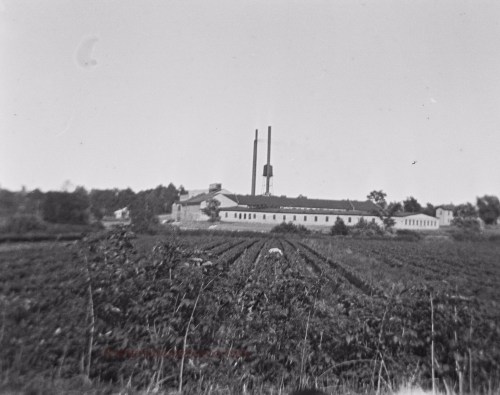
I found an unidentified photograph made from one of Joseph DeKorn’s glass negatives that seems to be from the heyday of paper manufacturing in Kalamazoo. Since it was one of the DeKorn negatives that means that the photograph was probably taken between 1903 and 1918. I suspect that it is an image of a paper mill. If you agree that it is probably a paper mill, do you think it is the Monarch mill or a different one? Before you answer that, you should check the photo in the second library link so that you have enough information.

According to one source, at one time, paper mills were the 5th largest employer in Kalamazoo. According to the source I quoted above, HALF the labor population worked in the paper industry! But that business dried up in the 80s. Obviously, paper is still being made, so why not in Kalamazoo?
Read Full Post »

In the 1970s, Grandpa identified some of the old photographs as members of the Ebelink family–from Kalamazoo, of course. He didn’t mention just who they were, but I wrote down the names on the back of the photos. I’ve labelled the photos as my grandfather told them to me and corrected them if I found an error.

Anna Ebelink Fisher Fletcher 1891

Ann Ebelink Myers

John Ebelink: 1891

The father (Benjamin Ebelink) and stepmother (Van de Giessen) of John Ebelink

So who were these people? According to the 1880 census, Benjamin and Wilhelmina, both born in Holland (the Netherlands), had three children: Frederich (age 6), John (age 5), and Joanna (age 2).  Since there is no existing 1890 census for Michigan, I had to skip ahead to 1900, where I found John married for four years to Jennie, with one child, Wilhelmina, age 3. A quick search for the death of John’s father Benjamin and I find the year 1916 in Ottawa, Michigan. He was a widower, so he must have already buried at least two wives.

But who were Anna and Ann? I can see Joanna being one of them. Are these two different sisters? And were they really married to Fisher and Myers?

It appears Anna married a Fletcher, not a Fisher. Could have been Grandpa’s memory–or my hearing.

Name: Anna Ebelink
Gender: Female
Race: White
Birth Year: abt 1878
Birth Place: Kalamazoo, Michigan
Marriage Date: 12 Jul 1900
Marriage Place: Kalamazoo, Kalamazoo, Michigan, USA
Age: 22
Residence Place: Kalamazoo, Michigan
Father: Barend Ebelink
Mother: Wilhelmina Stroup
Spouse: Claude H Fletcher
Record Number: 5305
Film: 68
Film Description: 1900 Delta – 1900 Mackinac

Benjamin was also Barend, a Dutch male given name, and it looks like John and Anna’s mother’s maiden name was Stroup. A bit curious about Anna’s photo is she appears to be in mourning, doesn’t she? I wonder when their mother died.

I can’t find Ann Ebelink Myers. Was she Anna or a different child?

I didn’t want to go too far down this tangent without knowing how these people are connected to my family. I found it by looking at the 1940 census. John and his family lived on Balch Street, right near my family. I would think that my mother and uncle must have known the family.

Read Full Post »

Aunt Jen and Uncle Lou’s (Jennie DeKorn Leeuwenhoek and Lambertus Leeuwenhoek) only child, Alice, married Clarence Moerdyk (Dutch spelling Moerdijk).


Clarence Dewey Moerdyk

1898–1985

BIRTH 24 MAY 1898 Kalamazoo, Kalamazoo Co., MI

DEATH 18 DEC 1985 Winter Park, FL

Clarence’s parents were Peter (Pieter) and Cora. His father immigrated from Biervliet, Zeeland, the Netherlands, when he was 2 years old, in 1867.

I once posted a photo of Clarence as a kid, but at the time I wasn’t sure who he was. Blog readers helped me discover that this is Clarence who lived at 120 W. Ransom in Kalamazoo. That address is directly north of Arcadia Creek, five blocks north of East Michigan Avenue. Would you say he is in his mid-teens?

Alice and Clarence were married in Kalamazoo on 12 September 1923 by The Reverend Benjamin Laman of Bethany Reformed Church.

Here is information about the church at that time from their website:


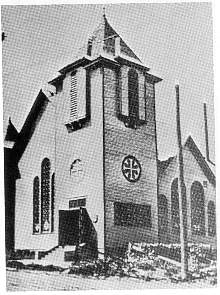
On June 5, 1905, in a tiny chapel near Burdick and Maple, the mission Sunday School that was to become Bethany held its first service. . . .

Growth under the leadership of these men was so great that less than two years later it was apparent that a larger building was needed. In 1907, a new church was built on the site of the original chapel. At this time the church had grown to include fifty-two families and seventy-seven communicant members. By the time that Reverend Kooiker left the church in 1910, Bethany had grown to sixty-nine families and one hundred eighteen communicant members.


Here is Clarence as I knew him in the early 60s:


Read Full Post »

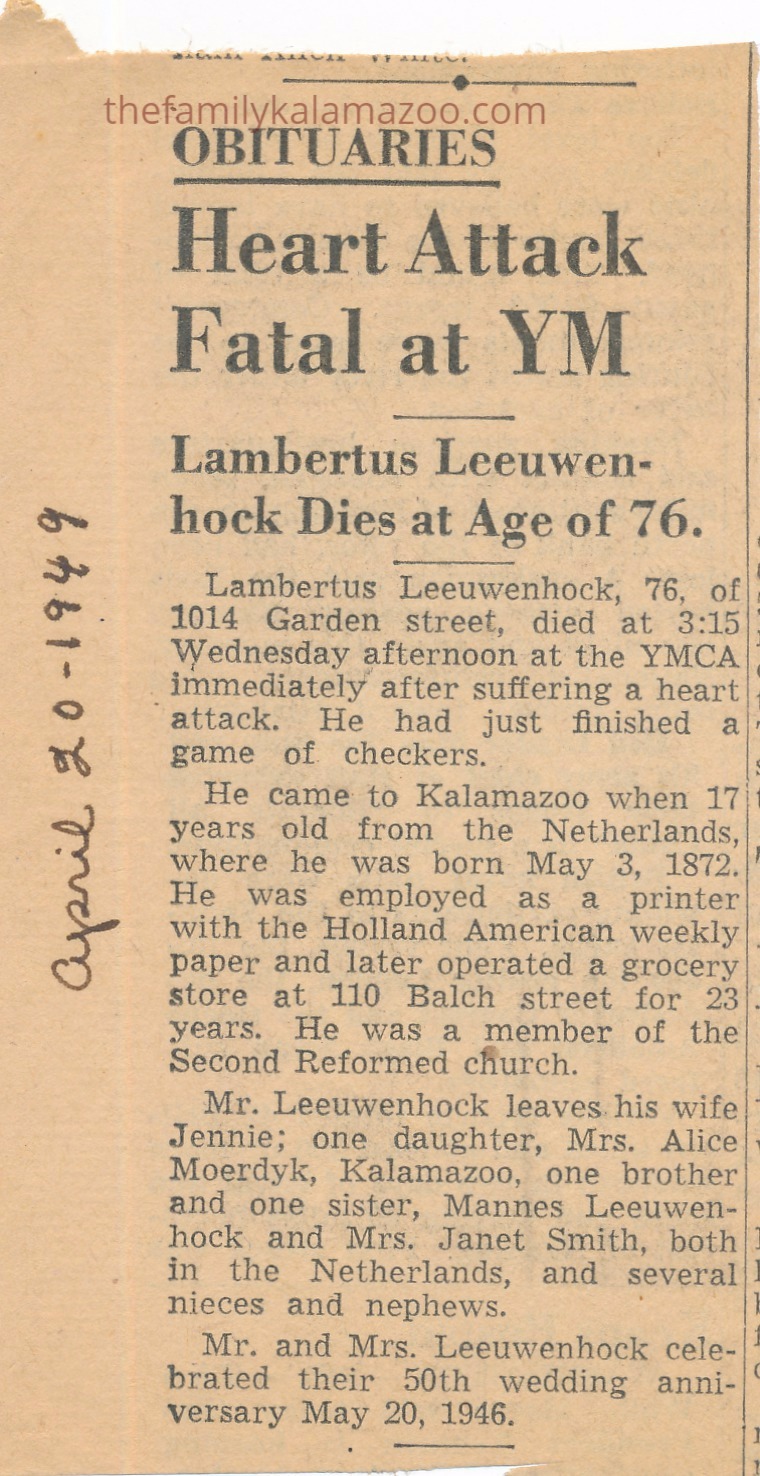
I’ve heard that Uncle Lou (Lambertus Leeuwenhoek) loved to play games–and was very good at them. Where and when he passed away is fitting, in that context.


Uncle Lou “died at 3:15 Wednesday afternoon at the YMCA immediately after suffering a heart attack. He had just finished a game of checkers.” I bet he won the game.

I need to research where the Y was located.

He died on Wednesday, April 20, 1949. Coincidentally, my father-in-law passed away in 1984 on April 20. Notice that Uncle Lou and Aunt Jen were married on May 20. My birthday is July 20. My cousin was born January 20. I always notice the number 20.

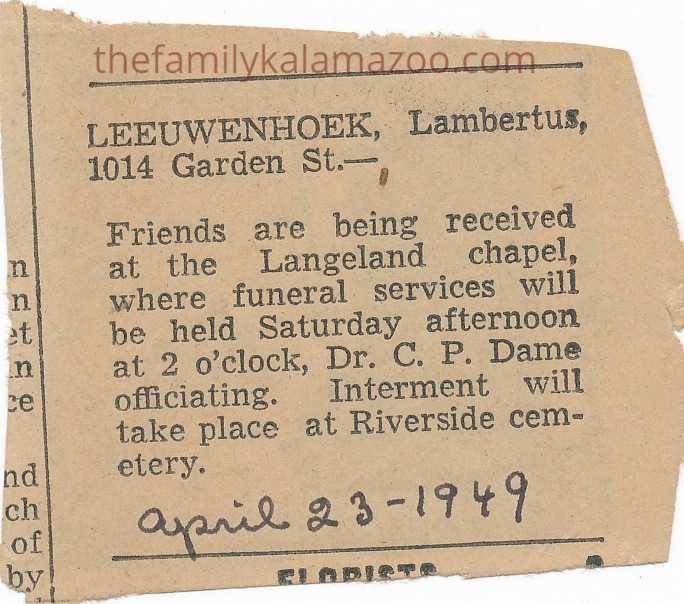
Here is the funeral announcement in the newspaper:

And here is a beautiful memorial book from Uncle Lou’s funeral. I wish I knew how to create a slideshow that allows a reader to enlarge each photo, but I don’t know if there is a way on WordPress.

This slideshow requires JavaScript.

What I find particularly useful from a genealogy standpoint are the names of the visitors on the last two pages. They are as interesting as the names in the obituary, if not more so.

Read Full Post »

Right now I am corresponding with several new people from the Noffke branch of the family, as well as from my dad’s family. The Noffkes are connected with the Waldecks and Kuschs and possibly immigrated from East Prussia. I’ve also got a really busy two months ahead of me, so I can’t share all the information or move very quickly on any of the leads I have.

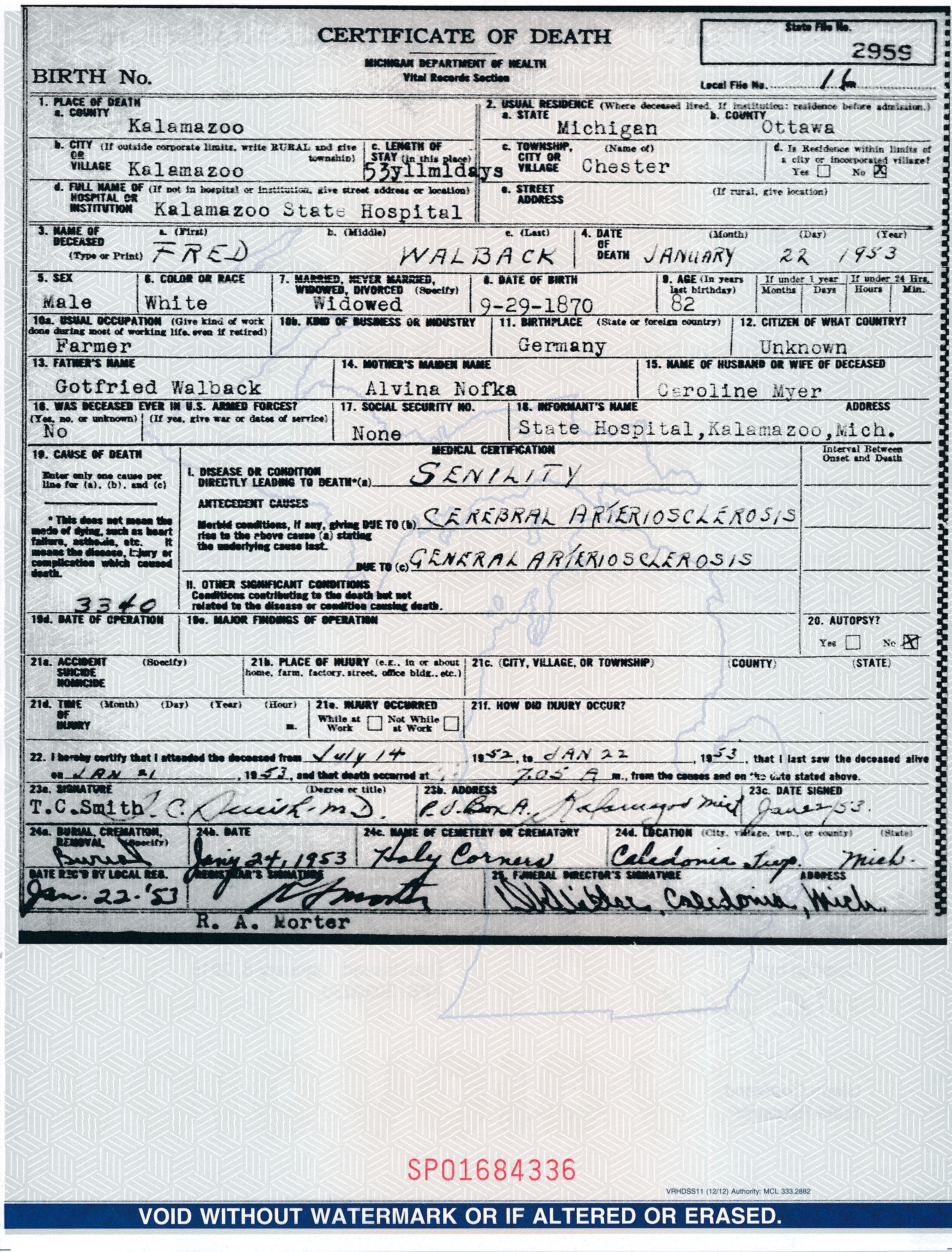
I’ve met another roadblock, though, in learning the name of the town these people actually came from. I tried to get the death certificates of all the Waldeck kids. By kids I mean my great-grandmother and her siblings. I found Godfrey’s. He is the only one I actually knew. His certificate says he was born in Germany. No help there.

I really wanted to find Fred’s because he is the one who was catastrophically injured in a streetcar and wagon accident and had to live out his life at the State Hospital in Kalamazoo. At first, I thought his certificate was lost, but then I found it under the name Walback, rather than Waldeck. Sadly, it gives the time he lived at the psychiatric hospital. 53 years, 11 months, 1 day. They don’t even know his last name, but they knew how long he was there to a day. Since he died on January 22, 1953. That would mean that he was injured before February 21, 1899. Imagine living in that institution for almost 54 years!

Of course, Fred’s death certificate also says he was born in Germany. No other origin info. For “citizen of what country?” they typed in “Unknown.”


On the 1900 census, his wife Caroline was found living with a farm couple out in the country, working as their servant. Their son Edward (the boy who was hit by the car when he was a young teen) would have been a toddler and probably was living in Grand Rapids with his maternal grandmother while his mother sent money to them. What a tragedy for that young family.

Several Waldeck siblings died while still in Europe, apparently as babies or children. But that leaves my great-grandmother Clara, her sisters Ada and Annie, and brother August. I haven’t been able to find any of their death certificates yet! A lot of the databases only go until 1952 in Kent County, and Clara died in 1953, the same year as Fred. August died during WWI, but I can find no information about him. If I can find these death certificates, maybe, just maybe, somebody will have something more definitive on there for origin than “Germany.”

Apparently, the State Hospital (Kalamazoo Psychiatric Hospital) had several buildings on their campus. Maybe Fred lived in this building, called Edwards, which housed male residents. This photo belongs to the Kalamazoo Public Library and can be found with others on their site. Click through the photo to enter.

Read Full Post »

HAPPY

BIRTHDAY,

MOM!!!i

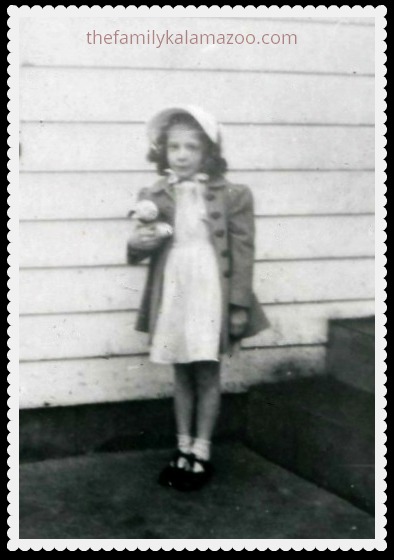
A beautiful lady and mom now and a beautiful girl then. Here she is by her house when she was a little girl:

I can’t help but wonder if this is a little Easter bonnet and an Easter toy in her arm.

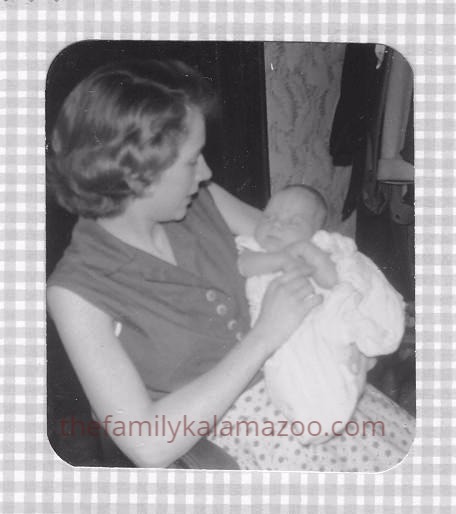
This is when I was a baby.

Have a beautiful day, Mom!!! xoxo

Read Full Post »

While I’m working on the 30/30 Poetry Project through Tupelo Press this month, I am not doing any work on the genealogy project!

But I found something yesterday that I wanted to share.

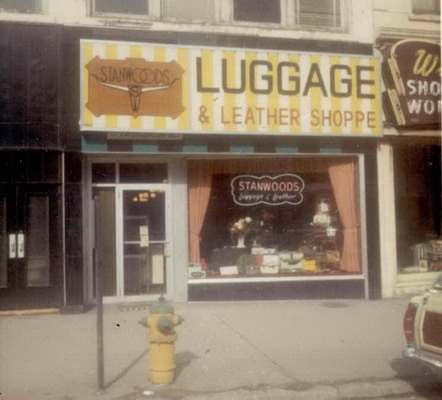
About 2 1/2 years ago, I mentioned that my father, and later my husband and I, owned Stanwoods Luggage and Leather in Kalamazoo.

These photos are from the 60s and 70s.

In that first post, I included this photo. There was a bell hanging from the front door so we could hear it open and close if we were in the back.

You see Why Shoe Works next door? Dad was the last owner of that business.

Every July the Downtown Kalamazoo Association would organize a sidewalk sale that most merchants would participate in. We always did, marking down items and putting them out in the heat for customers to pick over.

Here’s a photo of the sidewalk sale. I used to love working those for the excitement. Dad would stand out in front with a megaphone, addressing people across the wide main street. Our routine was broken, I was out of the confining store, and I could people watch as they rummaged through our merchandise.

Notice the round suitcases on the luggage display rack. Do you know what those are? Hatboxes!! We were still selling those in the 60s. Train cases, too. Those were boxlike suitcases where all your cosmetics and toiletries could stand upright. Today we use BAGGIES to carry our liquids. Yes, we’re definitely more civilized today.

Eventually we had T-shirts made with a new Stanwoods logo and wore the T-shirts on sidewalk days. That’s what I found yesterday! The last Stanwoods T-shirt.

Here’s a photo of the block of E. Michigan Avenue where Stanwoods existed.

Read Full Post »

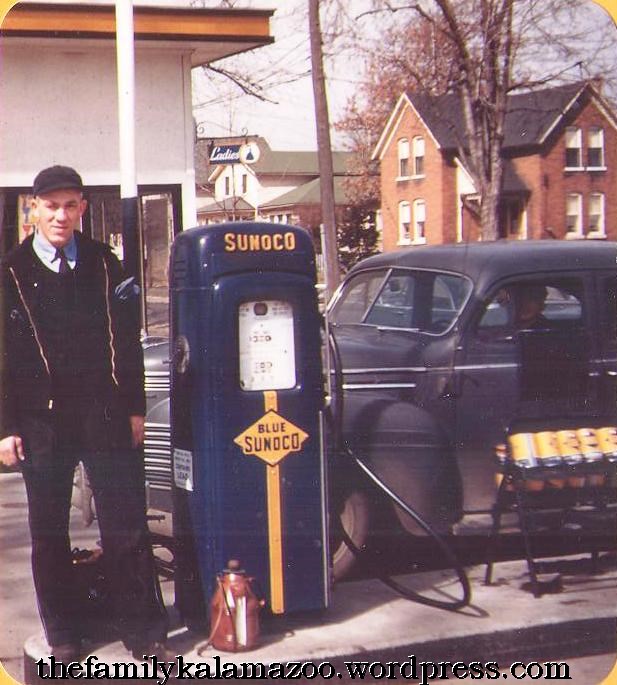
I like to talk about Grandpa Adrian Zuidweg’s Sunoco gas station because it seemed a little magical when I was a kid. Here is how it looked 20 years before my time–in 1939:

I don’t know who lived in the house on each side in 1939, but I did 20 years later. Maybe it was the same people. The man who lived in the house on the left of the photo (to the right of the station) was Willie Dunn. When I was newly married and he was moving, he let me have an antique oak library desk from the house. I’m looking at it right now. Simple Queen Anne legs and two drawers without pulls.

Here’s a photo I’ve posted before–the view is different, so here you can see a sampling of the houses across the street on Balch Street. Any ideas on the date of this photo? The pump looks different than the ones in the 1939 photo, and then there is the car to help. I bet Uncle Don would know!

Grandpa by the pump at his Sunoco station

Grandpa by the pump at his Sunoco station

The pumps in the first photo have globes on the top of them. Does anybody know if the globes lit up like lighted signs? I found a photo of a vintage pump that looks like that type:

There is something to be said for such a fancy model, but it was probably more expensive to build and to maintain. In case you’re wondering, yes, people collect old gas station memorabilia–anything with a brand name and a logo!

Here is what Grandpa’s gas station looks like today. Or shall I say the site of the station. You see that white house? You can see all the way to that house because Willie Dunn’s house is gone.

When you were a kid, did you enjoy visiting or playing at or working at a small business in your family?

Read Full Post »

« Newer Posts