Feeds:
Posts
Comments

Archive for the ‘Genealogy’ Category

My new friend (and Xth Mulder cousin) Elly sent me something she found in the Goes archives that I think is quite special.

Let me give a little context first. My grandfather, Adrian Zuidweg, was the son of Adriaan Zuijdweg who immigrated to the United States in 1893. Adriaan’s father and mother, Johannes and Jennie, also immigrated after their son–in 1901.

Johannes’ father was Adriaan Zuijdweg, 1805-1851. He only lived to be 46 years old.

I also want to “remind” you that both my maternal grandparents are descended from Carel Mulder, the jailer’s hand. So while Elly was researching the Mulders she came across information about not only a descendent of Carel in the form of Johanna, his daughter, but also her husband Adriaan Zuijdweg, my 3rd great-grandfather through my grandfather’s line.

Elly says:
I found a quote in the archives of Goes, that Adriaan Zuidweg (born in 1805 and married [to] Johanna Mulder, daughter of Carel Mulder) made a request at the town-councelors to make it possible ( to emigrate with his family –5 children) to the USA.
Apparently it was denied, because 6 years later he died in Goes.
 !!! He wanted to bring his branch of the family to the United States long before the family actually did come here!
Here is the text:
Landverhuizers
Als gevolg van de misoogst en armoede, maar ook vanwege de tegenwerking van de afgescheidenen van de Hervormde kerk, verlaten de zogenaamde ‘landverhuizers’ ons land en emigreren naar Amerika en Canada. Op de 26e juli 1845 verzoeken twee ingezetenen van de stad om in de gelegenheid gesteld te worden buiten hun kosten te vertrekken naar Noord Amerika omdat ze zich buiten staat bevinden hier in hun levensonderhoud te voorzien. Het betreft de ongehuwde 39-jarige Adriaan Johannes de Wolff, timmerman, metselaar en schilder, en de 40-jarige Adriaan Zuidweg, kleermaker, gehuwd en vijf kinderen.
Elly continues:
It was an article about emigration.
Translated it says:
Because of crop failure and poverty, but also because of the opposition against the members of the separated Reformed church , many people leave the Netherlands and emigrate to the US and Canada.
On 26 July 1845 two citizens of Goes made a request to be enabled to emigrate, with the costs of this emigration paid by the town, because they are not able to support their means of living in this town.
It concerns A.J.de Wolff ( 39 years old, not married), carpenter, bricklayer and painter, and Adriaan Zuidweg, tailor, married and 5 children.
Of course, my mind went off in many directions. I wondered if the family was very poor and if they were even hungry. I thought that Adriaan had absolutely no resources. That he had to essentially beg to leave. That he was denied that opportunity, which seems cruel, like imprisoning someone without food. That here was confirmation that Adriaan was a tailor as I had already learned.
Then it dawned on me that I didn’t know what “separated Reformed church” means. I had vaguely known that most of my Dutch ancestors were adherents to the Reformed religion (a branch of Calvinism), at least until they came to the United States. But what did this “separated” thing mean?
I tried to Google the information, but it got more and more confusing to me, so I asked Elly if she could help. She sent me some sources. A Google translation of a passage from http://encyclopedievanzeeland.nl/Emigratie_van_Afgescheidenen goes this way:

As the Pilgrim Fathers in 1620 as a community have migrated to America, so are also left the secessionists of South Beveland in the spring of 1847 and she settled in Michigan as a congregation.

Apparently for a short time in the mid-19th century, there were people seceding from the Reformed Church–and these people must have included my 3rd great-grandfather, Adriaan Zuijdweg. Apparently they were from Zeeland, and this was not a big “wave” all over the Netherlands.

According to Elly, this period lasted from approximately 1830-1850, and the people were not persecuted but did find a lot of opposition. The movement must have been very small and confined to the region because apparently it is not taught in history classes in the Netherlands.

According to Wikipedia:

During the early nineteenth century, large numbers of Dutch farmers, forced by high taxes and low wages, started immigrating to America. They mainly settled down in the Midwest, especially Michigan, Illinois and Iowa. In the 1840s, Calvinist immigrants desiring more religious freedom immigrated. West Michigan in particular has become associated with Dutch American culture, and the highly conservative influence Dutch Reformed Church, centering on the cities of Holland and (to a lesser extent)Grand Rapids.

Waves of Catholic Dutch emigrants, initially encouraged in the 1840s by Father Theodore J. Van den Broek, emigrated from southern Netherlands to form communities in Wisconsin, primarily to Little Chute, Hollandtown, and the outlying farming communities. Whole families and even neighborhoods left for America. Most of these early emigrants were from villages nearUden, including Zeeland, Boekel, Mill, Oploo and Gemert. By contrast, many Protestant agrarian emigrants to Michigan and Iowa were drawn from Groningen, Friesland, and Zeeland; areas known for their clay soils.[4]

The Dutch economy of the 1840s was stagnant and much of the motivation to emigrate was economic rather than political or religious. The emigrants were not poor, as the cost of passage, expenses and land purchase in America would have been substantial. They were not, however, affluent and many would have been risking most of their wealth on the chance of economic improvement. There were also political pressures at the time that favored mass emigrations of Catholics.[4][5][6] Yda Schreuder, Dutch Catholic Immigrant Settlement in Wisconsin, 1850-1905 (New York: Garland, 1989); and H. A. V. M. van Stekelenburg, Landverhuizing als regionaal verschijnsel: Van Noord-Brabant naar Noord-Amerika 1820-1880 (Tilburg: Stichting Zuidelijk Historisch Contact, 1991).

It’s true that many of my Dutch ancestors did come from Zeeland and perhaps one branch from Groningen, although one branch came from Zwolle. So was Adriaan really that poor or was he rather temporarily economically “flat” because of the worsening economy in his country? I’d say the latter.

I do feel bad that the family had this hardship and wonder how it affected the children, especially Johannes, Grandpa’s grandfather. Although his father Adriaan couldn’t get him to America, apparently his son Adriaan did so.

As an aside, when I was a kid I used to love the folk and fairy tales that featured tailors and shoemakers, so I find it charming when I hear that so many of my ancestors were tailors and shoemakers, as well as merchants.

Here’s another tangent. Why do the men have occupations like that so often, but the women are usually maids or servants? Is that because those were their jobs when they got married and then they generally quit work after getting married? Did the daughters of tailors and shoemakers become maids when they were old enough to work but still unmarried? Or did they remain maids throughout their lives? What did it mean to be a maid in Zeeland in the 1800s? And, most importantly, did they wear white pinafore aprons?

Elly and I both wonder what happened to Johanna after Adriaan’s death. I checked out my family tree to see what chronology I could see.

Johanna was 29 when she married Adriaan. Then she had four children in a row (Kornelis, Karel, Geertrui, Johannes). On 26 July, 1845, when Adriaan made his application for emigration, the children were 8, 7, 5, and 3. That’s quite a handful. Less than two years after the application, Johanna’s father, Carel Mulder, died. He is the one who got sick and his prison guard job was awarded to another son-in-law, NOT to Adriaan. Seven months after Carel’s death, Johanna gave birth to yet another child, Johanna. The sixth child, Willem, was born in 1849.

It’s no wonder that in 1869, when Johanna was 62 years old, she was working as a laborer in Goes. She must have had to go to work after Adriaan’s death, if not before. Did she work when she was pregnant? Who took care of her children? Her own father was undergoing his own problems before his death, so he couldn’t help her. First he was suspended from his job for insubordination, then he became ill and eventually passed away.

What of Adriaan’s parents? The other grandparents of the children . . . .   Adriaan’s father, a fish inspector, passed away in 1841, five years before the application to emigrate was made. His mother died in 1838 after seeing only one of her grandchildren by Adriaan born.

Where does some of this information about Adriaan and Johanna (Mulder) Zuijdweg come from? The Goes archives.  Elly says that this archives is linked to the archives in Zeeland.

Zeeuws Archief


Read Full Post »

While I am making connections and doing more behind the scenes (haha, sounds important) work on the genealogy, I thought I’d share an uncleaned-up photo from the Joseph DeKorn collection. The spots are just a little extra treat. I’d love to hear ideas about the best way to get rid of them!


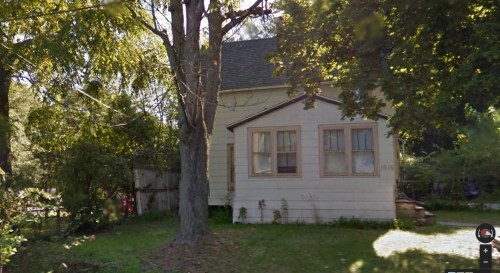
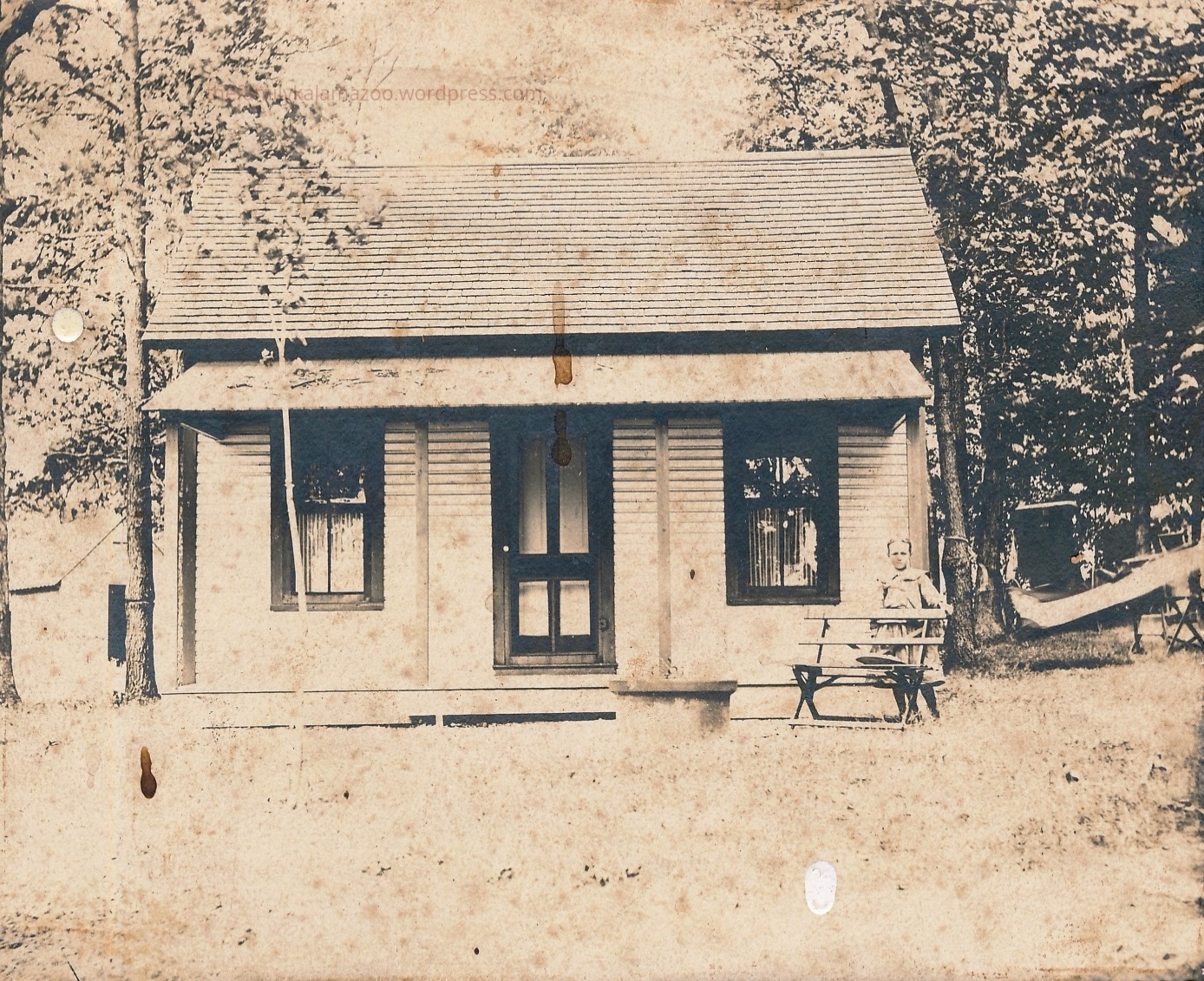
126 Balch Street, Kalamazoo, Michigan

The little girl behind the bench is Alice Leeuwenhoek, and the date is Thanksgiving 1907. I trust that this is Alice because Grandpa told me in the late 70s, and he knew Alice. Old writing on the back indicates the date. But is the address correct?

In the 1910 census Lambertus, Jennie, and Alice all lived at 110 Balch Street. The houses are numbered 110, 112, 120, 130, 210, 216. No number 126.

Is this the Leeuwenhoek house or not? I’m going to hazard a guess. The address written on the back of this photo is in my handwriting, which means that Grandpa gave me the address. I already suspect that the numbering was changed at some point on Burdick and Balch because the older numbers do not match to the current addresses. Maybe Grandpa gave me the address that was correct in the late 1970s, but not the address as it was in 1907.

Because of the way Alice is standing behind the bench, near the house, and alone, I think this is her own house.

The placement of this house would have been very near Richard DeKorn’s brick house at the corner of Burdick and Balch. I wrote about it in this post The Richard DeKorn House. Alice was Richard’s granddaughter as her mother Jennie was Richard’s daughter and my grandfather’s aunt. Grandpa and Alice were first cousins.

I looked on Google Maps to see what the area looks like today. 126 Balch is about the 4th house down from the DeKorn house on the corner. So, is it possible that in 1907 they lived in 126 and in 1910 they lived in 110? It’s possible because maybe Richard owned several houses on Balch Street. That would not be inconceivable. Or that he had owned the land and gave or sold parcels to family members.

Maybe all the families living on Balch street are not on the census with the Leeuwenhoeks because they weren’t home when the census taker came. That would further complicate things. All this makes me wish I had some time in Kalamazoo to get my hands on some of the property ownership records!

Still, I do feel confident that this is Alice standing in front of her house on Balch Street in 1907, and that she lived quite near her grandparents. Her grandmother, Alice Paak DeKorn, would die the following year–and Grandpa would be born.

Read Full Post »

In the midst of researching the Waldecks, I’ve been in contact with Elly, as you know, and Merry, who I haven’t told you about yet, from the Mulder branch of the family.

Elly found me through this blog, as I’ve mentioned. I found Merry through a DNA match. We both had our results stored at 23andme, and there it was, a fairly close match of 2nd-3rd cousin. When a match is that close, if both individuals have an idea of their family trees, you can usually find a match. It didn’t take us long at all.

Merry’s grandfather Henry (Heinrich Mulder) and my great-grandfather Charles were brothers! We are both descended from Pieter Philippus and Neeltje (Peter and Nellie) Mulder who arrived in Grand Rapids with two babies. One was Charles and the other was a baby named Jan who passed away shortly after the young couple arrived in the U.S. Henry was born in this country.

Peter and Nellie traveled on the ship Zaandam, which arrived in New York on August 29, 1887. They were able to immigrate because Peter had received a bequest when his grandmother Rosalie Melanie Bataille passed away.

I promise to get back to Elly’s findings in a later post. Today I want to share with you the photos of Peter and Nellie that Merry shared with me. And by putting them in the blog to share them with Elly and others as well!


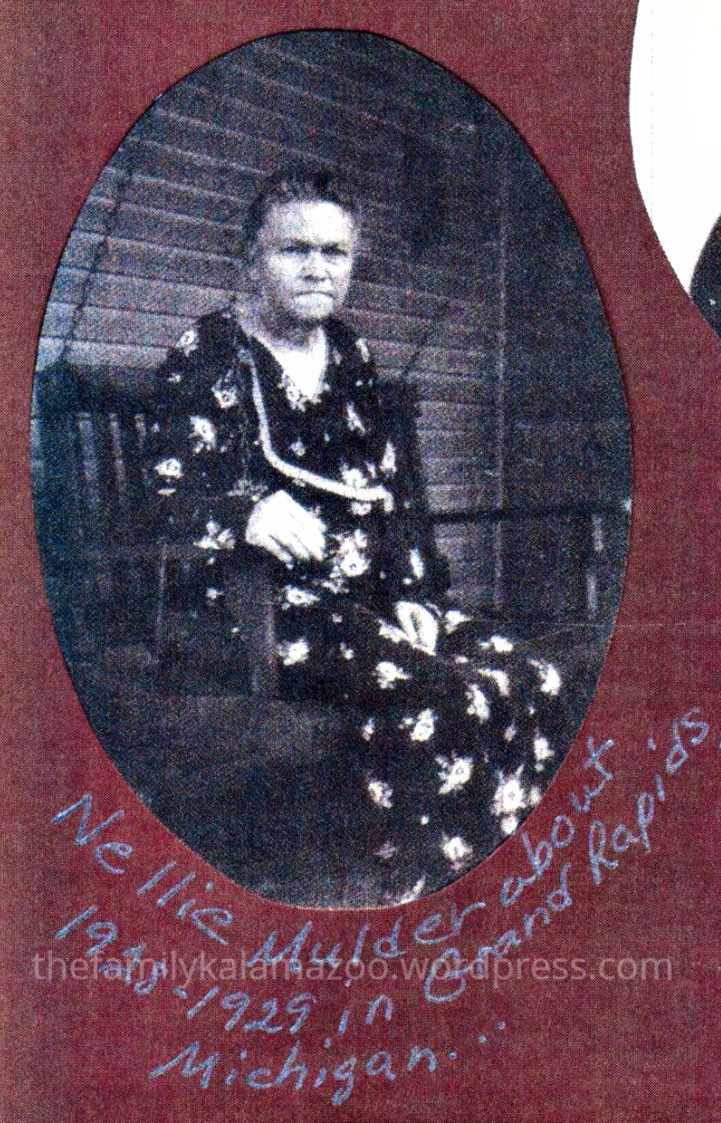
In this formal portrait, how old do you think they are? Note that Nellie was 63 when she died. Mom says that Peter was a very small man, so it seems that Nellie herself must have been very short. I recently read an article trying to answer the question of how the Dutch became the tallest people in the world. My own relatives were sometimes, but not always, on the short side, so I was curious. What I learned is that in the past 150 years the heighth of Dutch people has dramatically increased. Until this growth spurt they were the shortest in Europe!

As to why the Dutch grew, the article makes a case for eating a lot of dairy (among other causes). My husband says he thinks it also has to do with the Netherlands claiming more land from the sea and being able to eat meat instead of relying on fish for a large portion of their diet. I’m sure there are many ideas on this subject!

In the next photo, Nellie’s dress is very long.  While Peter (born 1865) was 3 years older than Nellie (born 1868), she passed away in 1932 and Peter lived until 1953, two years before I was born. After his wife’s death, Peter traveled around to his children’s homes, living with one then another. I wonder whose cooking he liked best (I hope it was my great-grandmother Clara who died the same year as Peter)!


Merry says that this photo of Nellie taken in a porch rocker should be dated somewhere between 1925 and 1929. Since it’s the same dress as above, I’ll assume these photos were taken around the same time.

Here is a formal portrait of Peter:


In this photo he looks like he could be related to Colonel Potter (MASH), in my opinion. Or the shopkeeper on Green Acres (Frank Cady as Mr. Drucker).

More to come about the Mulders, both those in Netherlands and those in Michigan!


Read Full Post »

Two and a half years ago I wrote a post explaining how I didn’t know anything about the Waldeck branch of my family. I’ll quote the post here and then give you an update, such as I have at this point.

Waldeck is a fairly common name.  There are two Castle Waldecks. Lots of places share the name Waldeck.  There are many Waldecks listed on Wikipedia, including the first Waldeck, who was a count, and some Waldeck princesses.  I bet there are a lot of paupers named Waldeck, too.

But so far I can’t find the town or region in Germany where my Waldeck family came from.

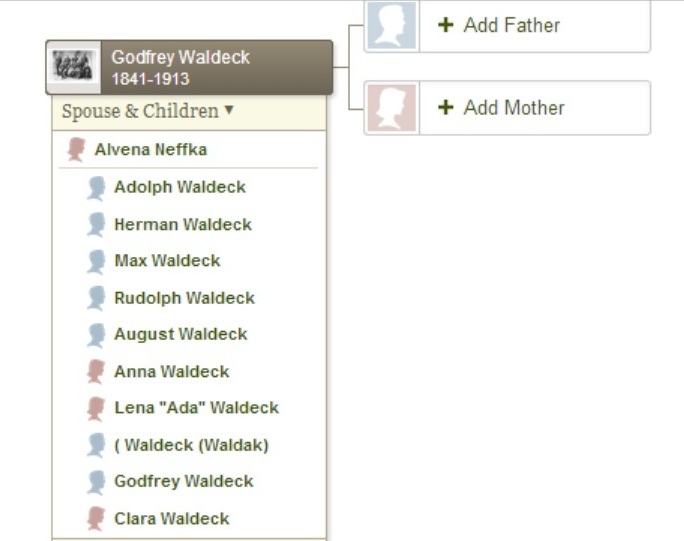
Look at the sorry state of the family tree:

Godfrey Waldeck family treeeGodfrey (Gottfried) and his wife Alvena (Alvina) immigrated to the United States with their family and then had more children. I don’t even know if all those children listed on this tree are theirs! Clara is.

And so is Godfrey (junior) because I remember him when I was young. He managed a grain elevator or something like that, but he also farmed his own land. He was blind from glaucoma when I met him, and he still walked down the road each day and drove his tractor in the fields. As an aside, glaucoma runs rampant in their family.

I know that Grandma used to like to go to the Waldeck family reunions, and I went to at least one myself, at a lake (of course).

Look at Alvina Waldeck above. The tree lists her as Alvina Neffka, as if that is her maiden name. But is it? I’ve also seen it listed as Noffke and on her death certificate her father was listed as Louis Koffler. Her mother was listed as Dora Couch.

Noffke is a German name, and so is Koffler.  Neffka is not German.  Neither is Couch.

One person I’ve spoken with has wondered if the family was more Polish than German, but I have no proof of that either.

I need some help with this and hope that somebody reads this blog and gives me some clues about the family!


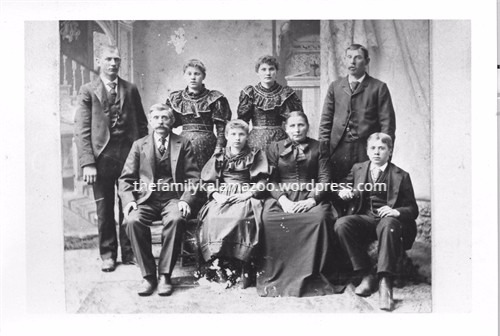
I am going to take a stab at identifying the people in the photo.

Back row:  Fred (according to a rumor, he was in a terrible accident), Ada Steeby (who had a daughter Ruth), Anna (did she marry a Stewart or Christianson or both), August (died in WWI, a bachelor)

Front row: Gottfried, Clara (my great-grandmother), Alvina, Godfrey

Looking at this photo and the names, can we write off Adolph, Rudolph, Max, Herman? Are they not part of our family?  Or were they older, born in Germany, and already living their own adult lives when this photo was taken?  And why isn’t Fred even on the family tree?!

Here is what I’ve learned. The family names from this branch are WALDECK, NOFFKE, and KUSCH. I believe that Couch was written by a non-German speaker on a document, and that the name is Kusch. I believe this because there are Noffke families and Kusch families in one particular area of what was (sort of) Germany: Pomerania in East Prussia. My ancestors in this branch were most likely ethnic Germans living in East Prussia, a place that would become northern Poland, a change in borders that would result in their exile at the end of WWII in 1945. Because nothing can be tied up neatly in genealogy, Waldecks do not live in the same region as Noffkes and Kuschs.

I did find a Dorothea Kusch from East Prussia who travelled to the United States from Pomerania in the 1880s, but on further analysis believe that she is a different Dorothea Kusch from Dora Kusch Noffke. This info gave me the idea that “Dora’s” name probably was Dorothea because my great-grandmother named her 3 daughters after the Noffke family. She would have named her oldest daughter Dorothea (Dorothy) after her own grandmother, as she named her second daughter Lucille after her own grandfather, Ludwig/Louis.  Her third daughter was named Alvena, after her own mother Alwine Noffke Waldeck.

Fred (born Friedrich and later Frederick), the man above who was in a terrible accident, I found just where my grandmother had warned: the State Hospital in Kalamazoo. He was in a streetcar and wagon accident and was confined to the psychiatric hospital after that. His wife and young son Edward moved in with her mother in Grand Rapids, Michigan. Fred died at the State Hospital, so that is how I found his death certificate.


While Fred was gone from home at the hospital, his 14-year-old son, Edward Waldeck, perhaps while he was working or traveling to school, was hit by a car. I found an article in the paper dated July 6, 1912 about how the driver left the boy and didn’t take him to the hospital. He was lucky to survive after being left alone. Read the description of his injuries in the article and see if you think the driver should have left him!

I have also discovered that Adolph, Rudolph, and Herman passed away while the family still lived in Germany, but I have not found death records for them. Max passed away shortly after the family moved to Michigan. August died during the time of WWI.

One more thing. Late last night I got an Ancestry “hint” on Aunt Vena and Uncle Al’s wedding–that is Clara Waldeck Mulder’s daughter Alvena. Their marriage license was now available online. I noticed that they were married in the Portland Baptist Church by Pastor E. A. Waldeck. How odd that the name was Waldeck! And E.A. Like Edward? Could he be the right age? And was the A correct? Yes, it was. Edward Waldeck, son of Fred, and Aunt Vena and Grandma’s first cousin. The boy hit by the car had married a young lady named Cora. In the 1930 census, he was an accountant for an auto shop and she was a music teacher. But in the 1940 census, he was now a minister with the Baptist church! Another click of a puzzle piece snapping into place!

Read Full Post »

As you know, I get sidetracked by a lot of subjects. In 2016, I would like to focus on 3 family branches. No telling how many tangents I’ll go off on though. I’ve met some wonderful distant relatives and other new friends through the blog and my genealogical research, and I would like to incorporate some of the information I’ve gotten as well as sharing some of my research.

Today I’d like to mention the Mulders. I’ve written of them before, and you can find the other posts from the “Individuals and Topics” section on the right: Mulders link. This is my maternal grandmother’s father’s family from Caledonia, Michigan; Grand Rapids, Michigan; and Goes, Zeeland, the Netherlands.

One Mulder I’ve (virtually) met is Elly, who lives in the Netherlands. She is descended from the same Karel Mulder, the jailor’s hand, that both my maternal grandparents were.  As she puts it, she is a descendant of Karel Mulder (1837-1881), the eldest son of Karel Mulder and Rosalie (Rose Melanie) Bataille.

Elly found a death announcement for Rose Melanie in the old local newspaper, de Goessche Courant.  It says that she died in the house of her son, Andries Mulder. Rose Melanie was a rather wealthy widow when she died. She had several houses and pieces of land in her possession.There is a statement of inheritance tax.
Let’s take a look at my genealogy results for this family from Yvette Hoitink.

Karel Mulder was born on 3 December 1812 at C 85 in Goes, Zeeland, the Netherlands.20 On 5 May 1836 he was a
shoemaker in Goes, Zeeland, the Netherlands.21 8 On 21 February 1837 he was a shoemaker in Goes, Zeeland, the
Netherlands.8 Karel died on 3 January 1870 at the age of 57 in Goes, Zeeland, the Netherlands.22 He owned 3/8 of a house
and yard in the “Papegaaistraatje [Parrot Street]” district C nr. 97 on 3 January 1870 at section D nr. 278 in Goes, Zeeland,
the Netherlands.5 Rose Melanie Bataille and Karel Mulder were married on 5 May 1836 in Goes, Zeeland, the Netherlands.21
Rose Melanie Bataille was born about 1810 in Etaples, France.21 On 5 May 1836 she was a servant in Goes, Zeeland, the
Netherlands.21 She lived in Goes, Zeeland, the Netherlands on 22 April 1881.11 Rose died on 10 July 1887 at the age of 77 in
Goes, Zeeland, the Netherlands.23

Karel Mulder and Rose Melanie Bataille had the following children:
8 i. Karel Mulder, born 21 February 1837, Goes, Zeeland, the Netherlands; died 22 April 1881, Goes,
Zeeland, the Netherlands. NOTE THAT KAREL IS ELLY’S ANCESTOR. HE IS ALSO MY ANCESTOR.
ii. Pieter Philip Mulder was born on 29 August 1838 in Goes, Zeeland, the Netherlands.24
iii. Kornelis Mulder was born on 4 September 1840 in Goes, Zeeland, the Netherlands.25 He died on 3 June
1887 at the age of 46 in Goes, Zeeland, the Netherlands.26 On 3 June 1887 he was a shoemaker in Goes,
Zeeland, the Netherlands.26
iv. Melanie Mulder was born on 21 January 1842 in Goes, Zeeland, the Netherlands.27 She died on 23 June
1884 at the age of 42 in Goes, Zeeland, the Netherlands.28
v. Johannes Mulder was born on 12 November 1843 in Goes, Zeeland, the Netherlands.29 He died on 7
January 1849 at the age of 5 in Goes, Zeeland, the Netherlands.30
vi. Andries Mulder was born on 23 January 1846 in Goes, Zeeland, the Netherlands.31 THE SON WHO ROSE MELANIE LIVED WITH WHEN SHE DIED AT AGE 77.
vii. Jan Mulder was born on 9 December 1848 in Goes, Zeeland, the Netherlands.32 On 22 April 1881 he was
a shopkeeper in paint and colonial goods in Goes, Zeeland, the Netherlands.5
viii. Johannes Mulder was born on 10 February 1851 in Goes, Zeeland, the Netherlands.33 He died on 26
June 1876 at the age of 25 in Goes, Zeeland, the Netherlands.34 On 26 June 1876 he was a shoemaker in
Goes, Zeeland, the Netherlands.34
ix. Jacobus Mulder was born on 13 May 1856 in Goes, Zeeland, the Netherlands.35 He died on 17 June 1874
at the age of 18 in Goes, Zeeland, the Netherlands.36 On 17 June 1874 he was a shopkeeper’s assistant in
Goes, Zeeland, the Netherlands.36

NOTE that Elly discovered that Rose Melanie was quite wealthy when she passed away. See above that when she was married she was a servant. It appears that Karel was a shopkeeper and must have done well for his family.

When Rose Melanie died, her son Karel (born 1837) had already been dead for 6 years and his youngest children, thanks to the 2nd wife ;), had been sent to an orphanage. You can read that sad tale here. With the bequest that Karel’s son Pieter received from his grandmother’s death, he took his wife and two babies (including my great-grandfather) to the United States.

So, Elly, if you’re reading, which child of Karel (born 1837) are you descended from? See below. Perhaps Karel or Izaak?

i. Karel Pierre Philippe Mulder was born on 8 May 1862 in Goes, Zeeland, the Netherlands.13
ii. Izaak Mulder was born on 20 July 1863 in Goes, Zeeland, the Netherlands.14
iii. Rose Melanie Mulder was born on 12 August 1864 in Goes, Zeeland, the Netherlands.15 She died on 1
December 1864 at the age of 0 in Goes, Zeeland, the Netherlands.16 DIED AS AN INFANT
iv. Pieter Philippus Mulder, born 10 October 1865, Goes, Zeeland, the Netherlands. My 2great grandfather.
v. Adrianus Cornelis Mulder was born on 7 October 1866 in Goes, Zeeland, the Netherlands.17 He lived at
the city orphanage in Goes, Zeeland, the Netherlands on 2 August 1881. He died on 15 March 1891 at
the age of 24 in Goes, Zeeland, the Netherlands.18 On 15 March 1891 Adrianus was a shopkeeper’s
assistant in Goes, Zeeland, the Netherlands.10 DIED AT AGE 24
vi. stillborn child Mulder was born on 5 October 1867 in Goes, Zeeland, the Netherlands.19 He died on 5
October 1867 at the age of 0 in Goes, Zeeland, the Netherlands.19 STILLBORN
10.

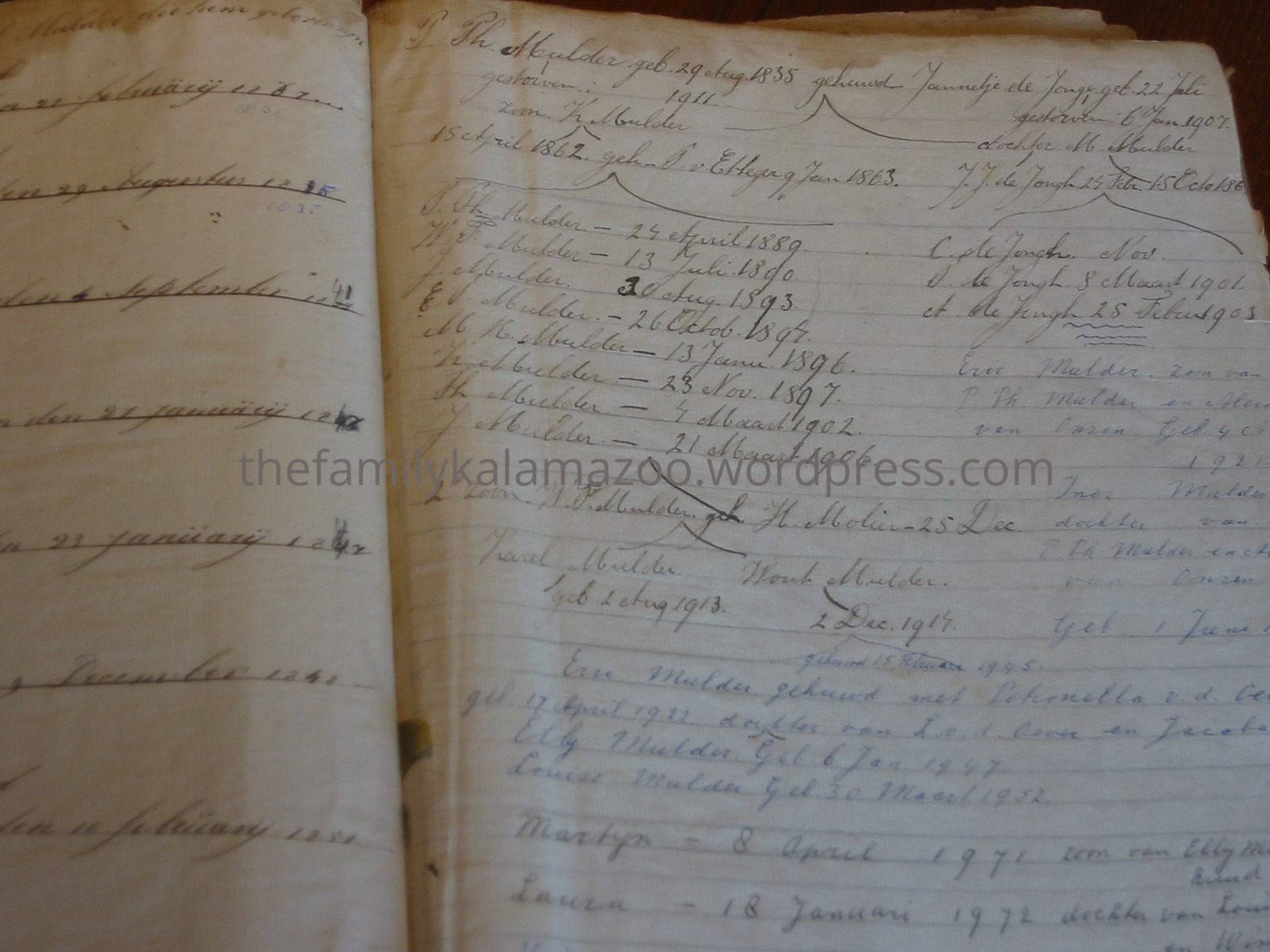
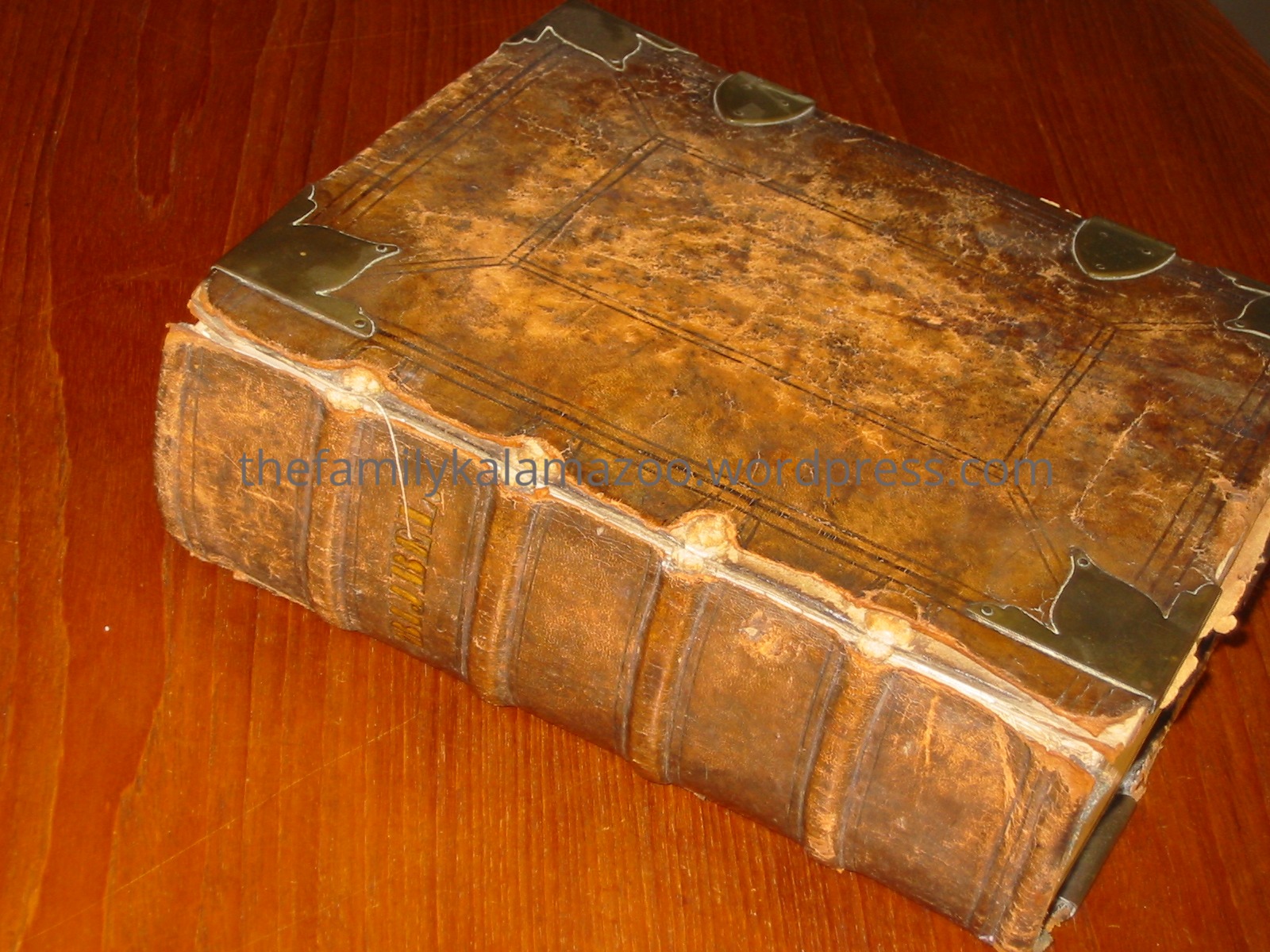
The best news so far from Elly, besides meeting her, is that she sent me photos of the family Bible!

The family history was written in this Bible, according to tradition. It was begun by Karel Mulder who was born in 1812. He started it in 1867, three years before he died.
I hope that Elly and I can continue to share information about the Mulder family!

Read Full Post »

On May 6, 2015, I posted about a photograph I found in the box of glass negatives that had been taken by Joseph DeKorn. I’ll copy here what I posted and then give you the information that has come to me since then. If you remember the story, skip to New Information on Louis Van Wyck

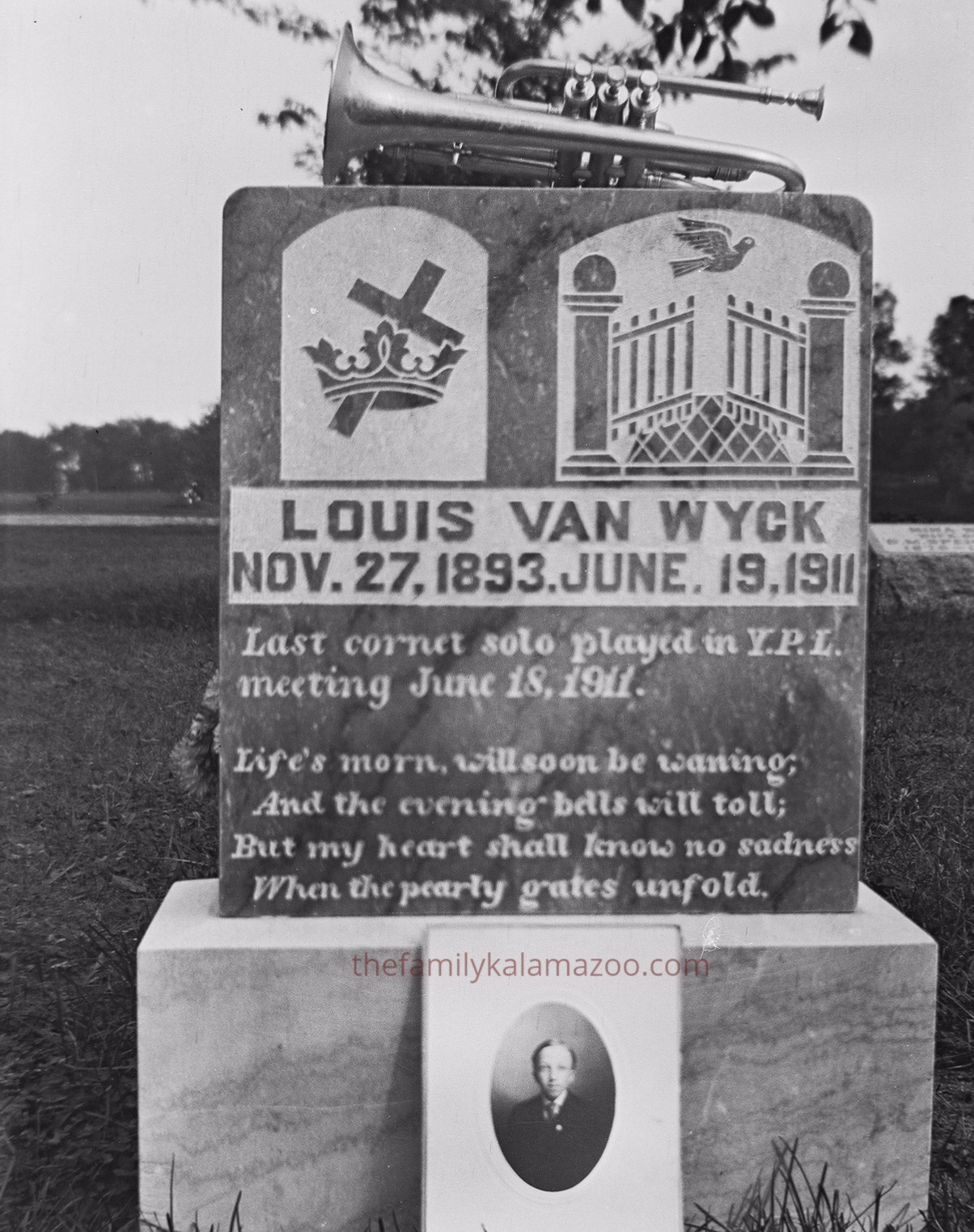
It seems to be an elaborate headstone for a man named Louis Van Wyck. Placed on top of the headstone is a cornet. The inscription reads, in part, “Last cornet solo played in Y.P.L. meeting June 18, 1911.”

His birth and death dates are also engraved on the headstone. He died the day after the cornet solo, on June 19, 1911. He was 17 years old–not a man, but a boy!

A photograph leans against the marble base. He looks young and blond. The stone is further engraved with images and a poem.


Although I have his dates, I can’t find Louis through Ancestry’s search function–or Find-a-Grave either. So I turned to Genealogy Bank where I found one article about his memorial service.

Read it here: Louis Van Wyck memorial service.  Note that the passage about the funeral is at the VERY END of this article.

I didn’t know what Y.P.L. on the headstone meant, but after reading about the Salvation Army hosting Louis’ memorial service, I looked it up online. It seems to mean Young People’s League. Now I have to admit I don’t know much of anything about the Salvation Army except that it is a Christian denomination and a charity, I sometimes donate furniture or clothing to them, and they (or volunteers like my family and friends) ring bells at Christmas outside shopping malls. I think Sarah in the musical Guys and Dolls belongs to a fictional representation of the Salvation Army.

That is kind of fitting because I just read up a bit and discovered that music has been important to the Salvation Army from the beginning. How fitting this headstone was, then, for poor Louis. But how did he die at such a young age? And how was he connected with Joseph DeKorn or my family? He would have been about 12 years younger than Joseph.

New Information on Louis Van Wyck.

I was frustrated that I knew so little about Louis Van Wyck and yet my grandfather’s uncle had photographed his beautiful headstone with his cornet and photograph adorning it and left it behind for our family. Who was Louis Van Wyck? Many of you offered advice. Pastsmith really went to work on the problem and found Louis’ death certificate and his grave.


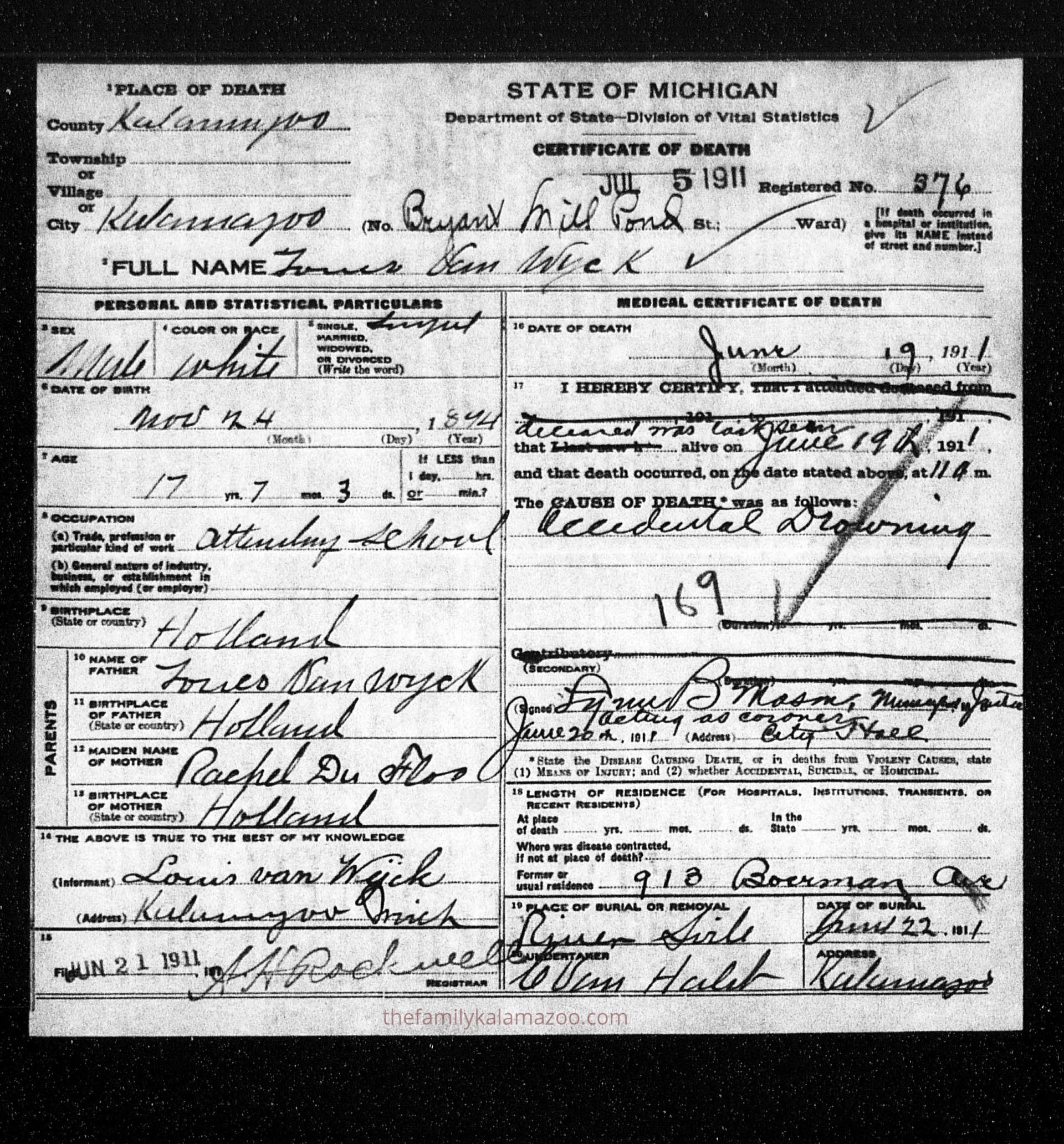
Things to notice in this death certificate are that he died of “accidental drowning” at Bryant Mill Pond. I looked up Bryant Mill Pond and discovered it is related to the Bryant (Paper) Mill. There were many operating paper mills at that time in the Kalamazoo area, all along the Kalamazoo River and Portage Creek. You can find quite a lot of information online about the cleanup that has been necessary in this area. I can’t imagine what the pond was like in those days. Was it full of papermill sludge or was it a clean pond that begged a boy to come swimming? Note that he drowned on June 19, 1911, just at the start of summer.

Louis’ parents were both from Holland, his father named Louis also and his mother born Rachel Du Floo. With this information I was able to find the family in the 1910 census, a year before Louis passed away. Louis had two sisters: Mary was 5 years older and his sister Kate was only 5 when Louis died. The senior Louis was a typesetter and worked for a newspaper. I wrote about how some members of my family worked on the Dutch-American newspaper here. Possibly Louis worked with them. In the 1920 census, Louis was listed as a price lister, whatever that is. It’s possible that the newspaper was out of business by then.

The family lived at 913 Boerman Avenue. This does not make them neighbors of my family, but it is within a long walk–the sort of walk my grandmother and I used to make when I was little. The house no longer exists as the area seems to be commercial now.

Since the families did not go to the same church, Joseph was 12 or 13 years older than Louis, and they were not neighbors, the connection could have been the typesetting.  After all, Louis, Sr., was born in the Netherlands and spoke Dutch. It seems that it would have been easier for him to be a typesetter in Dutch than in English.

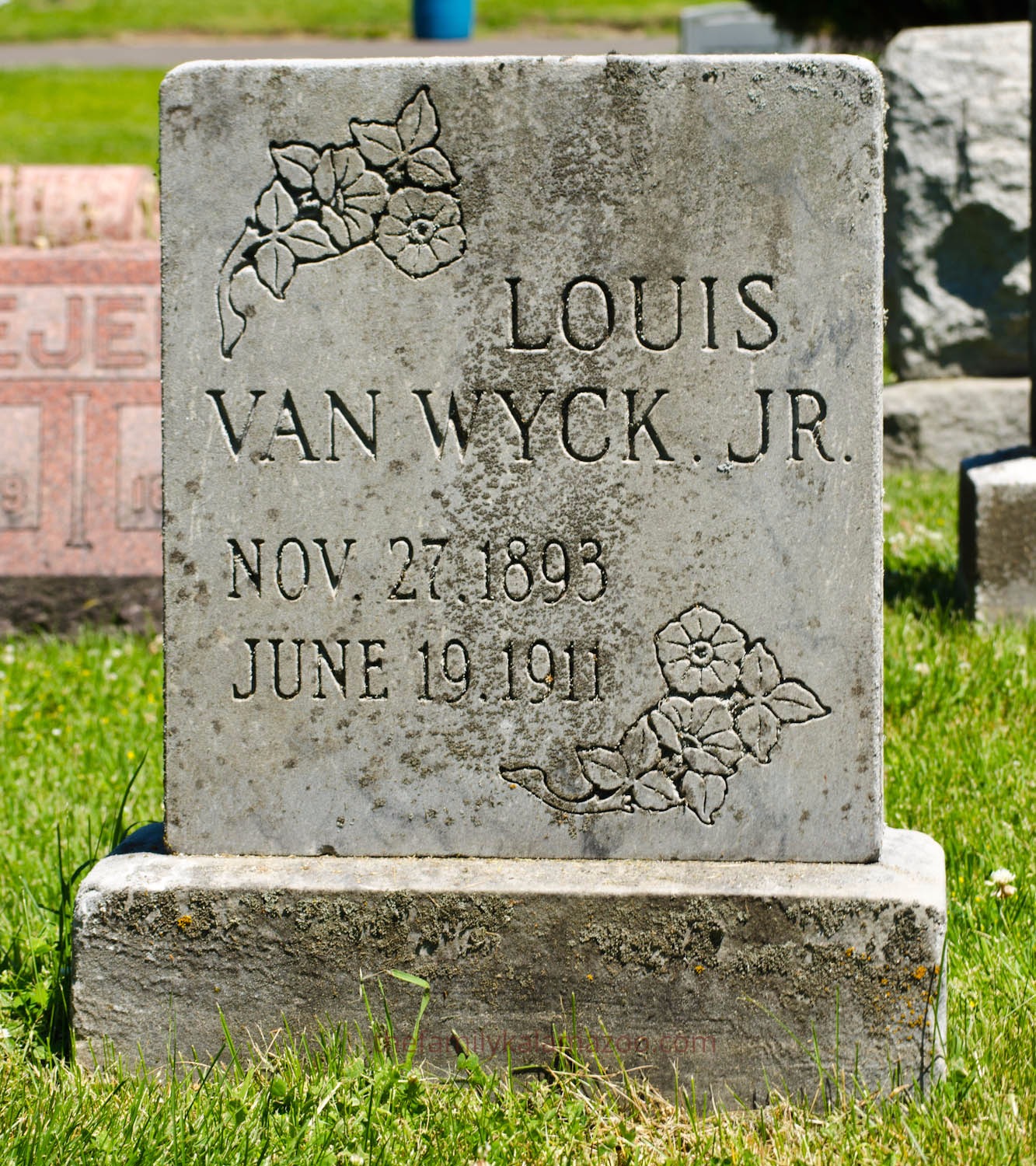
As the death certificate mentions, Louis was buried at Riverside Cemetery. Through Find-a-Grave, it appears that he has another headstone than the one above.


Two headstones, one very elegant and detailed and the other more simple, certainly does create a mystery. They also share dates of birth and death. However, Louis’ date of birth is different on his death certificate. There it reads November 24, 1894. Since the simple headstone appears to be the one at Riverside Cemetery, where is the other one or what happened to it?

After Pastsmith’s generous help, I was contacted by a reader from Kalamazoo who shared valuable insights. Joel wrote:

YPL stands for Young People’s Legion. As a child I was a member of the YPL. It was a group in The Salvation Army for 12-30 year olds. It was a Christian fellowship group and we had junior worship meetings. It sounds like LVW Jr played a cornet solo that Sunday, 6/18/1911 and drowned the next day. . . . More than 20 years ago I had possession of historic documents from his relatives published by The Salvation Army Chicago which told of his untimely death, or as we say in The Salvation Army, his “promotion to Glory.”

He also said:

LVW’s sister is Mary A (VanWyck) Fortune, 1888-1976, Find a grave #25812816, Riverside Cemetery, Kalamazoo. Her husband gave the books which archived “The Young Soldier” publication of The Salvation Army to my mother-in-law, shortly after Mary’s promotion to Glory in 1976. They came into my possession in the 1980’s. I have since forwarded them on to The Salvation Army Central Territory’s Museum and Archives in Hoffman Estates, IL.
As for LVW’s two headstones; I am more familiar with the one with the cornet on it. I don’t recall where I’ve seen it before. But I knew it before I saw it in your web site. Perhaps it was in this archive book I had, or in local S.A. archive photos. I would like to see the larger headstone. I’ve also seen the more plain headstone before your web site, I have no explanation for two headstones. The photo of Louis himself is the photo I’ve seen published and in the local S.A. archives, as well as others that are of that era.

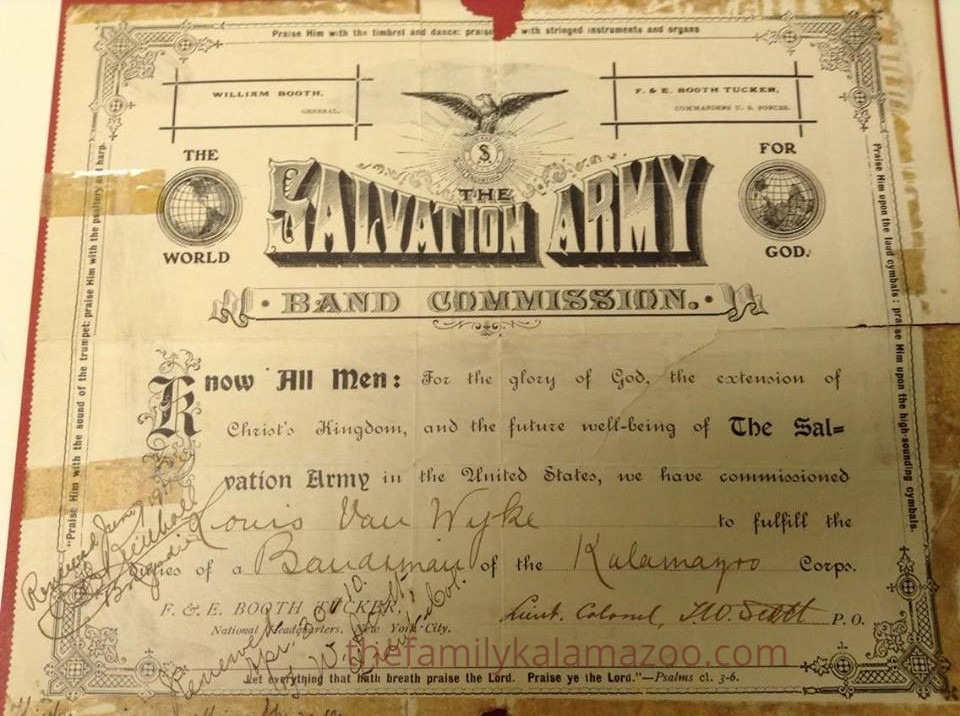
I came across the actual Band Commission for Louis VanWyke Jr.(Wyck is misspelled on the document) in our local SA archives from 1909. I have a picture of it but don’t know how to present it here. It has renewal comments written on it, renewing it until 1910, 1911, and 1912. Also, on the certificate is printed the name of the current General; William Booth. After Booth’s death in 1912 all subsequent SA documents say, “William Booth, Founder”, and would also list the current General.
I also have other anecdotal information regarding Louis’s sister, Mary A. Fortune, from my wife. In the 1960-70’s Mary and Neil Fortune lived next door to my wife’s parents, Richard and Shirley Aukes . . .  in Portage, MI. The Aukes’s and Mary were members of The Salvation Army of Kalamazoo, like Louis VW. Neil helped Richard build a garage. Later after Richard’s death in 1968 and Mary’s death in 1976, Neil gave Shirley Mary’s cedar hope chest. The hope chest was given to my wife, who in turn has given it to our daughter Betsy. Besides the hope chest, Shirley received the books chronicling Louis’s premature death.

At this point it became clear that Joel is the brother-in-law of my junior high classmate, Chris Aukes. We were in almost all our classes together for the three years of junior high school.

Note that Mary Fortune who Joel refers to is Louis’ older sister Mary.

Here is the 1909 Band Commission for Louis Van Wyck that Joel found in the local Salvation Army archives.


What talent Louis must have had. I’m so pleased to know more about Louis and hope to find out even more.

I tried to blow up the photo that rests against the first headstone. Though it is faded, it does give an idea of what Louis looked like.


Although Louis was not my relative, I enjoy finding out more about the history of the people who lived in Kalamazoo over 100 years ago.

Read Full Post »

My father’s mother used to love Christmas. She celebrated it on Christmas Eve, in the German tradition. Her favorite Christmas carol was “Silent Night,” also from the German tradition.

In this photo, Grandma sits with Aunt Marge.

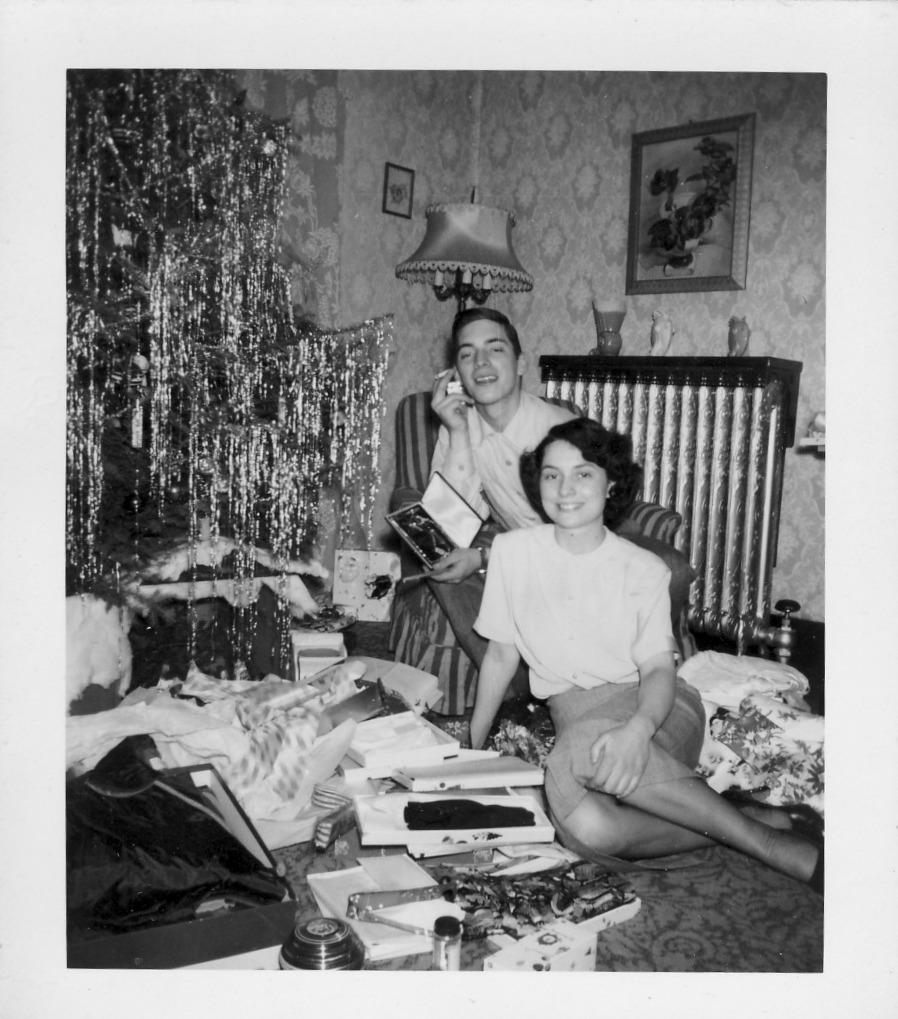
And here Aunt Marge is with a silly young man. (Yup, that looks like Dad!)


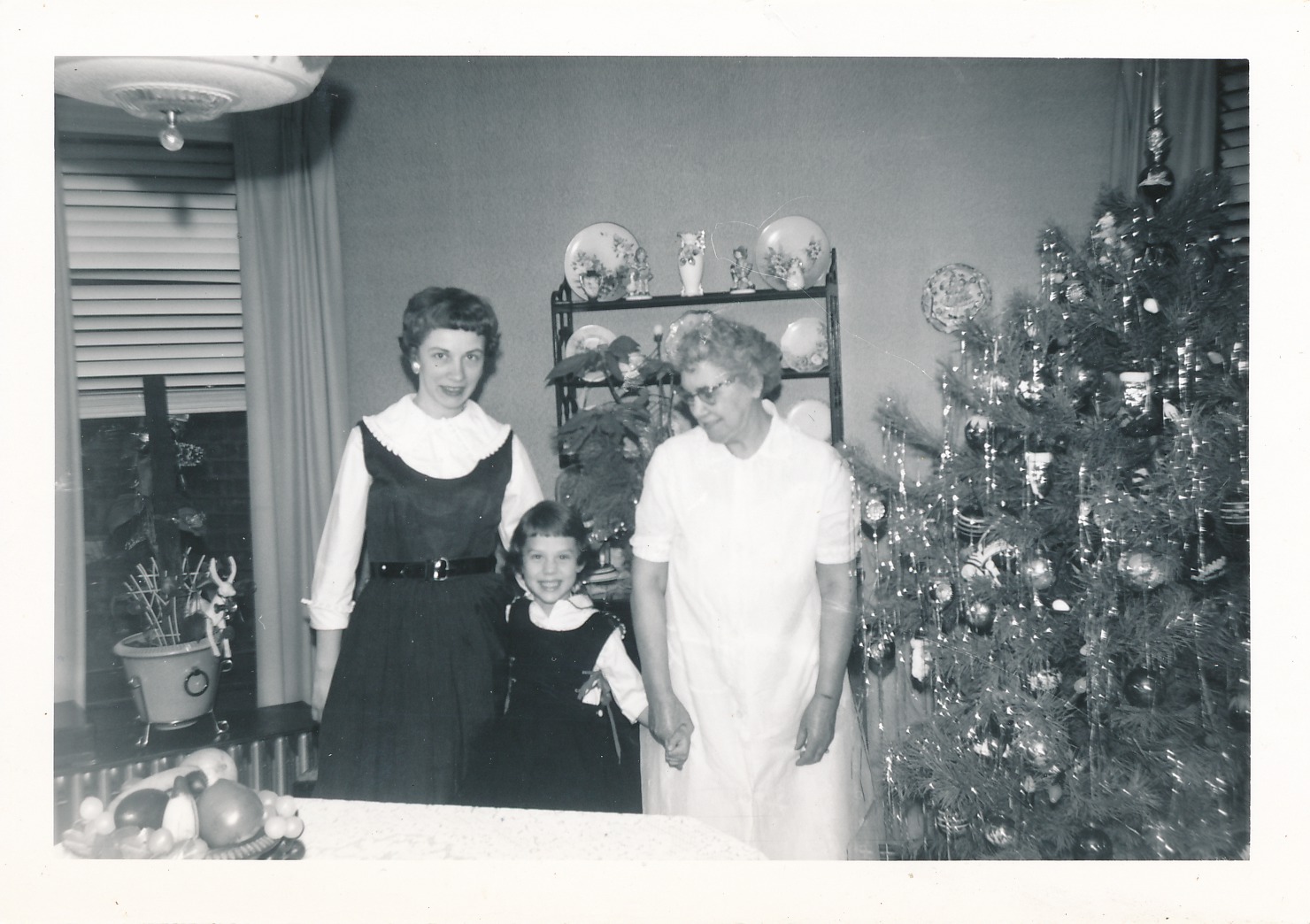
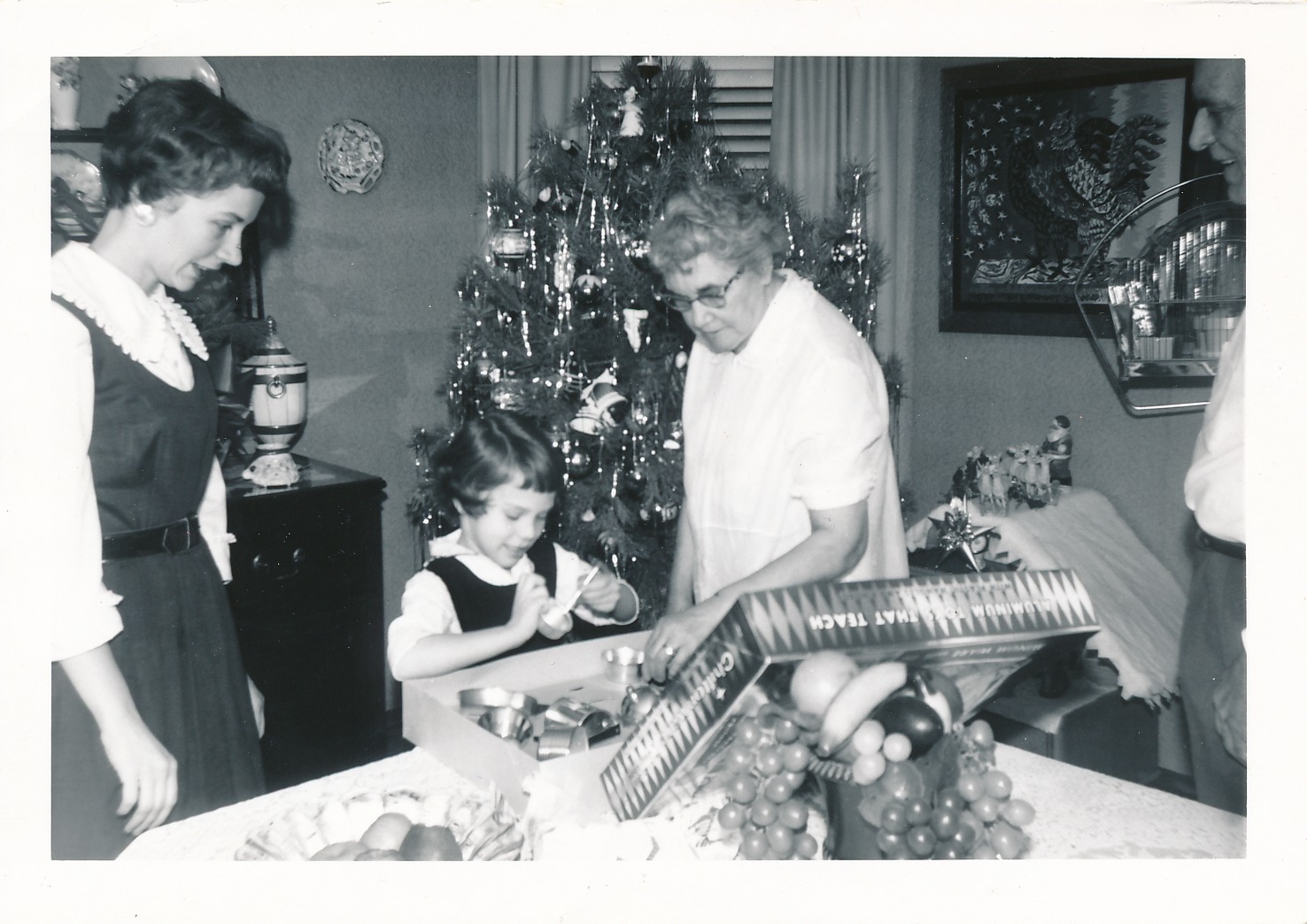
In Chicago, she kept a traditional Christmas tree (yes, also the German tradition) that she decorated with glass ornaments (mainly made in, wait for it, Germany) and strands of tinsel. In this photo, I must be around five and stand between Grandma and my mother.

Look what I got from Grandma!


When I was still young, Grandma changed her tree to a silver aluminum that changed color when a light wheel shone different colors on the tree. She decorated it in all pink balls. That’s the tree I remember from her duplex in Michigan. I looked, but couldn’t find a photo of it.

Another German tradition Grandma continued was putting electric candles in the window. I wish you could see the candles in this pic, but they might have been in the kitchen window. This is the picture window in Grandma’s duplex. She has a wreath up, and the nativity scene with the gifts below. It looks as if she didn’t have a tree this year. Judging by this fabulous hair (Mom, you let me go out like this?!), I was in junior high.

I think she gave my parents at least some of her old ornaments.

Read Full Post »

When Joost “George” Paak*  lost his wife in 1900 and then his mortgaged home in 1902, he must have been distraught and wondered how he would take care of five children. He was a laborer who was not even working at the time of the fire.

I know that he lost a mortgaged home because of the newspaper article (see post links below for the rest of the story) and because the 1900 census shows that he owned a mortgaged home. At that time, he worked as a farm laborer, but had been unemployed 3 months the previous year. I am guessing that this was a hard physical job and if he was sick he wouldn’t be able to work. I also think he had been unemployed for 3 months the previous year because of the winter. So he didn’t have a very stable job. He had immigrated to the United States at age 18 with his family. He was the oldest–he had 4 younger sisters. There was also a young brother who either died in the Netherlands or came here and would probably be known as William. Still checking into this.

In 1908, six years after the fire, George married Addie Amelia Gifford Wilder. This shows up on the 1910 census. At this time, George was listed as Joseph G. Peake (Joost could easily be Joseph or George, I guess), and he now had a stable job as a paper maker at the paper mill. He again owned a mortgaged home and guess where? At 1016 Trimble Avenue, the scene of the fire. So the house was rebuilt. And you know what? It still stands.

The 1920 census shows George still married to Addie. He owned his home free and clear. He was still a laborer for the paper company, earning wages, not salary. And he was 69 years old. Notice no retirement for George at that time!

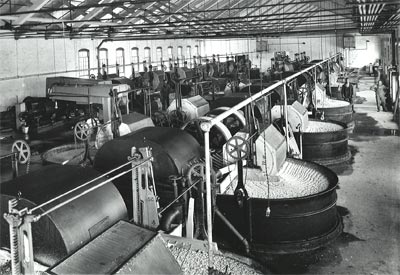
Paper mills were big business in Kalamazoo, by the way. The city was known as The Paper City. There is a great article published online by the Kalamazoo Public Library. Click the photo of the paper vats to go to the article.

PaperVats_400

All three censuses show George immigrating to the United States in 1868, although in one of them it looks like 1860. He was naturalized as a citizen in 1891.

What the census does not show is that George married Esther M. Fields in 1906, gaining a 4-year-old stepdaughter, Florence Wilder! But a year and a half after the wedding, Esther died! (Professor Lawrence heard that George might have been married as many as five times, but I do not have the documentation yet on the other two marriages–or the timeline).

In the 1910 census, George’s household includes Addie, Fannie, and George. These are the two youngest Paak children. And the household also includes Esther’s 7-year-old daughter Florence A. Wilder! So George kept her in the household, which must mean she had no other family to take her in. But his own children, Theresa (Tracy) who was 17, Jane who was 20, and Cora who was 22 were not living at home. Theresa, as we know, was living with the Pickards as their perhaps unofficial foster daughter and being sent to boarding school.

Why did Theresa not live at home with her father and stepmother while a stepdaughter of George continued to live there? Maybe after the upheaval in the household after her mother’s death, the fire, and then the death of her first stepmother it was determined it would be better for her to stay with the Pickards permanently?

Professor Lawrence did tell me that he had heard that the children were farmed out to people, especially relatives, after their mother died. But at the time of the fire two years later it seemed that they were living at home with their father. I do wonder if my own great-great-grandmother helped out when her sister-in-law died or after the fire. The clipping about the fire was saved in the family documents, so she (she died 6 years after the fire) or her daughter must have kept it.

Why did Jane who never did marry and lived to be 107 years old (there might be a connection there haha) not live at home? Maybe she had a job and was providing for herself already. Jane lived in a nursing home near the end. In the photo there is a sign for her 100th birthday. I do have a photo of her at her 107th with cake, but she is in bed and obviously not well, so I don’t want to share that one.

Where was Cora? Was she married yet? Her first child might have been born in 1915, although I have not done much research on Theresa’s siblings as of yet. If she wasn’t yet married, I wonder if she and Jane were living together. That would be something to search.

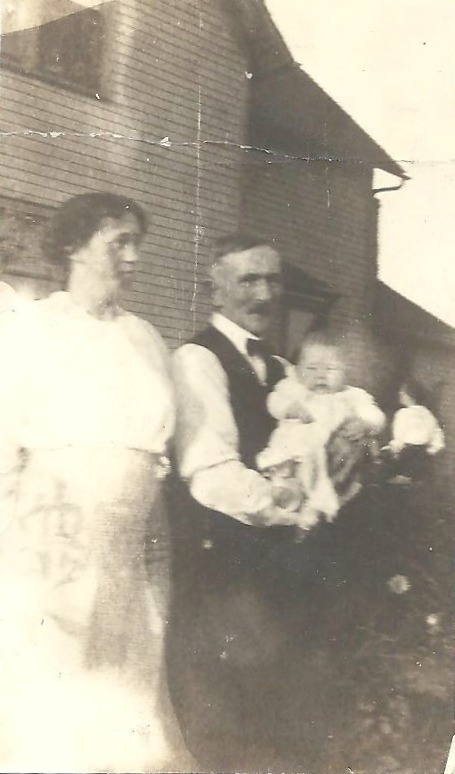
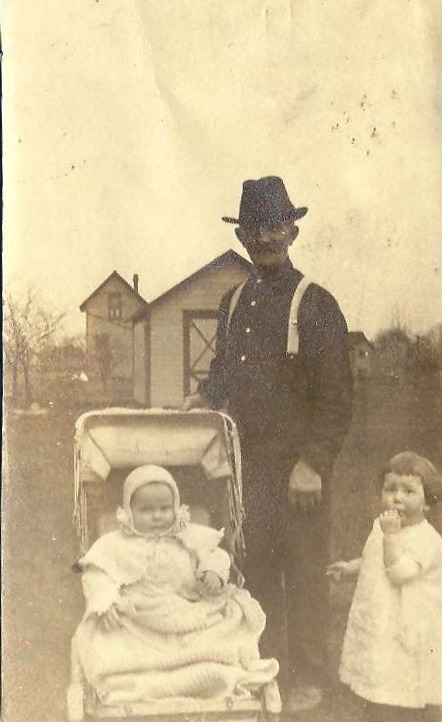
This photo was probably taken in 1925 when George was 76 years old and a happy grandfather. The woman is Cora, his oldest daughter with her son John Rankin. John was not her first child, but the first by her second husband, John Rankin, Sr.


Here is another photo of George with two children. As always, I appreciate any comments about date identification or other important information.

* I’ve changed his surname spelling to the one that my great-great-grandmother used because I see that he did also use that spelling in addition to other spellings.

Here are the other Pake/Paake /Paak //Peek posts:

A Series of Disasters

The Children After the Fire, 1902

Paak-a-boo

Saved from the Fire

Who is George Paak, Sr.?

Curious about George

George Paak’s Legacy, Part I

George Paak’s Legacy, Part II: Theresa’s Pre-Professional Education

George Paak’s Legacy, Part III: Theresa’s Professional Education

George Paak’s Legacy, Part IV: A Letter to His Daughter

George Paak’s Legacy, Part V: Theresa Gets Married

George Paak’s Legacy, Part VI: Who Were the Pickards


Read Full Post »

HAPPY

BIRTHDAY,

MOM!!!i

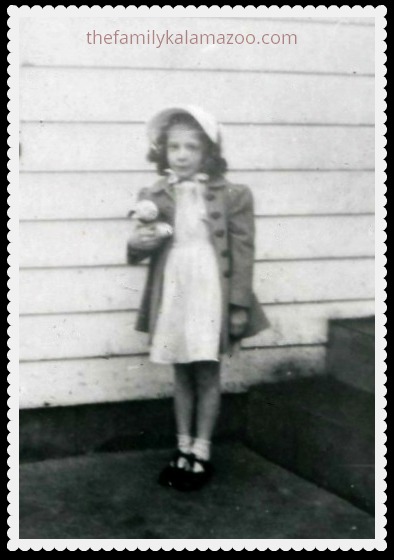
A beautiful lady and mom now and a beautiful girl then. Here she is by her house when she was a little girl:

I can’t help but wonder if this is a little Easter bonnet and an Easter toy in her arm.

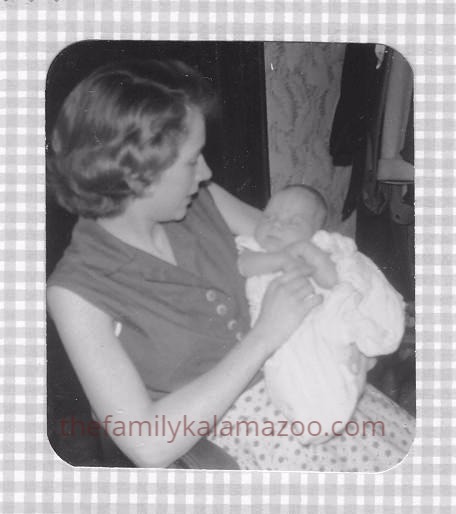
This is when I was a baby.

Have a beautiful day, Mom!!! xoxo

Read Full Post »

If you’ve been following along here for some time, you might remember my posts about Theresa Pake, the middle child (of five) of my great-great-grandmother’s brother, George Paak.

When we left off, Theresa had married Roy Lawrence.

I’d like to backtrack. Remember how her father’s house burned down two years after her mother passed away? It was 1902, and Theresa was only 8. The article in the newspaper showed how destitute the family was by the fire, George’s illness, and Lucy’s death. The paper emphasized that the oldest girl, Cora, had been running the household from the time she was 12 until the fire–when she was 14.

At some point after this, Theresa went to live as a foster child with Oliver and Una Pickard. It would have been hard to find this information strictly from documents, but I had a great lead in the form of Theresa’s son Professor Lawrence.

This is a quote from one of my earlier posts:

At some point Theresa lived with foster parents, Una Orline and Oliver Oratio Pickard.  Prof. Lawrence thinks she maybe have gone to live with them as early as age six, which would mean she wasn’t under the care of her older sister. However, the newspaper article about the fire in 1902 would show that she was still living at home at the time of the fire (nearly 8 years old). Regardless, at some point, the Pickards became the caregivers of Theresa. None of the other children in the family seem to have gone to live with the Pickards.

SO WHO WERE THE PICKARDS?

Professor Lawrence told me that Oliver was a postman and Una a nurse. He said he couldn’t find his mother with them in any of the censuses.

I did a little search myself to confirm and hopefully augment this information.

I found the Pickards in the 1900, 1920, 1930, and 1940 censuses.

1910 census Pickards

1900: living in a “home” with 74 other people. There is a couple that are the head of household and his wife. Then Oliver is listed as a nurse and Una as “wife” (incorrectly as the wife of the head of household). After that are 3 attendants, a cook, and a lot of patients. So were both Oliver and Una the nurses for the facility? I can’t find the address on the census document.

From there, I went to the previous page of the 1900 census. It’s a short page and this is how it ends after a listing of some patients: “Here rests the enumeration of that portion of the Michigan Asylum for the Insane situated in Kalamazoo township outside the City of Kalamazoo.”

But wait! the page with Oliver and Una is in Oshtemo Township. That gave me the idea to see if anything is written at the end of the Pickards’ “household on the page after the one listing Oliver and Una.”

Wow!!! Something was written and erased. I can barely make out anything, but it appears to say pretty much the same thing as the above quotation about the asylum but using Oshtemo instead of Kalamazoo!! Why was this information erased? So did the Michigan Asylum for the Insane have Kalamazoo Township AND Oshtemo Township facilities?!! I can’t go past that page because this section ends on page 36–and the Pickards are listed on page 35.

I looked up “Oshtemo township” with the Kalamazoo State Hospital, and I found that the hospital owned a farm in that township since 1888: Colony Farm Orchard. Some patients lived on and farmed the property. Could this be where Oliver and Una first worked together?

1920: living at 1846 Maple Street in Kalamazoo. They owned their own mortgaged home. Una’s parents lived with them. Oliver was a mail carrier and Una was a nurse at the State Hospital. At this point, Theresa was finishing up her education, still under the guidance of the Pickards. THERE! The State Hospital IS the Michigan Asylum for the Insane. The name was changed in 1911. So it looks like maybe Oliver quit nursing and became a mail carrier–and maybe they moved to their own home that way.

1930: living at 1844 Oakland Drive in Kalamazoo. They owned their home, worth $15,000. Notice that 1844 address here is similar to the address in the 1920 census. I wonder if it’s the same house and there is an error in the number and the street? Or are they two different “owned” homes?

1940: living at 1846 Oakland Drive in Kalamazoo. So it probably was 1846 Oakland Drive all along. Una is a registered nurse in “private work.” That makes sense because she is listed as 67, and she couldn’t possibly be providing care at the State Hospital at that age. Oliver said he worked 52 weeks in 1939, but his income from this work is listed as zero–but he has income from “other sources.”By now the house only valued at $8,000.

A look at the neighbors in the 1940 census does not show that preponderance of Dutch names that I’ve seen in the neighborhoods where my relatives lived. The surnames seem to be of English origin, for the most part. But in the 1920 census, the same neighborhood had more Dutch surnames. Maybe this reflects a change in the neighborhood–or in the demographics of Kalamazoo.

Professor Lawrence told me that Una was Theresa’s Sunday School teacher. She must have taken a liking to the girl. I think Theresa was an intelligent and hard-working child, so that may have appealed to Una who took her on either from affection or religious conviction or a mixture of both.

So who are these people who married young (she was 18 and he was 23) and worked and lived at the State Hospital until he left for a job as a mail carrier? Who never had their own children, but managed to provide a quality education and a religious upbringing to one of the Paake children? That would have been very hard work being a nurse at the “asylum.” It could also be dangerous. In approximately 1904, a resident doctor was stabbed to death.

I also think the Pickards were most likely Methodists as they chose to send Theresa out of state to a Methodist school.

What was it like for Theresa to live with the Pickards?

Here are the other Pake/Paake/Paak/Peek posts:

A Series of Disasters

The Children After the Fire, 1902

Paak-a-boo

Saved from the Fire

Who is George Paake, Sr.?

Curious about George

George Paake’s Legacy, Part I

George Paake’s Legacy, Part II: Theresa’s Pre-Professional Education

George Paake’s Legacy, Part III: Theresa’s Professional Education

George Paake’s Legacy, Part IV: A Letter to His Daughter

George Paake’s Legacy, Part V: Theresa Gets Married


Read Full Post »

« Newer Posts - Older Posts »