Feeds:
Posts
Comments

Archive for the ‘Family History’ Category

On 23 February 1931, my father’s uncle, Frank Anthony Klein, had some sort of possibly epileptic seizure and crashed his automobile into a tree. He died from his injuries, and his mother grieved deeply for him. She had already lost her oldest daughter and Frank was her only son.

A little over a year after that tragic event, his mother, Margarethe Wendel Klein, died of cancer, or so my father told me, in her home in Elmhurst, Illinois. I think these photos are of her grave at the cemetery because I don’t see her sitting next to her husband, my great-grandfather, Frank Klein. He is wearing glasses and has a mustache.

Here’s a close-up of the grave with its flowers.

The family is buried at Elm Lawn Cemetery in Elmhurst. Margarethe would have had a Catholic funeral service.

One twist (isn’t there always a twist or a mystery?): Margarethe’s death certificate says she died of Diabetic Coma. And that she had had Myocarditis for 10 years and Nephritis (institial) for 6 years. Myocarditis is an inflammation of the middle layer of the heart wall, and apparently it can be caused by a virus and may resolve. Interstitial nephritis is a kidney disorder. So she had diabetes. So did her daughter, my grandmother.

Why did my father think she died of cancer? He and his siblings and mother lived with his grandparents at the time, and he remembers his grandmother “lying in the library dying, while we played outside.”

Margarethe Wendel Klein

Helen, Marie, Elizabeth, Margarethe, Peter (SIL)

Frank Sr. on the ground with his grandkids

Uncle Frank and Grandma Marie Klein c. 1920

Uncle Frank and Grandma Marie Klein c. 1920

Read Full Post »

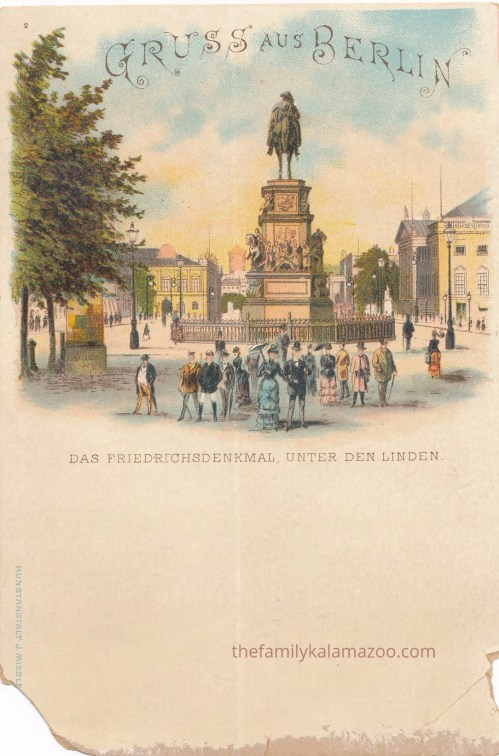
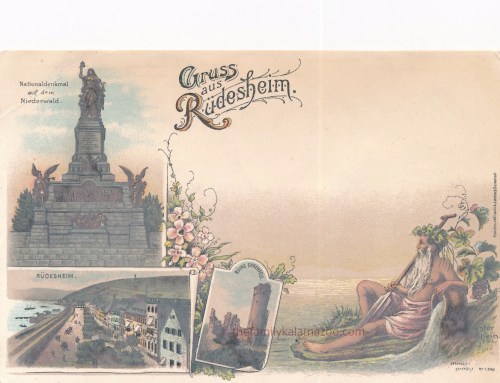
My grandparents had these over 100 year old postcards. Someone must have travelled to Germany, but these were never posted (mailed). Each one is a greeting from a particular German city.

image image

Read Full Post »

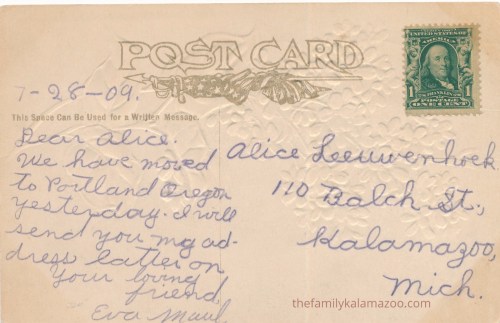
Finding neighbors and friends of my ancestors is always fun. Alice Leeuwenhoek received two postcards from girls who posted them from Portland, Oregon. Luckily, one girl, Eva Maul, signed her entire name so it was easy to look them up.


As Eva’s July 28, 1909, postcard states, the Maul family moved from Kalamazoo to Portland, Oregon.


On the 1910 census they are living in Portland:

Peter and Jennie Maul, with their children: Henry, Gertrude, Maurice, Eva, Jeannette, Garrett, and John. Eva was fourteen, so when she wrote the postcard, she was about thirteen. Gertrude was 17. She wrote the other postcard in 1912, when she was 19.

Notice she complains Alice hasn’t been writing, which makes me wonder how many friends the Maul girls made in their new home.

“Lovingly” seems to indicate that Gertrude and Alice had been very good friends. Alice was born in 1897, so in 1912 she would have been 15, so she was actually closer in age to Eva–even a bit younger.

I started to wonder if these girls had been neighbors of Alice and could be found in my old photographs.  So I did another search. Well well well. In the 1906 Kalamazoo City Directory Peter Maul was a butcher who lived at 112 Balch Street, right next door to Alice’s family! Uncle Lou was a grocer who lived at 110 Balch Street with his family. Alice’s mother’s name was Jennie–and so was the mother of Eva and Gertrude. I guess they all had a lot in common.

But why would Eva have to send Alice a postcard saying that they had moved when they lived next door? How odd.

Although I couldn’t spend too much time on this, a naturalization document popped up from decades later for father Peter Maul in Portland. His history is convoluted. He listed his race as Dutch, but his nationality as British. He emigrated from Calgary, Canada, but was born in Zeeland, Michigan, in 1866. WHAT? It makes no sense. By 1933 he was married to a woman named Blanche who hailed from the western part of the country. Before you think it’s a different Peter, the document lists all his children as well as an additional child.

This would be a fascinating thread to follow, but alas, there is so much to be done in my own branches, I have to stop here for now. For those of you who follow this blog and have been in contact over family branches–and posts you have not seen–I plan to spend a little more time in 2017 on genealogy and share some of the information I’ve been blessed with from all of you!

Read Full Post »

I’ll be taking a blogging break for the holidays, so I’ll leave you with this gift (that I first posted three years ago)  from Alice Paak (Richard) DeKorn to one of her children, possibly her daughter Cora, my great-grandmother. What a family and genealogy treasure–now 109 years old.

1907

Merry Xmas

from

MOTHER

In case you’re wondering about the use of the word “Xmas” instead of “Christmas,” this is what Wikipedia has to say:

There is a common belief that the word Xmas stems from a secular attempt to remove the religious tradition from Christmas by taking the “Christ” out of “Christmas”, but its use dates back to the 16th century.

I’m sure that this was just a way to fit it all on the tiny shell. What a lot of work to paint and letter this shell. I wonder if she made three, one for each of her children.

Happy holidays to you and yours! See you in the new year!

Read Full Post »

Blogger buddy José at Enhanced News Archive sent me a link to the 1869-1870 Kalamazoo City Directory that lists only one person with one of my family surnames. His name was William DeKorn, and he was a laborer who lived right downtown (194 S. Burdick Street). This seems much earlier than my family came to Kalamazoo. “My” DeKorns first settled in Ottawa County, near Holland, Michigan, before they made their way to Kalamazoo.

I decided to see if this William DeKorn could be related to my family. There is another branch (connected much further back) that settled in Grand Rapids, Michigan, so I wonder if he connected with them or with my family that first went to the Holland, Michigan area. I wrote about the other branch in this post: The Confusing Saga.

First I went to Ancestry and discovered that  this City Directory is the only item that comes up for the name William DeKorn, living in Kalamazoo.

Next I went to the Dutch genealogy website, WieWasWie , and there were not any William DeKorns or DeKornes, with or without a space between the De and the Korn. So, knowing that Willem is the Dutch version of William, I looked up that name. Only one Willem DeKorne who had any documentation in the years before 1869-70. He was from Hoedekenskerke, which is apparently 6.5 miles from Kapelle where my DeKorn/DeKornes come from. The Willem documents that come after 1869 are from a town in between these towns, so all the DeKornes seem to be in the same general area. The Willem I found is the son of Paulus. So I looked up Paulus, and they were all connected with those same three towns.

At that point, it would have seemed logical to try to connect Paulus with my ancestors. I have the DeKorns going back five more generations before Boudewijn.

Instead, I thought I would check to see if my ducks were in a row first. In other words, instead of searching farther outward, I went inward and took a peek at my family tree.

I was astonished to see be reminded how early those first immigrants, Boudewijn and Johanna (Remijinse) DeKorn, must have moved to Kalamazoo. In the 1860 census, they were still living in Ottawa, four years after immigrating from the Netherlands. But Johanna died in 1864 in Kalamazoo. Boudewijn died in Kalamazoo in 1873 or 1875. As you can see, Johanna’s death predated the City Directory publication.

So I took a look at the 1870 census. There was William DeKorn, much as he was in the City Directory, except the census recorded that he lived with his three children: Richard, Mary, and Jennie. In short, William WAS Boudewijn. And why wouldn’t he have changed his name to an “American” one? With a name like Boudewijn . . . . Richard was already listed as a brick mason in the census, although he was only nineteen years old.


There never was an earlier DeKorn in Kalamazoo, after all. Boudewijn was the first of the family to venture to Kalamazoo, probably because of the housing boom. I’m not sure if there if a way to locate the address on the census since every entry is listed in numerical order, but apparently not tied to a particular address.


It did strike me as odd that there was only one Willem DeKorne listed before 1870 on WieWasWie because, for centuries, the Dutch consistently reused the same names, giving a child the name of a grandparent, most typically. If Willem had been a family name for the DeKorns I would have seen more Willems from earlier years.


Knowing that Boudewijn changed his name to William might make it easier to search for other traces of his life in the United States.


Read Full Post »

I remember my grandfather wearing his Sunoco “uniform” and his Sunday sportcoat, but I never thought of him as at the height of fashion. At least not in his attire.

But take a look at him as a 22 year old in 1930!

At first I saw his sport coat, sweater, shirt, fancy belt, and plaid pants as a spiffy outfit, but didn’t stop to think: why is he wearing bloomers? haha

Well, he’s wearing knickers (no, I don’t mean those kind of knickers), which are short for knickerbockers. Copied from this website:

Knickerbockers, later shortened to knickers, were popular sports wear for wealthy gentleman. Knickers were baggy pants that fit low on the natural waist and tight below the knee, ballooning out around the thighs. For upper class gentlemen wearing white or light striped knickers in summer with a matching Norfolk jacket was the look of the teens and early 1920’s.

Grandpa is not wearing a Norfolk jacket, but one that does look a little preppy over that sweater and shirt collar.


Plaid Plus Fours

Variations of knickers included plus-fours, plus- sixes, plus-eights and plus-tens. The plus is how many inches below the knee they hung. Plus fours came in tweeds, linen, corduroy, and flannel. Many were solid colors but to be really trendy men wore stripes, checks, and plaid patterns.  They were already on trend when the prince of wales went on tour in American wearing plus fours. His approval meant any man NOT wearing plus fours was out of  fashion.

Notice that “to be really trendy men wore stripes, checks, and plaid patterns.” That’s Grandpa–“really trendy”!

Knickers were worn for more than just sports and casual entertainment. They were common among both fashion forward industries such as the movies, but also among working classes who found the sturdier material knickers quite useful on the farm, for making deliveries, and for some factory work. The short legs and light weight clothes made them cool to wear in summer.

Not sure what beach this photo was taken at, but his outfit is sporty for the time period, as befitting a walk on the beach. By today’s standards, he’s a little over-dressed!


Read Full Post »

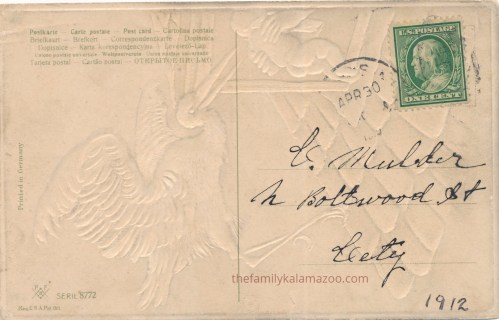
This postcard belonged to the Mulder family. As you can see from the reverse side, it was addressed to a Mulder, but which one? What is that bizarre looking letter in front of the surname? Is it C for Charles? For Clara? Is it CC for Charles and Clara? My great-grandparents were Charles and Clara Mulder. Or is it a weird M for Mister? N. Boltwood Street, City. But what city? If I could read that postmark, I would know, but I can’t.

When I look at the 1910 census, I can see that Charles and Clara Mulder lived on Boltwood Street in Hastings, Michigan! They boarded with another young couple, Otto and Mildred Jahnke. Great-grandpa was a machinist at the time–not yet a farmer with his own farm.

It almost looks like a self-addressed card. But not necessarily. If it is, I can take a guess at who the new arrival was: my grandmother! Lucille Edna Mulder was born April 17, 1912. It is also possible that a friend had a baby that same year, and that this was their birth announcement, but I like the idea of it being my grandmother’s.

It was amusing to see that the stork brought the baby through the roof. I’ve never noticed that idea before, figuring that Santa had the roof market to himself. But it makes sense. Storks, with their nests on the roofs of the buildings, are part of the folklore of the Netherlands. That said, the card was printed in Germany, and the family of Grandma’s mother Clara was German, whereas the Mulders were Dutch. So I looked up storks in Germany and, while they do have storks in Germany, they are more common in Holland, Sweden, Switzerland, and Belgium.

Note: this postcard uses the same way of addressing that the one last week did: using “city” instead of the name of the city itself. The assumption is that it’s used for intra-city correspondence.

Read Full Post »

Alice Leeuwenhoek received a postcard wishing her a Joyous Thanksgiving (and a Cordial one) in 1911.

The card was postmarked November 29 because the holiday fell on November 30 in 1911. If this seems late, Thanksgiving didn’t fall on the fourth Thursday of the month until 1941 when FDR changed it.

This card was sent by Alice’s cousin’s Elizabeth. Who in the world was her cousin Elizabeth?

Alice’s mother, Jennie DeKorn, had 2 siblings: her sister Cora had only my grandfather who was 3 in 1911. Her brother wasn’t even married yet and his children weren’t born until the 20s. So what about the Leeuwenhoeks? The only one I know that came to this country (and would have written in English and MAILED A CARD FROM KALAMAZOO) was Gerrit who died single at the age of 21 in the Spanish-American War.

Elizabeth appears to be young–by her handwriting, her slang (kinda), and the general sloppiness of the writing.

Since Alice lived in Kalamazoo and the card was postmarked Kalamazoo, it is also curious why Elizabeth said she wished Alice would “come down sometime.” It’s possible that she just lived on the other side of town since that can seem an enormous distance to children who can’t travel that far by themselves. Alice was 14 in 1911.

Could Elizabeth be a friend?

More mysteries.

What is not a mystery is that I wish you all a blessed Thanksgiving.


Read Full Post »

Some of you might remember the beautiful scrapbook of photographs that I was given by a very kind stranger. It belonged to one of the two adult daughters –Rhea or Lela–of my great-great-grandfather’s sister Jennie DeKorn Culver.

At least one of the three Culvers moved from Kalamazoo to Seattle on August 20, 1918. If only one Culver moved at that time, it wasn’t long before all three were living in the state of Washington. I have not been able to figure out exactly how the move occurred–or why–but it doesn’t stop me from being fascinated with the photos.


Although the majority of the photographs in the album are from 1917 and 1918, this one is marked 9-4-1915. It says it is on Riverside Drive. But what are those initials after the street?

In 1910 Jennie lived with her two daughters at 59 Kalamazoo Avenue in Kalamazoo. She was a seamstress in a corset factory. Rhea was 19 years old and a stenographer in a “paper stock company.” Lela, 21, was a teacher in a public school. I would really love to find out if Lela went to Western Normal School to become a teacher.

So is this Riverside Drive in Kalamazoo or elsewhere? According to Mapquest and Google, there is a Kalamazoo Avenue in Kalamazoo, but not Drive. Both Kalamazoo Avenue and Riverside Avenue are on the east side of Kalamazoo. There’s a famous Riverside Drive in NYC. I’m going to make a guess that those initials say N. Y.–New York City. Do you agree?

And is this one of the sisters? Unfortunately, I would say NO as both sisters had narrow faces. My guess is that this is a friend of the scrapbook owner.

On a slightly related subject, I just wanted to say:

CONGRATULATIONS to the WMU Broncos!!!

They are undefeated this season!!!! This is my alma mater. This is the alma mater of so many of my relatives. YAY!!!!!!!!!!!!!!

If you want to get hyped up, watch the video and ROW THE BOAT!


Related articles

Read Full Post »

In the 1970s, Grandpa identified some of the old photographs as members of the Ebelink family–from Kalamazoo, of course. He didn’t mention just who they were, but I wrote down the names on the back of the photos. I’ve labelled the photos as my grandfather told them to me and corrected them if I found an error.

Anna Ebelink Fisher Fletcher 1891

Ann Ebelink Myers

John Ebelink: 1891

The father (Benjamin Ebelink) and stepmother (Van de Giessen) of John Ebelink

So who were these people? According to the 1880 census, Benjamin and Wilhelmina, both born in Holland (the Netherlands), had three children: Frederich (age 6), John (age 5), and Joanna (age 2).  Since there is no existing 1890 census for Michigan, I had to skip ahead to 1900, where I found John married for four years to Jennie, with one child, Wilhelmina, age 3. A quick search for the death of John’s father Benjamin and I find the year 1916 in Ottawa, Michigan. He was a widower, so he must have already buried at least two wives.

But who were Anna and Ann? I can see Joanna being one of them. Are these two different sisters? And were they really married to Fisher and Myers?

It appears Anna married a Fletcher, not a Fisher. Could have been Grandpa’s memory–or my hearing.

Name: Anna Ebelink
Gender: Female
Race: White
Birth Year: abt 1878
Birth Place: Kalamazoo, Michigan
Marriage Date: 12 Jul 1900
Marriage Place: Kalamazoo, Kalamazoo, Michigan, USA
Age: 22
Residence Place: Kalamazoo, Michigan
Father: Barend Ebelink
Mother: Wilhelmina Stroup
Spouse: Claude H Fletcher
Record Number: 5305
Film: 68
Film Description: 1900 Delta – 1900 Mackinac

Benjamin was also Barend, a Dutch male given name, and it looks like John and Anna’s mother’s maiden name was Stroup. A bit curious about Anna’s photo is she appears to be in mourning, doesn’t she? I wonder when their mother died.

I can’t find Ann Ebelink Myers. Was she Anna or a different child?

I didn’t want to go too far down this tangent without knowing how these people are connected to my family. I found it by looking at the 1940 census. John and his family lived on Balch Street, right near my family. I would think that my mother and uncle must have known the family.

Read Full Post »

« Newer Posts - Older Posts »