Feeds:
Posts
Comments

Posts Tagged ‘history of Kalamazoo’

I’ll be taking a blogging break for the holidays, so I’ll leave you with this gift (that I first posted three years ago)  from Alice Paak (Richard) DeKorn to one of her children, possibly her daughter Cora, my great-grandmother. What a family and genealogy treasure–now 109 years old.

1907

Merry Xmas

from

MOTHER

In case you’re wondering about the use of the word “Xmas” instead of “Christmas,” this is what Wikipedia has to say:

There is a common belief that the word Xmas stems from a secular attempt to remove the religious tradition from Christmas by taking the “Christ” out of “Christmas”, but its use dates back to the 16th century.

I’m sure that this was just a way to fit it all on the tiny shell. What a lot of work to paint and letter this shell. I wonder if she made three, one for each of her children.

Happy holidays to you and yours! See you in the new year!

Read Full Post »

Blogger buddy José at Enhanced News Archive sent me a link to the 1869-1870 Kalamazoo City Directory that lists only one person with one of my family surnames. His name was William DeKorn, and he was a laborer who lived right downtown (194 S. Burdick Street). This seems much earlier than my family came to Kalamazoo. “My” DeKorns first settled in Ottawa County, near Holland, Michigan, before they made their way to Kalamazoo.

I decided to see if this William DeKorn could be related to my family. There is another branch (connected much further back) that settled in Grand Rapids, Michigan, so I wonder if he connected with them or with my family that first went to the Holland, Michigan area. I wrote about the other branch in this post: The Confusing Saga.

First I went to Ancestry and discovered that  this City Directory is the only item that comes up for the name William DeKorn, living in Kalamazoo.

Next I went to the Dutch genealogy website, WieWasWie , and there were not any William DeKorns or DeKornes, with or without a space between the De and the Korn. So, knowing that Willem is the Dutch version of William, I looked up that name. Only one Willem DeKorne who had any documentation in the years before 1869-70. He was from Hoedekenskerke, which is apparently 6.5 miles from Kapelle where my DeKorn/DeKornes come from. The Willem documents that come after 1869 are from a town in between these towns, so all the DeKornes seem to be in the same general area. The Willem I found is the son of Paulus. So I looked up Paulus, and they were all connected with those same three towns.

At that point, it would have seemed logical to try to connect Paulus with my ancestors. I have the DeKorns going back five more generations before Boudewijn.

Instead, I thought I would check to see if my ducks were in a row first. In other words, instead of searching farther outward, I went inward and took a peek at my family tree.

I was astonished to see be reminded how early those first immigrants, Boudewijn and Johanna (Remijinse) DeKorn, must have moved to Kalamazoo. In the 1860 census, they were still living in Ottawa, four years after immigrating from the Netherlands. But Johanna died in 1864 in Kalamazoo. Boudewijn died in Kalamazoo in 1873 or 1875. As you can see, Johanna’s death predated the City Directory publication.

So I took a look at the 1870 census. There was William DeKorn, much as he was in the City Directory, except the census recorded that he lived with his three children: Richard, Mary, and Jennie. In short, William WAS Boudewijn. And why wouldn’t he have changed his name to an “American” one? With a name like Boudewijn . . . . Richard was already listed as a brick mason in the census, although he was only nineteen years old.


There never was an earlier DeKorn in Kalamazoo, after all. Boudewijn was the first of the family to venture to Kalamazoo, probably because of the housing boom. I’m not sure if there if a way to locate the address on the census since every entry is listed in numerical order, but apparently not tied to a particular address.


It did strike me as odd that there was only one Willem DeKorne listed before 1870 on WieWasWie because, for centuries, the Dutch consistently reused the same names, giving a child the name of a grandparent, most typically. If Willem had been a family name for the DeKorns I would have seen more Willems from earlier years.


Knowing that Boudewijn changed his name to William might make it easier to search for other traces of his life in the United States.


Read Full Post »

I remember my grandfather wearing his Sunoco “uniform” and his Sunday sportcoat, but I never thought of him as at the height of fashion. At least not in his attire.

But take a look at him as a 22 year old in 1930!

At first I saw his sport coat, sweater, shirt, fancy belt, and plaid pants as a spiffy outfit, but didn’t stop to think: why is he wearing bloomers? haha

Well, he’s wearing knickers (no, I don’t mean those kind of knickers), which are short for knickerbockers. Copied from this website:

Knickerbockers, later shortened to knickers, were popular sports wear for wealthy gentleman. Knickers were baggy pants that fit low on the natural waist and tight below the knee, ballooning out around the thighs. For upper class gentlemen wearing white or light striped knickers in summer with a matching Norfolk jacket was the look of the teens and early 1920’s.

Grandpa is not wearing a Norfolk jacket, but one that does look a little preppy over that sweater and shirt collar.


Plaid Plus Fours

Variations of knickers included plus-fours, plus- sixes, plus-eights and plus-tens. The plus is how many inches below the knee they hung. Plus fours came in tweeds, linen, corduroy, and flannel. Many were solid colors but to be really trendy men wore stripes, checks, and plaid patterns.  They were already on trend when the prince of wales went on tour in American wearing plus fours. His approval meant any man NOT wearing plus fours was out of  fashion.

Notice that “to be really trendy men wore stripes, checks, and plaid patterns.” That’s Grandpa–“really trendy”!

Knickers were worn for more than just sports and casual entertainment. They were common among both fashion forward industries such as the movies, but also among working classes who found the sturdier material knickers quite useful on the farm, for making deliveries, and for some factory work. The short legs and light weight clothes made them cool to wear in summer.

Not sure what beach this photo was taken at, but his outfit is sporty for the time period, as befitting a walk on the beach. By today’s standards, he’s a little over-dressed!


Read Full Post »

Alice Leeuwenhoek received a postcard wishing her a Joyous Thanksgiving (and a Cordial one) in 1911.

The card was postmarked November 29 because the holiday fell on November 30 in 1911. If this seems late, Thanksgiving didn’t fall on the fourth Thursday of the month until 1941 when FDR changed it.

This card was sent by Alice’s cousin’s Elizabeth. Who in the world was her cousin Elizabeth?

Alice’s mother, Jennie DeKorn, had 2 siblings: her sister Cora had only my grandfather who was 3 in 1911. Her brother wasn’t even married yet and his children weren’t born until the 20s. So what about the Leeuwenhoeks? The only one I know that came to this country (and would have written in English and MAILED A CARD FROM KALAMAZOO) was Gerrit who died single at the age of 21 in the Spanish-American War.

Elizabeth appears to be young–by her handwriting, her slang (kinda), and the general sloppiness of the writing.

Since Alice lived in Kalamazoo and the card was postmarked Kalamazoo, it is also curious why Elizabeth said she wished Alice would “come down sometime.” It’s possible that she just lived on the other side of town since that can seem an enormous distance to children who can’t travel that far by themselves. Alice was 14 in 1911.

Could Elizabeth be a friend?

More mysteries.

What is not a mystery is that I wish you all a blessed Thanksgiving.


Read Full Post »

Some of you might remember the beautiful scrapbook of photographs that I was given by a very kind stranger. It belonged to one of the two adult daughters –Rhea or Lela–of my great-great-grandfather’s sister Jennie DeKorn Culver.

At least one of the three Culvers moved from Kalamazoo to Seattle on August 20, 1918. If only one Culver moved at that time, it wasn’t long before all three were living in the state of Washington. I have not been able to figure out exactly how the move occurred–or why–but it doesn’t stop me from being fascinated with the photos.


Although the majority of the photographs in the album are from 1917 and 1918, this one is marked 9-4-1915. It says it is on Riverside Drive. But what are those initials after the street?

In 1910 Jennie lived with her two daughters at 59 Kalamazoo Avenue in Kalamazoo. She was a seamstress in a corset factory. Rhea was 19 years old and a stenographer in a “paper stock company.” Lela, 21, was a teacher in a public school. I would really love to find out if Lela went to Western Normal School to become a teacher.

So is this Riverside Drive in Kalamazoo or elsewhere? According to Mapquest and Google, there is a Kalamazoo Avenue in Kalamazoo, but not Drive. Both Kalamazoo Avenue and Riverside Avenue are on the east side of Kalamazoo. There’s a famous Riverside Drive in NYC. I’m going to make a guess that those initials say N. Y.–New York City. Do you agree?

And is this one of the sisters? Unfortunately, I would say NO as both sisters had narrow faces. My guess is that this is a friend of the scrapbook owner.

On a slightly related subject, I just wanted to say:

CONGRATULATIONS to the WMU Broncos!!!

They are undefeated this season!!!! This is my alma mater. This is the alma mater of so many of my relatives. YAY!!!!!!!!!!!!!!

If you want to get hyped up, watch the video and ROW THE BOAT!


Related articles

Read Full Post »

In the 1970s, Grandpa identified some of the old photographs as members of the Ebelink family–from Kalamazoo, of course. He didn’t mention just who they were, but I wrote down the names on the back of the photos. I’ve labelled the photos as my grandfather told them to me and corrected them if I found an error.

Anna Ebelink Fisher Fletcher 1891

Ann Ebelink Myers

John Ebelink: 1891

The father (Benjamin Ebelink) and stepmother (Van de Giessen) of John Ebelink

So who were these people? According to the 1880 census, Benjamin and Wilhelmina, both born in Holland (the Netherlands), had three children: Frederich (age 6), John (age 5), and Joanna (age 2).  Since there is no existing 1890 census for Michigan, I had to skip ahead to 1900, where I found John married for four years to Jennie, with one child, Wilhelmina, age 3. A quick search for the death of John’s father Benjamin and I find the year 1916 in Ottawa, Michigan. He was a widower, so he must have already buried at least two wives.

But who were Anna and Ann? I can see Joanna being one of them. Are these two different sisters? And were they really married to Fisher and Myers?

It appears Anna married a Fletcher, not a Fisher. Could have been Grandpa’s memory–or my hearing.

Name: Anna Ebelink
Gender: Female
Race: White
Birth Year: abt 1878
Birth Place: Kalamazoo, Michigan
Marriage Date: 12 Jul 1900
Marriage Place: Kalamazoo, Kalamazoo, Michigan, USA
Age: 22
Residence Place: Kalamazoo, Michigan
Father: Barend Ebelink
Mother: Wilhelmina Stroup
Spouse: Claude H Fletcher
Record Number: 5305
Film: 68
Film Description: 1900 Delta – 1900 Mackinac

Benjamin was also Barend, a Dutch male given name, and it looks like John and Anna’s mother’s maiden name was Stroup. A bit curious about Anna’s photo is she appears to be in mourning, doesn’t she? I wonder when their mother died.

I can’t find Ann Ebelink Myers. Was she Anna or a different child?

I didn’t want to go too far down this tangent without knowing how these people are connected to my family. I found it by looking at the 1940 census. John and his family lived on Balch Street, right near my family. I would think that my mother and uncle must have known the family.

Read Full Post »

In the beautiful scrapbook that belonged to one of the Culver sisters, I discovered a postcard of Western State Normal School (Western Michigan University now) in Kalamazoo. I’ve never seen this view of the campus before. More of my relatives (and moi) have attended Western than any other school. I need to start a list of all the ancestors and relatives who are Western alumni.

I’m not sure of the year the postcard was published because the  back of the postcard indicates it cost 1 cent. Postcards cost that amount over a very large period of time. All it means is that it was not printed during WWI when the price went up to 2 cents. After the war, they went back down to 1 cent.

Because my business school classes were on what eventually became known as “East Campus” (the original site of the school), I remember the long walk up the hill, but it sure didn’t look like this. Neither did the buildings.

I searched online and found a postcard from 1910. If you click through the postcard you will go to site where I found it. It belongs to WMU.

Why do the red brick buildings look white in my postcard? Notice the tennis courts seen from this view. Now I can see that Oakland Drive is not down there. So maybe this is on the other side of Oakland? Apparently not. (Confusing!)

Here is a 1925 map of the campus, and on here it is easy to see where Oakland Drive is. If you want verification click through and go to the WMU website. When you put your mouse over the street it will show up as Oakland Drive.

aerial1925

Why is the same bus or trolley at the bottom of the drive in both photos?

Well, what do you know? That little trolley has its own Wikipedia page!

From Wikipedia:

The Western State Normal Railroad, also known as the Normal Railroad or Western Trolley, was a funicular [a cliff railway] which operated on the campus of Western Michigan University in Kalamazoo, Michigan, in the United States from 1908–1949. It is the only known example of a private railroad operated by a university.

In the early 1900s the primary campus of Western Michigan University, then known as Western State Normal School, was located on Prospect Hill (this area is now known as East Campus). To reach the buildings students and faculty faced a forbidding 150 step-climb, often in inclement weather. In an effort to address this problem, the school constructed a funicular along the northeast corner of the hill. The base of the line was at Davis Street, while the summit lay between East Hall and North Hall. There were two tracks, each with a cable-hauled car.

At its peak the railroad carried 2,280 passengers daily, but rising maintenance costs combined with the growing popularity of the automobile hastened its demise, and it carried its last passenger in 1949.In 2002 four senior engineering majors at WMU embarked on a project to build a replica of one of the trolleys. This proved no easy task: following the closure of the railroad in 1949, no effort was made to preserve the cars. The only physical remnant was a bench saved by a faculty member; while there were sketches and photographs for reference, no actual blueprints had survived. Commenting on the situation a WMU official remarked that “back then was a period in history so intent on the future, that everyone started forgetting about the past.”

Despite these challenges, the students successfully completed their project, which was unveiled April 8, 2003, and currently occupies a prominent place in front of the Bernhard Center on Western’s primary campus. Local residents and Western alumni who had ridden the trolley testified to the authenticity of the restoration.

Because I often get sidetracked in too many directions and because my time has been so limited, I need to make a list of all the projects to tackle in the future. Figuring out “who all” has gone to Western needs to top the list!

###

Originally I thought all the Culver photos were from after they moved to Seattle from Kalamazoo. Then it was discovered that some of the photos were from Kalamazoo. This postcard was in a stack with travel postcards and photos within the scrapbook.

Read Full Post »

I originally started this blog because of the wealth of photographs and glass negatives I had in my possession that once belonged to my grandfather’s uncle, Joseph Peter DeKorn. This post is a revision and update of the 2nd post on this blog.Joseph Peter DeKorn

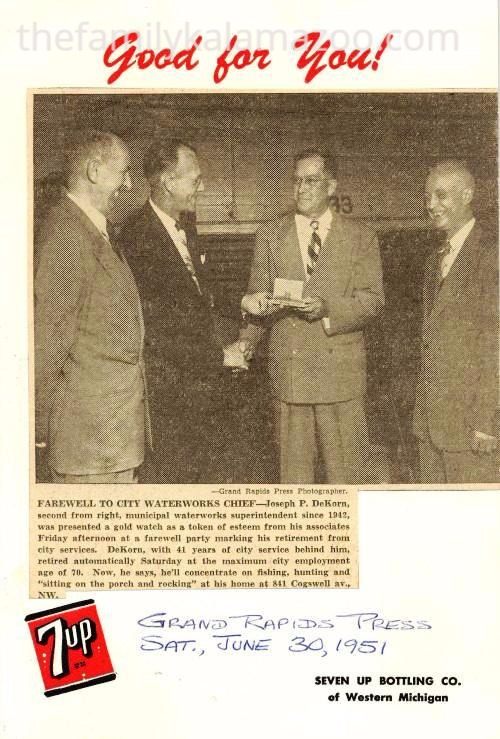
“Uncle Joe” was born to Richard DeKorn, local building contractor and brick mason, and Alice Paak DeKorn June 30, 1981, in Kalamazoo, Michigan. When he lived in Kalamazoo, he was an enthusiastic photographer, capturing scenes and people in Kalamazoo in the very early 1900s. Most of the photographs by Joseph which I have were taken between 1903 and 1918.  His draft registration for WWI is dated September 12, 1918.  He graduated from Kalamazoo College and the University of Michigan Engineering School in 1909.  Joe was a hydraulic engineer and worked for the City of Grand Rapids for over 30 years.  He retired as Superintendent of the Grand Rapids Water and Light Company.

gr-press-sat-6-30-51-joe-dekorn-retiring-city-waterworks-chief-001-1

Here is a commendation letter from the City Manager upon his retirement.

joe-dekorn-commendation-city-mgr-retirement-001-2

Personal life

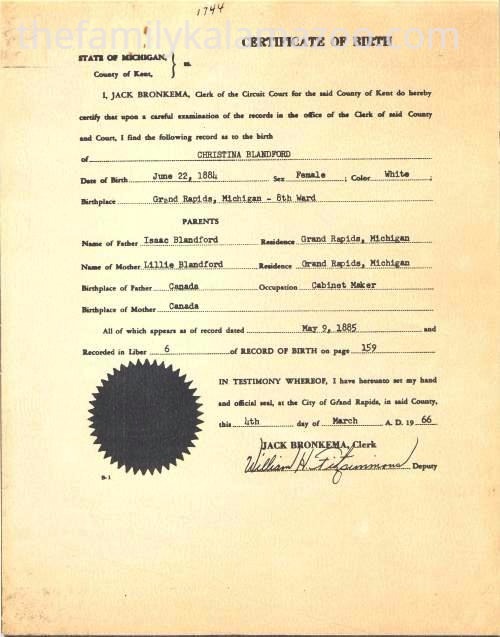
Joe married Christina Blandford on December 9, 1919 in Kalamazoo.  He was 38 and Christina was 35.  She was born June 22, 1884 in Grand Rapids, Michigan.  Christina’s parents were Isaac Blandford and Lily Kemp, both born in Ontario, Canada.   She graduated from Western Michigan Normal College (now Western Michigan University in Kalamazoo).  She was a school teacher and taught at Walker Township School, District #1 (later known as Fairview School) and Godfrey School in Grand Rapids.

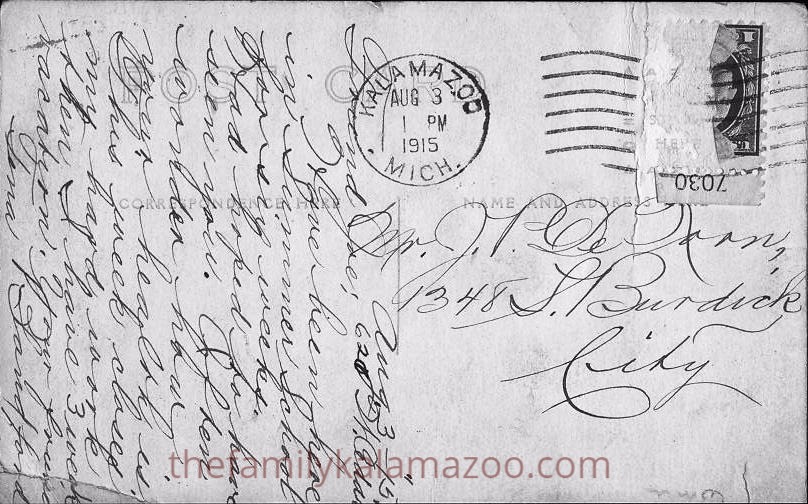
Aunt Tena, when Uncle Joe was still “Friend Joe” to her, wrote him this postcard in 1915:

Tena sent this postcard to Joe on August 3, 1915

Tena sent this postcard to Joe on August 3, 1915

Aunt Tena wrote from summer school in Lansing in her beautiful handwriting

Aunt Tena wrote from summer school in Lansing in her beautiful handwriting

Tena and Joe resided during their lifetime at 841 Cogswell Street, NW, Grand Rapids, Michigan, just three houses from the Blandford family homestead.  The couple raised their two sons, Richard and Phillip in Grand Rapids, Michigan. Richard was born on January 29, 1920, and Philip Eugene was born on August 4, 1922. Joe worked as a hydraulic engineer or filter engineer for the City Water & Light Department, Grand Rapids.  He passed away on March 24, 1962.

Joseph died March 24, 1967 in Grand Rapids and Tena died October 11, 1979 again in Grand Rapids, Michigan.

Unfortunately, I don’t remember Uncle Joe as I was too young, but I remember Aunt Tena as an elderly widow. She was memorable for her intelligence, kindness, fine china teacups, and her elegant and decorative old-fashioned handwriting (see postcard above).


The header photo (above) of the Kalamazoo flood in 1904 and the photos of downtown Kalamazoo from this post are some samples of Uncle Joe’s photographs.


Read Full Post »

Maureen Taylor, photo detective, helped me with a couple of photos a few years ago. The other day I bought her book, Family Photo Detective.

The book gives a good overview of many topics associated with identifying old family photographs. I haven’t read it all yet, but I did read certain sections because of various questions I already have in my mind.

In my post Mysterious Antique Photographs I posted a painted metal photograph which is unidentified. I believe it is from the Remine family. Although it can seem that the Remines are very distantly related, in fact, Richard DeKorn’s mother was a Remine:


Johanna Remijinse

1817–1864

BIRTH 15 JUL 1817 Kapelle, Zeeland, Netherlands

DEATH 1864 Kalamazoo City, Kalamazoo, Michigan

* my 3rd great-grandmother *

The consensus seems to be that the photo below (of an unidentified Remine female) is a tintype.


However, according to Taylor, a painted photo like this would be a daguerreotype which is painted on its metal surface with colored powders which are brushed or gently blown.

One of the characteristics of a daguerreotype over a tintype is that the image needs to be viewed from an angle. Another important characteristic is a mirror-like surface. I had to pull out the original to examine it for these traits.

It’s impossible to tell if the image needs to be viewed from an angle because the image is so thoroughly painted. But the background is not mirror-like, but rather a matte dark gray with a slight texture.

I went to the internet about this mystery and discovered a site that showcases some hand-painted tintypes. Unfortunately, after 45 years, The Ames Gallery in Berkeley is closing this year. I wonder what will happen to their photographs. Click the name of the gallery to see the painted tintypes.

I think we were right that this is a tintype that has been painted. In fact, the painting is so well done that her face is very realistic. Years ago, I used to work with gold leaf, embossing leather and vinyl products, and I suspect that the jewelry has been painted with gold-leaf.

It’s frustrating that I have not had the time to work on the photos and genealogy for many months (for the most part), but I like to keep moving along, getting one little thing after another accomplished so I don’t lose my touch haha.

Without a doubt, this is the most beautiful photograph in the whole collection.


Read Full Post »

Aunt Jen and Uncle Lou’s (Jennie DeKorn Leeuwenhoek and Lambertus Leeuwenhoek) only child, Alice, married Clarence Moerdyk (Dutch spelling Moerdijk).


Clarence Dewey Moerdyk

1898–1985

BIRTH 24 MAY 1898 Kalamazoo, Kalamazoo Co., MI

DEATH 18 DEC 1985 Winter Park, FL

Clarence’s parents were Peter (Pieter) and Cora. His father immigrated from Biervliet, Zeeland, the Netherlands, when he was 2 years old, in 1867.

I once posted a photo of Clarence as a kid, but at the time I wasn’t sure who he was. Blog readers helped me discover that this is Clarence who lived at 120 W. Ransom in Kalamazoo. That address is directly north of Arcadia Creek, five blocks north of East Michigan Avenue. Would you say he is in his mid-teens?

Alice and Clarence were married in Kalamazoo on 12 September 1923 by The Reverend Benjamin Laman of Bethany Reformed Church.

Here is information about the church at that time from their website:


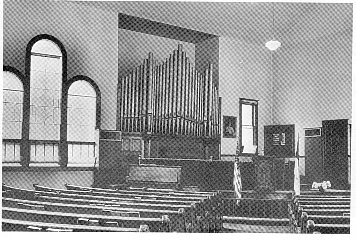
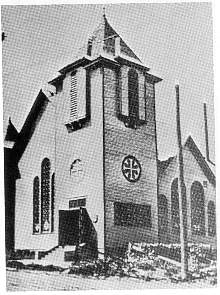
On June 5, 1905, in a tiny chapel near Burdick and Maple, the mission Sunday School that was to become Bethany held its first service. . . .

Growth under the leadership of these men was so great that less than two years later it was apparent that a larger building was needed. In 1907, a new church was built on the site of the original chapel. At this time the church had grown to include fifty-two families and seventy-seven communicant members. By the time that Reverend Kooiker left the church in 1910, Bethany had grown to sixty-nine families and one hundred eighteen communicant members.


Here is Clarence as I knew him in the early 60s:


Read Full Post »

« Newer Posts - Older Posts »