Feeds:
Posts
Comments

Posts Tagged ‘genealogy’

Alice Leeuwenhoek received a postcard wishing her a Joyous Thanksgiving (and a Cordial one) in 1911.

The card was postmarked November 29 because the holiday fell on November 30 in 1911. If this seems late, Thanksgiving didn’t fall on the fourth Thursday of the month until 1941 when FDR changed it.

This card was sent by Alice’s cousin’s Elizabeth. Who in the world was her cousin Elizabeth?

Alice’s mother, Jennie DeKorn, had 2 siblings: her sister Cora had only my grandfather who was 3 in 1911. Her brother wasn’t even married yet and his children weren’t born until the 20s. So what about the Leeuwenhoeks? The only one I know that came to this country (and would have written in English and MAILED A CARD FROM KALAMAZOO) was Gerrit who died single at the age of 21 in the Spanish-American War.

Elizabeth appears to be young–by her handwriting, her slang (kinda), and the general sloppiness of the writing.

Since Alice lived in Kalamazoo and the card was postmarked Kalamazoo, it is also curious why Elizabeth said she wished Alice would “come down sometime.” It’s possible that she just lived on the other side of town since that can seem an enormous distance to children who can’t travel that far by themselves. Alice was 14 in 1911.

Could Elizabeth be a friend?

More mysteries.

What is not a mystery is that I wish you all a blessed Thanksgiving.


Read Full Post »

Some of you might remember the beautiful scrapbook of photographs that I was given by a very kind stranger. It belonged to one of the two adult daughters –Rhea or Lela–of my great-great-grandfather’s sister Jennie DeKorn Culver.

At least one of the three Culvers moved from Kalamazoo to Seattle on August 20, 1918. If only one Culver moved at that time, it wasn’t long before all three were living in the state of Washington. I have not been able to figure out exactly how the move occurred–or why–but it doesn’t stop me from being fascinated with the photos.


Although the majority of the photographs in the album are from 1917 and 1918, this one is marked 9-4-1915. It says it is on Riverside Drive. But what are those initials after the street?

In 1910 Jennie lived with her two daughters at 59 Kalamazoo Avenue in Kalamazoo. She was a seamstress in a corset factory. Rhea was 19 years old and a stenographer in a “paper stock company.” Lela, 21, was a teacher in a public school. I would really love to find out if Lela went to Western Normal School to become a teacher.

So is this Riverside Drive in Kalamazoo or elsewhere? According to Mapquest and Google, there is a Kalamazoo Avenue in Kalamazoo, but not Drive. Both Kalamazoo Avenue and Riverside Avenue are on the east side of Kalamazoo. There’s a famous Riverside Drive in NYC. I’m going to make a guess that those initials say N. Y.–New York City. Do you agree?

And is this one of the sisters? Unfortunately, I would say NO as both sisters had narrow faces. My guess is that this is a friend of the scrapbook owner.

On a slightly related subject, I just wanted to say:

CONGRATULATIONS to the WMU Broncos!!!

They are undefeated this season!!!! This is my alma mater. This is the alma mater of so many of my relatives. YAY!!!!!!!!!!!!!!

If you want to get hyped up, watch the video and ROW THE BOAT!


Related articles

Read Full Post »

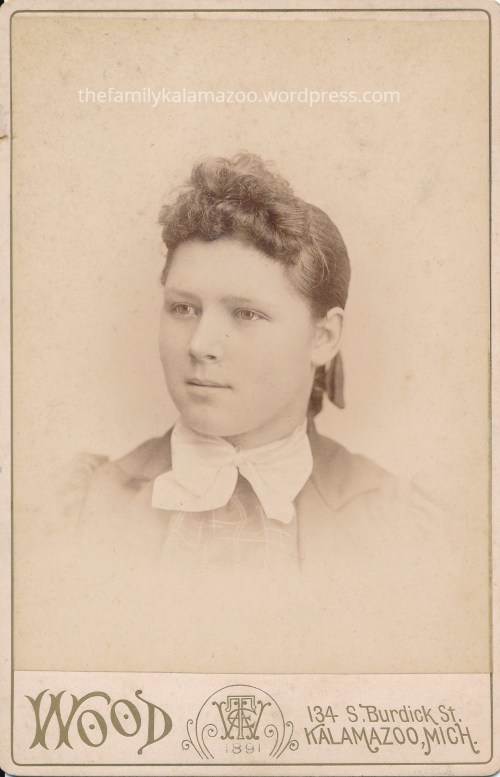
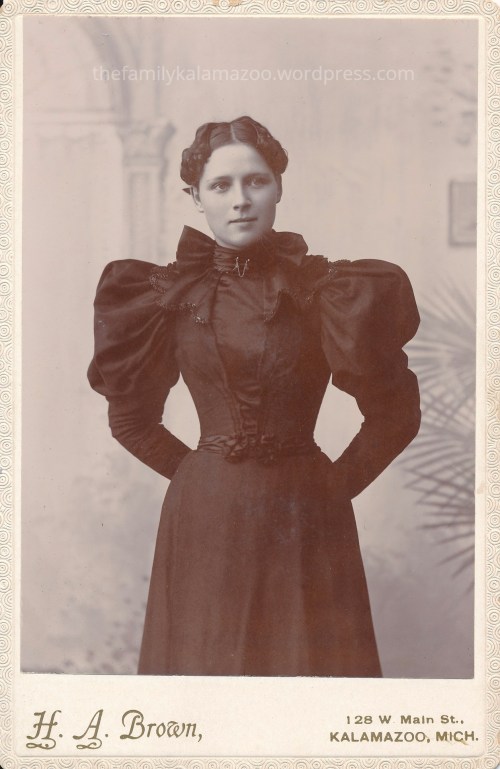
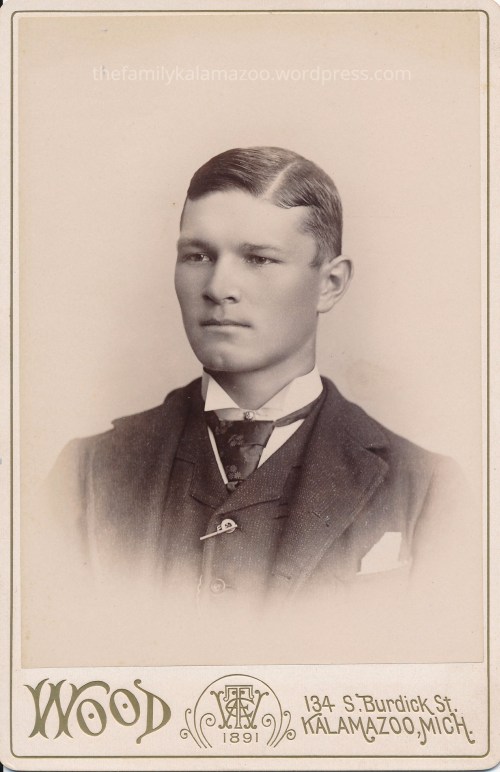
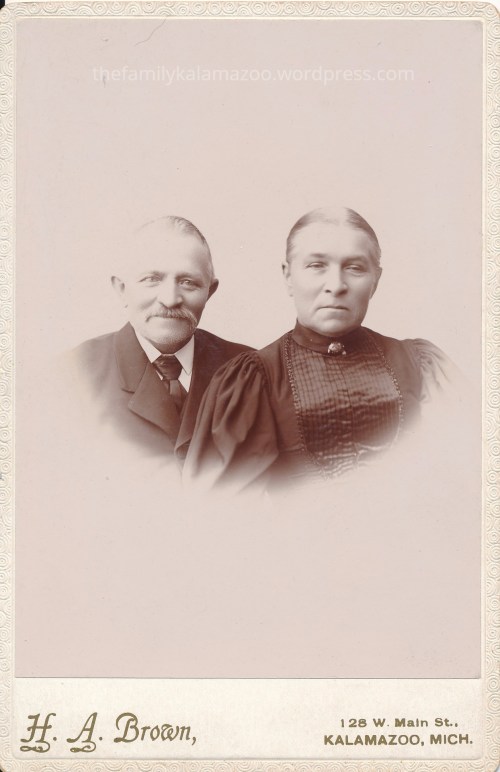
In the 1970s, Grandpa identified some of the old photographs as members of the Ebelink family–from Kalamazoo, of course. He didn’t mention just who they were, but I wrote down the names on the back of the photos. I’ve labelled the photos as my grandfather told them to me and corrected them if I found an error.

Anna Ebelink Fisher Fletcher 1891

Ann Ebelink Myers

John Ebelink: 1891

The father (Benjamin Ebelink) and stepmother (Van de Giessen) of John Ebelink

So who were these people? According to the 1880 census, Benjamin and Wilhelmina, both born in Holland (the Netherlands), had three children: Frederich (age 6), John (age 5), and Joanna (age 2).  Since there is no existing 1890 census for Michigan, I had to skip ahead to 1900, where I found John married for four years to Jennie, with one child, Wilhelmina, age 3. A quick search for the death of John’s father Benjamin and I find the year 1916 in Ottawa, Michigan. He was a widower, so he must have already buried at least two wives.

But who were Anna and Ann? I can see Joanna being one of them. Are these two different sisters? And were they really married to Fisher and Myers?

It appears Anna married a Fletcher, not a Fisher. Could have been Grandpa’s memory–or my hearing.

Name: Anna Ebelink
Gender: Female
Race: White
Birth Year: abt 1878
Birth Place: Kalamazoo, Michigan
Marriage Date: 12 Jul 1900
Marriage Place: Kalamazoo, Kalamazoo, Michigan, USA
Age: 22
Residence Place: Kalamazoo, Michigan
Father: Barend Ebelink
Mother: Wilhelmina Stroup
Spouse: Claude H Fletcher
Record Number: 5305
Film: 68
Film Description: 1900 Delta – 1900 Mackinac

Benjamin was also Barend, a Dutch male given name, and it looks like John and Anna’s mother’s maiden name was Stroup. A bit curious about Anna’s photo is she appears to be in mourning, doesn’t she? I wonder when their mother died.

I can’t find Ann Ebelink Myers. Was she Anna or a different child?

I didn’t want to go too far down this tangent without knowing how these people are connected to my family. I found it by looking at the 1940 census. John and his family lived on Balch Street, right near my family. I would think that my mother and uncle must have known the family.

Read Full Post »

In the beautiful scrapbook that belonged to one of the Culver sisters, I discovered a postcard of Western State Normal School (Western Michigan University now) in Kalamazoo. I’ve never seen this view of the campus before. More of my relatives (and moi) have attended Western than any other school. I need to start a list of all the ancestors and relatives who are Western alumni.

I’m not sure of the year the postcard was published because the  back of the postcard indicates it cost 1 cent. Postcards cost that amount over a very large period of time. All it means is that it was not printed during WWI when the price went up to 2 cents. After the war, they went back down to 1 cent.

Because my business school classes were on what eventually became known as “East Campus” (the original site of the school), I remember the long walk up the hill, but it sure didn’t look like this. Neither did the buildings.

I searched online and found a postcard from 1910. If you click through the postcard you will go to site where I found it. It belongs to WMU.

Why do the red brick buildings look white in my postcard? Notice the tennis courts seen from this view. Now I can see that Oakland Drive is not down there. So maybe this is on the other side of Oakland? Apparently not. (Confusing!)

Here is a 1925 map of the campus, and on here it is easy to see where Oakland Drive is. If you want verification click through and go to the WMU website. When you put your mouse over the street it will show up as Oakland Drive.

aerial1925

Why is the same bus or trolley at the bottom of the drive in both photos?

Well, what do you know? That little trolley has its own Wikipedia page!

From Wikipedia:

The Western State Normal Railroad, also known as the Normal Railroad or Western Trolley, was a funicular [a cliff railway] which operated on the campus of Western Michigan University in Kalamazoo, Michigan, in the United States from 1908–1949. It is the only known example of a private railroad operated by a university.

In the early 1900s the primary campus of Western Michigan University, then known as Western State Normal School, was located on Prospect Hill (this area is now known as East Campus). To reach the buildings students and faculty faced a forbidding 150 step-climb, often in inclement weather. In an effort to address this problem, the school constructed a funicular along the northeast corner of the hill. The base of the line was at Davis Street, while the summit lay between East Hall and North Hall. There were two tracks, each with a cable-hauled car.

At its peak the railroad carried 2,280 passengers daily, but rising maintenance costs combined with the growing popularity of the automobile hastened its demise, and it carried its last passenger in 1949.In 2002 four senior engineering majors at WMU embarked on a project to build a replica of one of the trolleys. This proved no easy task: following the closure of the railroad in 1949, no effort was made to preserve the cars. The only physical remnant was a bench saved by a faculty member; while there were sketches and photographs for reference, no actual blueprints had survived. Commenting on the situation a WMU official remarked that “back then was a period in history so intent on the future, that everyone started forgetting about the past.”

Despite these challenges, the students successfully completed their project, which was unveiled April 8, 2003, and currently occupies a prominent place in front of the Bernhard Center on Western’s primary campus. Local residents and Western alumni who had ridden the trolley testified to the authenticity of the restoration.

Because I often get sidetracked in too many directions and because my time has been so limited, I need to make a list of all the projects to tackle in the future. Figuring out “who all” has gone to Western needs to top the list!

###

Originally I thought all the Culver photos were from after they moved to Seattle from Kalamazoo. Then it was discovered that some of the photos were from Kalamazoo. This postcard was in a stack with travel postcards and photos within the scrapbook.

Read Full Post »

When I was in an antique mall, I picked up a clown doll. I do have a doll collection, but this clown didn’t fit the collection. I had no idea why I wanted it.

I’m not afraid of clowns, although some of these recent clown news stories could unnerve me if I experienced them. But when I got in the car with my “new” doll, I looked at it and said to myself, “Why did I want you?”

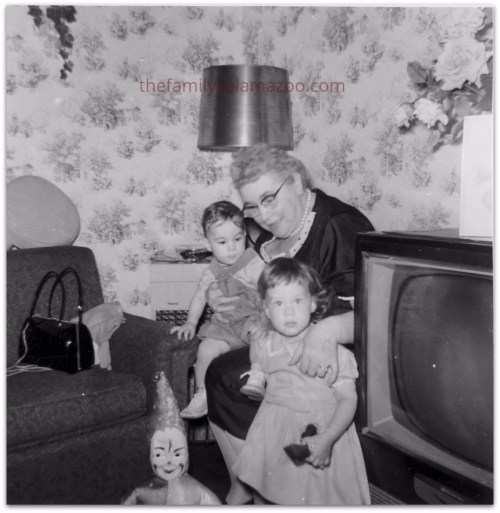
A week later, I was going through some old photos (as you know I do that a lot) and discovered this photo of myself at age two with my grandmother, my cousin Michael, and a doll.

Although it’s not the exact doll, it’s pretty close–even with the same markings. The one I found has a younger, sweeter face, whereas the one in the photo has a more mature face.

Did I have some memory of this doll that made me buy the one at the antique mall? Or did the experience of the earlier clown prepare me for a sense of familiarity when I saw the one for sale?

Was that my cousin’s doll–or mine? And who bought it?

Photos can be a mystery years later, even when you’re in the picture!

This post was inspired by Mary Louise Eklund’s post on Wednesday last week.

Read Full Post »

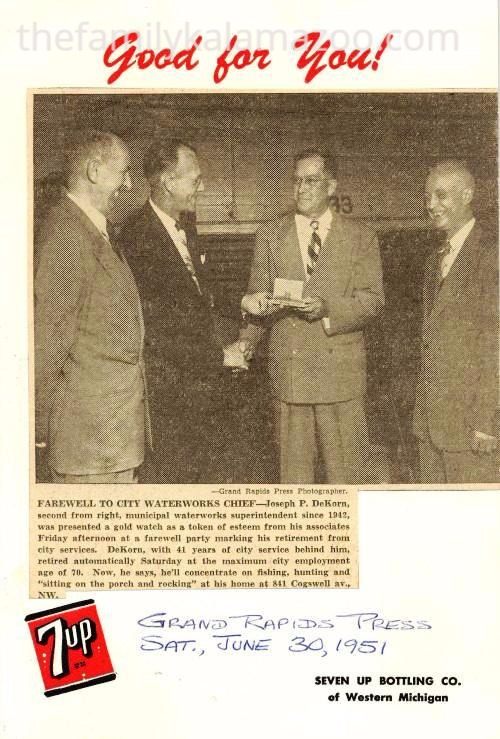
I originally started this blog because of the wealth of photographs and glass negatives I had in my possession that once belonged to my grandfather’s uncle, Joseph Peter DeKorn. This post is a revision and update of the 2nd post on this blog.Joseph Peter DeKorn

“Uncle Joe” was born to Richard DeKorn, local building contractor and brick mason, and Alice Paak DeKorn June 30, 1981, in Kalamazoo, Michigan. When he lived in Kalamazoo, he was an enthusiastic photographer, capturing scenes and people in Kalamazoo in the very early 1900s. Most of the photographs by Joseph which I have were taken between 1903 and 1918.  His draft registration for WWI is dated September 12, 1918.  He graduated from Kalamazoo College and the University of Michigan Engineering School in 1909.  Joe was a hydraulic engineer and worked for the City of Grand Rapids for over 30 years.  He retired as Superintendent of the Grand Rapids Water and Light Company.

gr-press-sat-6-30-51-joe-dekorn-retiring-city-waterworks-chief-001-1

Here is a commendation letter from the City Manager upon his retirement.

joe-dekorn-commendation-city-mgr-retirement-001-2

Personal life

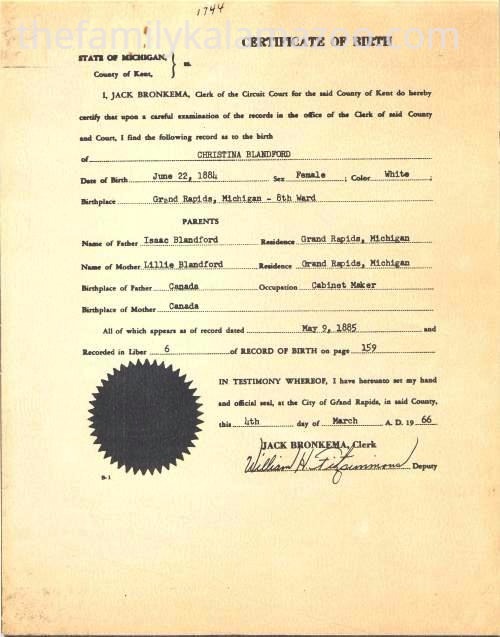
Joe married Christina Blandford on December 9, 1919 in Kalamazoo.  He was 38 and Christina was 35.  She was born June 22, 1884 in Grand Rapids, Michigan.  Christina’s parents were Isaac Blandford and Lily Kemp, both born in Ontario, Canada.   She graduated from Western Michigan Normal College (now Western Michigan University in Kalamazoo).  She was a school teacher and taught at Walker Township School, District #1 (later known as Fairview School) and Godfrey School in Grand Rapids.

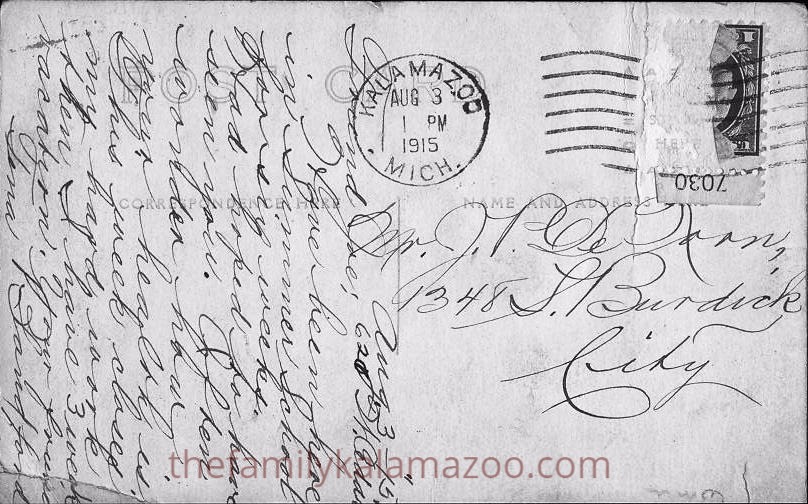
Aunt Tena, when Uncle Joe was still “Friend Joe” to her, wrote him this postcard in 1915:

Tena sent this postcard to Joe on August 3, 1915

Tena sent this postcard to Joe on August 3, 1915

Aunt Tena wrote from summer school in Lansing in her beautiful handwriting

Aunt Tena wrote from summer school in Lansing in her beautiful handwriting

Tena and Joe resided during their lifetime at 841 Cogswell Street, NW, Grand Rapids, Michigan, just three houses from the Blandford family homestead.  The couple raised their two sons, Richard and Phillip in Grand Rapids, Michigan. Richard was born on January 29, 1920, and Philip Eugene was born on August 4, 1922. Joe worked as a hydraulic engineer or filter engineer for the City Water & Light Department, Grand Rapids.  He passed away on March 24, 1962.

Joseph died March 24, 1967 in Grand Rapids and Tena died October 11, 1979 again in Grand Rapids, Michigan.

Unfortunately, I don’t remember Uncle Joe as I was too young, but I remember Aunt Tena as an elderly widow. She was memorable for her intelligence, kindness, fine china teacups, and her elegant and decorative old-fashioned handwriting (see postcard above).


The header photo (above) of the Kalamazoo flood in 1904 and the photos of downtown Kalamazoo from this post are some samples of Uncle Joe’s photographs.


Read Full Post »

Maureen Taylor, photo detective, helped me with a couple of photos a few years ago. The other day I bought her book, Family Photo Detective.

The book gives a good overview of many topics associated with identifying old family photographs. I haven’t read it all yet, but I did read certain sections because of various questions I already have in my mind.

In my post Mysterious Antique Photographs I posted a painted metal photograph which is unidentified. I believe it is from the Remine family. Although it can seem that the Remines are very distantly related, in fact, Richard DeKorn’s mother was a Remine:


Johanna Remijinse

1817–1864

BIRTH 15 JUL 1817 Kapelle, Zeeland, Netherlands

DEATH 1864 Kalamazoo City, Kalamazoo, Michigan

* my 3rd great-grandmother *

The consensus seems to be that the photo below (of an unidentified Remine female) is a tintype.


However, according to Taylor, a painted photo like this would be a daguerreotype which is painted on its metal surface with colored powders which are brushed or gently blown.

One of the characteristics of a daguerreotype over a tintype is that the image needs to be viewed from an angle. Another important characteristic is a mirror-like surface. I had to pull out the original to examine it for these traits.

It’s impossible to tell if the image needs to be viewed from an angle because the image is so thoroughly painted. But the background is not mirror-like, but rather a matte dark gray with a slight texture.

I went to the internet about this mystery and discovered a site that showcases some hand-painted tintypes. Unfortunately, after 45 years, The Ames Gallery in Berkeley is closing this year. I wonder what will happen to their photographs. Click the name of the gallery to see the painted tintypes.

I think we were right that this is a tintype that has been painted. In fact, the painting is so well done that her face is very realistic. Years ago, I used to work with gold leaf, embossing leather and vinyl products, and I suspect that the jewelry has been painted with gold-leaf.

It’s frustrating that I have not had the time to work on the photos and genealogy for many months (for the most part), but I like to keep moving along, getting one little thing after another accomplished so I don’t lose my touch haha.

Without a doubt, this is the most beautiful photograph in the whole collection.


Read Full Post »

Aunt Jen and Uncle Lou’s (Jennie DeKorn Leeuwenhoek and Lambertus Leeuwenhoek) only child, Alice, married Clarence Moerdyk (Dutch spelling Moerdijk).


Clarence Dewey Moerdyk

1898–1985

BIRTH 24 MAY 1898 Kalamazoo, Kalamazoo Co., MI

DEATH 18 DEC 1985 Winter Park, FL

Clarence’s parents were Peter (Pieter) and Cora. His father immigrated from Biervliet, Zeeland, the Netherlands, when he was 2 years old, in 1867.

I once posted a photo of Clarence as a kid, but at the time I wasn’t sure who he was. Blog readers helped me discover that this is Clarence who lived at 120 W. Ransom in Kalamazoo. That address is directly north of Arcadia Creek, five blocks north of East Michigan Avenue. Would you say he is in his mid-teens?

Alice and Clarence were married in Kalamazoo on 12 September 1923 by The Reverend Benjamin Laman of Bethany Reformed Church.

Here is information about the church at that time from their website:


On June 5, 1905, in a tiny chapel near Burdick and Maple, the mission Sunday School that was to become Bethany held its first service. . . .

Growth under the leadership of these men was so great that less than two years later it was apparent that a larger building was needed. In 1907, a new church was built on the site of the original chapel. At this time the church had grown to include fifty-two families and seventy-seven communicant members. By the time that Reverend Kooiker left the church in 1910, Bethany had grown to sixty-nine families and one hundred eighteen communicant members.


Here is Clarence as I knew him in the early 60s:


Read Full Post »

I’ve heard that Uncle Lou (Lambertus Leeuwenhoek) loved to play games–and was very good at them. Where and when he passed away is fitting, in that context.


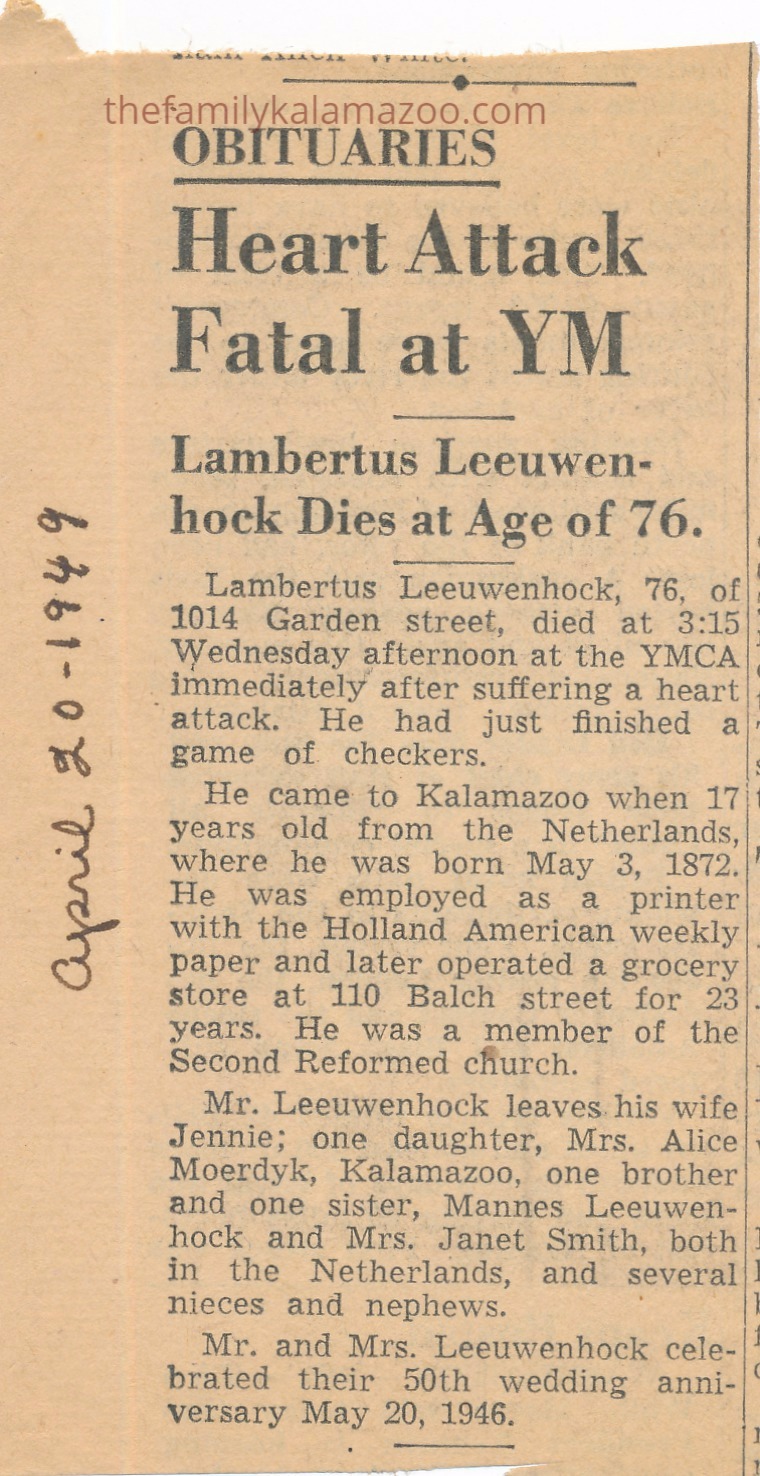
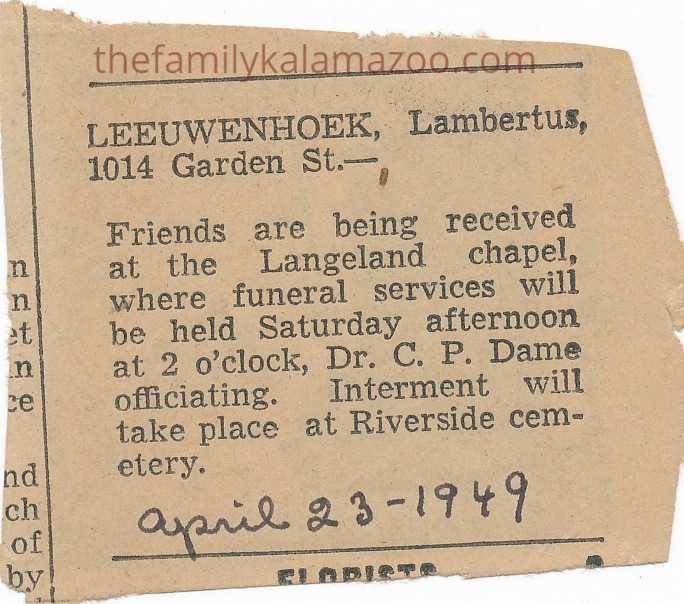
Uncle Lou “died at 3:15 Wednesday afternoon at the YMCA immediately after suffering a heart attack. He had just finished a game of checkers.” I bet he won the game.

I need to research where the Y was located.

He died on Wednesday, April 20, 1949. Coincidentally, my father-in-law passed away in 1984 on April 20. Notice that Uncle Lou and Aunt Jen were married on May 20. My birthday is July 20. My cousin was born January 20. I always notice the number 20.

Here is the funeral announcement in the newspaper:

And here is a beautiful memorial book from Uncle Lou’s funeral. I wish I knew how to create a slideshow that allows a reader to enlarge each photo, but I don’t know if there is a way on WordPress.

This slideshow requires JavaScript.

What I find particularly useful from a genealogy standpoint are the names of the visitors on the last two pages. They are as interesting as the names in the obituary, if not more so.

Read Full Post »

I’ve written about the Leeuwenhoeks, and in particular, my great grandmother’s brother-in-law, Lambertus Leeuwenhoek. He was called Uncle Lou by my grandfather, so he’s still called Uncle Lou by me today, although I never met him. I did know his wife, Aunt Jen, who survived him by decades.

Uncle Lou and Aunt Jen owned a general store. They had a store in Kalamazoo for a time and one in Vicksburg for a time, as well. In the 1910 and 1920 censuses, he and Aunt Jen are living at 110 Balch Street in Kalamazoo. His Kalamazoo store sold Gold Medal flour.

may-19-1910-leeuwenhoek-ad


In the 1930 census, they live at 111 East Prairie Street in Vicksburg. In the 1940 census I find them with Lou’s first name mangled into Laonbatius. They are living with their daughter Alice and her husband, Clarence Moerdyk, at 1014 Gerdan Street in Kalamazoo. Could that be GARDEN Street? Because that would be a real house in Kalamazoo. One still existing, most likely.

I looked for city directory entries, and I found these–all date jumbled:

Leeuwenhock Lambertus (Jennie) household 110 Balch, 1926 City Directory: See Page
Leeuwenhoek Alice M, dressrnkr, boards 110 Balch, Kalamazoo City 1915: See Page
Leeuwenhoek Lambertus (Jennie) resides at 1014 Garden, City Directory 1935: See Page
Leeuwenhoek Lambertus (Jennie), grocer 110 Balch, residence same, Kalamazoo City 1915: See Page
Leeuwenhoek Lambertus (Jennie), grocer 110 Balch, residence same, Kalamazoo City, 1905: See Page
Leeuwenhoek Lambertus, compositor, 306 Wall., Kalamazoo City 1895: See Page

Compositor means that Lou was working on the Dutch newspaper. See here. But he had a grocery store in his house?

And if he lived in Vicksburg in 1930, but lived in Kalamazoo in 1926 and 1935, he couldn’t have lived in and owned a store in Vicksburg for very long. Unfortunately, I haven’t found a source for Vicksburg advertising yet.

I found this photo of Uncle Lou standing out in the front of the store, but I’m not sure which city this is:

Any ideas on the years, judging by the cars? Any idea if that looks like Kalamazoo or Vicksburg in the distance?

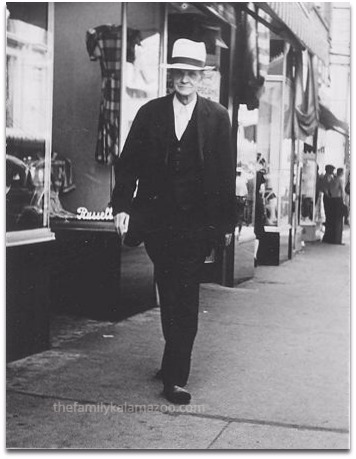
Likewise, I’m not sure which city Uncle Lou is in as he walks down the sidewalk? Does that window say “Russell” on it? In the city directories, there are many Russells, including ones owning businesses. There is one on Burdick Street, for instance, in my family’s neck o’ the woods, that is a variety store.

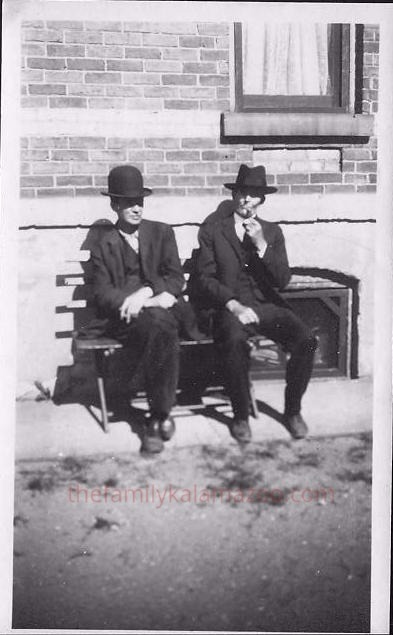
Here he is on a bench:

I wouldn’t be surprised to find this bench outside Richard DeKorn’s (his father-in-law) house on the corner of Burdick and Balch, judging by the design of the light colored stripe through the brick.

Here the photo is again–yes, it’s the same house. It’s hard to see Lou’s face up close. Below he is with his father-in-law, Richard DeKorn.
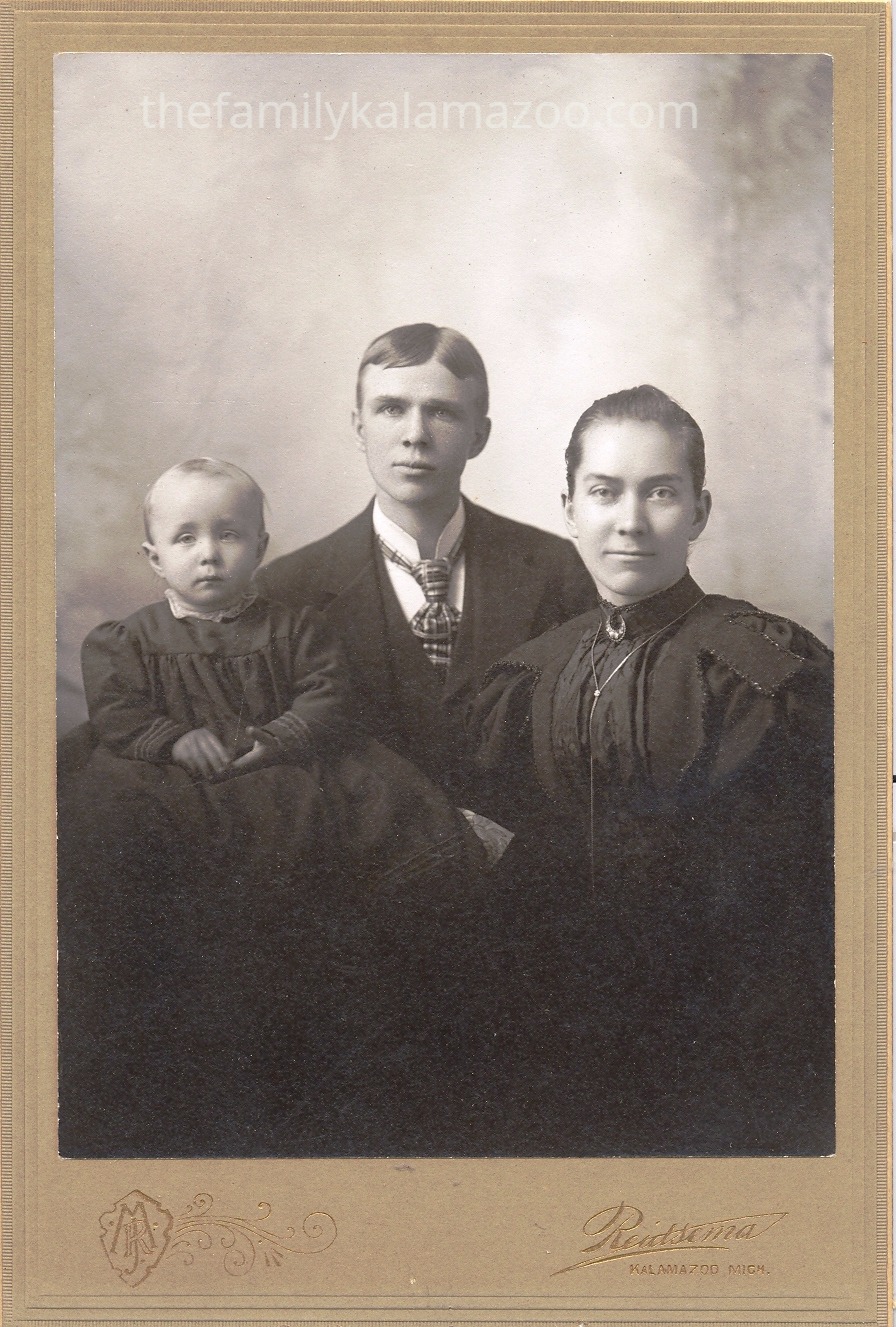
Uncle Lou with Aunt Jen and their only child, Alice:

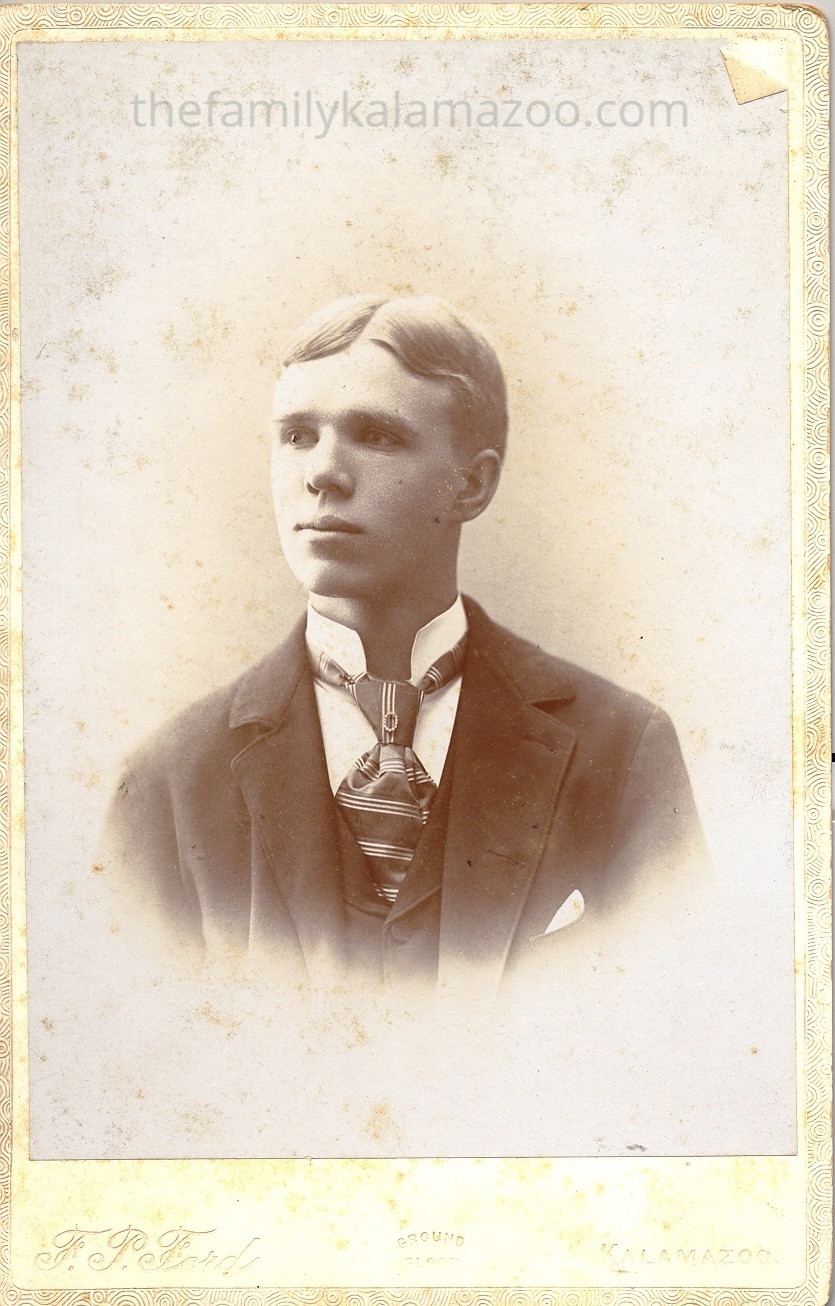
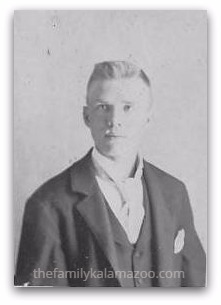
Here is a closeup of young Uncle Lou.

And now this is a curiosity. This photo is labelled Lou Leeuwenhoek by the same person who knew that the man walking down the street was Lou, that that was Lou standing out in front of his store, etc. But IS it Lou?

This is not his brother, for sure. While it’s not the same hairstyle as the photos above, the features seem to be the same–except for the eyes which, in the other photos, seem to be deep-set. Is the difference aging (the style of tie is the same) or lighting?  Or is the photo mislabeled?

***

You can check out the Bibles Uncle Lou brought with him from the Netherlands here.

Read Full Post »

« Newer Posts - Older Posts »