Feeds:
Posts
Comments

Posts Tagged ‘DeKorn family’

My last post Is it Live or is it Memento Mori? relied on information about the dates of the photographer of the photograph in question (whether the lady is dead or alive in the photo).  I used information from a listing of late 19th and early 20th century Kalamazoo photographers on Bushwacking Genealogy.

I started wondering if I approached my photos from this perspective if I could add information to my identification of photos and dates.

For example, this photograph of Carrie Paak Waruf was taken by Evans. Evans is not on Bushwacking’s list, but notice how the photo says “Successor to Packard 120 E. Main St.” So I looked when Packard seems to have stopped being a photographer at that address: 1887. But wait. Mary H. Packard seems to have been in business at that address in 1899. (The lesson here is to pay attention to the photographer’s address if it’s on the photo–they moved around quite a bit and it can help identify a year). Her husband committed suicide in 1898. So who was Evans? And what year was this photo of Carrie taken?

Carrie was born 8 May 1862 in Lexmond, Netherlands. She was my great-great-grandmother’s sister. That means that if Mary Packard was out of business by 1900, Carrie would have been 38 years old. And even older if it was sometime after that point.

That is not possible. This photograph is of a young woman. This is confusing. I might have learned something, but now I have still more questions (is this The Family Kalamazoo refrain or what? more questions, more questions)

Here is another one:

This woman is Jennie Remine Meyer (Meijer, married to Klaas Meijer who became Carlos Meyer).  She’s my first cousin, 4x removed. How old do you think she looks in this photo?

She was born 12 April 1860 in Kalamazoo. Just for the record, she passed away in Kalamazoo on 20 September 1940.

This photographer also bills him or herself as a successor to C. C. Packard, the photographer who died in 1898.  You are correct if you are guessing that Kidney is also not on Bushwacking’s list of photographers.

This is where I wish I had a Kalamazoo city directory for every year right at my fingertips.

If this photo was taken in 1900 or after she would have to be 40 or older.  I think she looks pretty good for 40. No botox, no makeup, no hair dye. But she could be 40, whereas I don’t see how Carrie could be 38 or older.

Then there are the clothes to consider. My instincts tell me Jennie’s clothing and hair is from an older period than Carrie’s, but that would be impossible because she is older than Carrie in the photos, but these two women are only two years apart in age.

There is much work to be done on solving the mystery of these two “successors” to photographer Packard.

Let’s just spot check a couple and see if the information on Bushwacking seems to correspond with the information I have about my photos.

This is Gertrude, Richard, and Adrian DeSmit, the children of John DeSmit and Mary DeKorn DeSmit. Gertrude was born in 1889, Richard 1887, and Adrian in 1891. If we assume that the children are about 6, 8, and 4 in this photo, the year it was taken would be 1895. The photographer Wood was Thomas E. Wood (also went by T.E. Wood) who was in business at least from 1887 to 1895, according to Bushwacking. She says he was not in the city directory in 1899. From 1887-88 he was at 316 E. Main St. From 1889-1895, he was at 134 S. Burdick St. The address on this photo is 134 S. Burdick St. (way up the street from the neighborhood where my relatives lived).


OH WAIT, what does that say in the middle of the bottom of the photo? 1895!!!!!!!! So my calculations about their ages was correct, plus it means that my grandfather was correct when he identified exactly which DeSmit children are pictured (there were many, but these were the youngest).  This verifies my info about the photo, as well as the info provided by Bushwacking.

Here is one more. Gerrit Leeuwenhoek:

Photographer Philley is not a common one in my albums, but he is on Bushwacking’s list. Silas Philley, Jr. In 1895, he was in business at 303 E. Main, and in 1899 at 305 E. Main. This photo says 303 East Main Street.

Gerrit died in the service of our military 23 July 1898. If you want to break your heart, read this: he only immigrated to the United States on in April 1897.  I’ve written about him previously in several posts–his death, his life in an orphanage, and the court case he brought against a teacher. You can search his name in my blog’s search bar.

But look at these dates. Since this photograph had to be taken in 1897 or 1898, it means that Philley was still operating out of 303 E. Main Street through that period. This helps narrow down the Bushwacking information a bit more.

I wonder why this photograph was taken and who paid for it. Since Gerrit was a young immigrant, I wonder if his older brother Lou paid for the photo. And I also wonder if it was taken because he was leaving for Cuba for the Spanish-American War. Would the government have taken photographs of new enlistees? If this were true, there might be more photos of young soon-to-be soldiers taken by Philley at this time period.
Read Full Post »

More tintypes! In Mysterious Antique Photographs I shared a beautiful tintype that I own.

Yesterday I opened the box of unscanned Remine photos. I haven’t had time to scan so many photos–or to organize either–but I thought I should just start doing a few a day because when WILL I ever have the time?

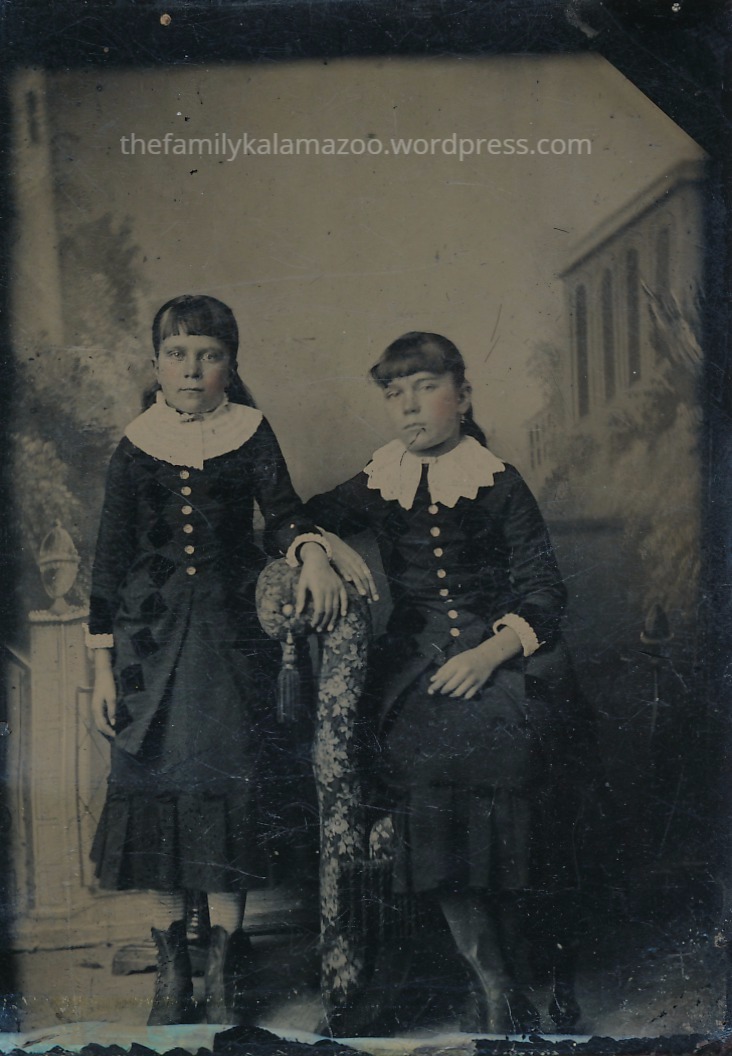
And I discovered these beautiful tiny tintypes. The one on the other post is large and painted. These are only 2.25 x 3.5 inches in size–and unpainted.

Because they are in the Remine box I can guess they might be Remines. Judging by the faces, I am ready to conclude they probably are Remines.

Because these girls and women were photographed full length (standing and seated), we can examine their entire outfits to try to guess a time period.

Therese was born in 1891. Could this photo be from around 1900?

I am having trouble identifying the correct information about Therese’s sisters. When I figure it out, this might help in identifying this tintype. For instance, if there were sisters born in 1880 and 1881 as might have been, this photo could, I suppose, be those sisters. If so, one of them is Genevieve Remine Tazelaar and the tintypes would be in the early 1890s.

I suppose the hair and collars could be 1900. But what about the fitted jackets with all the buttons? I can’t find anything like that in photos of 1900. Odd, too, that it would be a tintype if it was as late as 1900.

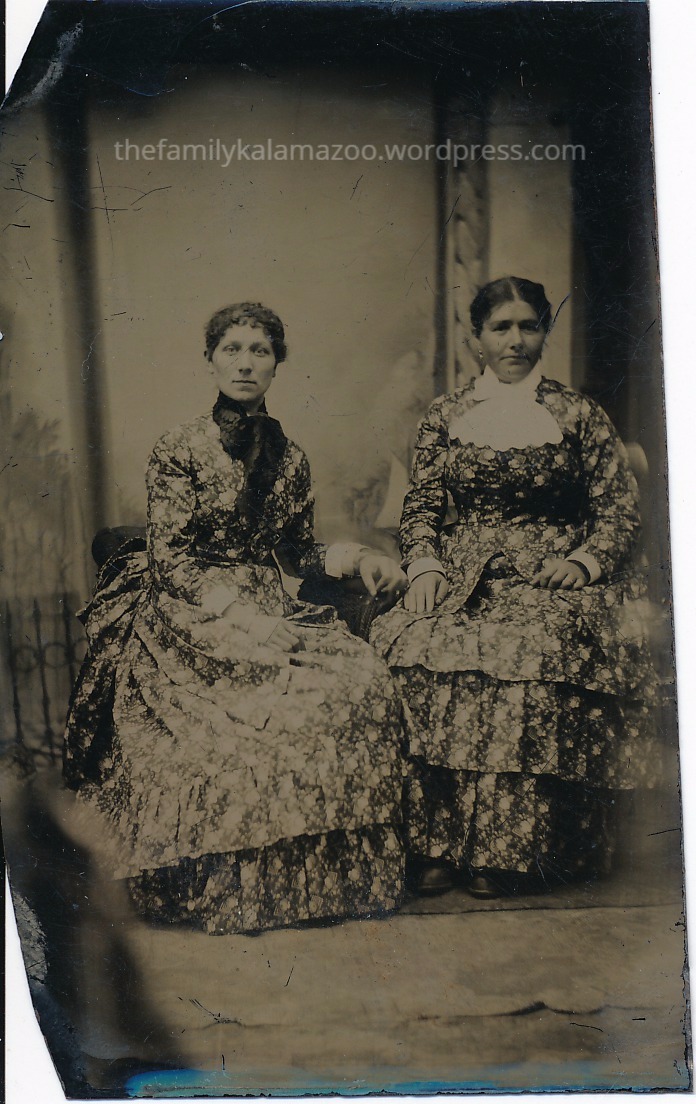
Here is the other tintype. I’m sorry it’s kind of crooked and uneven. It was difficult to scan it.

What about these outfits? They are not leg o’mutton sleeves, so does that rule out the 1890s?

I guess I am not very good at taking the nuances of change in fashion and extrapolating to what my relatives would have worn (generally a much more conservative version of the fashion).

The woman on our left looks a lot like Mary Paak Remine, Therese’s mother. She was born in 1859. But the woman doesn’t look terribly young in this photo. And then who would the other woman be? She looks NOTHING like the Paak sisters. She is not Mary’s mother because Jacoba Bassa had passed away long before this.

Were these photos taken in the Netherlands or the United States? The Remines were from Kapelle and the Paaks were from Lexmond. Notice the wallpaper/painted background. I’m pretty sure that these photos were taken in the same studio, perhaps near the same time period.

I’m afraid I have more questions now than I did before.


Read Full Post »

One of the branches of my family from the Netherlands was the Reminse branch.

On 26 August 1810, my 4th great-grandfather, Dirk Reminse, a bread baker, married Adriana Kriger (Krijger) in Kapelle, Zeeland, the Netherlands. Dirk was born 22 November 1786 in Kruiningen, Zeeland, Netherlands. At some point before his marriage he must have relocated to Kapelle, but Adriana also came from a different town. She was born 11 June 1787 in Biggekerke, Zeeland, Netherlands.

Houses on the Kerkplein (church square), Kapelle, Netherlands

The couple had the following children:
Gillis Remijinse 1811–1868

Jan Remijinse 1813–1837

Hendrika Remijinse 1814–1893

Johanna Remijinse 1817–1864

Johannis Remijinse 1819–1846

Adriaan Remijinse 1821–1849

Pieter Remijinse 1822–1830

Frans Remijinse 1823–1860

Gerard Remynse 1825–1910

Marinus Remijinse 1826–1863

Note the difference in the spelling of the surname. It is seen both ways. In this country it became REMINE.

Their daughter Johanna was born 15 July 1817 in Kapelle. She married Boudewijn DeKorne 21 May 1847 in Kapelle. Boudewijn had been born in Kapelle on 11 June 1816.

The couple had one daughter who died as an infant, then a son Richard and daughter Maria were born. Richard, my great-great grandfather, would end up being a well-known brick mason and contractor in Kalamazoo, Michigan, but first the family had to immigrate to the United States.

Johanna’s parents had both died. Dirk died 9 September 1840 in Kapelle. On 14 April 1845, Adriana passed away.

Boudewijn and Johanna arrived in this country in 1856 and first settled in Zeeland, Michigan. The following year their 4th and last child, Jennie was born. Jennie eventually became Jennie Culver who divorced her husband and moved to Seattle with her two teen daughters. I have posted about the magnificent photo album that belonged to one of Jennie’s daughters that a blog reader mailed to me.

Johanna Remijinse DeKorne was my last direct ancestor in the Remine line, although my grandfather stayed close to the family that continued that surname in Michigan.

I found a photograph of this branch of the family in the Netherlands. The photograph is not marked with a photography studio or any other identifying information. Someone, possibly my grandmother, wrote on the back “Remine family in Holland.” In order to figure out who is in the photograph I would need to know the approximate date of the photo. Since Johanna immigrated in 1857, this must be from a line of the family that ran parallel to her line. Would it be the family of one of her siblings?

I went back and examined the other Remine cousins in the United States. They stem from Johanna’s brother Gerard.  He seems to have immigrated to the United States between 1855 and 1857. Maybe he and his family even came over with his sister and hers? NOTE TO SELF: CHECK INTO THIS.

Why did the families remain close? Johanna’s son Richard’s wife Alice’s sister Mary married Richard Remine, son of Johanna’s brother Gerard! What does that make them? First cousin’s by marriage?

So the photo can’t be of Gerard’s family. That leaves eight other siblings to check into. And the children of all these siblings . . . . NOTE TO SELF: MORE WORK NEEDED HERE

CAN YOU GUESS A TIME PERIOD FOR THIS PHOTO?


Read Full Post »

In my stack of anonymous family photos, I have two that are different from the others.

In the first one, the image is imprinted on metal and then painted with colored paint.


In the other, a couple appear to be drawn, rather than photographed.


It’s likely that the photographs came from Grandpa’s family: Paak, DeKorn, Zuidweg, Remine, Bomhoff, or his other branches. Or they could be friends or neighbors.

UPDATE: My daughter thinks the tintype woman looks like Grandma in the eyes and mouth. “Grandma” would be my mother, Grandpa’s daughter.

Any thoughts on type of photographs or on dating of these images?

Read Full Post »

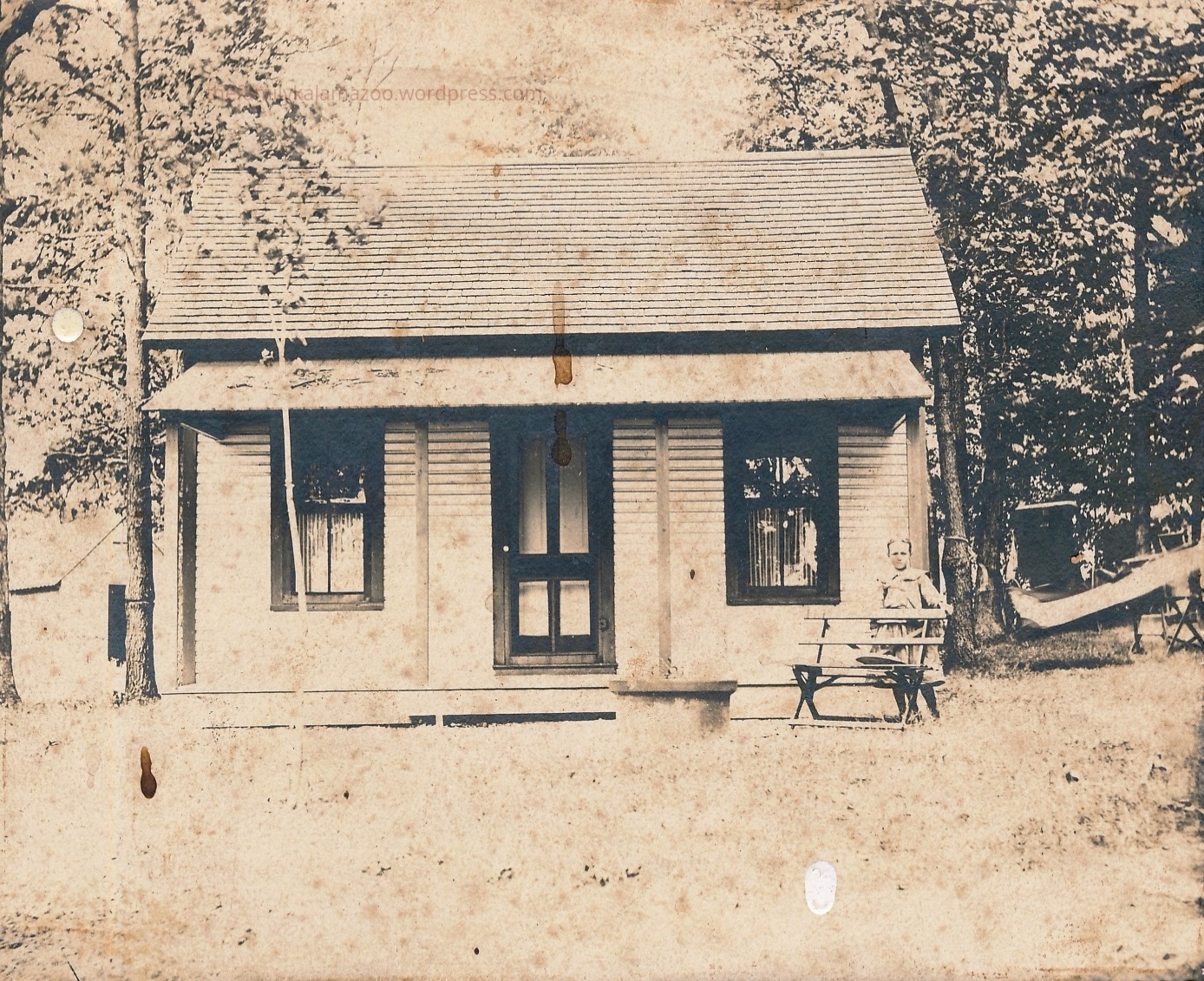
Actually the house was right in the middle of the city, not in the woods, but that sounds nice–very Ingalls-Wilder-ish.

A while back I posted a photo of a house with Alice Leeuwenhoek standing in front of it on Thanksgiving 1907. The address on the back was 126 Balch Street, which didn’t seem to conform to current addresses. I asked a lot of questions about it. Uncle Don explained that were some buildings behind the houses on the street.


126 Balch Street, Kalamazoo, Michigan

Then I heard from Jill-O, a librarian in Kalamazoo. (P.S. You will love her blog so go check it out!)

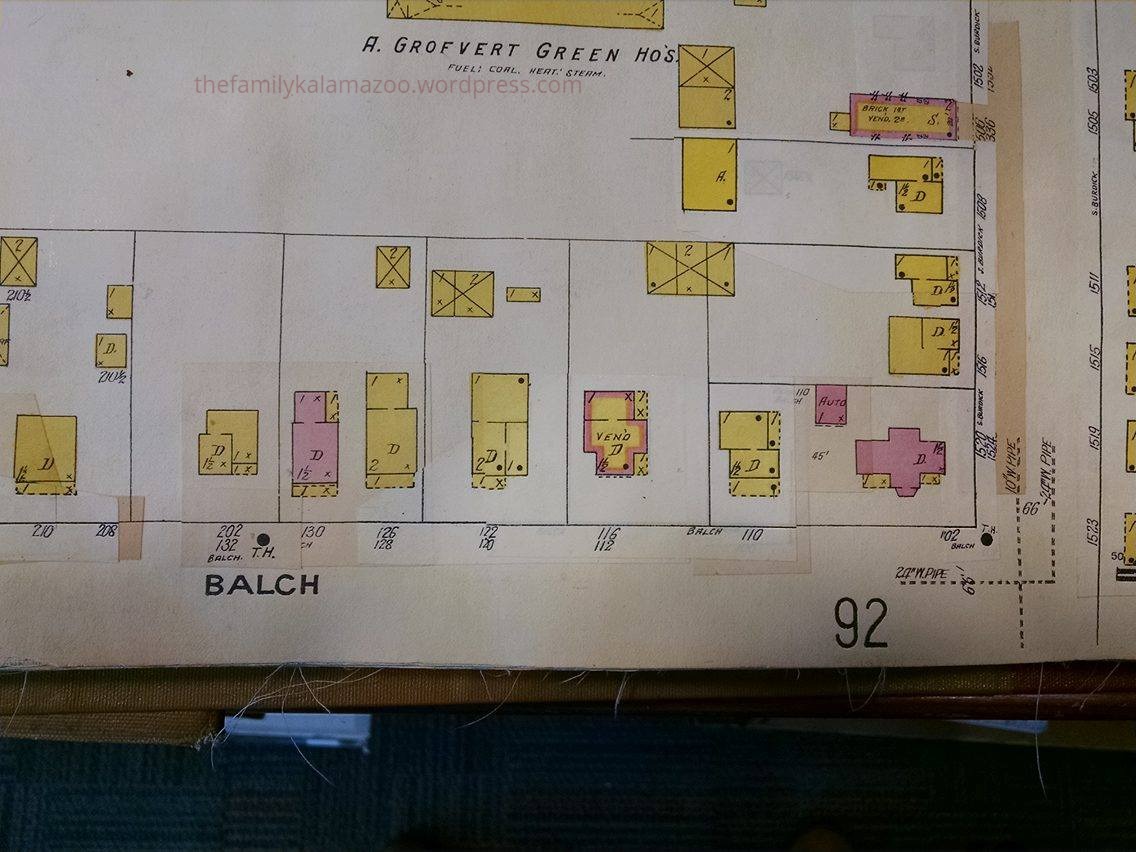
Here are the results of her research in a 1908 insurance street map of Kalamazoo:

Jill-O says:

It looks like the numbers are in the same location as today. There are a couple of outbuildings behind 126, so either the house was torn down and rebuilt, or the one of the outbuildings was used.

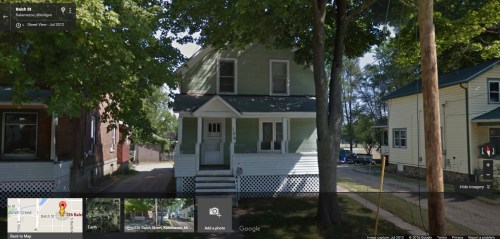
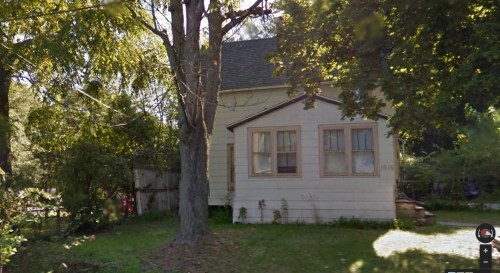
Here is the house that  is on the street, numbered 126, today.

Let’s look at the pic and think back to 1907. In the photo you can see an outbuilding behind the house, so it’s unlikely that it’s off the street, behind another building. But if it was 126, wouldn’t the outbuilding be poking out on the other side? And wouldn’t the house be larger? As to the second question, maybe not. The house shows one room and behind it another room, so maybe from the photo we can’t see the depth of the house. As to the first question, what if the photo is reversed? I don’t know too much about the process of taking photos or developing them in those days, and maybe the photo is reversed.

OR. What if this is an outbuilding and that building off to the left is a house on the street from another angle?

The more answers I find, the more questions I have. I think my husband is right: I ask way too many questions.

This map is invaluable to me because so many of my relatives lived in this neighborhood. I am going to use it to plug in the addresses on the census reports–yippee!!!

Thank you, Jill-O!

Read Full Post »

While I am making connections and doing more behind the scenes (haha, sounds important) work on the genealogy, I thought I’d share an uncleaned-up photo from the Joseph DeKorn collection. The spots are just a little extra treat. I’d love to hear ideas about the best way to get rid of them!


126 Balch Street, Kalamazoo, Michigan

The little girl behind the bench is Alice Leeuwenhoek, and the date is Thanksgiving 1907. I trust that this is Alice because Grandpa told me in the late 70s, and he knew Alice. Old writing on the back indicates the date. But is the address correct?

In the 1910 census Lambertus, Jennie, and Alice all lived at 110 Balch Street. The houses are numbered 110, 112, 120, 130, 210, 216. No number 126.

Is this the Leeuwenhoek house or not? I’m going to hazard a guess. The address written on the back of this photo is in my handwriting, which means that Grandpa gave me the address. I already suspect that the numbering was changed at some point on Burdick and Balch because the older numbers do not match to the current addresses. Maybe Grandpa gave me the address that was correct in the late 1970s, but not the address as it was in 1907.

Because of the way Alice is standing behind the bench, near the house, and alone, I think this is her own house.

The placement of this house would have been very near Richard DeKorn’s brick house at the corner of Burdick and Balch. I wrote about it in this post The Richard DeKorn House. Alice was Richard’s granddaughter as her mother Jennie was Richard’s daughter and my grandfather’s aunt. Grandpa and Alice were first cousins.

I looked on Google Maps to see what the area looks like today. 126 Balch is about the 4th house down from the DeKorn house on the corner. So, is it possible that in 1907 they lived in 126 and in 1910 they lived in 110? It’s possible because maybe Richard owned several houses on Balch Street. That would not be inconceivable. Or that he had owned the land and gave or sold parcels to family members.

Maybe all the families living on Balch street are not on the census with the Leeuwenhoeks because they weren’t home when the census taker came. That would further complicate things. All this makes me wish I had some time in Kalamazoo to get my hands on some of the property ownership records!

Still, I do feel confident that this is Alice standing in front of her house on Balch Street in 1907, and that she lived quite near her grandparents. Her grandmother, Alice Paak DeKorn, would die the following year–and Grandpa would be born.

Read Full Post »

When Joost “George” Paak*  lost his wife in 1900 and then his mortgaged home in 1902, he must have been distraught and wondered how he would take care of five children. He was a laborer who was not even working at the time of the fire.

I know that he lost a mortgaged home because of the newspaper article (see post links below for the rest of the story) and because the 1900 census shows that he owned a mortgaged home. At that time, he worked as a farm laborer, but had been unemployed 3 months the previous year. I am guessing that this was a hard physical job and if he was sick he wouldn’t be able to work. I also think he had been unemployed for 3 months the previous year because of the winter. So he didn’t have a very stable job. He had immigrated to the United States at age 18 with his family. He was the oldest–he had 4 younger sisters. There was also a young brother who either died in the Netherlands or came here and would probably be known as William. Still checking into this.

In 1908, six years after the fire, George married Addie Amelia Gifford Wilder. This shows up on the 1910 census. At this time, George was listed as Joseph G. Peake (Joost could easily be Joseph or George, I guess), and he now had a stable job as a paper maker at the paper mill. He again owned a mortgaged home and guess where? At 1016 Trimble Avenue, the scene of the fire. So the house was rebuilt. And you know what? It still stands.

The 1920 census shows George still married to Addie. He owned his home free and clear. He was still a laborer for the paper company, earning wages, not salary. And he was 69 years old. Notice no retirement for George at that time!

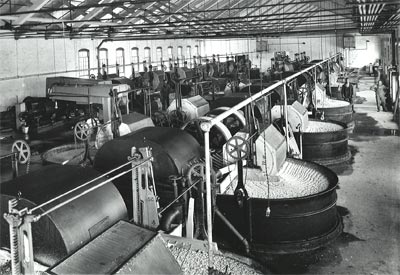
Paper mills were big business in Kalamazoo, by the way. The city was known as The Paper City. There is a great article published online by the Kalamazoo Public Library. Click the photo of the paper vats to go to the article.

PaperVats_400

All three censuses show George immigrating to the United States in 1868, although in one of them it looks like 1860. He was naturalized as a citizen in 1891.

What the census does not show is that George married Esther M. Fields in 1906, gaining a 4-year-old stepdaughter, Florence Wilder! But a year and a half after the wedding, Esther died! (Professor Lawrence heard that George might have been married as many as five times, but I do not have the documentation yet on the other two marriages–or the timeline).

In the 1910 census, George’s household includes Addie, Fannie, and George. These are the two youngest Paak children. And the household also includes Esther’s 7-year-old daughter Florence A. Wilder! So George kept her in the household, which must mean she had no other family to take her in. But his own children, Theresa (Tracy) who was 17, Jane who was 20, and Cora who was 22 were not living at home. Theresa, as we know, was living with the Pickards as their perhaps unofficial foster daughter and being sent to boarding school.

Why did Theresa not live at home with her father and stepmother while a stepdaughter of George continued to live there? Maybe after the upheaval in the household after her mother’s death, the fire, and then the death of her first stepmother it was determined it would be better for her to stay with the Pickards permanently?

Professor Lawrence did tell me that he had heard that the children were farmed out to people, especially relatives, after their mother died. But at the time of the fire two years later it seemed that they were living at home with their father. I do wonder if my own great-great-grandmother helped out when her sister-in-law died or after the fire. The clipping about the fire was saved in the family documents, so she (she died 6 years after the fire) or her daughter must have kept it.

Why did Jane who never did marry and lived to be 107 years old (there might be a connection there haha) not live at home? Maybe she had a job and was providing for herself already. Jane lived in a nursing home near the end. In the photo there is a sign for her 100th birthday. I do have a photo of her at her 107th with cake, but she is in bed and obviously not well, so I don’t want to share that one.

Where was Cora? Was she married yet? Her first child might have been born in 1915, although I have not done much research on Theresa’s siblings as of yet. If she wasn’t yet married, I wonder if she and Jane were living together. That would be something to search.

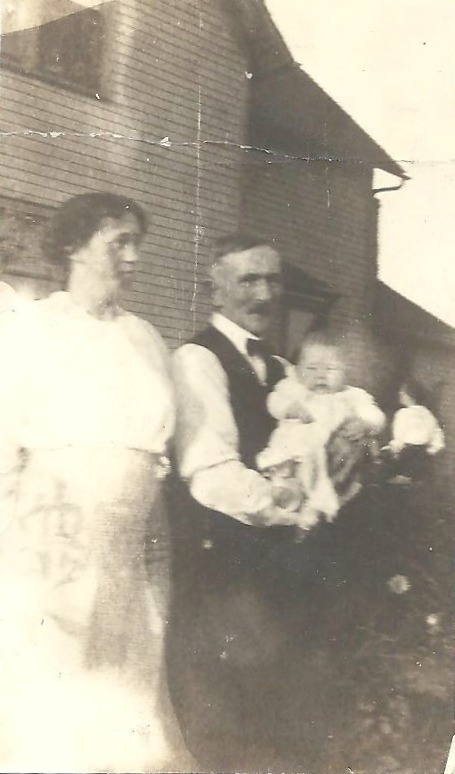
This photo was probably taken in 1925 when George was 76 years old and a happy grandfather. The woman is Cora, his oldest daughter with her son John Rankin. John was not her first child, but the first by her second husband, John Rankin, Sr.


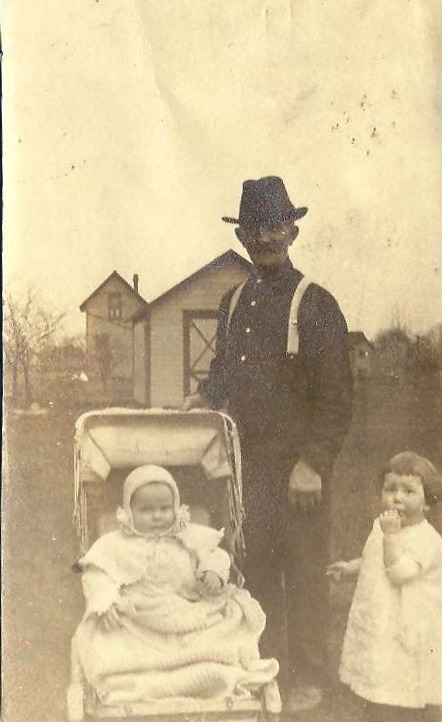
Here is another photo of George with two children. As always, I appreciate any comments about date identification or other important information.

* I’ve changed his surname spelling to the one that my great-great-grandmother used because I see that he did also use that spelling in addition to other spellings.

Here are the other Pake/Paake /Paak //Peek posts:

A Series of Disasters

The Children After the Fire, 1902

Paak-a-boo

Saved from the Fire

Who is George Paak, Sr.?

Curious about George

George Paak’s Legacy, Part I

George Paak’s Legacy, Part II: Theresa’s Pre-Professional Education

George Paak’s Legacy, Part III: Theresa’s Professional Education

George Paak’s Legacy, Part IV: A Letter to His Daughter

George Paak’s Legacy, Part V: Theresa Gets Married

George Paak’s Legacy, Part VI: Who Were the Pickards


Read Full Post »

If you’ve been following along here for some time, you might remember my posts about Theresa Pake, the middle child (of five) of my great-great-grandmother’s brother, George Paak.

When we left off, Theresa had married Roy Lawrence.

I’d like to backtrack. Remember how her father’s house burned down two years after her mother passed away? It was 1902, and Theresa was only 8. The article in the newspaper showed how destitute the family was by the fire, George’s illness, and Lucy’s death. The paper emphasized that the oldest girl, Cora, had been running the household from the time she was 12 until the fire–when she was 14.

At some point after this, Theresa went to live as a foster child with Oliver and Una Pickard. It would have been hard to find this information strictly from documents, but I had a great lead in the form of Theresa’s son Professor Lawrence.

This is a quote from one of my earlier posts:

At some point Theresa lived with foster parents, Una Orline and Oliver Oratio Pickard.  Prof. Lawrence thinks she maybe have gone to live with them as early as age six, which would mean she wasn’t under the care of her older sister. However, the newspaper article about the fire in 1902 would show that she was still living at home at the time of the fire (nearly 8 years old). Regardless, at some point, the Pickards became the caregivers of Theresa. None of the other children in the family seem to have gone to live with the Pickards.

SO WHO WERE THE PICKARDS?

Professor Lawrence told me that Oliver was a postman and Una a nurse. He said he couldn’t find his mother with them in any of the censuses.

I did a little search myself to confirm and hopefully augment this information.

I found the Pickards in the 1900, 1920, 1930, and 1940 censuses.

1910 census Pickards

1900: living in a “home” with 74 other people. There is a couple that are the head of household and his wife. Then Oliver is listed as a nurse and Una as “wife” (incorrectly as the wife of the head of household). After that are 3 attendants, a cook, and a lot of patients. So were both Oliver and Una the nurses for the facility? I can’t find the address on the census document.

From there, I went to the previous page of the 1900 census. It’s a short page and this is how it ends after a listing of some patients: “Here rests the enumeration of that portion of the Michigan Asylum for the Insane situated in Kalamazoo township outside the City of Kalamazoo.”

But wait! the page with Oliver and Una is in Oshtemo Township. That gave me the idea to see if anything is written at the end of the Pickards’ “household on the page after the one listing Oliver and Una.”

Wow!!! Something was written and erased. I can barely make out anything, but it appears to say pretty much the same thing as the above quotation about the asylum but using Oshtemo instead of Kalamazoo!! Why was this information erased? So did the Michigan Asylum for the Insane have Kalamazoo Township AND Oshtemo Township facilities?!! I can’t go past that page because this section ends on page 36–and the Pickards are listed on page 35.

I looked up “Oshtemo township” with the Kalamazoo State Hospital, and I found that the hospital owned a farm in that township since 1888: Colony Farm Orchard. Some patients lived on and farmed the property. Could this be where Oliver and Una first worked together?

1920: living at 1846 Maple Street in Kalamazoo. They owned their own mortgaged home. Una’s parents lived with them. Oliver was a mail carrier and Una was a nurse at the State Hospital. At this point, Theresa was finishing up her education, still under the guidance of the Pickards. THERE! The State Hospital IS the Michigan Asylum for the Insane. The name was changed in 1911. So it looks like maybe Oliver quit nursing and became a mail carrier–and maybe they moved to their own home that way.

1930: living at 1844 Oakland Drive in Kalamazoo. They owned their home, worth $15,000. Notice that 1844 address here is similar to the address in the 1920 census. I wonder if it’s the same house and there is an error in the number and the street? Or are they two different “owned” homes?

1940: living at 1846 Oakland Drive in Kalamazoo. So it probably was 1846 Oakland Drive all along. Una is a registered nurse in “private work.” That makes sense because she is listed as 67, and she couldn’t possibly be providing care at the State Hospital at that age. Oliver said he worked 52 weeks in 1939, but his income from this work is listed as zero–but he has income from “other sources.”By now the house only valued at $8,000.

A look at the neighbors in the 1940 census does not show that preponderance of Dutch names that I’ve seen in the neighborhoods where my relatives lived. The surnames seem to be of English origin, for the most part. But in the 1920 census, the same neighborhood had more Dutch surnames. Maybe this reflects a change in the neighborhood–or in the demographics of Kalamazoo.

Professor Lawrence told me that Una was Theresa’s Sunday School teacher. She must have taken a liking to the girl. I think Theresa was an intelligent and hard-working child, so that may have appealed to Una who took her on either from affection or religious conviction or a mixture of both.

So who are these people who married young (she was 18 and he was 23) and worked and lived at the State Hospital until he left for a job as a mail carrier? Who never had their own children, but managed to provide a quality education and a religious upbringing to one of the Paake children? That would have been very hard work being a nurse at the “asylum.” It could also be dangerous. In approximately 1904, a resident doctor was stabbed to death.

I also think the Pickards were most likely Methodists as they chose to send Theresa out of state to a Methodist school.

What was it like for Theresa to live with the Pickards?

Here are the other Pake/Paake/Paak/Peek posts:

A Series of Disasters

The Children After the Fire, 1902

Paak-a-boo

Saved from the Fire

Who is George Paake, Sr.?

Curious about George

George Paake’s Legacy, Part I

George Paake’s Legacy, Part II: Theresa’s Pre-Professional Education

George Paake’s Legacy, Part III: Theresa’s Professional Education

George Paake’s Legacy, Part IV: A Letter to His Daughter

George Paake’s Legacy, Part V: Theresa Gets Married


Read Full Post »

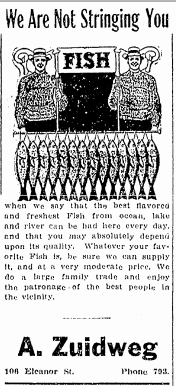
I’ve mentioned before that my great-grandfather, Adrian Zuidweg, Sr. (Adriaan Zuijdweg) owned a fish market when Grandpa was young.  In this photo he stands with an unidentified young employee.

Fish Market on Eleanor Street

Fish Market on Eleanor Street

I found some ads he ran in the Kalamazoo Gazette on Genealogy Bank. This one is from September 16, 1910.

This is a pretty fancy ad for a little market like he had. Some of the time he did a more simple ad like this one at Easter time–April 6, 1904.

Most of his ads, like those of many small businesses at that time, were a mere sentence or two in the JOTTINGS. I underlined his little ad so you could find it easily amidst the other “jotted” notes. This one is from December 24, 1907. Note the date and the hours listed.

That means my great-grandfather not only worked Christmas Eve until 9PM, but Christmas Morning as well!

Read Full Post »

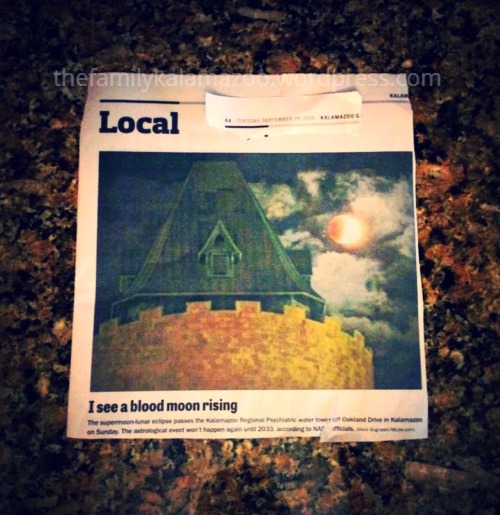
As I’ve mentioned before, my great-great-grandfather, Richard DeKorn, was a brick mason who worked on many public buildings in the Kalamazoo area.  He was a brick mason on the beautiful Ladies’ Library Association in 1878-79 and lead brick mason on the Kalamazoo Psychiatric Hospital Water Tower  in 1895. According to his obituary he was the contractor for the Pythian building and the Merchants Publishing Company building.

The asylum water tower was slated for demolition in 1974. Here is the story of how it came to be saved (from http://www.kpl.gov/local-history/health/kph-water-tower.aspx):

In spite of being on the National Register of Historic Buildings and endorsed by the Michigan Historical Commission and the Kalamazoo County Bi-Centennial Commission, the structure was earmarked by the State of Michigan for demolition in 1974. A local committee that called itself the Committee to Save the Tower launched a campaign to raise public funds to restore the building to its original grandeur and save it from the wrecking ball. A year later, Mrs. William John (Penny) Upjohn announced that $208,000 was successfully raised for this purpose. The money came from federal, state, and city contributions to the effort. Contributions also came from such disparate groups as school children, former state hospital patients, current hospital patients and employees, a hospital auxiliary, service clubs and concerned citizens. The campaign to save the structure was not without controversy. Some residents felt that the monies needed to repair the structure could better be spent on local service needs. Sen. Jack R. Welborn, R-Kalamazoo, pointed out, however, that taxpayers would be spending at least $150,000 to tear down the tower.

I recently visited Kalamazoo and went on a tour of Henderson Castle, a mansion built the same year as the water tower.


From a rooftop viewpoint, I was able to see the water tower in the distance.


And then my mother showed me a photograph that was in the local newspaper of the blood moon near the tower.


I’m off preparing for a poetry reading this weekend. Have a lovely weekend!

Read Full Post »

« Newer Posts - Older Posts »