Feeds:
Posts
Comments

Over a year ago, I wrote a series of posts about Theresa (Tracy) Paak, the daughter of my great-great-grandmother’s only brother. Theresa was the mother of Professor Lawrence, who has been kind enough to send me photographs and information about his branch of the family. If you’ve been following along here for some time, you might remember my posts about Theresa Pake, the middle child (of five) of my great-great-grandmother’s brother, George.

You might remember that after the disastrous fire that destroyed the family home, Theresa went to live with Oliver and Una Pickard. Mrs. Pickard was Theresa’s Sunday School teacher. I wrote about the Pickards in George Paak’s Legacy, Part VI: Who Were the Pickards? What I discovered in my research was that the Pickards were married young, remained childless, and began their careers as nurses, both living and working at the State Hospital (psychiatric hospital).  Eventually Una became a private duty nurse and Oliver a postman.

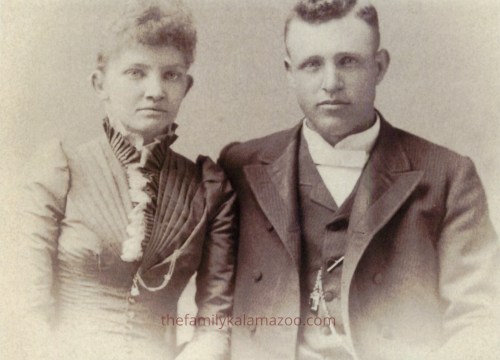
I really tried to imagine this couple and what they were like because they proved to be so important to Theresa’s life. The other day I got my wish to see what they looked like when Professor Lawrence sent me photographs.

Una was 18 and Oliver 23 when they married. Could this be their wedding portrait?

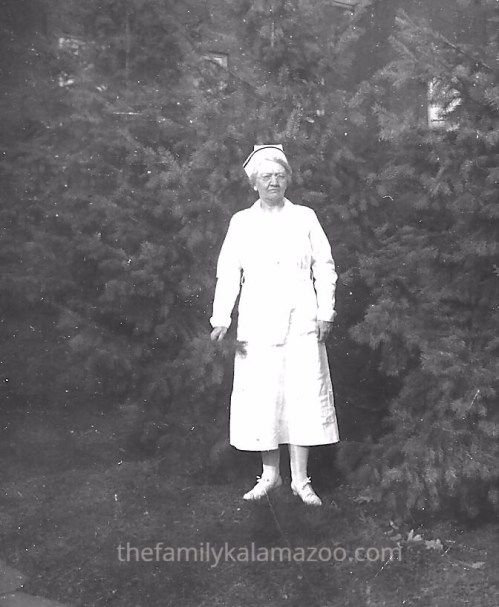
Here is Auntie Pick, as she was called, in uniform.

And Oliver, or “Uncle Bob,”  in the classic “man walking down the sidewalk pose” (yes, we’ve seen it a couple of times already with other people in other photos).

Here is a photograph of Theresa herself taking a photograph of her foster parents.


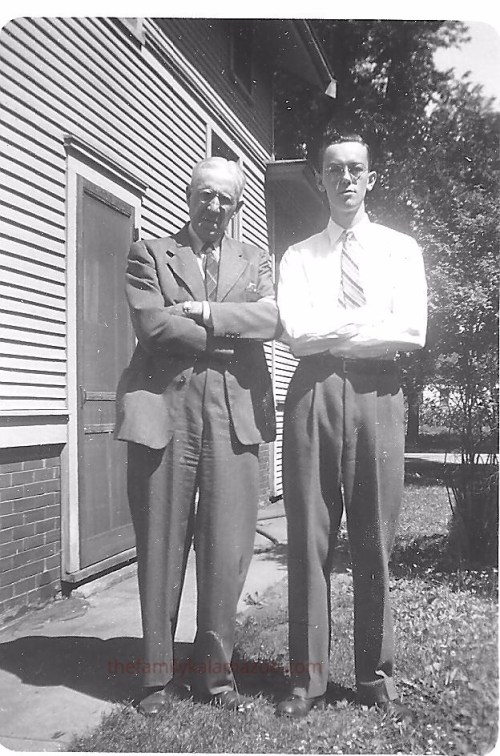
Here is “Uncle Bob” with Theresa’s son Richard, or Dick, in Wisconsin. This is Professor Lawrence’s brother.

There was some confusion in the censuses over the address of the Pickards, but I think they lived in the same house for years at 1846 Oakland Drive.

And many years later. The house is no longer there.

As a bonus, here are photographs of Una’s parents and of Una as a baby.

She looks the same as a baby as at eighteen!

Here are the other Pake/Paake/Paak/Peek posts:

A Series of Disasters

The Children After the Fire, 1902

Paak-a-boo

Saved from the Fire

Who is George Paake, Sr.?

Curious about George

George Paake’s Legacy, Part I

George Paake’s Legacy, Part II: Theresa’s Pre-Professional Education

George Paake’s Legacy, Part III: Theresa’s Professional Education

George Paake’s Legacy, Part IV: A Letter to His Daughter

George Paake’s Legacy, Part V: Theresa Gets Married


When Peter Mulder contacted me, he had a treasure that involved Jan Mulder and also my great-great grandfather, Pieter Mulder. After the death of his wife Neeltje, Pieter wrote to his brother Jan in the Netherlands. And here is the beautiful and heart-breaking letter.

Since the letter is written in Dutch, here is a translation that Peter provided for us:

October 23 1932


Beloved brother,

It is with sadness and a heavy heart that I must tell you my wife  has died  October 12th.

It’s a heavy day for me Jan,  there I have a daughter who always must be under my eye . She is not trusted to just go out unless a person familiar is with her. Oh, what I am missing Neeltje, she was everything to me. As children, we came together and we have been almost 48 years together, so we shared so much in life.

Now I am just about to the end all alone. Fortunately that Neeltje has passed away with the assurance that she went to the father House above. Often, she prayed for salvation  of this earthly life, yet she could not leave us because she knew I would be left behind with our daughter.

God gives my strength to the heavy loss.

I can not go longer Jan, write soon back to your brother. I’m moved now and living with my oldest son on the farm that gives me a little resistance.


My address is now

P Mulder

Caledonia

I will admit that this letter made me cry. I felt so bad because it sounds like Neeltje had suffered for a long time, which was why she prayed for salvation. Also, that Pieter felt worried about his youngest daughter. And I was so happy to see that Pieter felt close to Jan, his younger half-brother, even though they had been separated as children and had not seen each other in decades (because Pieter was in the U.S. and Jan was not). I was also happy to hear that he was content living in my great-grandfather Charles Mulder’s home.

Thinking about Neeltje’s health caused me to look for her death certificate, but I do not have it. If I can’t find it online, I might have to order it.

Pieter and Neeltje’s daughter must come in a later post as I have much to research about her. Pieter himself died in 1953 after moving between his children’s homes for 21 more years.


Sometimes when I am researching family lines from the Netherlands, I wonder: what happened to the descendants of my ancestor’s siblings during the World Wars? I have particularly wondered that about WWII, maybe because my parents were alive during that war and because I know more about it than WWI.

I never expected to discover any information.

Until I was contacted by Peter Mulder from the Netherlands! He has the same name as my mother’s Uncle Pete who I knew as a smiling man and a farmer. He also has the same name as my great-great-grandfather who immigrated to the U.S. I wrote about that Pieter Mulder finding himself an orphan after the death of his father and about his move across the ocean.

This Peter Mulder has graciously supplied me with a story of what happened to my great-great-grandfather’s half-brother, Jan Mulder.

After the death of my Pieter’s mother, Karel Mulder (my 3rd great-grandfather) married Klazina Otte, and had two sons with her: Cornelis and Jan. Actually, there were many children, but sadly the rest died as infants. Karel passed away on 22 April 1881 and his children by my 3rd great-grandmother Johanna were dispersed into jobs and the orphanage.

Klazina was left to care for her two sons. Eventually, in 1904, she moved with her sons to Apeldoorn. She would have been about 63, and she died on 8 November 1922 in Apeldoorn.

Cornelis, who was born 1 September 1872, was a tailor. He married Hendrika Jonker (born 07 May 1876), and they moved their family to Utrecht on 30 July 1928.

Jan, who happens to be the grandfather of Peter Mulder, was born on 20 December 1876.  By profession, he was a hairdresser.

Jan married Petertje van Baak. Interestingly, the witnesses at the wedding were Cornelis Mulder, his brother, and Izaak Mulder, his half-brother (Pieter’s older brother). I believe this shows that the children of Karel Mulder had remained close although the family was torn apart (as far as living arrangements) by his death.


Jan and Petertje wedding photo

6 October 1904

Jan and Petertje had three children:

Klazina Petronella Mulder, born 06 February 1905 and died 28 April 1994

Teunis Jan Mulder, born 20 May 1907

Izaak Mulder, born 23 January 1913 and died 14 December 1980

Izaak is Peter’s father.

Teunis, Nellie, Izaak

On November 1, 1929, Jan immigrated to Soerabaja/Soerabaia, now called Surabaya, which is the capital of Jawa Timur (East Java). Indonesia was part of the Dutch East Indies. Jan left his wife and three children behind. In 1936, the couple divorced, but he kept in contact with his children.

Jan enjoyed his life in Soerabaja. He had his own hairdresser business and played music in an orchestra. He played bass, violin, and flute.

In winter/spring of 1942, the Japanese invaded and took over Java. At that time, it was necessary for all Dutch people to register with the Japanese. After that, Jan was held  in the Ambarawa internment camp for several years. The living conditions were poor and deteriorated as time went on. Peter believes that almost 13,000 people died there during that period–including Jan Mulder, Peter’s grandfather, and the half-brother of my great-great-grandfather. He was 65 years old. I can’t imagine the difficulties he must have endured in his last years.


Growing Up in The Paper City

When I was a kid growing up in Kalamazoo, it was known as “The Paper City.” Our fifth grade teacher–a very eccentric personality–told us about the way paper was made and emphasized that the reason we were not to eat paper (a common habit in elementary school) was that the workers in the paper mills would chew tobacco and spit it at random into the vats of liquid paper. That was why we would occasionally see a little burst of tan, like a star or partial star, on a sheet of white paper.

Kalamazoo was home to several paper mills and companies. Here is a little info I found online:

Taking advantage of the area’s bountiful water resources, in 1867 the Kalamazoo Paper Company opened its first mill. According to historian Larry Massie, the company provided a training ground for paper makers and “was one reason for the amazing proliferation of paper mills throughout the Kalamazoo Valley.” The area’s proximity to Chicago, its excellent railroad network and its large labor force further aided the industry’s development. By the early twentieth century, Kalamazoo County was the state’s dominant paper producer. According to 1904 state census figures, its five paper and wood pulp mills (one-sixth of the state’s total) represented 25 percent of the industry’s capital value. By World War I, Kalamazoo was the center of the largest paper-producing area in the United States. The industry employed one-half of the city’s labor force.

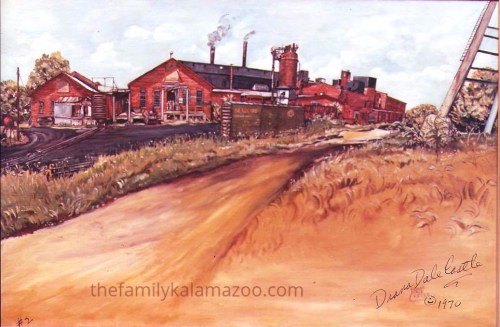
My mother-in-law, Diana Dale Castle, painted one of the mills in 1970. This is the Monarch Paper Mill, owned by Allied Paper Company.


The Kalamazoo Library has a terrible image of the Monarch mill from 1910 here. And this one slightly better.

Here is a photo of the machine room and of the male workers in 1915. There is also a photo of one John Bushouse at the mill in 1915. All this is left now of the Monarch Mill is the pond. In a Facebook group for old Kalamazoo, people talked about swimming at the mill pond. I can’t imagine this because I remember driving past the pond and thinking ICK and SCARY.

A quick search on Ancestry for John Bushouse reveals that it is a somewhat common name in Kalamazoo and that the owners of the name are immigrants from the Netherlands or their children. I could not find the John Bushouse that worked at the mill in 1915.

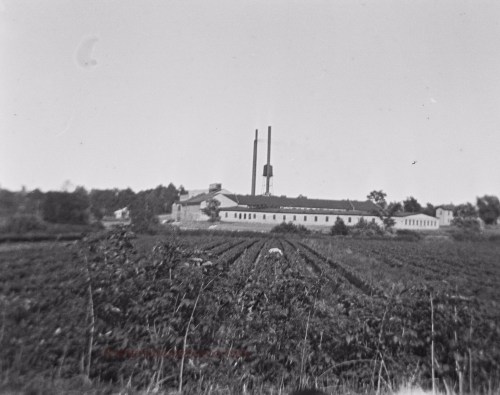
I found an unidentified photograph made from one of Joseph DeKorn’s glass negatives that seems to be from the heyday of paper manufacturing in Kalamazoo. Since it was one of the DeKorn negatives that means that the photograph was probably taken between 1903 and 1918. I suspect that it is an image of a paper mill. If you agree that it is probably a paper mill, do you think it is the Monarch mill or a different one? Before you answer that, you should check the photo in the second library link so that you have enough information.

According to one source, at one time, paper mills were the 5th largest employer in Kalamazoo. According to the source I quoted above, HALF the labor population worked in the paper industry! But that business dried up in the 80s. Obviously, paper is still being made, so why not in Kalamazoo?
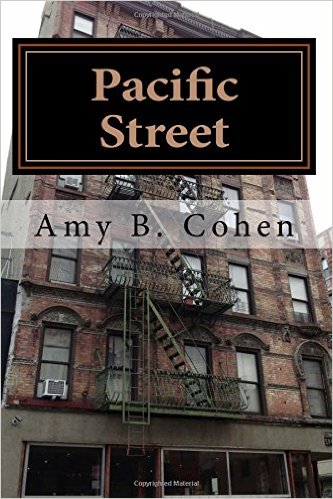
Amy Bess Cohen, who writes the excellent genealogy blog Brotman Blog: A Family Journey  about her family’s history has written Pacific Street, available now at Amazon.


The story of Cohen’s grandparents, Isadore and Gussie, is an inspiring coming-to-America tale with all the resonance of actual experience. Cohen has painstakingly documented the early part of her relatives’ lives through historical research using official documents and has incorporated information shared through family stories.

She has researched the settings and cultures described and added her own imagination to infuse the book with appropriate details and descriptions. This is no dry historical telling, but a well-structured adventure full of tragedies and triumphs like a novel, although more accurately, it is creative nonfiction in the historical subgenre.

As Cohen alternates the narratives of Isadore and Gussie (until their stories merge together near the end), the reader becomes one with the characters. The loneliness of both characters is excruciating, especially since family is so important to both of them.

Isadore is forced to immigrate to the United States by himself when he was only sixteen years old, and when he arrives the aunt entrusted to welcome him to the new world is emotionally unavailable to him. Gussie in many ways still lives the immigrant life of her parents’ generation. Her world is circumscribed and without time for play. When the two finally meet up in a very romantic first encounter, the reader is more than ready that these two find happiness.

Will their happiness last? The book resolves that question in a realistic manner. It will be a worthwhile experience for any reader to follow Isadore and Gussie on their journeys.

As a writer who frequently works with history and, especially, family history, I was impressed by Cohen’s ability to describe many characters in large families in a way that leaves a lasting impression on the reader. When I began the book and when I finished the book, I had the same thought: that the genre of this book can be further refined to young adult. The material is as complex and fascinating as any for the adult reader, but the approach to adult themes and the focus on the coming-of-age period of life for both protagonists is consistent with books for older children and teen readers, as well as adults.

This is a book you might want to read yourself and then pass on to your child or grandchild. It’s a story of family for families.

On 23 February 1931, my father’s uncle, Frank Anthony Klein, had some sort of possibly epileptic seizure and crashed his automobile into a tree. He died from his injuries, and his mother grieved deeply for him. She had already lost her oldest daughter and Frank was her only son.

A little over a year after that tragic event, his mother, Margarethe Wendel Klein, died of cancer, or so my father told me, in her home in Elmhurst, Illinois. I think these photos are of her grave at the cemetery because I don’t see her sitting next to her husband, my great-grandfather, Frank Klein. He is wearing glasses and has a mustache.

Here’s a close-up of the grave with its flowers.

The family is buried at Elm Lawn Cemetery in Elmhurst. Margarethe would have had a Catholic funeral service.

One twist (isn’t there always a twist or a mystery?): Margarethe’s death certificate says she died of Diabetic Coma. And that she had had Myocarditis for 10 years and Nephritis (institial) for 6 years. Myocarditis is an inflammation of the middle layer of the heart wall, and apparently it can be caused by a virus and may resolve. Interstitial nephritis is a kidney disorder. So she had diabetes. So did her daughter, my grandmother.

Why did my father think she died of cancer? He and his siblings and mother lived with his grandparents at the time, and he remembers his grandmother “lying in the library dying, while we played outside.”

Margarethe Wendel Klein

Helen, Marie, Elizabeth, Margarethe, Peter (SIL)

Frank Sr. on the ground with his grandkids

Uncle Frank and Grandma Marie Klein c. 1920

Uncle Frank and Grandma Marie Klein c. 1920

If you recall my posts about Jennie Culver, and her daughters Rhea and Lela, moving to Seattle, you will see that this photo fits neatly into the move. Try this post if you need a reminder or are new to the story:

Bingo: When Aunt Jennie Left for Seattle

On the back, one of the girls has written “my present domicile” and on the front, the date is 1918, the year other photos showed them at the train station, ready for the move.

I glanced at some of the other unidentified Culver photos to see if this apartment building (I assume it is apartments) shows up. Only one other photo with square brick columns shows up, but it can’t be of the same building. See here:

Notice what confuses me here. The square brick column, the white round column–the same as the first photo, right? But the white siding in the second photo is not in the first photo, right again?

I will say the age seems right for Seattle in this photo. The more I look at the Culver photos, the more Kalamazoo photos I suspect might be in the collection.

So who wrote “my present domicile” on this photograph? It wasn’t Jennie because the scrapbook and its photos clearly belonged to one of the daughters.  My confusion began with information I noticed that I wrote about in this post:Who Went Where When?. According to the newspaper, Rhea, the stenographer, moved to Seattle mid-August 1918. Jennie and Lela were not mentioned. But at some point Jennie and Lela did move to Seattle and lived there the rest of their lives. Somewhere around 1918. And Rhea did, too, except that in 1920 she was “spotted” living in Kalamazoo (see my post).

Can I assume that Rhea did go to Seattle August 20 as the newspaper and photograph verify? And that “my present domicile” was where Rhea lived? If so, can I conclude that the scrapbook belonged to Rhea. And that this photo I posted earlier was, in fact, Rhea in the plaid?

Is the handwriting on the above photo, the same as on the back of the first photograph I posted here?

Barely any letters to compare. They each have a final “le”–in Seattle and domicile. While nobody’s handwriting is completely consistent, are these in the bounds of what could be written by the same person? I will say there is a similarity to MY handwriting, weirdly. Both Miss Culver and I produce the triangular Ts of Emily Dickinson.

As usual, I manage to produce more questions than answers. This is becoming a disturbing trend!

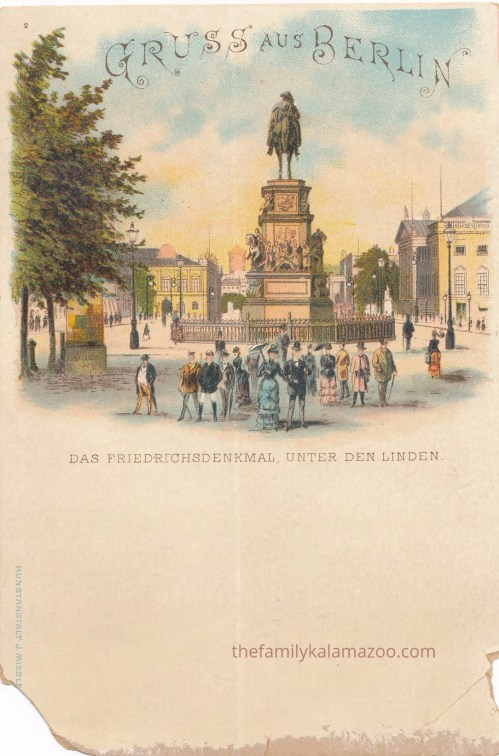
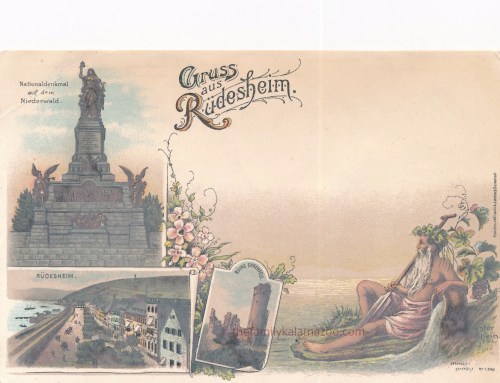
Greetings from Germany

My grandparents had these over 100 year old postcards. Someone must have travelled to Germany, but these were never posted (mailed). Each one is a greeting from a particular German city.

image image

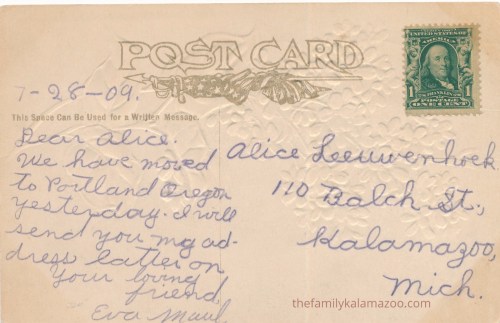
Finding neighbors and friends of my ancestors is always fun. Alice Leeuwenhoek received two postcards from girls who posted them from Portland, Oregon. Luckily, one girl, Eva Maul, signed her entire name so it was easy to look them up.


As Eva’s July 28, 1909, postcard states, the Maul family moved from Kalamazoo to Portland, Oregon.


On the 1910 census they are living in Portland:

Peter and Jennie Maul, with their children: Henry, Gertrude, Maurice, Eva, Jeannette, Garrett, and John. Eva was fourteen, so when she wrote the postcard, she was about thirteen. Gertrude was 17. She wrote the other postcard in 1912, when she was 19.

Notice she complains Alice hasn’t been writing, which makes me wonder how many friends the Maul girls made in their new home.

“Lovingly” seems to indicate that Gertrude and Alice had been very good friends. Alice was born in 1897, so in 1912 she would have been 15, so she was actually closer in age to Eva–even a bit younger.

I started to wonder if these girls had been neighbors of Alice and could be found in my old photographs.  So I did another search. Well well well. In the 1906 Kalamazoo City Directory Peter Maul was a butcher who lived at 112 Balch Street, right next door to Alice’s family! Uncle Lou was a grocer who lived at 110 Balch Street with his family. Alice’s mother’s name was Jennie–and so was the mother of Eva and Gertrude. I guess they all had a lot in common.

But why would Eva have to send Alice a postcard saying that they had moved when they lived next door? How odd.

Although I couldn’t spend too much time on this, a naturalization document popped up from decades later for father Peter Maul in Portland. His history is convoluted. He listed his race as Dutch, but his nationality as British. He emigrated from Calgary, Canada, but was born in Zeeland, Michigan, in 1866. WHAT? It makes no sense. By 1933 he was married to a woman named Blanche who hailed from the western part of the country. Before you think it’s a different Peter, the document lists all his children as well as an additional child.

This would be a fascinating thread to follow, but alas, there is so much to be done in my own branches, I have to stop here for now. For those of you who follow this blog and have been in contact over family branches–and posts you have not seen–I plan to spend a little more time in 2017 on genealogy and share some of the information I’ve been blessed with from all of you!

I’ll be taking a blogging break for the holidays, so I’ll leave you with this gift (that I first posted three years ago)  from Alice Paak (Richard) DeKorn to one of her children, possibly her daughter Cora, my great-grandmother. What a family and genealogy treasure–now 109 years old.

1907

Merry Xmas

from

MOTHER

In case you’re wondering about the use of the word “Xmas” instead of “Christmas,” this is what Wikipedia has to say:

There is a common belief that the word Xmas stems from a secular attempt to remove the religious tradition from Christmas by taking the “Christ” out of “Christmas”, but its use dates back to the 16th century.

I’m sure that this was just a way to fit it all on the tiny shell. What a lot of work to paint and letter this shell. I wonder if she made three, one for each of her children.

Happy holidays to you and yours! See you in the new year!