Feeds:
Posts
Comments

Archive for the ‘Kalamazoo late 1800s – early 1900s’ Category

You might remember reading a post about Grandpa’s girlfriend before Grandma in “Grandpa’s Girlfriend.” I noticed a later entry in the Memory Book where he was asked if his mother liked Grandma. He wrote that she never liked any girls he dated, but that she “accepted” Grandma. As well she should. By then, Cora, Grandpa’s mother, was dying (the spindle cell cancer that was in her death certificate that I posted the other day) and he was devoting his life to taking care of her. He didn’t have a job at the time. When he married Grandma, she not only helped him take care of his mother, but she worked full-time as a teacher, as well, that first year.

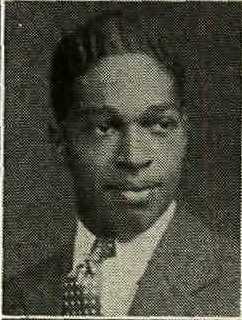
Another person that was important to Grandpa was the person he identified in the Memory Book as his best friend: Clarence Pettiford. He wrote, “Clarence Pettiford had good values and was nice to be around.” When I was a little girl and Grandpa was still living in the same neighborhood–and had his Sunoco Station there, too–Clarence also still lived in the neighborhood.

The way I knew Clarence was that Grandma and I would walk “uptown” to the downtown bank with the service station deposits–or take the bus if the weather was rainy or too hot. We would always stop and visit the man I thought was the most important banker in the elegant bank at the corner of Burdick and Michigan. He was known to me as “Mr. Pettiford,” and he was always so very nice to me. I thought he was such a fine gentleman in both the way he acted and his tall distinguished appearance. When I got older, it was a little surprising to me to learn that he was in charge of security, rather than the head banker.

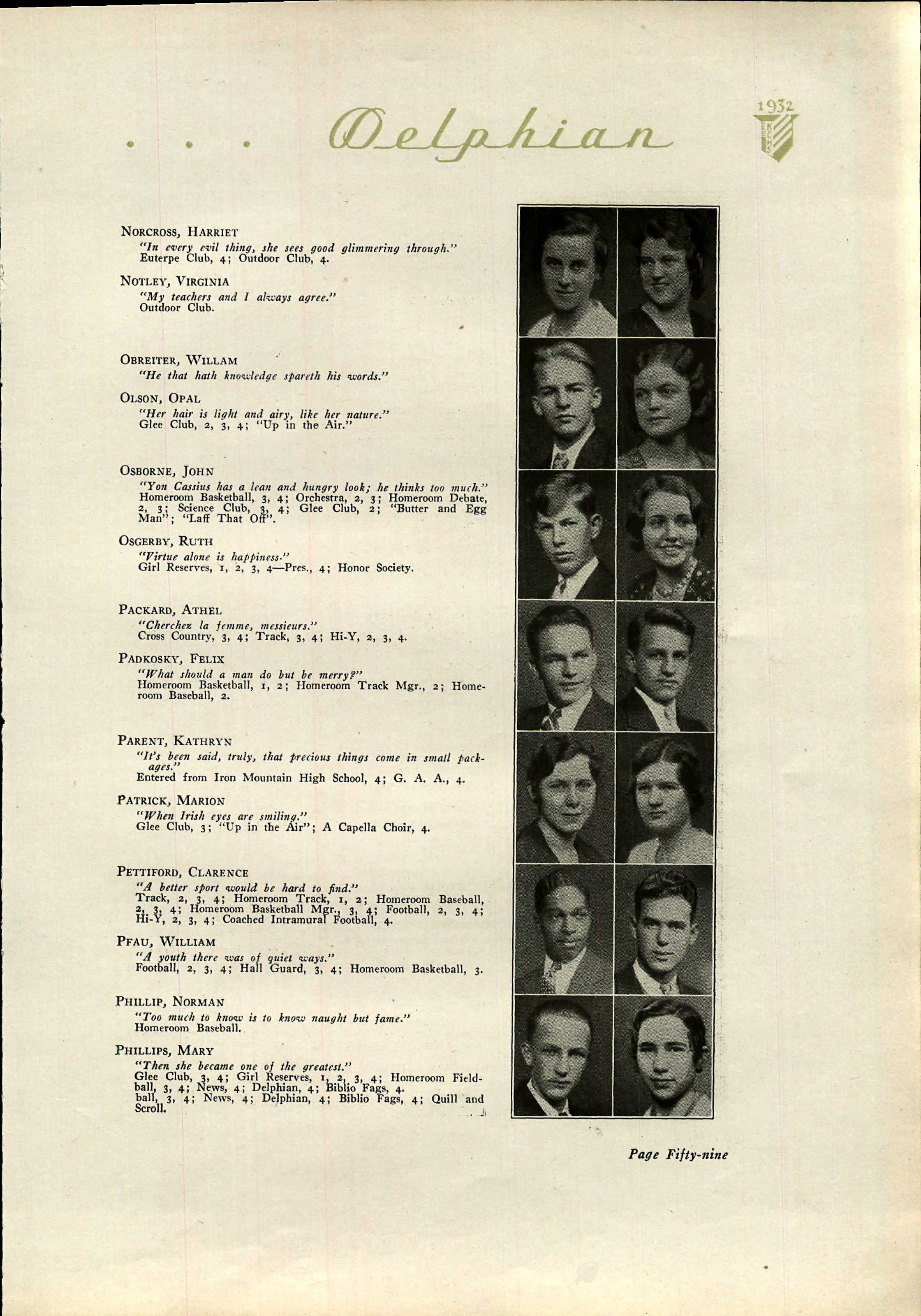
Grandpa wasn’t able to attend high school because he was blind in one eye, and it caused him a lot of distress. But Clarence did attend Kalamazoo Central High School, and I was able to find a  photo of him in the yearbook. I apologize for the quality of the photos–they are from the Delphian and not the best quality.


This photo comes from this page in the 1932 yearbook:

You can see that Clarence was quite the athlete. Grandpa also loved sports, but he would get sick from following the ball because of his bad eye. You can read what happened to his eye here. Clarence was about 3 years younger than Grandpa, but maybe the nearest boy who wasn’t a relative. Grandpa had about 7 boy cousins who lived nearby, but I imagine it was hard to be an only child and hang around with 7 boy cousins who were all brothers.

Back to Clarence: he lettered in football in 1930. He must have been 19 at the time. And in 1932, he must have been 21. The age is a little off, I know, but there might have been reasons that we don’t know. My other grandfather, for instance, immigrated from Europe when he was fourteen, and he was still playing football and declaiming in Glee Club for his high school when he was 21.

In this page, Clarence is the manager of the intramural team:

Oh my, did you read what it says about the Intramural Team? It’s for boys not talented enough for varsity or the reserve team. Yikes. Did they have to spell it out like that?

This blog post is a little tribute to the memory of Clarence Pettiford, a talented gentleman.

Read Full Post »

The other day I posted Richard DeKorn’s death certificate from Kalamazoo and asked for help with the cause of death. Readers were very helpful, and I’m so appreciative.

I mentioned at the time that Richard’s daughter and Grandpa’s mother, Cora DeKorn Zuidweg (Mrs. Adrian Zuidweg), wasn’t in the register of deaths. Two readers kindly sent me Cora’s death certificate that they found on the Seeking Michigan website.

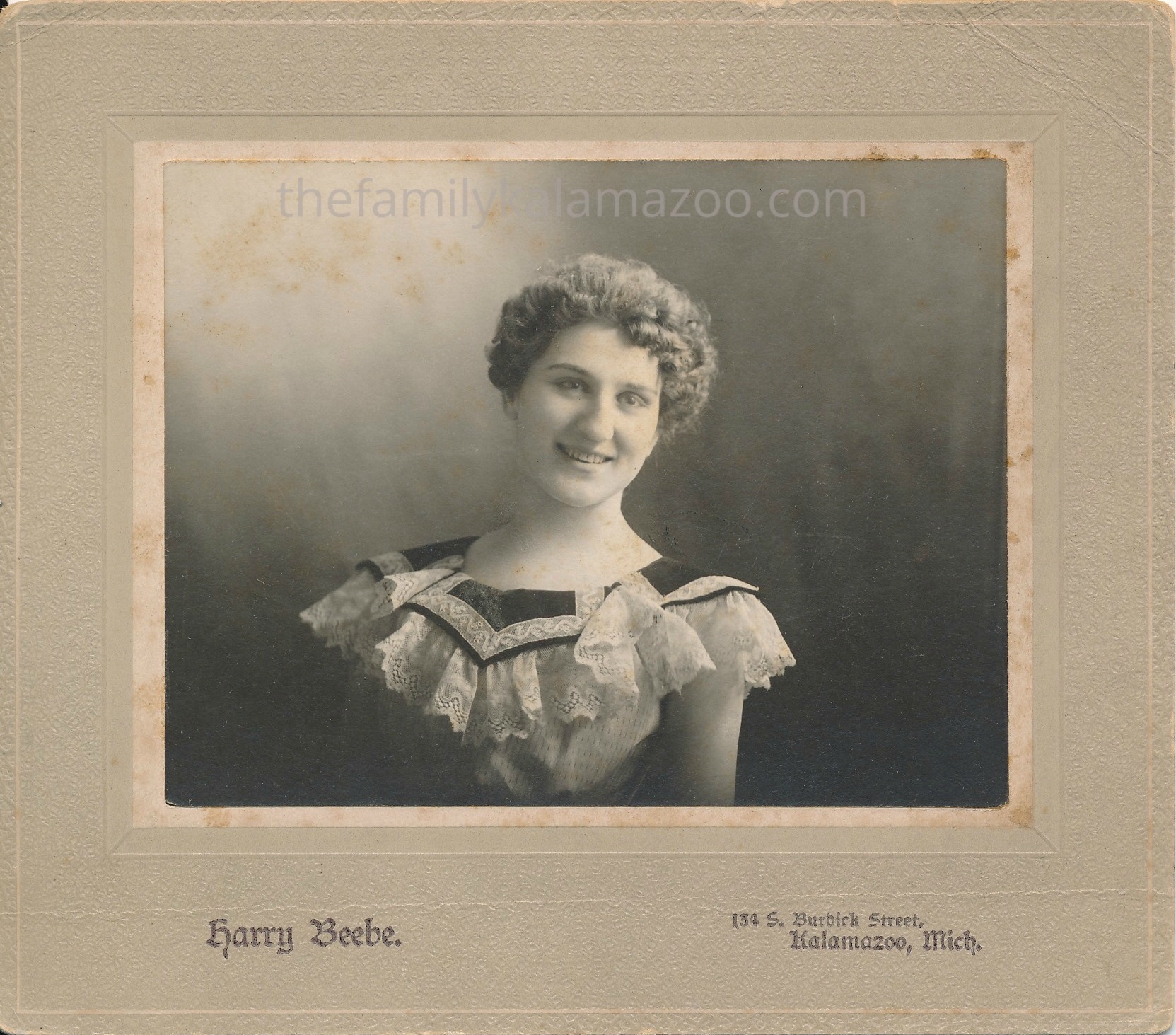
Cora is a particularly intriguing person to me because Grandpa and Grandma used to tell me that I looked a lot like her, especially with my hair pulled back. Cora always wore her hair up. The first time I saw this picture of Cora I was in my 20s and felt as if I was looking into a mirror.

Also, Grandpa’s stories about her included stories of her love for animals and her courage to defend them. I feel a real affinity in the area of love of animals and wish I had her courage.

Here are Cora and Adrian (senior) with Grandpa, Adrian (junior)

What I knew about Cora’s death was that she had cancer that had spread throughout her body and her brain became confused from the disease. I also knew that she was dying when my grandparents got married. That explains why they got married out of town and on their own. My grandmother moved into the house with Grandpa and his mother and took care of her until she died a few months later.

Now take a look at the cause of death on the certificate:

Exhaustion – debility from gen – metastatic sarcoma spindle cell – primary in left thigh, followed injury was removed 9-16-29 – had existed there 5 years.

I believe that it is what it says.

So cancer that started in her left thigh. Cancer that, according to Google, would be treated with chemo today. If caught in time, the results would probably be positive. Spindle cell sarcoma apparently is a connective tissue cancer.

I thought that was a little bit of a coincidence because it seems that Cora had the cancer since she was about 52 and when I was 50 I had a tumor in my foot. While my tumor turned out not to be cancer, it was a giant cell reparative granuloma, which means that it has some characteristics of cancer (possibility of metastasizing and also destruction and replacement of healthy tissue). My tumor is the type that also reacts to injury or pressure, as Cora’s did.

After checking out more on Google, I also learned that Giant Cell tumors can turn into cancer if left untreated–and sometimes into spindle cell. Notice that Cora’s original tumor wasn’t removed until 1929, about two years into her diagnosis.

All very curious. I know that I am lucky that I got 21st century medical care for my foot.

Cora passed away at age 57, never meeting her three grandchildren. My mother would be born less than two years after Cora’s death.


Read Full Post »

The haphazard method of genealogy research that I practice is fun because I follow threads that interest me at the moment, and since I am always juggling a lot at once because I’m a little hyper, it probably works best for me.

Nevertheless, this style has its limitations. I didn’t realize the extent, though, until I went to look up “causes of death” on death certificates for my grandfather’s family. Well, darn. They all lived and died in Kalamazoo–and apparently it is not easy to find death certificates in Kalamazoo. At least not from afar.

Out of 6 people–Grandpa’s parents and both sets of grandparents–I only have one death certificate, that of Richard DeKorn. When I pushed myself, I did find 4 of the other 5 on the death registers online. Then I emailed the County Clerk volunteers to see if someone can find the information for me. Keeping my fingers crossed on this one!

Grandpa’s mother, Cora DeKorn Zuidweg, isn’t even in the register. She passed away near the end of 1932, but I couldn’t find her the last few months of 1932 or even the beginning of 1933. I hope that volunteers can give me some insight into this issue.

Here is Richard DeKorn’s death certificate:

Here are some things I noticed of interest from the 1930 document:

Richard lived at 1440 Maple Street (not too far from Oakland Drive), not at the corner of Burdick and Balch. Does this mean that he had already moved with his second wife, Jennie, from the old neighborhood?

He died at New Borgess Hospital. So Borgess must have had that name at that time.

He had been retired for fifteen years from his occupation as a mason contractor. Since he was 78 when he passed away, he retired at age 63.

What does his cause of death state?

Secondary pneumonia 2 days.

Mucopurulent bronchitis 10 days.

Prostatic hypertrophy [interstial???] cystitis 3 months.

Is that last the same thing as prostatitis?

Does this mean that he had a UTI that eventually led to pneumonia?

If penicillin was first used as an antibiotic in 1928, what was the state of antibiotic usage in 1930? Were they being used yet? Did Richard die because he didn’t have an antibiotic for cystitis?

UPDATE:

Since I posted this earlier this morning, I’ve had some interesting info shared. Amy Cohen of Brotman Blog asked her medical expert about Richard’s cause of death. Here is what he said:

I would say with confidence that the ultimate cause of death was pneumonia–formerly known as the old man’s friend because it caused death quickly and with relatively little discomfort. It sounds as though he initially became ill with either a viral infection or had COPD (Chronic Bronchitis), which progressed to a pneumonia. Cystitis is any inflammation of the bladder, and it does not need to be infectious in nature. A man with an enlarged prostrate could have cystitis from inadequate bladder emptying and bladder distension. If a UTI was the primary factor, then the ultimate cause of death would have most likely been sepsis, not pneumonia.

As for antibiotic treatment at his time of death, none really existed. Sulfa-based antibiotics and penicillin may have been discovered in the late 20’s – early 30’s, but they would not be commercially available for another decade. Sulfa was being used in the 30’s, but Penicillin use didn’t really start until WW2 and probably was not widely prescribed until late 40’s – early 50’s.  People not dying from bacterial infections is just another thing Baby Boomers take for granted.

I sure do! I was born in 1955, and I remember getting a lot of penicillin as a kid because I was sick a lot. It never occurred to me that my parents wouldn’t have had that same advantage.

Also, TAO (who writes a fabulous blog about adoption) shared some specific information about penicillin. According to her, it wasn’t prescribed until 1945, which is corroborated by Amy’s medical expert.

Read Full Post »

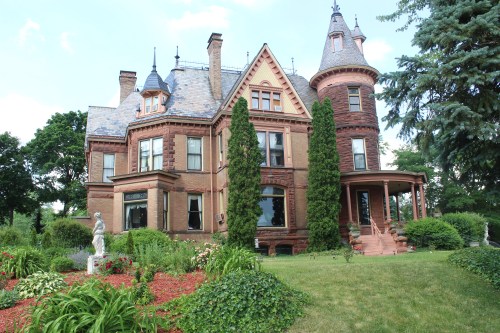
Great photos of a tour of Henderson Castle in Kalamazoo from Pedis-n-Passports.

pedisnpassports's avatarPedis-n-Passports

IMG_2085

While visiting Kalamazoo for my son’s college orientation at Western Michigan University, we had the incredible opportunity to spend a night at The Henderson Castle.  This delightful step back in time was more than we could have hoped for and was an enchanting reminder of our trip to Europe a few years ago when we resided in an Austrian castle.  Immediately upon entering, our senses were ignited with the spark of history–the aroma of old wood, the creaking of the original flooring and the soft melody of piano transported us to a royal destination.

View original post 581 more words

Read Full Post »

Almost two years ago, I posted photos of my grandfather as a very young man with an unidentified female. I hypothesized that she was his girlfriend before my grandmother.

Here they are together–looks like a couple to me.

I was going through some papers and found memory books my grandparents had prepared (one of his memories and one of hers) for the grandchildren. Inside Grandpa’s memory book, the question is asked: WHO IS THE GIRL YOU REMEMBER THE MOST?

This was his answer: (2) Vander Weele and Garthe: Don’t remember first names

So I did a little research on these names. I figured out who I believe at least one of the girls is, based on the census reports and other documents.

Garthe turned out to be Margaret Christine Garthe, born 11 days after my grandfather in 1908. She wasn’t from Kalamazoo, but from northern Michigan. She had come to Kalamazoo to attend Western. I found her in the 1928 Western State Teacher’s College yearbook.

Tell me if this isn’t the girl my grandfather is seen with above. Back row, 3rd from left.


From Ancestry it looks as if Margaret married Hans James Knutson. She passed away in 1997 in Muskegon, Michigan. Grandpa lived until 2000, happily married to the end to Grandma.

Read Full Post »

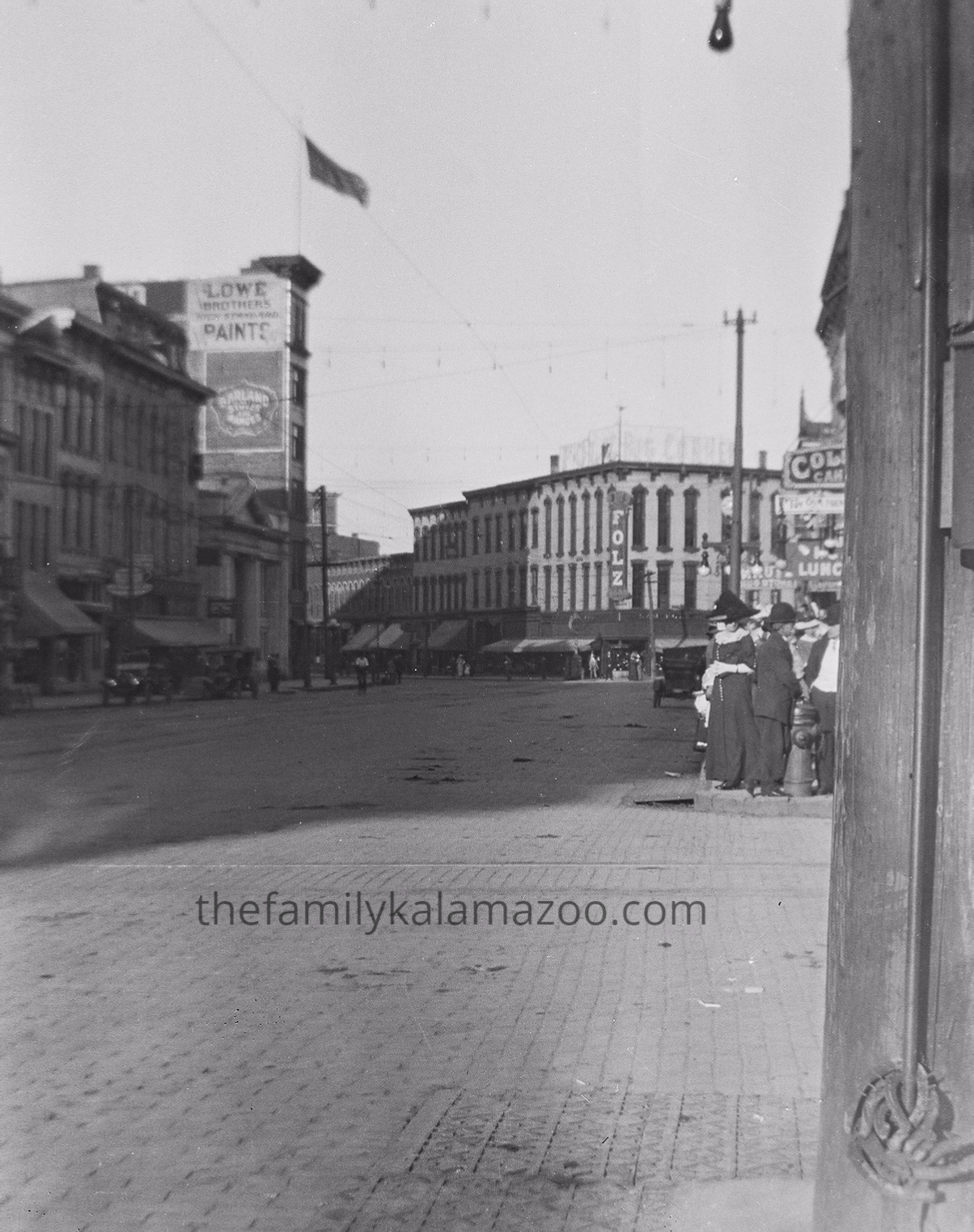
I was doing a little research for a post I want to write about my grandfather when I discovered this link to a historical photography project in Kalamazoo.

Students are taking old photos from the Kalamazoo Public Library collection and photographing the same scene from the same angle. Very interesting. It’s still a work in progress, and I can’t wait to see more.

Check it out here: KALAMAZOO THEN & NOW

Although I am so disappointed that Western Michigan University’s old campus was allowed to be destroyed for the most part, I do think Kalamazoo has a strong voice for history–in part because of the university and an active library and in part because so many people love Kalamazoo.

How about your community? How does it take care of its history?

downtown Kalamazoo, photo by Joseph DeKorn


Read Full Post »

My grandparents lived on Burdick Street in Kalamazoo. In fact, most of the family history on that side seems centered in the Burdick-Balch neighborhood. But as a kid I remember seeing a street sign on the right side when we drove south from Grandma and Grandpa’s house. It said “Remine.” I always thought that was such a funny coincidence because I knew we had Remine relatives. I imagined that it was an extremely common Dutch name.

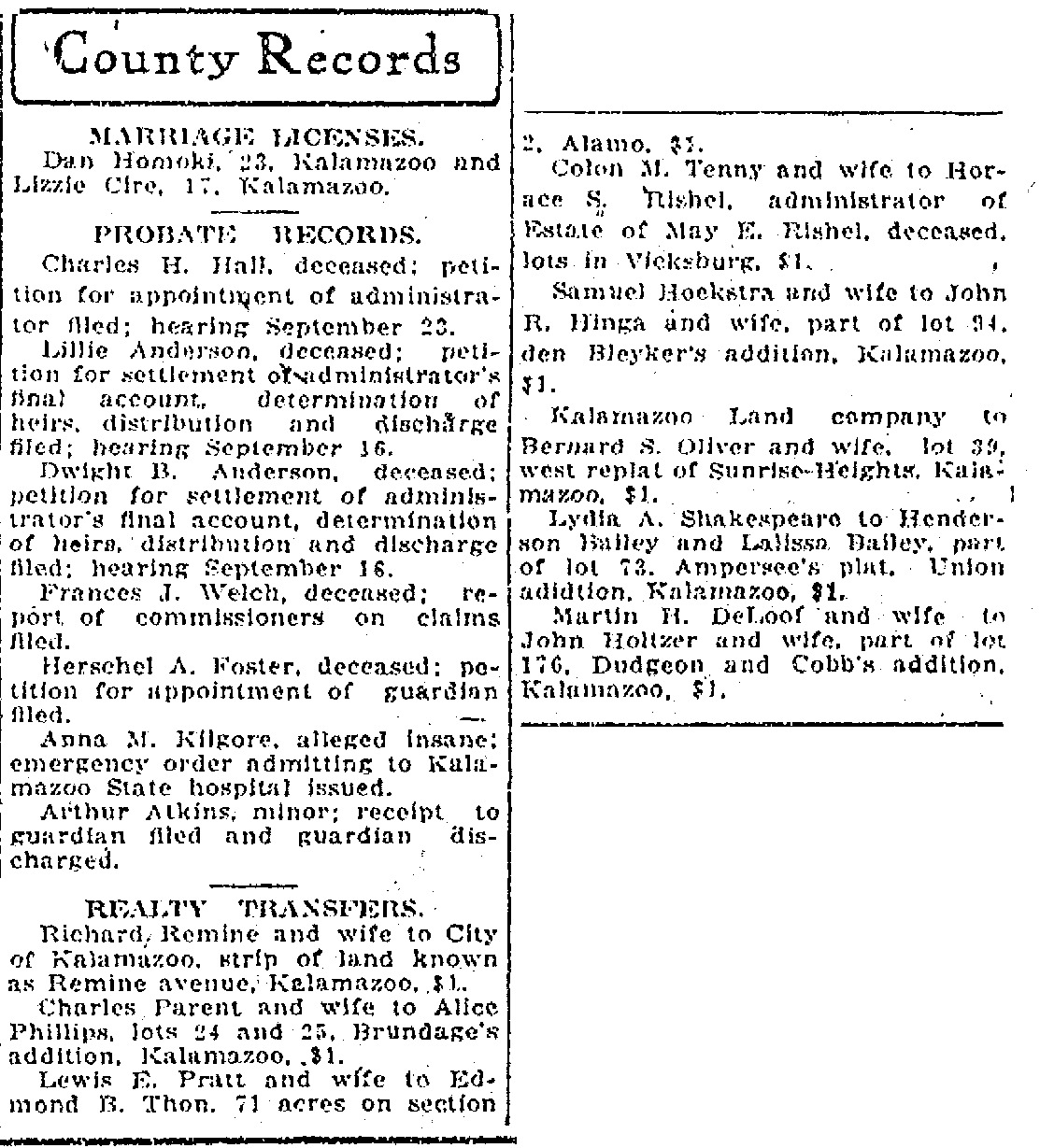
But when I was searching Genealogy Bank for Kalamazoo Gazette articles about the Remine and Tazelaar families, I encountered this little gem from August 22, 1918:

Look at the first item under REALTY TRANSFERS. “Richard Remine and wife to City of Kalamazoo, strip of land known as Remine avenue, Kalamazoo, $1.

Richard Remine is the father of Genevieve (and father-in-law of Frank Tazelaar), of Harold, and of Therese (Theresa, Tracy).

Was this common, to deed a piece of land to the city for the purpose of a road? And would it really have only been $1? Would there have been other parts of the negotiation? A discount on taxes, for instance? Or was it in order to have a way to develop a piece land and sell off lots?

Here is the intersection of Burdick and Remine according to Google Maps.


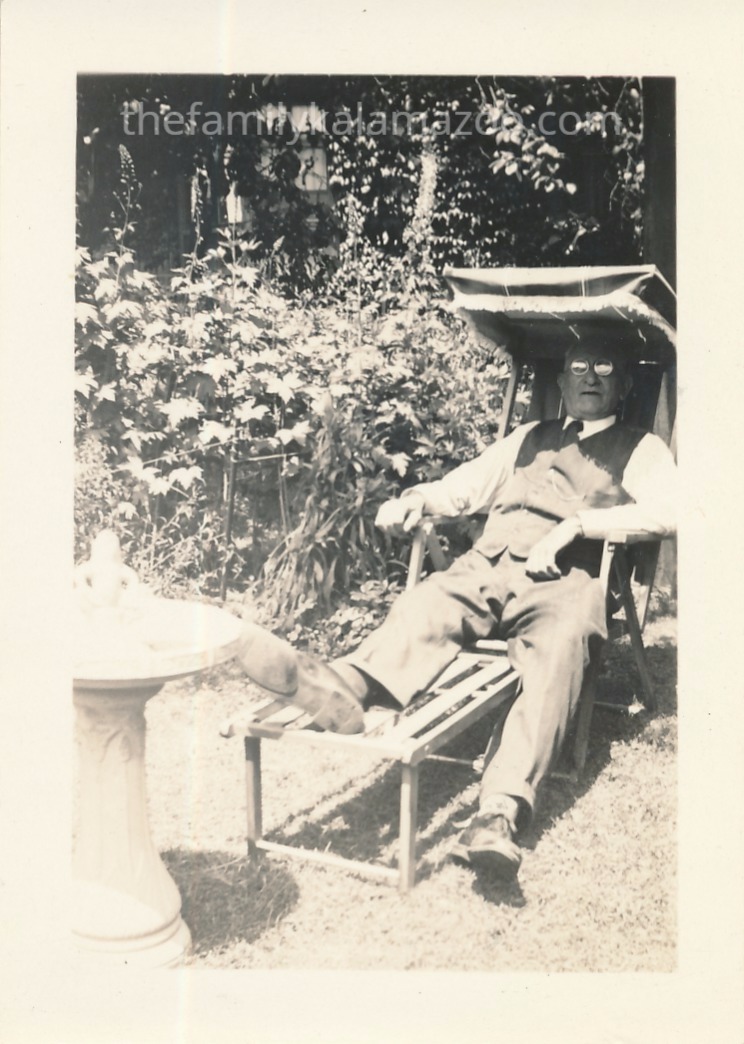
Richard lounging, years after the street was named

Found This Week–What a Treat!

I was looking for a book I can’t find. Instead, I ran across this photo–and it was labelled on the back! “Jane Remine Tazelaar.” So this is Genevieve with a smile on her face. She looks so much prettier smiling so sweetly! It’s easy to see why Frank would want to marry her. This is more proof that the family called her Jane, not Genevieve and not Jennie.

Jane (Genevieve) Remine Tazelaar

Jane Remine Tazelaar

Read Full Post »

My 3rd great grandmother, Johanna Remijnse de Korne had a brother named Gerrit Remine. He was born Geerard Remijnse, and like his sister and other siblings, was born in Kapelle, Netherlands. Gerrit’s birthdate was 21 February 1825.

Gerrit was married to Janna Kakebeeke (Kakebeke). They had three children (that I know of). Adriana, called Johanna, who gained the surname Bosman (I’ve written about Bosmans in the past), Jennie who married Carlos Meijer (Meyer), and Richard Remine. Richard was Frank Tazelaar’s father-in-law, the father of Genevieve.

I never noticed that the deaths of both Gerrit and Janna were in the same year–1910–and even if I had, they were 3 months apart, so I wouldn’t have drawn any conclusions.

Imagine my surprise to find a newspaper article explaining what happened to Gerrit in 1910 and giving a hint about Janna. The Kalamazoo Gazette article was dated 7 January 1910.

Coal gas poisoning appears to be different than carbon monoxide poisoning. I will quote from the beginning of the following article only to give you a flavor of the 1896 explanation:

JOURNAL ARTICLE

A Discussion On The Pathology Of Coal Gas Poisoning

John Haldane, John R. Davison, Alexander Scott, Stewart Lockie, J. Lorrain Smith and T. W. Parry
The British Medical Journal
Vol. 2, No. 1866 (Oct. 3, 1896), pp. 903-910
Published by: BMJ
Page Count: 8

The coal gas could have come from cooking, lighting, heating, or even a broken pipe.

No death certificate yet for Janna, but when I do find that it should confirm that she died belatedly from the coal gas tragedy.

UPDATE: Well, never assume that once these people changed the spelling of their names that they stayed put. Although Gerrit’s death article used the spelling “Remine,” Janna’s did not. In fact, even her first name changed

In this article, Janna becomes Jennie, which to my understanding makes less sense in Dutch than it does in English. And Remine is now Reminse. And look at her daughter, Jennie (Adriana) is “Mrs. C. Myers.” So Meijer that became Meyer is also Myers. Whew. And Richard Remine is now Richard Reminse. Good grief. You don’t even want to know how many ways I’ve seen Gerrit spelled!

Read Full Post »

As usual, the more I’ve learned, the more questions I have! Realizing that all the newspaper articles have not been properly entered into the Genealogy Bank database, I know I am probably missing more articles about Frank. Although it’s easy to always assume this with data entry of genealogical information, I can tell from the Gazette’s own files that this is true. There is an article where they repeat choice nuggets from the Gazette from 10-20 years previously and Frank shows up there, but the original article does not show up.

What seems to be great omissions are obituaries for both Frank and Genevieve (Remine) Tazelaar. Since Frank was so involved in the community, as the sheer number of articles attests, why wouldn’t there be an obituary for his wife in 1930 and for himself in 1950?

I don’t even have a death certificate for Frank and when I tried to order one, a website tried to steal take $60 from me!

Let’s see what I discovered through what I did find, though.

  • Frank was extremely involved in the Knights of Pythias and the Elks. He may have had a connection to the Masons.
  • He was not only involved in these organizations, but was frequently elected to the boards and organized dances and other activities. In 1916, Frank was made Master of Exchequer of the Pythias lodge. As chairman of the Pythias festivities for New Year’s Eve 1915/1916, Frank commissioned a streetcar to remain for the party stragglers so they would have a way to get home. For a party in 1916, Frank even made sure the ladies were presented with a “delicate” box of chocolates.
  • Frank was a sportsman who raced his mare Gas Light in the 1905-1906 period, which would have been just before his marriage. There was talk about the possibility of Gaslight being entered into the bigger races in Detroit and Chicago. Now I understand why the photograph of Frank with the horse and dog is marked “GASLIGHT.” That was the same horse!
  • Frank hunted for small game and birds.
  • Frank was a men’s clothing salesman of some repute.
  • Before his marriage, when Frank went on vacation, the Kalamazoo Gazette noted it.
  • When Frank changed places of employment, he was mentioned in the paper. In August 5, 1894, he worked for That Thomas clothing house. In 1896 (March 19)  he went to work at the brand new and elegant clothing house of Mr. Yesner as one of his three salesmen. In 1907, Frank went to work for Hershfield’s. See article below.
  • In March 1906, Frank bought a lot on Ranney Street from Mrs. Blanche Henderson and “is having a fine residence erected on it.” That house would be ready for his bride Genevieve less than 4 months later. Ranney is a small street off South Westnedge Ave.
  • On April 30, 1911, Frank was building an “elegant new home” at 122 North West Street (West Street later became Westnedge Avenue, according to Sharon Ferraro). The property is “for sale,” but of course when Frank had influenza in 1918, that is the house he and Genevieve lived at.
  • His “wife” is only mentioned once in the newspaper, related to the transfer of a piece of real estate to someone else for $1.

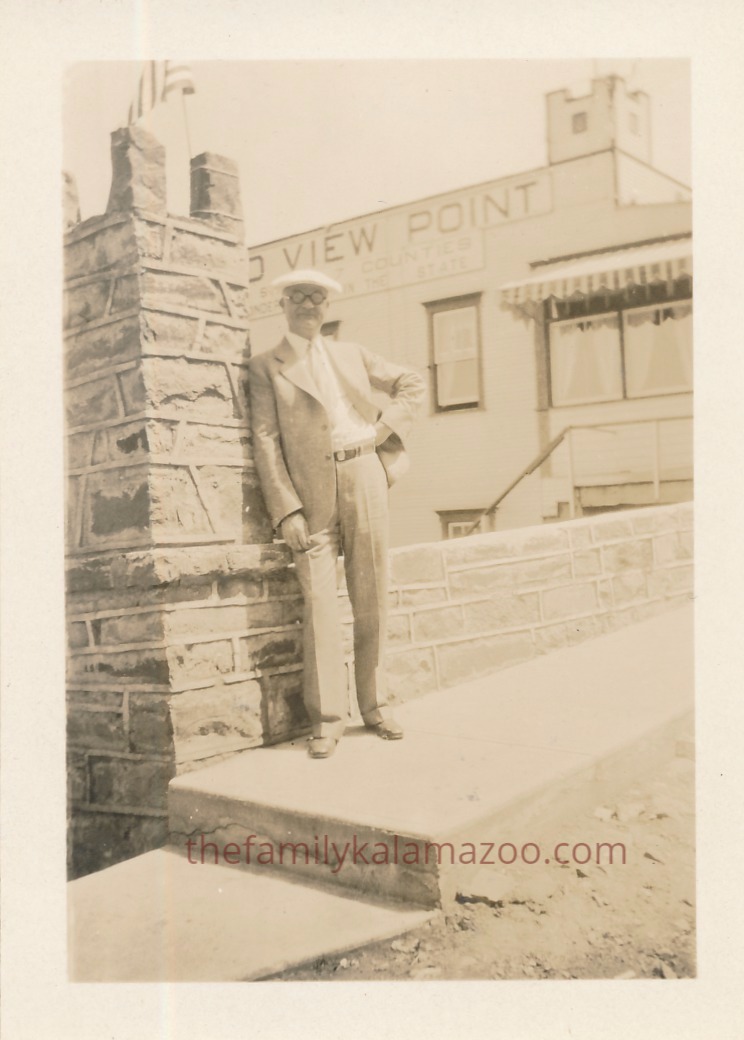
I also discovered another photograph of Frank. Are these riding goggles he is wearing?

Here are a sampling of newspaper articles with a couple of surprises.What does this theatre ad mean? Was Frank an actor? How could the entire cast be as presented at the Chicago Auditorium (read this link about this marvelous performance venue!), which was a 4,000 seat theatre?

I have to say that if Frank was an actor it would not surprise me at all. He had to have been a larger-than-life man, full of humor (2 or 3 times he’s quoted in a humor column), and loving a good time. He was quite young at the time this ad was placed. The date of 10 November 1901 is five years before his marriage. He was about 25.

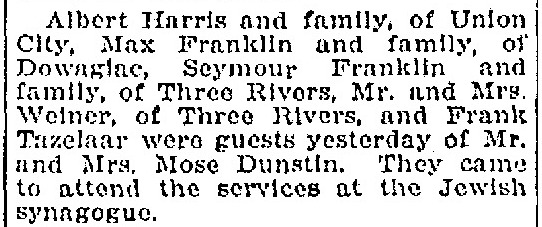
A curious item was in the Society and Personal column two months after Frank’s marriage to Genevieve:

Was Frank the only non-Jew in this party to attend synagogue services? And who was Mose Dunstin and how did Frank know him? All I have learned so far (of value to me for my curiosity) about Mose was that he was Moses Dunstin, born in “Russian Poland,” and his father’s surname was Danskin. He died 4 April 1910 in Kalamazoo at the age of 52. Cause of death was Angina Pectoris (chest pain) and contributing factors were influenza and albuminaria. Notice that for Moses I was able to get a free death certificate. So unfair . . . . Anyway, when Moses invited Frank to attend services, Moses was only 48.

Because the date of the article was 21 September 1906 I wondered if the event involved the High Holidays, but it seems that Sukkot began on September 21 (probably evening of September 20), so maybe it had to do with that holiday instead.

In 1907, Frank went to yet another clothier:

Notice it says Frank was with “That Thompson Clothing House” for 9 years. If he went with Yesner in 1896, that would mean he had been had the previous one since 1887. Since he was born in 1876, that would be impossible. What makes sense to me is that he left That Thomas for Yesner, left Yesner, and went back to That Thomas. Or the paper has the nine years wrong, which is also very possible. Note: I don’t yet know what year the Tazelaars immigrated to the U.S.

On January 29, 1914, the 80th birthday of Frank’s mother, Adriana Bek Tazelaar, was noticed. I prefer to post the whole Society column for this one. The mention is on the right side, the sixth paragraph down. In this paragraph there are mention of Adriana’s descendants, which is useful for locating Frank within his own family tree.

Later that year, on June 25, there is a somewhat humorous article about the fishing teams of the Knights of Pythias lodge. Frank is one of the team captains.  This article is notable for sharing Frank’s photo. He was about 39 here . . . .

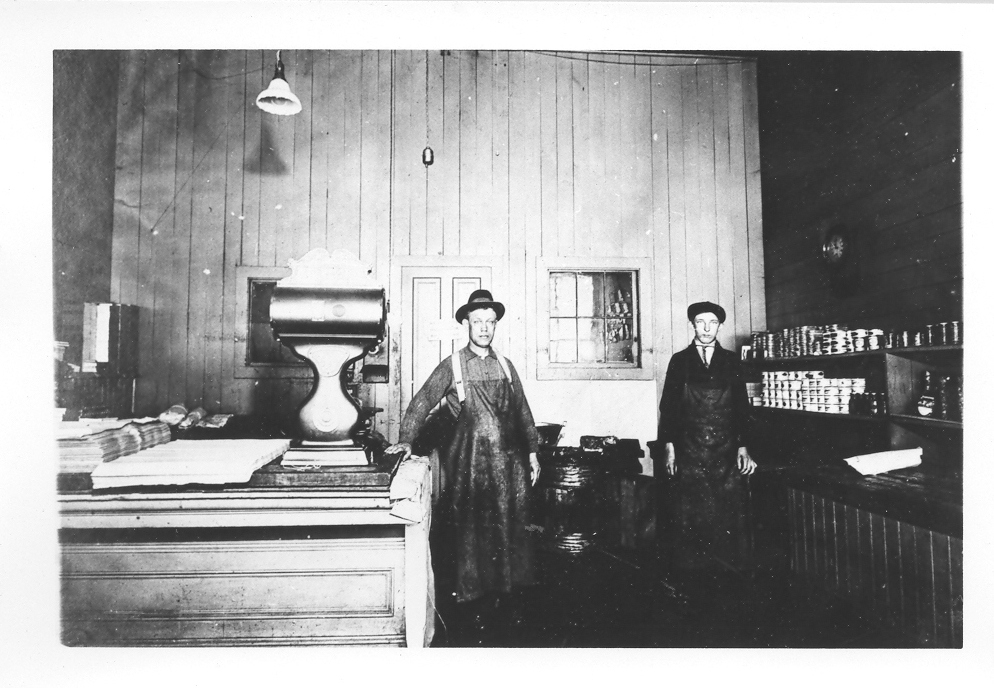
This article is ALSO notable for mentioning my great-grandfather’s fish market! Referring to the fish caught in the contest, the article says, “All fish must be delivered at Zuideweg’s [SIC: should be Zuidweg’s] market in Eleanor Street by Monday noon . . . .” So you know the connection, Genevieve Remine Tazelaar was the first cousin of my great-great-grandfather Richard DeKorn whose son-in-law was my great-grandfather Adrian Zuidweg who owned the fish market. Now the most important part: Richard DeKorn built the Pythian building known as Pythian Castle and, earlier, as the Telegraph Building. The link explains about the building.

I’ve posted a photo of the fish market in the past.

Fish Market on Eleanor Street with Adrian Zuidweg and helper

Seven years later, there is a notice that Frank needs to have a frame house moved from a lot.

April 3, 1921
Kalamazoo Gazette

When Genevieve died in September 1930, the couple were living at 423 S. Westnedge Avenue, so it stands to reason that Frank wanted to sell a frame house on new property so he could build a new house. It would be at least the third house he built for himself and his wife. Her parents probably lived there with them, as well. It might sound funny to move a house, but when I was little I watched a house being moved down the street while I was holding my grandmother’s hand. I never forgot that first image of a house on wheels, although I did see a similar scene much later in life.

The last article of any note I could find was on 29 September 1922.

From being the toast of the town to an arrest! For shooting ducks after sunrise yet, which is very unsportsmanlike. Maybe it was his companions who steered him wrong ;). At least he didn’t catch undersized bass like Mr. Denner!

All kidding aside, while I loved getting to know Frank, I am really ticked off that Genevieve’s life is completely erased, as if she never existed. This could be because it is so difficult to research the lives of women and also because Frank was so outgoing. I hope that she had a pleasant life.

Read Full Post »

Frank Tazelaar was married to one of the daughters of my great-great-grandmother’s sister. He’s the husband of my first cousin 3x removed. Yup, that is easy to remember, right? Remember the Paak/Peek sisters and brother? Mary Peek (the spelling she used) married Richard Remine. For decades I thought there were four Remine children: Jenny, Genevieve, Therese (Tracy), and Harold. I had information for all four. But after more work, I finally found a very important divorce record and now know that Jenny and Genevieve were the same person.

This is Jenny (when she was younger) or Genevieve (once she was married to Frank Tazelaar). My grandfather identified her as Jane, so she might have used that name when she was young also. Her grandmother’s name had been Jana. I will refer to her as Genevieve because that is the name she ended up using for decades.

Here is Frank:

But why am I writing about Frank Tazelaar now? Because Sharon Ferraro is researching the effects of the influenza pandemic in 1918 in Kalamazoo. And Frank’s name is on the list as someone who contracted the illness and survived. It does not appear that he was treated at a hospital. He was ill and off work for ten days and then was able to go back to “his store.” In the 1920 census he was listed as a salesman/buyer in a clothing shop (same entry in the 1930 census). On the influenza document, his wife is listed as Genevieve and they lived at 124 N. West. Although I have verified that this information is correct, I have never heard of that street in Kalamazoo.

Genevieve was born 24 June 1881 in Kalamazoo, the first child of her parents, Richard and Mary. She was first married to a man she might have met in Chicago. His name was Harry Cohn. They were married in Paw Paw, Michigan, on 29 January 1903, when she was 21 years old. Three years later, on 23 June, 1906, they were divorced. The grounds were listed as “desertion,” but who deserted whom? If that was really what happened. Apparently, though, they had not been together for quite some time because about two weeks later, on 9 July 1906, Genevieve and Frank married in Chicago.

Frank was born in Wissenkerke, Netherlands, on 18 January 1876, to Peter Tazelaar and Adriana Bek Tazelaar. When he was a boy, his family moved from Holland to Kalamazoo, Michigan. He was a few years older than Genevieve. His native tongue was Dutch, whereas Genevieve was American-born. It’s hard to imagine what happened with Genevieve’s first marriage or how she happened to marry Frank–and what the Chicago connection was between Genevieve, Frank, and Harry. In fact, unless she went away to Chicago to school, I can’t imagine her leaving her parents’ home by the age of 21. Was she sent away for some reason? Since she never had any children, it’s less likely that she was pregnant, although always possible. 

Genevieve did not have children with either Harry or with Frank. When Genevieve passed away on 17 September 1930 of appendicitis (leading to gangrene and peritonitis), the couple was living at 423 S. Westnedge with her parents, Mary and Richard. That must have been awkward because on 21 March 1932 he married Bernice Dayton, the manager of “Lerner Shop.” Could this be the same Lerner store (part of the nationwide chain) that I grew up with? It’s likely because the Lerner Shops were first opened in 1918. (As a cool aside, the uncle of lyricist Alan Jay Lerner was one of the two founders).

Here is another photo of Frank Tazelaar, at the Whistle Stop in Kalamazoo, on 15 February 2014, four years before he contracted the flu.

Frank Tazelaar
near Whistle Stop
Kalamazoo

As with most of my other blog posts, this story is ripe for more research. In particular, I’d like to search City Directories for addresses and businesses, as well as the local newspaper for articles about the couple and, possibly, “his” store.

OK, I peeked. There are many Kalamazoo Gazette articles about Frank. In fact, there are over 50 articles! Let’s see what we can find . . . next time.

But it won’t be ready until after my son’s wedding, so I will post Frank’s shenanigans on May 1!

Read Full Post »

« Newer Posts - Older Posts »