Feeds:
Posts
Comments

Archive for the ‘Adriaan Zuijdweg/Adrian Zuidweg Sr.’ Category

The other day I posted Richard DeKorn’s death certificate from Kalamazoo and asked for help with the cause of death. Readers were very helpful, and I’m so appreciative.

I mentioned at the time that Richard’s daughter and Grandpa’s mother, Cora DeKorn Zuidweg (Mrs. Adrian Zuidweg), wasn’t in the register of deaths. Two readers kindly sent me Cora’s death certificate that they found on the Seeking Michigan website.

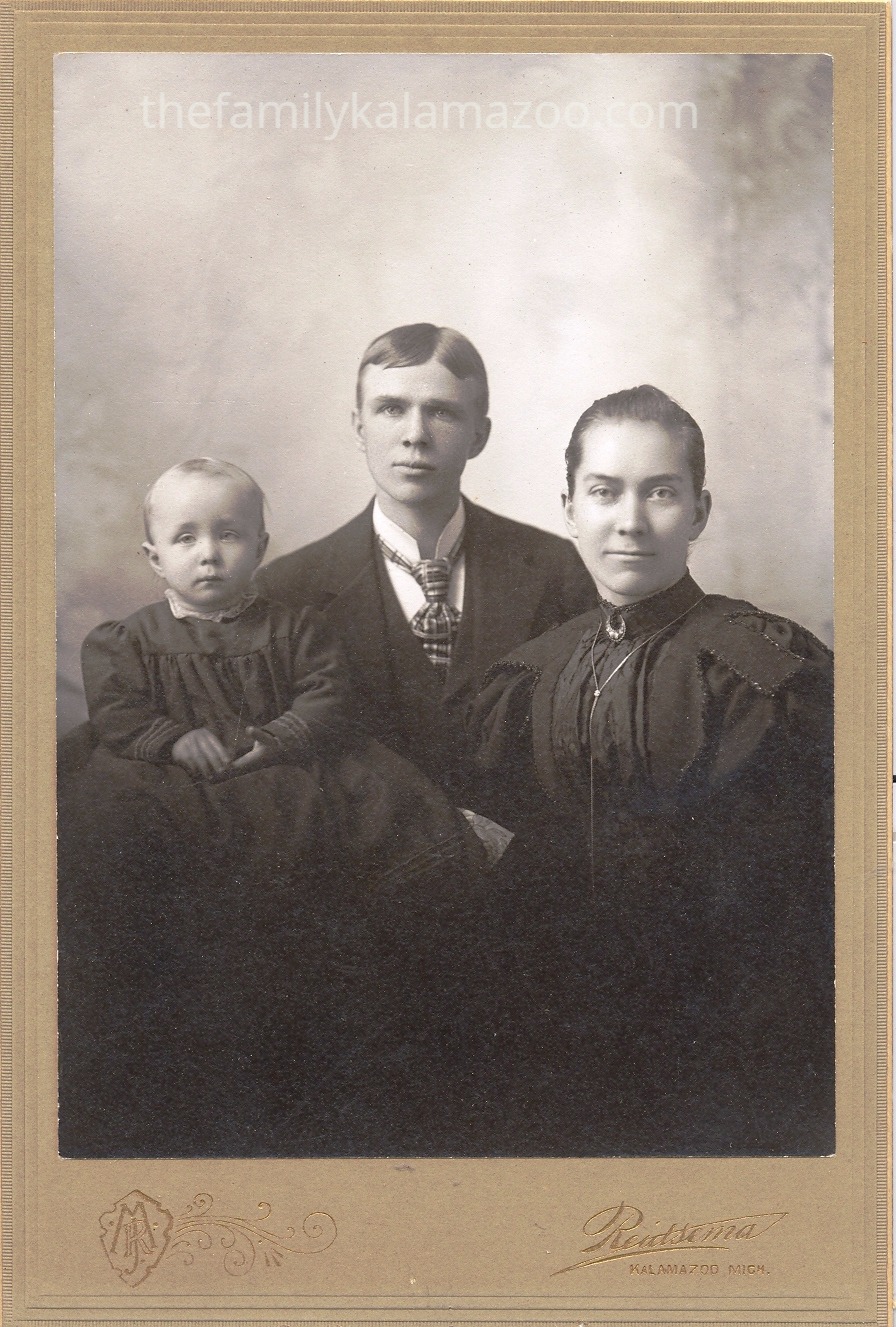
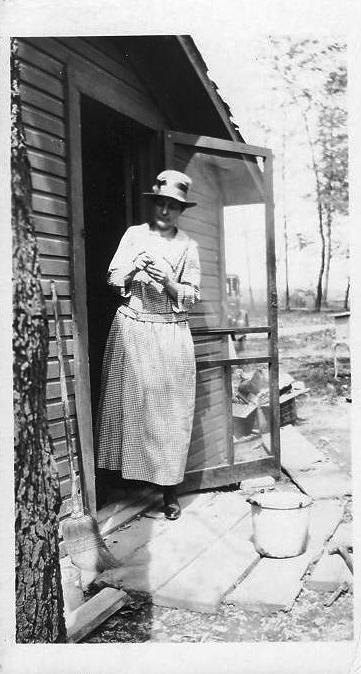
Cora is a particularly intriguing person to me because Grandpa and Grandma used to tell me that I looked a lot like her, especially with my hair pulled back. Cora always wore her hair up. The first time I saw this picture of Cora I was in my 20s and felt as if I was looking into a mirror.

Also, Grandpa’s stories about her included stories of her love for animals and her courage to defend them. I feel a real affinity in the area of love of animals and wish I had her courage.

Here are Cora and Adrian (senior) with Grandpa, Adrian (junior)

What I knew about Cora’s death was that she had cancer that had spread throughout her body and her brain became confused from the disease. I also knew that she was dying when my grandparents got married. That explains why they got married out of town and on their own. My grandmother moved into the house with Grandpa and his mother and took care of her until she died a few months later.

Now take a look at the cause of death on the certificate:

Exhaustion – debility from gen – metastatic sarcoma spindle cell – primary in left thigh, followed injury was removed 9-16-29 – had existed there 5 years.

I believe that it is what it says.

So cancer that started in her left thigh. Cancer that, according to Google, would be treated with chemo today. If caught in time, the results would probably be positive. Spindle cell sarcoma apparently is a connective tissue cancer.

I thought that was a little bit of a coincidence because it seems that Cora had the cancer since she was about 52 and when I was 50 I had a tumor in my foot. While my tumor turned out not to be cancer, it was a giant cell reparative granuloma, which means that it has some characteristics of cancer (possibility of metastasizing and also destruction and replacement of healthy tissue). My tumor is the type that also reacts to injury or pressure, as Cora’s did.

After checking out more on Google, I also learned that Giant Cell tumors can turn into cancer if left untreated–and sometimes into spindle cell. Notice that Cora’s original tumor wasn’t removed until 1929, about two years into her diagnosis.

All very curious. I know that I am lucky that I got 21st century medical care for my foot.

Cora passed away at age 57, never meeting her three grandchildren. My mother would be born less than two years after Cora’s death.


Read Full Post »

As usual, the more I’ve learned, the more questions I have! Realizing that all the newspaper articles have not been properly entered into the Genealogy Bank database, I know I am probably missing more articles about Frank. Although it’s easy to always assume this with data entry of genealogical information, I can tell from the Gazette’s own files that this is true. There is an article where they repeat choice nuggets from the Gazette from 10-20 years previously and Frank shows up there, but the original article does not show up.

What seems to be great omissions are obituaries for both Frank and Genevieve (Remine) Tazelaar. Since Frank was so involved in the community, as the sheer number of articles attests, why wouldn’t there be an obituary for his wife in 1930 and for himself in 1950?

I don’t even have a death certificate for Frank and when I tried to order one, a website tried to steal take $60 from me!

Let’s see what I discovered through what I did find, though.

  • Frank was extremely involved in the Knights of Pythias and the Elks. He may have had a connection to the Masons.
  • He was not only involved in these organizations, but was frequently elected to the boards and organized dances and other activities. In 1916, Frank was made Master of Exchequer of the Pythias lodge. As chairman of the Pythias festivities for New Year’s Eve 1915/1916, Frank commissioned a streetcar to remain for the party stragglers so they would have a way to get home. For a party in 1916, Frank even made sure the ladies were presented with a “delicate” box of chocolates.
  • Frank was a sportsman who raced his mare Gas Light in the 1905-1906 period, which would have been just before his marriage. There was talk about the possibility of Gaslight being entered into the bigger races in Detroit and Chicago. Now I understand why the photograph of Frank with the horse and dog is marked “GASLIGHT.” That was the same horse!
  • Frank hunted for small game and birds.
  • Frank was a men’s clothing salesman of some repute.
  • Before his marriage, when Frank went on vacation, the Kalamazoo Gazette noted it.
  • When Frank changed places of employment, he was mentioned in the paper. In August 5, 1894, he worked for That Thomas clothing house. In 1896 (March 19)  he went to work at the brand new and elegant clothing house of Mr. Yesner as one of his three salesmen. In 1907, Frank went to work for Hershfield’s. See article below.
  • In March 1906, Frank bought a lot on Ranney Street from Mrs. Blanche Henderson and “is having a fine residence erected on it.” That house would be ready for his bride Genevieve less than 4 months later. Ranney is a small street off South Westnedge Ave.
  • On April 30, 1911, Frank was building an “elegant new home” at 122 North West Street (West Street later became Westnedge Avenue, according to Sharon Ferraro). The property is “for sale,” but of course when Frank had influenza in 1918, that is the house he and Genevieve lived at.
  • His “wife” is only mentioned once in the newspaper, related to the transfer of a piece of real estate to someone else for $1.

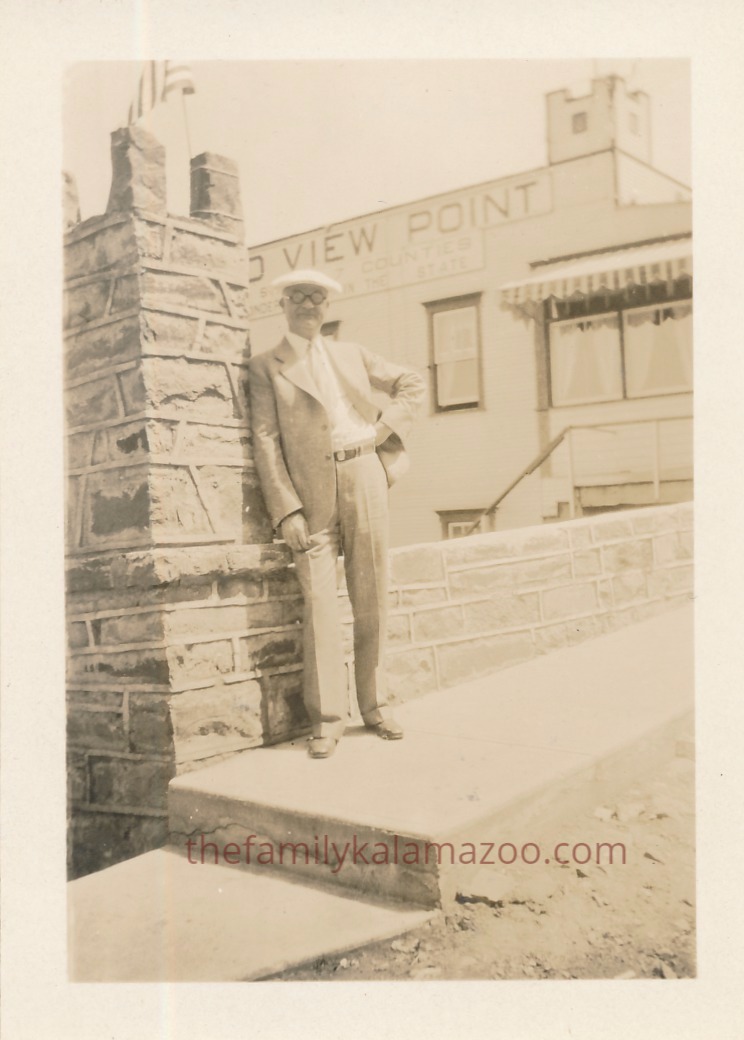
I also discovered another photograph of Frank. Are these riding goggles he is wearing?

Here are a sampling of newspaper articles with a couple of surprises.What does this theatre ad mean? Was Frank an actor? How could the entire cast be as presented at the Chicago Auditorium (read this link about this marvelous performance venue!), which was a 4,000 seat theatre?

I have to say that if Frank was an actor it would not surprise me at all. He had to have been a larger-than-life man, full of humor (2 or 3 times he’s quoted in a humor column), and loving a good time. He was quite young at the time this ad was placed. The date of 10 November 1901 is five years before his marriage. He was about 25.

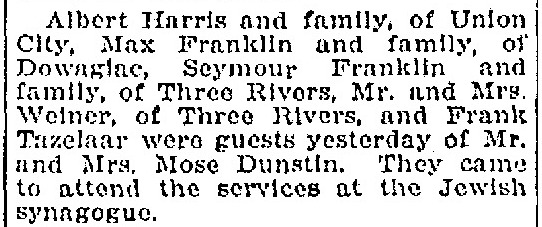
A curious item was in the Society and Personal column two months after Frank’s marriage to Genevieve:

Was Frank the only non-Jew in this party to attend synagogue services? And who was Mose Dunstin and how did Frank know him? All I have learned so far (of value to me for my curiosity) about Mose was that he was Moses Dunstin, born in “Russian Poland,” and his father’s surname was Danskin. He died 4 April 1910 in Kalamazoo at the age of 52. Cause of death was Angina Pectoris (chest pain) and contributing factors were influenza and albuminaria. Notice that for Moses I was able to get a free death certificate. So unfair . . . . Anyway, when Moses invited Frank to attend services, Moses was only 48.

Because the date of the article was 21 September 1906 I wondered if the event involved the High Holidays, but it seems that Sukkot began on September 21 (probably evening of September 20), so maybe it had to do with that holiday instead.

In 1907, Frank went to yet another clothier:

Notice it says Frank was with “That Thompson Clothing House” for 9 years. If he went with Yesner in 1896, that would mean he had been had the previous one since 1887. Since he was born in 1876, that would be impossible. What makes sense to me is that he left That Thomas for Yesner, left Yesner, and went back to That Thomas. Or the paper has the nine years wrong, which is also very possible. Note: I don’t yet know what year the Tazelaars immigrated to the U.S.

On January 29, 1914, the 80th birthday of Frank’s mother, Adriana Bek Tazelaar, was noticed. I prefer to post the whole Society column for this one. The mention is on the right side, the sixth paragraph down. In this paragraph there are mention of Adriana’s descendants, which is useful for locating Frank within his own family tree.

Later that year, on June 25, there is a somewhat humorous article about the fishing teams of the Knights of Pythias lodge. Frank is one of the team captains.  This article is notable for sharing Frank’s photo. He was about 39 here . . . .

This article is ALSO notable for mentioning my great-grandfather’s fish market! Referring to the fish caught in the contest, the article says, “All fish must be delivered at Zuideweg’s [SIC: should be Zuidweg’s] market in Eleanor Street by Monday noon . . . .” So you know the connection, Genevieve Remine Tazelaar was the first cousin of my great-great-grandfather Richard DeKorn whose son-in-law was my great-grandfather Adrian Zuidweg who owned the fish market. Now the most important part: Richard DeKorn built the Pythian building known as Pythian Castle and, earlier, as the Telegraph Building. The link explains about the building.

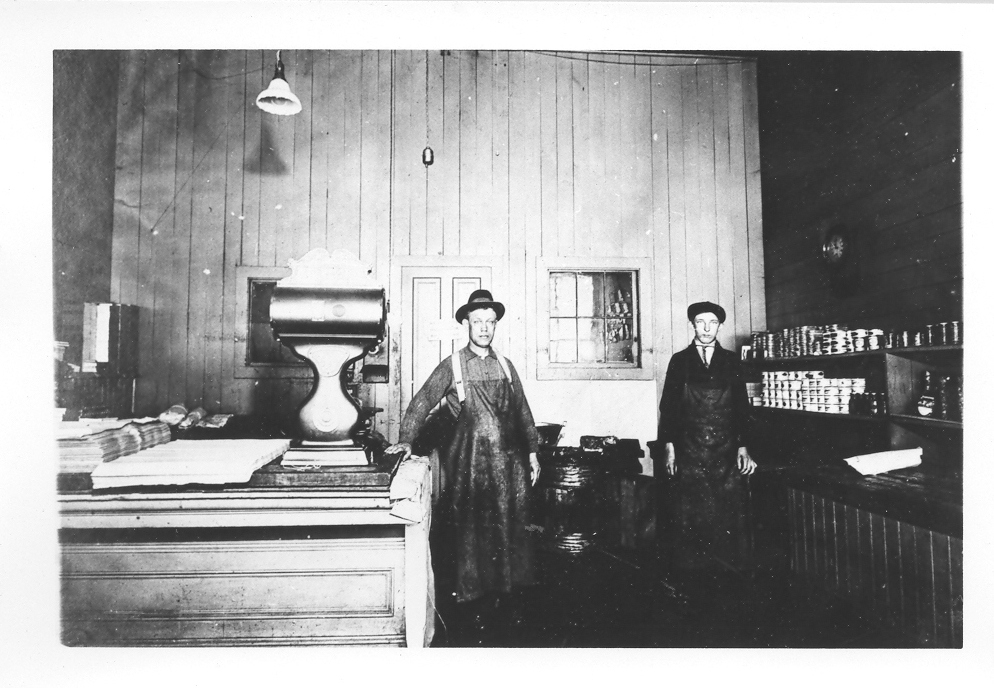
I’ve posted a photo of the fish market in the past.

Fish Market on Eleanor Street with Adrian Zuidweg and helper

Seven years later, there is a notice that Frank needs to have a frame house moved from a lot.

April 3, 1921
Kalamazoo Gazette

When Genevieve died in September 1930, the couple were living at 423 S. Westnedge Avenue, so it stands to reason that Frank wanted to sell a frame house on new property so he could build a new house. It would be at least the third house he built for himself and his wife. Her parents probably lived there with them, as well. It might sound funny to move a house, but when I was little I watched a house being moved down the street while I was holding my grandmother’s hand. I never forgot that first image of a house on wheels, although I did see a similar scene much later in life.

The last article of any note I could find was on 29 September 1922.

From being the toast of the town to an arrest! For shooting ducks after sunrise yet, which is very unsportsmanlike. Maybe it was his companions who steered him wrong ;). At least he didn’t catch undersized bass like Mr. Denner!

All kidding aside, while I loved getting to know Frank, I am really ticked off that Genevieve’s life is completely erased, as if she never existed. This could be because it is so difficult to research the lives of women and also because Frank was so outgoing. I hope that she had a pleasant life.

Read Full Post »

I’ve written about the Leeuwenhoeks, and in particular, my great grandmother’s brother-in-law, Lambertus Leeuwenhoek. He was called Uncle Lou by my grandfather, so he’s still called Uncle Lou by me today, although I never met him. I did know his wife, Aunt Jen, who survived him by decades.

Uncle Lou and Aunt Jen owned a general store. They had a store in Kalamazoo for a time and one in Vicksburg for a time, as well. In the 1910 and 1920 censuses, he and Aunt Jen are living at 110 Balch Street in Kalamazoo. His Kalamazoo store sold Gold Medal flour.

may-19-1910-leeuwenhoek-ad


In the 1930 census, they live at 111 East Prairie Street in Vicksburg. In the 1940 census I find them with Lou’s first name mangled into Laonbatius. They are living with their daughter Alice and her husband, Clarence Moerdyk, at 1014 Gerdan Street in Kalamazoo. Could that be GARDEN Street? Because that would be a real house in Kalamazoo. One still existing, most likely.

I looked for city directory entries, and I found these–all date jumbled:

Leeuwenhock Lambertus (Jennie) household 110 Balch, 1926 City Directory: See Page
Leeuwenhoek Alice M, dressrnkr, boards 110 Balch, Kalamazoo City 1915: See Page
Leeuwenhoek Lambertus (Jennie) resides at 1014 Garden, City Directory 1935: See Page
Leeuwenhoek Lambertus (Jennie), grocer 110 Balch, residence same, Kalamazoo City 1915: See Page
Leeuwenhoek Lambertus (Jennie), grocer 110 Balch, residence same, Kalamazoo City, 1905: See Page
Leeuwenhoek Lambertus, compositor, 306 Wall., Kalamazoo City 1895: See Page

Compositor means that Lou was working on the Dutch newspaper. See here. But he had a grocery store in his house?

And if he lived in Vicksburg in 1930, but lived in Kalamazoo in 1926 and 1935, he couldn’t have lived in and owned a store in Vicksburg for very long. Unfortunately, I haven’t found a source for Vicksburg advertising yet.

I found this photo of Uncle Lou standing out in the front of the store, but I’m not sure which city this is:

Any ideas on the years, judging by the cars? Any idea if that looks like Kalamazoo or Vicksburg in the distance?

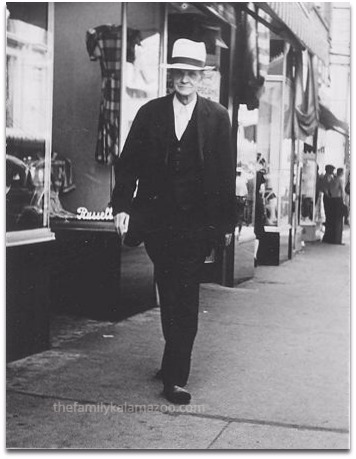
Likewise, I’m not sure which city Uncle Lou is in as he walks down the sidewalk? Does that window say “Russell” on it? In the city directories, there are many Russells, including ones owning businesses. There is one on Burdick Street, for instance, in my family’s neck o’ the woods, that is a variety store.

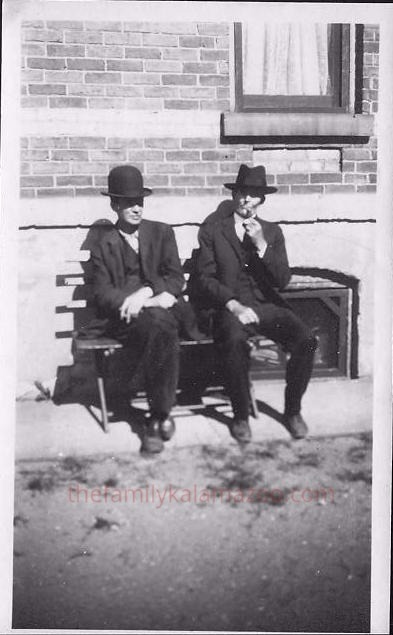
Here he is on a bench:

I wouldn’t be surprised to find this bench outside Richard DeKorn’s (his father-in-law) house on the corner of Burdick and Balch, judging by the design of the light colored stripe through the brick.

Here the photo is again–yes, it’s the same house. It’s hard to see Lou’s face up close. Below he is with his father-in-law, Richard DeKorn.

Uncle Lou with Aunt Jen and their only child, Alice:

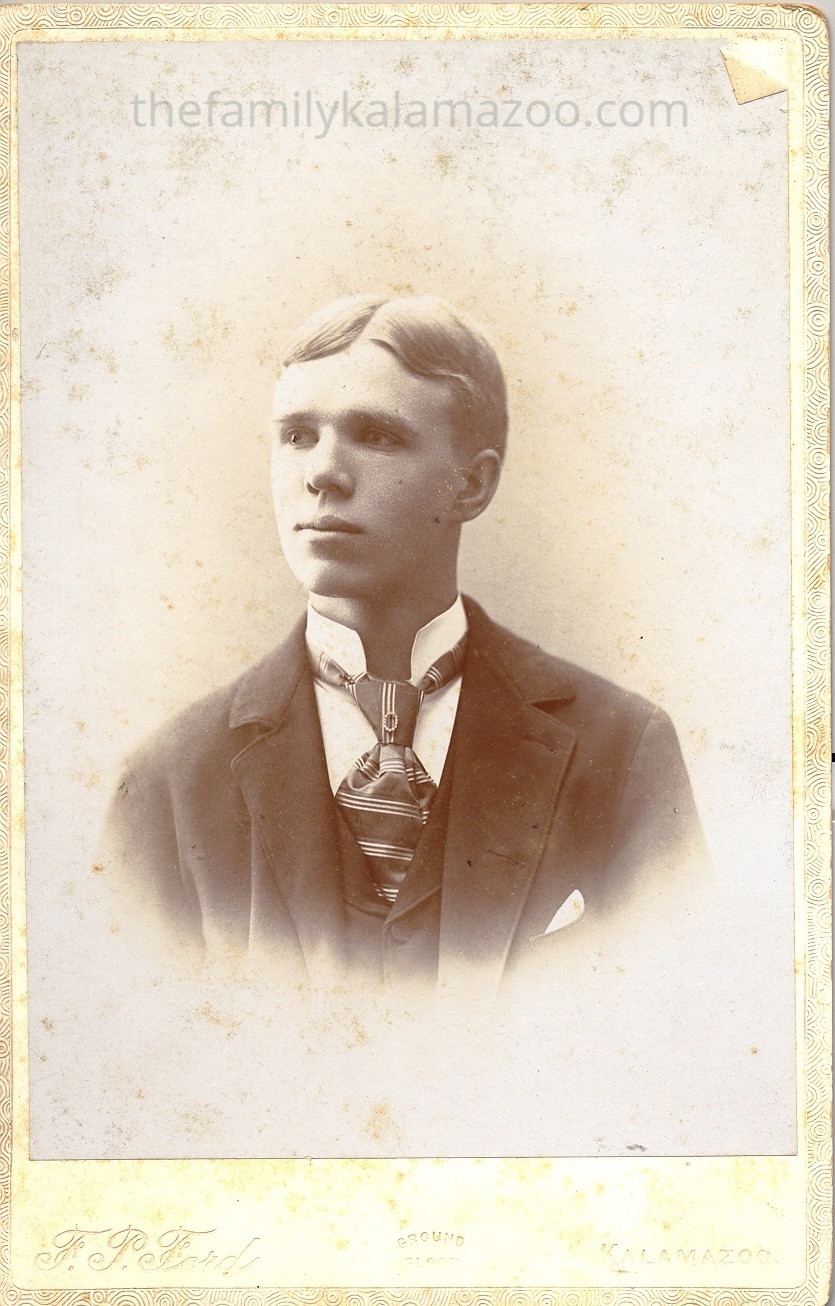
Here is a closeup of young Uncle Lou.

And now this is a curiosity. This photo is labelled Lou Leeuwenhoek by the same person who knew that the man walking down the street was Lou, that that was Lou standing out in front of his store, etc. But IS it Lou?

This is not his brother, for sure. While it’s not the same hairstyle as the photos above, the features seem to be the same–except for the eyes which, in the other photos, seem to be deep-set. Is the difference aging (the style of tie is the same) or lighting?  Or is the photo mislabeled?

***

You can check out the Bibles Uncle Lou brought with him from the Netherlands here.

Read Full Post »

One of the wonderful benefits of blogging about family history and genealogy is learning from my fellow bloggers. Last week I read a post by Amberly, The Genealogy Girl, about a site called Genealogy Gophers. I’d never heard of it, but she made it sound easy (and free), so I hopped over to the site and entered (somewhat randomly) one of my family surnames in the search form.

“Zuidweg” brought up several entries because I hadn’t narrowed down to time or place. This isn’t surprising because my Dutch cousin Elly thinks that Zuidweg might be a fairly common name, especially in Zeeland.

Before I could search the entries  individually, one popped up, clamoring for attention. It was one of those rare finds that I probably could have never found without this source.

An Honor Roll

Containing a Pictorial

Record of the War Service

of the Men and Women of

Kalamazoo County

1917-1918-1919

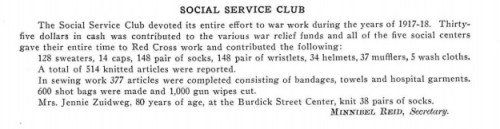
The entry in this book mentions my great-great-grandmother Jennie Zuidweg. Born Jennegien Bomhoff on 5 March 1838 in Zwolle, Overjissel, Netherlands, Jennie married Johannes Zuidweg in 1869, at age 31. She was a maid at that time and both her parents had already passed away. They had 3 children, but Lucas passed away at age 21. In 1901, Jennie and Johannes immigrated to the United states. She was sixty-three years old. She was older than I am. I can’t imagine uprooting my life at that age and moving so far away that I would never be able to return to the country I’d lived in all those years.

Johannes died in 1911, when Jennie was 73. She lived on, a widow, until her death in Kalamazoo, Michigan, on 16 December 1924 at the age of 86. My grandfather was the only child of her remaining son, Adriaan. He was 16 when his grandmother died. She had many grandchildren through her daughter Johanna VanLiere.

Between the death of Johannes and her own death, WWI occurred. So what was Jennie doing with her time when she was 80 years old?

According to this honor roll she had some remarkable knitting skills.

Jennie Zuidweg knit 38 pairs of socks 1917-1918

The Social Service Club had five centers in Kalamazoo. During 1917-1918 women who volunteered for these centers contributed a total of:

128 sweaters

14 caps

148 pair of socks

148 pair of wristlets

34 helmets

37 mufflers

5 wash cloths

Kalamazoo Country contributed a total of 514 knitted articles, 377 sewn articles, as well as 600 shot bags and 1,000 gun wipes.

The only volunteer singled out here is Mrs. Jennie Zuidweg, 80 years of age, at the Burdick Street Center, (who) knit 38 pairs of socks.

I used to knit when I was a kid, and socks sound like a lot of boring work to me. That is true dedication.

Read Full Post »

After my last post was published, Elly and I conferred again about our Mulder family. We discovered that of the six children of Adriaan and Johanna (Mulder) Zuijdweg, we had two differences. First of all, Elly didn’t have a record of the first child, Kornelis, born in 1837. And I did not have another child who died at a very young age. Although I had on my tree, Johanna, born 1847, I did not know that there was an earlier Johanna, born in 1845, who died on 5 March, 1847. She passed away two months before her Grandfather Mulder died, and less than two years after her father applied for emigration.

Now we know why the newspaper account said there were 5 children and not 6–or 4. At the time of the application for emigration there were five Zuijdweg children. But afterwards, one died and two more were born.

So it seems likely that there really were seven in total, with one dying as a baby.

But that ain’t all, folks. There are two other exciting discoveries made by Elly.

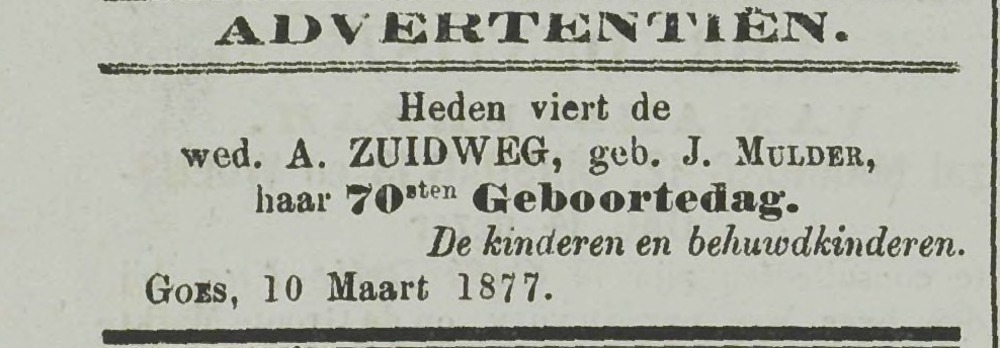
First, she found an advertisement for Johanna Mulder Zuijdweg’s 70th birthday! Johanna’s family must have been proud of her living to that age. Elly says it is customary in the Netherlands, even today for some people, to advertise 50th, 60th, 70th, etc. birthdays. It might mean that her family and friends had a small party for Johanna’s birthday.

Look at that ad. Very very interesting. It says ZUIDWEG. Not Zuijdweg. What is up with that? I thought the boundary between the two spellings was the Atlantic Ocean. But now I see this spelling used in the Netherlands! ***

Second, Elly noticed a “coincidence” when we saw the name Hogesteger in more than one place and she checked it out. I noticed it and just assumed (you know what they say about that word, right?) that it was a coincidence. But it’s no coincidence.

Adriaan Zuijdweg and his wife, Johanna Mulder Zuijdweg, wanted to emigrate to the United States in 1845. He might have been part of the group seceding from the Reformed Church. His wife’s brother, Johannes Mulder was married to Henderika Johanna Hogesteger. Johannes and Henderika emigrated to Holland, Michigan, in 1857 with their three children. But ten years before that, Henderika’s brother Johannes Hogesteger emigrated in 1847 for religious reasons. He actually was one of the leaders of the movement that seceded from the Reformed Church.

In fact, you can read here in Michigan History about how Johannes Hogesteger, a Mulder in-law, figured into the history of Michigan.

The city of Zeeland has a rich history of Christianity, beginning with the first settlers who emigrated from the Netherlands due to persecution from the State Church.

The First Reformed Church of Zeeland was formed before the city of Zeeland was founded; it was organized in the Netherlands before the 457 immigrants sailed to the United States. It is thought that this was the only other group of people besides the Pilgrims that immigrated to the U.S. as an organized church.

Reverend Cornelius Vander Meulen

Reverend Cornelius Vander Meulen

The first church service as a congregation was held three months after the arrival of the settlers, in the home of Jan Steketee. Many Sundays found the settlers worshipping outside, though in inclement weather they held services in one of the larger homes in the village. Rev. Vander Meulen was asked to be the pastor. Jannes Van de Luyster, who played an influential role in facilitating the immigration movement, was elected as elder, along with Johannes Hogesteger. Jan Steketee and Adrian Glerum were elected deacons.

In May 1848 the first church building was dedicated, but by the end of the year so many immigrants had arrived that it was necessary to build a new church. In 1849, the church recorded 175 families in the congregation.


What I get out of this is that my relatives were involved in the only other group besides the Pilgrims that moved an entire church to the United States. It seems that the Mulders (Johannes and Henderika) came ten years later than Henderika’s brother, but their 14-year-old son Karel arrived earlier. And Adriaan and Johanna never did make it to Michigan to join their fellow worshipers.

***

Info on Johanna from Zeeuw Archief

Birtday registers Zeewuws Archief


25.GOE-G-1845 Goes geboorteakten burgerlijke stand

Geboorteakte Johanna Maria Zuidweg, 10-05-1845
Soort akte:
Geboorteakte
Aktedatum:
10-05-1845
Aktenummer:
89
Geboortedatum:
10-05-1845
Geboorteplaats:
Goes
Kind:
Johanna Maria Zuidweg

Geslacht: Vrouwelijk
Vader:
Adriaan Zuidweg
Moeder:
Johanna Mulder
Gemeente:
Goes
Toegangsnummer:
25 Burgerlijke Stand Zeeland (1796) 1811-1980, (1796) 1811-1980
Inventarisnummer:
GOE-G-1845
Owner:
Zeeuws Archief


Death registers Zeeuws Archief


25.GOE-O-1847 Goes overlijdensakten burgerlijke stand
Overlijden Johanna Maria Zuidweg, 5-3-1847
Soort akte:
Overlijdensakte
Aktenummer:
74
Aktedatum:
1847
Gemeente:
Goes
Overlijdensdatum:
5-3-1847
Overlijdensplaats:
Goes
Overledene:
Johanna Maria Zuidweg

Geboorteplaats: Goes
Geslacht: Vrouwelijk
Leeftijd: 2 jaar
Vader:
Adriaan Zuidweg

Leeftijd: 42
Beroep: Kleermaker
Moeder:
Johanna Mulder

Leeftijd: 39
Beroep: Zonder
Toegangsnummer:
25 Burgerlijke Stand Zeeland (1796) 1811-1980, (1796) 1811-1980
Inventarisnummer:
GOE-O-1847
Owner:
Zeeuws Archief

Read Full Post »

My new friend (and Xth Mulder cousin) Elly sent me something she found in the Goes archives that I think is quite special.

Let me give a little context first. My grandfather, Adrian Zuidweg, was the son of Adriaan Zuijdweg who immigrated to the United States in 1893. Adriaan’s father and mother, Johannes and Jennie, also immigrated after their son–in 1901.

Johannes’ father was Adriaan Zuijdweg, 1805-1851. He only lived to be 46 years old.

I also want to “remind” you that both my maternal grandparents are descended from Carel Mulder, the jailer’s hand. So while Elly was researching the Mulders she came across information about not only a descendent of Carel in the form of Johanna, his daughter, but also her husband Adriaan Zuijdweg, my 3rd great-grandfather through my grandfather’s line.

Elly says:
I found a quote in the archives of Goes, that Adriaan Zuidweg (born in 1805 and married [to] Johanna Mulder, daughter of Carel Mulder) made a request at the town-councelors to make it possible ( to emigrate with his family –5 children) to the USA.
Apparently it was denied, because 6 years later he died in Goes.
 !!! He wanted to bring his branch of the family to the United States long before the family actually did come here!
Here is the text:
Landverhuizers
Als gevolg van de misoogst en armoede, maar ook vanwege de tegenwerking van de afgescheidenen van de Hervormde kerk, verlaten de zogenaamde ‘landverhuizers’ ons land en emigreren naar Amerika en Canada. Op de 26e juli 1845 verzoeken twee ingezetenen van de stad om in de gelegenheid gesteld te worden buiten hun kosten te vertrekken naar Noord Amerika omdat ze zich buiten staat bevinden hier in hun levensonderhoud te voorzien. Het betreft de ongehuwde 39-jarige Adriaan Johannes de Wolff, timmerman, metselaar en schilder, en de 40-jarige Adriaan Zuidweg, kleermaker, gehuwd en vijf kinderen.
Elly continues:
It was an article about emigration.
Translated it says:
Because of crop failure and poverty, but also because of the opposition against the members of the separated Reformed church , many people leave the Netherlands and emigrate to the US and Canada.
On 26 July 1845 two citizens of Goes made a request to be enabled to emigrate, with the costs of this emigration paid by the town, because they are not able to support their means of living in this town.
It concerns A.J.de Wolff ( 39 years old, not married), carpenter, bricklayer and painter, and Adriaan Zuidweg, tailor, married and 5 children.
Of course, my mind went off in many directions. I wondered if the family was very poor and if they were even hungry. I thought that Adriaan had absolutely no resources. That he had to essentially beg to leave. That he was denied that opportunity, which seems cruel, like imprisoning someone without food. That here was confirmation that Adriaan was a tailor as I had already learned.
Then it dawned on me that I didn’t know what “separated Reformed church” means. I had vaguely known that most of my Dutch ancestors were adherents to the Reformed religion (a branch of Calvinism), at least until they came to the United States. But what did this “separated” thing mean?
I tried to Google the information, but it got more and more confusing to me, so I asked Elly if she could help. She sent me some sources. A Google translation of a passage from http://encyclopedievanzeeland.nl/Emigratie_van_Afgescheidenen goes this way:

As the Pilgrim Fathers in 1620 as a community have migrated to America, so are also left the secessionists of South Beveland in the spring of 1847 and she settled in Michigan as a congregation.

Apparently for a short time in the mid-19th century, there were people seceding from the Reformed Church–and these people must have included my 3rd great-grandfather, Adriaan Zuijdweg. Apparently they were from Zeeland, and this was not a big “wave” all over the Netherlands.

According to Elly, this period lasted from approximately 1830-1850, and the people were not persecuted but did find a lot of opposition. The movement must have been very small and confined to the region because apparently it is not taught in history classes in the Netherlands.

According to Wikipedia:

During the early nineteenth century, large numbers of Dutch farmers, forced by high taxes and low wages, started immigrating to America. They mainly settled down in the Midwest, especially Michigan, Illinois and Iowa. In the 1840s, Calvinist immigrants desiring more religious freedom immigrated. West Michigan in particular has become associated with Dutch American culture, and the highly conservative influence Dutch Reformed Church, centering on the cities of Holland and (to a lesser extent)Grand Rapids.

Waves of Catholic Dutch emigrants, initially encouraged in the 1840s by Father Theodore J. Van den Broek, emigrated from southern Netherlands to form communities in Wisconsin, primarily to Little Chute, Hollandtown, and the outlying farming communities. Whole families and even neighborhoods left for America. Most of these early emigrants were from villages nearUden, including Zeeland, Boekel, Mill, Oploo and Gemert. By contrast, many Protestant agrarian emigrants to Michigan and Iowa were drawn from Groningen, Friesland, and Zeeland; areas known for their clay soils.[4]

The Dutch economy of the 1840s was stagnant and much of the motivation to emigrate was economic rather than political or religious. The emigrants were not poor, as the cost of passage, expenses and land purchase in America would have been substantial. They were not, however, affluent and many would have been risking most of their wealth on the chance of economic improvement. There were also political pressures at the time that favored mass emigrations of Catholics.[4][5][6] Yda Schreuder, Dutch Catholic Immigrant Settlement in Wisconsin, 1850-1905 (New York: Garland, 1989); and H. A. V. M. van Stekelenburg, Landverhuizing als regionaal verschijnsel: Van Noord-Brabant naar Noord-Amerika 1820-1880 (Tilburg: Stichting Zuidelijk Historisch Contact, 1991).

It’s true that many of my Dutch ancestors did come from Zeeland and perhaps one branch from Groningen, although one branch came from Zwolle. So was Adriaan really that poor or was he rather temporarily economically “flat” because of the worsening economy in his country? I’d say the latter.

I do feel bad that the family had this hardship and wonder how it affected the children, especially Johannes, Grandpa’s grandfather. Although his father Adriaan couldn’t get him to America, apparently his son Adriaan did so.

As an aside, when I was a kid I used to love the folk and fairy tales that featured tailors and shoemakers, so I find it charming when I hear that so many of my ancestors were tailors and shoemakers, as well as merchants.

Here’s another tangent. Why do the men have occupations like that so often, but the women are usually maids or servants? Is that because those were their jobs when they got married and then they generally quit work after getting married? Did the daughters of tailors and shoemakers become maids when they were old enough to work but still unmarried? Or did they remain maids throughout their lives? What did it mean to be a maid in Zeeland in the 1800s? And, most importantly, did they wear white pinafore aprons?

Elly and I both wonder what happened to Johanna after Adriaan’s death. I checked out my family tree to see what chronology I could see.

Johanna was 29 when she married Adriaan. Then she had four children in a row (Kornelis, Karel, Geertrui, Johannes). On 26 July, 1845, when Adriaan made his application for emigration, the children were 8, 7, 5, and 3. That’s quite a handful. Less than two years after the application, Johanna’s father, Carel Mulder, died. He is the one who got sick and his prison guard job was awarded to another son-in-law, NOT to Adriaan. Seven months after Carel’s death, Johanna gave birth to yet another child, Johanna. The sixth child, Willem, was born in 1849.

It’s no wonder that in 1869, when Johanna was 62 years old, she was working as a laborer in Goes. She must have had to go to work after Adriaan’s death, if not before. Did she work when she was pregnant? Who took care of her children? Her own father was undergoing his own problems before his death, so he couldn’t help her. First he was suspended from his job for insubordination, then he became ill and eventually passed away.

What of Adriaan’s parents? The other grandparents of the children . . . .   Adriaan’s father, a fish inspector, passed away in 1841, five years before the application to emigrate was made. His mother died in 1838 after seeing only one of her grandchildren by Adriaan born.

Where does some of this information about Adriaan and Johanna (Mulder) Zuijdweg come from? The Goes archives.  Elly says that this archives is linked to the archives in Zeeland.

Zeeuws Archief


Read Full Post »

I’ve mentioned before that my great-grandfather, Adrian Zuidweg, Sr. (Adriaan Zuijdweg) owned a fish market when Grandpa was young.  In this photo he stands with an unidentified young employee.

Fish Market on Eleanor Street

Fish Market on Eleanor Street

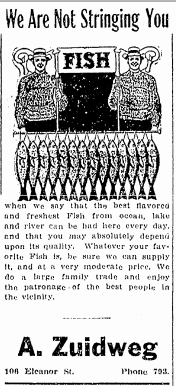
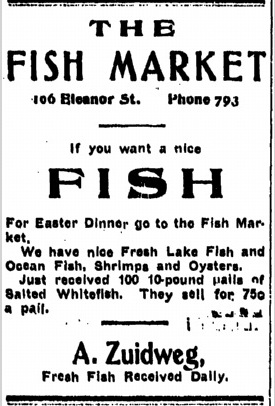
I found some ads he ran in the Kalamazoo Gazette on Genealogy Bank. This one is from September 16, 1910.

This is a pretty fancy ad for a little market like he had. Some of the time he did a more simple ad like this one at Easter time–April 6, 1904.

Most of his ads, like those of many small businesses at that time, were a mere sentence or two in the JOTTINGS. I underlined his little ad so you could find it easily amidst the other “jotted” notes. This one is from December 24, 1907. Note the date and the hours listed.

That means my great-grandfather not only worked Christmas Eve until 9PM, but Christmas Morning as well!

Read Full Post »
I recently found this photograph in a group of photos. Because of a clue on one of the other pix, I narrowed the date to between 1928 and 1931.

I know who the man is because he has a very distinctive look. This is my great-grandfather, born Adriaan Zuijdweg and called Adrian Zuidweg in the United States. I’ve written about him many times, but the best posts would be My Great-Grandfather Reinvented Himself as a Business Owner in the U.S. and My Grandfather’s Story, Part V and Back to the Dutch-American Newspaper.

Adrian died in 1929, according to my grandfather–of kidney disease. But I have not been able to find a death certificate or a grave. Maybe it’s because his name was mangled, but keeping that in mind, I still haven’t found him yet. It is so frustrating. Also, the newspapers from that year are not on Genealogy Bank. Nevertheless, I would put this photo at 1928 or 1929. Because other photos show him more fit than in his photo, I think he might have been ill (or close to it) by the time this photograph was taken.

But who are the women in this photo?

Adriaan Zuijdweg

Could the woman on the left be my Great-Grandmother Cora DeKorn Zuidweg? She looks a lot taller than he does, but maybe she was taller. I will post a known photo of her so you can compare.

Cora DeKorn at her father Richard DeKorn's cottage on Long Lake

Cora DeKorn at her father Richard DeKorn’s cottage on Long Lake

Similar hats, for sure! If that is Cora in the first photo, then she would have been about 53 years old. She herself passed away in 1932 from cancer.

Do you think that is Cora in the photo with Adrian?

Who is the shorter woman? Is this another photo of her?

The only child of Adrian and Cora was my grandfather. Cora’s only sister was Jennie–and this is not Jennie. However, she had two younger step-sisters, Marion and Marge Sootsman. They would have been in their 30s at this time. This woman does not look like one of them. She actually looks more like one of the Culver sisters, but we figured out that they moved to Seattle before this period.

The only thing is . . . there are a lot of photos of this woman. Was she a girlfriend of my grandfather?


Kinda looks like it. After a series of these photos, there is a series of him with my grandmother.

Do any family members know the answer to this mystery?


Read Full Post »

My grandfather’s father, Adriaan Zuijdweg (later called Adrian Zuidweg), was born in Goes, the Netherlands, on 3 January 1871. He was the oldest of three children. On 17 September 1872, Lucas was born. Then, on 23 December, 1873, Johanna Geertruida Maria was born. The children were barely a year apart in age. I find it interesting that their mother Jennie had a child every year for three years and then no more children. I wonder if she had a health problem after delivering Johanna.

Adriaan immigrated to the United States in 1893, but Johanna did not immigrate until 1904. She came to Kalamazoo, no doubt following her brother there. Lucas did not emigrate from Goes. Instead, on 4 April 1894, at the age of 21, he passed away. At the time of his death he was listed as a “laborer” in Goes; however, my grandfather’s story about his Uncle Lucas was different. Note that Lucas died not long after his older brother left the Netherlands.

Grandpa said that he was a sailor and, in a tragic accident, fell on the anchor of his ship and was killed.

It seems to me that Grandpa’s information has the stamp of authenticity, especially since Lucas did die at such a young age. But why was he listed as a laborer at the time of his death? Is that a term used for sailors? Maybe if he was hired as a sailor, but not part of the Navy?

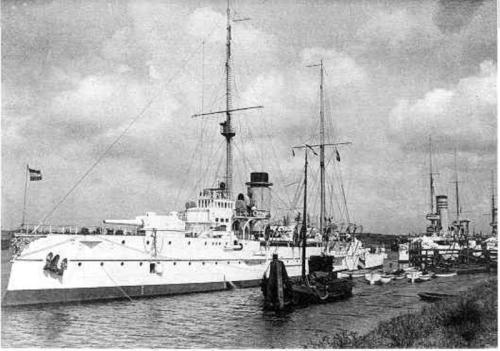
I found a website with a photograph of a Dutch “Coast Defence” ship. This photo might be a ship called Piet Hein in 1894, the year of Lucas’ death. Would a ship this big have an anchor that would have killed Lucas? Or would it have been a smaller boat? Click through to the website if you like.

Jacob van Heemskerck (1906)


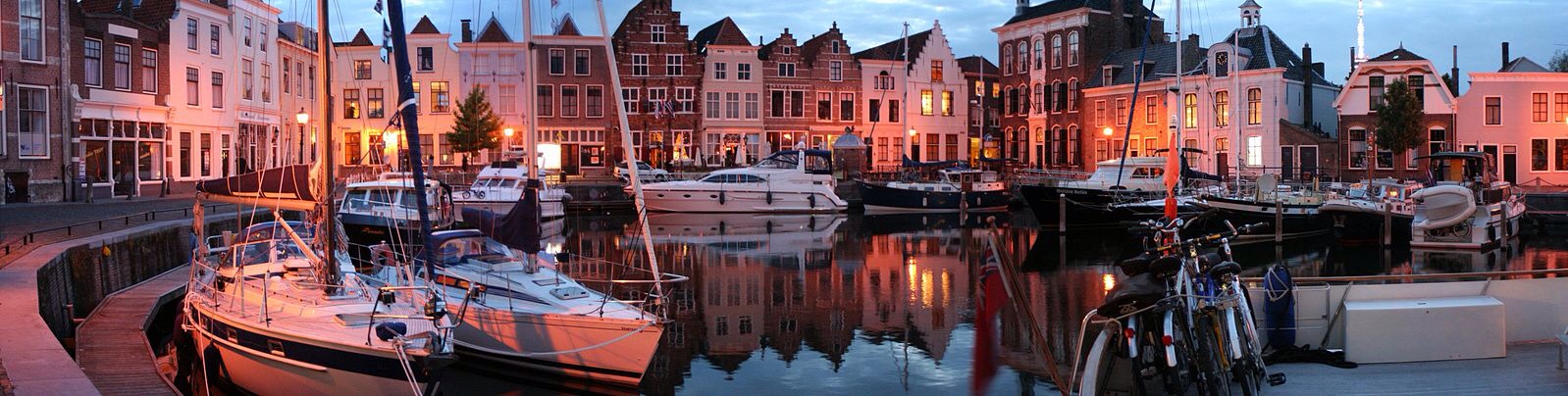
Hard to imagine a  ship this big in this harbor!! Photo of Goes harbor.

IMG_1390

Read Full Post »
I’ve traveled to California, Sedona, and Michigan in the past few weeks.  Needless to say, I am behind in my work even more than usual. I want to continue Theresa Pake’s story and to explore the Jennie DeKorn Culver photos more, but these projects take a good deal of time.

Instead, I decided to take a look at an old postcard postmarked 1911. The postcard is to Alice Leewenhoek, Richard DeKorn’s granddaughter through his daughter Jennie. Alice was an only child who lived with her mother Jennie and her father who Grandpa always called “Uncle Lou”–Lambertus Leewenhoek.

In the photo below, Alice is sitting with a friend, neighbor, or relative against the exterior wall of Richard DeKorn’s house. She holds a doll in her lap and is petting Tom or Carlo (if I had to guess, I would say it’s Tom).


Alice Leeuwenhoek with doll

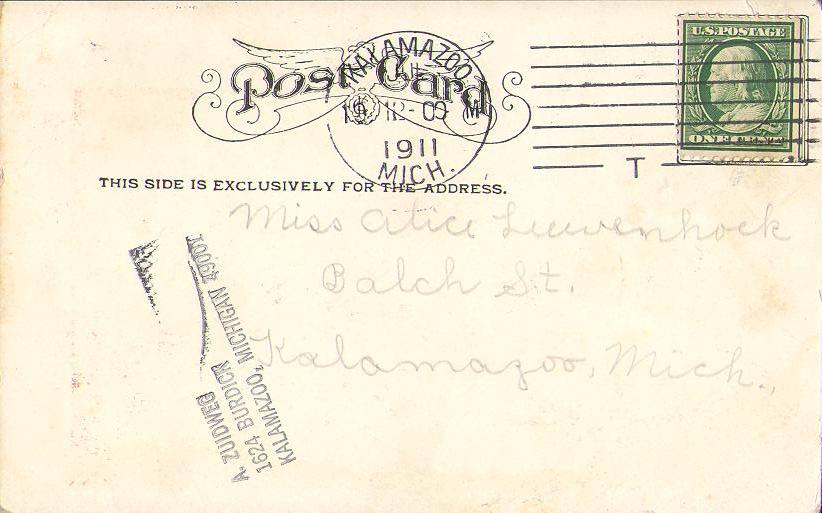
On this postcard, Nellie Bradt is thanking Alice for her “postal.” Nellie’s address is marked as 1130 S. Burdick Street.  The photograph is Bronson Park, which is the beautiful “town square” of Kalamazoo.

Bronson park front postcard


After seeing that the mailing address is listed as Balch St. and doesn’t include Alice’s street number (not uncommon for that time period in Kalamazoo), I went to my family tree on Ancestry and discovered that I had never found the Leewenhoek family on the 1910 census.  So I tried something different and looked for the 1910 census on Family Search. Bingo.  Instead of Lambertus Leewenhoek, I found Lamburtos Leenwenhock, at 110 Balch Street, Kalamazoo, Michigan. Uncle Lou was living with his wife Jennie and his daughter Alice who was 13 years old in that year–and therefore around 14 at the time of the postcard in 1911. New info: According to Uncle Don, they lived in the wooden house just behind the Richard DeKorn brick house.

Can you read anything more on the postmark besides the city, state, and year?  Is it December 9? Or does it say something else?

Bronson park back postcard


Grandpa and Alice were first cousins, their mothers were sisters.

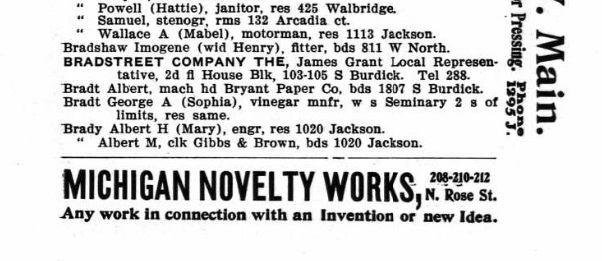
I haven’t been able to find Nellie Bradt in the 1910 census, but I did find her in an 1899 city directory. I then found her parents in a 1905 directory. I think I can find them more years, too. But I don’t understand how to read these entries. The 1899 entries are entirely different from the 1905, but neither one really gives me the address.

Here is the 1899 that lists Nellie with her parents, Mr. and Mrs. George A. Bradt. I understand they lived in the City of Kalamazoo. And I know “a” means acreage, but not how to interpret what any of this means or how it connects with an address.

Nellie Bradt 1899 city directory


Here is the 1905 directory entry. Nellie isn’t mentioned, but her parents are. What in the world does it mean?

Nellie Bradt's parents 1905 city directory

Is there a way to search for Nellie in the 1910 census using the 1130 S. Burdick Street address she gives? Can I search the census by address?

Note that many of my relatives lived in this Burdick/Balch neighborhood. When I look at the census records from late 19th and early 20th century, I see that almost everyone, if not everyone, who lived there was Dutch.

My grandfather’s gas station was at the corner of Burdick and Balch, across the street from the Richard DeKorn house. Grandpa lived in that house for part of his childhood, with his parents and grandfather, Richard. When he built his house down the block on Burdick, he was staying in the same general area his family had lived in for decades. He continued to work at his station and live in his house until he retired and moved to Portage.

I remember as a child meeting Mrs. Bradt Braat who lived next door to the gas station. The name is pronounced, by the way, like the sausages that go with beer. I wonder if she was related to the Nellie Bradt who wrote this postcard. Mom? Uncle Don? New info: no, she must not be as they were a Belgian family (see comments below).

Alice Leewenhoek was my grandfather’s cousin. Note that the postcard is stamped with the name and address of Grandpa’s father, A. Zuidweg. I wonder why?

One postcard. So many questions!

Read Full Post »

« Newer Posts - Older Posts »