Feeds:
Posts
Comments

Posts Tagged ‘Zuidweg surname’

I remember my grandfather wearing his Sunoco “uniform” and his Sunday sportcoat, but I never thought of him as at the height of fashion. At least not in his attire.

But take a look at him as a 22 year old in 1930!

At first I saw his sport coat, sweater, shirt, fancy belt, and plaid pants as a spiffy outfit, but didn’t stop to think: why is he wearing bloomers? haha

Well, he’s wearing knickers (no, I don’t mean those kind of knickers), which are short for knickerbockers. Copied from this website:

Knickerbockers, later shortened to knickers, were popular sports wear for wealthy gentleman. Knickers were baggy pants that fit low on the natural waist and tight below the knee, ballooning out around the thighs. For upper class gentlemen wearing white or light striped knickers in summer with a matching Norfolk jacket was the look of the teens and early 1920’s.

Grandpa is not wearing a Norfolk jacket, but one that does look a little preppy over that sweater and shirt collar.


Plaid Plus Fours

Variations of knickers included plus-fours, plus- sixes, plus-eights and plus-tens. The plus is how many inches below the knee they hung. Plus fours came in tweeds, linen, corduroy, and flannel. Many were solid colors but to be really trendy men wore stripes, checks, and plaid patterns.  They were already on trend when the prince of wales went on tour in American wearing plus fours. His approval meant any man NOT wearing plus fours was out of  fashion.

Notice that “to be really trendy men wore stripes, checks, and plaid patterns.” That’s Grandpa–“really trendy”!

Knickers were worn for more than just sports and casual entertainment. They were common among both fashion forward industries such as the movies, but also among working classes who found the sturdier material knickers quite useful on the farm, for making deliveries, and for some factory work. The short legs and light weight clothes made them cool to wear in summer.

Not sure what beach this photo was taken at, but his outfit is sporty for the time period, as befitting a walk on the beach. By today’s standards, he’s a little over-dressed!


Read Full Post »

Alice Leeuwenhoek received a postcard wishing her a Joyous Thanksgiving (and a Cordial one) in 1911.

The card was postmarked November 29 because the holiday fell on November 30 in 1911. If this seems late, Thanksgiving didn’t fall on the fourth Thursday of the month until 1941 when FDR changed it.

This card was sent by Alice’s cousin’s Elizabeth. Who in the world was her cousin Elizabeth?

Alice’s mother, Jennie DeKorn, had 2 siblings: her sister Cora had only my grandfather who was 3 in 1911. Her brother wasn’t even married yet and his children weren’t born until the 20s. So what about the Leeuwenhoeks? The only one I know that came to this country (and would have written in English and MAILED A CARD FROM KALAMAZOO) was Gerrit who died single at the age of 21 in the Spanish-American War.

Elizabeth appears to be young–by her handwriting, her slang (kinda), and the general sloppiness of the writing.

Since Alice lived in Kalamazoo and the card was postmarked Kalamazoo, it is also curious why Elizabeth said she wished Alice would “come down sometime.” It’s possible that she just lived on the other side of town since that can seem an enormous distance to children who can’t travel that far by themselves. Alice was 14 in 1911.

Could Elizabeth be a friend?

More mysteries.

What is not a mystery is that I wish you all a blessed Thanksgiving.


Read Full Post »

In the 1970s, Grandpa identified some of the old photographs as members of the Ebelink family–from Kalamazoo, of course. He didn’t mention just who they were, but I wrote down the names on the back of the photos. I’ve labelled the photos as my grandfather told them to me and corrected them if I found an error.

Anna Ebelink Fisher Fletcher 1891

Ann Ebelink Myers

John Ebelink: 1891

The father (Benjamin Ebelink) and stepmother (Van de Giessen) of John Ebelink

So who were these people? According to the 1880 census, Benjamin and Wilhelmina, both born in Holland (the Netherlands), had three children: Frederich (age 6), John (age 5), and Joanna (age 2).  Since there is no existing 1890 census for Michigan, I had to skip ahead to 1900, where I found John married for four years to Jennie, with one child, Wilhelmina, age 3. A quick search for the death of John’s father Benjamin and I find the year 1916 in Ottawa, Michigan. He was a widower, so he must have already buried at least two wives.

But who were Anna and Ann? I can see Joanna being one of them. Are these two different sisters? And were they really married to Fisher and Myers?

It appears Anna married a Fletcher, not a Fisher. Could have been Grandpa’s memory–or my hearing.

Name: Anna Ebelink
Gender: Female
Race: White
Birth Year: abt 1878
Birth Place: Kalamazoo, Michigan
Marriage Date: 12 Jul 1900
Marriage Place: Kalamazoo, Kalamazoo, Michigan, USA
Age: 22
Residence Place: Kalamazoo, Michigan
Father: Barend Ebelink
Mother: Wilhelmina Stroup
Spouse: Claude H Fletcher
Record Number: 5305
Film: 68
Film Description: 1900 Delta – 1900 Mackinac

Benjamin was also Barend, a Dutch male given name, and it looks like John and Anna’s mother’s maiden name was Stroup. A bit curious about Anna’s photo is she appears to be in mourning, doesn’t she? I wonder when their mother died.

I can’t find Ann Ebelink Myers. Was she Anna or a different child?

I didn’t want to go too far down this tangent without knowing how these people are connected to my family. I found it by looking at the 1940 census. John and his family lived on Balch Street, right near my family. I would think that my mother and uncle must have known the family.

Read Full Post »

Maureen Taylor, photo detective, helped me with a couple of photos a few years ago. The other day I bought her book, Family Photo Detective.

The book gives a good overview of many topics associated with identifying old family photographs. I haven’t read it all yet, but I did read certain sections because of various questions I already have in my mind.

In my post Mysterious Antique Photographs I posted a painted metal photograph which is unidentified. I believe it is from the Remine family. Although it can seem that the Remines are very distantly related, in fact, Richard DeKorn’s mother was a Remine:


Johanna Remijinse

1817–1864

BIRTH 15 JUL 1817 Kapelle, Zeeland, Netherlands

DEATH 1864 Kalamazoo City, Kalamazoo, Michigan

* my 3rd great-grandmother *

The consensus seems to be that the photo below (of an unidentified Remine female) is a tintype.


However, according to Taylor, a painted photo like this would be a daguerreotype which is painted on its metal surface with colored powders which are brushed or gently blown.

One of the characteristics of a daguerreotype over a tintype is that the image needs to be viewed from an angle. Another important characteristic is a mirror-like surface. I had to pull out the original to examine it for these traits.

It’s impossible to tell if the image needs to be viewed from an angle because the image is so thoroughly painted. But the background is not mirror-like, but rather a matte dark gray with a slight texture.

I went to the internet about this mystery and discovered a site that showcases some hand-painted tintypes. Unfortunately, after 45 years, The Ames Gallery in Berkeley is closing this year. I wonder what will happen to their photographs. Click the name of the gallery to see the painted tintypes.

I think we were right that this is a tintype that has been painted. In fact, the painting is so well done that her face is very realistic. Years ago, I used to work with gold leaf, embossing leather and vinyl products, and I suspect that the jewelry has been painted with gold-leaf.

It’s frustrating that I have not had the time to work on the photos and genealogy for many months (for the most part), but I like to keep moving along, getting one little thing after another accomplished so I don’t lose my touch haha.

Without a doubt, this is the most beautiful photograph in the whole collection.


Read Full Post »

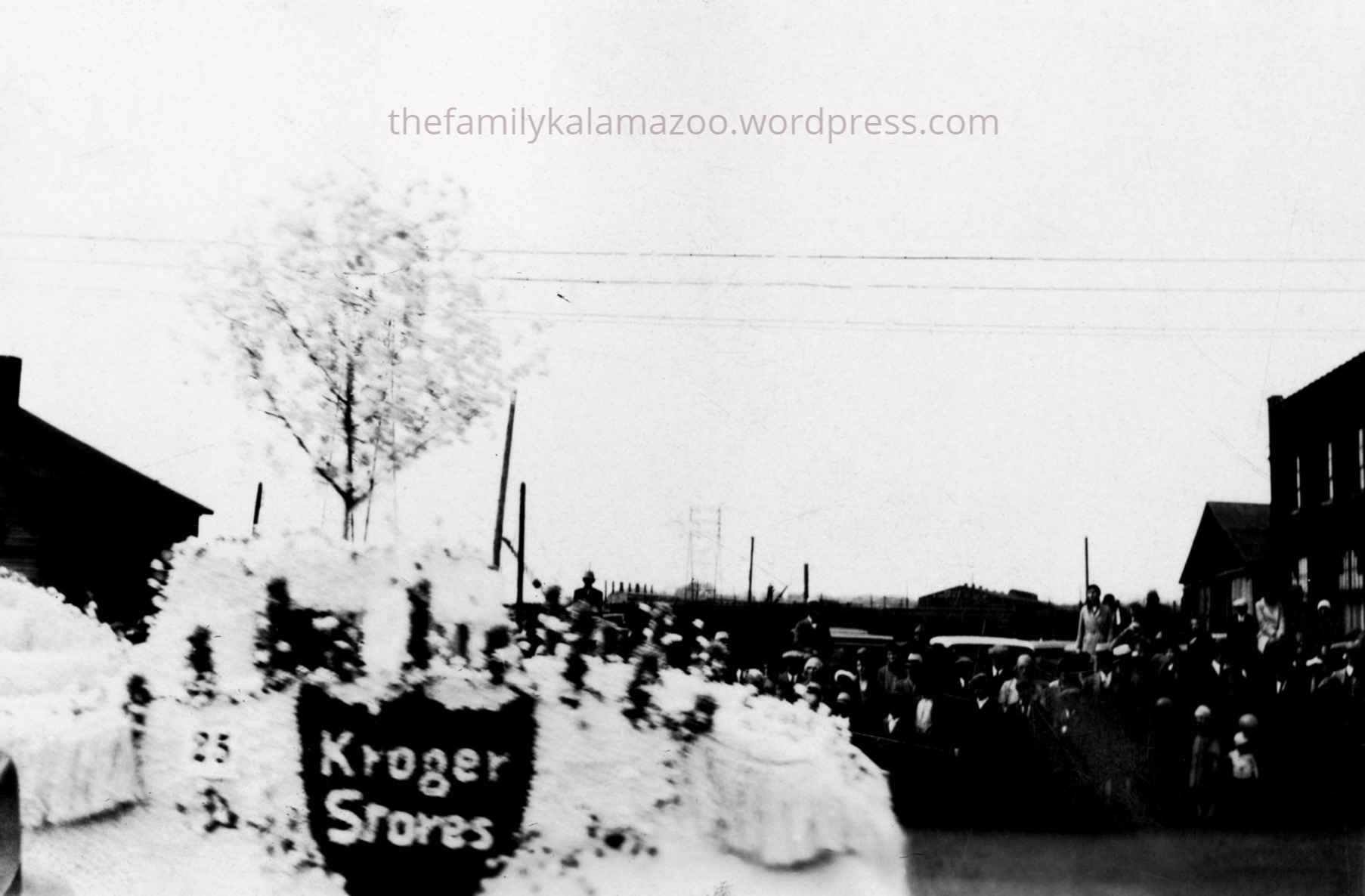
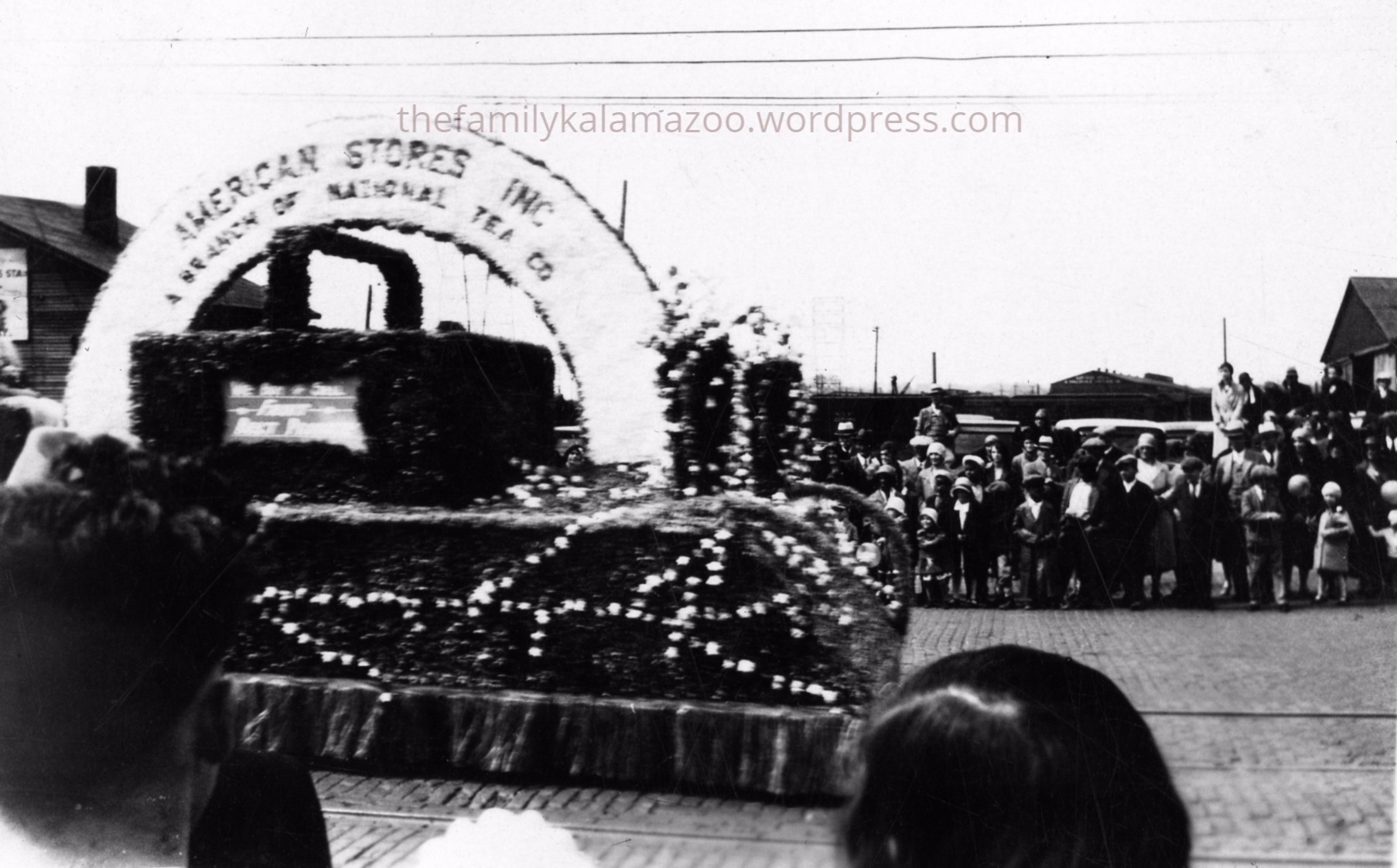
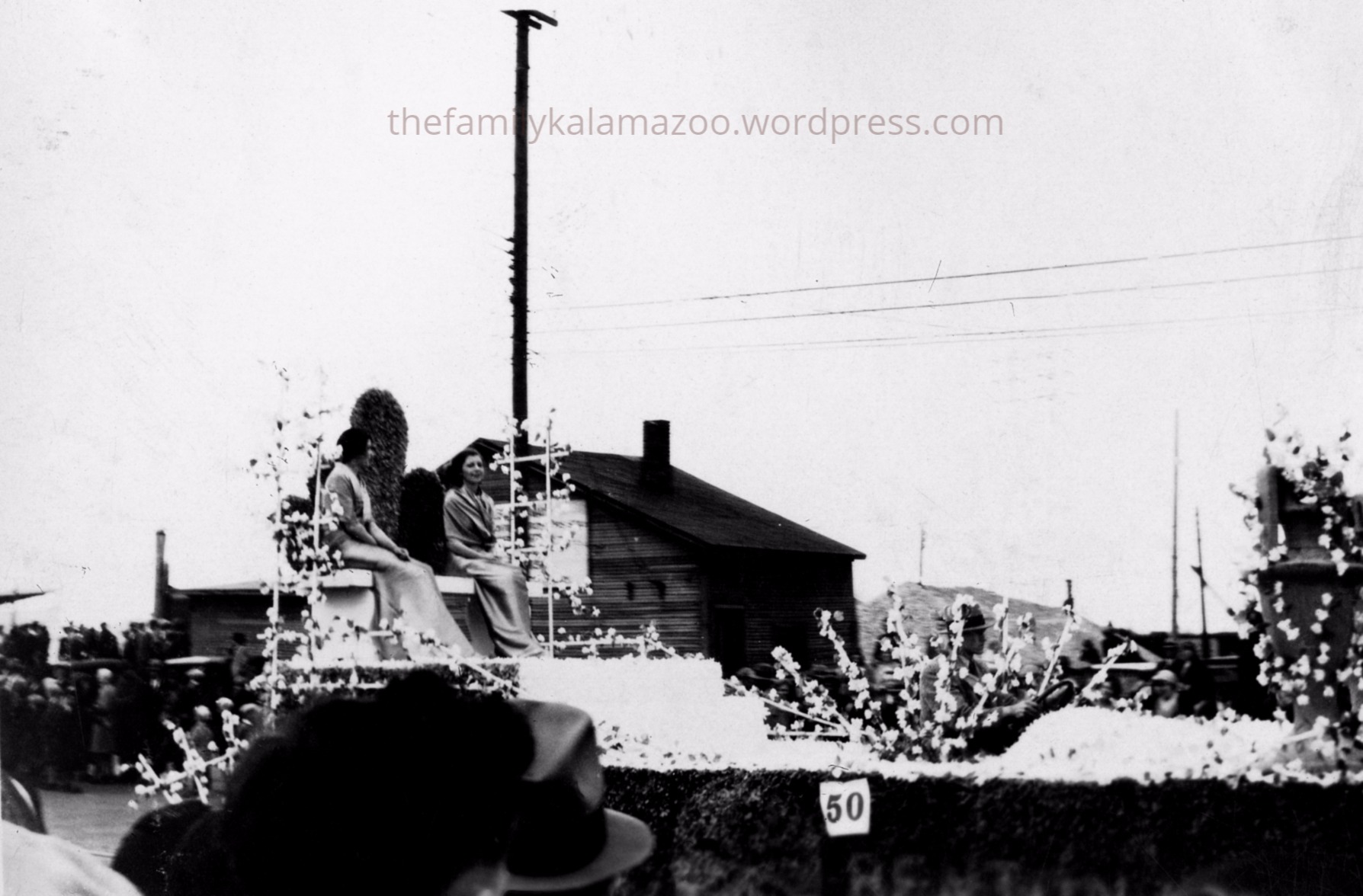
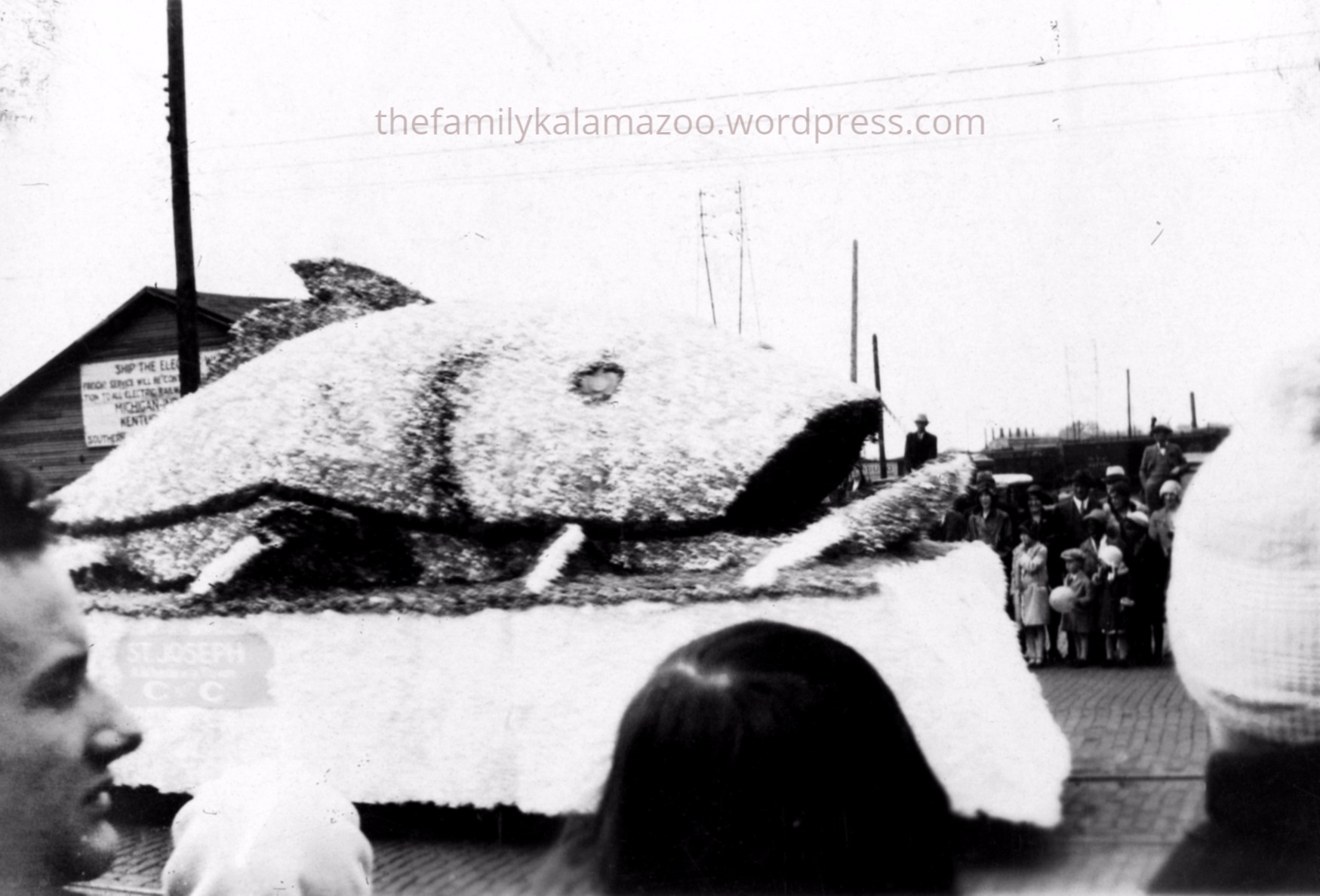
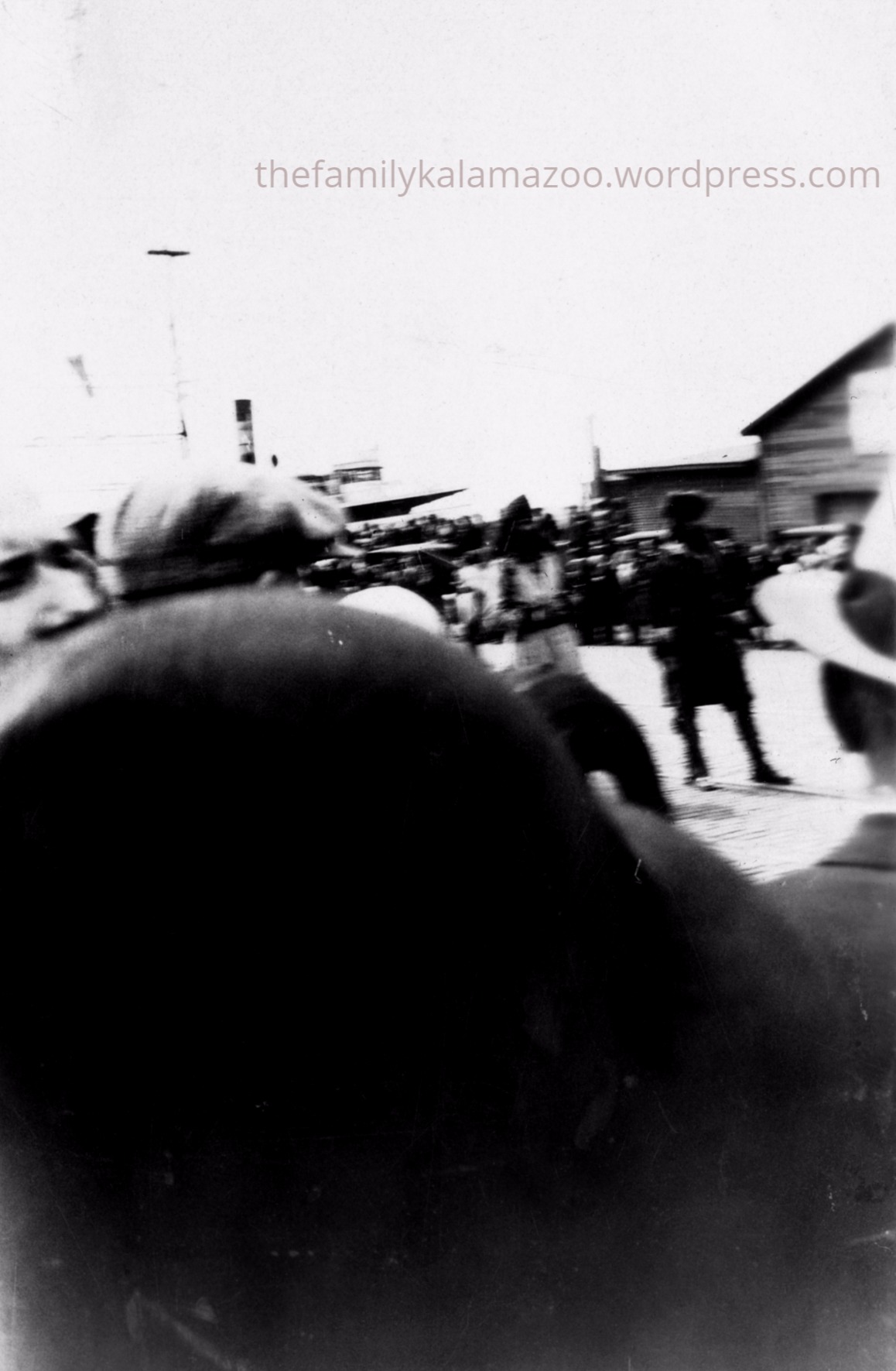
My grandfather, Adrian Zuidweg, had an album of photos which included those from a parade in 1931. It seems most likely that the parade took place in Kalamazoo, Michigan–probably down Burdick Street. But I need help identifying the buildings to know for sure. Many of the business names that are readable seem pretty “generic.” These names include Montgomery Ward, Ross Carrier, Kroger Stores, and Grand Hotel.

I know the date because of this float, but I don’t understand the significance of the “centennial” aspect of the design.

The Light float is the last photograph in the album. Here are the others in order of placement. If you can find any signs that this is Kalamazoo–or elsewhere–please let me know.


It seems odd that there aren’t any clues in these photos that indicate the “local” setting of the parade. There are quite a few ladies of the court. Kalamazoo is home to Western Michigan University and Kalamazoo College, but I don’t see any references to the schools, so maybe a check of 1930-31 and a 1931-32 yearbooks would rule out the colleges as participants in the parade.

A clue that I can’t interpret: Benton Harbor Exchange. This does seem to indicate that the parade was in Michigan, but was it in Benton Harbor or St. Joseph or Kalamazoo? And what exactly was the Benton Harbor Exchange?

Another possible clue: see that tall building in the background of the “downtown” photos? If that building can be identified it might help to lock in the city.

Just before the parade photos is one photo of Grandpa with Grandma when they were boyfriend and girlfriend–before they got married in 1932. Sorry about the watermark in the wrong place. I added watermarks en masse for these photos.

Read Full Post »

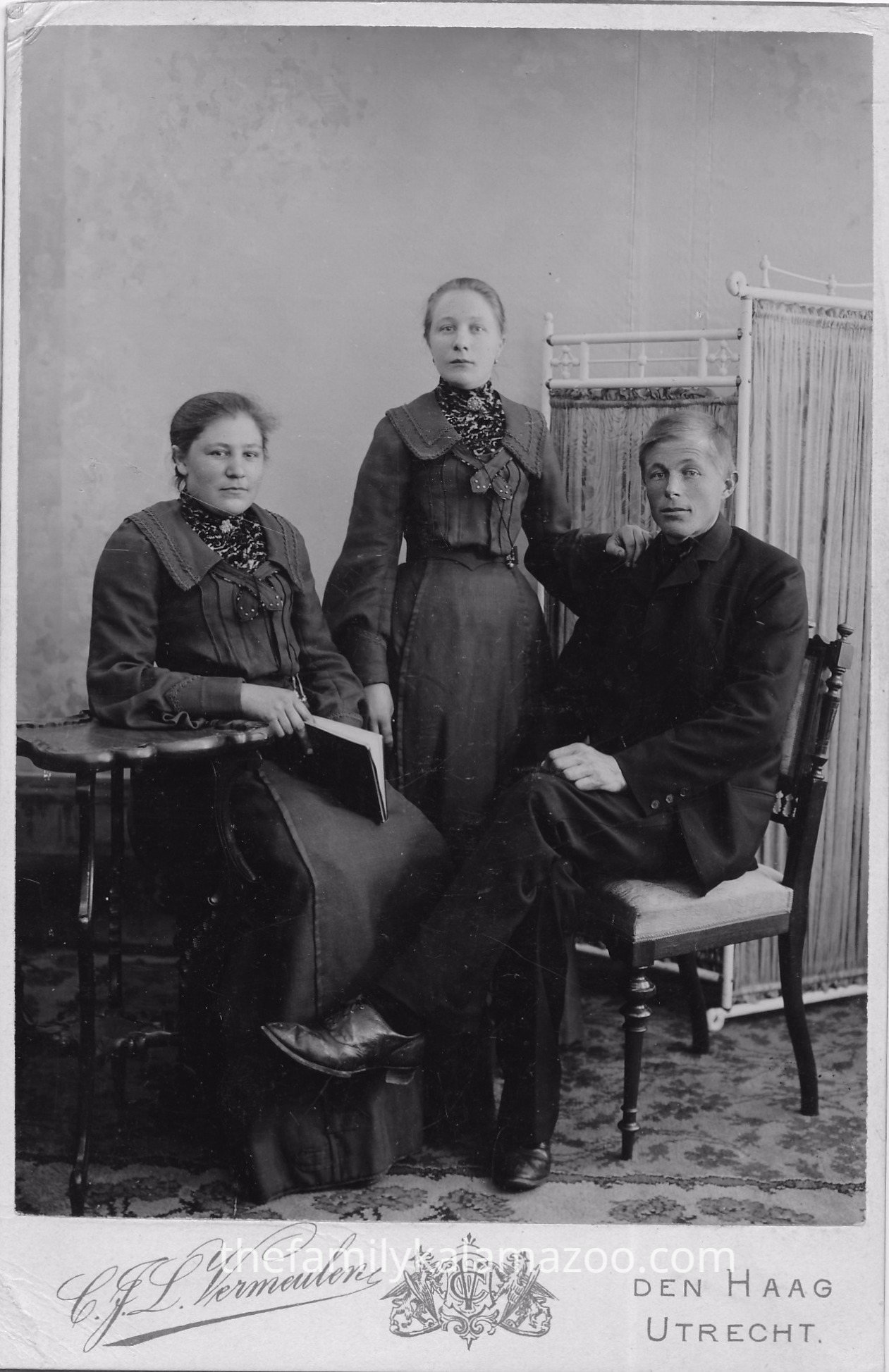
Last year I posted two unidentified photographs that I wished to identify. The photographer was based in the Dutch towns of Utrecht and Den Haag (The Hague).  Both photographs seemed to have the same props, so it was likely that they were taken around the same time at the same photography studio.

But they sure looked different. One looked as if the subject could have lived three hundred years ago. The other looked more turn-of-the-century.

Thanks to a Dutch reader, Hubert Theuns, I learned much information about the photos. In particular, he discovered that the older style outfit was the traditional costume of Cadzand, a small town in the Dutch province of Zeeland. In 2007 Cadzand had about 800 inhabitants. He told me that the photographer, Cornelis Johannes Lodewicus Vermeulen, was born in Utrecht 18.11.1861 and died in Hilversum 05.01.1936. Photographs from the period 1886-1915 can be found athttps://rkd.nl/nl/explore/portraits#query=cjl+vermeulen&start=0&filters%5Bcollectienaam%5D%5B%5D=RKD%20%28Collectie%20Iconografisch%20Bureau%29

Here are the two photos–first the more “modern” looking one and then the “traditional costume” photo.


Look at this amazing costume. It looks so Puritan to me.


Here are the backs of the photos:


Note that they both have the 3 digit telephone numbers. According to the research of Hubert Theuns:

The telephone was introduced at The Hague on July 1, 1883, and at Utrecht in February 1883. There used to be local telephone directories, but I have not (yet) found any on the internet. National telephone directories were published as from 1901. The collection of national telephone directories from 1901 till 1950 are being digitalised by the dutch national library, but unfortunately this process has found delays. Only the national directory of 1915 is available on the internet, and shows that the photographer in 1915 in Utrecht had the same three digit number as mentioned on the photograph, but that his number in The Hague already had four digits.

Hubert narrowed down the time period to pre WWI.

Now he has been able to get these photos published in a newsletter of the city of Goes, as well as its website! Check it out: IDENTIFY THESE PHOTOS.

Eventually these photos WILL be identified!  I am so grateful to Hubert. He is a reminder that genealogy is a collaboration of many people. It’s not a a selfish interest.
Thank you to everyone who has helped me with my research! I think of you all with fondness!

Read Full Post »

More tintypes! In Mysterious Antique Photographs I shared a beautiful tintype that I own.

Yesterday I opened the box of unscanned Remine photos. I haven’t had time to scan so many photos–or to organize either–but I thought I should just start doing a few a day because when WILL I ever have the time?

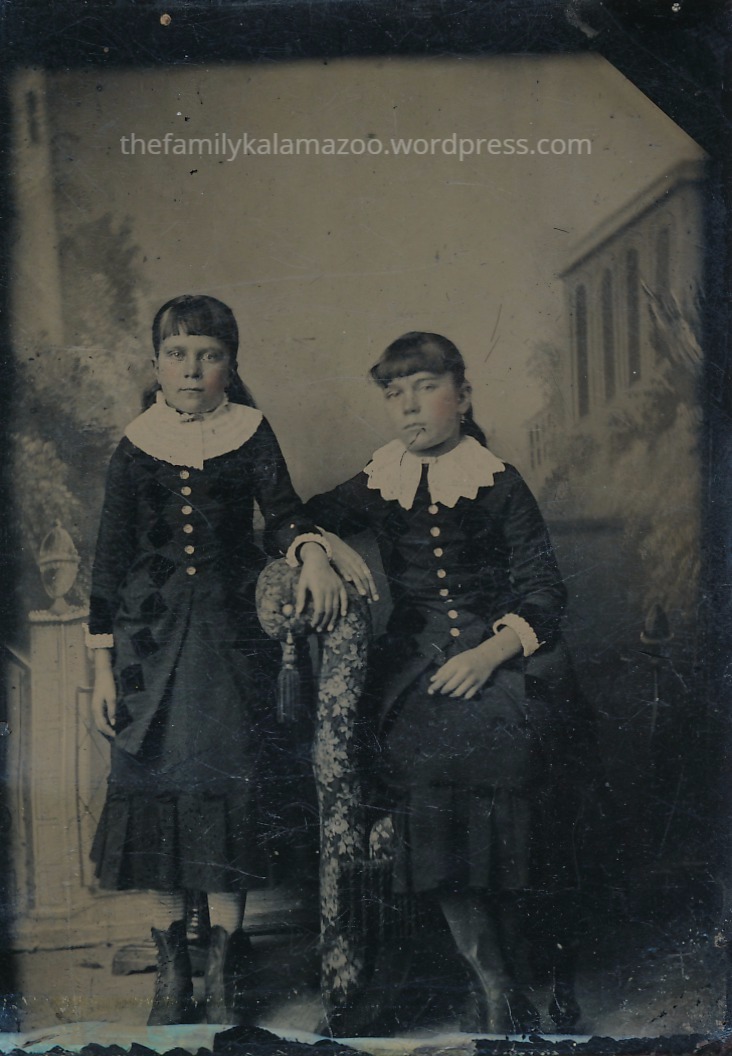
And I discovered these beautiful tiny tintypes. The one on the other post is large and painted. These are only 2.25 x 3.5 inches in size–and unpainted.

Because they are in the Remine box I can guess they might be Remines. Judging by the faces, I am ready to conclude they probably are Remines.

Because these girls and women were photographed full length (standing and seated), we can examine their entire outfits to try to guess a time period.

Therese was born in 1891. Could this photo be from around 1900?

I am having trouble identifying the correct information about Therese’s sisters. When I figure it out, this might help in identifying this tintype. For instance, if there were sisters born in 1880 and 1881 as might have been, this photo could, I suppose, be those sisters. If so, one of them is Genevieve Remine Tazelaar and the tintypes would be in the early 1890s.

I suppose the hair and collars could be 1900. But what about the fitted jackets with all the buttons? I can’t find anything like that in photos of 1900. Odd, too, that it would be a tintype if it was as late as 1900.

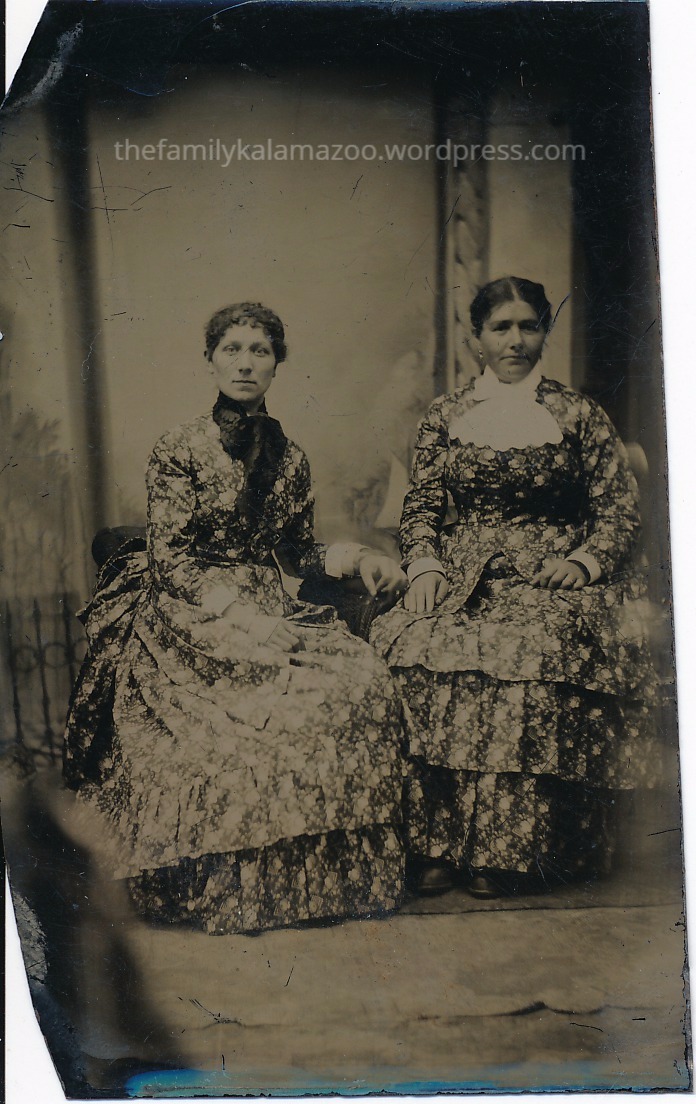
Here is the other tintype. I’m sorry it’s kind of crooked and uneven. It was difficult to scan it.

What about these outfits? They are not leg o’mutton sleeves, so does that rule out the 1890s?

I guess I am not very good at taking the nuances of change in fashion and extrapolating to what my relatives would have worn (generally a much more conservative version of the fashion).

The woman on our left looks a lot like Mary Paak Remine, Therese’s mother. She was born in 1859. But the woman doesn’t look terribly young in this photo. And then who would the other woman be? She looks NOTHING like the Paak sisters. She is not Mary’s mother because Jacoba Bassa had passed away long before this.

Were these photos taken in the Netherlands or the United States? The Remines were from Kapelle and the Paaks were from Lexmond. Notice the wallpaper/painted background. I’m pretty sure that these photos were taken in the same studio, perhaps near the same time period.

I’m afraid I have more questions now than I did before.


Read Full Post »

One of the branches of my family from the Netherlands was the Reminse branch.

On 26 August 1810, my 4th great-grandfather, Dirk Reminse, a bread baker, married Adriana Kriger (Krijger) in Kapelle, Zeeland, the Netherlands. Dirk was born 22 November 1786 in Kruiningen, Zeeland, Netherlands. At some point before his marriage he must have relocated to Kapelle, but Adriana also came from a different town. She was born 11 June 1787 in Biggekerke, Zeeland, Netherlands.

Houses on the Kerkplein (church square), Kapelle, Netherlands

The couple had the following children:
Gillis Remijinse 1811–1868

Jan Remijinse 1813–1837

Hendrika Remijinse 1814–1893

Johanna Remijinse 1817–1864

Johannis Remijinse 1819–1846

Adriaan Remijinse 1821–1849

Pieter Remijinse 1822–1830

Frans Remijinse 1823–1860

Gerard Remynse 1825–1910

Marinus Remijinse 1826–1863

Note the difference in the spelling of the surname. It is seen both ways. In this country it became REMINE.

Their daughter Johanna was born 15 July 1817 in Kapelle. She married Boudewijn DeKorne 21 May 1847 in Kapelle. Boudewijn had been born in Kapelle on 11 June 1816.

The couple had one daughter who died as an infant, then a son Richard and daughter Maria were born. Richard, my great-great grandfather, would end up being a well-known brick mason and contractor in Kalamazoo, Michigan, but first the family had to immigrate to the United States.

Johanna’s parents had both died. Dirk died 9 September 1840 in Kapelle. On 14 April 1845, Adriana passed away.

Boudewijn and Johanna arrived in this country in 1856 and first settled in Zeeland, Michigan. The following year their 4th and last child, Jennie was born. Jennie eventually became Jennie Culver who divorced her husband and moved to Seattle with her two teen daughters. I have posted about the magnificent photo album that belonged to one of Jennie’s daughters that a blog reader mailed to me.

Johanna Remijinse DeKorne was my last direct ancestor in the Remine line, although my grandfather stayed close to the family that continued that surname in Michigan.

I found a photograph of this branch of the family in the Netherlands. The photograph is not marked with a photography studio or any other identifying information. Someone, possibly my grandmother, wrote on the back “Remine family in Holland.” In order to figure out who is in the photograph I would need to know the approximate date of the photo. Since Johanna immigrated in 1857, this must be from a line of the family that ran parallel to her line. Would it be the family of one of her siblings?

I went back and examined the other Remine cousins in the United States. They stem from Johanna’s brother Gerard.  He seems to have immigrated to the United States between 1855 and 1857. Maybe he and his family even came over with his sister and hers? NOTE TO SELF: CHECK INTO THIS.

Why did the families remain close? Johanna’s son Richard’s wife Alice’s sister Mary married Richard Remine, son of Johanna’s brother Gerard! What does that make them? First cousin’s by marriage?

So the photo can’t be of Gerard’s family. That leaves eight other siblings to check into. And the children of all these siblings . . . . NOTE TO SELF: MORE WORK NEEDED HERE

CAN YOU GUESS A TIME PERIOD FOR THIS PHOTO?


Read Full Post »

In my stack of anonymous family photos, I have two that are different from the others.

In the first one, the image is imprinted on metal and then painted with colored paint.


In the other, a couple appear to be drawn, rather than photographed.


It’s likely that the photographs came from Grandpa’s family: Paak, DeKorn, Zuidweg, Remine, Bomhoff, or his other branches. Or they could be friends or neighbors.

UPDATE: My daughter thinks the tintype woman looks like Grandma in the eyes and mouth. “Grandma” would be my mother, Grandpa’s daughter.

Any thoughts on type of photographs or on dating of these images?

Read Full Post »

One of the wonderful benefits of blogging about family history and genealogy is learning from my fellow bloggers. Last week I read a post by Amberly, The Genealogy Girl, about a site called Genealogy Gophers. I’d never heard of it, but she made it sound easy (and free), so I hopped over to the site and entered (somewhat randomly) one of my family surnames in the search form.

“Zuidweg” brought up several entries because I hadn’t narrowed down to time or place. This isn’t surprising because my Dutch cousin Elly thinks that Zuidweg might be a fairly common name, especially in Zeeland.

Before I could search the entries  individually, one popped up, clamoring for attention. It was one of those rare finds that I probably could have never found without this source.

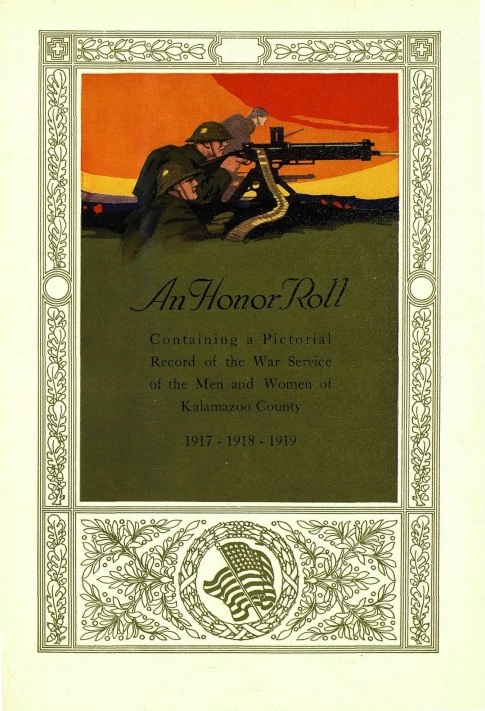
An Honor Roll

Containing a Pictorial

Record of the War Service

of the Men and Women of

Kalamazoo County

1917-1918-1919

The entry in this book mentions my great-great-grandmother Jennie Zuidweg. Born Jennegien Bomhoff on 5 March 1838 in Zwolle, Overjissel, Netherlands, Jennie married Johannes Zuidweg in 1869, at age 31. She was a maid at that time and both her parents had already passed away. They had 3 children, but Lucas passed away at age 21. In 1901, Jennie and Johannes immigrated to the United states. She was sixty-three years old. She was older than I am. I can’t imagine uprooting my life at that age and moving so far away that I would never be able to return to the country I’d lived in all those years.

Johannes died in 1911, when Jennie was 73. She lived on, a widow, until her death in Kalamazoo, Michigan, on 16 December 1924 at the age of 86. My grandfather was the only child of her remaining son, Adriaan. He was 16 when his grandmother died. She had many grandchildren through her daughter Johanna VanLiere.

Between the death of Johannes and her own death, WWI occurred. So what was Jennie doing with her time when she was 80 years old?

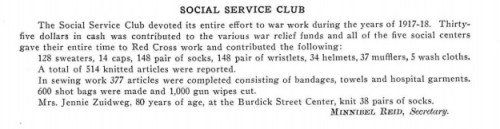
According to this honor roll she had some remarkable knitting skills.

Jennie Zuidweg knit 38 pairs of socks 1917-1918

The Social Service Club had five centers in Kalamazoo. During 1917-1918 women who volunteered for these centers contributed a total of:

128 sweaters

14 caps

148 pair of socks

148 pair of wristlets

34 helmets

37 mufflers

5 wash cloths

Kalamazoo Country contributed a total of 514 knitted articles, 377 sewn articles, as well as 600 shot bags and 1,000 gun wipes.

The only volunteer singled out here is Mrs. Jennie Zuidweg, 80 years of age, at the Burdick Street Center, (who) knit 38 pairs of socks.

I used to knit when I was a kid, and socks sound like a lot of boring work to me. That is true dedication.

Read Full Post »

« Newer Posts - Older Posts »