Feeds:
Posts
Comments

Posts Tagged ‘Mulder’

Looking through my computer files (such a mess!), I found an old Word document I thought I’d share with you.

When my daughter was 10 she wanted to be a paperdoll centerfold for American Girl magazine. One of the requirements was to interview female living relatives about their childhoods. Her oldest female relative that we knew of (my daughter was adopted) was her great-grandmother, Lucille Edna Mulder (Zuidweg), who was born April 17, 1912. She passed away in 2000, just two years after my daughter interviewed her.

Here are the interview results.

Edna Mulder never wanted to be called Lucille, especially by her older sister, Dorothy, or her younger sister, Alvena.  They were called Dot and Vena, so she wanted to be called Edna.   Edna also had two younger brothers, Peter and Charles.  Her parents owned a farm in Caledonia, Michigan.  Her father came from a Dutch-American family and her mother from a German-American family.
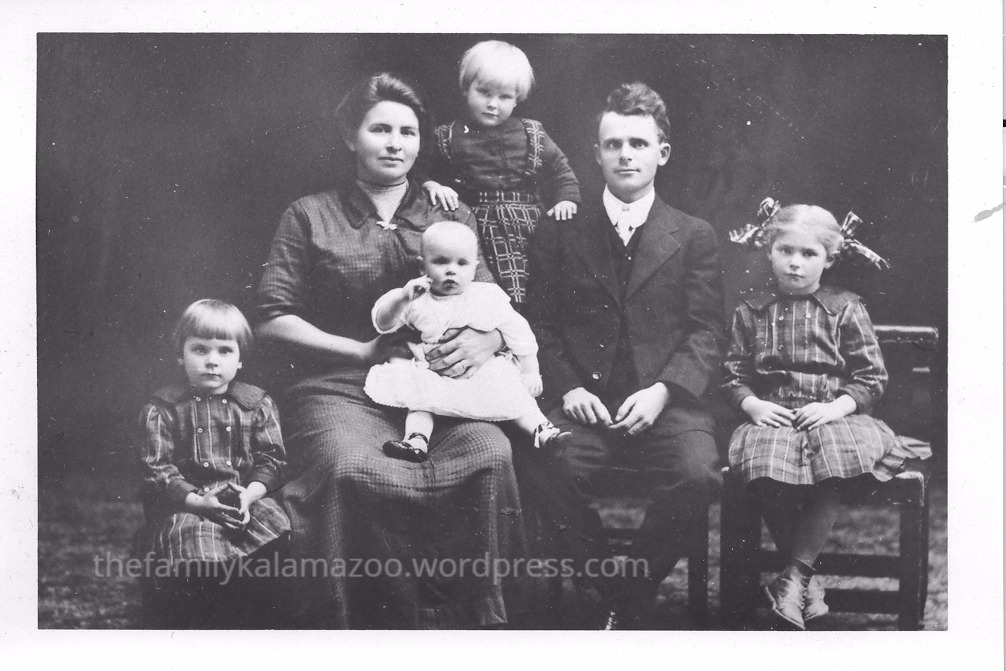
 

Edna, Clara (holding Pete), Vena, Charles, and Dot

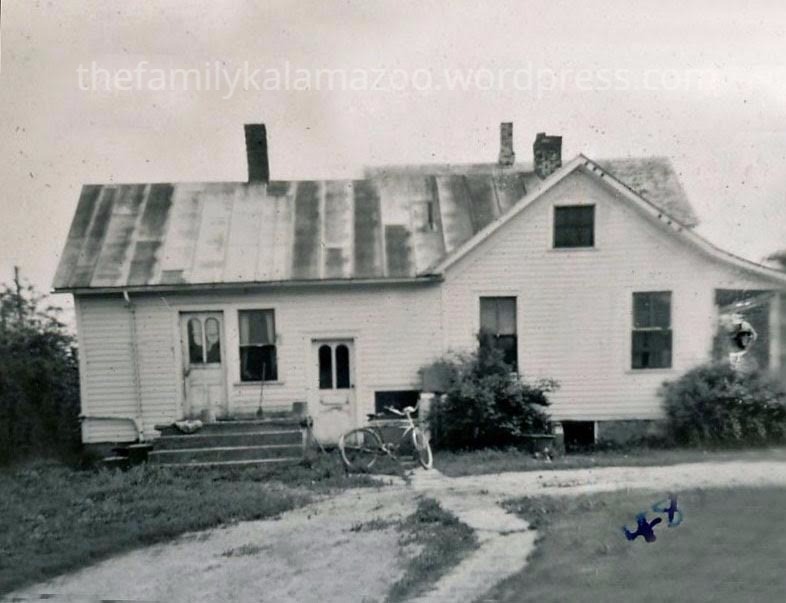
The farmhouse had a big dining room in the middle of the first floor.  The kitchen was out in back and had a coal-burning stove/oven.  The front room was tiny, with barely enough room for the big wood-burning stove and her father’s rocking chair.  He sat and smoked his pipes and cigars in the evening.  He played cribbage with a friend with a small chair pulled up to the fire.  All the downstairs had linoleum laid on it after Edna grew up and moved away from home; while she was home, it was a wooden floor.  The upstairs was two rooms:  a bedroom for her parents and one big bedroom for the five children.  They slept five to one bed, with the boys sleeping across the width at the girls’ feet.  It was COLD up there in the Michigan winters–with no heat.  Edna’s father had built the house; most of the furniture was handmade, too, some of it quite old.

Edna’s farm had a big family of cats, but they weren’t house pets.  They were kept to kill the mice in the barn.  Edna’s job was to put food and water out on the back porch for them.  The farm had lots of corn fields, cows, pigs, and an apple orchard.  It even had a small stream for fishing, but you had to drive the wagon down there, it was so far away.

But Edna and her siblings were used to long walks.  The three girls walked three miles to school everyday and three miles back home.  They kept each other warm by cuddling together as they walked.  Once in a great while, during the worst weather, Edna’s mother drove all the children to school in a tiny black Amish buggy.

Sometimes the girls were naughty.  For instance, they knew their parents had a store charge at the grocery store in Caledonia.  A couple of times the girls couldn’t resist and charged a giant candy bar or a banana.  (Fruit was a big treat; Edna only saw oranges at Christmastime).  When their parents found out later, they would “get bawled out.”

Edna’s family didn’t have much money, except for owning the farm, but her father collected a few hundred books.  He had several series of books for children which offered moral and religious instruction, as well as some adventure books.  Edna had plenty to read while she was growing up.  But she didn’t have a lot of time to read because she always had a lot of chores.  Farms need a lot of care!  Edna learned to cook basic meat, potato, and vegetable dishes while she lived at home with her family.  She also became a good baker, making delicious cookies, pies, and cakes.  She wanted to be a teacher or a writer when she grew up, but she also wanted to have a home and a family and to take good care of them.

###

I’ve posted photos of the farm where Edna grew up before:
Final note: This turned out to be a great project for my daughter and for me because it was about our shared knowledge–some of what my grandmother taught my mother was taught to me and taught, in turn, to my daughter–and we both learned about history through the life of an ordinary girl. And, yes, my daughter did get to be an American Girl paperdoll. You can read the story and see the photos here: An American Girl’s Family Tree


Read Full Post »

I wrote about my great-grandfather, Charles Mulder, and his farm in Caledonia, Michigan here. That post also lists other links that pertain to Great Grandpa and the Mulders.

At the time I didn’t have a good photograph of the farm, but now I have discovered a good one of the farmhouse, just as I remember it. Facing this way, the apple tree the swing hung from was to the left. The fields were also to the left, the road to the right. Because of the porch, you can see that the front of the house is on the right side.

Look at that! Is it the same swing I swung on or a different one? This is Mom’s cousin Elaine playing at the farm.

Do you have any fond farm memories?

Read Full Post »

As a high school student at Caledonia High School in Michigan in the 1920s, my grandmother, Lucille Edna Mulder, was a good student. As I have written about before, she was Class Historian at graduation–and kept a beautiful graduation scrapbook.

She also kept a meticulous notebook for botany class. Here is a slideshow of the entire book. I will post a few still images below the slideshow.

Did you ever record precise information like this for a homework assignment? If so, do you think you learned from it?

This slideshow requires JavaScript.

These dried flowers look like nature prints! I wish I had been required or encouraged to keep a notebook like this.

Read Full Post »

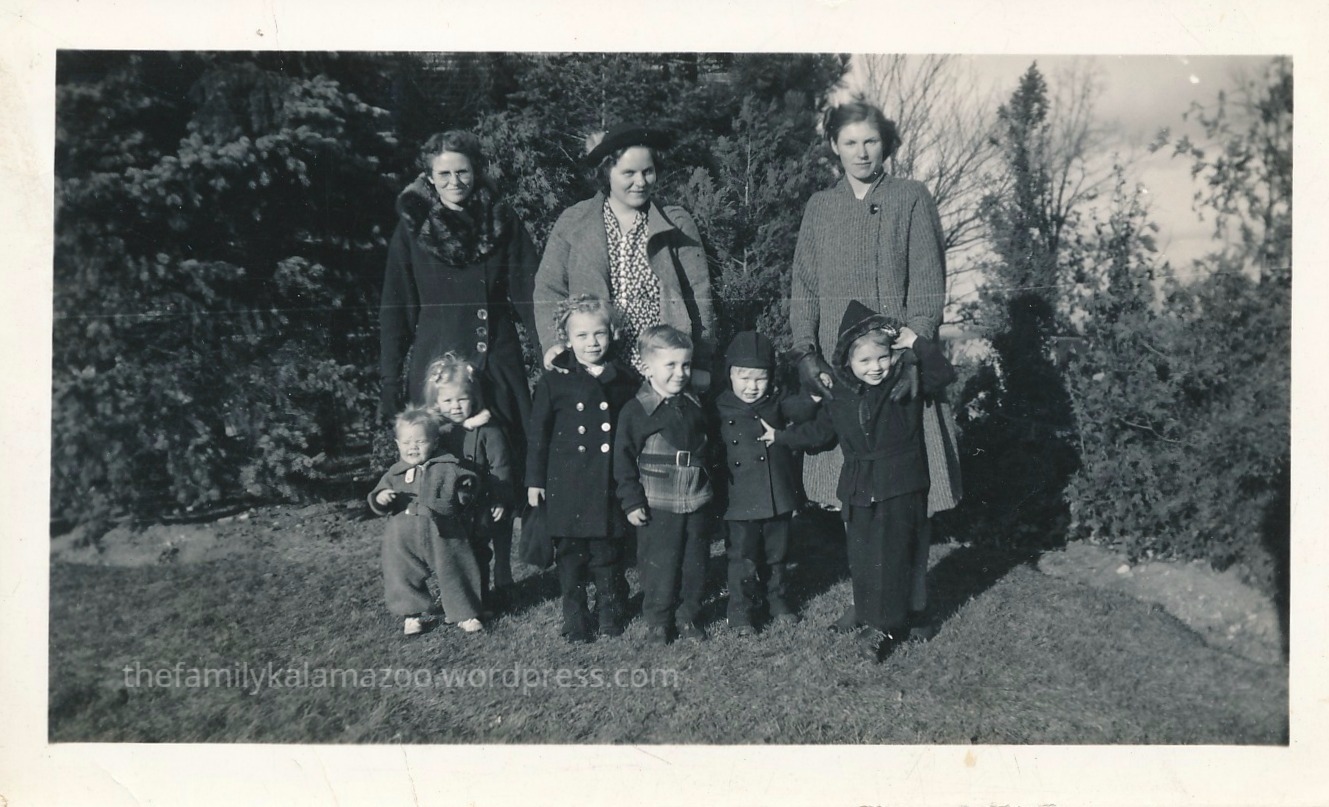
I am digitizing some photographs for my mother, and I found this picture that I just love. It’s my mother’s mother (in the middle) with her two sisters. They are standing with their children–the ones who were born at this point. By the age of the children here, I would say that the picture was taken around 1939-40. What is a little confusing is that nobody looks pregnant and two of them should have been pregnant around that time, unless there are tiny babies asleep just outside the boundaries of the pic!

The photo would have been taken somewhere in southwestern Michigan. CLICK ON THE PHOTO TO ENLARGE!

From left to right: Vena with her two oldest daughters, then grandma (Lucille Edna Mulder Zuidweg) with my mom (Janet) and Uncle Don, then Dorothy with her two oldest. Each of them had another child after the first two.

I’ve written posts about my grandmother. Dorothy showed up a bit, too, because the girls graduated high school together. You can read about their graduation here and here and here. In this post, Grandma, Dorothy, and Vena are shown as children with their parents and one brother (again, the youngest had not yet been born).  Grandma’s teaching contract from 1931 can be found here.

If you never read my posts about Grandma’s high school scrapbook, check out the links. It’s a gorgeous scrapbook from her graduation in 1929. She was Class Historian and her older sister Dorothy was salutatorian.

If anybody in the family wants me to post the names of the children here, I will add them to the post. Just let me know.

Isn’t my mom, the tallest one here, a cutie in her double-breasted coat?

Read Full Post »

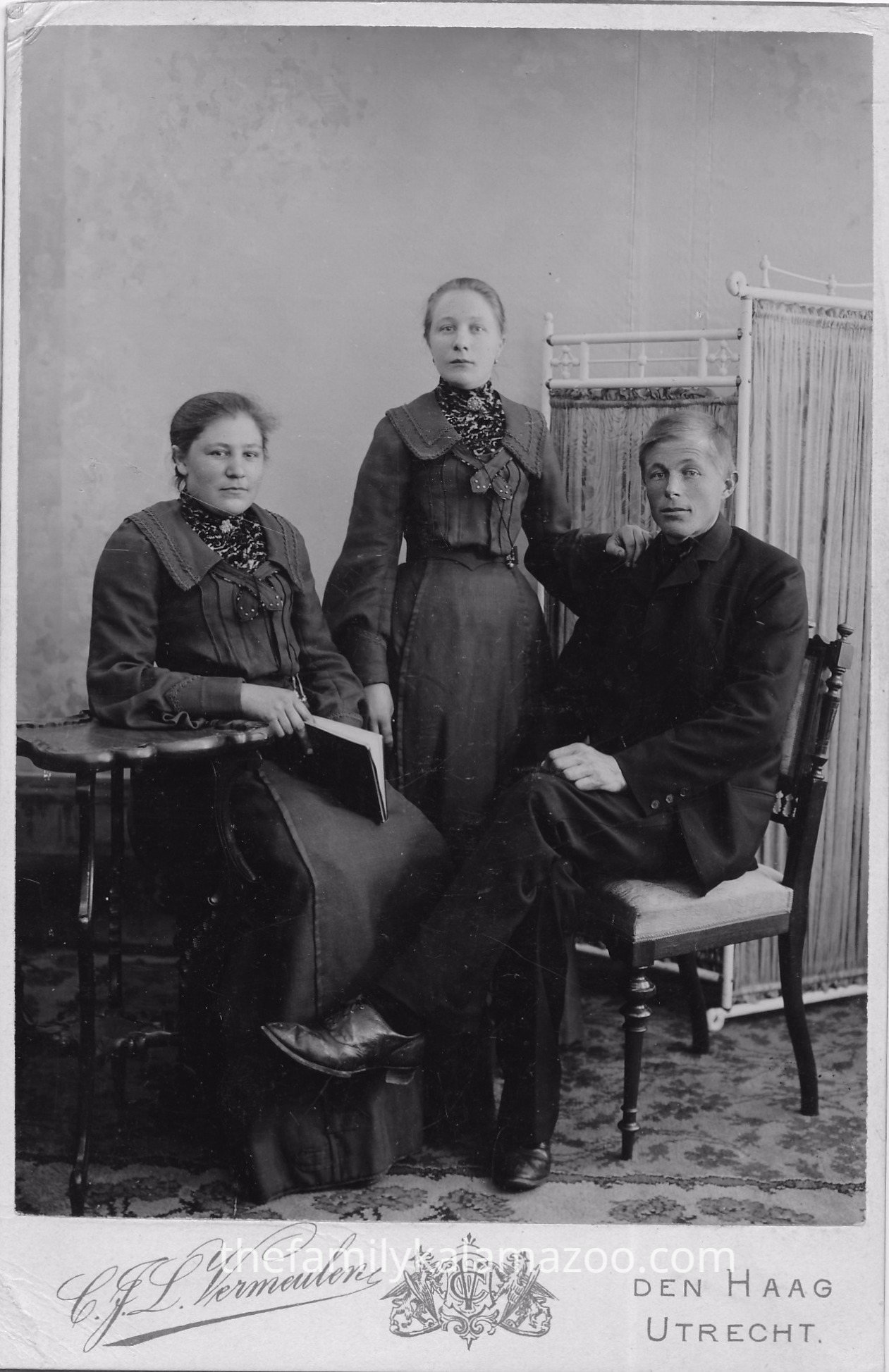
If you tuned in last week (here), you saw a photograph of a woman in a Pilgrim-style bonnet and black dress. The photographer was based in the Dutch towns of Utrecht and Den Haag (The Hague).  Thanks to a Dutch reader, Hubert Theuns, I learned these facts associated with the photo:

The photographer, Cornelis Johannes Lodewicus Vermeulen, was born in Utrecht 18.11.1861 and died in Hilversum 05.01.1936. Photographs from the period 1886-1915 can be found athttps://rkd.nl/nl/explore/portraits#query=cjl+vermeulen&start=0&filters%5Bcollectienaam%5D%5B%5D=RKD%20%28Collectie%20Iconografisch%20Bureau%29

In the Dutch province of Zeeland there is a society for the preservation of traditional costumes. The secretary of that society identified the traditional costume as the traditional costume of Cadzand, a small town in the Dutch province of Zeeland. In 2007 Cadzand had about 800 inhabitants. I believe this information may be useful to you.

I was thrilled with this information. The thought of a costume native to a small town–and owning a family photograph of that costume–was beyond anything I ever expected.

A couple of days later, I had a thought. What if I was wrong and this photo wasn’t the only one by this photographer in my archival boxes? So I searched and searched. And then I found. This photo:

Compare it with the photograph of the woman. Different table, but the screen and the carpet are the same. The chair might be the same. Now we have clothing that looks more fashionable for the period.

Craziest connection between the two photos: the book held by a woman above and by the woman below! The same book? What is the meaning of holding the book? Is this a stylistic tic of the photographer or does it have Victorian meaning, something like the language of flowers?

Do you think these photos were taken at the same time? Part of a family group? Could the woman below be the mother of the three above?


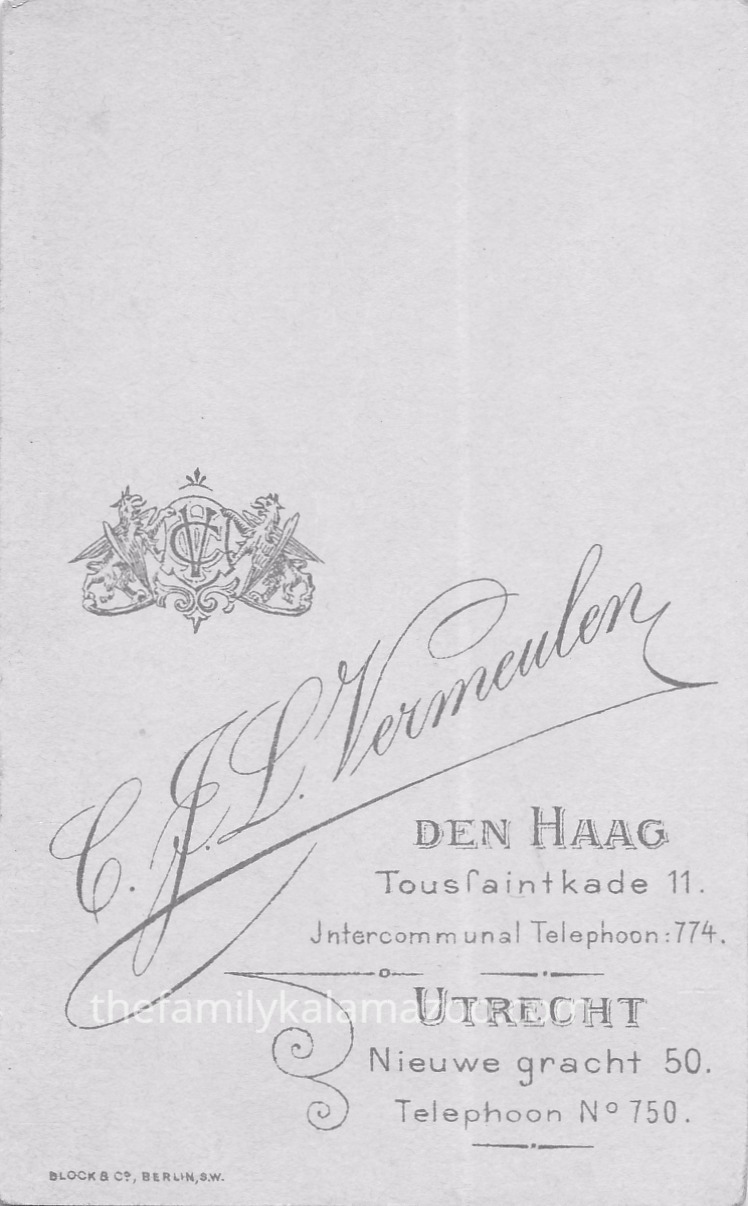
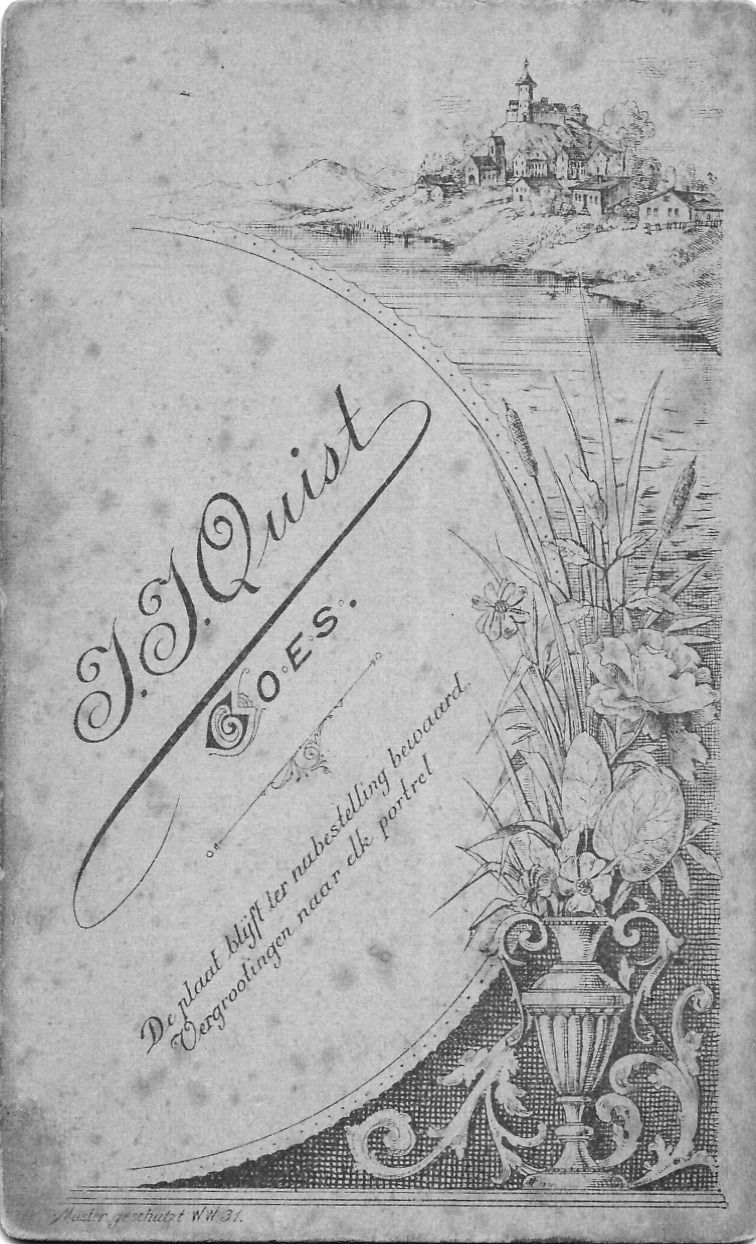
Here are the backs of the photos in case they offer any clues:


Note that they both have the 3 digit telephone numbers. According to the research of Hubert Theuns:

The telephone was introduced at The Hague on July 1, 1883, and at Utrecht in February 1883. There used to be local telephone directories, but I have not (yet) found any on the internet. National telephone directories were published as from 1901. The collection of national telephone directories from 1901 till 1950 are being digitalised by the dutch national library, but unfortunately this process has found delays. Only the national directory of 1915 is available on the internet, and shows that the photographer in 1915 in Utrecht had the same three digit number as mentioned on the photograph, but that his number in The Hague already had four digits.

That leaves quite a range of time that the photo could have been taken. It definitely is pre-WWI; that is one thing I know. But are the styles 1890s or after 1900? It seems to me that the skirts are becoming “slim,” so maybe closer to 1910?

Well, Hubert has been busy at work and has been able to narrow down the time period even more. This is what he wrote yesterday:

New developments. I contacted a local history circle in Zeeland (without being a member) to have the photo put up at their website for identification. I got the reply that they contacted a museum in Nieuwvliet, devoted to the regional costume of Cadzand. The museum replied that the scan of the photo is not detailed enough and requested the original photo. . . .
I also contacted the museum on communication (devoted to the telephone) in The Hague about telephone directories. The librarian informed me that the archive of the municipality of The Hague has a collection of old telephone directories of The Hague. This morning I visited the archive and consulted their collection of “Adresboeken” for The Hague and Scheveningen.
C.J.L. Vermeulen was listed for the first time in the Adresboek, 47th edition, year 1898-1899, but without telephone number.
In the books 1899-1900, 1900-1901, 1901-1902, en 1902-1903 he is mentioned with telephone number 774 (as on the photo).
In the book 52the edition 1903-1904 the telephone number is 1873.
On the basis of the information the photo must originate from 1899-1902, with a possible extension to 1898-1903).

Isn’t that something?! Now we know that the photograph had to have been taken between 1898 and 1903, most likely between 1899 and 1902. Hubert’s sleuthing is beyond compare!

For me, there is no comparison between the two photographs in interest. The woman in the bonnet has a compelling expression and handles the book as if she cares about books. The young woman holding the book doesn’t seem to care at all about it. She does look uncomfortable–as if she would rather change into her everyday clothes! I’d guess it was her sister, standing, who wanted them to wear matching fashionable dresses.

My gratitude to Hubert Theuns is boundless. I could not have imagined such a detailed answer to the questions of the lady in the unusual outfit.

Read Full Post »

UPDATE:  This photograph has been identified as to the clothing and location it is from.  See the update at the bottom of the post!!

This one is no doubt my favorite of the unidentifed photos in the archival storage box.

Look at her outfit. She looks like a pilgrim, doesn’t she? Or maybe Emily Dickinson with a pilgrim bonnet on?


Look at the book in her hand. What is it? A Bible? A hymnal? A prayer book? Surely there is significance to the text.

This is one of my few photos from Utrecht. Did I have family there?

Well, Alice Paak, my great-grandmother, was from Lexmond, which is south of Utrecht, so you could say that that branch of the family comes from the vicinity of Utrecht.

I can’t figure out the relationship. Also, Alice and her siblings were blue-eyed blondes.

Here is the back of the photo in case it offers any clues:

UPDATE: Reader Hubert Theuns has commented below with the following information which adds a lot of information to this photograph.

The photographer, Cornelis Johannes Lodewicus Vermeulen, was born in Utrecht 18.11.1861 and died in Hilversum 05.01.1936. Photographs from the period 1886-1915 can be found athttps://rkd.nl/nl/explore/portraits#query=cjl+vermeulen&start=0&filters%5Bcollectienaam%5D%5B%5D=RKD%20%28Collectie%20Iconografisch%20Bureau%29

In the Dutch province of Zeeland there is a society for the preservation of traditional costumes. The secretary of that society identified the traditional costume as the traditional costume of Cadzand, a small town in the Dutch province of Zeeland. In 2007 Cadzand had about 800 inhabitants. I believe this information may be useful to you.

FASINATING information. I had never heard of Cadzand, but now I will do my research. It doesn’t look too terribly far from Goes–and both towns are in Zeeland.


Read Full Post »

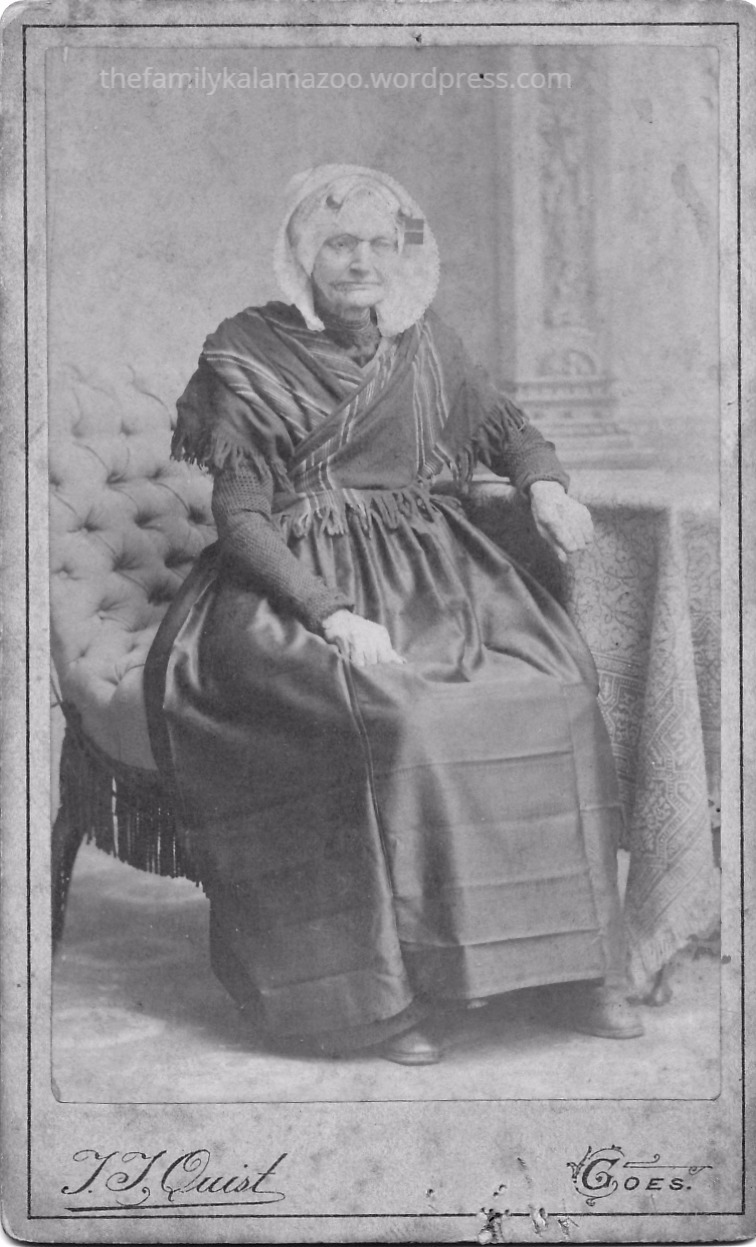
Here’s another old photo that remains unidentified. Clearly, this elderly lady is from Goes, the Netherlands, and, no doubt, died in Goes.  Because of her age in this photograph, imagine how early she must have been born!

She must be from one of these branches: Paaks, Zuidwegs, or Mulders. It’s unlikely that she is a direct ancestor of Alice Paak, though, because Alice’s mother (born Bassa) died in her early 40s, in 1865. And her mother, a van Nek, died in 1848.

It’s less likely to be a Mulder because most of these photos come from my grandfather’s’ family, not my grandmother’s. She’s not a DeKorn because they came from Kapelle (very close to Goes, but not Goes). That leaves the Zuidwegs–or perhaps an aunt or other relatives of the Paaks.

How do you like her bonnet? Why does it look like her dress has creases around the skirt?

Here is the back of the photo in case it offers any clues:


Read Full Post »

I’ve written before about my great-grandfather, Charles Mulder, of Caledonia, Michigan. He was born in 1885 in the Netherlands, but moved with his parents and younger brother to Grand Rapids, Michigan, when he was only two.  His baby brother Jan passed away within a few months.

Although Great-Grandpa was raised by his parents in Grand Rapids, where his father built furniture, he ended up starting his own adult life in Caledonia–as a farmer. He came from town folk. They weren’t farmers. What would have made him decide to become a farmer? And how did he purchase his farm?  These are good questions, I know, and I wonder if there is anybody who can answer them. Maybe his daughter, my grandmother, didn’t even know the answers.

I used to love to visit GG and his 2nd wife Margaret on the farm. My great-grandmother had passed away a couple of years before I, the oldest great-grandchild, was born. So I grew up knowing Margaret, a very nice lady, as my GG.

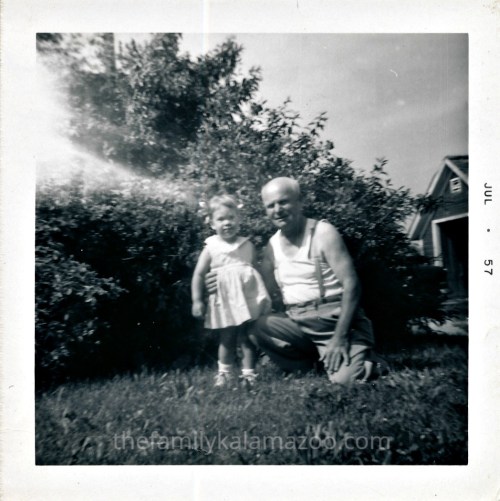
I’m guessing that in this photograph, I am with Great-Grandpa at his farm. He’s very comfortable in his undershirt and suspenders, and I see the hint of a dark colored (red?) outbuilding behind him. I remember the barn, the corncrib, and the henhouse. And let’s not forget the outhouse!

This photograph, as you can see, was taken in July 1957, which means that I was just turning two.

Message to my family: if anybody has any photos of the farm, please scan and send to me!

###

Here are links to other posts about Charles Mulder of Caledonia, my great-grandfather (the 1st two are my favorites):

The Blog Will Now Come to Order

I Raided Great-Grandpa’s Library

Great-Grandpa’s Family: The Mulders of Grand Rapids

The Mulders Pre-1917

Pieter the Orphan


Read Full Post »

Try to keep this in mind as you read: I am having a lot of trouble dating this photograph. Maybe with the dates of the people in the photo, you can help me date it.

Great-Grandpa Charles Mulder was born Karel Pieter Philippus Mulder on 6 March 1885 in Goes, Zeeland, the Netherlands.  He was the son of Pieter Philippus (son of Karel, Karel, Carel, Johannes, in that order).

He emigrated in 1887 from Kloetinge, Zeeland, Netherlands and arrived in New York City on 29 August 1887 . Note that he was 2 years old.

Great-Grandpa was the oldest child of Pieter and Nellie (Neeltje) Gorsse.

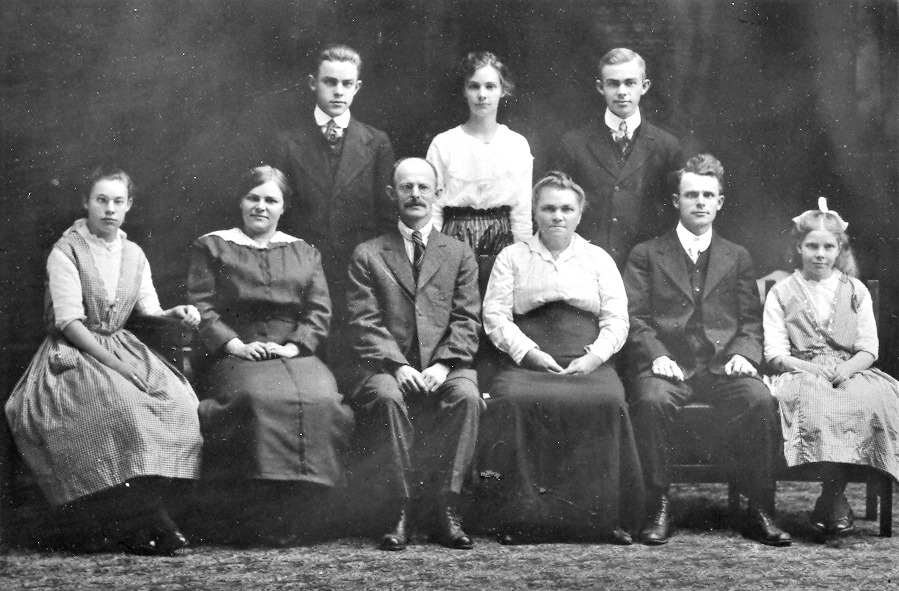
Pieter and Nellie Mulder and family

Pieter (1865-1953) and Nellie (1868-1932) are in the middle of the front row.  If you have ever heard about the wonderful furniture that used to be made in Grand Rapids, Michigan, you would be hearing about some of the furniture made by Pieter, a cabinet-maker.

Great-Grandpa, with the curly dark hair, is next to his mother. I will try to identify the others, but I cannot be absolutely certain.

Back row: Peter, Cora, Henry

Peter was the father of Rod Mulder, who I knew when I was younger. He married Alida, and they had at least four boys: Rod, Willis, Richard, and Robert.

Cora married John Gerow and was the mother of Eleanor, a lady I knew when I was a kid.

Henry engraved stone monuments and developed emphysema. His married Mae and raised his family in Hastings, Michigan. According to the 1930 census, they had 4 children: Eloise, James, Mary, and Judith.

In the front row, the girl with the glasses on our left is Nellie. I believe she might have had some sort of disability. Nellie was still living at home with her parents in the 1930 census, when she was 27 or 28 years old.

Then there is Jennie who married Edward Kooistra or Koistra. They had a son, Karl.

Rose (Rosa) is on the other side of Great-Grandpa. She contracted TB. But then so did Great-Grandpa; I remember visiting him in the sanitarium or hospital. Rose was living at home with her parents in the 1920 census; she was 14.

Sadly, I discovered that there were also two children who passed away. Jan was born after Charles–in 1886–and passed away the following year, four months after the family arrived in the United States!  Imagine: a young couple, ages 22 and 19, immigrate to the United States with a 2-year-old and a 1-year-old (two babies). Then in a few months, the younger baby is gone.

Then there was another Rose who was born in 1892, after Cora. She passed away in 1904, two years before her namesake was born.

What year do you think this photo was taken? It’s a little confusing to me. Great-Grandpa got married in 1910, when Rose would have been four years old. She’s clearly older than that here. I wonder if both Charles and Jennie were already married when this photo was taken. My grandmother was born in 1912, so if the photo was taken when Rose was about ten (1916), then Great-Grandpa would ALREADY HAVE FOUR CHILDREN.

Here’s an alternative view: that I was told wrong about which child is which. What if this photograph has the Rose in it that was born in 1892–and if it was that Rose who had TB and in fact died of it? Then the names were assigned wrong. But is there a way that the people here fit the dates if that is the case?

How about the clothes? Any ideas on the date of the photograph from the clothing?

In order the children were:

Charles (1885)

Jan (1886-1887)

Jennie (1887)

Cora (1890)

Rose (1892-1904)

Henry (1897)

Peter (1900)

Nellie (1902)

Rose (1906)

My grandparents told me that Great-Grandpa’s family (this is my grandmother’s father) lived in Goes very near the Zuidwegs (my grandfather’s father’s family). They were printers, engravers, and machinists. However, genealogical research shows that, in the old country, Pieter was a fisherman, a laborer, and a shoe maker. I would guess that when the family came to Grand Rapids, that Pieter learned the furniture trade. After all, he was only 22 when he got to this country.

I do know that the printer and engraver part was true at least for my grandfather’s father, Adriaan Zuijdweg. The Mulders and Zuidwegs were city people, not farmers, so it’s curious that my great-grandfather became a farmer.

Great-Grandpa died on 27 April 1967, when I was 11 years old. I used to imagine that the family line began with him at his farm in Caledonia, not realizing that he was brought up in Grand Rapids or that his father made furniture or what hardships his parents must have gone through.


http://www.gettyimages.com/detail/120016511


Read Full Post »

My grandmother, Lucille Edna Mulder (Zuidweg), was born April 17, 1912. If she hadn’t passed away in 2000, she would be 102 today. I miss her every day.

Grandma holding me

Grandma holding me 1955

Last year I posted about Grandma’s high school graduation scrapbook. Here is the link. There are a lot of photos in that book; in most of them Grandma is hanging out with her friends and classmates.

Below, Grandma is in all but the lower right photo. One of the girls is her best friend, Blanche Stauffer. Grandma and Blanche are in the upper right photo together–that’s Grandma in front. Blanche has the straight dark bangs. In the lower left Grandma is with another friend.


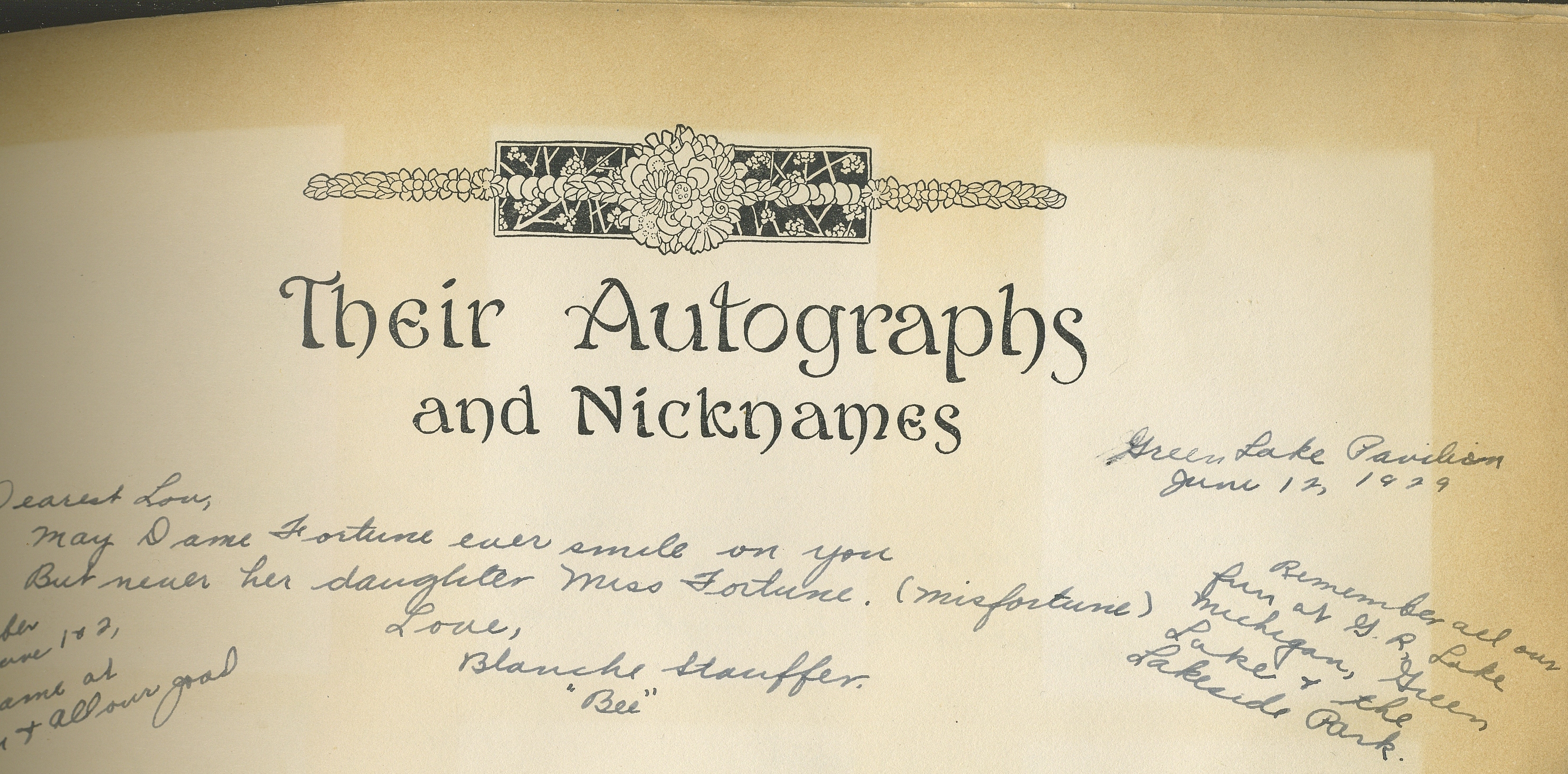
The scrapbook has an autograph page, and the words from Blanche are front and center:

Grandma and I have a lot in common. One thing is that a best friend was very important to us growing up. I looked up Blanche on Ancestry, and I was amazed to learn that she, like my grandmother, was the second child in the family. Blanche’s older sister was one year older. That was the same with Grandma: her older sister Dorothy was one year older.

Blanche was class valedictorian, Dorothy was salutatorian, and Grandma–with the 3rd highest GPA–was class historian. I read a list of Grandma’s classmates, and Blanche’s older sister was not in their class. At least Blanche didn’t have the sisterly competition that Grandma had to put up with ;).

Writing is another commonality between Grandma and me. When she was elderly and had just gotten sprung from a very negative experience with a rehabilitation nursing center, she made me promise I would never give up writing. I promised her, and I have kept my word. I remember Grandma submitting funny stories and occasionally getting them published when I was very young.

Recently, my mother told me an anecdote that made me realize that Grandma and I share another interest. When I was little and my mother worked full-time, Grandma babysat me. We sang Ethel Merman songs like “Anything You Can Do.”  I could always manage to sing louder and higher than Grandma.

Any note you can reach
I can go higher.
I can sing anything
Higher than you.
No, you can’t. (High)
Yes, I can. (Higher) No, you can’t. (Higher)
Yes, I CAN! (Highest)

What I didn’t realize is that when my mother and her siblings were little, my grandmother (who was always with my grandfather, to my memory) went to New York City with her sister Dorothy. They saw Ethel Merman in Annie Get Your Gun.  She actually saw this song performed live by Merman. My mother says it was one of the highlights of her life, and I believe it because I remember this music around Grandma often when it was “just us.”  I still love musicals and so does my daughter, who performs in professional productions.

Grandma and I shared other songs, too. She used to hold me on her lap while we sang “She’ll Be Coming Around the Mountain” and “This Old Man (Knick Knack Paddy Whack).” My memories of my grandmother are treasured heirlooms.

Happy birthday, Grandma.

Read Full Post »

« Newer Posts - Older Posts »