Feeds:
Posts
Comments

Posts Tagged ‘Kalamazoo history’

Today kicks off Women’s History Month, which is celebrated throughout the month of March. Nobody can work on their family history and genealogy and not be confronted with the imbalance between the history of men and the history of women. The mere fact that women are so difficult to find because of the historic practice of taking on their husband’s surnames is enough, but there are other factors, as well. For instance, I only have to examine the history of my own ancestors to see that European and American women, until fairly recently, worked at outside jobs but their occupations rarely resulted in careers.  Sometimes they worked outside the home for decades, but often, once women married, they quit their jobs and began to have children.

When I wrote the poems and short stories in my chapbook Kin Types I consciously tried to bring the lives of these “invisible” women to life. Here is a 53 second video my daughter made of the book last summer.


As you probably realize, the research and the writing itself was a labor of love. The book is available through Amazon, Barnes & Noble, and Finishing Line Press. If you click through the next image, it leads to the Amazon site.

There are other wonderful poems about women and history. Here is a favorite poem by the late great Adrienne Rich. I am only posting the beginning and then you have to follow the link for the rest because WordPress does not allow for the specific formatting that some poems need.

This poem investigates the life of Caroline Herschel, the younger sister of astronomer William Herschel. Although she had to do a lot of her brother’s bidding during her life, she eventually learned to love astronomy and became an esteemed astronomer after discovering several comets.  There are an unknown number of women like this throughout history because most of them were not rewarded during their lifetimes as Caroline Herschel was. For instance, how much did Vivian Eliot help her husband T. S. Eliot with his writing? Einstein’s first wife Mileva Maric was also a physicist and might have co-authored the Theory of Relativity with Einstein, but she got no credit.

Planetarium

BY ADRIENNE RICH

Thinking of Caroline Herschel (1750—1848)
astronomer, sister of William; and others.

A woman in the shape of a monster

a monster in the shape of a woman

the skies are full of them


a woman      ‘in the snow

among the Clocks and instruments

or measuring the ground with poles’


in her 98 years to discover

8 comets

Continue here: Planetarium

This woman is taking a much-needed break next week. See you the week after!

Read Full Post »

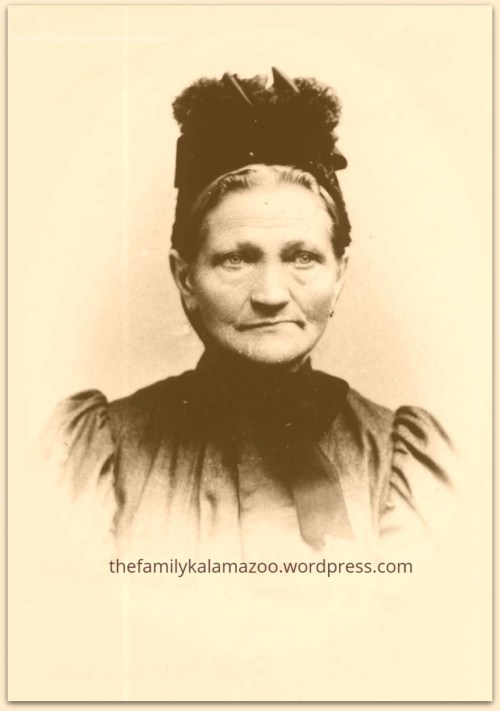
There is so much to see and research in every photograph, every document, and every story. It’s no wonder I always feel that I have not exhausted a topic. One of those topics is the hat that Jennie Zuidweg (wife of Johannes and mother of Lucas who died on the anchor) wore in her photos. She wore it when she was younger and, no doubt, living in the Netherlands–specifically Goes, Zeeland.

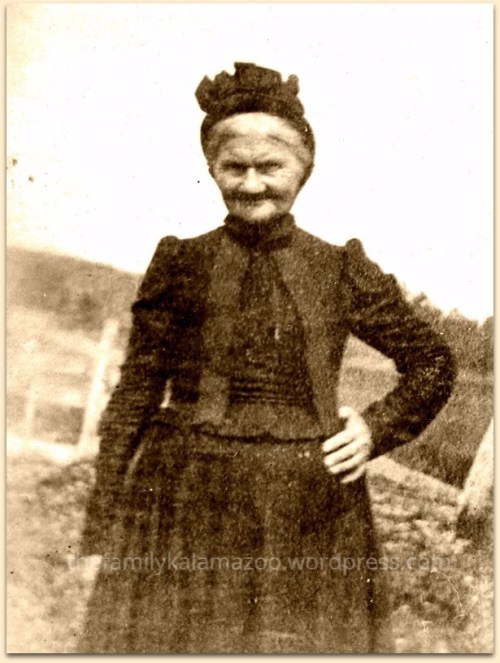
And she wore it when she was old and living in Kalamazoo, Michigan.

And then I saw another Dutch relative wearing the hat.

I put all this in the back of my mind, and then on a Dutch Facebook group somebody mentioned a type of hat, and it clicked in my head that I needed to research this hat.

What I found is that this type of hat seems to be called a Kapothoed. According to Google translation, this means hood hat or bonnet. So I did a Google search of Kapothoed. Although all that comes up are not the same, there are several that are.

Google Search for Kapothoed

and from Pinterest.

Kapothoed

What this shows me is that what I assumed to be an old-fashioned country bonnet was really an actual style that existed in the Netherlands. Some of the bonnets or kapothoed that I found by searching Dutch museum collections online are closer to the head, but there are some that are high like these.

Here is a high one from Europeana Collections, an online digital collection of artifacts.

Now that I have seen more kapothoed designs, I can see that the hats Jennie wore when she was younger and when she was elderly are two different hats, two different styles of bonnets.

These bonnets are very different from the traditional Dutch caps which look like the variations in these photos from Wikipedia.

Actually, the caps that women in Goes, Zeeland, wore were the most dramatic, along with the hair combed back at the forehead and the large jewelry worn at the temples.

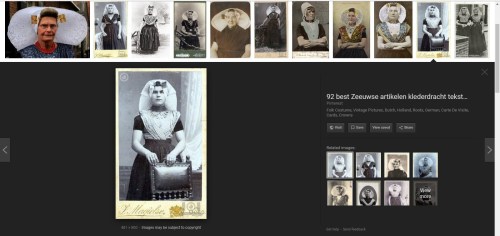
I spent a lot of time trying to find an image online that I am allowed to download and put into this post, but I couldn’t find the right image of the Goes costume. Instead, I did a Google search of the “traditional costume of Goes, Zeeland” and created a screen shot to show you.

These are oorijzers or ear irons. Various styles had different names. The block or cube style were boeken (books). A spiral metal style were called krullen (curls). This next photo is a woman from Spijkenisse in 1900. I am including it to show you the krullen style ear irons.

Krullen

Here is what Wikipedia has to say about oorijzer. I am quoting them because it’s the best information I found online:

The ear iron is part of the costume for women, especially in the northern provinces of the Netherlands and Zeeland . It originally formed part of the civic power, which was taken over in the regional councils.

Initially the ear iron was a metal bracket to keep the caps in place. It was worn over a cap and a luxurious top hat was put on it. In the course of time the ear iron grew into a showpiece. Decorative gold plates or curls stuck out at the front of the ear irons . . . .

Only in the 19th century did various forms of the ear-iron form a specific part of Dutch regional dress. In Images of dress, morals and customs from 1803-1807 there is no question of ear iron in women from Friesland. In the French era, when the so-called independent regions of the Republic of the United Netherlands come under a single administration, the need for maintaining their own identity arises in the regions. In the Netherlands, the ear iron force is cultivated and has its own development. The prosperity is great, as a result of which the ear iron is getting bigger and bigger. In the course of the century, the narrow band is becoming wider, the buds become larger and flatter and take the form of a flower pot.

Different Ear Irons in the Zuiderzee Museum

A slang term for them might be kissers. A tradition (not universally shared) has it that the kissers were meant to keep boys away from the girls. I’m amazed how the hair looks so plain and yet the cap and oorijzers are so extravagant looking. Coral bead necklaces are part of the traditional costume. You could tell if a woman was Protestant or Catholic by her cap.

If you would like to read more about the oorijzers, here is a blog post by a graduate student in fashion. The Oorijzer

As you know, I am no expert on traditional Dutch costumes. I found this information online. But I think knowing that my ancestors wore outfits like this is eye-opening.

One last thing I’d like to point out is that although I have a couple of traditional costume antique photographs, they are not from Goes, unfortunately. I wish I had a photo of my ancestor dressed this way. Instead, what I do have from late 19th century Netherlands is not traditional attire, but more “modern” European clothing.

P.S. The unidentified lady (called “Mother’s aunt” and written about here) was photographed in Groningen. For fun I thought I’d share a link about Albarta ten Oever (1772–1854), an artist from Groningen who happened to be a woman. Check it out.

by Albarta ten Oever

Koetsreizigers in Schipborg (1806)

landscape of “coach travelers” in Schipborg, a village in Drenthe

And then here’s another article of interest to this blog, Calvinism in the Netherlands. When I was a history grad student (never finished that particular degree) my specialty was religious history, particularly the history of the Reformation (where Protestantism, often in the form of Calvinism, replaced Catholicism for masses of Europeans). So the full history of what has happened with Calvinism in the Netherlands is of particular interest to me. My own family background from the Netherlands was Dutch Reformed (Calvinism), but before my mother was raised, the family had moved away from a strict form of Protestantism.

Read Full Post »

My grandfather, Adrian Zuidweg, in a toy car in Kalamazoo, Michigan.

Do you think this toy car was purchased or built? I searched images of these pedal cars from the era of 1913-18, and I didn’t see anything quite this “bare bones.” Notice that there aren’t any fenders, little touches like that. So I’m not sure, although it does appear to be the Packard logo.

It doesn’t surprise me that my grandfather would have a nice toy like this. He was an only child, and his father owned a fish market.

Look at his sweet little hat. And the clothesline out back.

Read Full Post »

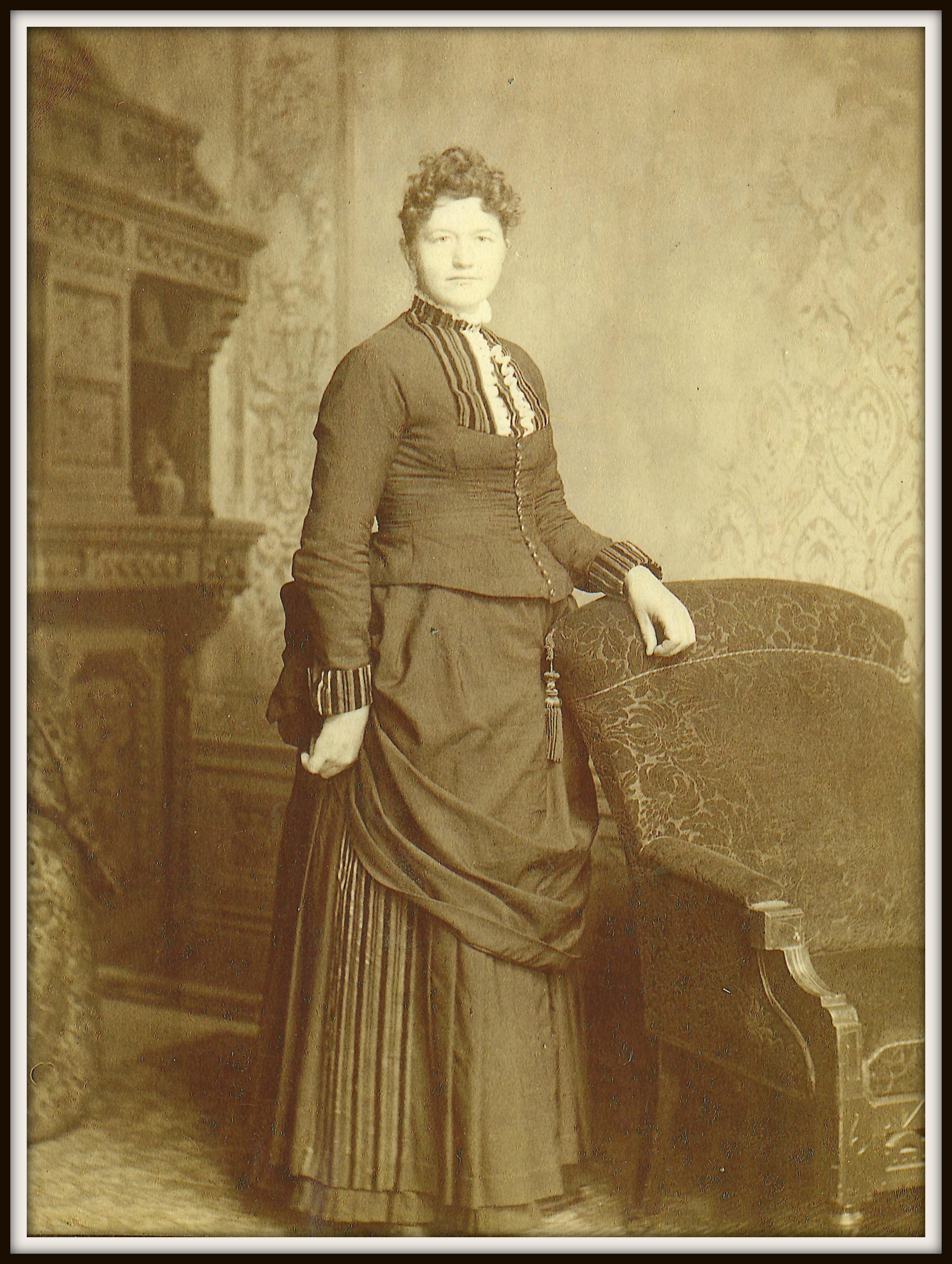
In scanning the beautiful antique album this fall, I came across this tintype that kind of haunts me. Maybe it’s because the tintypes are so rare in the family collection. Maybe it’s because of her eyes.

Just ignore the strange corners. I tried to clean it up a bit at the corners (just for this post), and it didn’t turn out as I expected!

So how do I go about narrowing in on who might be in the image?

Because all the photos so far in the antique album seem to be related to the 5 Paak siblings and their familys, I feel that it is likely that she is related to the Paaks somehow.

I have such a desire to find a photo of Janna Kakebeeke Remine, the mother of Dick, grandmother of Therese, Genevieve, and Harold, who immigrated to Kalamazoo and passed away in 1910. She was the mother-in-law of Mary, one of the Paak sisters. But Janna was born in 1827. I was thinking 1880s for this dress, and this woman is not 60. In fact, as usual, I have no idea how old she is, what year her dress was, or what year her hairstyle was. It can’t be Dick’s mother-in-law Jacoba Bassa Paak either. She died in 1865 in the Netherlands!

What I have to get used to is the fact that the photographs I own are never of those earlier individuals, so they are images of more “recent” generations. I posted this one on a Facebook group for dating photographs.  Very consistently, readers thought the tintype is around 1880. They based this on two main aspects: the fact that it is a tintype and not a photograph and the woman’s outfit. Tintypes were most frequent a bit earlier than the ’80s, but they can be found in the 1880s and even later.

I thought that the silhouette of her dress and the finishings looked like the 1880s. One thing I can file away in my brain for later is the dress appears to black, a mourning dress, so someone close to the woman had died within perhaps the previous year. Of course, that is very subjective–I mean, it seems as if they would have always been in mourning dress! I’m not very happy with books or websites about women’s clothing styles. They tend to focus on the clothing of the wealthy, the fashionista, and those in evening wear. My relatives were not fashionistas, they were not wealthy (although often not poor either), and sometimes they were governed by a religious conservatism. They didn’t get their photographs taken in evening wear, if they even had any.
For further consideration, I’ll use the date of 1880, knowing it could be 10 years difference either way.

The only way I can now find the woman in the tintype is by comparing her with photographs of known Paak women and women who have married into the family AND using the data on my family tree for birth and death dates.

Do you think this woman is about 25? or younger or older? Let’s say she’s 25, for the sake of trying to figure out who she is. If so, she was born around 1855. That would make her a contemporary of Alice Paak DeKorn (born 1852) and her siblings.


Aaltje (Alice) Paak DeKorn

Anna Catherina (Annie) was born 1855


Maaike (Mary) Paak Remine born 1859


Cornelia (Carrie) Paak Waruf born in 1862

So. There are four* Paak sisters, and I don’t see this woman as one of them, although she could be a contemporary–or a bit older.

* There actually were five Paak sisters, but Willempje, who was born in 1856, did not immigrate with the girls, their father, and their brother. Although I have not been able to find a death or marriage record, I suspect she died as a child. The brother, George, married Lucy Kliphouse, who is not the woman in the tintype.

Lucy Kliphouse Paake

Alice had two SILs–Jennie DeKorn Culver and Mary DeKorn DeSmit.

Jenny DeKorn Culver


Mary DeKorn DeSmit

Is she one of them? (I don’t think so).

Mary Paak Remine had two SILs that I know of.


Adrianna (Jennie) Remine Meijer was born in 1860

Jennie was the sister-in-law of Mary Paak Remine. Another sister-in-law of Mary was Johanna Remine Bosman, born in 1855.

None of these look right to me. And these last two are sisters, but don’t look like it.

Carrie Paak Waruf’s husband Henry (Hank) does not appear to have had any sisters. He immigrated as a child with his parents from the Netherlands to Kalamazoo, and I don’t see a record of any siblings in the census records I have been able to find.

That leaves Annie, the least known of any of the sisters. Annie was married to Jacob Salomon Verhulst (whose grandmother, by the way, was a Flipse–see Flipse posts, if you’re curious). The only photo I have that I know is Annie is the full-length photo I posted above. I never heard anybody talk about her, except when Grandpa identified the photograph.

I don’t know if Annie and Jacob had any children. I have found no record of any children. They married in 1890.

Jacob did have two sisters, that I can find. One was Cornelia who died as a child in Holland. The other was Pieternella, was born 1843 in Kortgene and died 18 days later.

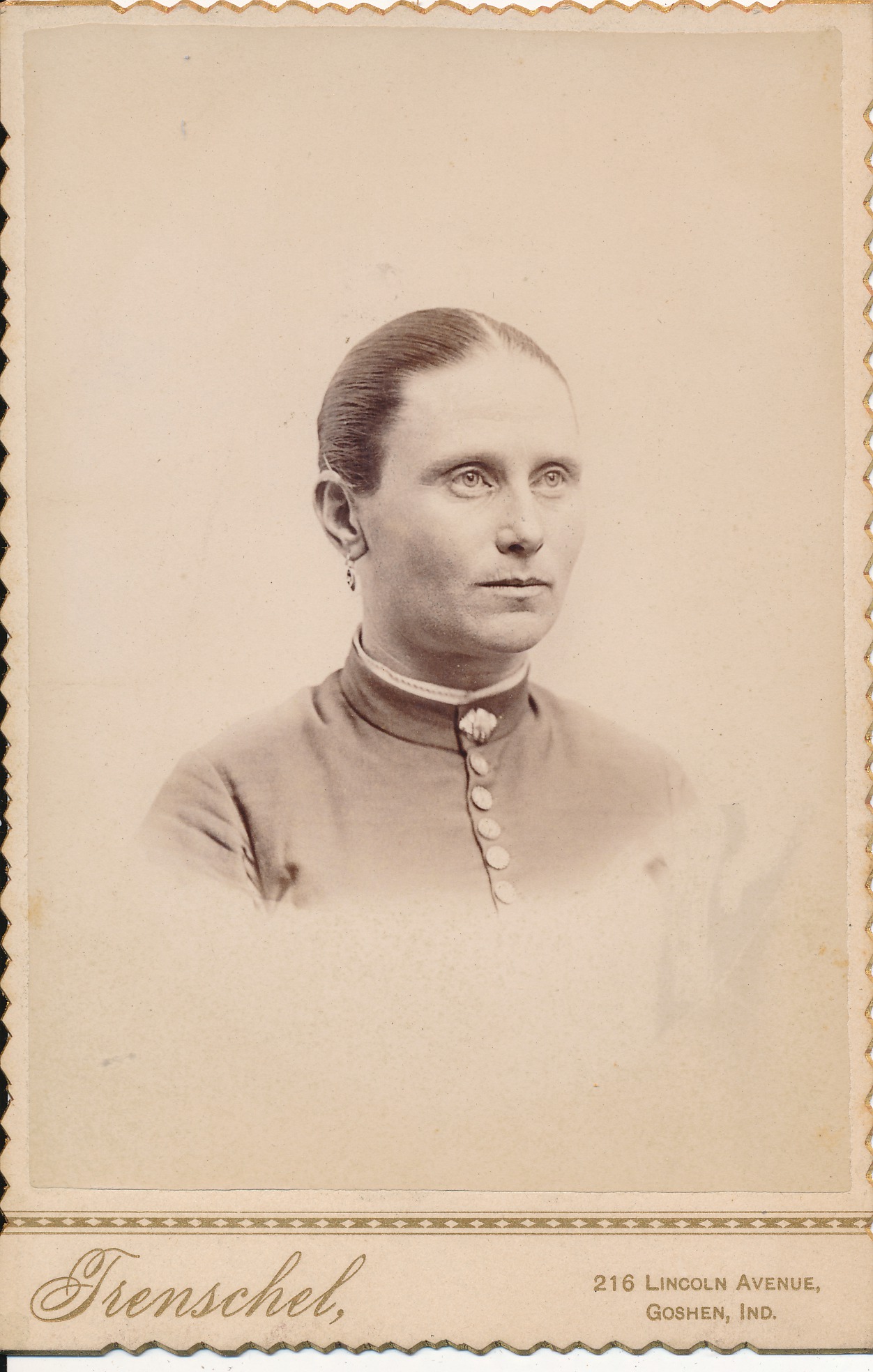
So there you have it. Those are the Paak women and their sisters-in-law. My next guess would be a cousin of the Paaks–or like Annigje Haag, the fiancee or wife of a cousin.  So I will keep searching in that “outer layer” of family members.

That said, if you see any flaws in what I’ve determined so far, please let me know, and I will expand my search even more.

Now that it’s a new year, I want to keep my genealogy goals focused.

  1. Continue scanning of all photographs
  2. Organize the physical photos, documents, and heirlooms.
  3. Create a list of provenance for all heirlooms
  4. Bring my Ancestry tree up to date with all info I have
  5. Find and work on software for a tree that is just for my tree
  6. Continue trying to identify photographs
  7. Research gaps and brick walls

Pretty ambitious, I know. Some of my blog posts will just be updates on how I am doing on items 1-5, rather than the results of actual research. Be patient. You know how helpful you all are to me, and I appreciate it more than you will ever know. Thank you!!!


Read Full Post »

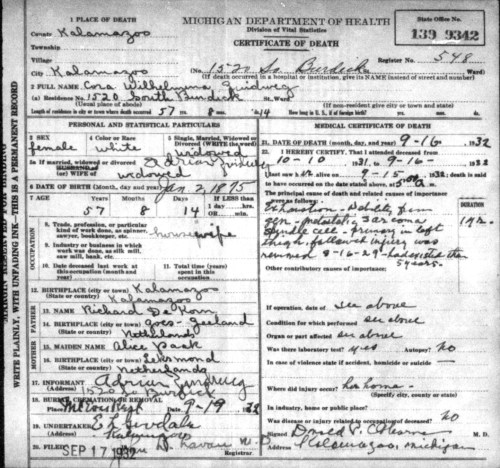
Two years ago I posted about Grandma’s uncle Fred Waldeck and his wife Caroline Meir (Meier). Fred was terribly injured in a streetcar accident. Because of severe brain damage, he had to live out the rest of his life at the State Hospital in Kalamazoo. He lived there for over 53 years.

Before the accident, the young couple had had one child, Edward. He also was involved in an accident when he was fourteen years old–when a man hit his bicycle in a hit-and-run!

Here are two posts about Fred, Caroline, and Edward.

The Waldeck Search Begins to Yield a Few Answers

Waldeck Family Research

I had never seen a photograph of Caroline or Ed, although I do have the one photograph of Fred with his family of origin. Fred is the man standing on the left, behind his father. The mother is Alwine, the younger sister of August Noffke. The little girl seated is my great-grandmother, Clara.

Recently, I made contact with a man named Roy through Ancestry.com who is related to Caroline Meir Waldeck. He rescued some negatives of the Meir family that his father was going to throw away and had them made into photographs.


Caroline Meir Waldeck, Wilhelmina Draheim Meir, and Louise Meir Schulz (Caroline’s sister)

Both Roy and I would like to know if Edward Waldeck is in the group shots. Edward August Gottfried Waldeck (1897-1971) was my first cousin, 2x removed.

Here is one of the young men so you can focus on them. Roy has names for the ones on each end, and thinks he knows who the second from left is.

Could the third from left be Edward?

Here he is with a young woman, maybe his future wife or wife Cora van Strien? Does he show resemblance to Caroline and/or to Fred? If you know who these people are, please let us know.

So wonderful that Roy saved the negatives and thus the images of the Meir family!

Read Full Post »

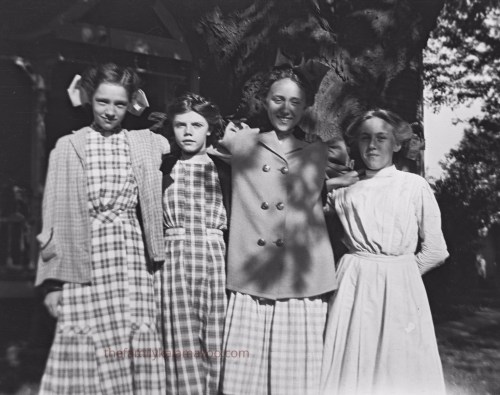
In the collection of images derived from Joseph DeKorn’s glass negatives, there are photos of children. Unfortunately, children are hard to identify, and I don’t know who most of them are. In this beautiful photograph, Grandpa’s first cousin, Alice Leeuwenhoek, is shown with three friends, neighbors, or relatives. The girls and their clothing remind me of the book and movie Pollyanna. The novel was written in 1913, and Alice was born in 1897, so this is close! Alice is the tall girl in the double-breasted coat.

Alice was married at age 26 to Clarence Moerdyk. They never had any children. Alice was a successful seamstress. Sadly, she passed away at age 66, leaving behind her husband and her mother, Jennie Leeuwenhoek. She was buried at Riverside Cemetery in Kalamazoo.


As usual, if anybody has any ideas about the identities of the other girls, please let me know!

I hope you have someone or someones to spend a happy Thanksgiving with! This year it’s just my husband and me, and I accidentally bought a 24-pound turkey (don’t ask). Any ideas on dishes I can make with the turkey and then freeze? Besides soup, of course.

Read Full Post »

I’ve published so many posts about the Paak* family that I thought I would share with you a photograph of Professor Lawrence, the man who provided me so many photos and much information on the family, and two of his siblings (children of Theresa Pake Lawrence).


In the turquoise dress is Una Orline Lawrence Shultz, in the middle is Professor Edgar “Ed” Lawrence himself, and on the right is brother Richard “Dick” Lawrence. These are the three children of Theresa Pake Lawrence.

When she married Roy Lawrence, he had three children, Duane, Caryl, and Audrey, so Professor Lawrence and his siblings had three half-siblings.

Here is a photo of Professor Lawrence with his half-sister, Caryl Ruth Lawrence. Caryl retired from the U.S. Army as a Major. Professor Lawrence is also a veteran of the army.

The siblings had a younger brother Robert J. Borger (foster brother who was a Lawrence in every way but legally) who died at age 42 in a motorcycle/pickup accident in 1977 in Schoolcraft, Michigan.

Now let’s back up a generation. Remember that Theresa and her siblings lived with their father George/Joseph after the death of their mother. Then their house burned down. After that, Theresa went to live with the Pickards as their foster child. Theresa is in the front on the left. Sister Jane is in the back on the right. She was called Jennie as a child.

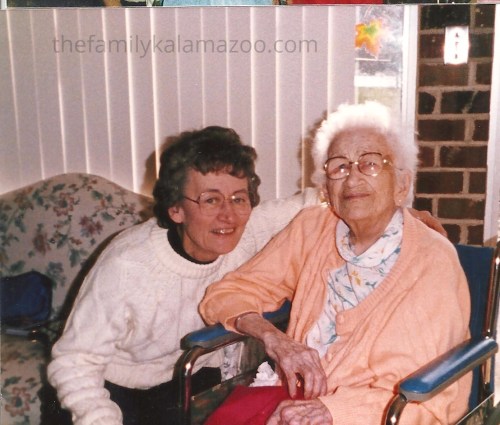
To show the link between Theresa’s generation and that of her children, I am sharing a photo of Professor Lawrence’s sister Una, the niece of Jane, with her Aunt Jane at the nursing home on the occasion of Jane’s 100th birthday. Jane had no children, and I like to see her sibling’s children were watching over her.

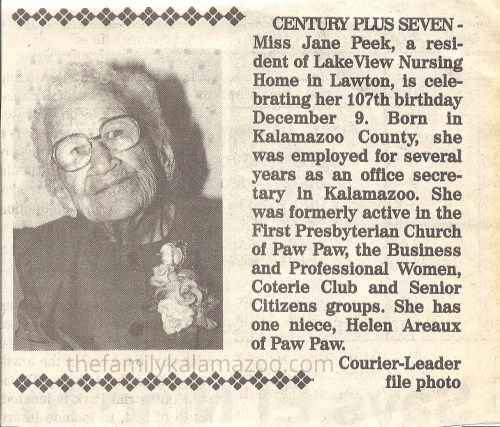
Jane ultimately lived to be almost 108 years old. She passed away in 1998. Think of all the changes in the world that she experienced!

Professor Lawrence gave me an invite to his family tree, so I am going to go through and make sure we both have the same information. Anybody know if there is a comparison tool on Ancestry? Or some way to more easily compare two trees?

I admit that I bounce around from one branch to another, but if I stuck with one branch I would never move forward on anything else because each branch has so many individuals and stories and details.


* I’ve changed his surname spelling to the one that my great-great-grandmother used because I see that he did also use that spelling in addition to other spellings.

Here are the other Pake/Paake /Paak //Peek posts:

A Series of Disasters

The Children After the Fire, 1902

Paak-a-boo

Saved from the Fire

Who is George Paak, Sr.?

Curious about George

George Paak’s Legacy, Part I

George Paak’s Legacy, Part II: Theresa’s Pre-Professional Education

George Paak’s Legacy, Part III: Theresa’s Professional Education

George Paak’s Legacy, Part IV: A Letter to His Daughter

George Paak’s Legacy, Part V: Theresa Gets Married

George Paak’s Legacy, Part VI: Who Were the Pickards

George Paak’s Legacy, Part VII: Imagining the Man and His Home


Read Full Post »

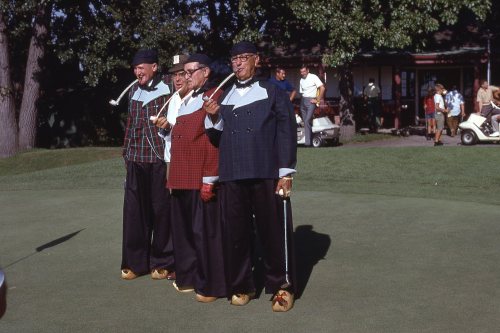
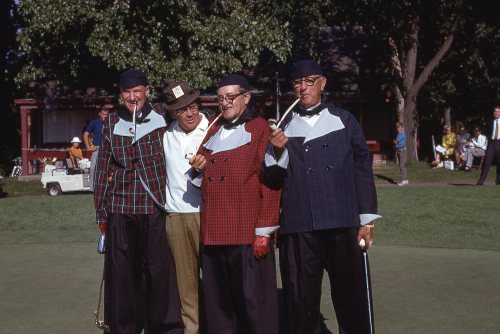
These photographs don’t belong to me, and they aren’t even of my family. But a fellow genealogist, The Psychogenealogist, began posting photos on Twitter, and I noticed the setting of the Kalamazoo Country Club. These photos were taken in 1968 and belonged to his grandfather, Michael John Hanley Jr. (1924-2015), who felt that KCC was a home away from home. Many family events were held there.

Michael moved to Kalamazoo from Flint in the late 60s, perhaps 1968, and was a GM plant manager through the early 80s. His two youngest children finished out high school in Kalamazoo. He maintained a residence in Kalamazoo until his death, but wintered in Florida after retirement. His first wife was Betty Grace Sears, who died in 1981, and at some point after that, he married Mary Jo Hipskind Johnson (1926-2011). Mary Jo graduated from St. Augustine High School in 1944.

If you’re from Kalamazoo, take a look and see if you recognize anyone in the pix–or what they were doing dressed up this way with klompen on their feet!

Give me a holler if you recognize individuals or the event!

Read Full Post »

What a lovely review of Kin Types by genealogy blogger Ann Marie Bryant! Thank you so much for your thoughtfulness!

Ann Marie Bryant's avatarTales of a Family

Recently, a fellow blogger and an ever-encouraging supporter, Luanne Castle wrote a lovely book of poems about her family.  From the start, Kin Types captured my imagination with the thought provoking title and the intriguing cover.   It began with sage advice from familial ancestors who have lived a life of hard work and a heartfelt existence that helped those in need.

View original post 171 more words

Read Full Post »

We just got back from Lake Tahoe last night, and I have a lot of catching up to do—including blog reading!

This beautiful funeral photograph from Kalamazoo seems to belong to someone in my family, but who is the mystery woman? I have not been able to figure it out. If anybody has any ideas, based on knowledge of the family or even based on photos I’ve already posted, please let me know!

Any idea on what decade this is? Was this typical of a certain era to create a tableau like this from a funeral? The only other photo I have that is similar is the one for Louis Van Wyck‘s funeral in 1911. His funeral was hosted by the Salvation Army.

John M. Reidsema ran his photography business in Kalamazoo from at least 1889 – 1905, possibly earlier and/or later.

Read Full Post »

« Newer Posts - Older Posts »