Feeds:
Posts
Comments

Posts Tagged ‘family history’


I wonder which Richard DeKorn building site this is.  The thin line of trees behind it is interesting because that doesn’t look like right downtown.  What do you think the buildings behind the site are?  And that long low structure?

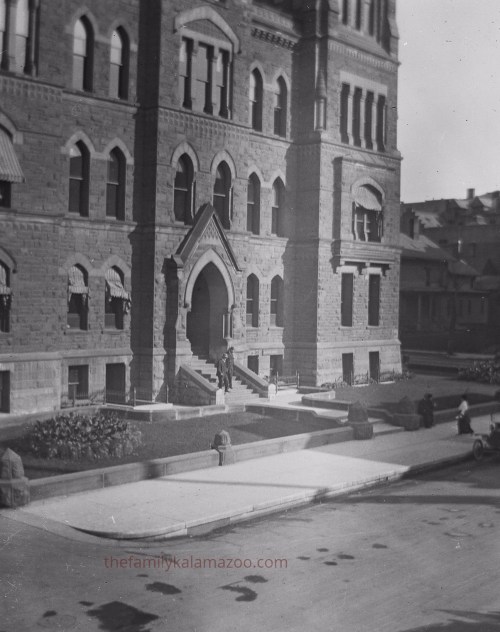
The next photo was identified by reader David K. as “the old city hall in Grand Rapids.” http://cdn.loc.gov/service/pnp/habshaer/mi/mi0000/mi0015/photos/089268pv.jpg This makes sense because the photographer, Joseph DeKorn, ended up going to work for the City of Grand Rapids, eventually becoming  Superintendent of the Grand Rapids Water and Light Company. The details of the building are beautiful, as is the landscaping.

Joseph DeKorn took the following photo of Kalamazoo’s downtown. Comments by readers help to describe more about the location.

Downtown Kalamazoo

Downtown Kalamazoo

As usual, I don’t know enough about these photographs.  The first one was a photo I found with old newspaper clippings.  The other two were from glass negatives taken by Joseph DeKorn.  Any guesses on age, based on the clothing of the people?

Read Full Post »

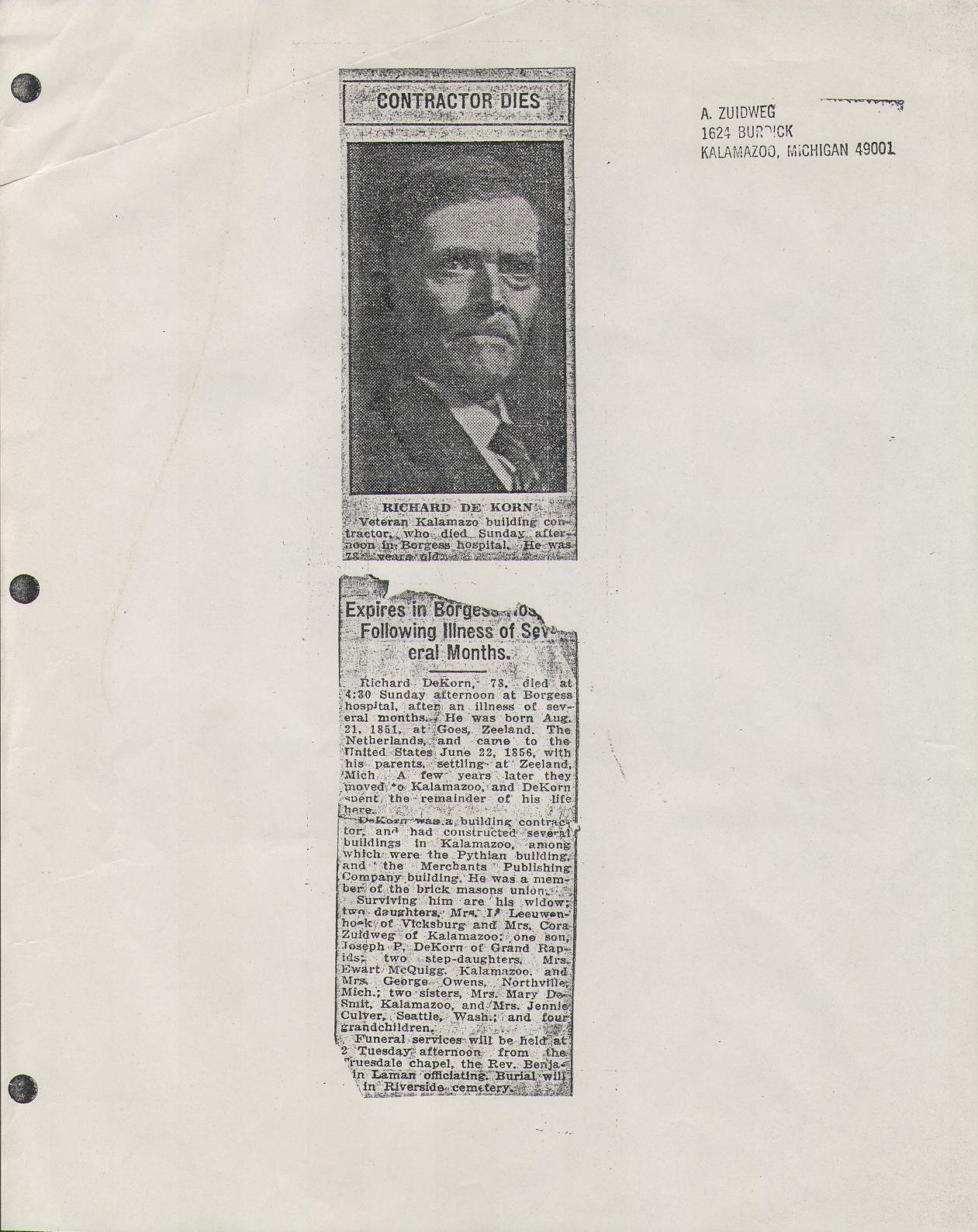
Richard DeKorn obituary

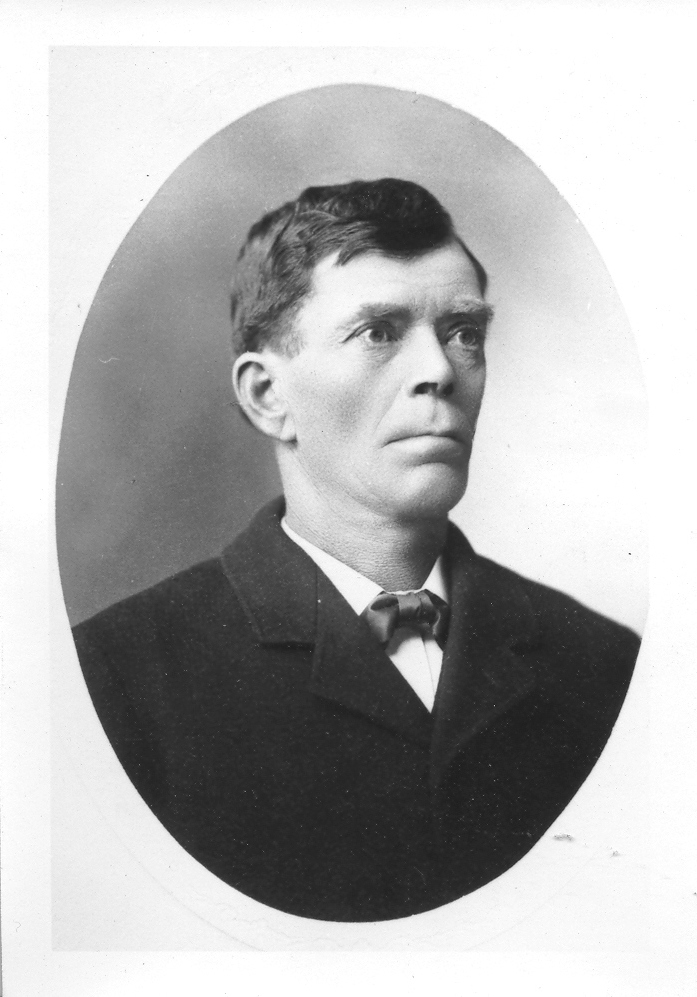
This obit confirms that Richard’s (Dirk de Korne)  sister, Jennie Culver, did move to Seattle and raise her family there.  Also, although the genealogy research done by Yvette Hoitink shows Richard was born in Kapelle, this obituary states what I had always been told, that he was from Goes.  Those towns are not far from each other.

I’ve written a couple of other posts about Richard DeKorn, including Richard DeKorn, Brick Mason and General Contractor.  This obituary mentions two other buildings I didn’t realize he had built:  the Pythian Building and the Merchants Publishing Company building.  I also learned that he was a member of the brick masons union.

Pythian Building

Pythian Building

I’ve mentioned before that he built the Telegraph building, the tower at the state hospital, and the Ladies Library Association building (and many others).

You see Park Cafe in the low building to the side of the building?  I remember them from the sixties and seventies when they used to make the best olive burgers anywhere in the world.  The grease would soak right through the waxed paper, and they were absolutely smothered in green olives.  I recall walking past the building to get my burger and thinking what a beautiful old building it was, never dreaming that my great-great grandfather had built it.

NEW INFORMATION ADDED IN THE NEXT POST!!  EXTRA, EXTRA, READ ALL ABOUT IT!!!

Read Full Post »

In the world of family history blogs, I feel like the new kid on the block.  I probably am the new kid on the block.  There’s always that one moment when you know you’ve been accepted into the new neighborhood.  For me it was when Mom at Maybe someone should write that down  passed to me the Liebster award.  I had to look up what Liebster means and apparently it means dearest in German.  If I have that wrong, please correct me, but I thought that was a sweet name.liebster-award2

In order to accept the Liebster Award, one must do the following things:

1.  Thank (and link to) the presenter of my 2013 Liebster Award:

Thank you, Mom!  Her blog, “Maybe someone should write that down,” is a beautiful site, filled with a variety of posts related to family history, genealogy, the past, and blogging.  Mom herself is a great conversationalist in blogland and a welcome and welcoming presence.  Please check out her blog, if you don’t already know her site!

2.  Post 11 fascinating facts about one’s own self:

Hahaha, that would presuppose that there were even a couple of fascinating facts about myself.  I’ll try facts about my ancestors–how about them apples?

i. My maternal grandmother L. Edna Mulder Zuidweg  had the third highest GPA and was class historian when she graduated from Caledonia High School in 1929.

ii. My grandfather Adrian Zuidweg lost the sight in one eye from a sewing needle when he was three years old.  He was treated at the University of Michigan Medical Center in Ann Arbor, which must have been quite a trek for the family from Kalamazoo.

iii.  My paternal grandmother Marie K. Wakefield was the head fitter for the 28 Shop at the Marshall Field flagship store in Chicago.

iv. My great-grandfather Charles Mulder blew his pipe smoke into a plastic Yogi Bear bubble pipe I had and made me smoke it.  I’ve hated tobacco smoke ever since.

v.  My great-grandfather Frank Klein built a fish pond and gazebo at his Elmhurst, Illinois, house.

vi. My grandmother L. Edna Mulder Zuidweg had to walk 3 miles to school and 3 miles back each day.  She walked with her siblings.  When there was a bad storm, her mother drove the children to school in a tiny black Amish buggy.

vii. My great-great-grandmother Jennie Zuidweg wore eleven skirts and petticoats, each one filled with pockets.  She carried items in many of the pockets.

viii. My great-grand-uncle Lucas Zuidweg, a sailor, died when he fell on an anchor.

ix. The husband of my great-grand-aunt Jennie DeKorn Leeuwenhoek is a descendent of the man who invented the microscope, Anton Van Leeuwenhoek.

x. My maternal grandparents share a common ancestor, Karel Mulder, a “jailer’s hand.”

xi. My great-grandmother Cora DeKorn Zuidweg loved horses and, as a girl, wanted to spend as much time with them as possible.  As an adult, when she saw a man whipping his horse, she turned the man’s whip on him.

3.  Answer the 11 questions that my nominator made up for me:

I’m already confused by all the 11s.  Were there questions?

4.  Make up 11 questions to be answered by the 11 blogs who I choose to award the Liebster to:

Here they are (but if you don’t want to answer them, you don’t have to):  please list 11 fun facts about your ancestors.

5.  Nominate 11 bloggers who I personally enjoy, AND whose subscriber count does not exceed 200 and link to the 11 I choose, and then be sure to tell them why my website is pinging at them.  Since I don’t know how to tell what subscriber count anyone has, I’ll give you a list of a few of my dearest family history and genealogy blogs, although 11 doesn’t even begin to do the list justice!

Here they are in no particular order:

i.  Back atcha, Mom.  Please visit her lovely blog, Maybe someone should write that down.

ii. Jose over at Enhanced News Archive is an absolute treasure.  He researches newspapers and shares the results online so that the information can be plugged into family trees.  He does this service for strangers, as well as for fellow bloggers.  What a genealogy hero!

iii. EmilyAnn Frances at Child Out of Time writes charmingly about her family history, which has its roots in Italian, Spanish, and Jewish heritages.

iv. Sheryl at One Hundred Years Ago writes a unique blog.  Each post showcases a diary entry written by her grandmother 100 years ago and then Sheryl herself provides informative research about a related topic.

v. Sheila at I’ll Call It Like I See It and also of Red’s Rants and Raves is a wonderful participant in Blogland.  In the first blog, she writes humor and the subjects are varied.  The 2nd blog she actually ghost writes for the rescue Welsh Terrier Red ;).

vi. Jackie Dinnis, from Brighton, writes beautifully about her own life and that of her family.  Her blog provides a window into life in that part of the world over the past decades.

vii. Jedwardnajera’s Blog is a great read.  He’s a writer and artist and he also posts from a 400 page manuscript his father, who was born in 1908, wrote in Spanish.

viii. Relatively Frank showcases a collection of essays written by the blogger’s father.  Very poignant window into the life of one who has gone before.

ix. Deborah Sweeney at Genealogy Lady is a very accomplished genealogist.  I’m fascinated by her rich family stories.

x. William at Among My Branches is a thirty-something genealogy addict ;).  His stories are well-researched and engaging.

xi. Helen Tovey on Stitching Yesteryear weaves together family stories and needlework on her very lovely blog.

Thanks, Mom, for giving me the opportunity to give shout-outs to a group of great family history bloggers!

Read Full Post »

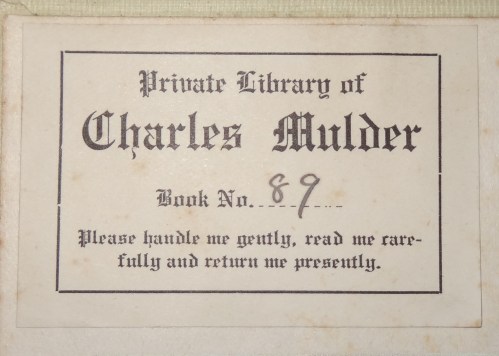
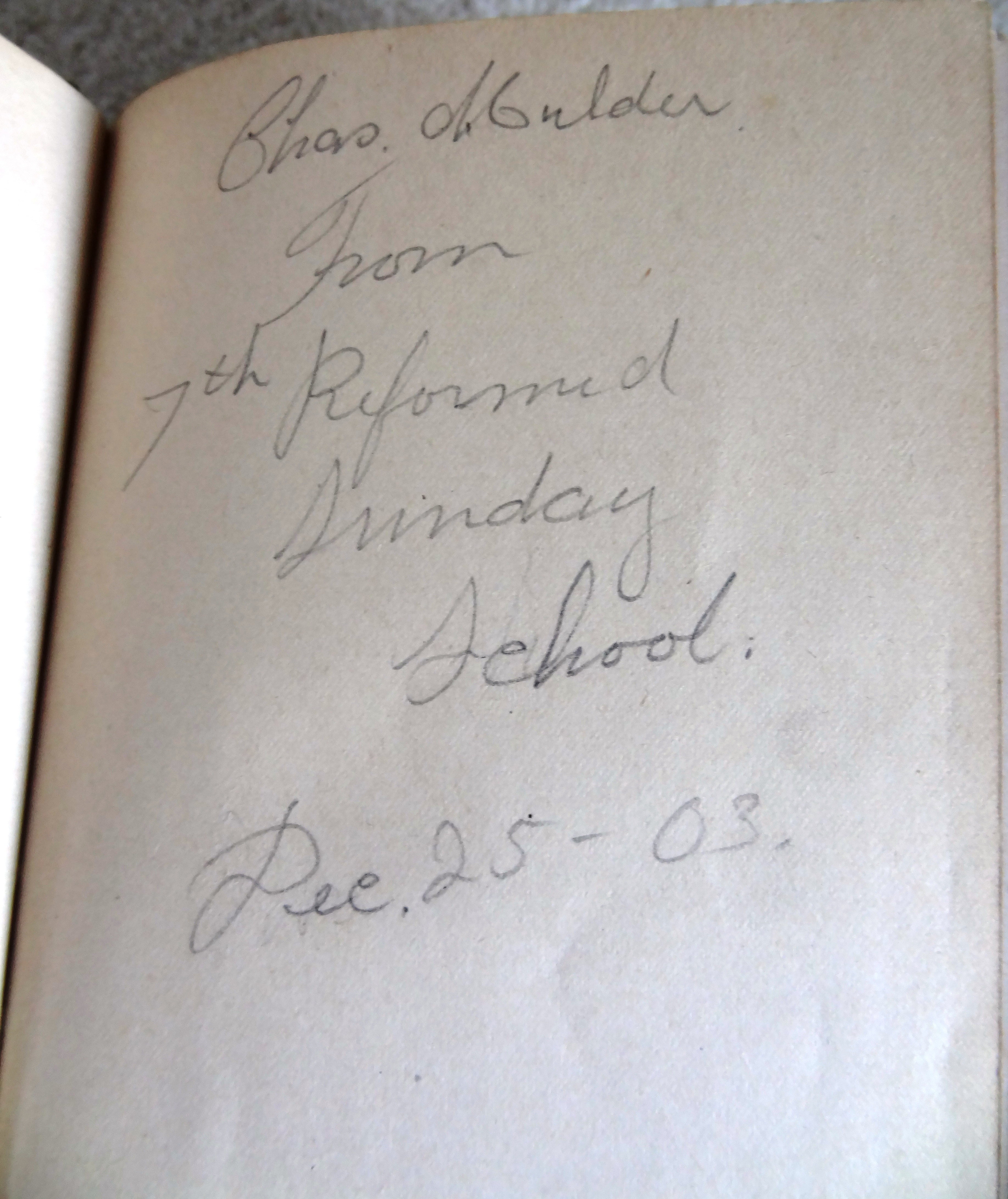
When I was a little girl and my great-grandfather Charles Mulder and his wife Margaret sold the farm and moved to a different house, I was given my great grandfather’s old books.  These were books which dated back to his childhood and youth.  One of the books was signed with the date December 25, 1903; I shared that on a recent post and will re-post a thumbnail here.  However, I think these books date to the late 19th century.  Great Grandpa was born in 1885.

The most beautiful set were little bone colored books with light blue and gilt, and I read every one of them.  My favorites were the one which were rags to riches stories with strong morals.  These were similar to Horatio Alger stories in that the riches were not truly great wealth, but the ability to have self-respect within our society and to do good for others.  My least favorites were the ones which sounded too much like prayers.

These were published by The American Tract Society, which is still in business.  According to Wikipedia:
The American Tract Society (ATS) is a nonprofit, nonsectarian but evangelical organization founded on May 11, 1825 in New York City for the purpose of publishing and disseminating Christian literature. ATS traces its lineage back through the New York Tract Society (1812) and the New England Tract Society (1814) to the Religious Tract Society of London, begun in 1799. Over the years, ATS has produced and distributed many millions of pieces of literature.

I wish the books were in better shape, but in the nearly 50 years I have owned them, they have really started to show their age.  They are spotting, and the bindings are getting loose.  Before too long, I will have owned them for half their lifetime.

Book #89I wonder how many there were!

Book #89
I wonder how many there were!

In case you would like to start reading one:

Read Full Post »

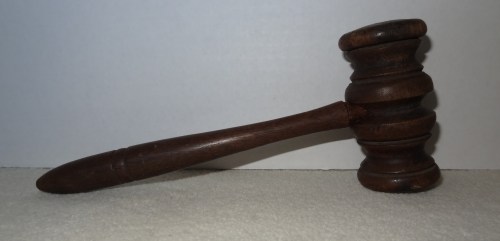
This gavel belonged to my great-grandfather Charles Mulder of Caledonia, Michigan.

He was my maternal grandmother‘s father and his name at birth, in 1885 in Goes, Zeeland, the Netherlands, was Karel Pieter Phillipus Mulder.  His great-great-grandfather was Carel Mulder, born March 8, 1780 in Goes, the Netherlands.  His occupation was a jailor’s hand.

This same Carel Mulder is also an ancestor of my maternal grandfather.  I wrote about the discovery of this coincidence in an earlier post.

Great Grandpa was a working farmer for many years.  I remember his farm with great affection because it had a rope swing from an apple tree, a barn, a chicken coop, outhouse, and fields where we once went on a hayride. Across the country road, a the thick woods nurtured a colorful assortment of wild flowers.

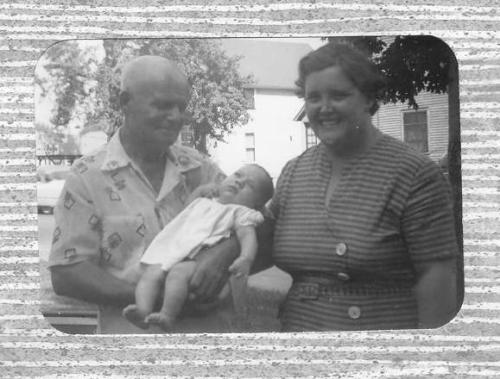
Great Grandpa, me (the first great grandchild), and Margaret

Great Grandpa, me (the first great-grandchild), and Margaret

In the above photo, Great Grandpa is with the only “great-grandmother” I knew, his second wife, Margaret, a very sweet lady.  My great-grandmother Clara passed away from uterine cancer two years before I was born.

Charles and Clara (Waldeck) Mulder

Charles and Clara (Waldeck) Mulder

My father told me that Great Grandpa held the position of Township Supervisor years ago and that is where he used this gavel.

On pages 252-256 of Ernest B. Fisher’s 1918 book, Grand Rapids and Kent County, Michigan: historical account of …, Volume 1I discovered more specific information about Great Grandpa and Caledonia.

Fisher explains that Caledonia was a “wilderness” with narrow trails by the local Native Americans (“red men,” according to Fisher) when Europeans first arrived there.  He states:

At the mouth of Coldwater river was a great Indian camping ground and burial place. The Indians did not leave there entirely until a comparatively recent date. One of them, old Soh-na-go, or “Squirrel,” was seen at quite a late day visiting the burial place and the hunting grounds of his fathers, but the “white man’s axe” had been there and it was no longer a home for him.

He goes on to say:

Caledonia, situated on Section 29, is a prosperous village of 600 people. It was settled in 1850, the first plat was made in 1870, and it reached the dignity of an incorporated municipality in 1888. It is situated on the Michigan Central railroad and hence has good shipping facilities which make it the center of trade for a wide extent of fertile country. It has one Methodist and two United Brethren churches, a bank, and a weekly newspaper, the News, and the requisite number of mercantile establishments and general industries.

The township of Caledonia is one of the best agricultural districts in Kent county, and the thrifty farmers are profitably engaged in all classes of diversified farming.

What interested me is that I saw that inside one of Great Grandpa’s books he went to a (Dutch) Reformed Church in 1903.  He was so ensconced in life in Caledonia by 1915 that he was Township Supervisor (and Grandma was born in 1912 in Caledonia).  The quote above says that there was one Methodist and two United Brethren churches, and I do know that my grandmother was a Methodist and that we used to have family reunions in the basement of the Methodist Church in Caledonia when I was a kid.  So where did he go to the Reformed Church?

According to records I found through ancestry.com, he immigrated to the United States with his family when he was two or three and grew up in Grand Rapids, not out in the country on a farm, after all.

Back to what Mr. Fisher had to tell me about my great-grandfather:

Below is given a list of the supervisors of the township from its organization down to the present time: 1840, John P. McNaughton; 1842, Norman Foster; 1844, Roswell F. Tyler and William Gibson; 1845, John A. Cornell; 1846, Justus G. Beach; 1848, Reuben H. Smith; 1849, William H. Brown; 1854, Lyman Gerould; 1857, Zabin Williams; 1858, William H. Brown; 1860, Warren S. Hale; 1861, William H. Brown; 1863, William J. Wood; 1865, Adam B. Sherk; 1868, William J. Wood; 1869, Marcus Buell; 1870, Adam B. Sherk; 1871, Robert S. Jackson; 1872, William J. Wood; 1873, Martin Whitney; 1877, Austin W. Hill; 1878, Marcus Buell; 1879, Sherman T. Colson; 1889, Alfred W. Stow; 1891, Sherman T. Colson; 1895, Eugene Ward; 1900, Joseph E. Kennedy; 1901, Alfred Newman; 1904, EugeneWard; 1906, Alfred Newman; 1907, Frederick W. Ruehs; 1912, Merrill M. Kriger; 1914, John J. Luneke; 1915, Charles R. Mulder, present incumbent.

Great Grandpa was the Supervisor of the Township of Caledonia.  He used this gavel to call the meetings to order.  Maybe this desire for order comes to him from his great-great-grandfather, the jailor’s hand.

Read Full Post »

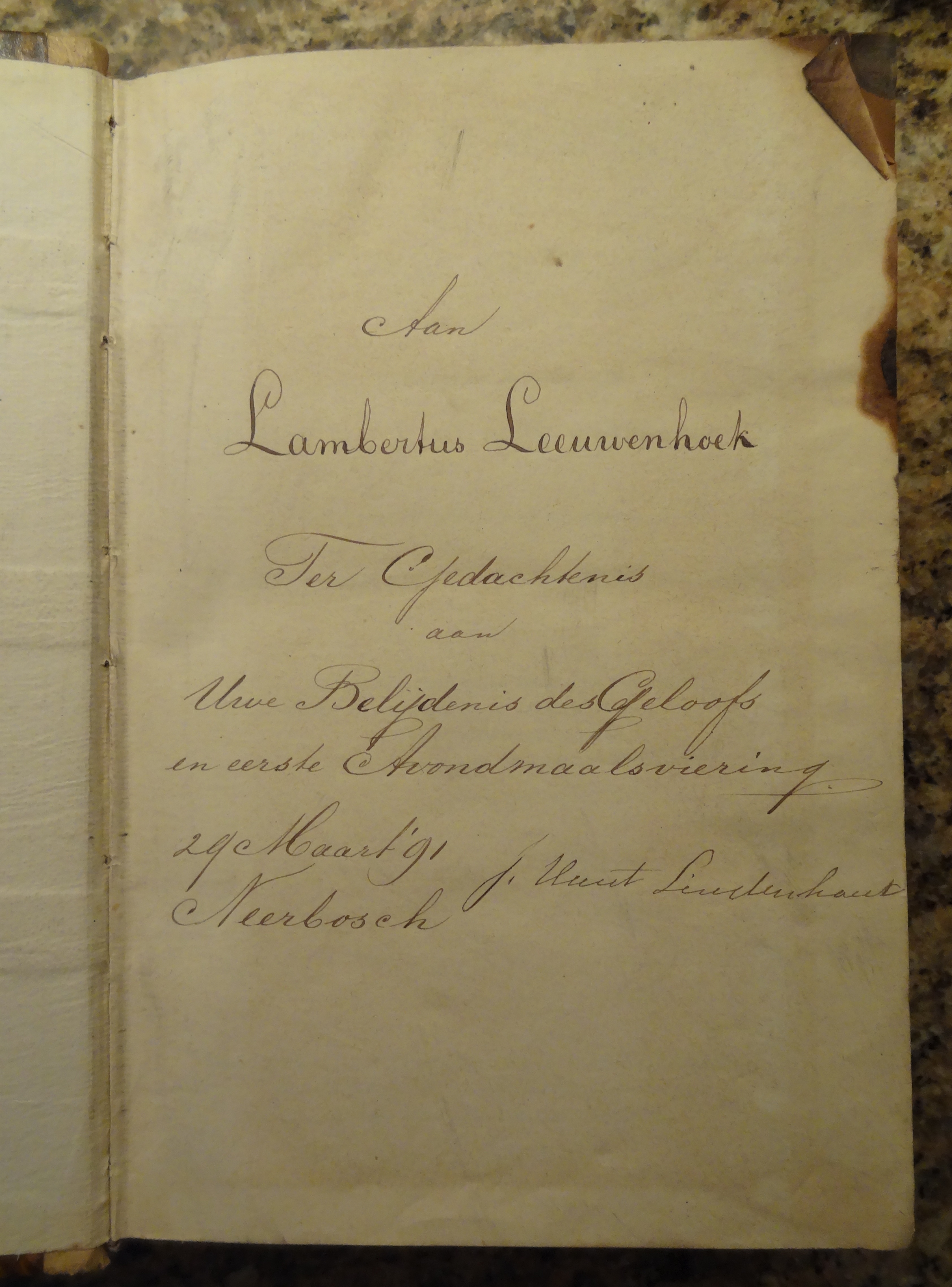
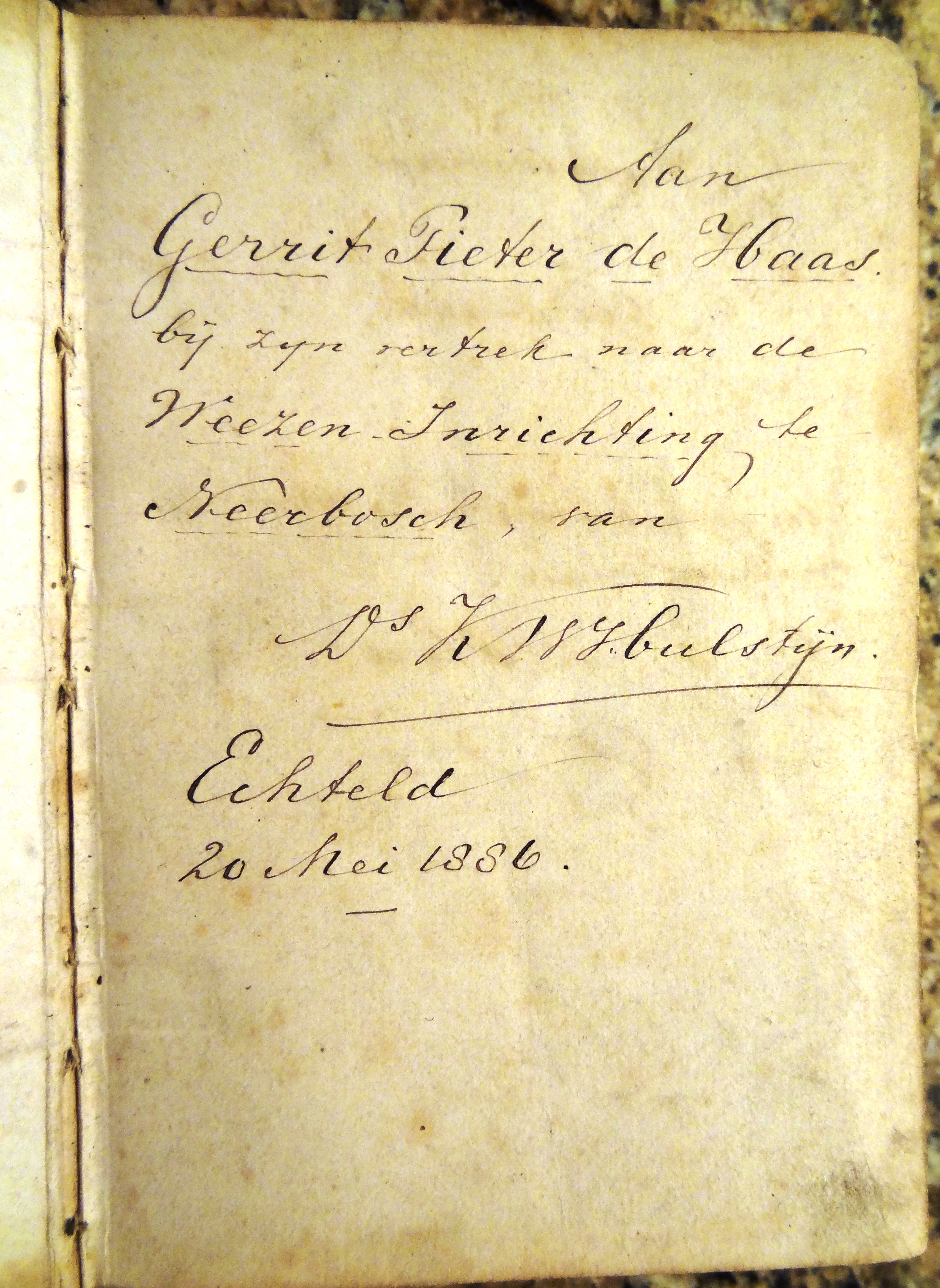
Ok, so maybe it’s not a full collection.  Uncle Lou (Lambertus Leeuwenhoek) left behind two Bibles, both printed in Dutch.  One is a full size Bible to read at home.  The other is smaller, perhaps the size he could tuck into his pocket and carry around.

Uncle Lou's Bijbels

Uncle Lou’s Bijbels

When my grandfather and grandmother gave me the family photographs and glass negatives, they showed me a family Bible or Bijbel, as it is called in Dutch. It wasn’t one of these, but one that had my direct family tree written inside the cover.  That was what my grandparents used to help guide their memories about the people associated with the photographs.  I don’t know what has happened to the Bible.  I hope someone in the family has it and is taking good care of it.  If you are reading this, Bible-keeper, please let me know it’s safe and, if you can, send me some pix!

The insides of Uncle Lou’s Bijbels

The writing inside the front of the larger Bible

The writing inside the front of the larger Bible

These words are printed inside the front of the smaller Bijbel

These words are printed inside the front of the smaller Bijbel

Inside the front of the smaller Bijbel, next page

Inside the front of the smaller Bijbel, next page

Lou wrote his name at the back of this Bijbel

Lou wrote his name at the back of this Bijbel

Read Full Post »

Since I’ve been talking a lot about these DeKorn ancestors and so many of them were born in Kapelle, Zeeland, the Netherlands, I thought I’d scout around online and see what I could see of the town.  I’ve only been to Holland once, for a very brief time, and I didn’t know what towns to look for at the time–so I’ve never seen the area my ancestors came from.

As I showed in a previous post, Kapelle is located in the Dutch province of Zeeland, very close to Goes.  It’s not all that far from Middelburg, the capital of Zeeland.

Kapelle is located at the A flag and Goes is just to the left

Kapelle is located at the A flag and Goes is just to the left

These are houses on the Kerkplein (church square):

Kapellefrom Wikipedia

Kapelle
from Wikipedia

Here is Kapelle in 1910:

Kapelle,Zeeland Zuid Beveland gezin C. van Willegen, 8 kinderen in Klederdracht , meubelhandel en winkel in Galanterieen, hondenkar rond 1910

English: Kapelle (Zeeland NL) train station, r...

Kapelle train station

Read Full Post »

Last post I showed you the photo of my great-great-great-grandfather, Boudewijn de Korne.  I just discovered new information about him written by his grandson Joseph DeKorn.  Boudewijn, his wife Johanna, and their two children travelled to the United States with Gerrit Remine (Gerrard Remijnse), who was Johanna’s brother.

They travelled on a sailing vessel and arrived at Kalamazoo, Michigan on June 22, 1856.  However, “they located in Zeeland, Michigan” for several years.  “The voyage across was bad and long.”  Joseph’s father Richard and Aunt Mary told him it took 90 days, but Joseph didn’t believe it was actually that long.

I mentioned that Boudewijn and his wife Johanna had two living children when they left the Netherlands.  The older is Richard DeKorn; I have introduced him several times before.  Note that Richard’s generation appears to have dropped the final E from their last name.

Richard:  Dirk de Korne, born 21 Aug 1851, Kapelle, Zeeland, the Netherlands; died 26 Jan 1930, Kalamazoo,
Kalamazoo, Michigan, United States.  Also known as Richard and, when younger, Derrick.

Richard DeKorn (Dirk de Korne)

Richard DeKorn (Dirk de Korne)

Mary:  Maria Catharina de Korne was born on 4 Jan 1855 in Kapelle, Zeeland, the Netherlands.  Mary married John DeSmit in Kalamazoo in 1873 and they had at eight children.  Her daughter Frances married a Flipse.  When I got married in 1975 my mother took me to Flipse Flower shop to order my bridal bouquet because they were “shirt tail relatives.”  It’s hard to imagine it from this photo, but Mary only died two years before I was born.

Mary DeKorn DeSmit

Mary DeKorn DeSmit

After the family moved to the United States, Boudewijn and Johanna had another daughter, Adriana, in 1959, who is one year old in the 1860 census.   Nothing after that.

However, a 10-year-old daughter Jennie shows up in the 1870 census, which Jose from Enhanced News Archive was kind enough to find for me.

Joseph DeKorn’s documentation mentions Jennie, but not Adriana.  My grandfather identified the woman in this photograph as Jennie, Richard’s sister, who married a man named John Culver and eventually moved to Seattle, Washington.  She died in Pierce, Washington, on July 4, 1947.  According to her death record, she was born around 1861.  One difficulty in searching is that there is another Jennie Culver (married to Earl) who lived in Kalamazoo during Jennie DeKorn Culver’s lifetime.

So the question remains: was there an Adriana born in 1859 as well as Jennie born in 1860 or 1861?  Or are they the same person?  If Adriana had lived and kept her name, she would have been mentioned in Joseph’s statement.  So either she passed away as an infant or she became known as Jennie or, perhaps most likely, the census got her name wrong to begin with.

UPDATE: IT IS NOW 2018, FIVE YEARS LATER, AND I STILL DO NOT HAVE BIRTH OR BAPTISM INFORMATION ABOUT JENNIE OR ADRIANA. I AM GOING TO ASSUME FOR NOW THAT JENNIE IS ADRIANA–UNTIL I FIND OUT TO THE CONTRARY. THIS IS BECAUSE JENNIE IS A COMMON NICKNAME FOR ADRIANA.

Jennie DeKorn Culver

Jennie DeKorn Culver

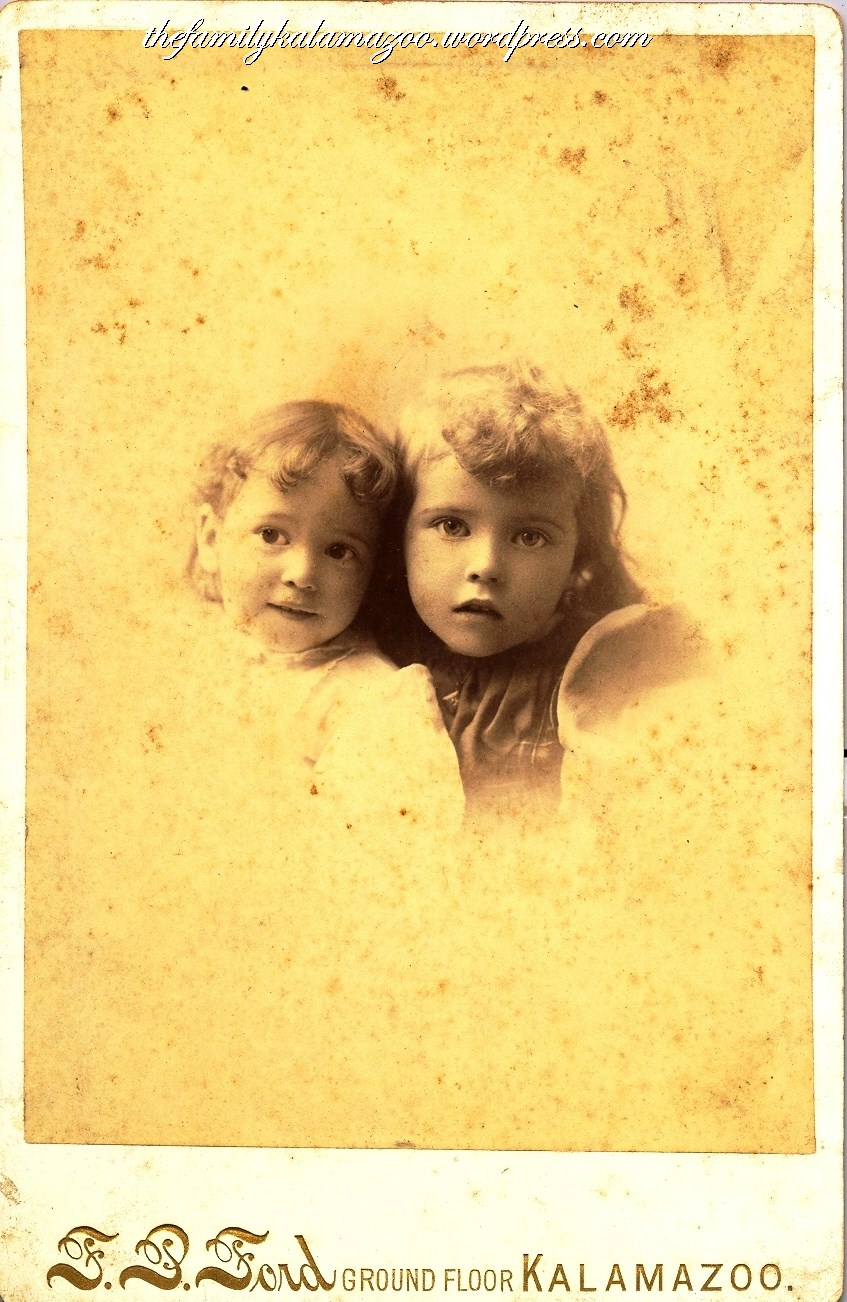
This is a photo of Jenny and John Culver’s children:

The Culver Children

The Culver Children

Read Full Post »

Dutch Arnold

Dutch Arnold

Dutch Arnold was the saloon keeper on S. Burdick Street, Kalamazoo, Michigan.

My grandfather had this photograph and explained to me that he was “Dutch Arnold, the saloon keeper,” but I don’t believe Dutch was a relative.

So I looked him up and found out that the man has a history.

From the Kalamazoo Gazette files

From the Kalamazoo Gazette files

Read more articlesabout Dutch.

Read Full Post »

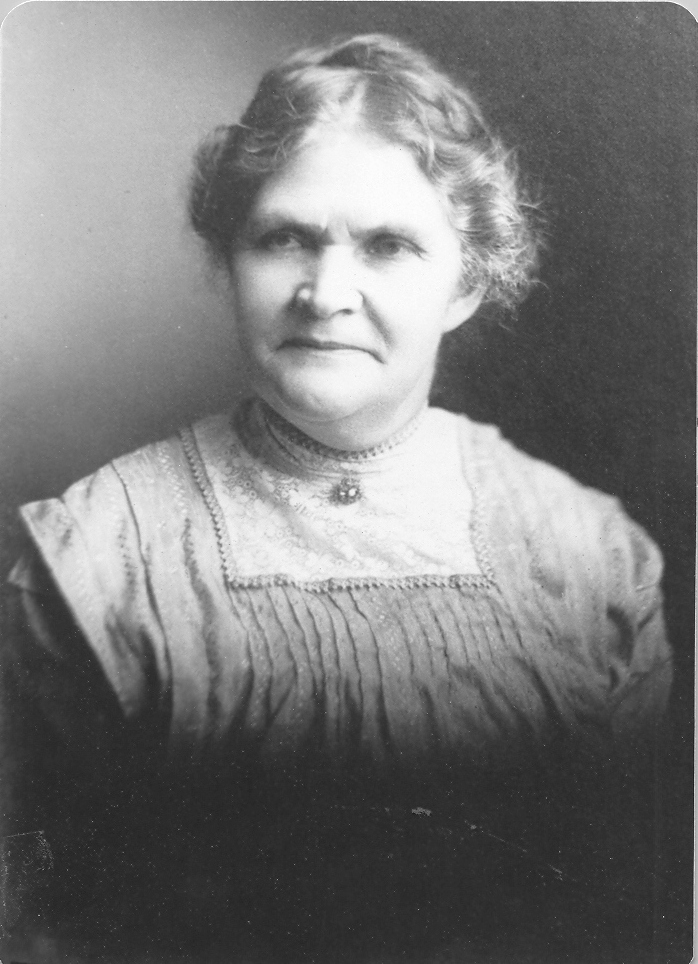
Last post I told you about my great-great-grandmother Alice Paak (Peek) DeKorn. She had three younger sisters, who all grew up in Kalamazoo, as well.  There were two brothers, but I have not tracked them down yet.  To clarify about the last name: Grandpa first identified the name to me as Paak, but genealogical research in the Netherlands shows that the name is actually Peek.

As a reminder, this is Alice:

Alice Paak DeKorn

Alice Peek DeKorn

Here is her sister Annie, born Anna Catharina Peek on January 6, 1855 in Lexmond, Zuid-Holland, the Netherlands.

Here is her sister Mary, born Maaike Peek on July 29, 1859 in Lexmond, Zuid-Holland, the Netherlands.

Mary Paak Remine

Mary Peek Remine

Here is her sister Carrie, born Cornelia Peek on 8 May, 1862 in Lexmond, Zuid-Holland, the Netherlands.

Carrie Paak Waruf

Carrie Peek Waruf

While the Peek girls are all pretty, clearly my great great is the prettiest of all!

Read Full Post »

« Newer Posts - Older Posts »