Feeds:
Posts
Comments

Posts Tagged ‘DeKorn genealogy’

If you recall my posts about Jennie Culver, and her daughters Rhea and Lela, moving to Seattle, you will see that this photo fits neatly into the move. Try this post if you need a reminder or are new to the story:

Bingo: When Aunt Jennie Left for Seattle

On the back, one of the girls has written “my present domicile” and on the front, the date is 1918, the year other photos showed them at the train station, ready for the move.

I glanced at some of the other unidentified Culver photos to see if this apartment building (I assume it is apartments) shows up. Only one other photo with square brick columns shows up, but it can’t be of the same building. See here:

Notice what confuses me here. The square brick column, the white round column–the same as the first photo, right? But the white siding in the second photo is not in the first photo, right again?

I will say the age seems right for Seattle in this photo. The more I look at the Culver photos, the more Kalamazoo photos I suspect might be in the collection.

So who wrote “my present domicile” on this photograph? It wasn’t Jennie because the scrapbook and its photos clearly belonged to one of the daughters.  My confusion began with information I noticed that I wrote about in this post:Who Went Where When?. According to the newspaper, Rhea, the stenographer, moved to Seattle mid-August 1918. Jennie and Lela were not mentioned. But at some point Jennie and Lela did move to Seattle and lived there the rest of their lives. Somewhere around 1918. And Rhea did, too, except that in 1920 she was “spotted” living in Kalamazoo (see my post).

Can I assume that Rhea did go to Seattle August 20 as the newspaper and photograph verify? And that “my present domicile” was where Rhea lived? If so, can I conclude that the scrapbook belonged to Rhea. And that this photo I posted earlier was, in fact, Rhea in the plaid?

Is the handwriting on the above photo, the same as on the back of the first photograph I posted here?

Barely any letters to compare. They each have a final “le”–in Seattle and domicile. While nobody’s handwriting is completely consistent, are these in the bounds of what could be written by the same person? I will say there is a similarity to MY handwriting, weirdly. Both Miss Culver and I produce the triangular Ts of Emily Dickinson.

As usual, I manage to produce more questions than answers. This is becoming a disturbing trend!

Read Full Post »

I’ll be taking a blogging break for the holidays, so I’ll leave you with this gift (that I first posted three years ago)  from Alice Paak (Richard) DeKorn to one of her children, possibly her daughter Cora, my great-grandmother. What a family and genealogy treasure–now 109 years old.

1907

Merry Xmas

from

MOTHER

In case you’re wondering about the use of the word “Xmas” instead of “Christmas,” this is what Wikipedia has to say:

There is a common belief that the word Xmas stems from a secular attempt to remove the religious tradition from Christmas by taking the “Christ” out of “Christmas”, but its use dates back to the 16th century.

I’m sure that this was just a way to fit it all on the tiny shell. What a lot of work to paint and letter this shell. I wonder if she made three, one for each of her children.

Happy holidays to you and yours! See you in the new year!

Read Full Post »

Blogger buddy José at Enhanced News Archive sent me a link to the 1869-1870 Kalamazoo City Directory that lists only one person with one of my family surnames. His name was William DeKorn, and he was a laborer who lived right downtown (194 S. Burdick Street). This seems much earlier than my family came to Kalamazoo. “My” DeKorns first settled in Ottawa County, near Holland, Michigan, before they made their way to Kalamazoo.

I decided to see if this William DeKorn could be related to my family. There is another branch (connected much further back) that settled in Grand Rapids, Michigan, so I wonder if he connected with them or with my family that first went to the Holland, Michigan area. I wrote about the other branch in this post: The Confusing Saga.

First I went to Ancestry and discovered that  this City Directory is the only item that comes up for the name William DeKorn, living in Kalamazoo.

Next I went to the Dutch genealogy website, WieWasWie , and there were not any William DeKorns or DeKornes, with or without a space between the De and the Korn. So, knowing that Willem is the Dutch version of William, I looked up that name. Only one Willem DeKorne who had any documentation in the years before 1869-70. He was from Hoedekenskerke, which is apparently 6.5 miles from Kapelle where my DeKorn/DeKornes come from. The Willem documents that come after 1869 are from a town in between these towns, so all the DeKornes seem to be in the same general area. The Willem I found is the son of Paulus. So I looked up Paulus, and they were all connected with those same three towns.

At that point, it would have seemed logical to try to connect Paulus with my ancestors. I have the DeKorns going back five more generations before Boudewijn.

Instead, I thought I would check to see if my ducks were in a row first. In other words, instead of searching farther outward, I went inward and took a peek at my family tree.

I was astonished to see be reminded how early those first immigrants, Boudewijn and Johanna (Remijinse) DeKorn, must have moved to Kalamazoo. In the 1860 census, they were still living in Ottawa, four years after immigrating from the Netherlands. But Johanna died in 1864 in Kalamazoo. Boudewijn died in Kalamazoo in 1873 or 1875. As you can see, Johanna’s death predated the City Directory publication.

So I took a look at the 1870 census. There was William DeKorn, much as he was in the City Directory, except the census recorded that he lived with his three children: Richard, Mary, and Jennie. In short, William WAS Boudewijn. And why wouldn’t he have changed his name to an “American” one? With a name like Boudewijn . . . . Richard was already listed as a brick mason in the census, although he was only nineteen years old.


There never was an earlier DeKorn in Kalamazoo, after all. Boudewijn was the first of the family to venture to Kalamazoo, probably because of the housing boom. I’m not sure if there if a way to locate the address on the census since every entry is listed in numerical order, but apparently not tied to a particular address.


It did strike me as odd that there was only one Willem DeKorne listed before 1870 on WieWasWie because, for centuries, the Dutch consistently reused the same names, giving a child the name of a grandparent, most typically. If Willem had been a family name for the DeKorns I would have seen more Willems from earlier years.


Knowing that Boudewijn changed his name to William might make it easier to search for other traces of his life in the United States.


Read Full Post »

Some of you might remember the beautiful scrapbook of photographs that I was given by a very kind stranger. It belonged to one of the two adult daughters –Rhea or Lela–of my great-great-grandfather’s sister Jennie DeKorn Culver.

At least one of the three Culvers moved from Kalamazoo to Seattle on August 20, 1918. If only one Culver moved at that time, it wasn’t long before all three were living in the state of Washington. I have not been able to figure out exactly how the move occurred–or why–but it doesn’t stop me from being fascinated with the photos.


Although the majority of the photographs in the album are from 1917 and 1918, this one is marked 9-4-1915. It says it is on Riverside Drive. But what are those initials after the street?

In 1910 Jennie lived with her two daughters at 59 Kalamazoo Avenue in Kalamazoo. She was a seamstress in a corset factory. Rhea was 19 years old and a stenographer in a “paper stock company.” Lela, 21, was a teacher in a public school. I would really love to find out if Lela went to Western Normal School to become a teacher.

So is this Riverside Drive in Kalamazoo or elsewhere? According to Mapquest and Google, there is a Kalamazoo Avenue in Kalamazoo, but not Drive. Both Kalamazoo Avenue and Riverside Avenue are on the east side of Kalamazoo. There’s a famous Riverside Drive in NYC. I’m going to make a guess that those initials say N. Y.–New York City. Do you agree?

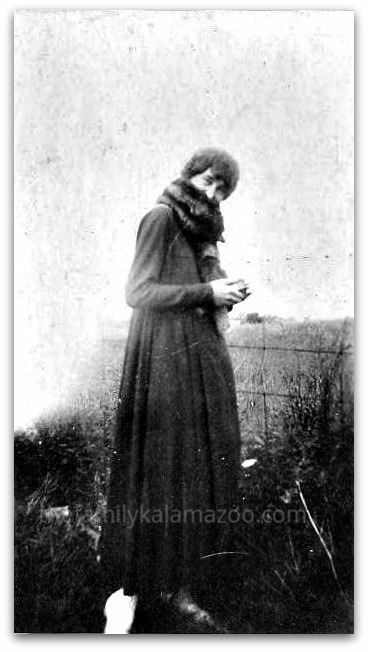
And is this one of the sisters? Unfortunately, I would say NO as both sisters had narrow faces. My guess is that this is a friend of the scrapbook owner.

On a slightly related subject, I just wanted to say:

CONGRATULATIONS to the WMU Broncos!!!

They are undefeated this season!!!! This is my alma mater. This is the alma mater of so many of my relatives. YAY!!!!!!!!!!!!!!

If you want to get hyped up, watch the video and ROW THE BOAT!


Related articles

Read Full Post »

Maureen Taylor, photo detective, helped me with a couple of photos a few years ago. The other day I bought her book, Family Photo Detective.

The book gives a good overview of many topics associated with identifying old family photographs. I haven’t read it all yet, but I did read certain sections because of various questions I already have in my mind.

In my post Mysterious Antique Photographs I posted a painted metal photograph which is unidentified. I believe it is from the Remine family. Although it can seem that the Remines are very distantly related, in fact, Richard DeKorn’s mother was a Remine:


Johanna Remijinse

1817–1864

BIRTH 15 JUL 1817 Kapelle, Zeeland, Netherlands

DEATH 1864 Kalamazoo City, Kalamazoo, Michigan

* my 3rd great-grandmother *

The consensus seems to be that the photo below (of an unidentified Remine female) is a tintype.


However, according to Taylor, a painted photo like this would be a daguerreotype which is painted on its metal surface with colored powders which are brushed or gently blown.

One of the characteristics of a daguerreotype over a tintype is that the image needs to be viewed from an angle. Another important characteristic is a mirror-like surface. I had to pull out the original to examine it for these traits.

It’s impossible to tell if the image needs to be viewed from an angle because the image is so thoroughly painted. But the background is not mirror-like, but rather a matte dark gray with a slight texture.

I went to the internet about this mystery and discovered a site that showcases some hand-painted tintypes. Unfortunately, after 45 years, The Ames Gallery in Berkeley is closing this year. I wonder what will happen to their photographs. Click the name of the gallery to see the painted tintypes.

I think we were right that this is a tintype that has been painted. In fact, the painting is so well done that her face is very realistic. Years ago, I used to work with gold leaf, embossing leather and vinyl products, and I suspect that the jewelry has been painted with gold-leaf.

It’s frustrating that I have not had the time to work on the photos and genealogy for many months (for the most part), but I like to keep moving along, getting one little thing after another accomplished so I don’t lose my touch haha.

Without a doubt, this is the most beautiful photograph in the whole collection.


Read Full Post »

Aunt Jen and Uncle Lou’s (Jennie DeKorn Leeuwenhoek and Lambertus Leeuwenhoek) only child, Alice, married Clarence Moerdyk (Dutch spelling Moerdijk).


Clarence Dewey Moerdyk

1898–1985

BIRTH 24 MAY 1898 Kalamazoo, Kalamazoo Co., MI

DEATH 18 DEC 1985 Winter Park, FL

Clarence’s parents were Peter (Pieter) and Cora. His father immigrated from Biervliet, Zeeland, the Netherlands, when he was 2 years old, in 1867.

I once posted a photo of Clarence as a kid, but at the time I wasn’t sure who he was. Blog readers helped me discover that this is Clarence who lived at 120 W. Ransom in Kalamazoo. That address is directly north of Arcadia Creek, five blocks north of East Michigan Avenue. Would you say he is in his mid-teens?

Alice and Clarence were married in Kalamazoo on 12 September 1923 by The Reverend Benjamin Laman of Bethany Reformed Church.

Here is information about the church at that time from their website:


On June 5, 1905, in a tiny chapel near Burdick and Maple, the mission Sunday School that was to become Bethany held its first service. . . .

Growth under the leadership of these men was so great that less than two years later it was apparent that a larger building was needed. In 1907, a new church was built on the site of the original chapel. At this time the church had grown to include fifty-two families and seventy-seven communicant members. By the time that Reverend Kooiker left the church in 1910, Bethany had grown to sixty-nine families and one hundred eighteen communicant members.


Here is Clarence as I knew him in the early 60s:


Read Full Post »

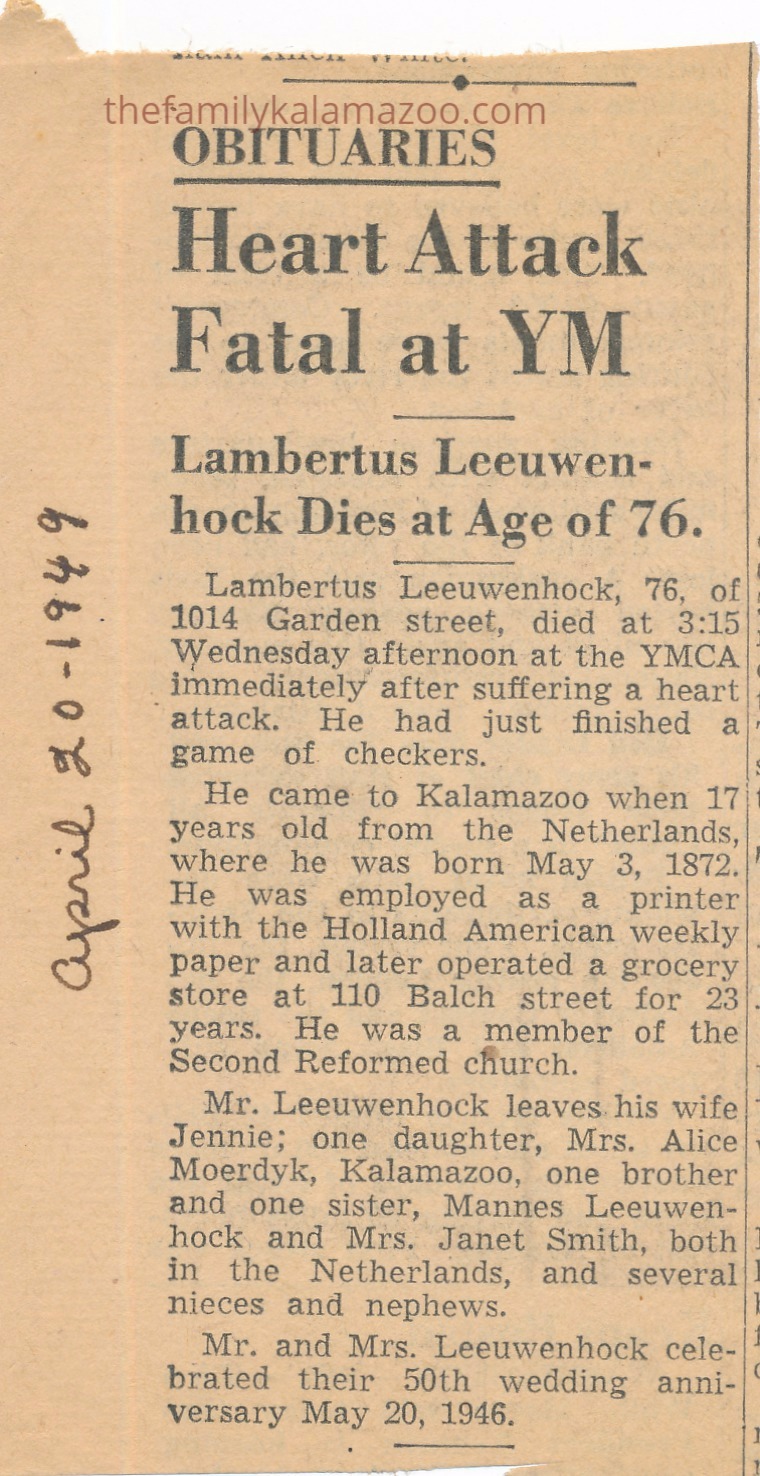
I’ve heard that Uncle Lou (Lambertus Leeuwenhoek) loved to play games–and was very good at them. Where and when he passed away is fitting, in that context.


Uncle Lou “died at 3:15 Wednesday afternoon at the YMCA immediately after suffering a heart attack. He had just finished a game of checkers.” I bet he won the game.

I need to research where the Y was located.

He died on Wednesday, April 20, 1949. Coincidentally, my father-in-law passed away in 1984 on April 20. Notice that Uncle Lou and Aunt Jen were married on May 20. My birthday is July 20. My cousin was born January 20. I always notice the number 20.

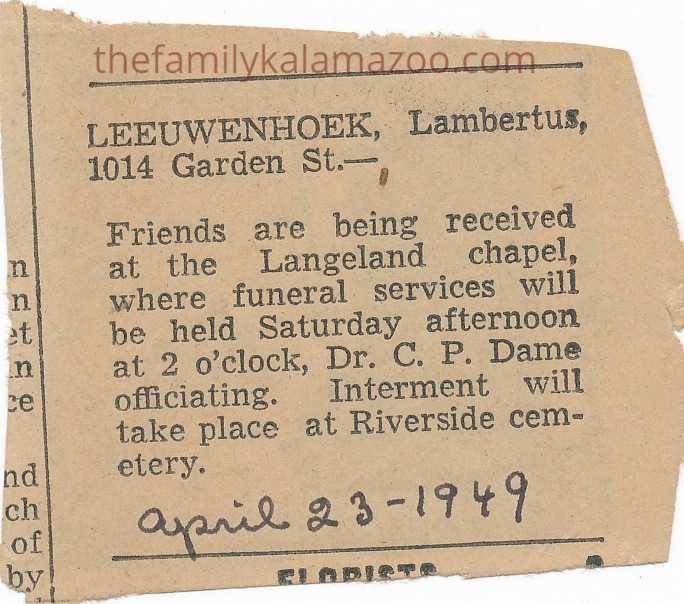
Here is the funeral announcement in the newspaper:

And here is a beautiful memorial book from Uncle Lou’s funeral. I wish I knew how to create a slideshow that allows a reader to enlarge each photo, but I don’t know if there is a way on WordPress.

This slideshow requires JavaScript.

What I find particularly useful from a genealogy standpoint are the names of the visitors on the last two pages. They are as interesting as the names in the obituary, if not more so.

Read Full Post »

OK, we’re going to try this again. You might have seen my post last week about this–which I subsequently deleted when it became obvious I’d missed a clue.

My great-great-grandfather’s sister Jennie DeKorn Culver (divorced) and her two adult daughters moved from Kalamazoo to Seattle at some point. All three women died there. Only Lela seems to have married–at the age of 63.

Two weeks ago, I posted the photo that gives the exact date the Culvers moved to Seattle. Here it is again with the date of August 20, 1918 written on it. One of the Culver daughters is in this photo.


I also posted a photo of all three Culver women–Aunt Jennie DeKorn Culver and her daughter Rhea and Lela–with some identified travelers or perhaps people seeing them off on their travels.

After much searching I did find one newspaper “jotting” that mentions the move. It was posted in the Kalamazoo Gazette on August 13, 1918.


Of COURSE, the mystery deepens. Why does it mention only Rhea and not her mother or sister? I can’t believe they wouldn’t be mentioned if they did, in fact, move at the same time.Maybe Rhea went with the other people in the photo? If so, when did Jennie and Lela move?

I will say that Jennie does look as if she is dressed for travel (she is the 3rd from the left). Do you agree with me? The other daughter, the one in the striped silk could be dressed for travel–or not.

In 1918, Rhea (born 1890) was 28 years old. She was single and a grown woman. I wonder if she went with any of the Culver family or she went with a religious group. Lela was also single and 30 that year. Jennie was 61. I will be 61 this summer. I can’t imagine making that move with my two daughters if I didn’t know anybody else in Seattle.

Also, this new information sheds light on that photo of the young Culver woman with the older woman (above). Maybe that is Rhea and she IS going with that woman to Seattle.

This is where it gets even more confusing.

In the 1920 census, Rhea, stenographer, is living in Kalamazoo with a cousin and the cousin’s husband, Charles Pierce, and daughter! The cousin is Cora DeSmit Pierce, the daughter of Jennie’s sister Mary. WHAT? So Rhea left for Seattle on her own and came back to Kalamazoo? Homesick?

Cora DeSmit Pierce

But wait.

Also in the 1920 census, Jennie and Lela (teacher) were living in Seattle! So Rhea moved to Seattle, according to the paper. It doesn’t say she joined her family there. It sounds as if she is the first Culver to move to Seattle. But how did the others end up in Seattle and Rhea NOT by 1920?

Can this get any more confusing? I will have to study the photo album more to see if I can find any other clues in there. I would like to examine yearly city directories in both Seattle and Kalamazoo, but even if I could, it still might not divulge what happened.

What do you think? Did Rhea move first and the rest of her family come later? Any ideas on where to research next?

Related articles

Read Full Post »

Last week I was given the most wonderful identification of the church that I thought was in Seattle circa 1918. It turned out to be First Congregational Church in Kalamazoo, Michigan, 1917!!!

The young lady in plaid is a Culver, I’m sure. I don’t know who the other lady is. All dressed up for travel. What does the caption say? STARTING FOR SEATTLE AUG. 20, 1918. Hah, you can’t ask for anything better than that in genealogy and family history research. The actual answer–to the day–complete with new outfits and a Gladstone bag in the hand of the older woman. Look it up. It was named after Prime Minister Gladstone, and it’s a very specific and stylish type of luggage. I know this because . . . ta dum . . . I used to own a luggage store. Look at how crisp their clothing was. These poor orphanage girls, daughters of a woman who had to figure out how to make a living for her family of divorce, looks like they are doing pretty well. No idea why . . . .

Here are other photos. Tell me: what does it look like. Are these other people traveling with the Culver women? If so, why are they going to Seattle? Are they all planning to settle there? They seem to be “of a group” because the man is carrying a bag. But what if he’s holding the lady’s Gladstone for her? Maybe they aren’t all going.  I’m confusing myself. What I do believe is that that is Jennie to our right (and their left) of her plaid-skirted daughter. And I think the boldly decorated young lady on plaid’s right (to us she is farthest left) is the other Culver girl. 


Remember that this date is before the end of WWI, which ended in November.

While I have solved the mystery of when the Culver women left for Seattle, I still do not know WHY or WITH WHOM.

Related articles

Read Full Post »

Last year I posted a photo that I believed was taken in Seattle. It was in the Culver-DeKorn photo album that was so kindly sent to me by a “caretaker” of the photos for decades. I wondered what the uniform was that the man was wearing and what the building was that is shown behind him. My assumptions have been shaken to the core. The old post is in quote marks, and below that is what I discovered!

First let me tell you a little more about Jennie DeKorn Culver, my 3rd great-aunt. She is a very sympathetic character to me. She went through a divorce when very few people did so, and she lost her daughters to the orphanage for a little while because of that. She was an artist when that was not approved of for a woman, especially from her background.

Jennie’s parents and two siblings were all born in the Netherlands, but Jennie was born in 1857 in Ottawa, Michigan.

When Jennie was 7, her mother died. When she was 16, her father died. The year before her father died, her oldest sibling, Richard DeKorn, married Alice Paak  on May 10, 1872. Her sister Mary married John DeSmit on October 4, 1872. So when their father passed away, that left Jennie alone. Jennie didn’t marry John Culver until she was 25. What did she do from age 16 to 25 and where did she live?

Here is the old post:

(The Culver-DeKorn family: my great-great grandfather’s sister, Jenny DeKorn Culver, and her daughters, Lela and Rhea, who moved from Kalamazoo to Seattle 100 years ago.)

In the scrapbook which I received from a blog reader I found this photograph. Any ideas on the type of uniform? Since this would have been around the time of the end of WWI, does the uniform have to do with the war?

I don’t know who the man is. Most of the Culver photos are of women.

But the clues would leave me to believe the photo was taken in Seattle in or around 1918. But did Seattle have old elegant buildings like this at that time?

###

Well, my goodness! I had a surprise yesterday when a blog reader posted a comment that upset my whole way of looking at the photo album in general:

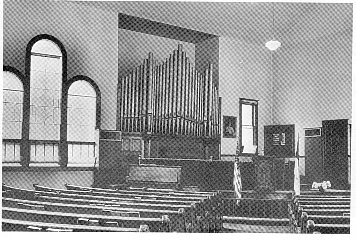
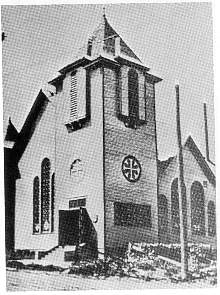
That building is the old First Congregational Church in Kalamazoo. It burned down in 1925. There is a colorized view of the building halfway down this page.

http://www.kpl.gov/local-history/religion/first-congregational.aspx


This slideshow requires JavaScript.

I can’t find a Carl Sadler in Kalamazoo who would be born around 1915 or 1916. Since these photos were taken in 1917, I am estimating that he was born around that time.

Another thing to consider: how many other photos in the album are from Kalamazoo?!

But stay tuned for the next installment of Aunt Jennie. Because I have some more new info about her!

Related articles

Read Full Post »

« Newer Posts - Older Posts »