Feeds:
Posts
Comments

For as long as I could remember my family always celebrated Christmas Eve the same way. After the Christmas Eve service at church, the family would head over to my grandmother’s house–or that of one of her siblings. There was a progressive meal so after awhile we would move on to another house. I remember three houses and three courses, but eventually, I think it became two houses. Nobody does it any longer as my grandmother’s generation is all gone now.

While there were always a lot of delicious Christmas desserts (Grandma, in particular, was a wonderful baker), the main course–the one that couldn’t be avoided missed–was the oyster stew. Year after year, I watched the women stirring the pot of oyster-studded milk, but do you think I ever thought to ask where this tradition came from? Well, maybe I did, but I never got an answer. Maybe nobody knew.

What I should have specifically asked Grandma is “did your mom make the oyster stew on Christmas Eve, too?” But I didn’t.

Suddenly this year I wondered where oyster stew came from. It seemed so out of the ordinary, and my family’s holiday eating habits were not out of the ordinary at all. Turkey or ham, casseroles, cole slaw, jello dishes, cookies–“All-American” food.

I thought about how Grandma’s whole family participated in this tradition. Nobody ever said, “Hey, let’s make clam chowder instead.” Or meatballs. Or tamales. Nobody said, “Let’s try this new recipe.” Nope. Oyster stew.

I wondered if the recipe and the tradition had been passed down in the family. If so, they would have gotten it from Grandma’s mother, Clara Waldeck Mulder. And if it went back still further, it would have come from her mother, Alwine Noffke Waldeck, who might have been born, as her brother August was, in the little Pomeranian town Schwetzkow. Schwetzkow is about 12-15 miles from the Baltic Sea. Alwine was an adult with children when she immigrated her, so she would have brought her traditions with her.

To try to get to the origins, I researched the subject through my friend Ms. Google. One of the most popular articles right now is this one: Oyster Stew on Christmas. This writer argues that the origin lies with the Pilgrims who were “oyster crazy.” She says that when the Irish Catholics came in the 19th century, they latched onto the oyster stew because it closely resembled the traditional Irish ling stew and ling (a type of fish) was not available in the United States. Hmm, my oyster-stew-slurping family are definitely not DAR and not Irish and not Catholic. I couldn’t imagine anybody choosing a tradition of oyster stew just for the heck of it.

At least one article said that Germans couldn’t get oysters because the water is too cold, but then why does Russia get oysters from the Baltic? All in all, the research was very sparse about the Baltic, other than the problems with invasion of foreign species and pollution. Another issue is that in the 19th century, oysters were inexpensive and could be eaten by people without means. Canned oysters have also been readily available in the winter.

I posed my question on both my personal Facebook page and on the Prussian Genealogy group on Facebook. Interesting to see the difference in responses. On my personal page, where I am friends with people who come from a wide variety of backgrounds, only two people (besides family) had heard of the tradition. They both ate oyster stew on Christmas Eve with their Swedish in-laws. This didn’t deter me because Sweden and Pomerania were on opposite sides of the Baltic, and part of Pomerania was even Swedish for some time!

I wrote to my friend, the Swedish writer Catharina Lind, and asked her. She said that there have “never been oysters either in the Baltic Sea or the Bottnian sea, the east coast of Sweden. The salinity level is too low for oysters and the water is too cold. There are oysters in the Nordic sea, but very few, so oysters have never really been part of any Swedish tradition. There are no oyster dishes in Scandinavian (Sweden, Norway, Finland) Christmas traditions. Though a lot of fish, mostly herring and whitefish, and in modern times also salmon. We traditionally eat plenty of pork.” Catharina went on to speculate that perhaps the Swedish Christmas soup made with porcini and oyster mushrooms could have evolved over time to mean fishy oysters instead of mushrooms.

So I thought it was all over.

But then, on the Prussian Facebook Group, where everyone has Prussian, if not only Pomeranian roots, people began to chime in–lots of people have said that their Midwestern Prussian relatives always served oyster stew on Christmas Eve.

Then somebody found the recipe for several German Christmas soups printed in German–and oyster stew is one of them!

OYSTER SOUP RECIPE

Recipe in English

Servings: 4

24 pcs oysters (including juice)

40 g of butter

3/4 cup whole milk (hot)

sweet paprika

salt

pepper

For oyster soup, cook the thrown oysters in the hot butter with oyster juice. When the oyster margins begin to ripen, add the milk, season with salt and pepper and heat. Serve the oyster soup in soup bowls sprinkled with sweet paprika (if desired).


None of this research leads to a definitive answer about the origin of my family’s tradition. Clearly, a lot of ethnicities in the United States have claimed oyster stew. If you’ve ever eaten it, you might wonder why anybody would want to claim it. The only time I liked it was when my husband joined the family and “sneaked” wine and spices into the dish. Now it’s been years since I’ve eaten oyster stew, and I don’t miss the taste, but I do miss everybody who was there at the time.

I wonder if anybody in my family still serves oyster stew!

Catharina’s Christmas books are available here. I also recommend her beautiful book, “Fly Wings, Fly High!” It’s a lyrical memoir about the magpie family she shares her yard with and her own struggles with heart disease.

Pioneer of the Family

After reading the tragic story of August and discovering that maybe, just maybe, he was born in Schwetzkow, Pommern (Pomerania), Prussia, I decided to do a little more digging.

I started with the family reunion notes. The Waldeck-Noffke family held regular family reunions, had officers, and kept notes. Imagine people doing that today!

The junction of the two families was the marriage between Gottfried Waldeck and Alwine Noffke, both of Prussia, my great-great-grandparents.

At the beginning of the notes is an attempt to sum up the “pioneers” of the family in the United States.

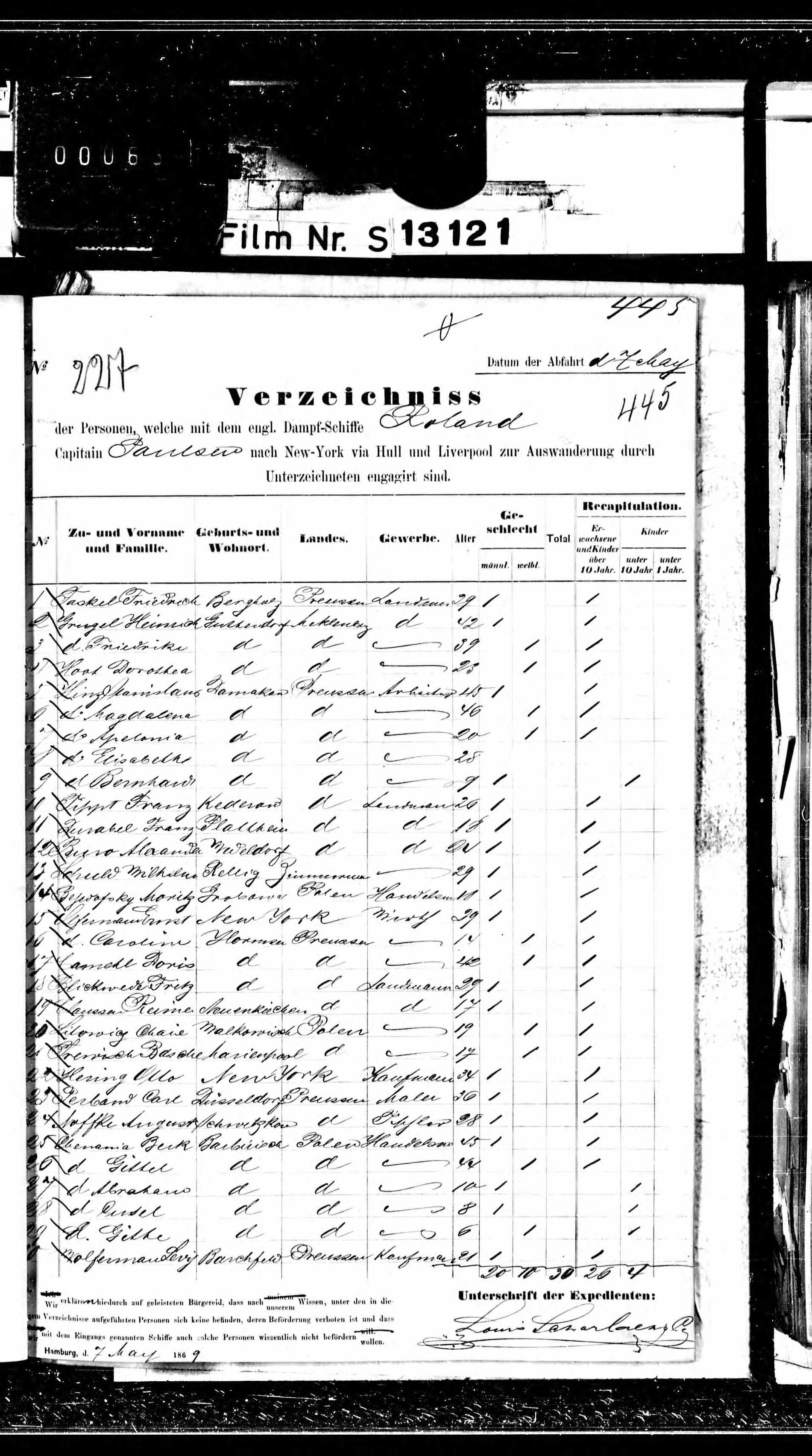
The first person who immigrated–or as I think of him, the canary in the coal mine–was August himself, the man who I wrote about last week, Alwine’s older brother. He was born in 1841 or 1842 and left Schwetzkow in 1869 at age 28.

INFO FROM PASSENGER LIST

August Noffke

Male

Age 28

Tischler (carpenter)

DOB abt 1841

Residence: Schwetzkov, Prussia (Germany)

Departure Date: 7 May 1869

Port of Departure: Hamburg

Port of Arrival: Hull (New York via Liverpool)

Ship: Roland

Captain: Paulsen

Shipping clerk: Louis Scharlach & Co.

Shipping line: H. J. Perlbach & Co.

Ship Type: Dampfschiff (steamboat)

Ship flag: Deutschland

Accomodation: ohne Angabe (without indication)

Volume: 373-71, VIII B 1 Band 015

Household members: August Noffke, age 28

Hull might be a port for “transmigrants” in England. I wish I knew what “Hull (New York via Liverpool)” really means.

The family notes say that his “parents and family” followed him “in about three years.”

The notes also say that August first went to Chicago, then resided in Caledonia township (Kent County, Michigan) with his parents, before returning to settle in Chicago. Also written is that the family doesn’t know when the pioneers (being August and his parents) died. So he was written off to Chicago.

There are records for an August Noffke in Chicago, but then there are quite a few August Noffkes. It apparently was not a rare name.


The Grand Rapids city directories show August living in Grand Rapids in 1872 (and throughout the 1880s), marrying Maria Mueller (Mary) of Big Rapids, Michigan, on 2 November 1875, and having children subsequently, all in Grand Rapids.

The passenger list shows that August was a tischler, which means carpenter. The article in the paper at the time of his death mentioned that he was a cabinet maker.

I do wonder why he left Prussia at age 28. Wouldn’t he have been married already? Why wait until that age?

More questions than answers, as usual!

Apparently, August was buried at Greenwood Cemetery in Grand Rapids. I’ve requested a photo of his headstone through Findagrave. Amberly at The Genealogy Girl suggested I look for the divorce filing since the newspaper article indicated that he had tried to file for divorce and then had stopped because of the children. I am awaiting news from the Western Michigan University archives on that matter.

Two years ago I posted about Grandma’s uncle Fred Waldeck and his wife Caroline Meir (Meier). Fred was terribly injured in a streetcar accident. Because of severe brain damage, he had to live out the rest of his life at the State Hospital in Kalamazoo. He lived there for over 53 years.

Before the accident, the young couple had had one child, Edward. He also was involved in an accident when he was fourteen years old–when a man hit his bicycle in a hit-and-run!

Here are two posts about Fred, Caroline, and Edward.

The Waldeck Search Begins to Yield a Few Answers

Waldeck Family Research

I had never seen a photograph of Caroline or Ed, although I do have the one photograph of Fred with his family of origin. Fred is the man standing on the left, behind his father. The mother is Alwine, the younger sister of August Noffke. The little girl seated is my great-grandmother, Clara.

Recently, I made contact with a man named Roy through Ancestry.com who is related to Caroline Meir Waldeck. He rescued some negatives of the Meir family that his father was going to throw away and had them made into photographs.


Caroline Meir Waldeck, Wilhelmina Draheim Meir, and Louise Meir Schulz (Caroline’s sister)

Both Roy and I would like to know if Edward Waldeck is in the group shots. Edward August Gottfried Waldeck (1897-1971) was my first cousin, 2x removed.

Here is one of the young men so you can focus on them. Roy has names for the ones on each end, and thinks he knows who the second from left is.

Could the third from left be Edward?

Here he is with a young woman, maybe his future wife or wife Cora van Strien? Does he show resemblance to Caroline and/or to Fred? If you know who these people are, please let us know.

So wonderful that Roy saved the negatives and thus the images of the Meir family!

This story is very tragic, and I hope family members don’t mind me sharing it because we need all types of stories to do justice to our history. Having read family history stories for years now, I know that every family had events like this occur. This post is about the Noffke branch.

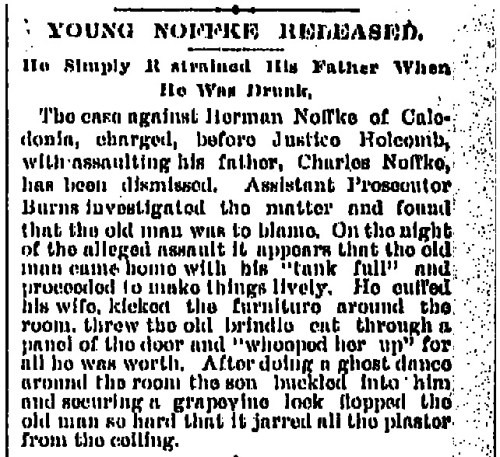
A year and a half ago, I wrote about Louisa/Louiza/Louise Rutkoski, who had married my 3rd great uncle, Charles Noffke, back in Prussia–before immigrating to the United States. When they arrived here, they had a son, Herman, and after settling in Kent County, Louise gave birth to a daughter, Clara. The reason I wrote about Louise was that I had discovered through old newspaper articles that on 7 July 1920 she had drowned in Emmons Lake while suffering an acute attack of “indigestion.”

At the time, I didn’t mention a much earlier article I found about Louise, Charles, and Herman. However, coupled with the story of Louise’s death, that earlier article did inspire a poem, called “Half-Naked Woman Found Dead,” that I included in Kin Types. 

This is the article I found quite some time ago, published in the Grand Rapids Press in 1893.

At the time I read this article, I was saddened for the whole family, but I saw it as a terror for Louise and Herman.

The other day, I was organizing my files on this family and made a little stop at Genealogy Bank to recheck the articles. They have changed the site, and I’m not familiar with it yet. It seems to me that some articles are no longer easy to find, but one I had never seen before popped up.

It’s not only a tragic story in its own right, but it happened a year and a half before Herman put a stop to Charles’ violence. I can’t help but wonder if the event sparked a worsening state in Charles, his emotions, and brought about or increased his drinking.

My great-great-grandmother, Alwine Noffke Waldeck had only two siblings (that I know of), brothers Charles and August. What could have happened in 1891 to send Charles into a state where his violent actions were recorded in the local newspaper?

This is what I found about brother August in the 22 May 1891 issue of the Grand Rapids newspaper, The Evening Leader.

Look at that sensational headling: SHOT THROUGH THE BRAIN. Then the subtitle: August H. Noffke Commits Suicide After Threatening His Wife. So when Charles came home and “proceeded to make things lively,” endangering his wife, son, and the brindle cat, his only brother had somewhat recently been extremely intoxicated and killed himself.

If you read the whole article, you will see that there are two sides to this story–or maybe three. Was Mary Mueller/Miller Noffke mentally ill, cruel, and a nag, causing an unemployed depressed man to finally take his own life? Or was August abusing her and she was trying to put a stop to it through the courts when he got drunk and violent? Did he truly kill himself or did she shoot him? What really happened in that family–and what happened that day?

The way the article ends does try to slant the story against Mary with her cavalier attitude toward August’s death and funeral.

Of course, I’ve only found three (not four!) Noffke children: Maria, Otto, and Emma. I have no idea what happened to any of them except that Otto got married when he was twenty in Montana where he was living at the time and Maria (called Anna) married a man named Benson and ended up living in Illinois (but her body was returned to Michigan for burial). After such a dysfunctional upbringing and the suicide of their father, I’m a little worried about what happened to August’s four children.

One last thing. When I was researching Maria Anna Noffke, I found her death record–and on it was the only mention I’ve ever found of a birth place in Europe for the Noffkes–the birthplace of her father, August. I had already been told by a professional German genealogist that the Noffke surname could be found in Pomerania, so I hoped I would eventually find them there. And that’s what has happened. It lists a place called Schwitzkow. I couldn’t find this place anywhere. But then a man on the Prussian Genealogy group on Facebook identified it: http://gemeinde.schwetzkow.kreis-stolp.de/.  This was in Pomerania. I don’t know how big it was when the Noffkes immigrated from there in the 19th century, but in 1925, there were about 300 people and about 56 residences! TINY! And everyone was Protestant–no Catholics or Jews at all. Schwetzkow lies 57 miles west of Gdansk (Danzig), and I have seen that name mentioned somewhere in my years of searching my Prussian branch. But do you think I can now remember where I saw it? No . . . .

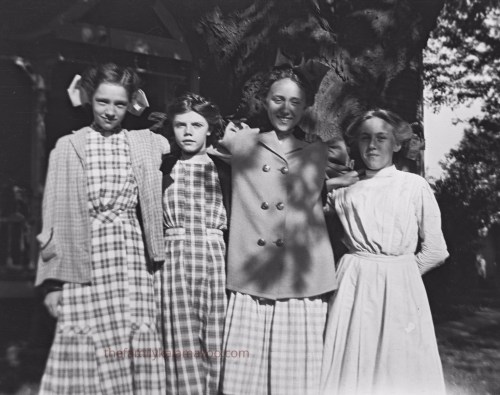
In the collection of images derived from Joseph DeKorn’s glass negatives, there are photos of children. Unfortunately, children are hard to identify, and I don’t know who most of them are. In this beautiful photograph, Grandpa’s first cousin, Alice Leeuwenhoek, is shown with three friends, neighbors, or relatives. The girls and their clothing remind me of the book and movie Pollyanna. The novel was written in 1913, and Alice was born in 1897, so this is close! Alice is the tall girl in the double-breasted coat.

Alice was married at age 26 to Clarence Moerdyk. They never had any children. Alice was a successful seamstress. Sadly, she passed away at age 66, leaving behind her husband and her mother, Jennie Leeuwenhoek. She was buried at Riverside Cemetery in Kalamazoo.


As usual, if anybody has any ideas about the identities of the other girls, please let me know!

I hope you have someone or someones to spend a happy Thanksgiving with! This year it’s just my husband and me, and I accidentally bought a 24-pound turkey (don’t ask). Any ideas on dishes I can make with the turkey and then freeze? Besides soup, of course.

I’ve published so many posts about the Paak* family that I thought I would share with you a photograph of Professor Lawrence, the man who provided me so many photos and much information on the family, and two of his siblings (children of Theresa Pake Lawrence).


In the turquoise dress is Una Orline Lawrence Shultz, in the middle is Professor Edgar “Ed” Lawrence himself, and on the right is brother Richard “Dick” Lawrence. These are the three children of Theresa Pake Lawrence.

When she married Roy Lawrence, he had three children, Duane, Caryl, and Audrey, so Professor Lawrence and his siblings had three half-siblings.

Here is a photo of Professor Lawrence with his half-sister, Caryl Ruth Lawrence. Caryl retired from the U.S. Army as a Major. Professor Lawrence is also a veteran of the army.

The siblings had a younger brother Robert J. Borger (foster brother who was a Lawrence in every way but legally) who died at age 42 in a motorcycle/pickup accident in 1977 in Schoolcraft, Michigan.

Now let’s back up a generation. Remember that Theresa and her siblings lived with their father George/Joseph after the death of their mother. Then their house burned down. After that, Theresa went to live with the Pickards as their foster child. Theresa is in the front on the left. Sister Jane is in the back on the right. She was called Jennie as a child.

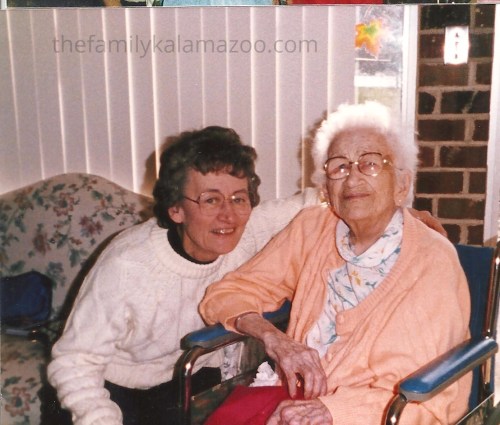
To show the link between Theresa’s generation and that of her children, I am sharing a photo of Professor Lawrence’s sister Una, the niece of Jane, with her Aunt Jane at the nursing home on the occasion of Jane’s 100th birthday. Jane had no children, and I like to see her sibling’s children were watching over her.

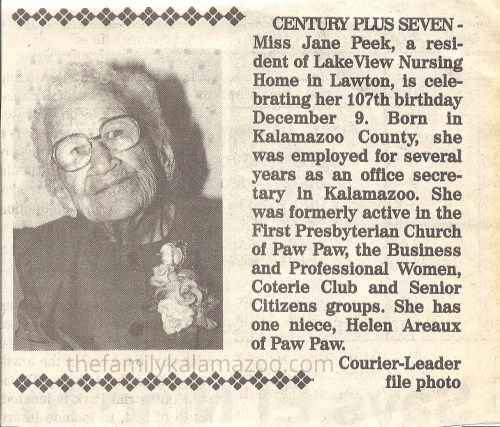
Jane ultimately lived to be almost 108 years old. She passed away in 1998. Think of all the changes in the world that she experienced!

Professor Lawrence gave me an invite to his family tree, so I am going to go through and make sure we both have the same information. Anybody know if there is a comparison tool on Ancestry? Or some way to more easily compare two trees?

I admit that I bounce around from one branch to another, but if I stuck with one branch I would never move forward on anything else because each branch has so many individuals and stories and details.


* I’ve changed his surname spelling to the one that my great-great-grandmother used because I see that he did also use that spelling in addition to other spellings.

Here are the other Pake/Paake /Paak //Peek posts:

A Series of Disasters

The Children After the Fire, 1902

Paak-a-boo

Saved from the Fire

Who is George Paak, Sr.?

Curious about George

George Paak’s Legacy, Part I

George Paak’s Legacy, Part II: Theresa’s Pre-Professional Education

George Paak’s Legacy, Part III: Theresa’s Professional Education

George Paak’s Legacy, Part IV: A Letter to His Daughter

George Paak’s Legacy, Part V: Theresa Gets Married

George Paak’s Legacy, Part VI: Who Were the Pickards

George Paak’s Legacy, Part VII: Imagining the Man and His Home


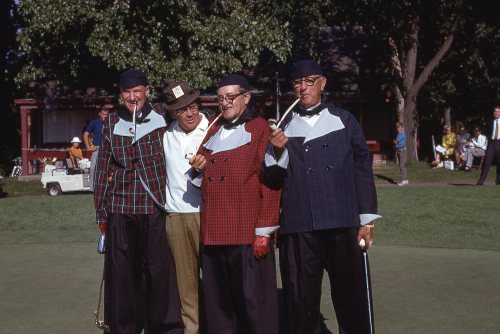
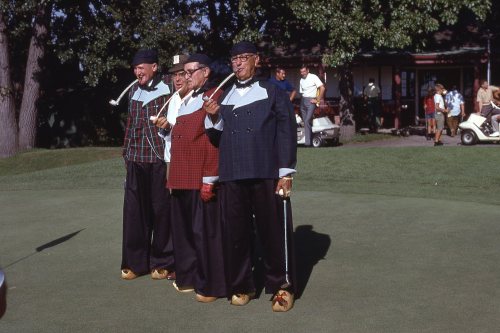
These photographs don’t belong to me, and they aren’t even of my family. But a fellow genealogist, The Psychogenealogist, began posting photos on Twitter, and I noticed the setting of the Kalamazoo Country Club. These photos were taken in 1968 and belonged to his grandfather, Michael John Hanley Jr. (1924-2015), who felt that KCC was a home away from home. Many family events were held there.

Michael moved to Kalamazoo from Flint in the late 60s, perhaps 1968, and was a GM plant manager through the early 80s. His two youngest children finished out high school in Kalamazoo. He maintained a residence in Kalamazoo until his death, but wintered in Florida after retirement. His first wife was Betty Grace Sears, who died in 1981, and at some point after that, he married Mary Jo Hipskind Johnson (1926-2011). Mary Jo graduated from St. Augustine High School in 1944.

If you’re from Kalamazoo, take a look and see if you recognize anyone in the pix–or what they were doing dressed up this way with klompen on their feet!

Give me a holler if you recognize individuals or the event!

Kin Types by Luanne Castle

What a lovely review of Kin Types by genealogy blogger Ann Marie Bryant! Thank you so much for your thoughtfulness!

Ann Marie Bryant's avatarTales of a Family

Recently, a fellow blogger and an ever-encouraging supporter, Luanne Castle wrote a lovely book of poems about her family.  From the start, Kin Types captured my imagination with the thought provoking title and the intriguing cover.   It began with sage advice from familial ancestors who have lived a life of hard work and a heartfelt existence that helped those in need.

View original post 171 more words

Before I get started, just wanted to remind you that I now have a second family history blog called Entering the Pale. As I said last week: If you have any interest in following another part of our family, please head over there and follow. Also, you might want to follow if you have interest in history in general or history of the Pale of Settlement (Ukraine, Moldova, Belarus, etc.) or Jewish history. Besides, I need more followers :).

Another photograph in the beautiful antique photo album was taken in the Netherlands, but unlike most of the portraits, this one is labeled on the back.


I had to ask a Facebook group for help with this, and then I also wrote to Adri van Gessel who has been so wonderfully helpful in all matters of Dutch genealogy.

The town is Gorinchem (none of my relatives seem to be from Gorinchem, so that was confusing), and the lady’s name is Annigje Haag.

It’s very confusing to see that an American family member has a 19th-century photograph possibly given by a woman in a town there doesn’t seem to be a connection to. I also couldn’t place her surname.

But eventually the truth revealed itself, thanks to these other people and a trip to wiewaswie.

Annigje Haag was born on 3 February 1858, in Nieuwland. She died on 2 December 1921, in Meerkerk.

On 15 January 1882, in Nieuwland, Annigje married Dirk Boer, who was born on 29 March 1854 in Meerkerk. By the way, he died on 27 September 1923 in Meerkerk. This means that the portrait was taken before 15 January 1882.

Who was Dirk? He was the son of Willem Boer and Teuntje Bassa. Bassa is a surname I know.

Teuntje Bassa, born on 20 November 1816 in Lexmond (a town I know), is the sister of Jacoba Bassa, the wife of Teunis Peek and the mother of Alice Peek/Paak DeKorn (the woman who grabbed the burning stove to remove it from the neighbor’s house). Therefore, Dirk, Annigje’s fiance or new husband, was Alice’s first cousin. They would have known each other.

For location, note that Meerkerk and Nieuwland are between Lexmond and Gorinchem.

Here’s an interesting little tidbit. Notice her belt? There is a woman in an old photograph on a website wearing the exact same belt! Go here. Isn’t that wild?


I posted recently that my husband is becoming interested in his own family history. We are working together with a genealogist to knock down some bricks in the brick wall–and they are flying out at an amazing rate. In order to document the process and share what we are learning I’ve started another blog for hubby’s family. It’s called Entering the Pale. If you have any interest in following another part of our family, please head over there and follow. I don’t expect the posts to be regular, but I will post periodically. Also, you might want to follow if you have interest in history in general or history of the Pale of Settlement (Ukraine, Moldova, Belarus, etc.) or Jewish history.

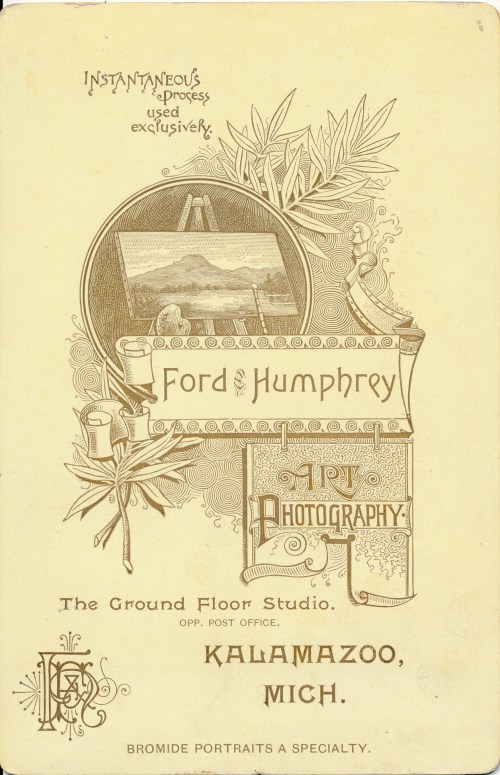
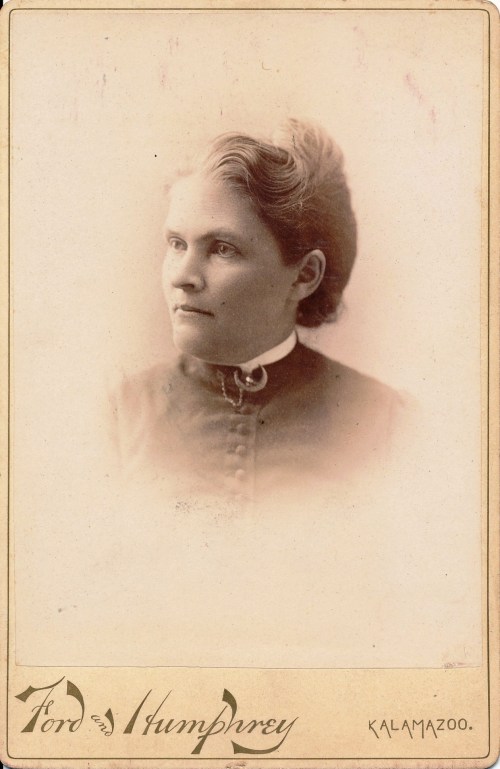
Today I’m sharing another mystery photo from the family. I do not know who this is, when it was taken, or anything other than that it is from Kalamazoo. The photographer, Ford and Humphrey, is not on the list of Kalamazoo photographers compiled by Bushwacking Genealogy–unless this is Frank Ford. He was in business from approximately 1887-1900, although not listed in the city directory in 1899.

I looked up Humphrey in the city directories that are online. There are quite a few people with that surname in Kalamazoo at the end of the 19th century and beginning of the 20th, but nobody is listed as a photographer.

Notice that it says this studio makes “bromide portraits” their specialty. I googled this phrase, but found that silver bromide and potassium bromide have both been used for photography. It looks as if this could narrow the time for the photo down to 1880-1900, so not much help there.

Was the photography studio on the ground floor of the post office? Is that what that means? What is OPP.?

Have you ever seen a hairstyle like this? Was it a thing, a fashion? Her hair looks very straight and smooth up front.

And what about the jewelry at the neck? How would you describe it? Is it a crescent moon with a pearl and a chain?

About all I can figure out is that I’m looking at a natural blonde.