Feeds:
Posts
Comments

Two weeks ago I wrote about a pioneer of Kalamazoo, Michigan, John DeSmit, Sr., and last week I wrote more about his family.

I mentioned that it appears that his first wife was Jennie (perhaps Van Sluis) and she was the mother of John’s oldest child, John Jr. Then he married Jacoba Lamper. But I really didn’t have too much information sorting out the wives.

I know I said I would write about the next generation next, but before I do that, I want to clarify a little more about Jacoba and Jennie.

Adri Van Gessel has been very helpful in this matter. According to Adri:

Jacoba Lamper emigrated to the USA in 1855, together with her mother Christina de Bart and her brothers Marinus, Adriaan (Adrian) and Lauris (Louis). Her father died in 1840.

Marinus was never married. Adrian married on May 31, 1860 at Kalamazoo to Hermania (Minnie) Reidsma (in the presence of a.o. Jan Smith). Louneres (Louis) married on September 9, 1858 at Kalamazoo to Gertrude Elizabeth VanEst (in the presence of a.o. Jan Smit).

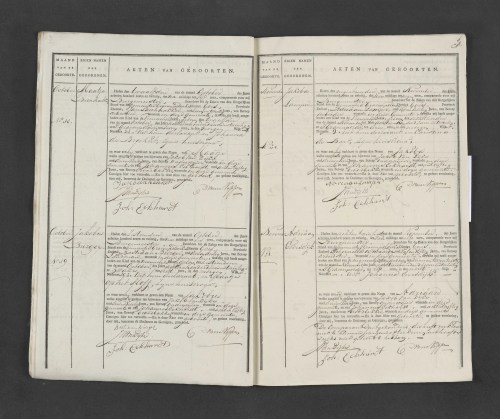
In the book “Emigranten naar Amerika……” all emigrants are listed in alphabetical order.

So there’s no Jennie listed on the page of Jannis.

Only Jannis is listed as emigrating. No wife and no four other couples are listed with Jannis, although his newspaper interview account states that five couples traveled together. Adri then did more painstaking work on this to try to locate Jennie’s emigration information by scanning an entire 200 page book. No luck. He also considered other first names. For instance, Jennie is a common nickname for Adriana in the Netherlands.

Interesting that Jacoba married 7 August 1855. She must have married the minute she stepped off the boat! Also intriguing is her mother immigrating to the United States with her children, although her husband had been gone for fifteen years. It makes me wonder if there was some connection between the Lampers and either the DeSmits or another Kalamazoo family. Since Jacoba married so soon after arriving, I wonder if the wedding was planned ahead of time. Of course, John would have been eager to remarry with a baby to take care of.

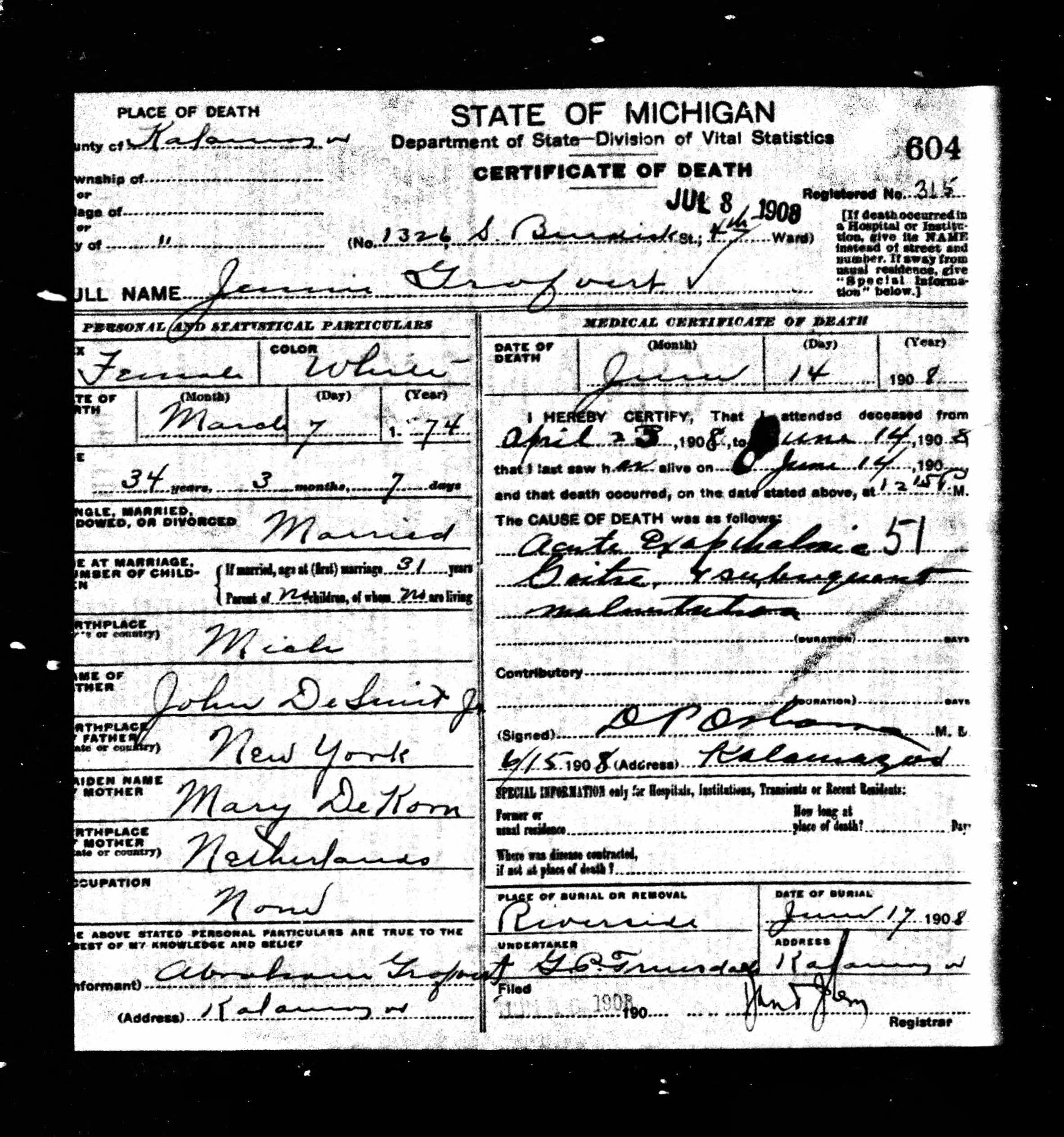
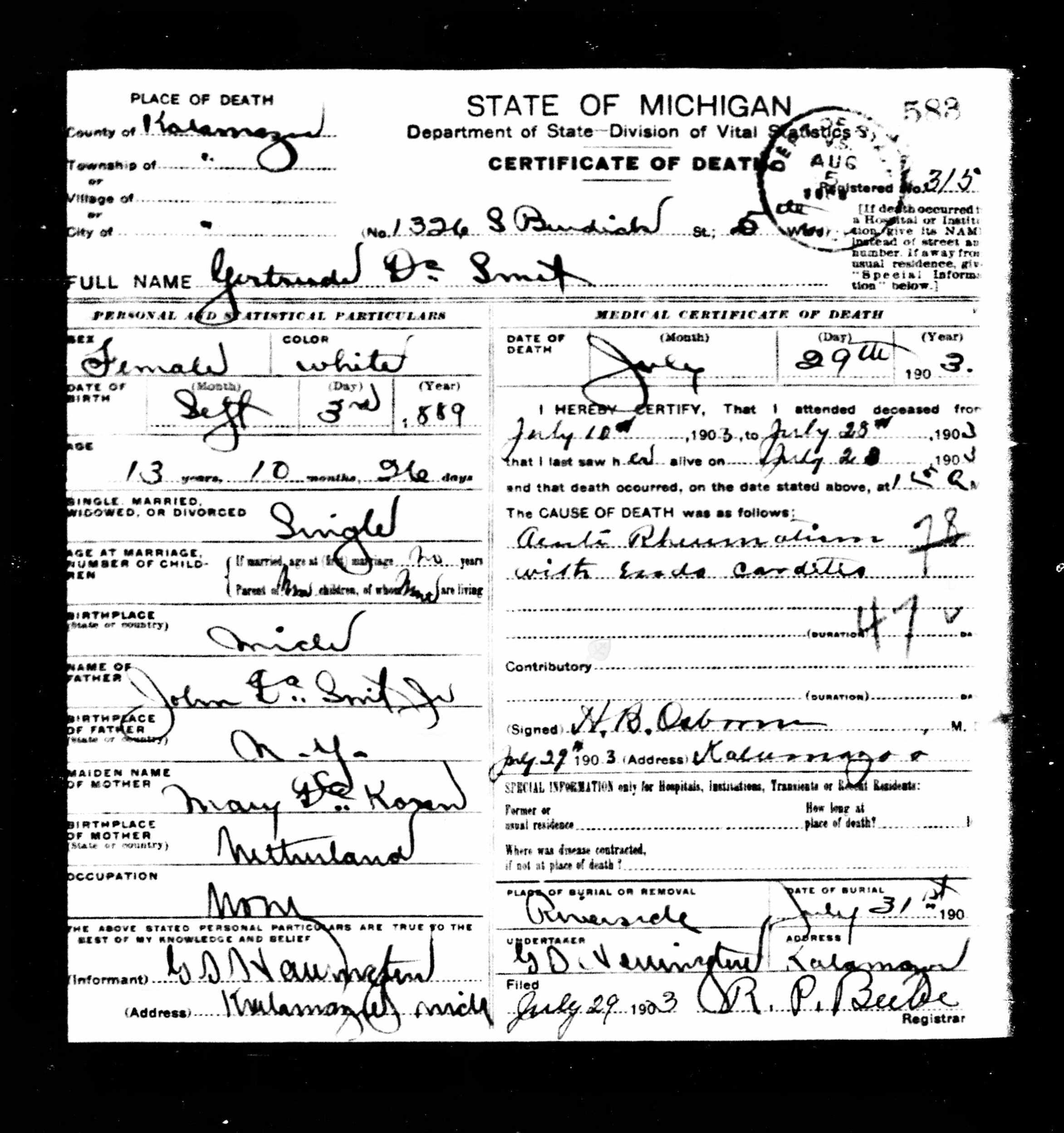
What I need to do is to try to get more information about the family from Holland, Erie County, New York. Or Long Island. Because therein lies a big problem. While Jannis/John talked about working on Long Island to the newspaper and his son’s death certificate says he was born there, there is another record, the marriage record of John DeSmit, Jr. and Mary DeKorn that indicates he was actually born in Holland, which is the far western part of New York State, about 400 miles from Long Island! Holland is 30 miles SE of Buffalo. Must be pretty cold there in the winter . . . .

Death Certificate of John DeSmit, Jr.

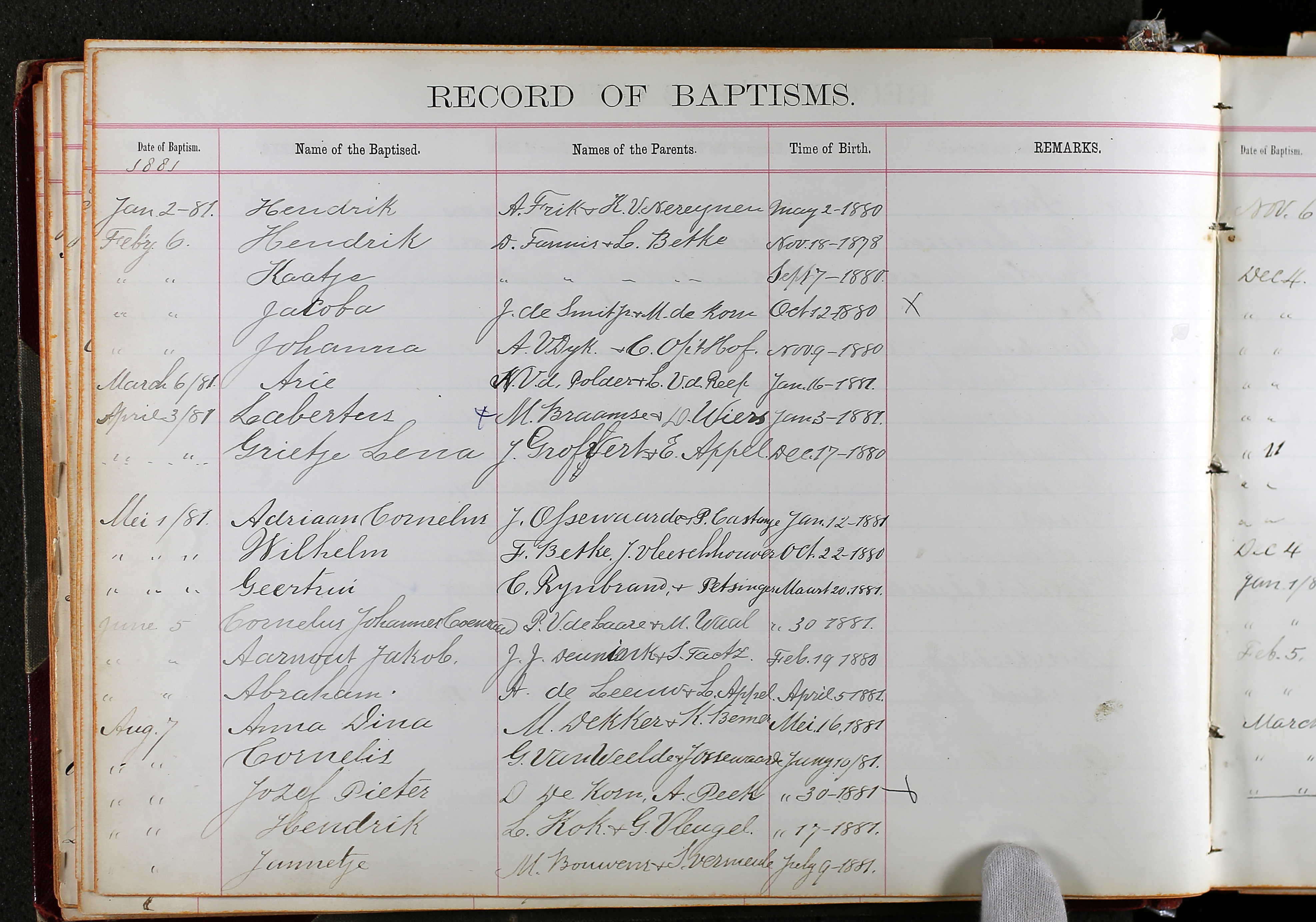
Marriage Record of John DeSmit Jr. and Mary DeKorn

(Yes, you read that right. Mary’s brother, my great-great-grandfather Richard DeKorn’s marriage record is right above John and Mary’s!)

According to Wikipedia:

HOLLAND, NY

The town of Holland was established in 1818 from part of the (now defunct) town of Willink, which once included all the southern part of Erie County. The name was derived from Willem Willink, one of the original investors of the Holland Land Company, which owned most of the land in western New York and sold it off to cities and townships that exist today. The name “Holland” is one of many surviving remnants of the Dutch investors who once owned this region. As with the town of Willink, the locations named after these investors have been given new names. Many of the original town buildings met their fate due to fire. Today the Holland Historical Society resides in the original fire hall on Main Street.

LONG ISLAND, NY

In the 19th century, Long Island was still mainly rural and agricultural. Suburbanization started modestly on Long Island when reliable steam ferry service allowed prosperous Wall Streeters to get to new Brooklyn Heights homes in time for dinner. Rural traffic was served by the new Brooklyn and Jamaica Plank road through Jamaica Pass, among others. After the American Civil War, streetcar suburbs sprawled out onto the outwash plain of central and southern Kings County. Trolleys also brought workers from other parts of western Queens to Long Island City jobs.

The Long Island Rail Road was begun as a combined ferry-rail route to Boston via Greenport. The predecessor to the Long Island Rail Road began service in 1836 from the ferry terminal (t o Manhattan) through Brooklyn to Jamaica in Queens, and completed the line to the east end of Long Island in 1844. Other rail lines to Coney Island, the Rockaways and Long Beach serviced the beach resort towns. The growing and merging railroads opened up more than 50 stations in (present-day) Nassau County and over 40 in Suffolk Country, laying the foundation for the future suburbanization of the island.[9]

From 1830 until 1930, population roughly doubled every twenty years, and several cities were incorporated, such as the City of Brooklyn in Kings County, and Long Island City in Queens.

I am not used to researching the mid-19th century in the United States because most of my ancestors were not here that early. I’ve learned that birth records were not required before 1880 in New York State, so the hope of finding that record for John, Jr., died a swift death. That is no excuse for not finding his baptism in the Reformed records, though. It seems that everything that has to do with the DeSmits between arrival in the United States and John, Sr., marrying Jacoba Lamper is missing. Where is Jennie buried, for instance?

Missing (or what I wish I could find)

  • Ship manifest
  • Emigration records of Jennie and the other four couples
  • Any Dutch records on Jennie at all
  • Birth record and/or baptism of John, Jr.
  • Jennie’s death record
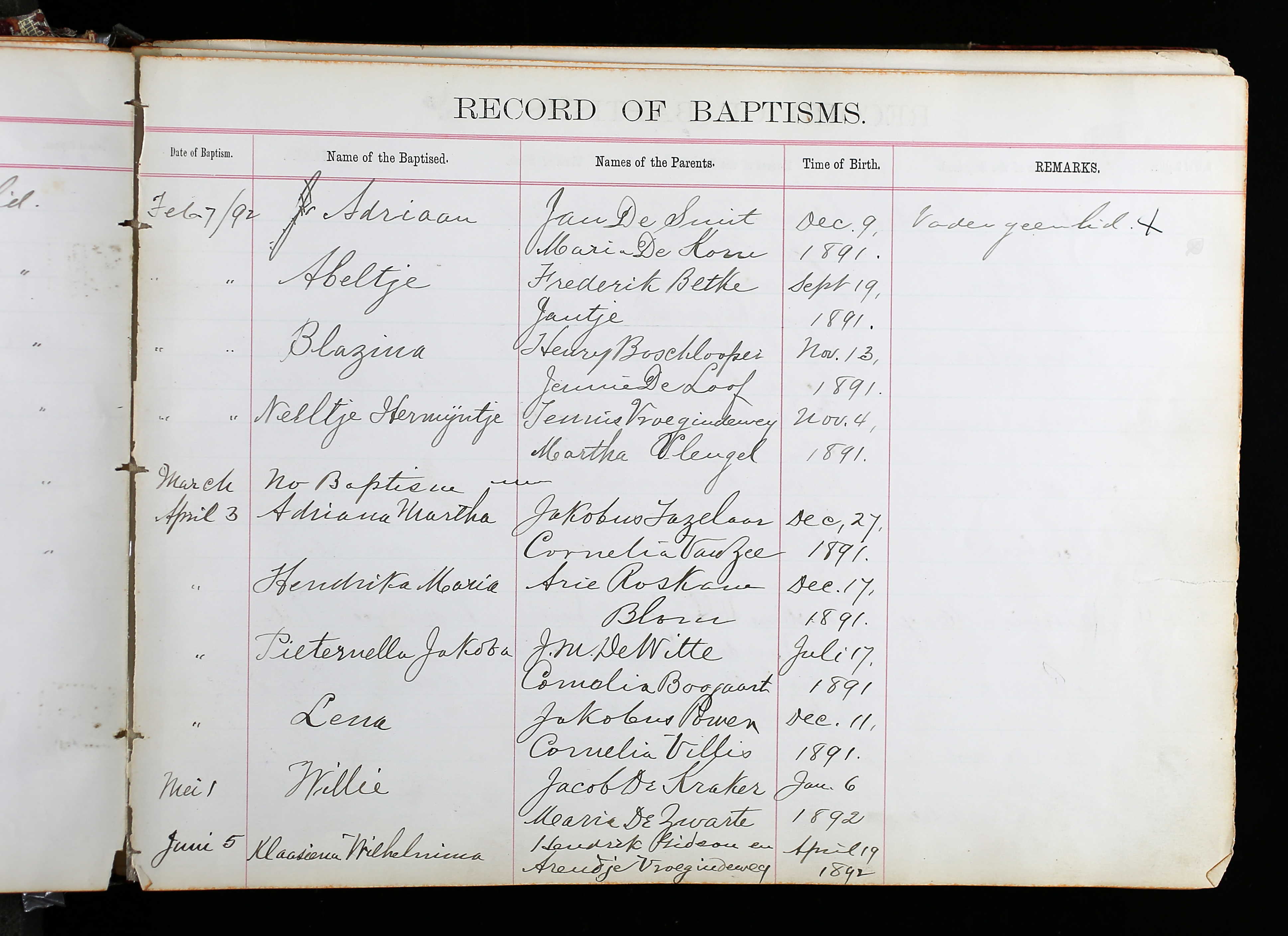
  • Kalamazoo record of John’s marriage to Jacoba Lamper (what we have is a church record only)

Well, this brick wall isn’t even truly one of mine since Mary DeKorn married into the DeSmit family. I’ll continue my tangent, though, by writing about the next generation of DeSmits (I hope).

I really was trying to imagine what Kalamazoo was like when John DeSmit, Sr. brought his family to the town. A population of 1,200. What were the streets and houses like? When I tried to research 1854, this is what I found: the Kalamazoo State Hospital (asylum) began being built in 1854!
My own earliest relatives in Kalamazoo were the DeKorns–Mary DeKorn’s family. Her father, Boudewin, and mother, Johanna, arrived in the United States in 1855 or 56, right when Jacoba arrived and married John. The DeKorns, however, first settled in Zeeland, Michigan. Within a few years they moved to Kalamazoo with their three young children. Johanna was unfortunately gone by 1864 and Boudewin by 1873. They were my 3rd great-grandparents.

Therefore, Boudewin and Johanna were the same generation as John and Jacoba DeSmit. John’s oldest child, John Jr., would marry Boudewin’s middle child, Mary.

In my first post about the DeSmits there is a newspaper article about how John, Sr., worked on Bronson Park. Here is a great article with photos that show the history of Bronson Park.

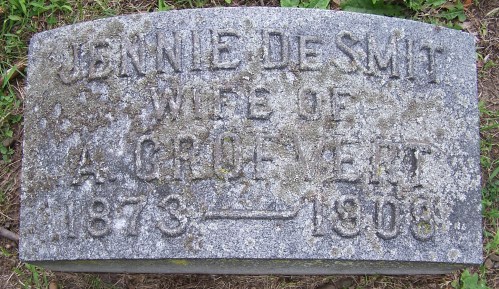
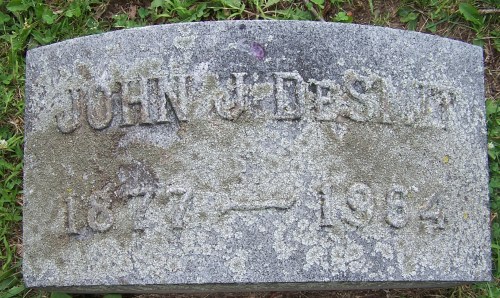
I requested photos of John and Jacoba’s headstones for their Findagrave memorials a couple of weeks ago, but no response yet.

Speaking of Findagrave, the person who has my OWN FATHER’S memorial page has not responded to my two demands for management of it. We’ll see about that . . . .

UPDATE ON FINDAGRAVE: Findagrave responded to my request immediately and transferred my father’s memorial page to me. They were very accommodating even if the original site creator was not.

John DeSmit’s Family

Last week I wrote about a pioneer of Kalamazoo, Michigan, John DeSmit, Sr. I had learned that he was actually at least John DeSmit III because his father and grandfather who lived and died in the Netherlands, were also Jan or Jannis.

Now I want to give you an idea of John’s wives and their children.  This post was almost published without some very important information sent me by Adri Van Gessel indicating that John DeSmit, Sr. actually had two wives and that the first wife is the mother of only his oldest child, John DeSmit, Jr. Also, I was helped by Hubert Theuns. An enormous thank you for their help!

John Sr. must have married his first wife in the Netherlands. I have not yet found the marriage record, but according to the newspaper, it was probably between 1848 and 1851, when they emigrated. Her name is listed on the death certificate of her one child, John Jr.

The certificate says his mother was Jennie Van S…… Could be Sluice or Sluis or Sh something. I do believe she was still alive when John moved to Kalamazoo with her and their son.

According to one of the newspaper articles published on my last post, the family came to Kalamazoo on 2 May 1854.

The next time we find the family “on paper,” is a marriage record between John Senior and Jacoba Lamper. Jennie must have died between 2 May 1854 and the date of the new marriage, 7 August 1855.

Jacoba was born 18 November 1827 in ‘s-Gravenpolder. Her parents were Adriaan Lamper and Christina de Bart (Lamper). This name is also elsewhere seen as de Bat and de Bath.

Note for DeSmit and Lamper family members: Hubert found documents for other Lamper family members, as well as for John DeSmit’s parents, etc. If you are interested in these documents, please email about them as I am not going to post them all on here.

IMMIGRATION

Regarding their immigration, Hubert also found the following emigration information in http://www.zeeuwengezocht.nl/. Remember that this is emigration, not immigration, so it has to do with John leaving the Netherlands, not actually entering the United States.

Genealogische Afschriften 810/2 Emigrant Jannis de Smit
Woonplaats:
Zuidzande
Rol:
Emigrant
Leeftijd:
26
Beroep:
Landmansknecht (profession: farmer’s apprentice)
Kerkelijke gezindte:
Nederlands-hervormd (religion: Dutch Reformed)
Toegangsnummer:
164 Verzameling Genealogische Afschriften (GA), 1600-2017
Reden:
Verbetering van bestaan (reason for emigration: Amelioration of existence)
Datum vertrek:
1851
Bestemming land:
Noord-Amerika
Betreft:
Staten van landverhuizingen (archief Provinciaal Bestuur Zeeland)
Nummer:
Genealogische Afschriften 810/2
Pagina:
27
Inventarisnummer:
Prijs fotokopie:
€ 5,00

Organisatie: Zeeuws Archief

Although it doesn’t give much more information than the newspaper accounts did, it confirms that the couple immigrated to the United States in 1851 (and not 1850). We know they left from Rotterdam, so now it remains to be seen if I can find them through ship manifest/immigration records.

According to the newspaper article, John and Jennie traveled with four other young married couples. Perhaps that will help locate them.

JOHN DESMIT, JR.

Once John and Jennie arrived in the United States (John in wooden shoes and corduroys, as the newspaper affirmed), he sought work on Long Island, New York, where their first child, John, Jr. was born on 18 July 1853. He would live a full life and die 30 October 1928 in Kalamazoo. He was married to Mary DeKorn (the sister of Richard DeKorn, my great-great-grandfather). Mary was born 4 January 1855 in Kapelle, Zeeland, Netherlands. She died 28 March 1953 in Kalamazoo. They had eight children who lived past infancy.


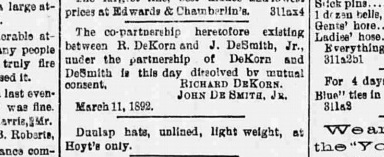
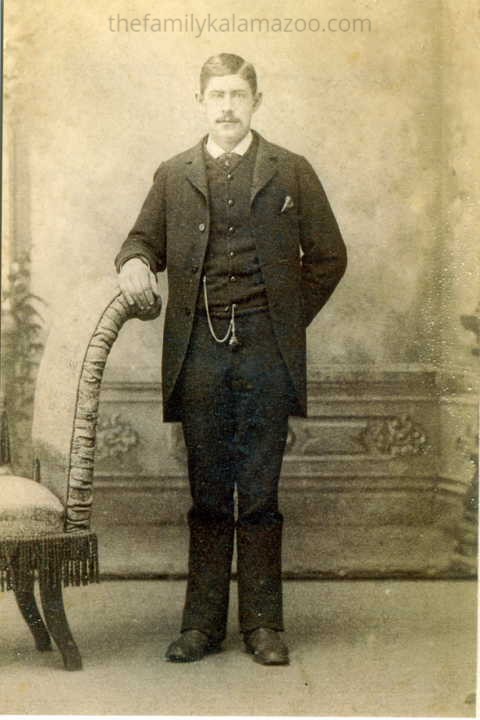
I am not sure if I have a photo of John, Jr. But the motivation for beginning this series on the DeSmits was because I found a little newpaper article in the Telegraph dated 11 March 1892 that mentioned John, Jr., and Richard DeKorn, my great-great-grandfather. They apparently were in partnership together until this date. Since they were both brick masons, did they work together? Or was it a realty partnership? I do not know. But it’s fitting that the brothers-in-law were partners.

In 1854, John, Sr., Jennie, and John, Jr. moved to Kalamazoo. Soon after, Jennie must have died, but I can find no proof of this as of yet. I cannot find her death record, a grave record, nothing. Keep in mind that until I do all this information about the two wives is as yet unverified.

As with Johns Sr. and Jr. I will mainly use the American version of the names for the rest of the children in this post. These are the children John had with Jacoba Lamper.
TWO BABES TAKEN TOO SOON

Adrian was born 17 May 1856 and, sadly, died 9 November 1856.

Francena was born 4 July 1857 and, though the couple might have celebrated the birth of a baby born on Independence Day, she died over a month later, on 27 August 1857. The death of these two children early on must have been real “dog’s weather” and “black snow” for the DeSmits. (Those are expressions he used to refer to hard times in a newspaper interview.

ADRIAN DESMIT

On 4 November 1858, Adrian was born. This baby survived, living until 25 March 1938 when he died in Banks Township in Antrim County, Michigan. Adrian married Anna Versluis, and they had one daughter. Eventually, Adrian would marry Alice Nyland.


The photo of Adrian is from Tim Morris.

This photo was from my grandfather, Adrian Zuidweg.

FRANCINA DESMIT

Halloween (October 31) 1862, Francina was born. She died 21 September 1900, still a young woman. She married Renier Van Delester (many spellings of both first and surnames). They had two sons.

CHRISTINA DESMIT

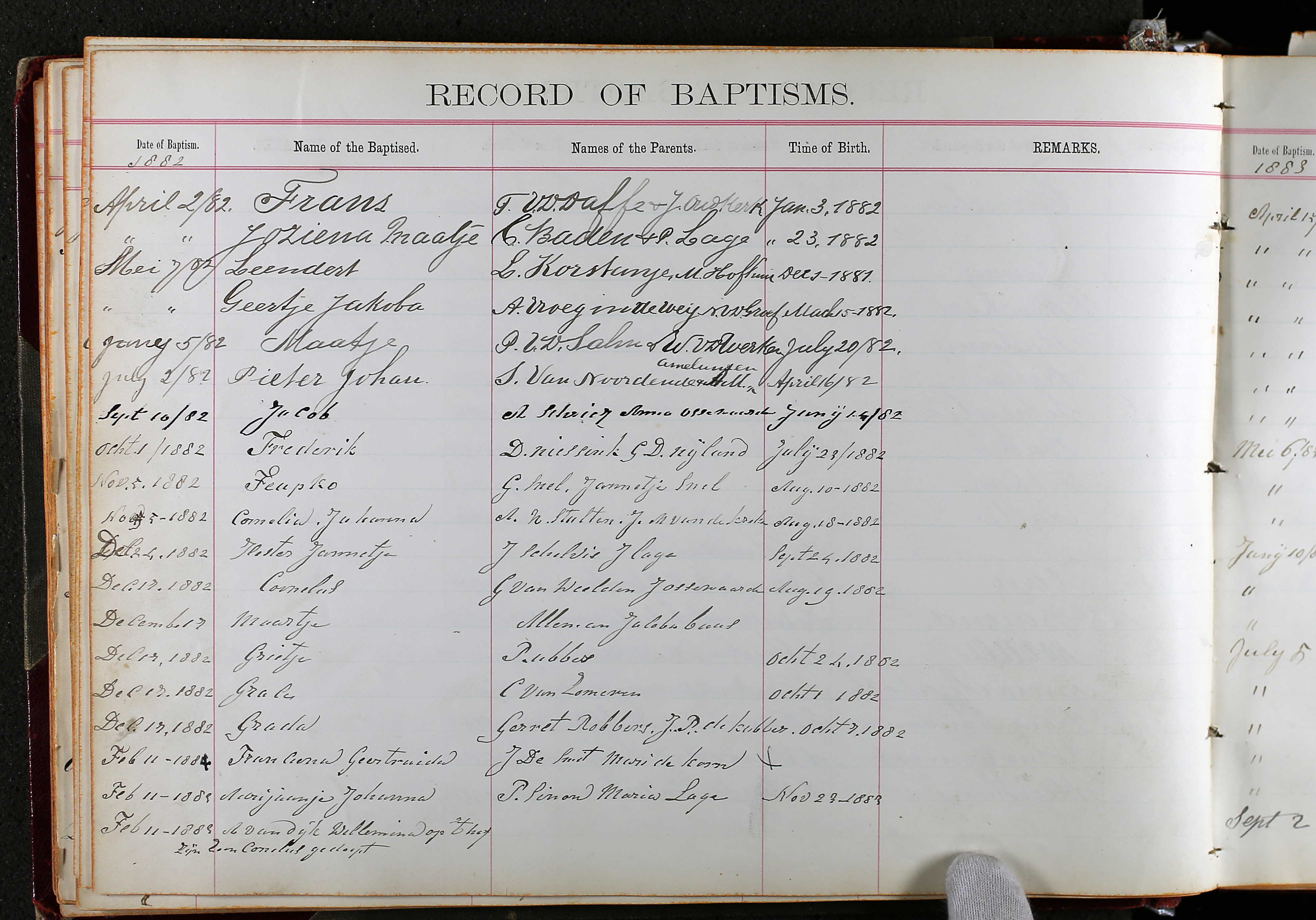
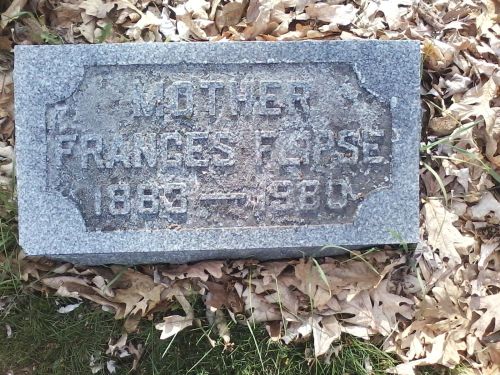
Christina was born, most likely, in September 1864. The date has not yet been discovered, other than in the Dutch Reformed Church records, where it states she was born 31 September 1864. Unless, the calendar has changed since the 1860s, there is no September 31. Christina married Jacob Flipse, Jr. They did not have children. She passed away 15 February 1914.

ELIZABETH DESMIT

On 23 April 1866, Elizabeth was born. She married Jacob Hycoop, and they had 2 daughters. She lived until 18 May 1946. In fact, in one of the newspaper articles, it was her yard where John, Sr., hoed the celery on his birthday.

ANOTHER BABE GONE TOO SOON

Baby Catharina was born 2 July 1869, but passed away on 16 January 1870.

MARTIN DESMIT

Finally, Martin was born 17 November 1870, and grew up to marry Adriana Schiereck. They had a son called Clarence Wynoble, so it is probable that Clarence was Martin’s stepson. Martin died 6 November 1942 in Plainwell, Michigan.


All except John, Jr. were born in Kalamazoo, and they all died in Michigan–most of them in Kalamazoo. In a future post I will discuss the next generation of DeSmits–the children of John, Jr., Adrian, Francina, Elizabeth, and Martin.


I realized that it was far past time that I research the DeSmit family. To give you an idea of how they fit into my family, let me give you a little overview. My great-great grandfather, Richard DeKorn, had two siblings: his sister Jennie Culver and his sister Mary DeSmit. Well, they were born DeKorns, but took on their  husband’s surnames, of course.

Because of the beautiful gift of the “found” photograph album sent to me by a kind stranger I have posted quite a bit about Jennie Culver, her divorce, and her two girls, Rhea and Lela. Jennie is featured in one of the poems in my chapbook Kin Types“What Came Between a Woman and Her Duties.” This poem was first published in the literary magazine Copper Nickel.

Richard’s sister Mary DeKorn married John DeSmit, Jr., and that is my connection with the DeSmit family, so I will begin the story of the DeSmits with that of Mary’s father-in-law, John DeSmit, Sr., a pioneer of Kalamazoo, Michigan.

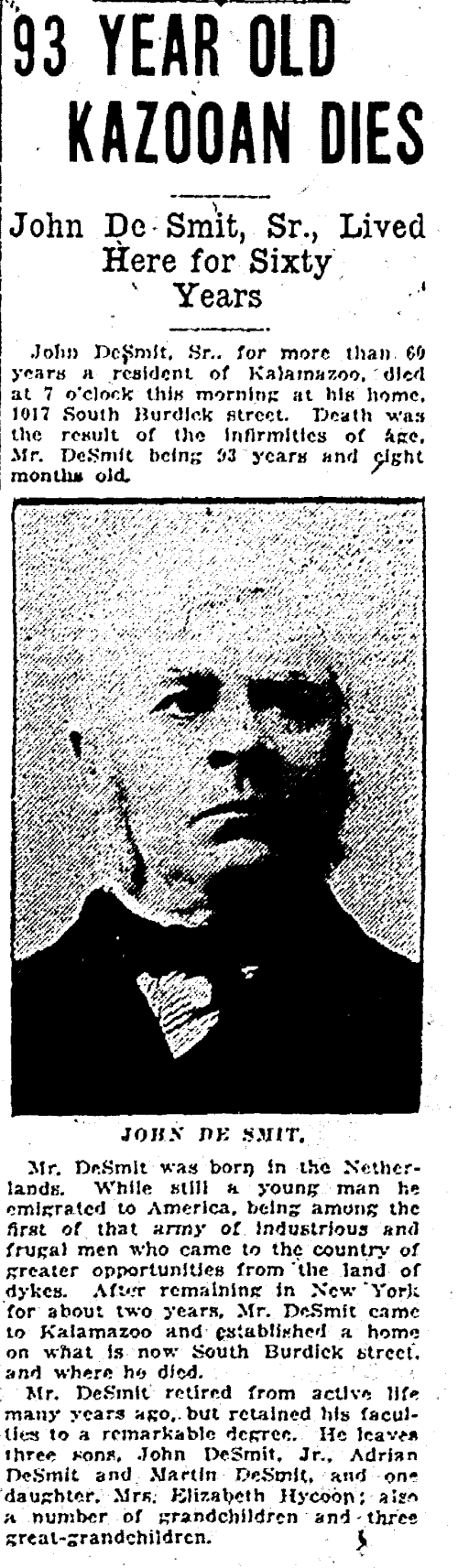
On 2 July 1912, the Kalamazoo Gazette published this article about John. Because it was his birthday celebration and not an obituary, I believe it has a good chance of being an accurate history of his life. There is even a photo!

John DeSmit, one of Kalamazoo’s oldest pioneer residents, celebrated his 87th birthday anniversary yesterday by industriously laboring all day in a celery patch in the rear of the home of his daughter, Mrs. Elizabeth Hycoop on South Burdick Street.

For a man of his advanced years Mr. DeSmit is remarkably hearty and spry. Age has not dimmed the sparkle in his eye and at times they twinkle with merriment, as he laughingly comments on events of early-day or present-day Kalamazoo. To a reporter for The Gazette who asked him if he was enjoying himself on his 87th birthday he laughingly replied:

“Yes, this is my 87th birthday. I am feeling fine and having a lot of fun all by myself.”

Mr. DeSmit, accompanied by his wife and a baby boy, arrived in Kalamazoo on May 2, 1854. There were only about 1,200 inhabitants in the village then and money was not as plentiful as it is today.

ARRIVED HERE WITH EMPTY PURSE

“When I first came here,” said Mr. DeSmit, “I did anything I could get to do. I got my first job on the afternoon of the day I arrived. It was tending a mason. I was so near flat busted that I went to work without eating dinner. I was paid ten shillings a day to start. I picked up the trade by degrees and most of the time since then I have worked as a mason. I finally began to do contracting in a small way and some of the jobs I did were the building of the spring works in ’78 and the old Kalamazoo house in ’79. I also built the old part of the American house.

“In ’76 my friends induced me to make the race for alderman from the Fourth ward and I was elected. I served that year and ’77. In ’79 I was re-elected and served two years. In ’88 I was appointed to street commissioner.

It was Mr. DeSmit who dug Axtell creek in ’77-’78, draining a large section of marsh land, much of which is now included in the most valuable tract of celery land in Kalamazoo. In ’72 he built the sewer from the jail through the courthouse yard to Arcadia Creek. This was when little was known of the sewer building in Kalamazoo and when few would bid on a sewer job.

HELPED IMPROVE BRONSON PARK

In ’77 Mr. DeSmit raised $1,000 by subscription to fill in and improve Bronson park and the council–then the board of trustees–voted another $1,000 for the work. It was then late in the fall and as he left the council the following spring, being succeeded by George Kidder, it fell to the lot of the latter to complete the park work begun by Mr. DeSmit.

Mr. DeSmit came to America in 1850, arriving in New York on October 1 of that year with his bride and four other young married couples. They sailed from Rotterdam and were 113 days in crossing the ocean. None of the five couples had any money upon arriving in America, but the men of the party secured work in the woods of Long Island and after many hard struggles saved enough of their meagre wages to emigrate west to the land of promise. As far as he knows Mr. DeSmit is the only one of the five couples now living.

HE’S HAPPY AND CONTENTED AS ANY

“I’ve worked hard all my life,” said Mr. DeSmith, “and I’ve seen a lot of happiness. I’ve also seen some dog’s weather and some black snow, but it’s what we all get in this life some time or other. I guess for a man of my years I’m about as happy and contented as any.

Mr. DeSmit has five children living, all of whom reside in Kalamazoo. They are John, Adrian, and Martin DeSmit and Mrs. Elizabeth Hycoop and Mrs. Christine Flipse.

The aged man lives at 1017 South Burdick Street.

He lived on South Burdick. Of course, he did! That area of Burdick must have been quite the “Holland” or Dutch enclave.

Is this article not a windfall for a family researcher? Look at some of the facts I found.

  • He arrived in the United States on 1 October 1850  This will prove to be a bit off.
  • He left approximately 113 days before that  This will be contradicted in another article.
  • He lived on Long Island for awhile before coming to Michigan
  • When he came to Kalamazoo, only 1,200 people lived there
  • He was instrumental in getting Bronson Park off to a good start (Bronson Park is the town square of Kalamazoo)
  • They left Netherlands through Rotterdam; however, no info about where in Holland they came from
  • How he got started as a mason
  • How he happened to be in New York (because this is where John Jr. was born)
  • I am not the only person who persistent types DeSmith instead of DeSmit (ugh)
  • I learned some new expressions: “dog’s weather” and “black snow”–“dog’s weather” or hondeweer is a common Dutch expression meaning bad weather, such as rain or a storm. I was given help for this through a kind Facebook group. The answer to “black snow” can be found here. It means: “misery, experiencing poverty” and is better known in Belgium. This in interesting because one of my helpers with the DeSmit family believes they came from an area very close to Belgium.

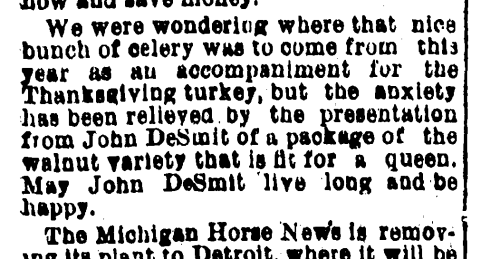
There are several newspaper articles about John DeSmit gifting celery to the Gazette, particularly at the time of Thanksgiving and Christmas–so much so, that they expected it. This one is 30 November 1893:

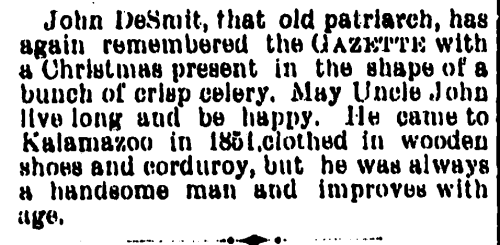
This theme is repeated over several years. Here is one from Christmas day 1896.

Although the year 1851 is probably incorrect (1854 fits with the chronology better), you have to love the details: “clothed in wooden shoes and corduroy.”

Three years later, the paper commemorates John DeSmit’s 90th birthday.

Here we learn that he came to Kalamazoo in 1854 and that he served in the Dutch army in 1845. And that his birthdate is 1 July 1825. We also get an overview that tells how important his construction work was to the formation of Kalamazoo’s streets and sewers. John belonged to the Reformed church.  Best yet, the photo is better in this clipping than in the first.

John DeSmit was still going strong for his 91st birthday party.


Even back in 1899, the paper was celebrating John DeSmit’s 74th birthday. Some of the details here are different than in the other articles. I can’t help but wonder if the paper made mistakes or if John’s memory altered things as he got older. For instance, here it is 135 days on the ocean from Rotterdam to NYC, whereas it was 113 days in 1912 (13 years later). Also, the address of his house is slightly off here, but I do appreciate that the info is shared here that he owned his house since 1858. Notice that in 1899 he had six living children, whereas later he had five and then four. Also in the following article, one of his children is living outside of Kalamazoo.

Eventually, John DeSmit succumbed to old age.

John DeSmit passed away on 10 March 1919 at the Burdick Street house he had lived at for decades. According to his obituary’s omission of daughter Christine Flipse, she appears to have passed away. But more on that later when I write about John’s wife wives and their children and grandchildren.

Alas, even with all these newspaper clues I can not find a trace of John DeSmit in wiewaswie records. His Dutch name was Jan, but although I have his birthdate and an approximate time period for his marriage date, I cannot find his birth or marriage records.

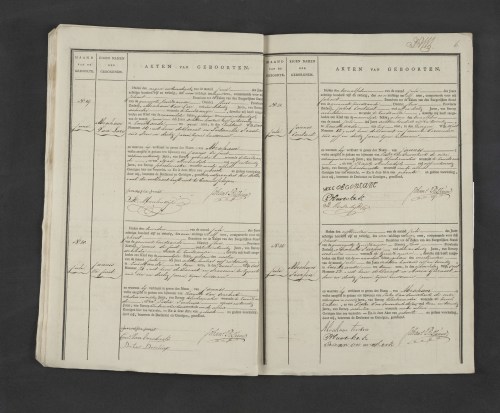
That all changed a few hours ago when Hubert Theuns discovered John Sr.’s birth record. He found it in the Zeeuws archives, which is where I should have looked to begin with. The date was correct: John was born 1 July 1825!! in Zuidzande, Netherlands, which is not far from Belgium.

John’s birth name was Jannis, and his father was also Jannis, so rather than being senior, he was at least III because “Senior’s” grandfather and father were Jan! Thank you Hubert.

Thank you so much for all the help of Adri Van Gessel, Adriaan Leeuwenhoek, and Joel Reeves!

Because my mother’s grandmother, Clara Waldeck Mulder, died less than two years before I was born, I always felt that I had missed out by not knowing her. It seemed as if our paths had almost crossed, but missed. By the time I knew what was what, Great-Grandpa was married to Margaret, a sweet lady who was a good great-grandmother. But I knew I had missed out on meeting the mother of my grandmother, the woman who once managed that scary and fascinating stove in the old farmhouse in Caledonia, Michigan. I knew Mom thought she was a good cook.

So it was really fun that as I was scanning the photo album my mother had made documenting her teen years I found a photo of Great-Grandma a year before she died.

How well I remember those aprons! When you cook, they are the smart thing to wear, although the tummy area always gets the worst of it because it’s convenient to wipe your hands there. They were a style of the past when I was young and newly married, but I still prefer an apron that really covers me up like that to one that ties at the waist.

Jeanne mentioned at the top of the photo is my mother’s cousin Jeanne who in a lineup of cousins is #2 to my mother, my mother being the oldest.

Their Grandma was photographed by Jeanne in the summer of 1952, and she would die 6 September 1953, at the age of 69 years old of uterine cancer. (Yes, her death certificate is posted here).

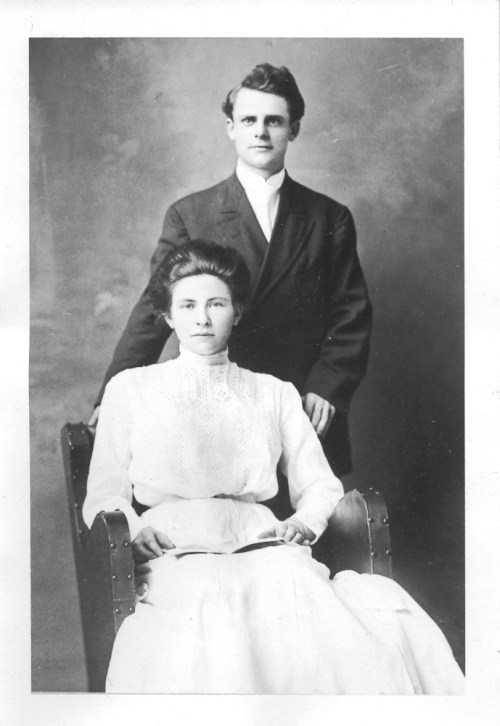
Great-Grandma Clara is pictured here as a young bride with her husband, Charles Mulder, my great-grandfather.

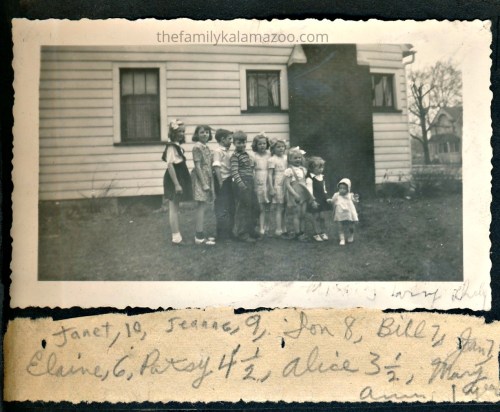
You know that lineup I was mentioning? Here is one!

That’s Mom there on our left with the big bow and Jeanne right next to her.

The littlest ones aren’t in the photo and probably not yet born, but this is a good start on all the cousins, the grandchildren of Clara Mulder!


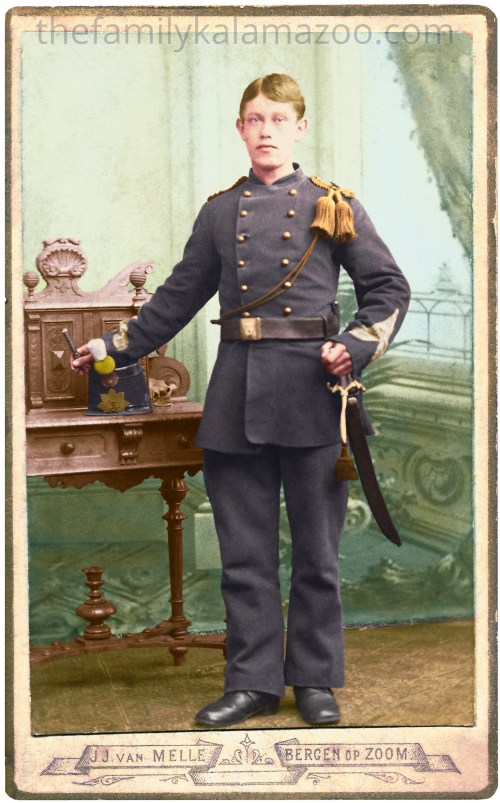
Last week I showed you the beautiful work Val Erde at Colouring the Past did on my great-grandfather Adrian Zuidweg (Adriaan Zuijdweg) photograph, so I wanted Val to perform her magic on a woman or two in my photo collection.

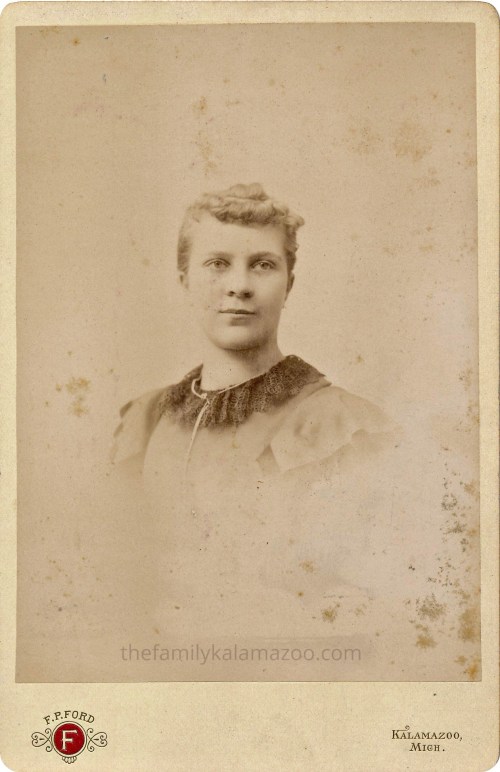
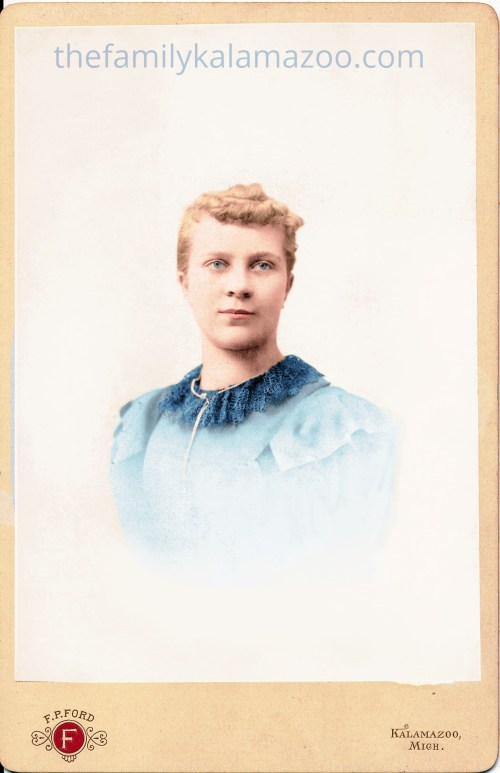
Here is a photograph of Adrian’s wife, Cora DeKorn Zuidweg, my great-grandmother. I don’t believe I have shared this one yet as it was in the beautiful old album I only recently scanned. This is the youngest I have seen Cora where I knew for sure that it was, indeed, Cora.

Cora hasn’t quite lost the “baby fat” in her face here.

She is beautiful, though the photo has damage, especially foxing stains, on it.

But look at Cora after Val gives her some color!

I also asked Val to color a photo of Cora’s mother, Alice Paak DeKorn. The one I gave her was quite faded, so the resulting work is not as vibrant as the others, but it still allows Alice to come off the page into my heart.

Here was the original:

That does it for now with the “in living color” photos. I ordered these two and Adrian’s for this blog, and I share two others on my blog Entering the Pale. I hope to order more sometime in the future. Don’t hesitate to check out Val’s blog for more examples of her beautiful work.


Adriaan in Living Color

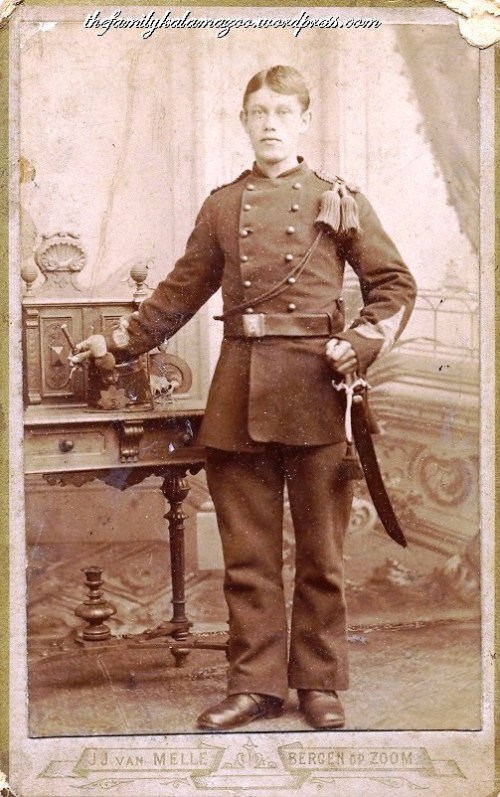
I asked the amazing Val Erde at Colouring the Past to color the original photograph of my great-grandfather Adrian Zuidweg (Adriaan Zuijdweg) in his Dutch army uniform. I’ve posted the original before.

Adriaan Zuijdweg

The photograph was taken in Bergen op Zoom, which is in the south of the Netherlands and is not his hometown of Goes, which is in Zeeland. Val thought it possible that Adrian had to serve  because the Dutch were embroiled in the Aceh War. It was also known as the Dutch War or the Infidel War (1873–1904) and was an armed military conflict between the Sultanate of Aceh and the Kingdom of the Netherlands. The culminiation was that it consolidated Dutch rule over modern-day Indonesia.

My grandfather never told me where his father served, only that he had gone AWOL because his superior had a contagious disease. Since he immigrated to the United States in 1893 at the age of 22, he could only have been 22 or younger in the photograph.

What a beautiful uniform he had! Val tells me that the odd-shaped chevron on his uniform identifies him as a sergeant. Here he is in living color.


I’m so grateful to Val for the beautiful work she’s done here. This is the final version after Val made a correction surrounding the cigar.


Last week, for Women’s History Month, I shared the death certificates of my 2 grandmothers and 4 great-grandmothers. I then searched for death certificates for my eight 2x great grandmothers. All eight were born in other countries: Netherlands, Germany, and Alsace (now France).

MATERNAL SIDE

This one is for Alice Paak DeKorn, who died 5 May 1908 in Kalamazoo, Michigan.

The cause of death is heart disease. Since she was only 55, that seems somewhat unusual. She is the woman who survived a terrible fire. Could that have caused permanent damage to her heart?

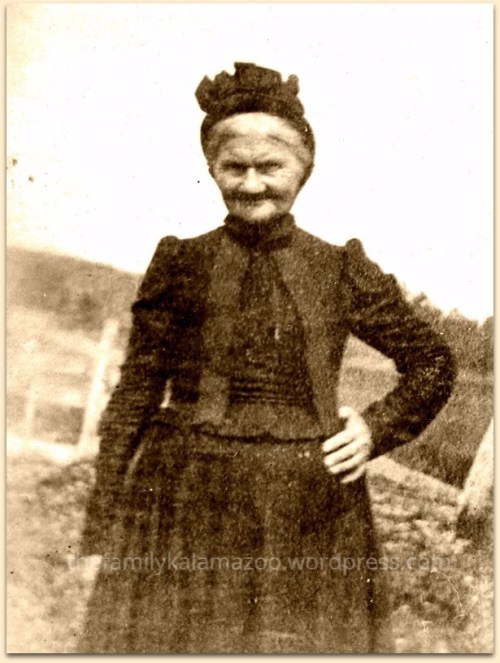
Next up is Jennie Bomhoff Zuidweg who passed away 13 December 1924 in Kalamazoo, Michigan, at age 86 of senility.


That cause of death as senility is a bit mystifying to me. Grandma remembered his grandmother. After all, he was born in 1908, so when she died he would have been 16 years old. He never said anything about her having dementia at all when he talked about her, and I have to believe he would have mentioned it. She looks pretty old in this photo, and she looks like she knows her own mind, so to speak.

But can I quibble with a death certificate when I wasn’t there at the time?

Alwine Noffke Waldeck died 9 June 1912 in Caledonia, Kent County, Michigan. She was 65 years old.

The cause of death is “interstitial nephritis” and dropsy. Dropsy means edema, a subject close to my thoughts because I have lymphedema. Hmm, here is another kidney disease death, like the two in last week’s post. Only this one is on my mother’s side and not my father’s.

Alwine is the mother seated in the middle.

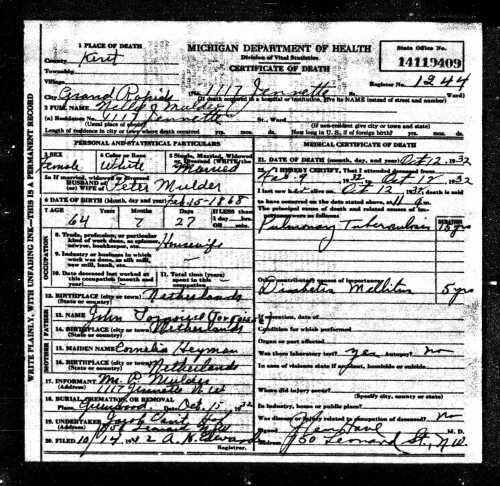
My fourth maternal 2x great grandmother was Nellie Gorsse Mulder who died in Grand Rapids, Michigan, on 12 October 1932. Cause of death was pulmonary tuberculosis, which she had had for 15 years. She also had had diabetes for 5 years.

This is Nellie who died at age 63.

PATERNAL SIDE

I’ll be darned, but I don’t have a single death certificate or death record for these four women. Note that my maternal 2x greats all passed away in the United States, but the paternals did not (to my knowledge).

Elisabetha Adelseck Wendel and Elisabetha Wink Klein were both born in Budesheim, Germany. Presumably they both died there. I wrote for records, but have not received a response. I am not sure how to obtain these records on my own if I can’t get responses to my emails.

Same problem with the other two.

Anne Reihr Schirmer from Leumschwiller, France, and Madeline Groll Scholler from Muespach, France. Again, I think they both died there. But nobody has responded to my requests.

Until I can get those records, it’s hard to feel that they are “real.”  I have no photos of these women either, but feel very lucky to have the four above.

As to the 3x great grandmothers and beyond, I do have some records of many of the Dutch ones because the Dutch records are so easily available online. They makes things so much easier for me! Of course, none of these have causes of death listed.

Any ideas on how to move forward on finding death records for the women from Germany and France?

Because of Women’s History Month, I thought I would pull together information on how the women who came before me passed away. I wanted to put all my grandmothers together in one post and thought by sharing their deaths it would shed some light on their lives, at least at the end. I also have a ghoulish fascination with looking them over for the variety of ways I might die myself. After all, their deaths could be a form of inheritance.

But what I discovered made me pretty mad at myself. I have so neglected death certificates. I think it’s because a death certificate in Michigan tends to be a document that I have to pay for that I have relied on social security death info, as well as burial info and death registry dates. I haven’t been assertive about going after the certificates themselves. This is why I don’t call myself a genealogist, but a family historian. I’m more of a storyteller than a rock solid researcher.

Here are my grandmothers and great-grandmothers and how they died.

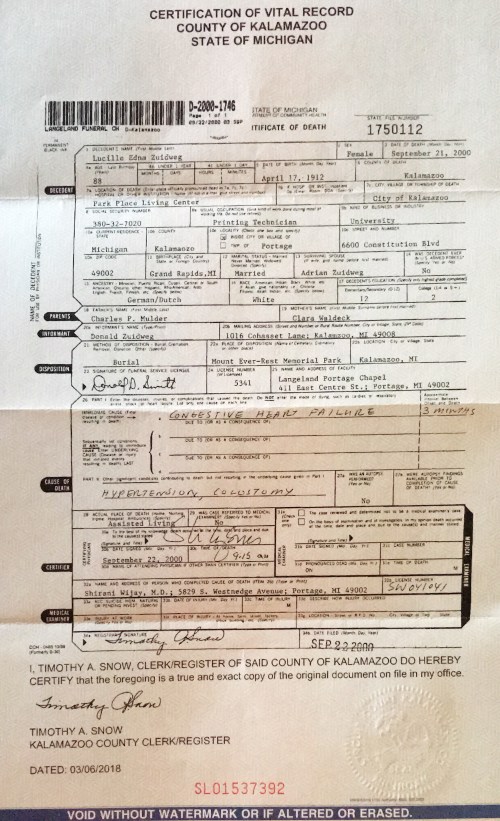
My maternal grandmother, Lucille Edna Mulder Zuidweg, passed away on 21 September 2000 in Kalamazoo, Michigan, at age 88. After the death of my grandfather three months earlier, she was ill and living at a nursing home for round the clock care. The real round the clock care came from my aunt who slept in a chair in Grandma’s room. She was with her most of the time. What my aunt did is wonderful because Grandma hated being in an institutional place. She was like me about that, and it must have been horrible for her there. Thank goodness, she had her daughter with her.

Grandma on our left

I didn’t have her death certificate, so I had to order it from Kalamazoo County. It arrived without a hitch. I see that the cause of death was congestive heart failure. The documentation gives no evidence of all she went through with the cancers that she had. The congestive heart failure might be explained by science in one way, but my explanation is that she died of a broken heart after losing my grandfather.

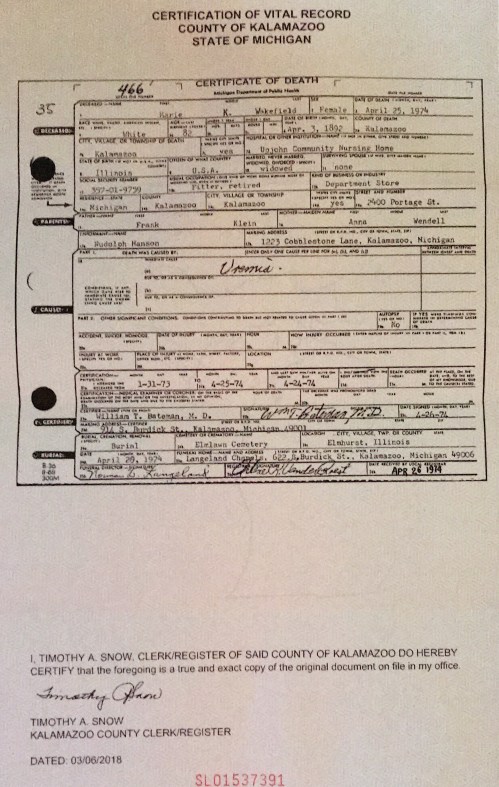
My paternal grandmother, Marie Klein (Kline) Wakefield, passed away on 25 April, 1974, in Kalamazoo, Michigan. She had been living in the Upjohn Nursing Home, which at the time was the premier nursing home in Kalamazoo. Her ex-neighbor and friend, Shirley Kulp, was the head nurse so there was always someone to watch over Grandma. Grandma was 82.

The above photo is my grandmother, Marie. In case you’re wondering about the difference in styles between the one of my grandmother, Edna, Marie was fully 20 years older than Edna.

I didn’t have Marie’s death certificate either, so I had to order it from Kalamazoo County.

Are you noticing the pattern here? [Knocking head against wall]

Luckily, it came in the mail with my other grandmother’s certificate.

Grandma passed away from uremia. I did remember that cause of death, although I had heard of it as a diagnosis while she was still alive, but dying in the hospital. This grandmother is who I inherited my congenital primary lymphedema from.

Then there are my four great-grandmothers.

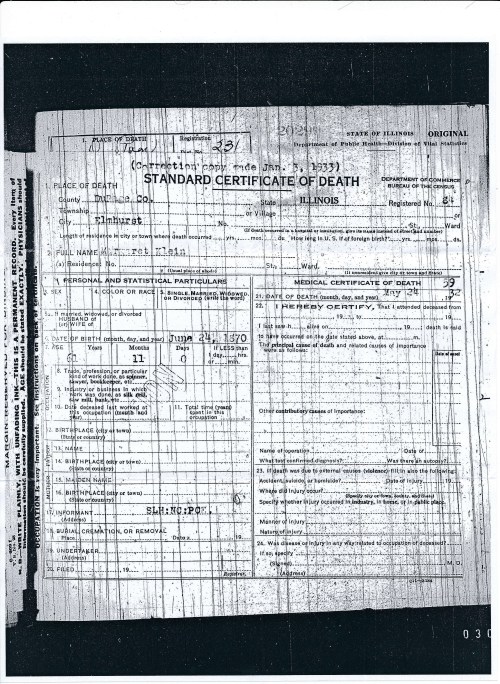
Margarethe Wendel Klein died 24 May 1932 in Elmhurst, Illinois. I have her death certificate (woohoo!). I also have a corrected certificate. The only thing corrected is her birth date, and guess what? Both documents are wrong! According to the Catholic church books in Budesheim, Margarethe was born on June 25, 1869, NOT May 30, 1869 as it says on the death certificate and NOT June 24, 1870 as it says on the corrected copy.

She died of a diabetic coma and also had nephritis and myocarditis. Her health had obviously been poor, although she was only 62–the age I am now. She had also already lost two of her five children, so she had been through a lot. When Margarethe died, her body lay in a casket in their house in Elmhurst. My father told me that there was a thunderstorm during the time it was there, and that the grandchildren were terrified at the combination of events and hid under the huge picnic table style dining room table. She was buried on May 27, but it looks like (from historical rainfall records) the storm most likely occurred the day after her death, on May 25.

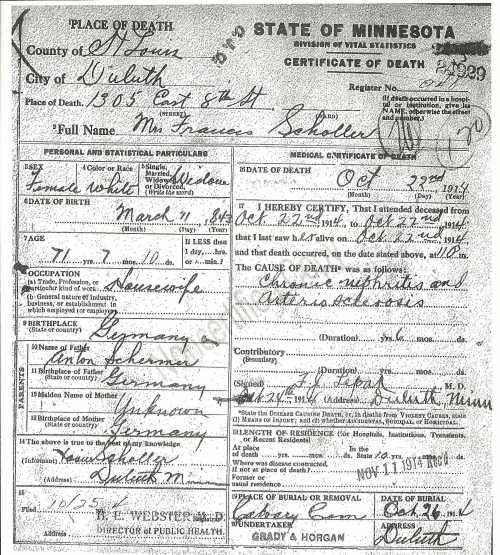
Francoise Schirmer (Schermer) Scholler died 22 October 1914 in Duluth, Minnesota.


Cause of death at age 71: chronic nephritis and arterioschlerosis.

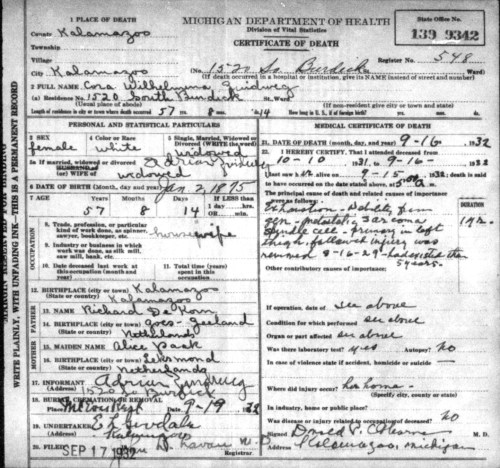
Cora DeKorn Zuidweg died at age 57 on 16 September 1932 in Kalamazoo, Michigan. I have posted about this one in the past.

Cause of death: Exhaustion – debility from gen – metastatic sarcoma spindle cell – primary in left thigh, followed injury was removed 9-16-29 – had existed there 5 years.

Clara Waldeck Mulder died on 6 September 1953 in Kent County, Michigan, at age 69. I did not have her death certificate and ordered it from Kent County.  I knew that she died of cancer, but I had eagerly awaited the actual cause of death on the certificate. When I received the document, I saw that cause of death was carcinoma of the uterus. That is what I had been told.

Don’t tell me it doesn’t unnerve you a little when you see that your ancestors died too young, even if they were older people. Since my grandmothers were 82 and 88, I figured that was a normal lifetime. But when I add in the great-grandmothers’ ages at death the average goes way down. The average of the age at death of all six ladies is 71.5. The average age for the 4 greats is 64.75. I feel blessed that they were all old enough when they died to see their children grow up. Every woman doesn’t have that opportunity, obviously. And look at the pattern. All four greats died much younger than my grandmothers, so things are improving, probably from better healthcare.

Of six grandmothers, I had three death certificates and was able to order the other three. Can I take it back another generation to the 2x greats? There will be eight women. How many certificates will I produce? A future post, peeps!


Today kicks off Women’s History Month, which is celebrated throughout the month of March. Nobody can work on their family history and genealogy and not be confronted with the imbalance between the history of men and the history of women. The mere fact that women are so difficult to find because of the historic practice of taking on their husband’s surnames is enough, but there are other factors, as well. For instance, I only have to examine the history of my own ancestors to see that European and American women, until fairly recently, worked at outside jobs but their occupations rarely resulted in careers.  Sometimes they worked outside the home for decades, but often, once women married, they quit their jobs and began to have children.

When I wrote the poems and short stories in my chapbook Kin Types I consciously tried to bring the lives of these “invisible” women to life. Here is a 53 second video my daughter made of the book last summer.


As you probably realize, the research and the writing itself was a labor of love. The book is available through Amazon, Barnes & Noble, and Finishing Line Press. If you click through the next image, it leads to the Amazon site.

There are other wonderful poems about women and history. Here is a favorite poem by the late great Adrienne Rich. I am only posting the beginning and then you have to follow the link for the rest because WordPress does not allow for the specific formatting that some poems need.

This poem investigates the life of Caroline Herschel, the younger sister of astronomer William Herschel. Although she had to do a lot of her brother’s bidding during her life, she eventually learned to love astronomy and became an esteemed astronomer after discovering several comets.  There are an unknown number of women like this throughout history because most of them were not rewarded during their lifetimes as Caroline Herschel was. For instance, how much did Vivian Eliot help her husband T. S. Eliot with his writing? Einstein’s first wife Mileva Maric was also a physicist and might have co-authored the Theory of Relativity with Einstein, but she got no credit.

Planetarium

BY ADRIENNE RICH

Thinking of Caroline Herschel (1750—1848)
astronomer, sister of William; and others.

A woman in the shape of a monster

a monster in the shape of a woman

the skies are full of them


a woman      ‘in the snow

among the Clocks and instruments

or measuring the ground with poles’


in her 98 years to discover

8 comets

Continue here: Planetarium

This woman is taking a much-needed break next week. See you the week after!

Kapothoed to Kalamazoo

There is so much to see and research in every photograph, every document, and every story. It’s no wonder I always feel that I have not exhausted a topic. One of those topics is the hat that Jennie Zuidweg (wife of Johannes and mother of Lucas who died on the anchor) wore in her photos. She wore it when she was younger and, no doubt, living in the Netherlands–specifically Goes, Zeeland.

And she wore it when she was old and living in Kalamazoo, Michigan.

And then I saw another Dutch relative wearing the hat.

I put all this in the back of my mind, and then on a Dutch Facebook group somebody mentioned a type of hat, and it clicked in my head that I needed to research this hat.

What I found is that this type of hat seems to be called a Kapothoed. According to Google translation, this means hood hat or bonnet. So I did a Google search of Kapothoed. Although all that comes up are not the same, there are several that are.

Google Search for Kapothoed

and from Pinterest.

Kapothoed

What this shows me is that what I assumed to be an old-fashioned country bonnet was really an actual style that existed in the Netherlands. Some of the bonnets or kapothoed that I found by searching Dutch museum collections online are closer to the head, but there are some that are high like these.

Here is a high one from Europeana Collections, an online digital collection of artifacts.

Now that I have seen more kapothoed designs, I can see that the hats Jennie wore when she was younger and when she was elderly are two different hats, two different styles of bonnets.

These bonnets are very different from the traditional Dutch caps which look like the variations in these photos from Wikipedia.

Actually, the caps that women in Goes, Zeeland, wore were the most dramatic, along with the hair combed back at the forehead and the large jewelry worn at the temples.

I spent a lot of time trying to find an image online that I am allowed to download and put into this post, but I couldn’t find the right image of the Goes costume. Instead, I did a Google search of the “traditional costume of Goes, Zeeland” and created a screen shot to show you.

These are oorijzers or ear irons. Various styles had different names. The block or cube style were boeken (books). A spiral metal style were called krullen (curls). This next photo is a woman from Spijkenisse in 1900. I am including it to show you the krullen style ear irons.

Krullen

Here is what Wikipedia has to say about oorijzer. I am quoting them because it’s the best information I found online:

The ear iron is part of the costume for women, especially in the northern provinces of the Netherlands and Zeeland . It originally formed part of the civic power, which was taken over in the regional councils.

Initially the ear iron was a metal bracket to keep the caps in place. It was worn over a cap and a luxurious top hat was put on it. In the course of time the ear iron grew into a showpiece. Decorative gold plates or curls stuck out at the front of the ear irons . . . .

Only in the 19th century did various forms of the ear-iron form a specific part of Dutch regional dress. In Images of dress, morals and customs from 1803-1807 there is no question of ear iron in women from Friesland. In the French era, when the so-called independent regions of the Republic of the United Netherlands come under a single administration, the need for maintaining their own identity arises in the regions. In the Netherlands, the ear iron force is cultivated and has its own development. The prosperity is great, as a result of which the ear iron is getting bigger and bigger. In the course of the century, the narrow band is becoming wider, the buds become larger and flatter and take the form of a flower pot.

Different Ear Irons in the Zuiderzee Museum

A slang term for them might be kissers. A tradition (not universally shared) has it that the kissers were meant to keep boys away from the girls. I’m amazed how the hair looks so plain and yet the cap and oorijzers are so extravagant looking. Coral bead necklaces are part of the traditional costume. You could tell if a woman was Protestant or Catholic by her cap.

If you would like to read more about the oorijzers, here is a blog post by a graduate student in fashion. The Oorijzer

As you know, I am no expert on traditional Dutch costumes. I found this information online. But I think knowing that my ancestors wore outfits like this is eye-opening.

One last thing I’d like to point out is that although I have a couple of traditional costume antique photographs, they are not from Goes, unfortunately. I wish I had a photo of my ancestor dressed this way. Instead, what I do have from late 19th century Netherlands is not traditional attire, but more “modern” European clothing.

P.S. The unidentified lady (called “Mother’s aunt” and written about here) was photographed in Groningen. For fun I thought I’d share a link about Albarta ten Oever (1772–1854), an artist from Groningen who happened to be a woman. Check it out.

by Albarta ten Oever

Koetsreizigers in Schipborg (1806)

landscape of “coach travelers” in Schipborg, a village in Drenthe

And then here’s another article of interest to this blog, Calvinism in the Netherlands. When I was a history grad student (never finished that particular degree) my specialty was religious history, particularly the history of the Reformation (where Protestantism, often in the form of Calvinism, replaced Catholicism for masses of Europeans). So the full history of what has happened with Calvinism in the Netherlands is of particular interest to me. My own family background from the Netherlands was Dutch Reformed (Calvinism), but before my mother was raised, the family had moved away from a strict form of Protestantism.