Feeds:
Posts
Comments

Archive for the ‘Netherlands history’ Category

Last week I wrote about a pioneer of Kalamazoo, Michigan, John DeSmit, Sr. I had learned that he was actually at least John DeSmit III because his father and grandfather who lived and died in the Netherlands, were also Jan or Jannis.

Now I want to give you an idea of John’s wives and their children.  This post was almost published without some very important information sent me by Adri Van Gessel indicating that John DeSmit, Sr. actually had two wives and that the first wife is the mother of only his oldest child, John DeSmit, Jr. Also, I was helped by Hubert Theuns. An enormous thank you for their help!

John Sr. must have married his first wife in the Netherlands. I have not yet found the marriage record, but according to the newspaper, it was probably between 1848 and 1851, when they emigrated. Her name is listed on the death certificate of her one child, John Jr.

The certificate says his mother was Jennie Van S…… Could be Sluice or Sluis or Sh something. I do believe she was still alive when John moved to Kalamazoo with her and their son.

According to one of the newspaper articles published on my last post, the family came to Kalamazoo on 2 May 1854.

The next time we find the family “on paper,” is a marriage record between John Senior and Jacoba Lamper. Jennie must have died between 2 May 1854 and the date of the new marriage, 7 August 1855.

Jacoba was born 18 November 1827 in ‘s-Gravenpolder. Her parents were Adriaan Lamper and Christina de Bart (Lamper). This name is also elsewhere seen as de Bat and de Bath.

Note for DeSmit and Lamper family members: Hubert found documents for other Lamper family members, as well as for John DeSmit’s parents, etc. If you are interested in these documents, please email about them as I am not going to post them all on here.

IMMIGRATION

Regarding their immigration, Hubert also found the following emigration information in http://www.zeeuwengezocht.nl/. Remember that this is emigration, not immigration, so it has to do with John leaving the Netherlands, not actually entering the United States.

Genealogische Afschriften 810/2 Emigrant Jannis de Smit
Woonplaats:
Zuidzande
Rol:
Emigrant
Leeftijd:
26
Beroep:
Landmansknecht (profession: farmer’s apprentice)
Kerkelijke gezindte:
Nederlands-hervormd (religion: Dutch Reformed)
Toegangsnummer:
164 Verzameling Genealogische Afschriften (GA), 1600-2017
Reden:
Verbetering van bestaan (reason for emigration: Amelioration of existence)
Datum vertrek:
1851
Bestemming land:
Noord-Amerika
Betreft:
Staten van landverhuizingen (archief Provinciaal Bestuur Zeeland)
Nummer:
Genealogische Afschriften 810/2
Pagina:
27
Inventarisnummer:
Prijs fotokopie:
€ 5,00

Organisatie: Zeeuws Archief

Although it doesn’t give much more information than the newspaper accounts did, it confirms that the couple immigrated to the United States in 1851 (and not 1850). We know they left from Rotterdam, so now it remains to be seen if I can find them through ship manifest/immigration records.

According to the newspaper article, John and Jennie traveled with four other young married couples. Perhaps that will help locate them.

JOHN DESMIT, JR.

Once John and Jennie arrived in the United States (John in wooden shoes and corduroys, as the newspaper affirmed), he sought work on Long Island, New York, where their first child, John, Jr. was born on 18 July 1853. He would live a full life and die 30 October 1928 in Kalamazoo. He was married to Mary DeKorn (the sister of Richard DeKorn, my great-great-grandfather). Mary was born 4 January 1855 in Kapelle, Zeeland, Netherlands. She died 28 March 1953 in Kalamazoo. They had eight children who lived past infancy.


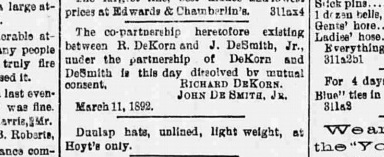
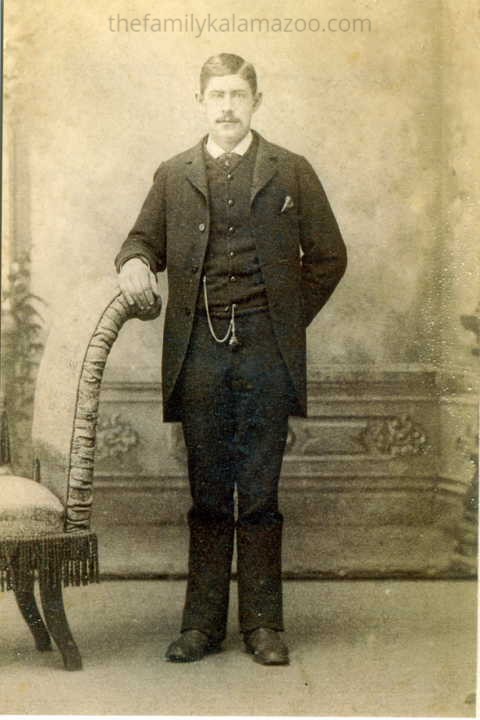
I am not sure if I have a photo of John, Jr. But the motivation for beginning this series on the DeSmits was because I found a little newpaper article in the Telegraph dated 11 March 1892 that mentioned John, Jr., and Richard DeKorn, my great-great-grandfather. They apparently were in partnership together until this date. Since they were both brick masons, did they work together? Or was it a realty partnership? I do not know. But it’s fitting that the brothers-in-law were partners.

In 1854, John, Sr., Jennie, and John, Jr. moved to Kalamazoo. Soon after, Jennie must have died, but I can find no proof of this as of yet. I cannot find her death record, a grave record, nothing. Keep in mind that until I do all this information about the two wives is as yet unverified.

As with Johns Sr. and Jr. I will mainly use the American version of the names for the rest of the children in this post. These are the children John had with Jacoba Lamper.

TWO BABES TAKEN TOO SOON

Adrian was born 17 May 1856 and, sadly, died 9 November 1856.

Francena was born 4 July 1857 and, though the couple might have celebrated the birth of a baby born on Independence Day, she died over a month later, on 27 August 1857. The death of these two children early on must have been real “dog’s weather” and “black snow” for the DeSmits. (Those are expressions he used to refer to hard times in a newspaper interview.

ADRIAN DESMIT

On 4 November 1858, Adrian was born. This baby survived, living until 25 March 1938 when he died in Banks Township in Antrim County, Michigan. Adrian married Anna Versluis, and they had one daughter. Eventually, Adrian would marry Alice Nyland.


The photo of Adrian is from Tim Morris.

This photo was from my grandfather, Adrian Zuidweg.

FRANCINA DESMIT

Halloween (October 31) 1862, Francina was born. She died 21 September 1900, still a young woman. She married Renier Van Delester (many spellings of both first and surnames). They had two sons.

CHRISTINA DESMIT

Christina was born, most likely, in September 1864. The date has not yet been discovered, other than in the Dutch Reformed Church records, where it states she was born 31 September 1864. Unless, the calendar has changed since the 1860s, there is no September 31. Christina married Jacob Flipse, Jr. They did not have children. She passed away 15 February 1914.

ELIZABETH DESMIT

On 23 April 1866, Elizabeth was born. She married Jacob Hycoop, and they had 2 daughters. She lived until 18 May 1946. In fact, in one of the newspaper articles, it was her yard where John, Sr., hoed the celery on his birthday.

ANOTHER BABE GONE TOO SOON

Baby Catharina was born 2 July 1869, but passed away on 16 January 1870.

MARTIN DESMIT

Finally, Martin was born 17 November 1870, and grew up to marry Adriana Schiereck. They had a son called Clarence Wynoble, so it is probable that Clarence was Martin’s stepson. Martin died 6 November 1942 in Plainwell, Michigan.


All except John, Jr. were born in Kalamazoo, and they all died in Michigan–most of them in Kalamazoo. In a future post I will discuss the next generation of DeSmits–the children of John, Jr., Adrian, Francina, Elizabeth, and Martin.


Read Full Post »

I realized that it was far past time that I research the DeSmit family. To give you an idea of how they fit into my family, let me give you a little overview. My great-great grandfather, Richard DeKorn, had two siblings: his sister Jennie Culver and his sister Mary DeSmit. Well, they were born DeKorns, but took on their  husband’s surnames, of course.

Because of the beautiful gift of the “found” photograph album sent to me by a kind stranger I have posted quite a bit about Jennie Culver, her divorce, and her two girls, Rhea and Lela. Jennie is featured in one of the poems in my chapbook Kin Types“What Came Between a Woman and Her Duties.” This poem was first published in the literary magazine Copper Nickel.

Richard’s sister Mary DeKorn married John DeSmit, Jr., and that is my connection with the DeSmit family, so I will begin the story of the DeSmits with that of Mary’s father-in-law, John DeSmit, Sr., a pioneer of Kalamazoo, Michigan.

On 2 July 1912, the Kalamazoo Gazette published this article about John. Because it was his birthday celebration and not an obituary, I believe it has a good chance of being an accurate history of his life. There is even a photo!

John DeSmit, one of Kalamazoo’s oldest pioneer residents, celebrated his 87th birthday anniversary yesterday by industriously laboring all day in a celery patch in the rear of the home of his daughter, Mrs. Elizabeth Hycoop on South Burdick Street.

For a man of his advanced years Mr. DeSmit is remarkably hearty and spry. Age has not dimmed the sparkle in his eye and at times they twinkle with merriment, as he laughingly comments on events of early-day or present-day Kalamazoo. To a reporter for The Gazette who asked him if he was enjoying himself on his 87th birthday he laughingly replied:

“Yes, this is my 87th birthday. I am feeling fine and having a lot of fun all by myself.”

Mr. DeSmit, accompanied by his wife and a baby boy, arrived in Kalamazoo on May 2, 1854. There were only about 1,200 inhabitants in the village then and money was not as plentiful as it is today.

ARRIVED HERE WITH EMPTY PURSE

“When I first came here,” said Mr. DeSmit, “I did anything I could get to do. I got my first job on the afternoon of the day I arrived. It was tending a mason. I was so near flat busted that I went to work without eating dinner. I was paid ten shillings a day to start. I picked up the trade by degrees and most of the time since then I have worked as a mason. I finally began to do contracting in a small way and some of the jobs I did were the building of the spring works in ’78 and the old Kalamazoo house in ’79. I also built the old part of the American house.

“In ’76 my friends induced me to make the race for alderman from the Fourth ward and I was elected. I served that year and ’77. In ’79 I was re-elected and served two years. In ’88 I was appointed to street commissioner.

It was Mr. DeSmit who dug Axtell creek in ’77-’78, draining a large section of marsh land, much of which is now included in the most valuable tract of celery land in Kalamazoo. In ’72 he built the sewer from the jail through the courthouse yard to Arcadia Creek. This was when little was known of the sewer building in Kalamazoo and when few would bid on a sewer job.

HELPED IMPROVE BRONSON PARK

In ’77 Mr. DeSmit raised $1,000 by subscription to fill in and improve Bronson park and the council–then the board of trustees–voted another $1,000 for the work. It was then late in the fall and as he left the council the following spring, being succeeded by George Kidder, it fell to the lot of the latter to complete the park work begun by Mr. DeSmit.

Mr. DeSmit came to America in 1850, arriving in New York on October 1 of that year with his bride and four other young married couples. They sailed from Rotterdam and were 113 days in crossing the ocean. None of the five couples had any money upon arriving in America, but the men of the party secured work in the woods of Long Island and after many hard struggles saved enough of their meagre wages to emigrate west to the land of promise. As far as he knows Mr. DeSmit is the only one of the five couples now living.

HE’S HAPPY AND CONTENTED AS ANY

“I’ve worked hard all my life,” said Mr. DeSmith, “and I’ve seen a lot of happiness. I’ve also seen some dog’s weather and some black snow, but it’s what we all get in this life some time or other. I guess for a man of my years I’m about as happy and contented as any.

Mr. DeSmit has five children living, all of whom reside in Kalamazoo. They are John, Adrian, and Martin DeSmit and Mrs. Elizabeth Hycoop and Mrs. Christine Flipse.

The aged man lives at 1017 South Burdick Street.

He lived on South Burdick. Of course, he did! That area of Burdick must have been quite the “Holland” or Dutch enclave.

Is this article not a windfall for a family researcher? Look at some of the facts I found.

  • He arrived in the United States on 1 October 1850  This will prove to be a bit off.
  • He left approximately 113 days before that  This will be contradicted in another article.
  • He lived on Long Island for awhile before coming to Michigan
  • When he came to Kalamazoo, only 1,200 people lived there
  • He was instrumental in getting Bronson Park off to a good start (Bronson Park is the town square of Kalamazoo)
  • They left Netherlands through Rotterdam; however, no info about where in Holland they came from
  • How he got started as a mason
  • How he happened to be in New York (because this is where John Jr. was born)
  • I am not the only person who persistent types DeSmith instead of DeSmit (ugh)
  • I learned some new expressions: “dog’s weather” and “black snow”–“dog’s weather” or hondeweer is a common Dutch expression meaning bad weather, such as rain or a storm. I was given help for this through a kind Facebook group. The answer to “black snow” can be found here. It means: “misery, experiencing poverty” and is better known in Belgium. This in interesting because one of my helpers with the DeSmit family believes they came from an area very close to Belgium.

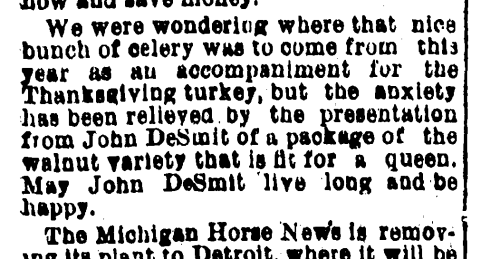
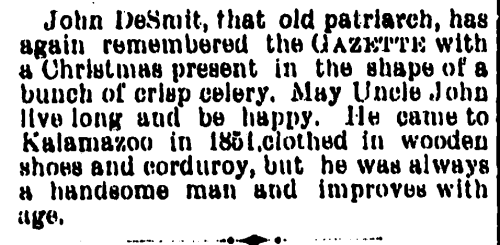
There are several newspaper articles about John DeSmit gifting celery to the Gazette, particularly at the time of Thanksgiving and Christmas–so much so, that they expected it. This one is 30 November 1893:

This theme is repeated over several years. Here is one from Christmas day 1896.

Although the year 1851 is probably incorrect (1854 fits with the chronology better), you have to love the details: “clothed in wooden shoes and corduroy.”

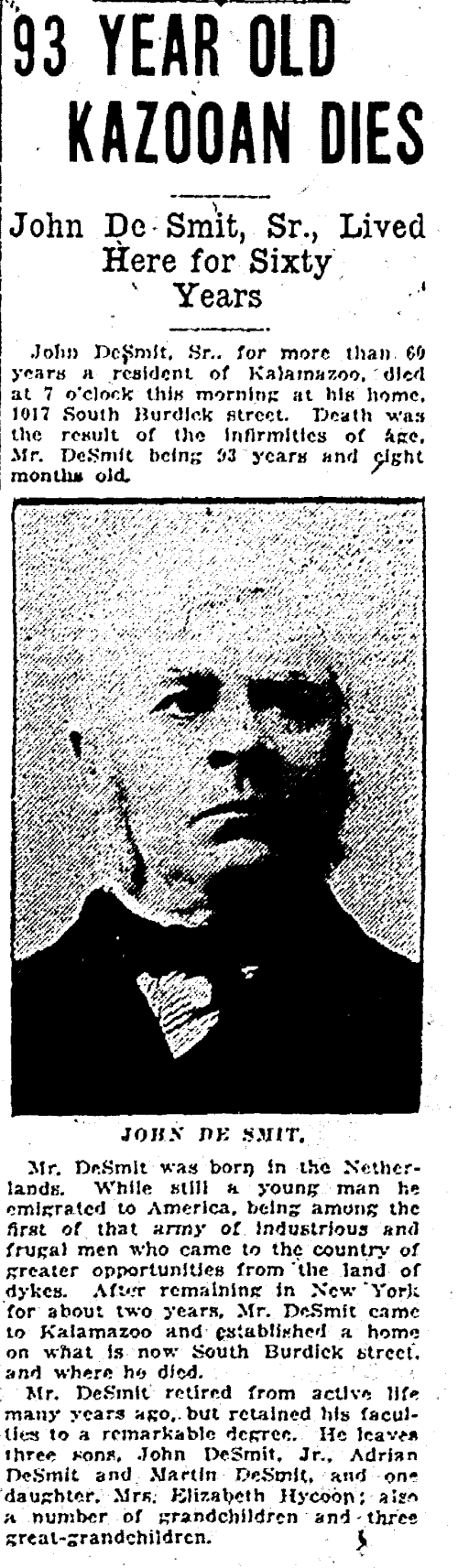
Three years later, the paper commemorates John DeSmit’s 90th birthday.

Here we learn that he came to Kalamazoo in 1854 and that he served in the Dutch army in 1845. And that his birthdate is 1 July 1825. We also get an overview that tells how important his construction work was to the formation of Kalamazoo’s streets and sewers. John belonged to the Reformed church.  Best yet, the photo is better in this clipping than in the first.

John DeSmit was still going strong for his 91st birthday party.


Even back in 1899, the paper was celebrating John DeSmit’s 74th birthday. Some of the details here are different than in the other articles. I can’t help but wonder if the paper made mistakes or if John’s memory altered things as he got older. For instance, here it is 135 days on the ocean from Rotterdam to NYC, whereas it was 113 days in 1912 (13 years later). Also, the address of his house is slightly off here, but I do appreciate that the info is shared here that he owned his house since 1858. Notice that in 1899 he had six living children, whereas later he had five and then four. Also in the following article, one of his children is living outside of Kalamazoo.

Eventually, John DeSmit succumbed to old age.

John DeSmit passed away on 10 March 1919 at the Burdick Street house he had lived at for decades. According to his obituary’s omission of daughter Christine Flipse, she appears to have passed away. But more on that later when I write about John’s wife wives and their children and grandchildren.

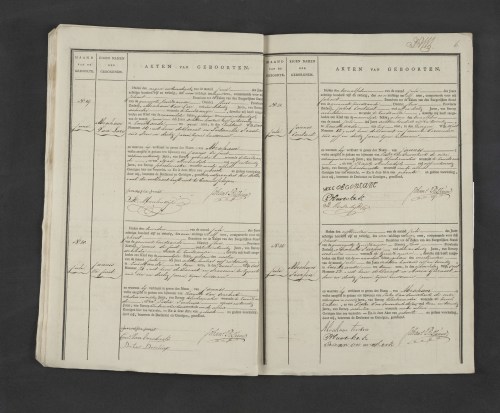
Alas, even with all these newspaper clues I can not find a trace of John DeSmit in wiewaswie records. His Dutch name was Jan, but although I have his birthdate and an approximate time period for his marriage date, I cannot find his birth or marriage records.

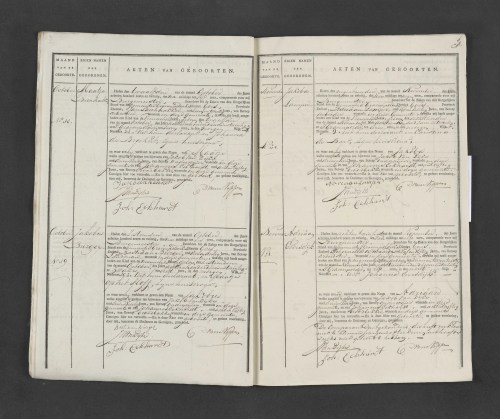
That all changed a few hours ago when Hubert Theuns discovered John Sr.’s birth record. He found it in the Zeeuws archives, which is where I should have looked to begin with. The date was correct: John was born 1 July 1825!! in Zuidzande, Netherlands, which is not far from Belgium.

John’s birth name was Jannis, and his father was also Jannis, so rather than being senior, he was at least III because “Senior’s” grandfather and father were Jan! Thank you Hubert.

Thank you so much for all the help of Adri Van Gessel, Adriaan Leeuwenhoek, and Joel Reeves!

Read Full Post »

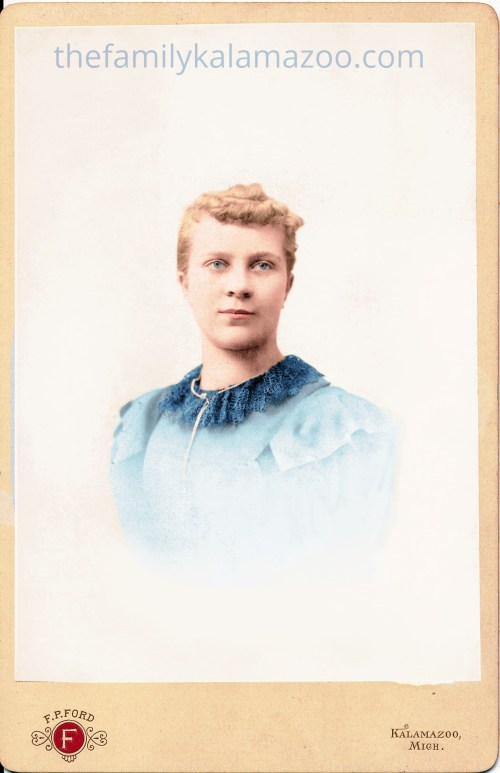
Last week I showed you the beautiful work Val Erde at Colouring the Past did on my great-grandfather Adrian Zuidweg (Adriaan Zuijdweg) photograph, so I wanted Val to perform her magic on a woman or two in my photo collection.

Here is a photograph of Adrian’s wife, Cora DeKorn Zuidweg, my great-grandmother. I don’t believe I have shared this one yet as it was in the beautiful old album I only recently scanned. This is the youngest I have seen Cora where I knew for sure that it was, indeed, Cora.

Cora hasn’t quite lost the “baby fat” in her face here.

She is beautiful, though the photo has damage, especially foxing stains, on it.

But look at Cora after Val gives her some color!

I also asked Val to color a photo of Cora’s mother, Alice Paak DeKorn. The one I gave her was quite faded, so the resulting work is not as vibrant as the others, but it still allows Alice to come off the page into my heart.

Here was the original:

That does it for now with the “in living color” photos. I ordered these two and Adrian’s for this blog, and I share two others on my blog Entering the Pale. I hope to order more sometime in the future. Don’t hesitate to check out Val’s blog for more examples of her beautiful work.


Read Full Post »

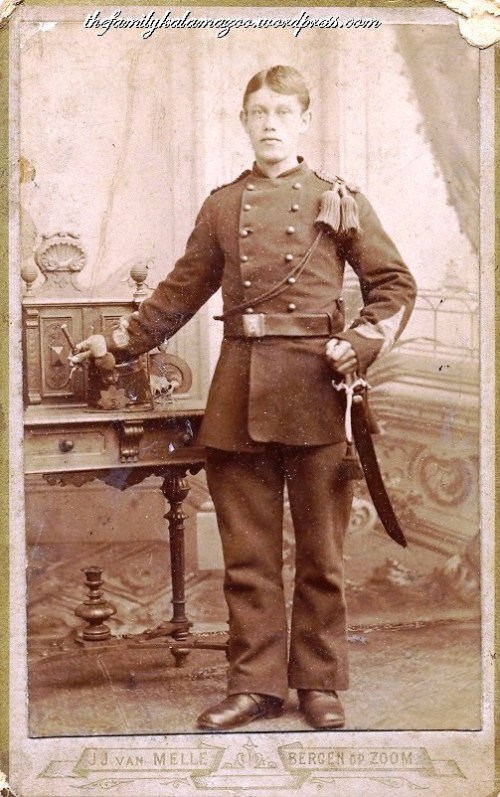
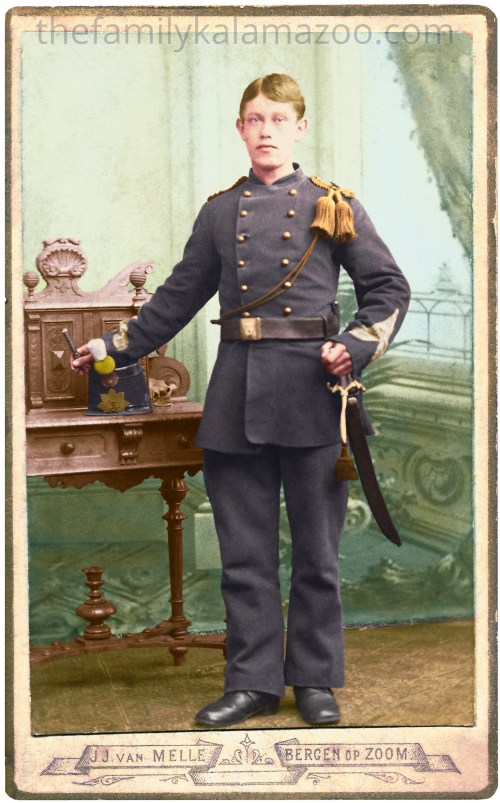
I asked the amazing Val Erde at Colouring the Past to color the original photograph of my great-grandfather Adrian Zuidweg (Adriaan Zuijdweg) in his Dutch army uniform. I’ve posted the original before.

Adriaan Zuijdweg

The photograph was taken in Bergen op Zoom, which is in the south of the Netherlands and is not his hometown of Goes, which is in Zeeland. Val thought it possible that Adrian had to serve  because the Dutch were embroiled in the Aceh War. It was also known as the Dutch War or the Infidel War (1873–1904) and was an armed military conflict between the Sultanate of Aceh and the Kingdom of the Netherlands. The culminiation was that it consolidated Dutch rule over modern-day Indonesia.

My grandfather never told me where his father served, only that he had gone AWOL because his superior had a contagious disease. Since he immigrated to the United States in 1893 at the age of 22, he could only have been 22 or younger in the photograph.

What a beautiful uniform he had! Val tells me that the odd-shaped chevron on his uniform identifies him as a sergeant. Here he is in living color.


I’m so grateful to Val for the beautiful work she’s done here. This is the final version after Val made a correction surrounding the cigar.


Read Full Post »

Last week, for Women’s History Month, I shared the death certificates of my 2 grandmothers and 4 great-grandmothers. I then searched for death certificates for my eight 2x great grandmothers. All eight were born in other countries: Netherlands, Germany, and Alsace (now France).

MATERNAL SIDE

This one is for Alice Paak DeKorn, who died 5 May 1908 in Kalamazoo, Michigan.

The cause of death is heart disease. Since she was only 55, that seems somewhat unusual. She is the woman who survived a terrible fire. Could that have caused permanent damage to her heart?

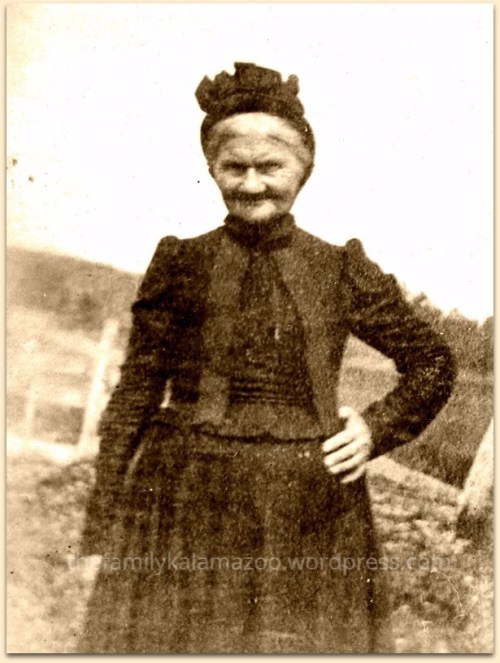
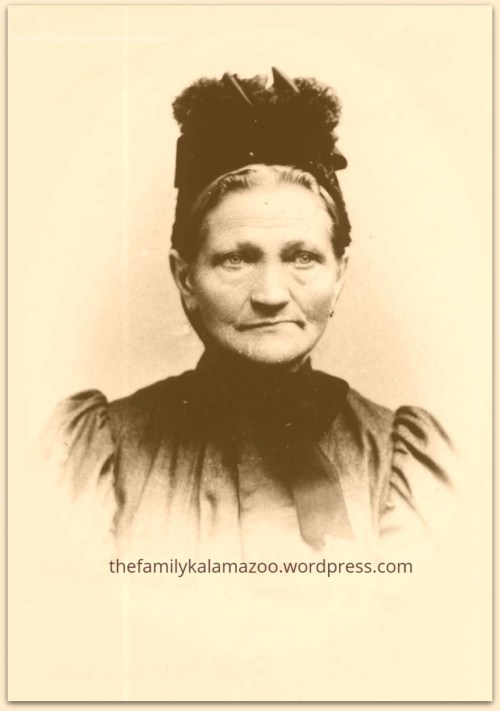
Next up is Jennie Bomhoff Zuidweg who passed away 13 December 1924 in Kalamazoo, Michigan, at age 86 of senility.


That cause of death as senility is a bit mystifying to me. Grandma remembered his grandmother. After all, he was born in 1908, so when she died he would have been 16 years old. He never said anything about her having dementia at all when he talked about her, and I have to believe he would have mentioned it. She looks pretty old in this photo, and she looks like she knows her own mind, so to speak.

But can I quibble with a death certificate when I wasn’t there at the time?

Alwine Noffke Waldeck died 9 June 1912 in Caledonia, Kent County, Michigan. She was 65 years old.

The cause of death is “interstitial nephritis” and dropsy. Dropsy means edema, a subject close to my thoughts because I have lymphedema. Hmm, here is another kidney disease death, like the two in last week’s post. Only this one is on my mother’s side and not my father’s.

Alwine is the mother seated in the middle.

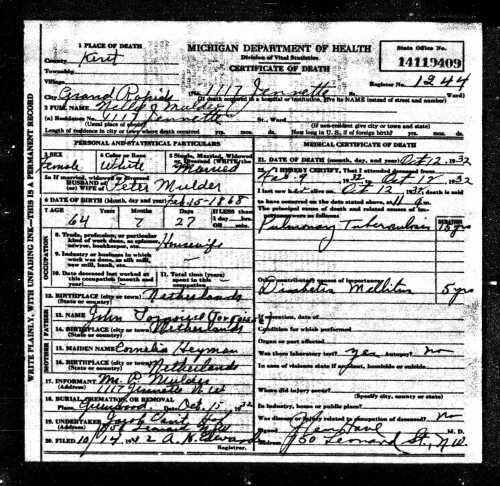
My fourth maternal 2x great grandmother was Nellie Gorsse Mulder who died in Grand Rapids, Michigan, on 12 October 1932. Cause of death was pulmonary tuberculosis, which she had had for 15 years. She also had had diabetes for 5 years.

This is Nellie who died at age 63.

PATERNAL SIDE

I’ll be darned, but I don’t have a single death certificate or death record for these four women. Note that my maternal 2x greats all passed away in the United States, but the paternals did not (to my knowledge).

Elisabetha Adelseck Wendel and Elisabetha Wink Klein were both born in Budesheim, Germany. Presumably they both died there. I wrote for records, but have not received a response. I am not sure how to obtain these records on my own if I can’t get responses to my emails.

Same problem with the other two.

Anne Reihr Schirmer from Leumschwiller, France, and Madeline Groll Scholler from Muespach, France. Again, I think they both died there. But nobody has responded to my requests.

Until I can get those records, it’s hard to feel that they are “real.”  I have no photos of these women either, but feel very lucky to have the four above.

As to the 3x great grandmothers and beyond, I do have some records of many of the Dutch ones because the Dutch records are so easily available online. They makes things so much easier for me! Of course, none of these have causes of death listed.

Any ideas on how to move forward on finding death records for the women from Germany and France?

Read Full Post »

There is so much to see and research in every photograph, every document, and every story. It’s no wonder I always feel that I have not exhausted a topic. One of those topics is the hat that Jennie Zuidweg (wife of Johannes and mother of Lucas who died on the anchor) wore in her photos. She wore it when she was younger and, no doubt, living in the Netherlands–specifically Goes, Zeeland.

And she wore it when she was old and living in Kalamazoo, Michigan.

And then I saw another Dutch relative wearing the hat.

I put all this in the back of my mind, and then on a Dutch Facebook group somebody mentioned a type of hat, and it clicked in my head that I needed to research this hat.

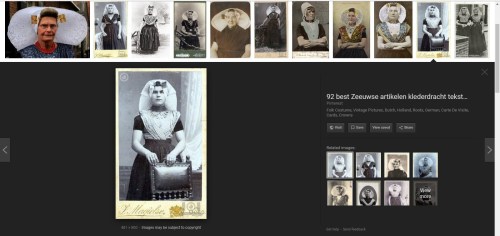
What I found is that this type of hat seems to be called a Kapothoed. According to Google translation, this means hood hat or bonnet. So I did a Google search of Kapothoed. Although all that comes up are not the same, there are several that are.

Google Search for Kapothoed

and from Pinterest.

Kapothoed

What this shows me is that what I assumed to be an old-fashioned country bonnet was really an actual style that existed in the Netherlands. Some of the bonnets or kapothoed that I found by searching Dutch museum collections online are closer to the head, but there are some that are high like these.

Here is a high one from Europeana Collections, an online digital collection of artifacts.

Now that I have seen more kapothoed designs, I can see that the hats Jennie wore when she was younger and when she was elderly are two different hats, two different styles of bonnets.

These bonnets are very different from the traditional Dutch caps which look like the variations in these photos from Wikipedia.

Actually, the caps that women in Goes, Zeeland, wore were the most dramatic, along with the hair combed back at the forehead and the large jewelry worn at the temples.

I spent a lot of time trying to find an image online that I am allowed to download and put into this post, but I couldn’t find the right image of the Goes costume. Instead, I did a Google search of the “traditional costume of Goes, Zeeland” and created a screen shot to show you.

These are oorijzers or ear irons. Various styles had different names. The block or cube style were boeken (books). A spiral metal style were called krullen (curls). This next photo is a woman from Spijkenisse in 1900. I am including it to show you the krullen style ear irons.

Krullen

Here is what Wikipedia has to say about oorijzer. I am quoting them because it’s the best information I found online:

The ear iron is part of the costume for women, especially in the northern provinces of the Netherlands and Zeeland . It originally formed part of the civic power, which was taken over in the regional councils.

Initially the ear iron was a metal bracket to keep the caps in place. It was worn over a cap and a luxurious top hat was put on it. In the course of time the ear iron grew into a showpiece. Decorative gold plates or curls stuck out at the front of the ear irons . . . .

Only in the 19th century did various forms of the ear-iron form a specific part of Dutch regional dress. In Images of dress, morals and customs from 1803-1807 there is no question of ear iron in women from Friesland. In the French era, when the so-called independent regions of the Republic of the United Netherlands come under a single administration, the need for maintaining their own identity arises in the regions. In the Netherlands, the ear iron force is cultivated and has its own development. The prosperity is great, as a result of which the ear iron is getting bigger and bigger. In the course of the century, the narrow band is becoming wider, the buds become larger and flatter and take the form of a flower pot.

Different Ear Irons in the Zuiderzee Museum

A slang term for them might be kissers. A tradition (not universally shared) has it that the kissers were meant to keep boys away from the girls. I’m amazed how the hair looks so plain and yet the cap and oorijzers are so extravagant looking. Coral bead necklaces are part of the traditional costume. You could tell if a woman was Protestant or Catholic by her cap.

If you would like to read more about the oorijzers, here is a blog post by a graduate student in fashion. The Oorijzer

As you know, I am no expert on traditional Dutch costumes. I found this information online. But I think knowing that my ancestors wore outfits like this is eye-opening.

One last thing I’d like to point out is that although I have a couple of traditional costume antique photographs, they are not from Goes, unfortunately. I wish I had a photo of my ancestor dressed this way. Instead, what I do have from late 19th century Netherlands is not traditional attire, but more “modern” European clothing.

P.S. The unidentified lady (called “Mother’s aunt” and written about here) was photographed in Groningen. For fun I thought I’d share a link about Albarta ten Oever (1772–1854), an artist from Groningen who happened to be a woman. Check it out.

by Albarta ten Oever

Koetsreizigers in Schipborg (1806)

landscape of “coach travelers” in Schipborg, a village in Drenthe

And then here’s another article of interest to this blog, Calvinism in the Netherlands. When I was a history grad student (never finished that particular degree) my specialty was religious history, particularly the history of the Reformation (where Protestantism, often in the form of Calvinism, replaced Catholicism for masses of Europeans). So the full history of what has happened with Calvinism in the Netherlands is of particular interest to me. My own family background from the Netherlands was Dutch Reformed (Calvinism), but before my mother was raised, the family had moved away from a strict form of Protestantism.

Read Full Post »

Three years ago, I wrote about the youngest child of Johannes and Jennie Zuijdweg. I explained that Grandpa had told me that Lucas, age 21, was a sailor and, in a tragic accident, fell on the anchor of his ship and was killed.

Lucas was certainly a blue-eyed blond, like his sister, and looks remarkably like her and like Johannes, their father.

Since I had been writing about Johannes recently, I thought it fitting to revisit his son’s death.

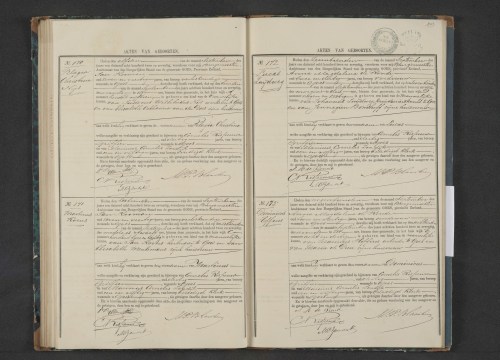
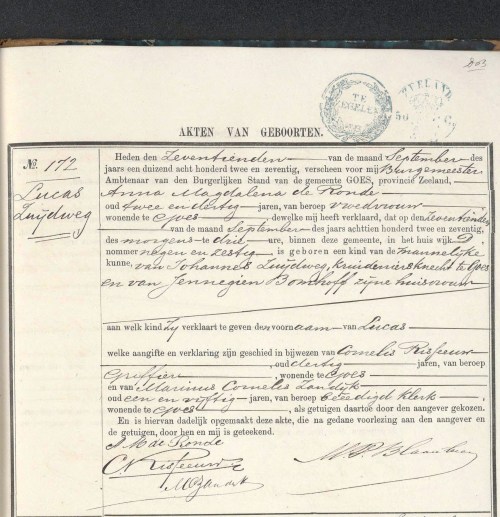
On Zeeuwen Gezocht, I found the birth and death records of Lucas. I hoped to discover the cause of his death written on the documents.

And here is the cropped version.

Here is the death record.

Again, here is the cropped version.

According to a very nice member of a Facebook group, the translation is as follows:

Today, the 4th of April, 1894, appeared to me,
officer of the Civil Registry of the town of Goes

Jan Bruggeman, aged 56 years, profession : undertaker, living at Goes, not related (to the deceased),
and Hubertus van Liere, aged 53 years, profession : merchant, living at Goes, not related,
who have declared to me that on the 4th of April 1894 at 4 o’clock at night (AM) passed away
Lucas Zuijdweg, aged 21 years, born at Goes, profession : labourer, lived at Goes, son of
Johannes Zuijdweg, announcer, and of Jannegien Bomhoff, his wife.

And is immediately made up this record, which has been signed by myself and declarants after being read out.

Unfortunately, there is no record of how Lucas passed away. Well, I wonder. What if there is a newspaper article? I guess I need to learn Dutch and then learn how to search for newspaper articles in Dutch papers!

What does come to mind from this document is wonder that an undertaker was with him when he died. What in the world? Since Grandpa said this was an accident, I wonder in what bad shape Lucas was in and if he was taken, still alive, to a morgue? How can that be? And Hubertus van Liere might not be a relative, but of course, the daughter of Johannes and Jennie–Lucas’ sister–would marry Marinus Van Liere in 1900.

Also, it states that Johannes was an announcer. He has also been a crier in past records. But mainly he was listed as a merchant. So he was an announcer when Lucas died and a few months later, when he was sentenced, he was a merchant again? How did he accomplish these two occupations?

According to Dutch genealogist, Yvette Hoitink, there aren’t many Dutch graves on Findagrave. She suggests begraafplaatsen, which are the Dutch graves that have been put online. Lucas is not listed, and they are still looking for volunteers to photograph graves. I am not even sure how to find out where he is buried.


Read Full Post »

The more I peer into the past, the more I feel like Pandora. In addition to discovering wonderful information about my ancestors, sometimes I discover sad, tragic, or even disturbing events.

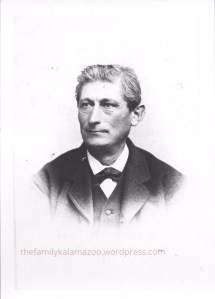
For instance, I have found out more about the sentencing of my great-great-grandfather Johannes Zuijdweg (Zuidweg).

Unfortunately, what I discovered is not positive.

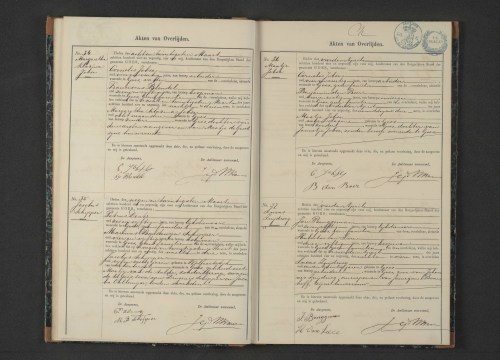
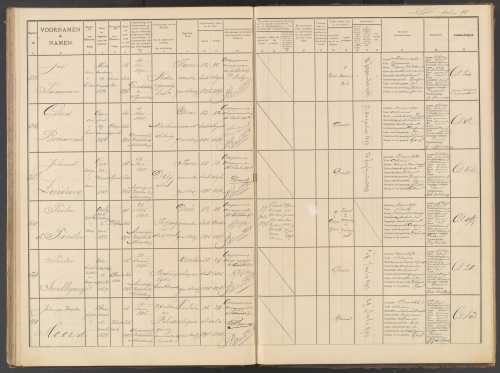
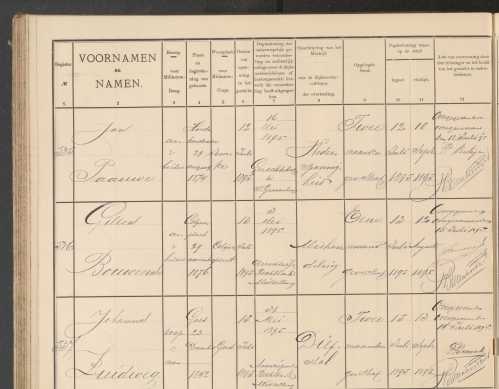
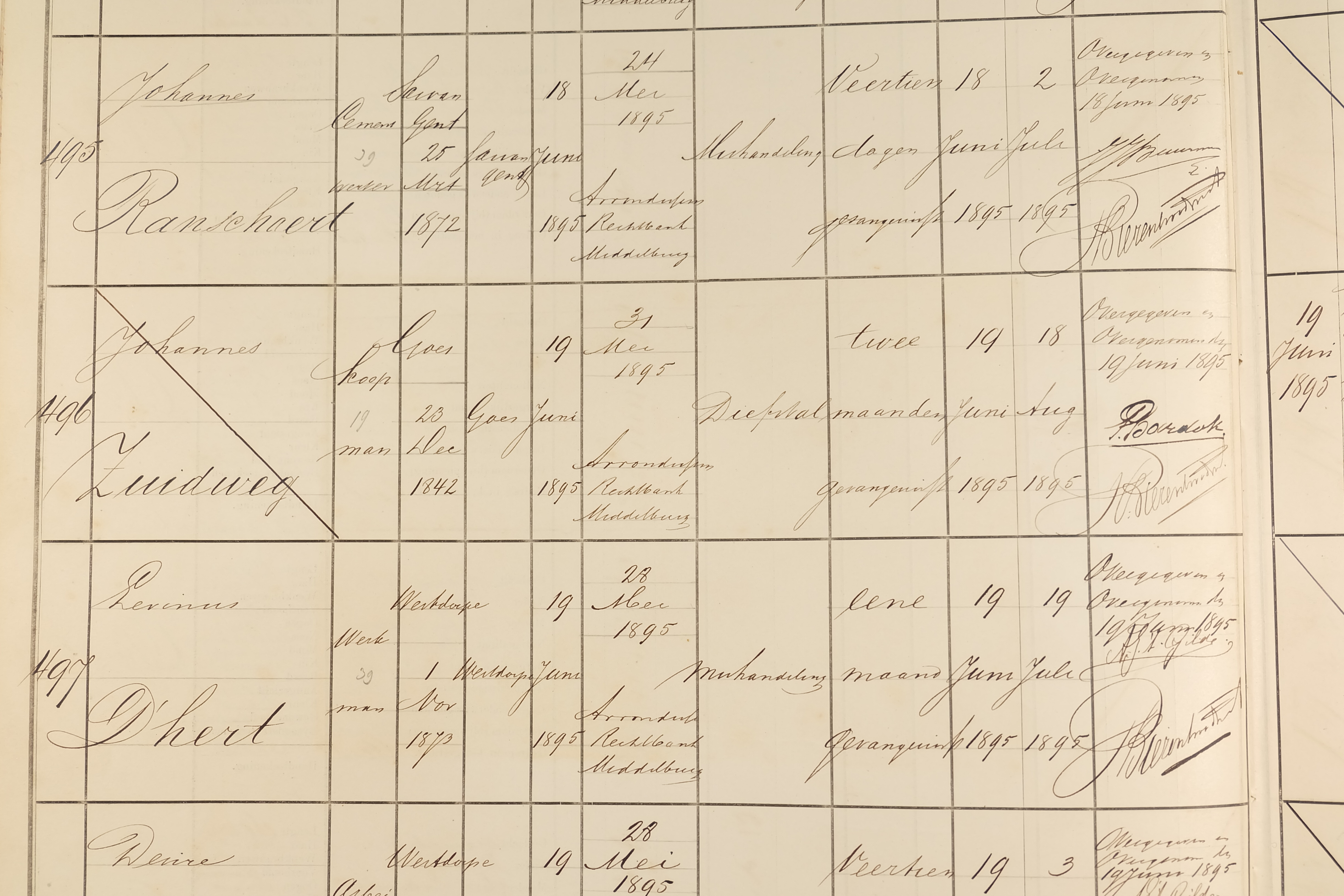
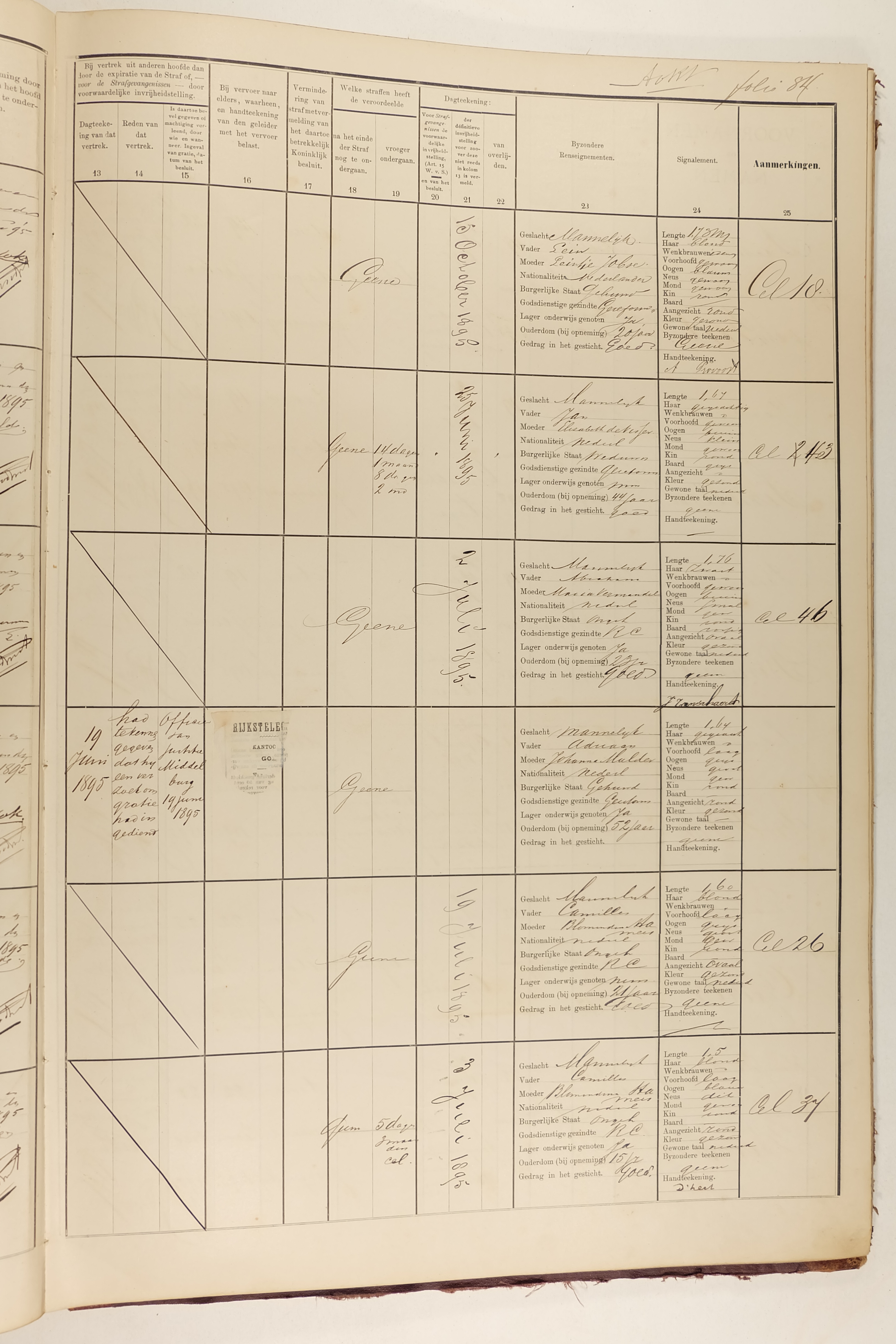
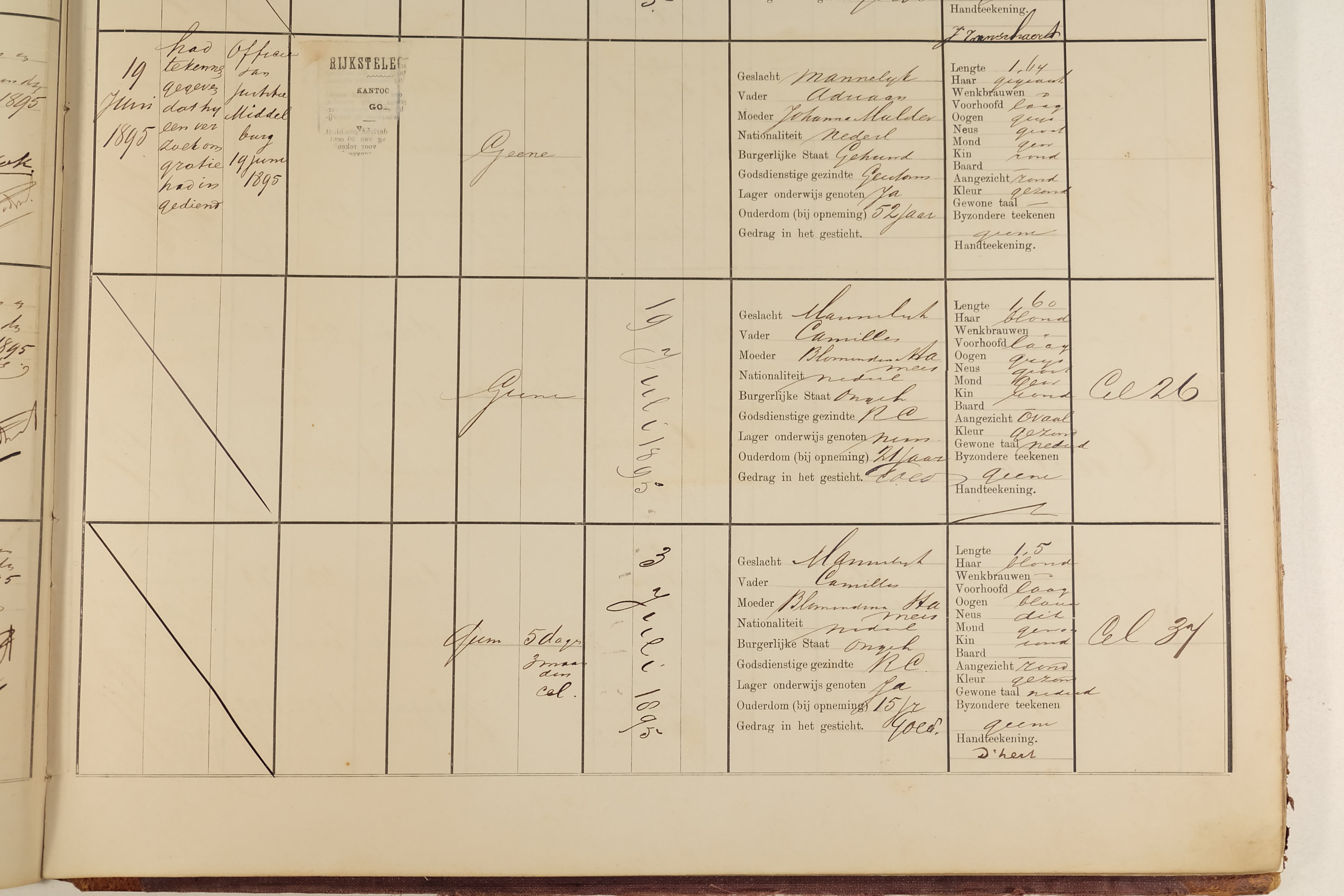
Here it is cropped a bit to make it easier (thanks for the idea, Amy!). His entry is the third down on both pages.


According to this document and the kind translators on Facebook, Johannes did serve two months in jail for theft, from July 15 to September 13, 1895. Imagine how Jennie felt. She had just lost her youngest child (of three) to a gruesome accident and now, a year later, her husband was serving time in jail. Everyone in their neighborhood and at their church must have known.

I don’t know if I will ever discover what was stolen or what the situation was, but I will always believe that the death of Lucas had something to do with it–given that death, the older age of Johannes, and his otherwise respectable history.

Remember for that last document when Johannes’ hair and eyebrows were translated as blond? The translation I received for this document for his looks is this way:

I can only read the enlarged part…. sex: male father: Adriaan mother: Johanna Maria Mulder nationality: Dutch civil status: married religion: reformed lower basic education: yes age (at inclusion) 52 behaviour (in institute (?) : good lenght: 1.64 m hair: greyish eyebrows: same (greyish) forehead : low eyes: grey nose: large mouth: ordinary chin: round beard: none face: oval complexion: healthy language spoken (literally: ordinary language) special features (?): none

“Greyish” hair and eyebrows!

I’ve sponsored Johannes’ memorial at Findagrave. You can find it here. I discovered that someone had posted an obituary for him on the site. Since the paper had apparently misspelled two names, I put a note explaining what the spelling should have been.

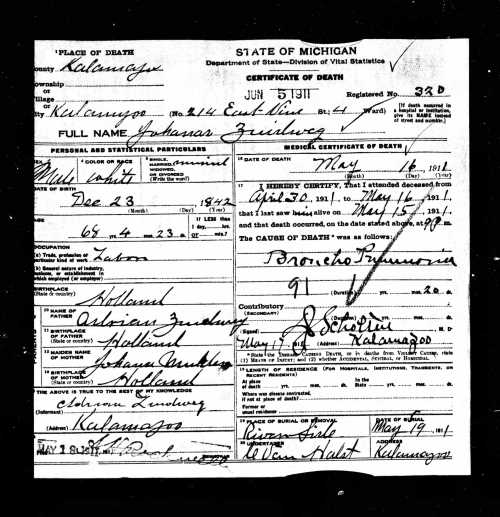
JOHANIUS ZUIDWEG. Following a long Illness, Johanius Zuidweg, aged 68, died at his home, 214 east Vine street, 9 o’clock last night. He came to this country from Holland nine years ago. He is survived by a widow, a daughter, Mrs. Marleilus Van Liere, and a son, Adrian Zuidweg, all of this city. The funeral will be held at the residence 1:30 o’clock Friday afternoon and from the Fourth Reformed church at 2 o’clock, the Rev. Mr. Frost officiating. The interment will be in Riverside cemetery. Kalamazoo Telegraph-Press May 17, 1911 (copied as written in paper)

Note:Johanius should be Johannes. Marleilus should be Marinus.

I was sorry to see that Johannes suffered a long illness before he passed away. 

However, when I look at the death certificate, his illness appears to have been 20 days. The cause of death was broncho pneumonia. I wonder if he had another illness that then turned into pneumonia.

Read Full Post »

Up until now, I’ve written very little about my great-great-grandfather Johannes Zuijdweg (Zuidweg). He was married to Jennie Bomhoff Zuidweg. I wrote about her knitting skills for U.S. troops here. Johannes and Jennie were my grandfather’s paternal grandparents. He talked about Jennie to me, but he didn’t really know his grandfather who died when Grandpa was only three.

The birth of Johannes is an important moment in the history of our family because his parents tie together the Zuijdwegs/Zuidwegs and the Mulders. Grandpa was a Zuidweg, and Grandma was a Mulder. Both families were from Goes, Netherlands, and they both are descended from Karel Mulder, the jailer’s hand.

The record of the marriage of Johannes and Jennie I found at wiewaswie. Here is a transcription of the marriage document:

BS Huwelijk met Johannes Zuijdweg

Groom
Johannes Zuijdweg
Profession
kruideniersknecht
Birth place
Goes
Age
26
Bride
Jenneqien Bomhoff
Profession
dienstbode
Birth place
Zwolle
Age
31
Father of groom
Adriaan Zuijdweg
Mother of the groom
Johanna Mulder
Profession
Arbeidster
Father of bride
Lúcas Bomhoff
Mother of the bride
Johanna Danser
Event
Huwelijk
Event date
04-11-1869
Event place
Goes

To read (in Dutch) the pages of the record, read the page on the right of the first image and the page on the left of the second image. If you look at the signers on the document itself you will see that one of the signers was a Van Liere. That is another family that has shared a path with my family.

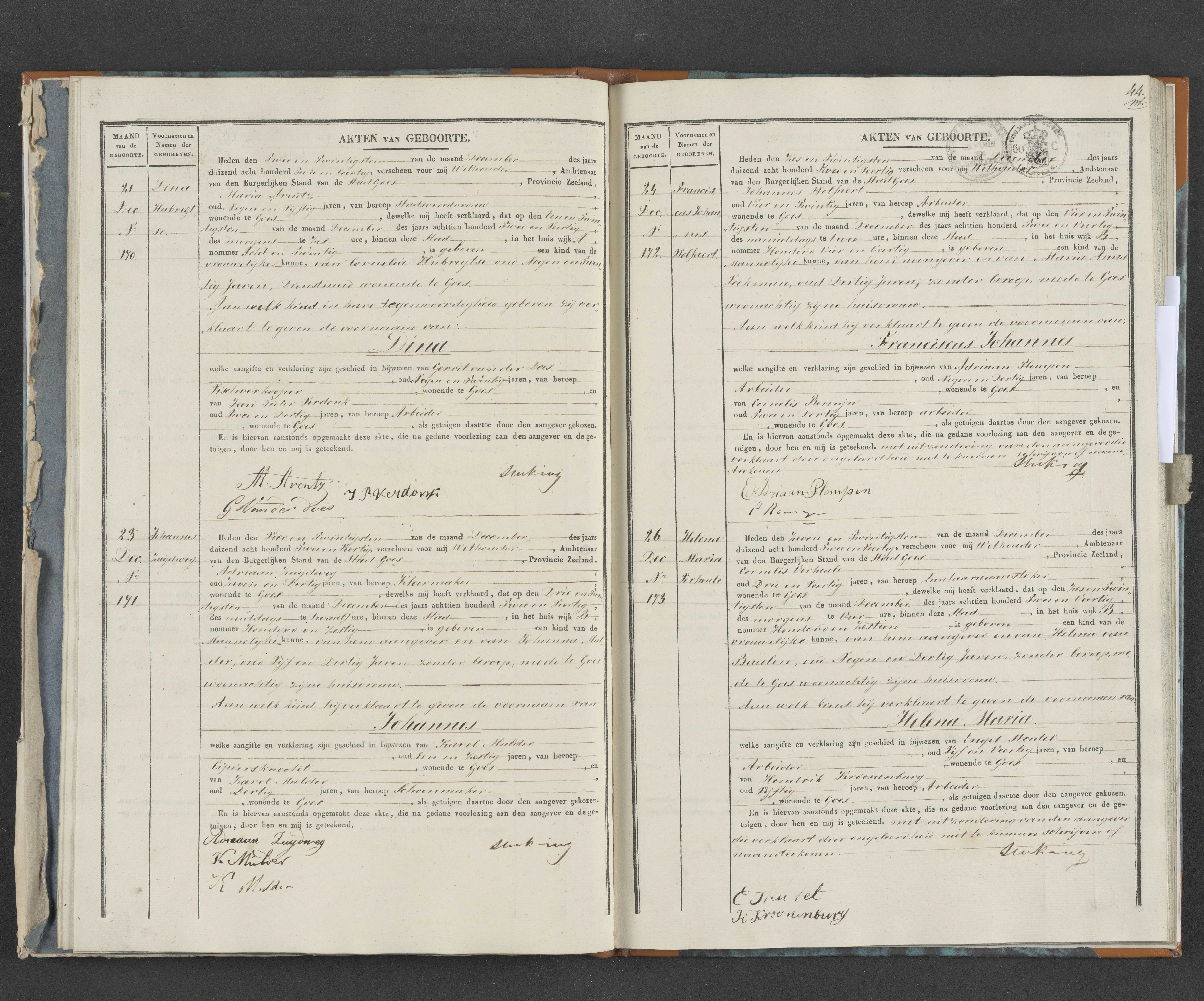
Johannes was born in Goes on 23 December 1842. Here is the transcription on wiewaswie:

BS Geboorte met Johannes Zuijdweg

Child
Johannes Zuijdweg
Birth date
23-12-1842
Birth place
Goes
Gender
Man
Event
Geboorte
Event date
23-12-1842
Event place
Goes
Document type
BS Geboorte
Institution name
Zeeuws Archief
Institution place
Middelburg
Collection region
Zeeland
Archive
25
Registration number
GOE-G-1842
Sourcenumber
171
Registration date
24-12-1842
Certificate place
Goes
Collection
Goes geboorteakten burgerlijke stand

birth record of Johannes Zuijdweg

In the Netherlands, Johannes worked as a grocer’s hand, a crier, and a merchant. Johannes and Jennie had three children. When Johannes was in his fifties, on 4 April 1894, the youngest child, Lucas (now a young man) was killed in an accident. According to Grandpa, he fell on a boat anchor.   Within a few months of the death of Lucas, there was an astonishing development in Johannes’ life. He was sentenced to prison!


On the Facebook group “Dutch Genealogy,” a kind person translated as much of the document as he could.

Column 1: (record number) 496 —
Column 2 (First Names and (last) names) Johannes Zuidweg
Column 3: Occupation koopman (merchant) —
Column 4: (Location and date of birth) Goes on 20 December 1842
Column 5: (Place of Residence) Goes
Column 6: (not sure, I guess date entered in the book?) 19 June 1895
Column 7: (again nit sure, I guess date of judgement) 31 May 1895, Jurisdiction Court Middelburg
Column 8: (description of offense) Diefstal (Theft) —
Column 9: (Opgelegde Straf,, Punishment) twee maanden gevangenstraf (two month imprisonment) — \
Column 10: (dagtekening straf ingaat , start of punishment) 19 June 1895
Column 11: (dagtekening straf eidigt, end of punishment) 18 August 1895
Column 12: (again, nut sure. Date of transfer?) 19 June 1895 (and signatures)
Column 13: ( ) 19 June 1895
Column 14: () had te kenning gegeven dat hij een verzoek om gratie had ingedient ( he noted that he had requested clemency)
Column 15 (): Officier van Justitie, Middelburg, 19 June 1895 —
Column xx: () Geene (none)
Column xx () Geslacht (gender) Mannelijk (Male)
Vader (Father) Adriaan
Moeder (Mother) Johanna Mulder
Nationality : Nederlandse
Burgerlijke Stand (civil status): Gehuwd (Married)
Godsdienstige gezindte (religious affiliation): Gereform. (I think, reformed)
Lager onderwijs genoten (elementary education): yes
Ouderdom (bij opneming) (Age at time of entering prison): 52 years
Gedrag in het gesticht (behavior in institute): (not filled in; he may have served)
Column yy (): Length 1m 60 cm; Color Hair: Blond; Eyebrows: Blond; Forehead: low; eyes: grijs (grey) neus (nose): groot (large); mond (mouth) )can’t read; kin (chin) round; baard (beard) none, aangezicht (face) round; kleur (facial tint): gezond (healthy); gewone taal (ordinary language): (—) Byzondere teekenen: geene (none). Handteekening (signature) (blank space)

The attached page is a telegram from the courthouse in Middelburg to the Prison in Goes, stating that “Nu Zuijdweg verklaart gratie the hebben gevraagd moet hij niet worden opgenomen, doch moet de beslissing op zijn verzoek afgewacht worden” (Now that Zuijdweg declares that he asked for clemency, he must not be taken in, but await the decision on his request), signed by the officer of the court, Van Hoek.

Johannes was 5’4 1/2 inches tall. While this seems short for a Dutch man by today’s standards (today the average height for a Dutch man is over 6′ tall), it probably was not that unusual in the 1800s.

According to the translation, Johannes was sentenced to two months in the penitentiary. The person who translated the document believes that Johannes was given clemency and did not serve the time. There might be other documents relating to this issue, and I will keep probing to try to find out more information.

I have been told by several Dutch people that times were very different then, and that it was very “easy” to end up in jail over minor infractions. I believe that this had something to do with the death of Johannes’ youngest son a few months before, but that is just a guess. I do wonder if this happening had something to do with the decision of Johannes and Jennie, both older people, deciding to emigrate.

In 1901, Johannes and Jennie followed their son Adriaan to Michigan. Three years later, their remaining child, Johanna Zuidweg Van Liere, immigrated with her husband, Marinus, and son to Michigan. Marinus owned a shoe store on Burdick Street.

In Kalamazoo, Michigan, Johannes and Jennie lived in at least two different homes, if not more. For a while they lived in one of the houses owned by Richard DeKorn. Sometimes Johannes’ name is spelled John. He passed away after living in the United States for ten years.

In one of the many changes in birthdates I’ve found in researching family history, Johannes’ birth record shows that he was born in 1842, but his headstone states that he was born in 1843. I believe the birth record, as the Dutch records are astonishingly well documented. I wish I knew more of what Johannes’ life was like in that last decade of his life. He was surrounded with male grandchildren as Grandpa was the only child of son Adrian and daughter Johanna and Marinus had eight boys!

Read Full Post »

In scanning the beautiful antique album this fall, I came across this tintype that kind of haunts me. Maybe it’s because the tintypes are so rare in the family collection. Maybe it’s because of her eyes.

Just ignore the strange corners. I tried to clean it up a bit at the corners (just for this post), and it didn’t turn out as I expected!

So how do I go about narrowing in on who might be in the image?

Because all the photos so far in the antique album seem to be related to the 5 Paak siblings and their familys, I feel that it is likely that she is related to the Paaks somehow.

I have such a desire to find a photo of Janna Kakebeeke Remine, the mother of Dick, grandmother of Therese, Genevieve, and Harold, who immigrated to Kalamazoo and passed away in 1910. She was the mother-in-law of Mary, one of the Paak sisters. But Janna was born in 1827. I was thinking 1880s for this dress, and this woman is not 60. In fact, as usual, I have no idea how old she is, what year her dress was, or what year her hairstyle was. It can’t be Dick’s mother-in-law Jacoba Bassa Paak either. She died in 1865 in the Netherlands!

What I have to get used to is the fact that the photographs I own are never of those earlier individuals, so they are images of more “recent” generations. I posted this one on a Facebook group for dating photographs.  Very consistently, readers thought the tintype is around 1880. They based this on two main aspects: the fact that it is a tintype and not a photograph and the woman’s outfit. Tintypes were most frequent a bit earlier than the ’80s, but they can be found in the 1880s and even later.

I thought that the silhouette of her dress and the finishings looked like the 1880s. One thing I can file away in my brain for later is the dress appears to black, a mourning dress, so someone close to the woman had died within perhaps the previous year. Of course, that is very subjective–I mean, it seems as if they would have always been in mourning dress! I’m not very happy with books or websites about women’s clothing styles. They tend to focus on the clothing of the wealthy, the fashionista, and those in evening wear. My relatives were not fashionistas, they were not wealthy (although often not poor either), and sometimes they were governed by a religious conservatism. They didn’t get their photographs taken in evening wear, if they even had any.

For further consideration, I’ll use the date of 1880, knowing it could be 10 years difference either way.

The only way I can now find the woman in the tintype is by comparing her with photographs of known Paak women and women who have married into the family AND using the data on my family tree for birth and death dates.

Do you think this woman is about 25? or younger or older? Let’s say she’s 25, for the sake of trying to figure out who she is. If so, she was born around 1855. That would make her a contemporary of Alice Paak DeKorn (born 1852) and her siblings.


Aaltje (Alice) Paak DeKorn

Anna Catherina (Annie) was born 1855


Maaike (Mary) Paak Remine born 1859


Cornelia (Carrie) Paak Waruf born in 1862

So. There are four* Paak sisters, and I don’t see this woman as one of them, although she could be a contemporary–or a bit older.

* There actually were five Paak sisters, but Willempje, who was born in 1856, did not immigrate with the girls, their father, and their brother. Although I have not been able to find a death or marriage record, I suspect she died as a child. The brother, George, married Lucy Kliphouse, who is not the woman in the tintype.

Lucy Kliphouse Paake

Alice had two SILs–Jennie DeKorn Culver and Mary DeKorn DeSmit.

Jenny DeKorn Culver


Mary DeKorn DeSmit

Is she one of them? (I don’t think so).

Mary Paak Remine had two SILs that I know of.


Adrianna (Jennie) Remine Meijer was born in 1860

Jennie was the sister-in-law of Mary Paak Remine. Another sister-in-law of Mary was Johanna Remine Bosman, born in 1855.

None of these look right to me. And these last two are sisters, but don’t look like it.

Carrie Paak Waruf’s husband Henry (Hank) does not appear to have had any sisters. He immigrated as a child with his parents from the Netherlands to Kalamazoo, and I don’t see a record of any siblings in the census records I have been able to find.

That leaves Annie, the least known of any of the sisters. Annie was married to Jacob Salomon Verhulst (whose grandmother, by the way, was a Flipse–see Flipse posts, if you’re curious). The only photo I have that I know is Annie is the full-length photo I posted above. I never heard anybody talk about her, except when Grandpa identified the photograph.

I don’t know if Annie and Jacob had any children. I have found no record of any children. They married in 1890.

Jacob did have two sisters, that I can find. One was Cornelia who died as a child in Holland. The other was Pieternella, was born 1843 in Kortgene and died 18 days later.

So there you have it. Those are the Paak women and their sisters-in-law. My next guess would be a cousin of the Paaks–or like Annigje Haag, the fiancee or wife of a cousin.  So I will keep searching in that “outer layer” of family members.

That said, if you see any flaws in what I’ve determined so far, please let me know, and I will expand my search even more.

Now that it’s a new year, I want to keep my genealogy goals focused.

  1. Continue scanning of all photographs
  2. Organize the physical photos, documents, and heirlooms.
  3. Create a list of provenance for all heirlooms
  4. Bring my Ancestry tree up to date with all info I have
  5. Find and work on software for a tree that is just for my tree
  6. Continue trying to identify photographs
  7. Research gaps and brick walls

Pretty ambitious, I know. Some of my blog posts will just be updates on how I am doing on items 1-5, rather than the results of actual research. Be patient. You know how helpful you all are to me, and I appreciate it more than you will ever know. Thank you!!!


Read Full Post »

« Newer Posts - Older Posts »