Feeds:
Posts
Comments

Archive for the ‘Michigan history’ Category

In the beautiful scrapbook that belonged to one of the Culver sisters, I discovered a postcard of Western State Normal School (Western Michigan University now) in Kalamazoo. I’ve never seen this view of the campus before. More of my relatives (and moi) have attended Western than any other school. I need to start a list of all the ancestors and relatives who are Western alumni.

I’m not sure of the year the postcard was published because the  back of the postcard indicates it cost 1 cent. Postcards cost that amount over a very large period of time. All it means is that it was not printed during WWI when the price went up to 2 cents. After the war, they went back down to 1 cent.

Because my business school classes were on what eventually became known as “East Campus” (the original site of the school), I remember the long walk up the hill, but it sure didn’t look like this. Neither did the buildings.

I searched online and found a postcard from 1910. If you click through the postcard you will go to site where I found it. It belongs to WMU.

Why do the red brick buildings look white in my postcard? Notice the tennis courts seen from this view. Now I can see that Oakland Drive is not down there. So maybe this is on the other side of Oakland? Apparently not. (Confusing!)

Here is a 1925 map of the campus, and on here it is easy to see where Oakland Drive is. If you want verification click through and go to the WMU website. When you put your mouse over the street it will show up as Oakland Drive.
aerial1925

Why is the same bus or trolley at the bottom of the drive in both photos?

Well, what do you know? That little trolley has its own Wikipedia page!

From Wikipedia:

The Western State Normal Railroad, also known as the Normal Railroad or Western Trolley, was a funicular [a cliff railway] which operated on the campus of Western Michigan University in Kalamazoo, Michigan, in the United States from 1908–1949. It is the only known example of a private railroad operated by a university.

In the early 1900s the primary campus of Western Michigan University, then known as Western State Normal School, was located on Prospect Hill (this area is now known as East Campus). To reach the buildings students and faculty faced a forbidding 150 step-climb, often in inclement weather. In an effort to address this problem, the school constructed a funicular along the northeast corner of the hill. The base of the line was at Davis Street, while the summit lay between East Hall and North Hall. There were two tracks, each with a cable-hauled car.

At its peak the railroad carried 2,280 passengers daily, but rising maintenance costs combined with the growing popularity of the automobile hastened its demise, and it carried its last passenger in 1949.In 2002 four senior engineering majors at WMU embarked on a project to build a replica of one of the trolleys. This proved no easy task: following the closure of the railroad in 1949, no effort was made to preserve the cars. The only physical remnant was a bench saved by a faculty member; while there were sketches and photographs for reference, no actual blueprints had survived. Commenting on the situation a WMU official remarked that “back then was a period in history so intent on the future, that everyone started forgetting about the past.”

Despite these challenges, the students successfully completed their project, which was unveiled April 8, 2003, and currently occupies a prominent place in front of the Bernhard Center on Western’s primary campus. Local residents and Western alumni who had ridden the trolley testified to the authenticity of the restoration.

Because I often get sidetracked in too many directions and because my time has been so limited, I need to make a list of all the projects to tackle in the future. Figuring out “who all” has gone to Western needs to top the list!

###

Originally I thought all the Culver photos were from after they moved to Seattle from Kalamazoo. Then it was discovered that some of the photos were from Kalamazoo. This postcard was in a stack with travel postcards and photos within the scrapbook.

Read Full Post »

I originally started this blog because of the wealth of photographs and glass negatives I had in my possession that once belonged to my grandfather’s uncle, Joseph Peter DeKorn. This post is a revision and update of the 2nd post on this blog.Joseph Peter DeKorn

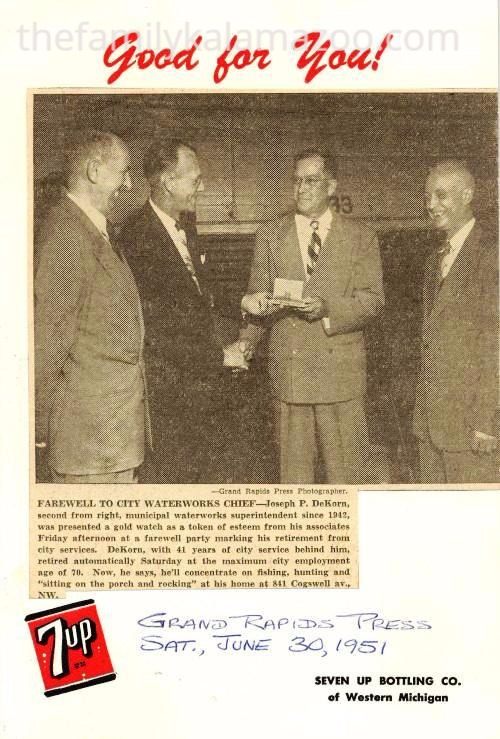
“Uncle Joe” was born to Richard DeKorn, local building contractor and brick mason, and Alice Paak DeKorn June 30, 1981, in Kalamazoo, Michigan. When he lived in Kalamazoo, he was an enthusiastic photographer, capturing scenes and people in Kalamazoo in the very early 1900s. Most of the photographs by Joseph which I have were taken between 1903 and 1918.  His draft registration for WWI is dated September 12, 1918.  He graduated from Kalamazoo College and the University of Michigan Engineering School in 1909.  Joe was a hydraulic engineer and worked for the City of Grand Rapids for over 30 years.  He retired as Superintendent of the Grand Rapids Water and Light Company.

gr-press-sat-6-30-51-joe-dekorn-retiring-city-waterworks-chief-001-1

Here is a commendation letter from the City Manager upon his retirement.

joe-dekorn-commendation-city-mgr-retirement-001-2

Personal life

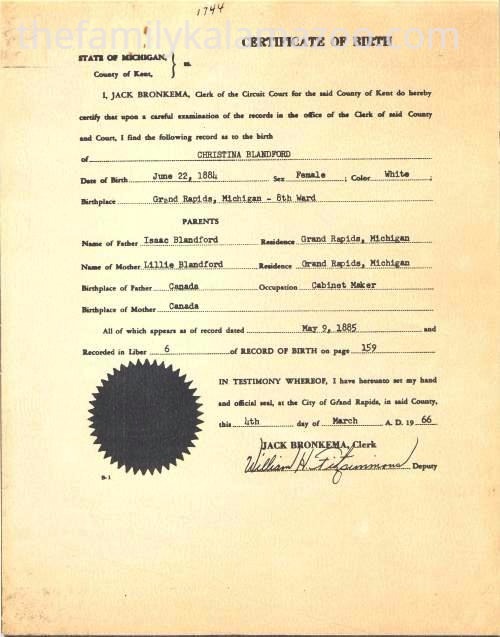
Joe married Christina Blandford on December 9, 1919 in Kalamazoo.  He was 38 and Christina was 35.  She was born June 22, 1884 in Grand Rapids, Michigan.  Christina’s parents were Isaac Blandford and Lily Kemp, both born in Ontario, Canada.   She graduated from Western Michigan Normal College (now Western Michigan University in Kalamazoo).  She was a school teacher and taught at Walker Township School, District #1 (later known as Fairview School) and Godfrey School in Grand Rapids.

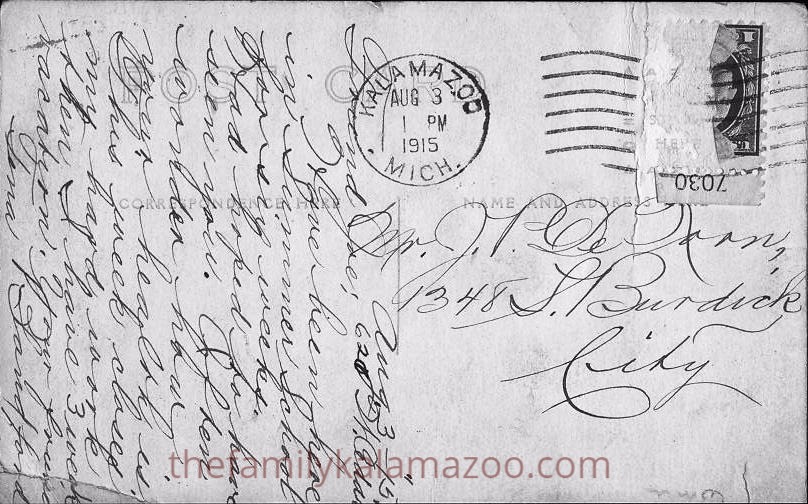
Aunt Tena, when Uncle Joe was still “Friend Joe” to her, wrote him this postcard in 1915:

Tena sent this postcard to Joe on August 3, 1915

Tena sent this postcard to Joe on August 3, 1915

Aunt Tena wrote from summer school in Lansing in her beautiful handwriting

Aunt Tena wrote from summer school in Lansing in her beautiful handwriting

Tena and Joe resided during their lifetime at 841 Cogswell Street, NW, Grand Rapids, Michigan, just three houses from the Blandford family homestead.  The couple raised their two sons, Richard and Phillip in Grand Rapids, Michigan. Richard was born on January 29, 1920, and Philip Eugene was born on August 4, 1922. Joe worked as a hydraulic engineer or filter engineer for the City Water & Light Department, Grand Rapids.  He passed away on March 24, 1962.

Joseph died March 24, 1967 in Grand Rapids and Tena died October 11, 1979 again in Grand Rapids, Michigan.

Unfortunately, I don’t remember Uncle Joe as I was too young, but I remember Aunt Tena as an elderly widow. She was memorable for her intelligence, kindness, fine china teacups, and her elegant and decorative old-fashioned handwriting (see postcard above).


The header photo (above) of the Kalamazoo flood in 1904 and the photos of downtown Kalamazoo from this post are some samples of Uncle Joe’s photographs.


Read Full Post »

I’ve written about the Leeuwenhoeks, and in particular, my great grandmother’s brother-in-law, Lambertus Leeuwenhoek. He was called Uncle Lou by my grandfather, so he’s still called Uncle Lou by me today, although I never met him. I did know his wife, Aunt Jen, who survived him by decades.

Uncle Lou and Aunt Jen owned a general store. They had a store in Kalamazoo for a time and one in Vicksburg for a time, as well. In the 1910 and 1920 censuses, he and Aunt Jen are living at 110 Balch Street in Kalamazoo. His Kalamazoo store sold Gold Medal flour.

may-19-1910-leeuwenhoek-ad


In the 1930 census, they live at 111 East Prairie Street in Vicksburg. In the 1940 census I find them with Lou’s first name mangled into Laonbatius. They are living with their daughter Alice and her husband, Clarence Moerdyk, at 1014 Gerdan Street in Kalamazoo. Could that be GARDEN Street? Because that would be a real house in Kalamazoo. One still existing, most likely.

I looked for city directory entries, and I found these–all date jumbled:

Leeuwenhock Lambertus (Jennie) household 110 Balch, 1926 City Directory: See Page
Leeuwenhoek Alice M, dressrnkr, boards 110 Balch, Kalamazoo City 1915: See Page
Leeuwenhoek Lambertus (Jennie) resides at 1014 Garden, City Directory 1935: See Page
Leeuwenhoek Lambertus (Jennie), grocer 110 Balch, residence same, Kalamazoo City 1915: See Page
Leeuwenhoek Lambertus (Jennie), grocer 110 Balch, residence same, Kalamazoo City, 1905: See Page
Leeuwenhoek Lambertus, compositor, 306 Wall., Kalamazoo City 1895: See Page

Compositor means that Lou was working on the Dutch newspaper. See here. But he had a grocery store in his house?

And if he lived in Vicksburg in 1930, but lived in Kalamazoo in 1926 and 1935, he couldn’t have lived in and owned a store in Vicksburg for very long. Unfortunately, I haven’t found a source for Vicksburg advertising yet.

I found this photo of Uncle Lou standing out in the front of the store, but I’m not sure which city this is:

Any ideas on the years, judging by the cars? Any idea if that looks like Kalamazoo or Vicksburg in the distance?

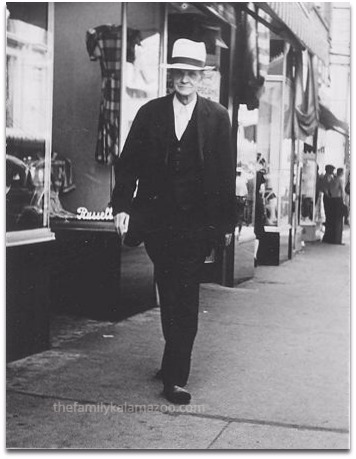
Likewise, I’m not sure which city Uncle Lou is in as he walks down the sidewalk? Does that window say “Russell” on it? In the city directories, there are many Russells, including ones owning businesses. There is one on Burdick Street, for instance, in my family’s neck o’ the woods, that is a variety store.

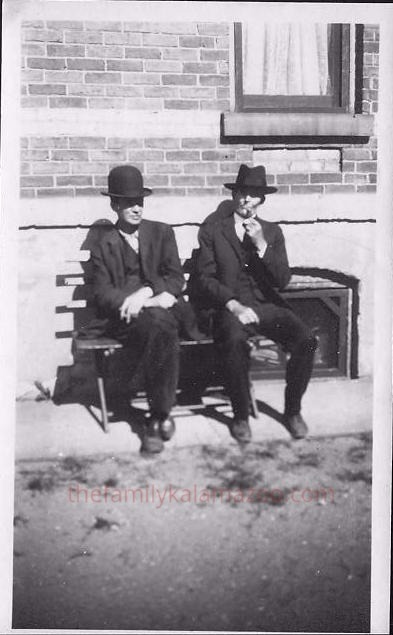
Here he is on a bench:

I wouldn’t be surprised to find this bench outside Richard DeKorn’s (his father-in-law) house on the corner of Burdick and Balch, judging by the design of the light colored stripe through the brick.

Here the photo is again–yes, it’s the same house. It’s hard to see Lou’s face up close. Below he is with his father-in-law, Richard DeKorn.

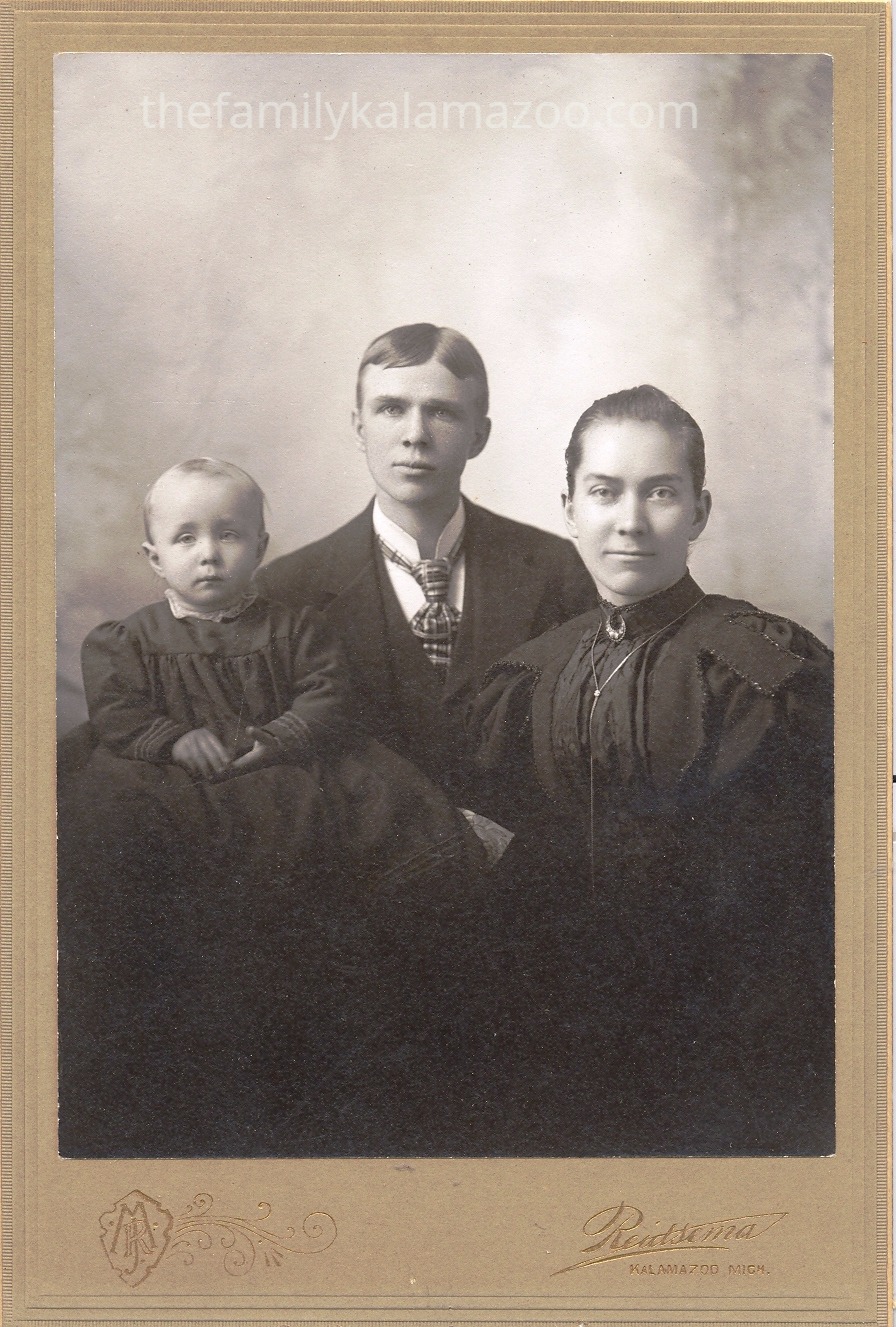
Uncle Lou with Aunt Jen and their only child, Alice:

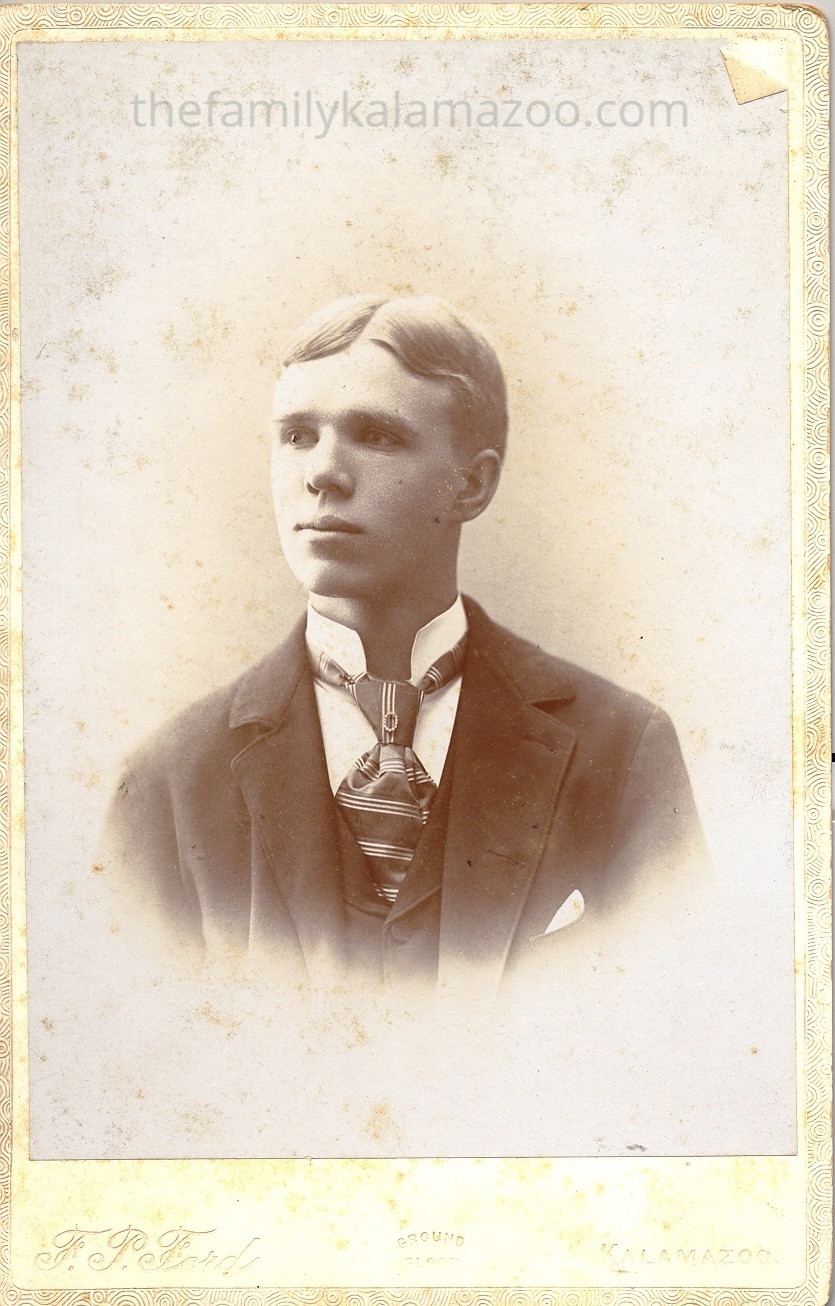
Here is a closeup of young Uncle Lou.

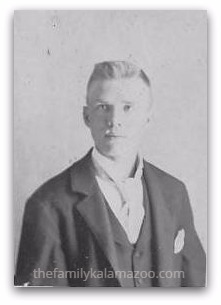
And now this is a curiosity. This photo is labelled Lou Leeuwenhoek by the same person who knew that the man walking down the street was Lou, that that was Lou standing out in front of his store, etc. But IS it Lou?

This is not his brother, for sure. While it’s not the same hairstyle as the photos above, the features seem to be the same–except for the eyes which, in the other photos, seem to be deep-set. Is the difference aging (the style of tie is the same) or lighting?  Or is the photo mislabeled?

***

You can check out the Bibles Uncle Lou brought with him from the Netherlands here.

Read Full Post »

On August 17 I originally published this post and mentioned that I had only been able to verify that, by 1947, Harold Remine had attained at least the title of Assistant Chief Engineer of the Quebec Hydro Electrical Commission. I not been able to find information after that date about his career.  My family believed he was Chief Engineer, but without an international subscription to Ancestry.com, I felt stymied at finding more information.

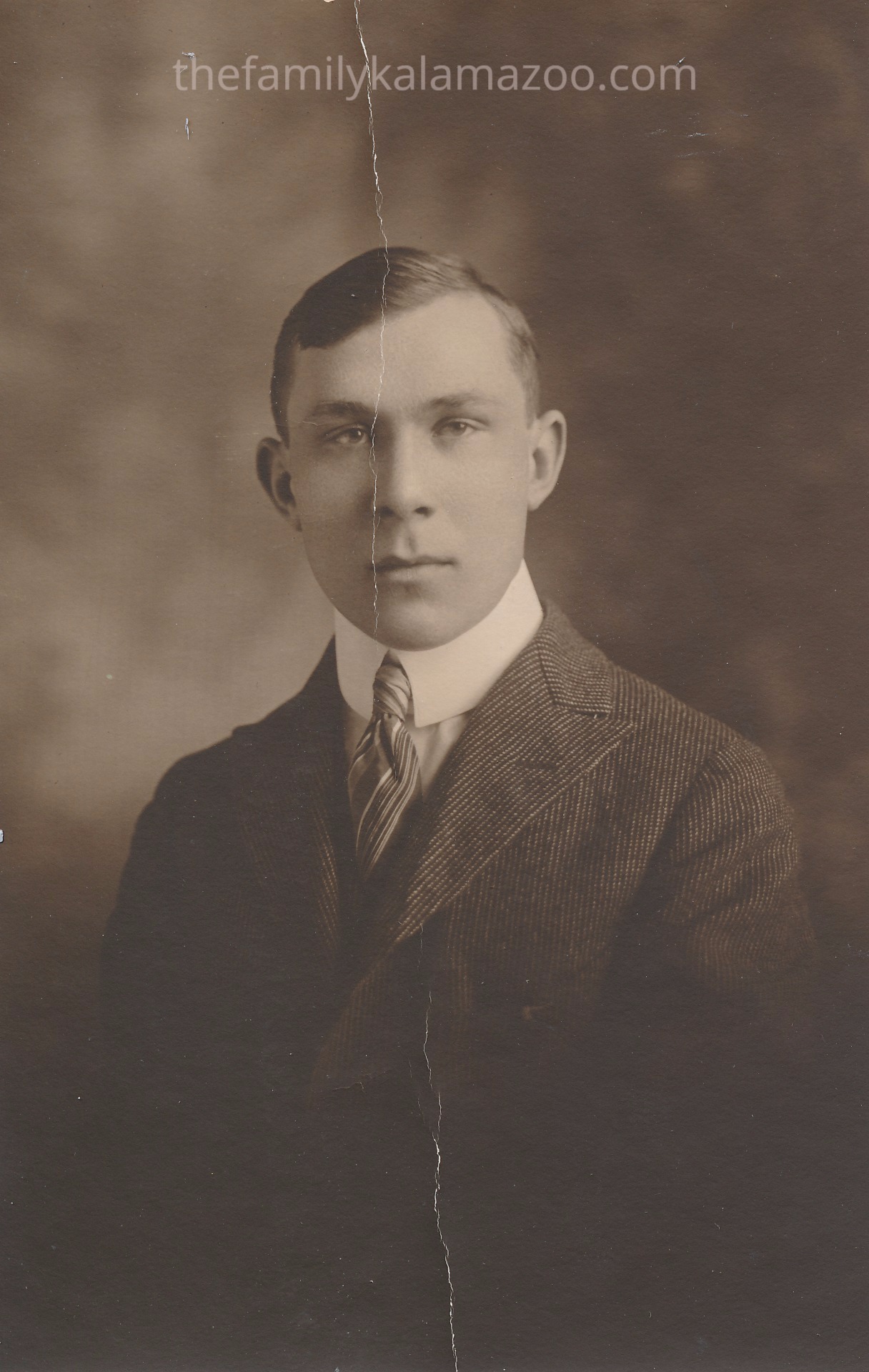
That is, I felt stymied until I applied some watermarks to some Remine family documents and discovered a little treasure of information. See below Harold’s photograph!

Harold Henry Remine
1897–1975

BIRTH 7 SEPTEMBER 1897 Kalamazoo City, Kalamazoo, Michigan

DEATH DECEMBER 1975 Montreal, Quebec, Canada

1st cousin 3x removed


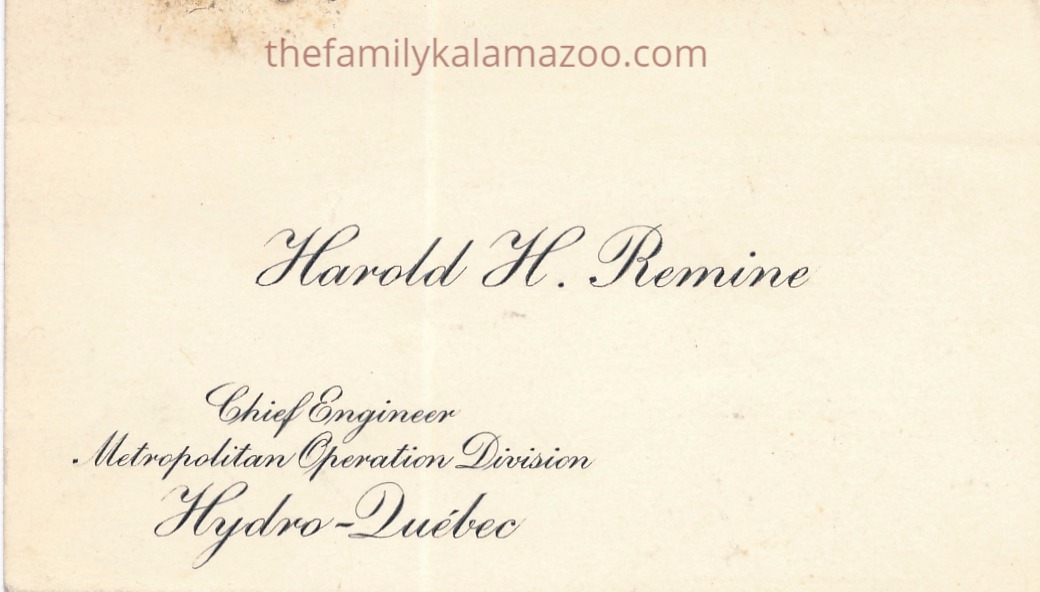
Look at this little marvel of verification! Harold’s own business card.

What does that say? CHIEF ENGINEER METROPOLITAN OPERATION DIVISION HYDRO-QUEBEC. Never give up hope because sometimes this stuff just falls into your lap!

***


Now if I was willing to be extorted, I would expand my Ancestry account from U.S. to “international” and be able to do more Canadian searches. Alas, it has gotten so expensive!

Anybody else irritated about that price?


Read Full Post »

A hundred years ago it seems to have been commonplace to have postcards made from personal photos. I found this example of an “occasional postcard,” meaning it was made on the occasion of Harold Remine sitting on the moon.

The two men with Harold are his brother-in-law Frank Tazelaar on the left and his father Richard Remine on the right (the taller man).

Here is what it says on the back:

The postcard is addressed to Harold’s sister, Therese Remine or Genevieve Remine Tazelaar. He was the youngest of three children, the only boy, and Therese was the youngest girl–six years older than Harold. I think it might have been Therese. Apparently, at this young age, Harold didn’t believe in basic punctuation, such as periods and commas–or know how to spell “rode”–(and you thought only kids today are lazy), although he went on to graduate from the University of Michigan and become the Chief Engineer of the Quebec Hydro Electrical Commission.

Well sister how do you like the picture we got this taken on Burdick Street after leaving you at the train papas broke one plate so we had to pose twice before we could get a good one we told ma we had road out to Otsego and back on the moon isn’t that a _____ for you life ___ me. YHE Harold Remine

Can you read that last line? I can’t quite make it out. Also, what does YHE mean? I tried Googling it, but came up empty-handed. I assume the Y means Your or Yours. What do you think?

When he refers to Papa breaking a plate, he means a glass plate or negative of the image.

Do you think Harold is about 14 or 15 here? If so, that would make this photo from about 1911-1912. Genevieve and Frank Tazelaar were married in 1906, so the timing on that is correct, as well. Harold seems big, but he could even be a bit younger, I suppo

Harold Henry Remine

1897–1975

BIRTH 7 SEPTEMBER 1897 Kalamazoo City, Kalamazoo, Michigan

DEATH DECEMBER 1975 Montreal, Quebec, Canada

1st cousin 3x removed


Read Full Post »

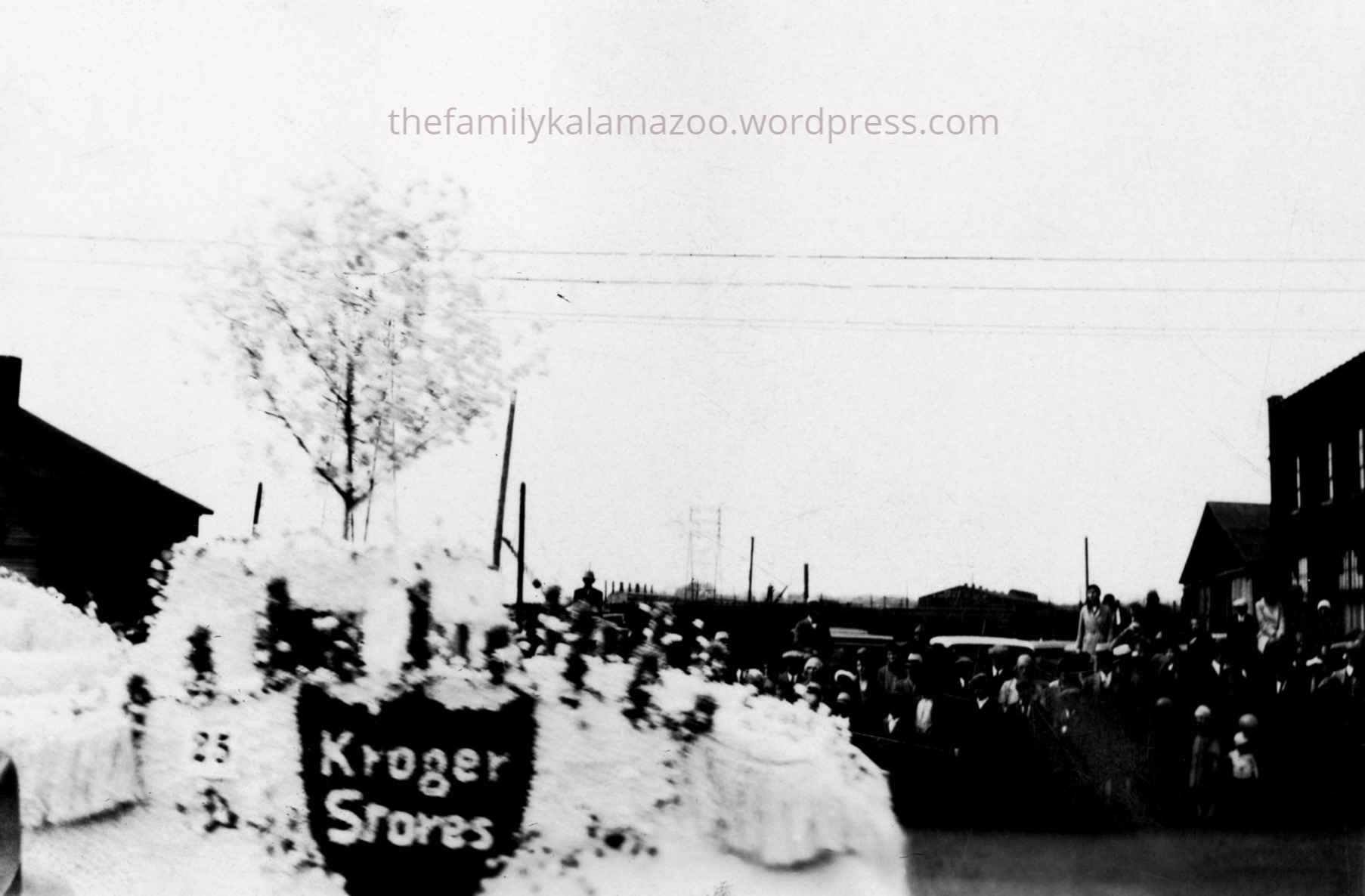
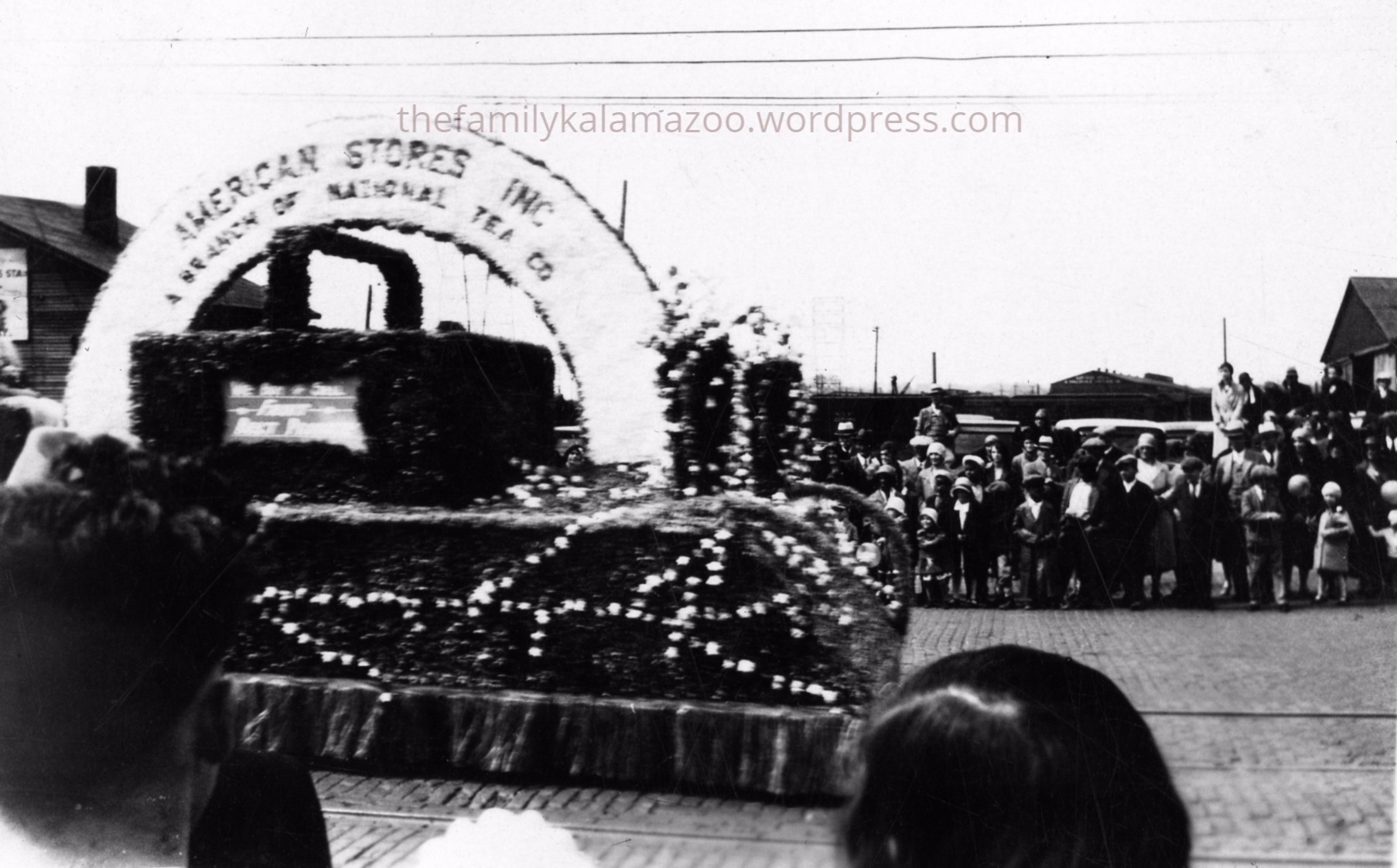
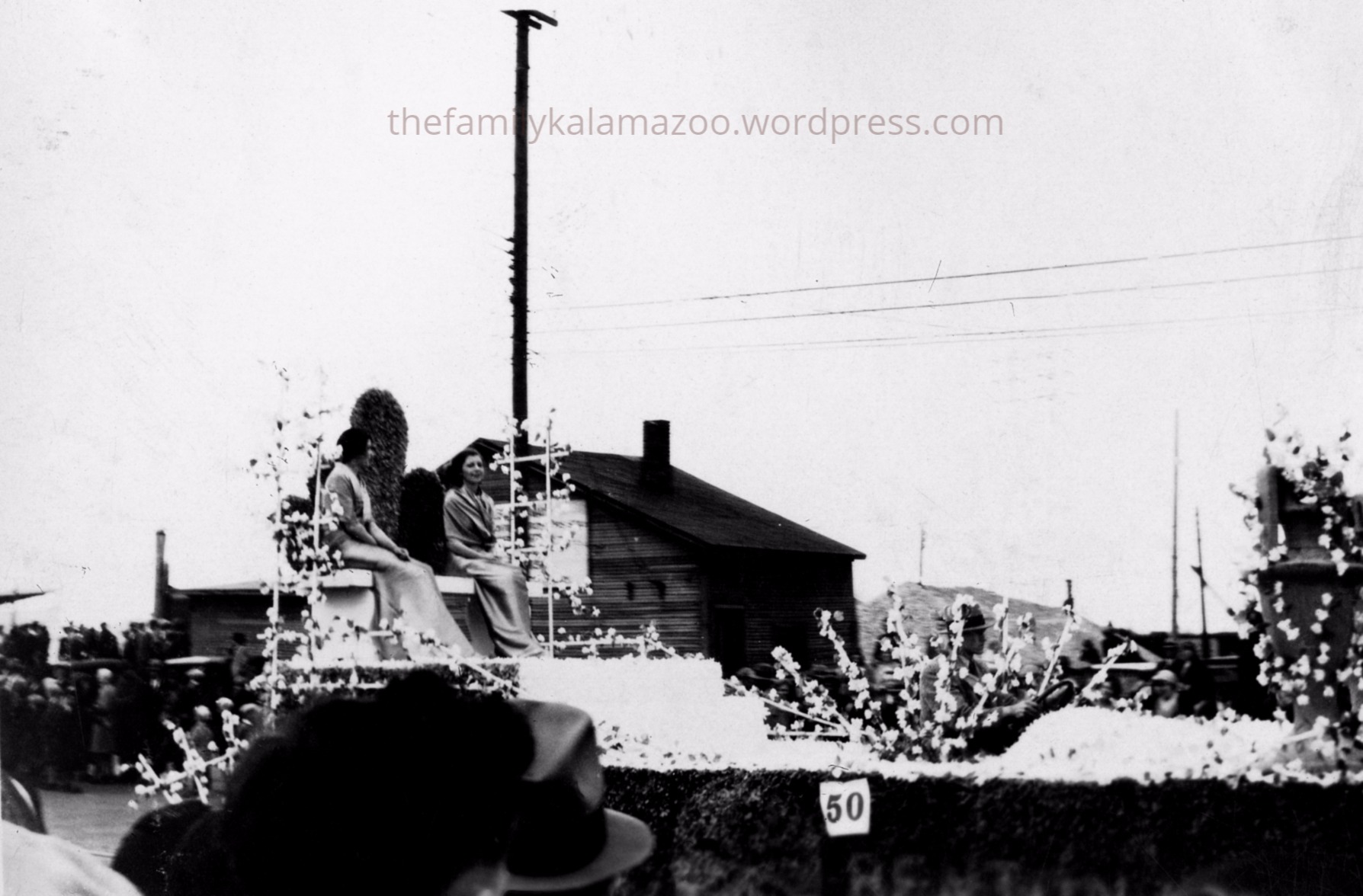
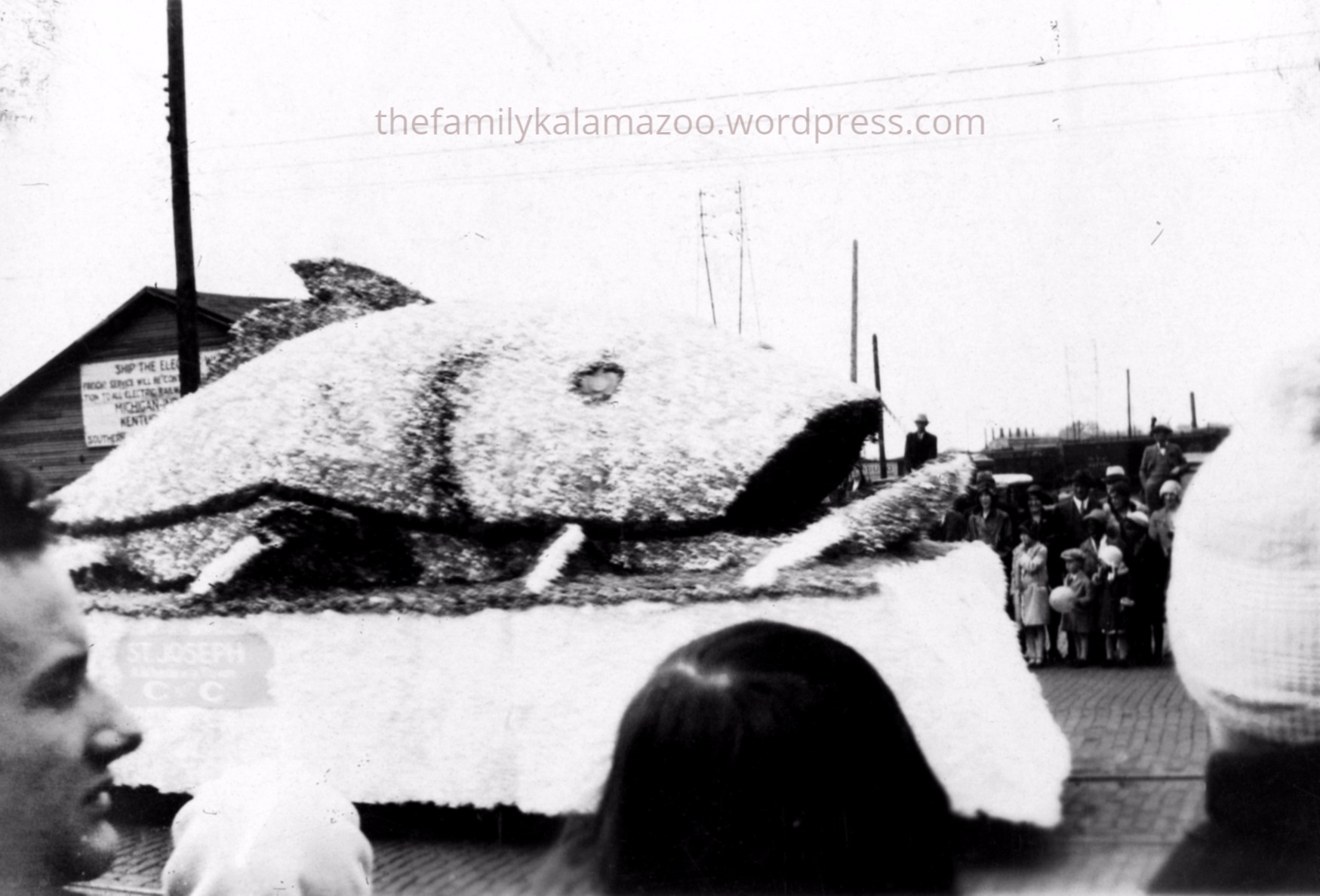
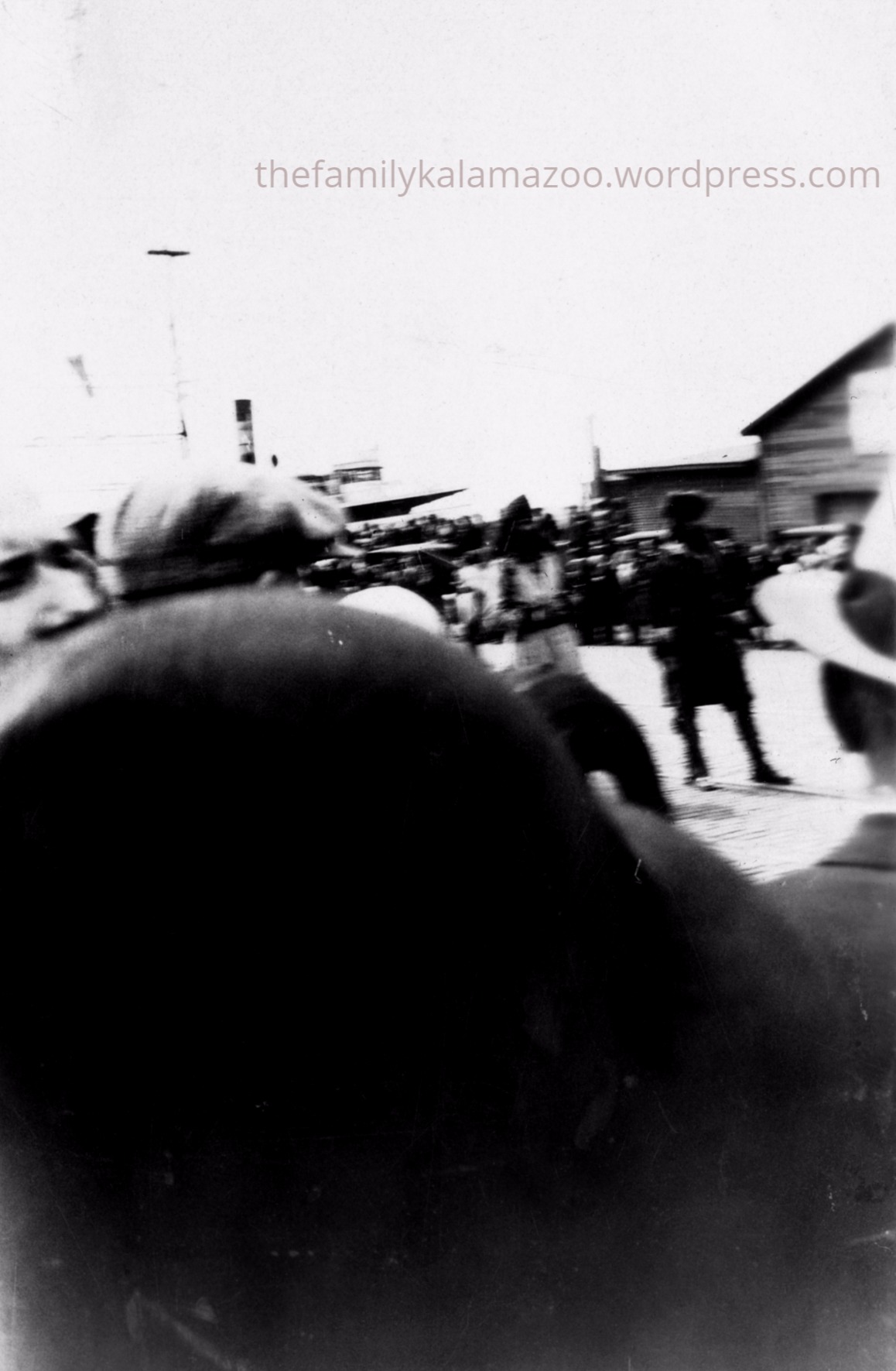
My grandfather, Adrian Zuidweg, had an album of photos which included those from a parade in 1931. It seems most likely that the parade took place in Kalamazoo, Michigan–probably down Burdick Street. But I need help identifying the buildings to know for sure. Many of the business names that are readable seem pretty “generic.” These names include Montgomery Ward, Ross Carrier, Kroger Stores, and Grand Hotel.

I know the date because of this float, but I don’t understand the significance of the “centennial” aspect of the design.

The Light float is the last photograph in the album. Here are the others in order of placement. If you can find any signs that this is Kalamazoo–or elsewhere–please let me know.


It seems odd that there aren’t any clues in these photos that indicate the “local” setting of the parade. There are quite a few ladies of the court. Kalamazoo is home to Western Michigan University and Kalamazoo College, but I don’t see any references to the schools, so maybe a check of 1930-31 and a 1931-32 yearbooks would rule out the colleges as participants in the parade.

A clue that I can’t interpret: Benton Harbor Exchange. This does seem to indicate that the parade was in Michigan, but was it in Benton Harbor or St. Joseph or Kalamazoo? And what exactly was the Benton Harbor Exchange?

Another possible clue: see that tall building in the background of the “downtown” photos? If that building can be identified it might help to lock in the city.

Just before the parade photos is one photo of Grandpa with Grandma when they were boyfriend and girlfriend–before they got married in 1932. Sorry about the watermark in the wrong place. I added watermarks en masse for these photos.

Read Full Post »

I’ve written before about my great-great-grandmother’s sister, Carrie Paak Waruf, and her husband Henry Waruf: Who Was Hank Waruf, Kalamazoo Gunsmith, Tennyson’s Words for Henry Waruf’s Funeral, and All the Peek Girls (note that Paak can be spelled Peek, Paake, etc.). And when they traveled to Cuba.

But I’d like you to look at some photos I have that Grandpa had me mark Aunt Carrie.

The first one is a favorite. Carrie and Henry Waruf were well-off merchants. They had no children. And Aunt Carrie did like to spend money on her outfits. Is that a fur piece or a feather boa around her neck here? And what about this hat? On what planet was this popular? I assume it was expensive. That almost looks like a Minnie Pearl price tag on it. Is that a ribbon? Overall the hat mystifies me. I’d place her at around 40 in this photo. What do you think? By the way, she was born in 1862, so that would make the year of this photo around 1902.

Photo #1

Here is another photo of Aunt Carrie.

Photo #2

These are obviously the same woman, although the 2nd photo seems to be a much younger photo. This brings up the mystery of her age that arose in the post What Can the Photographer Tell Me When He’s No longer Here. The evidence on the 2nd photo about the photographer made it seem as if this photo was also around 1900. So now I am more confused than before. But it makes me wonder if that successor craziness went on more than once. I still think she looks under 35 in the 2nd photo, maybe even much younger than that.  Look at the differences in wrinkles with the first photo.

Now, if anybody has an idea on the date of that peculiar hat, it would help assign dates to these photos!

I’m very satisfied with the identity of the woman in photos one and two because I have another photo or two of her with her husband. There is no doubt.

Here is the bigger mystery. Grandpa also told me that this next photo was Aunt Carrie. I don’t see how that is possible. What do you think?

Photo #3

Is this Aunt Carrie? Or is it one of her sisters? There were Alice, Anna, Mary, and Carrie. This is not my great-great-grandmother Alice. But could it be Mary or Anna?

Here is Mary:

Photo #4

Mary Paak Remine

Mary Paak Remine

Here is Anna:

Photo #5

Annie Paak

Annie Paak

And here is Alice:

Photo #6

Alice Paak DeKorn

Can you hear me screaming? She almost looks like a sister. She looks enough like them that Grandpa called her Carrie. But who is she?


Read Full Post »

Two and a half years ago (how can it be that long ago?!) I posted a series of 12 “episodes” called “My Grandfather’s Story,” which was the results of an interview of Grandpa conducted by a social worker when my grandparents were living in a senior apartment complex. If you want to check the story out, just type My Grandfather’s Story into the search bar of this blog and you will be taken to links to all the posts.

But my own family interviewed Grandpa (and Grandma, too) about life in “the old days,” as well!

I thought I would share a very brief clip where Grandpa is being interviewed about where he was born, and a bit about the neighborhood he was family was living in. It relates to a post where I wondered about a house the Leeuwenhoeks may have lived in. This would have been Grandpa’s Aunt Jen and Uncle Lou and their daughter Alice. You can find it here: Did the Leeuwenhoeks Live Here? After getting information from a reader, I posted Library Research on That Little House in the Woods.

Now we hear in Grandpa’s own words what he has to say about the neighborhood. When my mother asks about “the brick house,” she means Richard DeKorn’s (Grandpa’s grandfather) house. See it and read about it here: The Richard DeKorn House. My aunt Alice is seated on our left, and she begins the questions. Uncle Don is in the middle, and that is Mom on his other side.

One of the interesting points Grandpa mentions is that his grandfather, Richard DeKorn, owned three houses in the first block of Balch. By first block, I believe he means from the corner of Balch and Burdick. One would be the “brick house” he built himself. One of the others might be the Leeuwenhoek house.

Grandpa liked to tell stories about the past, so I think he would have liked these blog posts.


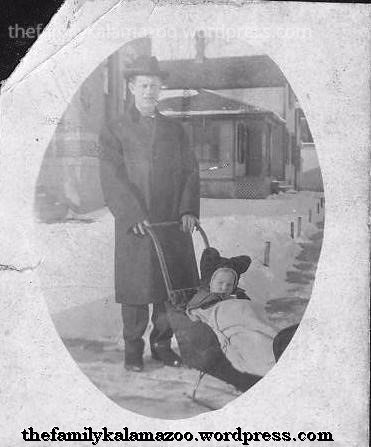
Grandpa and his father

Read Full Post »

Two posts ago, in What I Discovered in the Box of Unscanned Remine Photos, I posted a photo of two girls circa 1870s or 1880s. One reader wondered if one of the girls could be deceased. She saw the wooden stand behind the girl. While I didn’t think this particular girl was deceased, and photographers mainly used stands behind people to help them hold still for the 15-20 minutes required to take the photo, it is true that photos of the dead, called Memento Mori, were quite common.

In fact, I have a Pinterest board devoted to the subject.

Of all the antique photos that I have in my collection, I don’t think I have any memento mori. Apparently, the style did not catch on with my relatives. By the beginning of the 20th century, most of the Victorian form of photographing the dead had (sorry) died out.

However, there is one photo that sometimes I wonder about . . . .

This particular photo might, in fact, be too late. The photographer was in business from at least 1899-1915. I found researched information on the site Bushwacking Genealogy.

Dornbush, Henry G.: Lived 1878-1962. In business at least 1899-1915. Not a photographer in 1920 census.
1899-1915:  120 E. Main

But maybe he was in business a bit before 1899. Or maybe this photo is from 1899 or 1900 and was on the tail end of the fashion.

Why do I wonder about this photograph? Notice the rose the man is wearing. It is upside down. In the 19th century, flowers were a language between people. This photograph has the general feeling of a wedding portrait because of the flowers, but because his flower is upside down, it likely means he is in mourning.

Notice how her body leans into and behind him, but is stiff in appearance. Her gaze is directed off somewhere, while he looks into the camera.

I would like to identify this couple. It’s very possible they are on my family tree. Just in case she is deceased here, any ideas for how to compile a search on Ancestry of death dates? After all, I have a couple thousand people to sort through.

What do you think? Is this photograph memento mori or can all the clues be explained away?

Read Full Post »

More tintypes! In Mysterious Antique Photographs I shared a beautiful tintype that I own.

Yesterday I opened the box of unscanned Remine photos. I haven’t had time to scan so many photos–or to organize either–but I thought I should just start doing a few a day because when WILL I ever have the time?

And I discovered these beautiful tiny tintypes. The one on the other post is large and painted. These are only 2.25 x 3.5 inches in size–and unpainted.

Because they are in the Remine box I can guess they might be Remines. Judging by the faces, I am ready to conclude they probably are Remines.

Because these girls and women were photographed full length (standing and seated), we can examine their entire outfits to try to guess a time period.

Therese was born in 1891. Could this photo be from around 1900?

I am having trouble identifying the correct information about Therese’s sisters. When I figure it out, this might help in identifying this tintype. For instance, if there were sisters born in 1880 and 1881 as might have been, this photo could, I suppose, be those sisters. If so, one of them is Genevieve Remine Tazelaar and the tintypes would be in the early 1890s.

I suppose the hair and collars could be 1900. But what about the fitted jackets with all the buttons? I can’t find anything like that in photos of 1900. Odd, too, that it would be a tintype if it was as late as 1900.

Here is the other tintype. I’m sorry it’s kind of crooked and uneven. It was difficult to scan it.

What about these outfits? They are not leg o’mutton sleeves, so does that rule out the 1890s?

I guess I am not very good at taking the nuances of change in fashion and extrapolating to what my relatives would have worn (generally a much more conservative version of the fashion).

The woman on our left looks a lot like Mary Paak Remine, Therese’s mother. She was born in 1859. But the woman doesn’t look terribly young in this photo. And then who would the other woman be? She looks NOTHING like the Paak sisters. She is not Mary’s mother because Jacoba Bassa had passed away long before this.

Were these photos taken in the Netherlands or the United States? The Remines were from Kapelle and the Paaks were from Lexmond. Notice the wallpaper/painted background. I’m pretty sure that these photos were taken in the same studio, perhaps near the same time period.

I’m afraid I have more questions now than I did before.


Read Full Post »

« Newer Posts - Older Posts »