Feeds:
Posts
Comments

Archive for the ‘Kalamazoo late 1800s – early 1900s’ Category

If you’ve been following along here for some time, you might remember my posts about Theresa Pake, the middle child (of five) of my great-great-grandmother’s brother, George Paak.

When we left off, Theresa had married Roy Lawrence.

I’d like to backtrack. Remember how her father’s house burned down two years after her mother passed away? It was 1902, and Theresa was only 8. The article in the newspaper showed how destitute the family was by the fire, George’s illness, and Lucy’s death. The paper emphasized that the oldest girl, Cora, had been running the household from the time she was 12 until the fire–when she was 14.

At some point after this, Theresa went to live as a foster child with Oliver and Una Pickard. It would have been hard to find this information strictly from documents, but I had a great lead in the form of Theresa’s son Professor Lawrence.

This is a quote from one of my earlier posts:

At some point Theresa lived with foster parents, Una Orline and Oliver Oratio Pickard.  Prof. Lawrence thinks she maybe have gone to live with them as early as age six, which would mean she wasn’t under the care of her older sister. However, the newspaper article about the fire in 1902 would show that she was still living at home at the time of the fire (nearly 8 years old). Regardless, at some point, the Pickards became the caregivers of Theresa. None of the other children in the family seem to have gone to live with the Pickards.
SO WHO WERE THE PICKARDS?

Professor Lawrence told me that Oliver was a postman and Una a nurse. He said he couldn’t find his mother with them in any of the censuses.

I did a little search myself to confirm and hopefully augment this information.

I found the Pickards in the 1900, 1920, 1930, and 1940 censuses.

1910 census Pickards

1900: living in a “home” with 74 other people. There is a couple that are the head of household and his wife. Then Oliver is listed as a nurse and Una as “wife” (incorrectly as the wife of the head of household). After that are 3 attendants, a cook, and a lot of patients. So were both Oliver and Una the nurses for the facility? I can’t find the address on the census document.

From there, I went to the previous page of the 1900 census. It’s a short page and this is how it ends after a listing of some patients: “Here rests the enumeration of that portion of the Michigan Asylum for the Insane situated in Kalamazoo township outside the City of Kalamazoo.”

But wait! the page with Oliver and Una is in Oshtemo Township. That gave me the idea to see if anything is written at the end of the Pickards’ “household on the page after the one listing Oliver and Una.”

Wow!!! Something was written and erased. I can barely make out anything, but it appears to say pretty much the same thing as the above quotation about the asylum but using Oshtemo instead of Kalamazoo!! Why was this information erased? So did the Michigan Asylum for the Insane have Kalamazoo Township AND Oshtemo Township facilities?!! I can’t go past that page because this section ends on page 36–and the Pickards are listed on page 35.

I looked up “Oshtemo township” with the Kalamazoo State Hospital, and I found that the hospital owned a farm in that township since 1888: Colony Farm Orchard. Some patients lived on and farmed the property. Could this be where Oliver and Una first worked together?

1920: living at 1846 Maple Street in Kalamazoo. They owned their own mortgaged home. Una’s parents lived with them. Oliver was a mail carrier and Una was a nurse at the State Hospital. At this point, Theresa was finishing up her education, still under the guidance of the Pickards. THERE! The State Hospital IS the Michigan Asylum for the Insane. The name was changed in 1911. So it looks like maybe Oliver quit nursing and became a mail carrier–and maybe they moved to their own home that way.

1930: living at 1844 Oakland Drive in Kalamazoo. They owned their home, worth $15,000. Notice that 1844 address here is similar to the address in the 1920 census. I wonder if it’s the same house and there is an error in the number and the street? Or are they two different “owned” homes?

1940: living at 1846 Oakland Drive in Kalamazoo. So it probably was 1846 Oakland Drive all along. Una is a registered nurse in “private work.” That makes sense because she is listed as 67, and she couldn’t possibly be providing care at the State Hospital at that age. Oliver said he worked 52 weeks in 1939, but his income from this work is listed as zero–but he has income from “other sources.”By now the house only valued at $8,000.

A look at the neighbors in the 1940 census does not show that preponderance of Dutch names that I’ve seen in the neighborhoods where my relatives lived. The surnames seem to be of English origin, for the most part. But in the 1920 census, the same neighborhood had more Dutch surnames. Maybe this reflects a change in the neighborhood–or in the demographics of Kalamazoo.

Professor Lawrence told me that Una was Theresa’s Sunday School teacher. She must have taken a liking to the girl. I think Theresa was an intelligent and hard-working child, so that may have appealed to Una who took her on either from affection or religious conviction or a mixture of both.

So who are these people who married young (she was 18 and he was 23) and worked and lived at the State Hospital until he left for a job as a mail carrier? Who never had their own children, but managed to provide a quality education and a religious upbringing to one of the Paake children? That would have been very hard work being a nurse at the “asylum.” It could also be dangerous. In approximately 1904, a resident doctor was stabbed to death.

I also think the Pickards were most likely Methodists as they chose to send Theresa out of state to a Methodist school.

What was it like for Theresa to live with the Pickards?

Here are the other Pake/Paake/Paak/Peek posts:

A Series of Disasters

The Children After the Fire, 1902

Paak-a-boo

Saved from the Fire

Who is George Paake, Sr.?

Curious about George

George Paake’s Legacy, Part I

George Paake’s Legacy, Part II: Theresa’s Pre-Professional Education

George Paake’s Legacy, Part III: Theresa’s Professional Education

George Paake’s Legacy, Part IV: A Letter to His Daughter

George Paake’s Legacy, Part V: Theresa Gets Married


Read Full Post »

As I’ve mentioned before, my great-great-grandfather, Richard DeKorn, was a brick mason who worked on many public buildings in the Kalamazoo area.  He was a brick mason on the beautiful Ladies’ Library Association in 1878-79 and lead brick mason on the Kalamazoo Psychiatric Hospital Water Tower  in 1895. According to his obituary he was the contractor for the Pythian building and the Merchants Publishing Company building.

The asylum water tower was slated for demolition in 1974. Here is the story of how it came to be saved (from http://www.kpl.gov/local-history/health/kph-water-tower.aspx):

In spite of being on the National Register of Historic Buildings and endorsed by the Michigan Historical Commission and the Kalamazoo County Bi-Centennial Commission, the structure was earmarked by the State of Michigan for demolition in 1974. A local committee that called itself the Committee to Save the Tower launched a campaign to raise public funds to restore the building to its original grandeur and save it from the wrecking ball. A year later, Mrs. William John (Penny) Upjohn announced that $208,000 was successfully raised for this purpose. The money came from federal, state, and city contributions to the effort. Contributions also came from such disparate groups as school children, former state hospital patients, current hospital patients and employees, a hospital auxiliary, service clubs and concerned citizens. The campaign to save the structure was not without controversy. Some residents felt that the monies needed to repair the structure could better be spent on local service needs. Sen. Jack R. Welborn, R-Kalamazoo, pointed out, however, that taxpayers would be spending at least $150,000 to tear down the tower.

I recently visited Kalamazoo and went on a tour of Henderson Castle, a mansion built the same year as the water tower.


From a rooftop viewpoint, I was able to see the water tower in the distance.


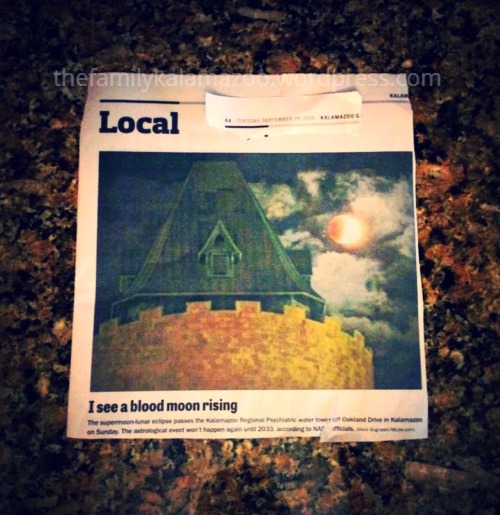
And then my mother showed me a photograph that was in the local newspaper of the blood moon near the tower.


I’m off preparing for a poetry reading this weekend. Have a lovely weekend!

Read Full Post »

In a post called “Who Was Hank Waruf, Kalamazoo Gunsmith?” I wrote about the husband of my great-great-grandmother’s sister, Carrie (Paak) Waruf. The couple owned the resort Ramona Palace and Ramona Park, as well as many cottages and their own home, at Long Lake in Portage, Michigan.

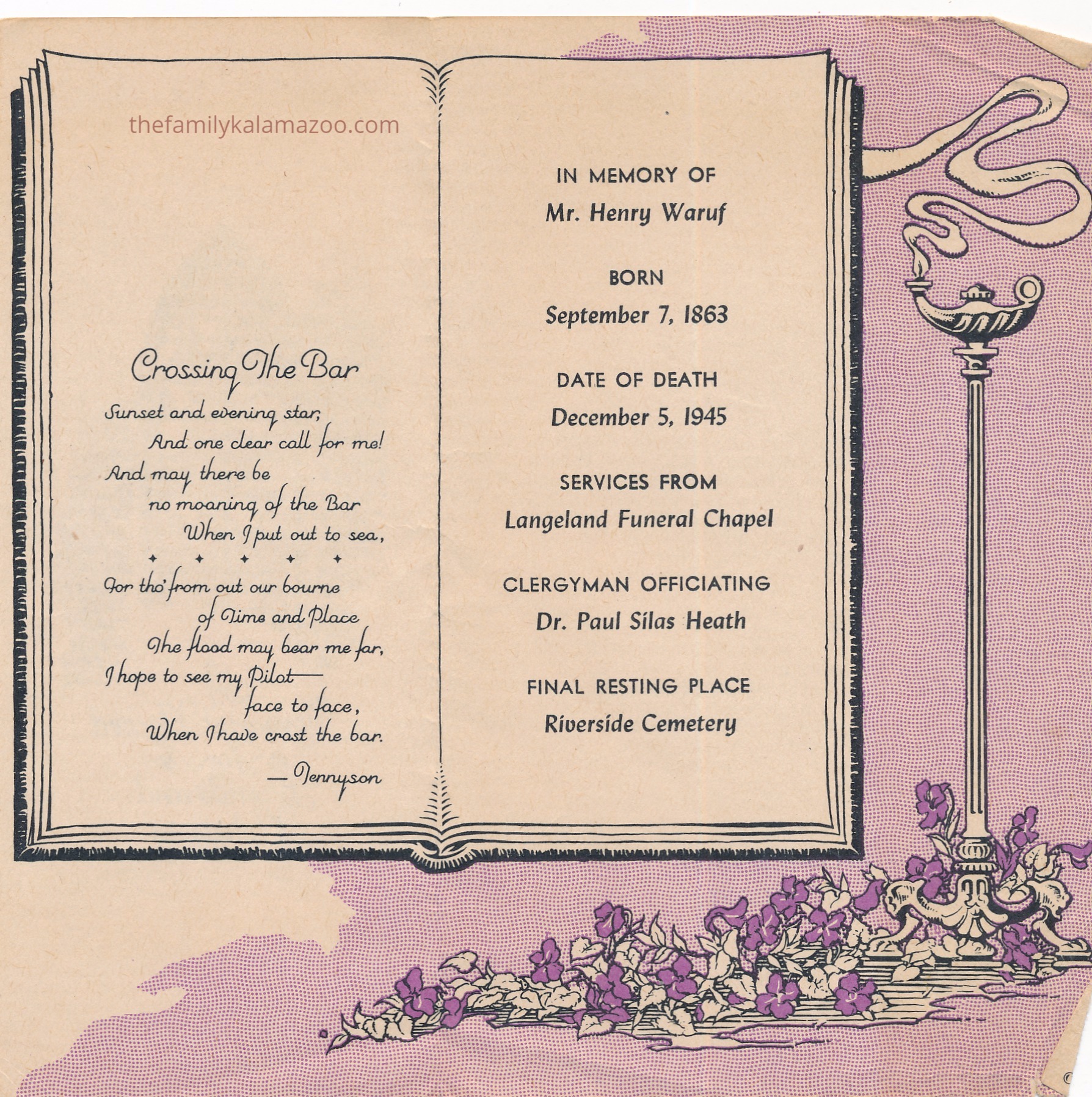
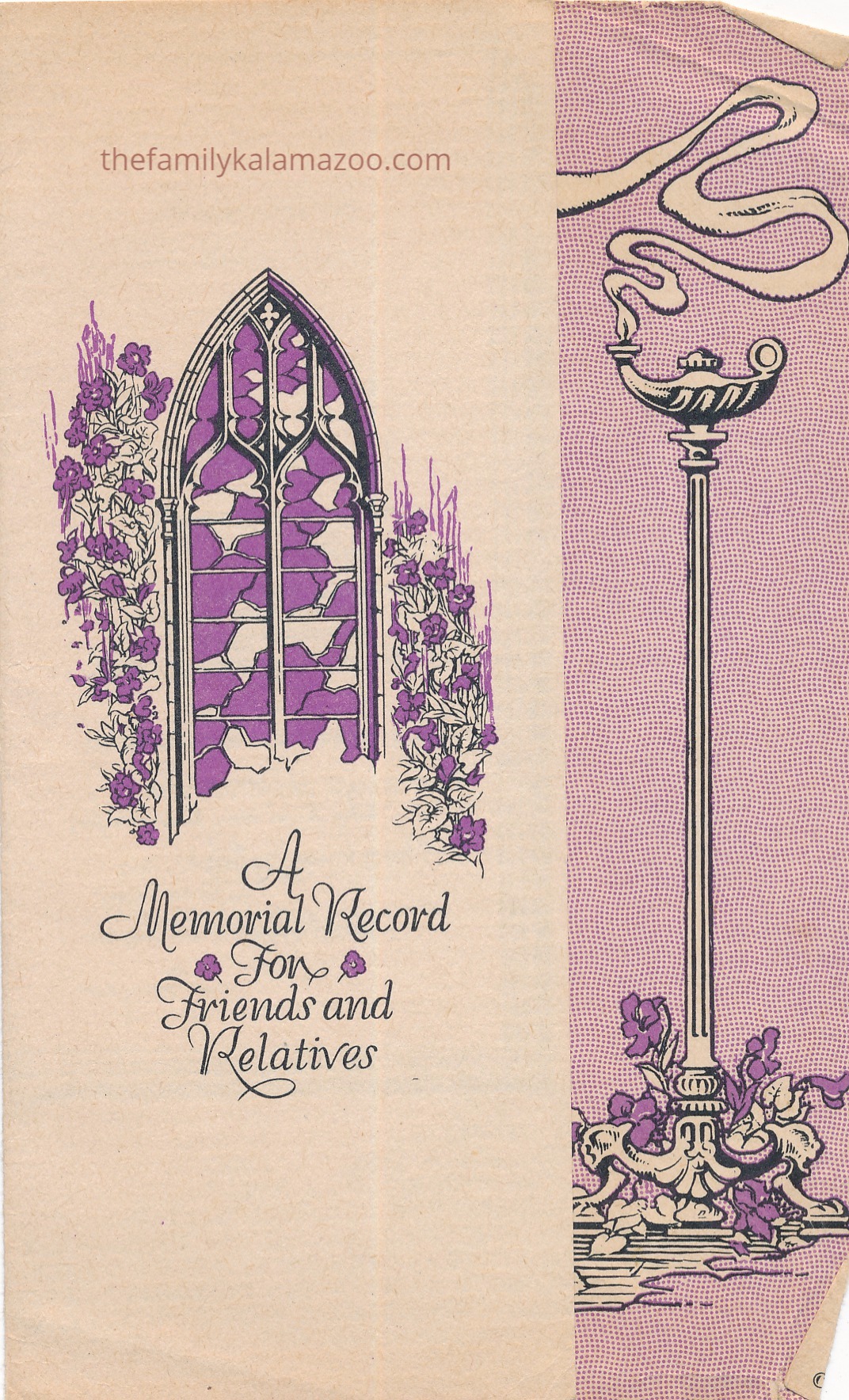
In my files I found the brochure for Henry Waruf’s (Walraven) funeral.


Henry Waruf’s wife Carrie and my GGGrandmother Alice Paak DeKorn had a sister named Mary. One of Mary’s daughters was Genevieve. She was married to Frank Tazalaar. Here are Henry and Frank together (with a little dog).


I get the impression from some of our photos that Hank Waruf was a man other men wanted to hang around .

Read Full Post »

I lost my oldest cat, Mac. He passed away a week ago last Sunday. His actual name was Macavity, and he was named after T.S. Eliot’s “Mystery Cat” (in the poem and the Broadway musical). I’m a dedicated animal lover, so I always like to see evidence of animals in the lives of my ancestors. I wrote a post called Dogs in the Family that showcases some photos of pets from 100 years ago, as well as my own four cats.

I found a postcard from 105 years ago that features a type of tabby cat. My cat Mac was an orange and white tabby, so this caught my attention. It’s part of a collection of cards received by Alice Leeuwenhoek.

This card was mailed from Grand Rapids, Michigan, in 1910. Alice was my grandfather’s first cousin–their mothers were sisters–and she was born in Kalamazoo in 1897.

I wish I knew what the inside joke about eating well means! Alice was a very slender woman.

Notice that the postcard isn’t signed. So frustrating! Does it sound like a good friend or a relative?  Does the handwriting give a clue? Alice was 13 years old when she received this card.

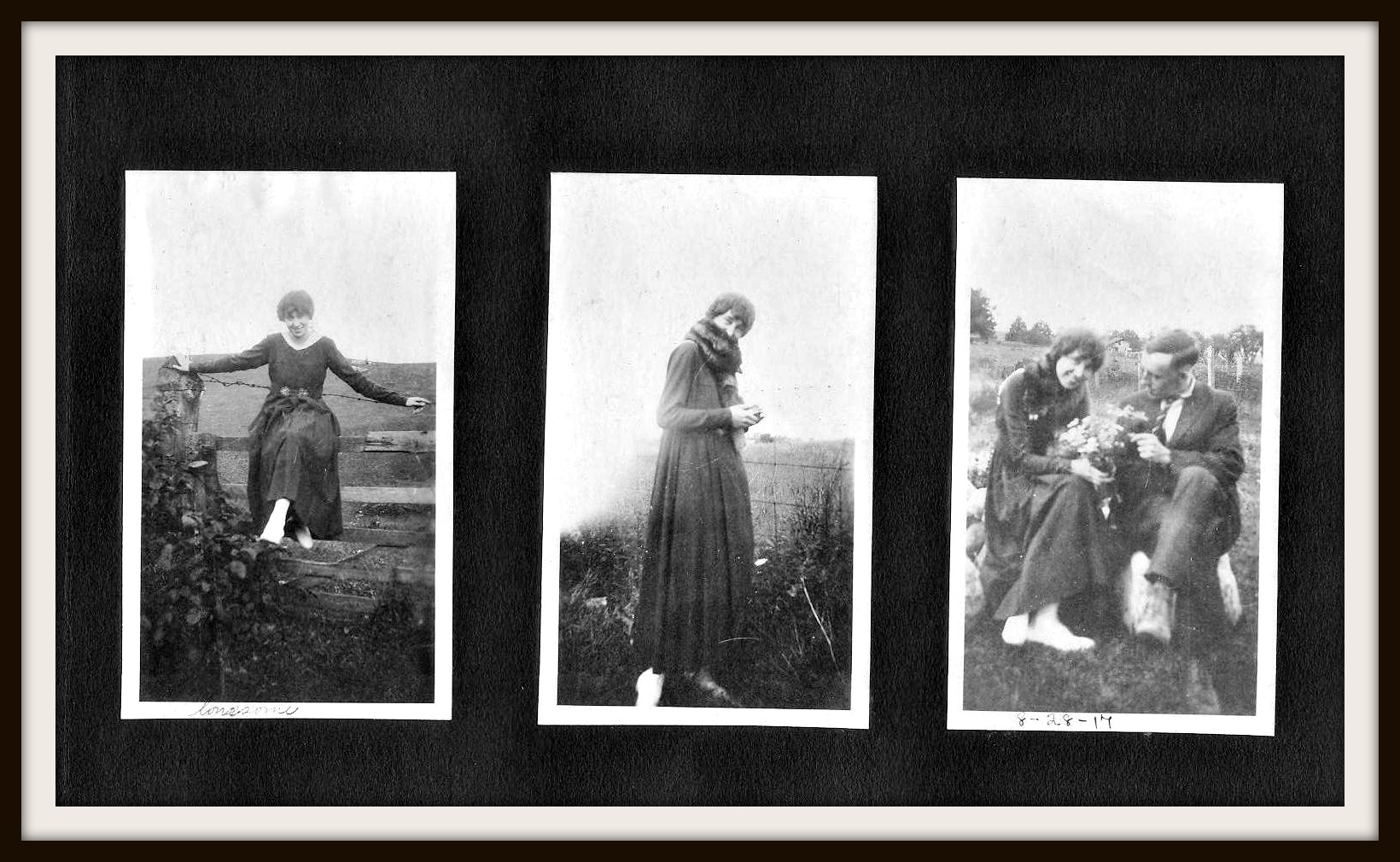
Here she is seven years later (age 20)–dressing fashionably, posing, and with a young man!

Alice wouldn’t marry until 1923, at age 26, and it wasn’t to the man in this photo.

If you go to Dogs in the Family, you will see a photo of Alice as a child with her aunt, my great-grandmother Cora DeKorn Zuidweg, and my grandfather, Adrian Zuidweg–with the family dogs.

I’ll leave you with photo of Alice and moi when I was 3 years old. Alice was 61. I knew Alice quite well when I was a child. She passed away when I was 8 years old, in 1963.

Read Full Post »

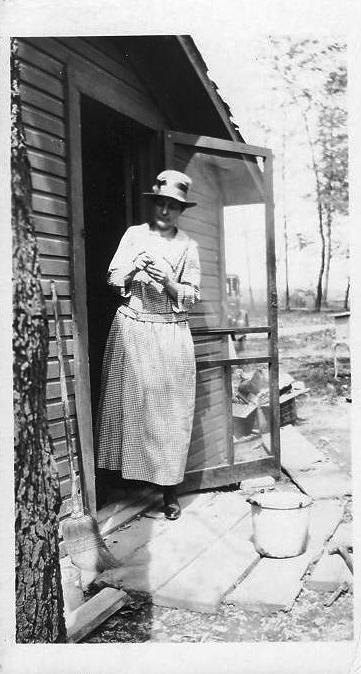
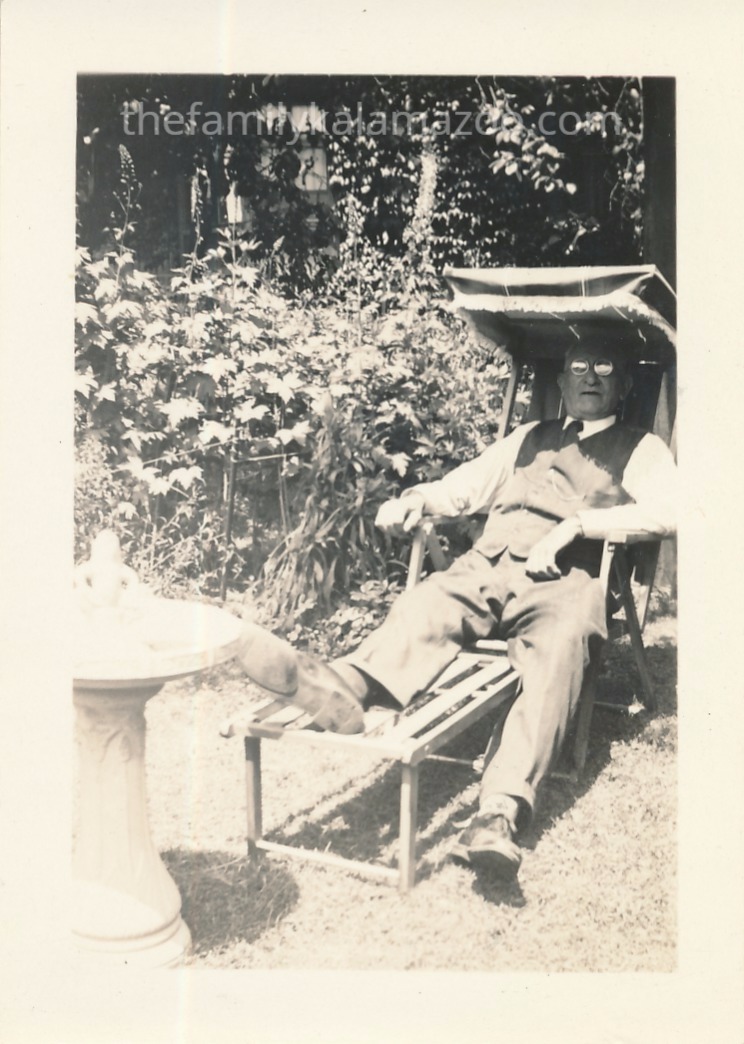
I recently found this photograph in a group of photos. Because of a clue on one of the other pix, I narrowed the date to between 1928 and 1931.

I know who the man is because he has a very distinctive look. This is my great-grandfather, born Adriaan Zuijdweg and called Adrian Zuidweg in the United States. I’ve written about him many times, but the best posts would be My Great-Grandfather Reinvented Himself as a Business Owner in the U.S. and My Grandfather’s Story, Part V and Back to the Dutch-American Newspaper.

Adrian died in 1929, according to my grandfather–of kidney disease. But I have not been able to find a death certificate or a grave. Maybe it’s because his name was mangled, but keeping that in mind, I still haven’t found him yet. It is so frustrating. Also, the newspapers from that year are not on Genealogy Bank. Nevertheless, I would put this photo at 1928 or 1929. Because other photos show him more fit than in his photo, I think he might have been ill (or close to it) by the time this photograph was taken.

But who are the women in this photo?

Adriaan Zuijdweg

Could the woman on the left be my Great-Grandmother Cora DeKorn Zuidweg? She looks a lot taller than he does, but maybe she was taller. I will post a known photo of her so you can compare.

Cora DeKorn at her father Richard DeKorn's cottage on Long Lake

Cora DeKorn at her father Richard DeKorn’s cottage on Long Lake

Similar hats, for sure! If that is Cora in the first photo, then she would have been about 53 years old. She herself passed away in 1932 from cancer.

Do you think that is Cora in the photo with Adrian?

Who is the shorter woman? Is this another photo of her?

The only child of Adrian and Cora was my grandfather. Cora’s only sister was Jennie–and this is not Jennie. However, she had two younger step-sisters, Marion and Marge Sootsman. They would have been in their 30s at this time. This woman does not look like one of them. She actually looks more like one of the Culver sisters, but we figured out that they moved to Seattle before this period.

The only thing is . . . there are a lot of photos of this woman. Was she a girlfriend of my grandfather?


Kinda looks like it. After a series of these photos, there is a series of him with my grandmother.

Do any family members know the answer to this mystery?


Read Full Post »

Remember the Culver family: my great-great grandfather’s sister, Jenny DeKorn Culver, and her daughters, Lela and Rhea, who moved from Kalamazoo to Seattle 100 years ago.

In the scrapbook which I received from a blog reader I found this photograph. Any ideas on the type of uniform? Since this would have been around the time of the end of WWI, does the uniform have to do with the war?

I don’t know who the man is. Most of the Culver photos are of women.

But the clues would leave me to believe the photo was taken in Seattle in or around 1918. But did Seattle have old elegant buildings like this at that time?


What about the building? My first inclination was a church, but I don’t see any crosses. Are those rosettes for ornamentation?


Related articles

Read Full Post »

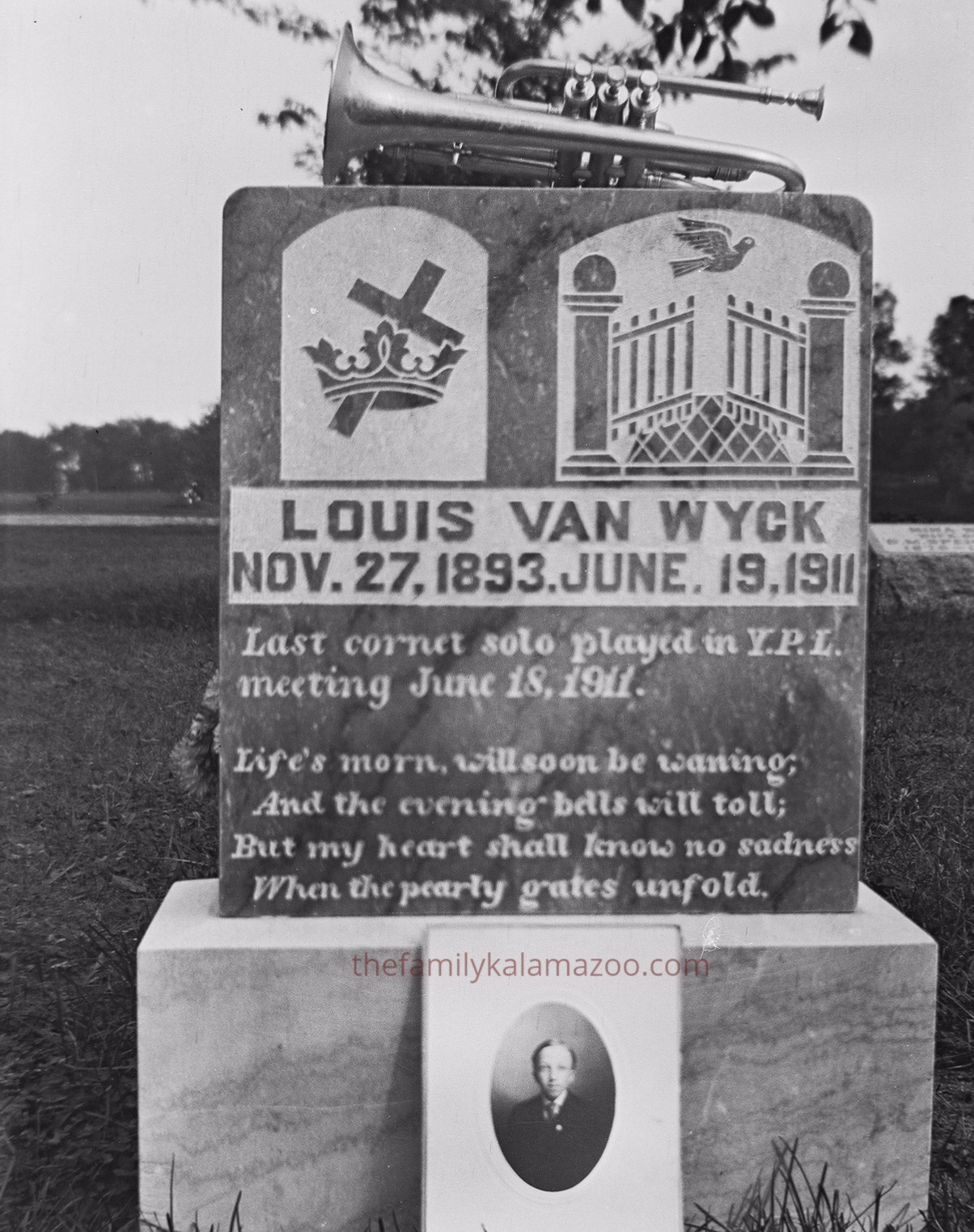
In the box of glass negatives from photographs taken by Joseph DeKorn there is an image that I wonder about. It seems to be an elaborate headstone for a man named Louis Van Wyck. Placed on top of the headstone is a cornet. The inscription reads, in part, “Last cornet solo played in Y.P.L. meeting June 18, 1911.”

His birth and death dates are also engraved on the headstone. He died the day after the cornet solo, on June 19, 1911. He was 17 years old–not a man, but a boy!

A photograph leans against the marblebase. He looks young and blond. The stone is further engraved with images and a poem.

Although I have his dates, I can’t find Louis through Ancestry’s search function–or Find-a-Grave either. So I turned to Genealogy Bank where I found one article about his memorial service.

Read it here: Louis Van Wyck memorial service.  Note that the passage about the funeral is at the VERY END of this article.

I didn’t know what Y.P.L. on the headstone meant, but after reading about the Salvation Army hosting Louis’ memorial service, I looked it up online. It seems to mean Young People’s League. Now I have to admit I don’t know much of anything about the Salvation Army except that it is a Christian denomination and a charity, I sometimes donate furniture or clothing to them, and they (or volunteers like my family and friends) ring bells at Christmas outside shopping malls. I think Sarah in the musical Guys and Dolls belongs to a fictional representation of the Salvation Army.

That is kind of fitting because I just read up a bit and discovered that music has been important to the Salvation Army from the beginning. How fitting this headstone was, then, for poor Louis. But how did he die at such a young age? And how was he connected with Joseph DeKorn or my family? He would have been about 12 years younger than Joseph.

And why can’t I find him in documents in my initial search?

Read Full Post »

Henry (Hank) Waruf and his wife Carrie (Paak) Waruf owned the resort Ramona Palace and Ramona Park, as well as many cottages and their own home, at Long Lake in Portage, Michigan.

Since Carrie is one of the Paak sisters, and her sister Alice Paak DeKorn was my great-great-grandmother, I’ve focused more on the Paaks. But Henry Waruf is a very interesting character in Kalamazoo’s early history.

Adri van Gessel was so kind to do some research on the Waruf family. Henry himself appeared to be a bit of a dead end because the name Waruf seemed to come out of nowhere. But Adri broke through that brick wall and discovered Henry’s origins.

Who Was Hank?

Henry was born Hendrik Walraven on September 7, 1863 at Kloetinge, the Netherlands. Apparently Koetinge is part of Goes. Big shock there since the majority of my mom’s ancestors seem to have come from Goes.

He was married on June 2, 1882 at Kalamazoo (MI) to Cornelia Peek (Carrie Paak), daughter of Teunis Peek and Jacoba Bassa.  Cornelia was born on May 8, 1862 at Lexmond and died in January 1957 at Kalamazoo (MI).  Henry died on November 29, 1945 at Orlando (FL).

I don’t know if Henry was on vacation in Florida, living there part of the year, or if the couple (who had no children) had moved there and Carrie went back to Kalamazoo after his death. I could try to research this through city directories, phone books, etc. The research I have done was mainly through newspapers, and I discovered that, although Henry (or Hank) usually spelled his last name “Waruf,” sometimes it shows up as “Warruf.” Still, it looks to me as if Joseph is the one who changed the family surname to Warruf/Waruf in the United States from the original Walraven.

Henry had one sister,  Maria Walraven, born March 3, 1866 at Goes, but she died before 1870 in the Netherlands.

Henry and Maria were born to Joseph Walraven (Joseph Warruf), son of Hendrikus Walraven and Elisabetha Resch, who was born on October 13, 1837 at Goes, died on December 11, 1910 at Kalamazoo (MI).

Joseph was married on May 21, 1863 at Goes to Melanie de Munck (Mary), daughter of Jan de Munck and Maria Joseph Bataille.  Melanie was born on October 16, 1840 at Goes and died on March 18, 1914 at Kalamazoo (MI). Joseph, Melanie, and Henry immigrated to the U.S. in 1868, when Henry was 5 years old.

A Bataille Connection

Notice the name Bataille. I’ve previously written about a Bataille ancestor in these posts:

An Update on the Bataille Family

A Familial Occupation

How Did Etaples, France, Show Up in My Family Tree?

Hank Went into Business

As I mentioned, “Hank” (Henry) and Carrie (Cornelia) were married in 1882, when he was 19 and she was 20. By 1885, he was advertising a business selling guns in the Kalamazoo Gazette, where it’s noted that he took over the gun shop of W. Blanchard.

Sept 17, 1885 Click the link and scroll to the bottom for the ad. By September 1886, Hank added “gunsmith” to his name on the ads.

I was astonished to discover, in an 1897 Polk Directory, that Henry Waruf owned the gun shop in partnership with Richard “Ro-mine” who I take to be Richard Remine. Richard “Dick” Remine was Hank’s brother-in-law. He was married to Carrie’s sister, Mary, another sister of my great-great-grandmother. Richard was born in 1857 and so was six years older than Hank. I’ve written before that the person who inherited the Long Lake resort was Therese Remine, Richard’s daughter. So there might have been another reason that she was the sole inheritor of that property–because her father had been in business with Waruf. How long were they partners? I am going to guess that Waruf was the true businessman of the two–and an ambitious man.


Richard Remine

Hank Was a Man of Many Talents

Hank shows up often in the Gazette, and I was able to see that he became a talented shooter, a prize-winning breeder of English Spaniels (no wonder my grandfather’s family always had this breed of dogs), and a collector of real estate. He reported regularly to the State Board of Fish Commissioners on the fish in Long Lake.

Here is an article where he literally won all the prizes at a shoot. Sept 7, 1899. There are many articles about the shoots he attended and referreed. He also represented Kalamazoo at a state shoot in Bay City.

The award-winning dogs owned by Henry show up in publications by the American Kennel Club, The Field Dog Stud Book, and The Fanciers’ Journal. I traced the beginnings of this sideline to a Gazette article that mentions that Hank was going into the business of raising hunting dogs and had brought in a fine pointer from Lowell with a pedigree going “way back.”  Click the link for the article–right side about 1/3 down.Feb 28, 1899.

In 1919, there is a newspaper article about the houses that Waruf was selling. These houses were all on the north side of Kalamazoo. I know that he also owned all the cottages near the resort at Long Lake, so he was used to being a landlord. I wonder if he had been renting out all these houses or if he was flipping them. I suspect he had been renting the houses. Here is the article. April 2, 1919

Finally, on August 30, 1904, Kalamazoo Gazette published a cute story. A Gazette reporter climbed the water tower at the asylum. This is the tower that my great-great-grandfather Richard DeKorn built (click here). From that vantage point he was able to see all the way to Gull Lake in one direction and Long Lake in another. He mentions a great many notable people and what he claims he saw them doing at the time. About Waruf, he wrote, “‘Hank’ Waruf shining up his guns at Long Lake for the duck season.” The details in the article conjure up a Breughel painting, so I find it a little impossible, but definitely amusing. Here is the article: Aug 30, 1904


***

Here are some images I have previously published on The Family Kalamazoo:

Carrie (Paak) and Henry Waruf

Home of Hank and Carrie Waruf, Sprinkle Road

Home of Hank and Carrie Waruf, Sprinkle Road

I’ve written about the place and the people here:

Read Full Post »

I wondered when I could ever get back to Theresa Pake. Since I couldn’t make time, I thought I would share something about her anyway!

On January 20, 1928, Theresa married Roy Lawrence. I’m posting this late on January 20, 2015, so that it’s the date of their anniversary.  Roy was born 5 November 1884, about 9 years before his bride.


Roy was a cigar smoker, but he quit when he married Theresa.

Is Theresa’s hair marcelled here? And what is the corsage she is wearing?


A Series of Disasters

The Children After the Fire, 1902

Paak-a-boo

Saved from the Fire

Who is George Paake, Sr.?

Curious about George

George Paake’s Legacy, Part I

George Paake’s Legacy, Part II: Theresa’s Pre-Professional Education

George Paake’s Legacy, Part III: Theresa’s Professional Education

George Paake‘s Legay, Part IV: A Letter to His Daughter


Read Full Post »

Here’s another unidentified photograph. The cardboard frame says it’s from Kalamazoo, but of course, it could be a copy. That said, I have noticed that most of my photographs of adults have been taken in Kalamazoo, not brought from the Netherlands or mailed from the Netherlands either. Nevertheless, maybe my unidentified pix fit into that latter category!


I have no notes from Grandpa on this one. He’s certainly Dutch, even the frame is from a Dutch photographer.  He’s balding, but tries to make up for it with his rather wild mustache.  Looks like he uses a curling iron for it.

His glasses are noted. But what I find particularly interesting is the color and tie. Surely that is a style from a certain period? Maybe even the cut of his coat lapels?

His posture is ramrod straight, so he at least wants to give the impression of a business man or upstanding citizen.

Any ideas about this one? Decade? His age?

Read Full Post »

« Newer Posts - Older Posts »