Feeds:
Posts
Comments

Posts Tagged ‘family history’

As you know, I get sidetracked by a lot of subjects. In 2016, I would like to focus on 3 family branches. No telling how many tangents I’ll go off on though. I’ve met some wonderful distant relatives and other new friends through the blog and my genealogical research, and I would like to incorporate some of the information I’ve gotten as well as sharing some of my research.

Today I’d like to mention the Mulders. I’ve written of them before, and you can find the other posts from the “Individuals and Topics” section on the right: Mulders link. This is my maternal grandmother’s father’s family from Caledonia, Michigan; Grand Rapids, Michigan; and Goes, Zeeland, the Netherlands.

One Mulder I’ve (virtually) met is Elly, who lives in the Netherlands. She is descended from the same Karel Mulder, the jailor’s hand, that both my maternal grandparents were.  As she puts it, she is a descendant of Karel Mulder (1837-1881), the eldest son of Karel Mulder and Rosalie (Rose Melanie) Bataille.

Elly found a death announcement for Rose Melanie in the old local newspaper, de Goessche Courant.  It says that she died in the house of her son, Andries Mulder. Rose Melanie was a rather wealthy widow when she died. She had several houses and pieces of land in her possession.There is a statement of inheritance tax.
Let’s take a look at my genealogy results for this family from Yvette Hoitink.

Karel Mulder was born on 3 December 1812 at C 85 in Goes, Zeeland, the Netherlands.20 On 5 May 1836 he was a
shoemaker in Goes, Zeeland, the Netherlands.21 8 On 21 February 1837 he was a shoemaker in Goes, Zeeland, the
Netherlands.8 Karel died on 3 January 1870 at the age of 57 in Goes, Zeeland, the Netherlands.22 He owned 3/8 of a house
and yard in the “Papegaaistraatje [Parrot Street]” district C nr. 97 on 3 January 1870 at section D nr. 278 in Goes, Zeeland,
the Netherlands.5 Rose Melanie Bataille and Karel Mulder were married on 5 May 1836 in Goes, Zeeland, the Netherlands.21
Rose Melanie Bataille was born about 1810 in Etaples, France.21 On 5 May 1836 she was a servant in Goes, Zeeland, the
Netherlands.21 She lived in Goes, Zeeland, the Netherlands on 22 April 1881.11 Rose died on 10 July 1887 at the age of 77 in
Goes, Zeeland, the Netherlands.23

Karel Mulder and Rose Melanie Bataille had the following children:
8 i. Karel Mulder, born 21 February 1837, Goes, Zeeland, the Netherlands; died 22 April 1881, Goes,
Zeeland, the Netherlands. NOTE THAT KAREL IS ELLY’S ANCESTOR. HE IS ALSO MY ANCESTOR.
ii. Pieter Philip Mulder was born on 29 August 1838 in Goes, Zeeland, the Netherlands.24
iii. Kornelis Mulder was born on 4 September 1840 in Goes, Zeeland, the Netherlands.25 He died on 3 June
1887 at the age of 46 in Goes, Zeeland, the Netherlands.26 On 3 June 1887 he was a shoemaker in Goes,
Zeeland, the Netherlands.26
iv. Melanie Mulder was born on 21 January 1842 in Goes, Zeeland, the Netherlands.27 She died on 23 June
1884 at the age of 42 in Goes, Zeeland, the Netherlands.28
v. Johannes Mulder was born on 12 November 1843 in Goes, Zeeland, the Netherlands.29 He died on 7
January 1849 at the age of 5 in Goes, Zeeland, the Netherlands.30
vi. Andries Mulder was born on 23 January 1846 in Goes, Zeeland, the Netherlands.31 THE SON WHO ROSE MELANIE LIVED WITH WHEN SHE DIED AT AGE 77.
vii. Jan Mulder was born on 9 December 1848 in Goes, Zeeland, the Netherlands.32 On 22 April 1881 he was
a shopkeeper in paint and colonial goods in Goes, Zeeland, the Netherlands.5
viii. Johannes Mulder was born on 10 February 1851 in Goes, Zeeland, the Netherlands.33 He died on 26
June 1876 at the age of 25 in Goes, Zeeland, the Netherlands.34 On 26 June 1876 he was a shoemaker in
Goes, Zeeland, the Netherlands.34
ix. Jacobus Mulder was born on 13 May 1856 in Goes, Zeeland, the Netherlands.35 He died on 17 June 1874
at the age of 18 in Goes, Zeeland, the Netherlands.36 On 17 June 1874 he was a shopkeeper’s assistant in
Goes, Zeeland, the Netherlands.36

NOTE that Elly discovered that Rose Melanie was quite wealthy when she passed away. See above that when she was married she was a servant. It appears that Karel was a shopkeeper and must have done well for his family.

When Rose Melanie died, her son Karel (born 1837) had already been dead for 6 years and his youngest children, thanks to the 2nd wife ;), had been sent to an orphanage. You can read that sad tale here. With the bequest that Karel’s son Pieter received from his grandmother’s death, he took his wife and two babies (including my great-grandfather) to the United States.

So, Elly, if you’re reading, which child of Karel (born 1837) are you descended from? See below. Perhaps Karel or Izaak?

i. Karel Pierre Philippe Mulder was born on 8 May 1862 in Goes, Zeeland, the Netherlands.13
ii. Izaak Mulder was born on 20 July 1863 in Goes, Zeeland, the Netherlands.14
iii. Rose Melanie Mulder was born on 12 August 1864 in Goes, Zeeland, the Netherlands.15 She died on 1
December 1864 at the age of 0 in Goes, Zeeland, the Netherlands.16 DIED AS AN INFANT
iv. Pieter Philippus Mulder, born 10 October 1865, Goes, Zeeland, the Netherlands. My 2great grandfather.
v. Adrianus Cornelis Mulder was born on 7 October 1866 in Goes, Zeeland, the Netherlands.17 He lived at
the city orphanage in Goes, Zeeland, the Netherlands on 2 August 1881. He died on 15 March 1891 at
the age of 24 in Goes, Zeeland, the Netherlands.18 On 15 March 1891 Adrianus was a shopkeeper’s
assistant in Goes, Zeeland, the Netherlands.10 DIED AT AGE 24
vi. stillborn child Mulder was born on 5 October 1867 in Goes, Zeeland, the Netherlands.19 He died on 5
October 1867 at the age of 0 in Goes, Zeeland, the Netherlands.19 STILLBORN
10.

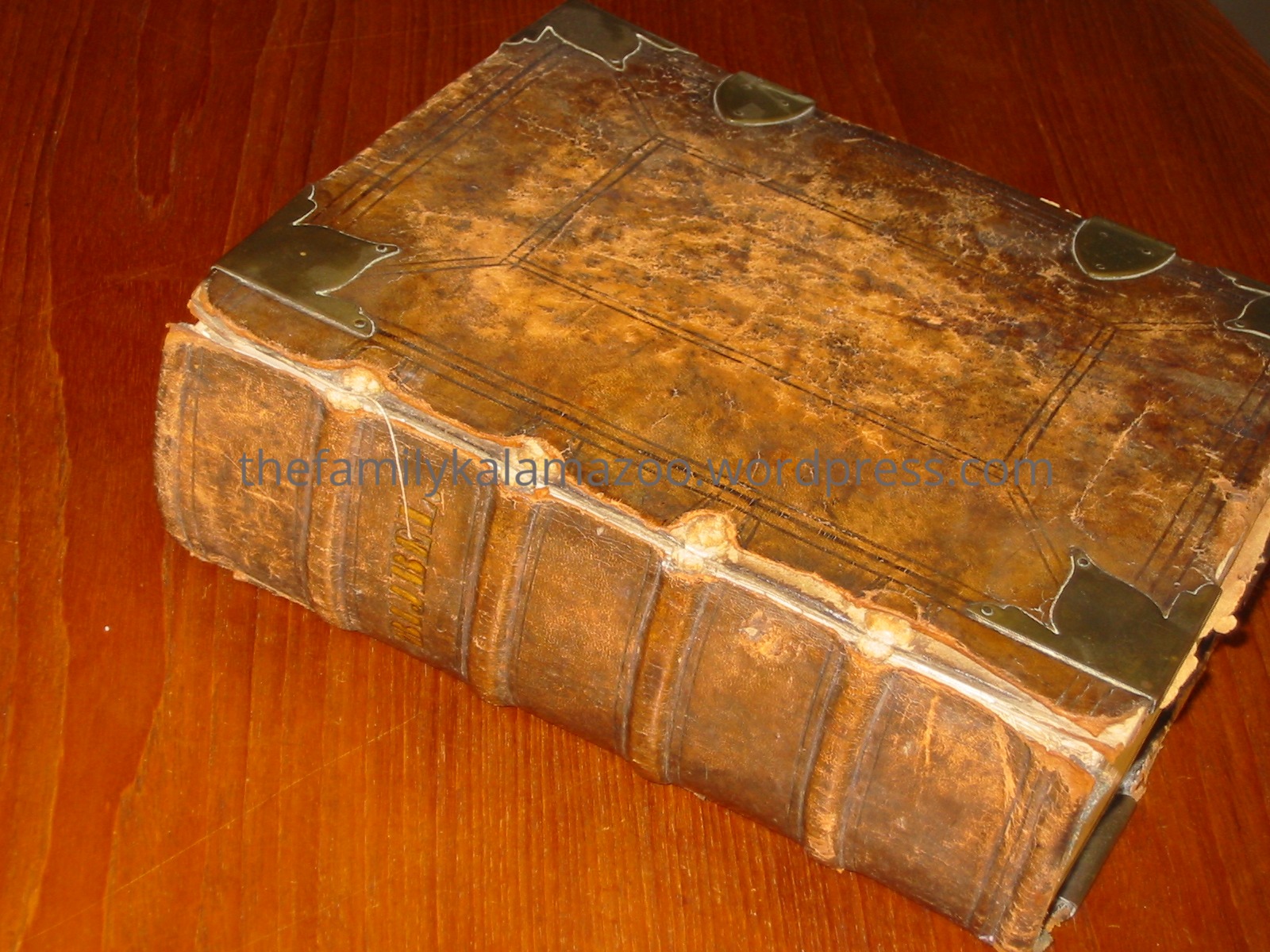
The best news so far from Elly, besides meeting her, is that she sent me photos of the family Bible!
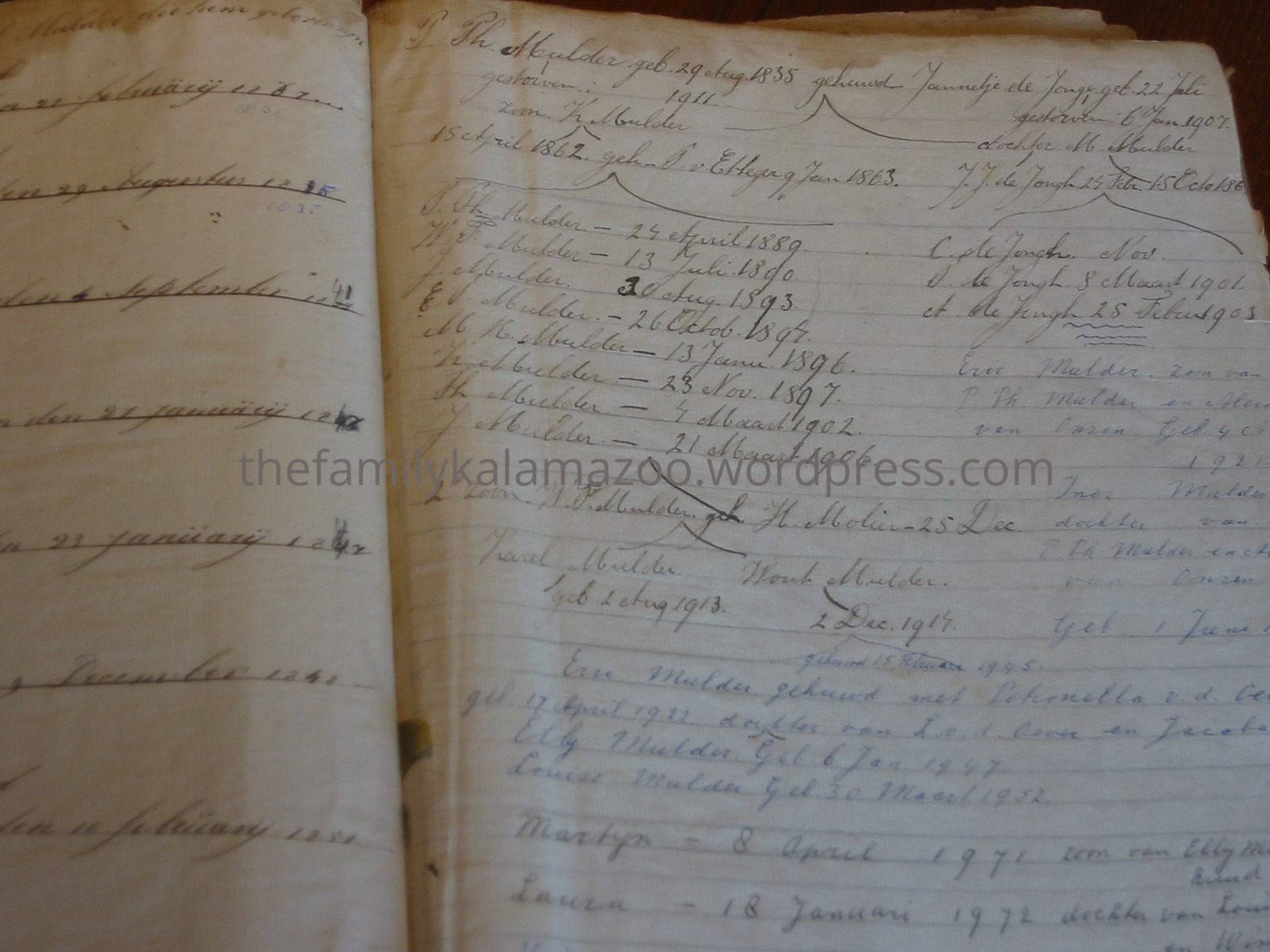
The family history was written in this Bible, according to tradition. It was begun by Karel Mulder who was born in 1812. He started it in 1867, three years before he died.
I hope that Elly and I can continue to share information about the Mulder family!

Read Full Post »

On May 6, 2015, I posted about a photograph I found in the box of glass negatives that had been taken by Joseph DeKorn. I’ll copy here what I posted and then give you the information that has come to me since then. If you remember the story, skip to New Information on Louis Van Wyck

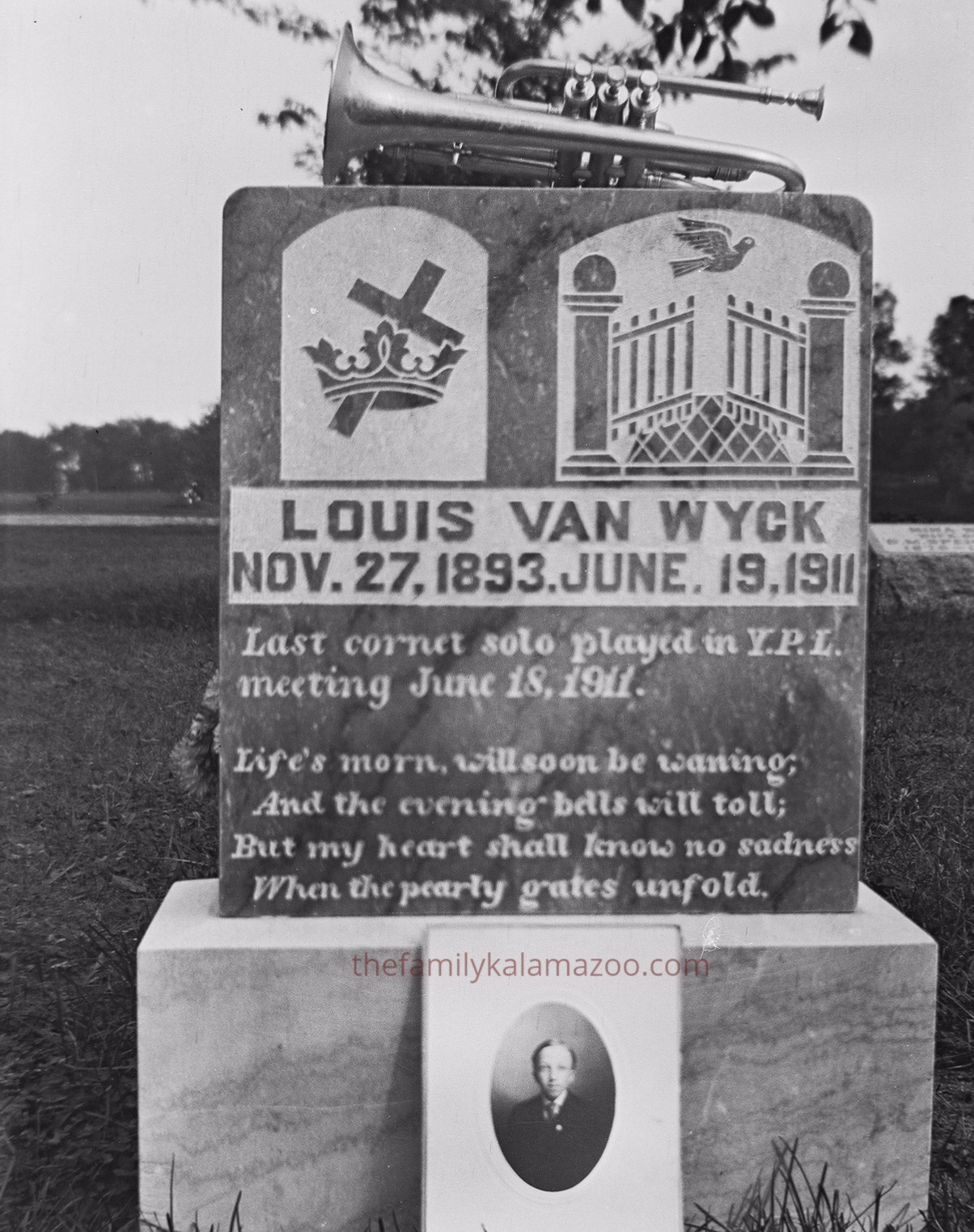
It seems to be an elaborate headstone for a man named Louis Van Wyck. Placed on top of the headstone is a cornet. The inscription reads, in part, “Last cornet solo played in Y.P.L. meeting June 18, 1911.”

His birth and death dates are also engraved on the headstone. He died the day after the cornet solo, on June 19, 1911. He was 17 years old–not a man, but a boy!

A photograph leans against the marble base. He looks young and blond. The stone is further engraved with images and a poem.


Although I have his dates, I can’t find Louis through Ancestry’s search function–or Find-a-Grave either. So I turned to Genealogy Bank where I found one article about his memorial service.

Read it here: Louis Van Wyck memorial service.  Note that the passage about the funeral is at the VERY END of this article.

I didn’t know what Y.P.L. on the headstone meant, but after reading about the Salvation Army hosting Louis’ memorial service, I looked it up online. It seems to mean Young People’s League. Now I have to admit I don’t know much of anything about the Salvation Army except that it is a Christian denomination and a charity, I sometimes donate furniture or clothing to them, and they (or volunteers like my family and friends) ring bells at Christmas outside shopping malls. I think Sarah in the musical Guys and Dolls belongs to a fictional representation of the Salvation Army.

That is kind of fitting because I just read up a bit and discovered that music has been important to the Salvation Army from the beginning. How fitting this headstone was, then, for poor Louis. But how did he die at such a young age? And how was he connected with Joseph DeKorn or my family? He would have been about 12 years younger than Joseph.

New Information on Louis Van Wyck.

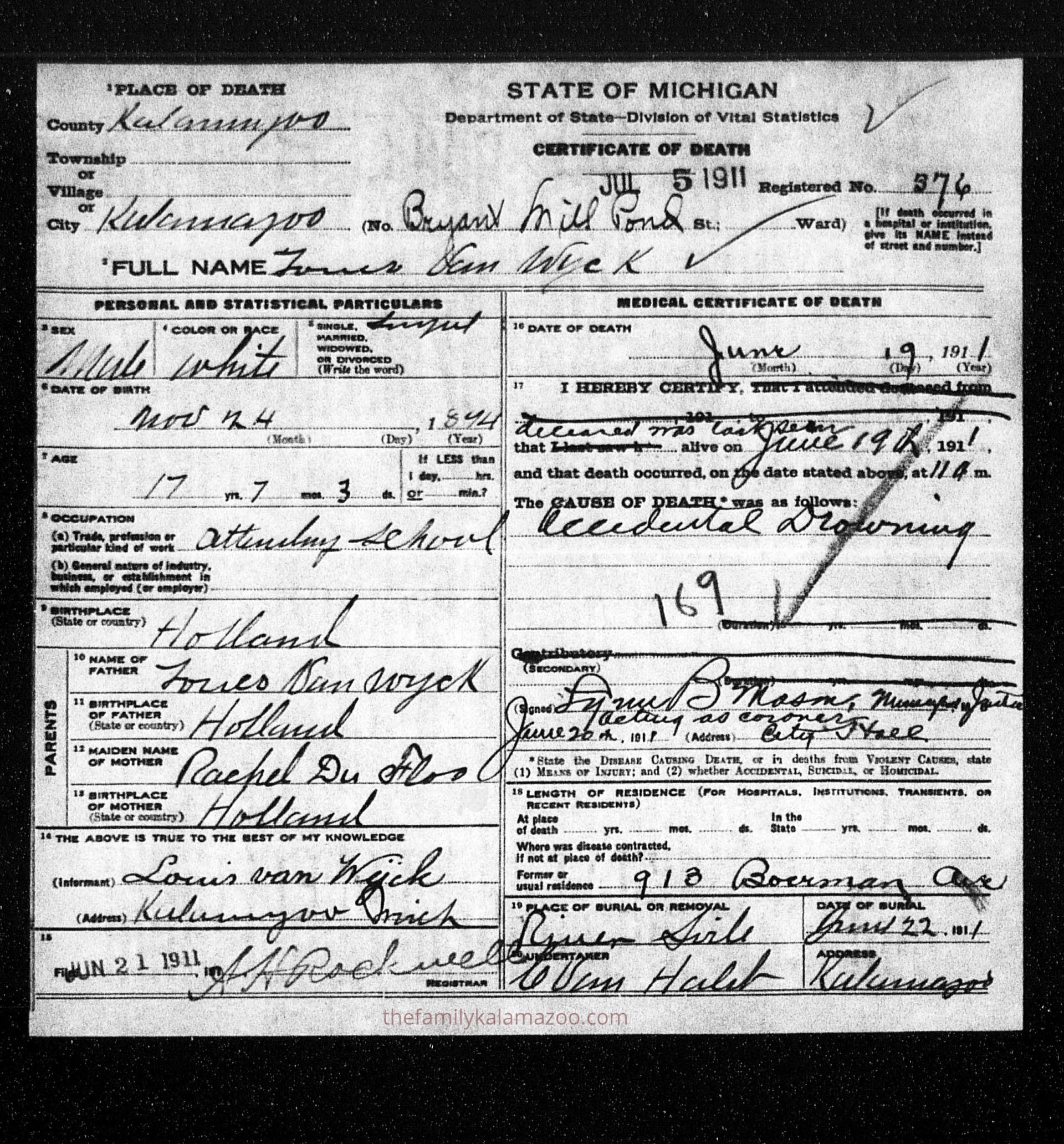
I was frustrated that I knew so little about Louis Van Wyck and yet my grandfather’s uncle had photographed his beautiful headstone with his cornet and photograph adorning it and left it behind for our family. Who was Louis Van Wyck? Many of you offered advice. Pastsmith really went to work on the problem and found Louis’ death certificate and his grave.


Things to notice in this death certificate are that he died of “accidental drowning” at Bryant Mill Pond. I looked up Bryant Mill Pond and discovered it is related to the Bryant (Paper) Mill. There were many operating paper mills at that time in the Kalamazoo area, all along the Kalamazoo River and Portage Creek. You can find quite a lot of information online about the cleanup that has been necessary in this area. I can’t imagine what the pond was like in those days. Was it full of papermill sludge or was it a clean pond that begged a boy to come swimming? Note that he drowned on June 19, 1911, just at the start of summer.

Louis’ parents were both from Holland, his father named Louis also and his mother born Rachel Du Floo. With this information I was able to find the family in the 1910 census, a year before Louis passed away. Louis had two sisters: Mary was 5 years older and his sister Kate was only 5 when Louis died. The senior Louis was a typesetter and worked for a newspaper. I wrote about how some members of my family worked on the Dutch-American newspaper here. Possibly Louis worked with them. In the 1920 census, Louis was listed as a price lister, whatever that is. It’s possible that the newspaper was out of business by then.

The family lived at 913 Boerman Avenue. This does not make them neighbors of my family, but it is within a long walk–the sort of walk my grandmother and I used to make when I was little. The house no longer exists as the area seems to be commercial now.

Since the families did not go to the same church, Joseph was 12 or 13 years older than Louis, and they were not neighbors, the connection could have been the typesetting.  After all, Louis, Sr., was born in the Netherlands and spoke Dutch. It seems that it would have been easier for him to be a typesetter in Dutch than in English.

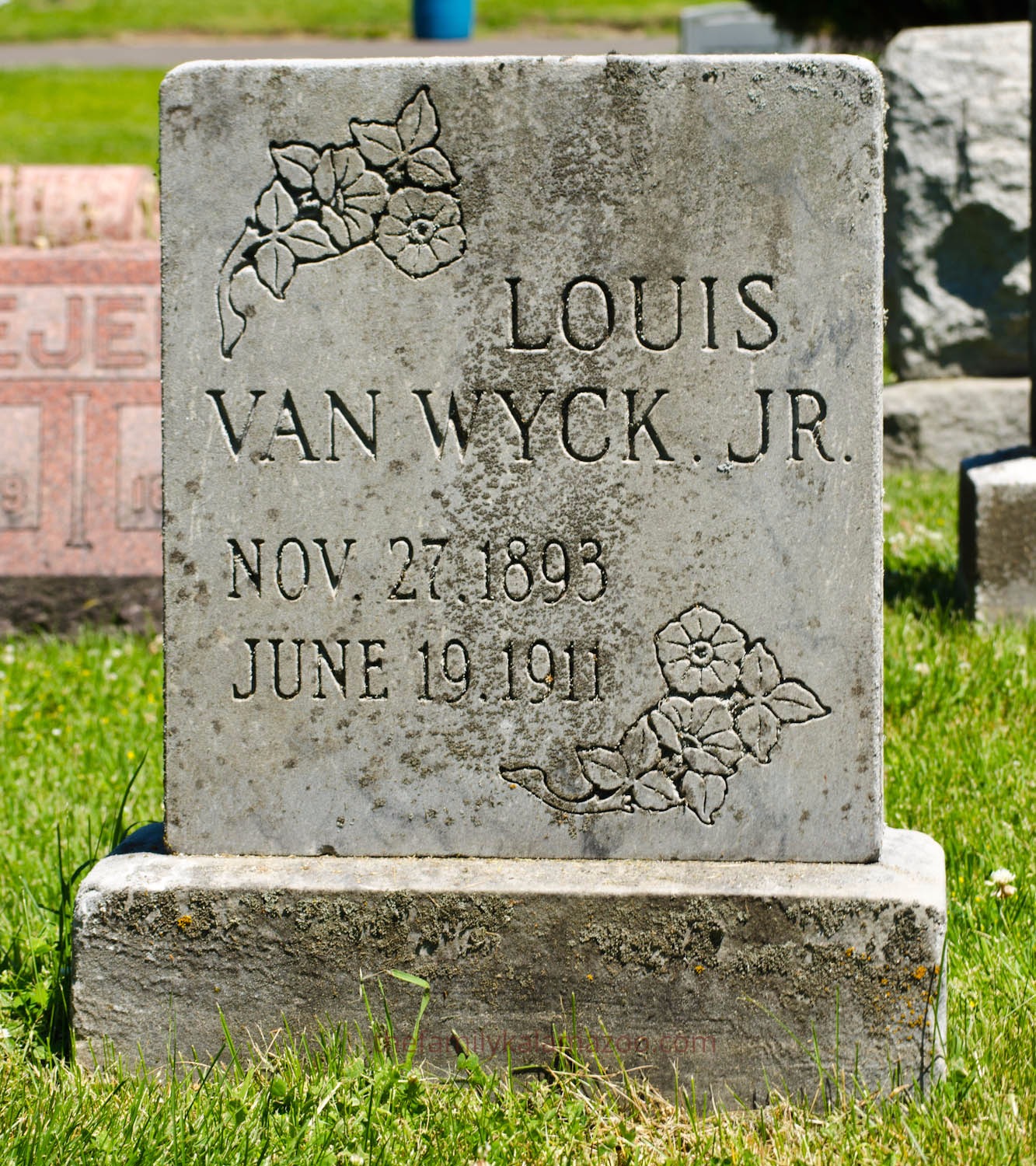
As the death certificate mentions, Louis was buried at Riverside Cemetery. Through Find-a-Grave, it appears that he has another headstone than the one above.


Two headstones, one very elegant and detailed and the other more simple, certainly does create a mystery. They also share dates of birth and death. However, Louis’ date of birth is different on his death certificate. There it reads November 24, 1894. Since the simple headstone appears to be the one at Riverside Cemetery, where is the other one or what happened to it?

After Pastsmith’s generous help, I was contacted by a reader from Kalamazoo who shared valuable insights. Joel wrote:

YPL stands for Young People’s Legion. As a child I was a member of the YPL. It was a group in The Salvation Army for 12-30 year olds. It was a Christian fellowship group and we had junior worship meetings. It sounds like LVW Jr played a cornet solo that Sunday, 6/18/1911 and drowned the next day. . . . More than 20 years ago I had possession of historic documents from his relatives published by The Salvation Army Chicago which told of his untimely death, or as we say in The Salvation Army, his “promotion to Glory.”

He also said:

LVW’s sister is Mary A (VanWyck) Fortune, 1888-1976, Find a grave #25812816, Riverside Cemetery, Kalamazoo. Her husband gave the books which archived “The Young Soldier” publication of The Salvation Army to my mother-in-law, shortly after Mary’s promotion to Glory in 1976. They came into my possession in the 1980’s. I have since forwarded them on to The Salvation Army Central Territory’s Museum and Archives in Hoffman Estates, IL.
As for LVW’s two headstones; I am more familiar with the one with the cornet on it. I don’t recall where I’ve seen it before. But I knew it before I saw it in your web site. Perhaps it was in this archive book I had, or in local S.A. archive photos. I would like to see the larger headstone. I’ve also seen the more plain headstone before your web site, I have no explanation for two headstones. The photo of Louis himself is the photo I’ve seen published and in the local S.A. archives, as well as others that are of that era.

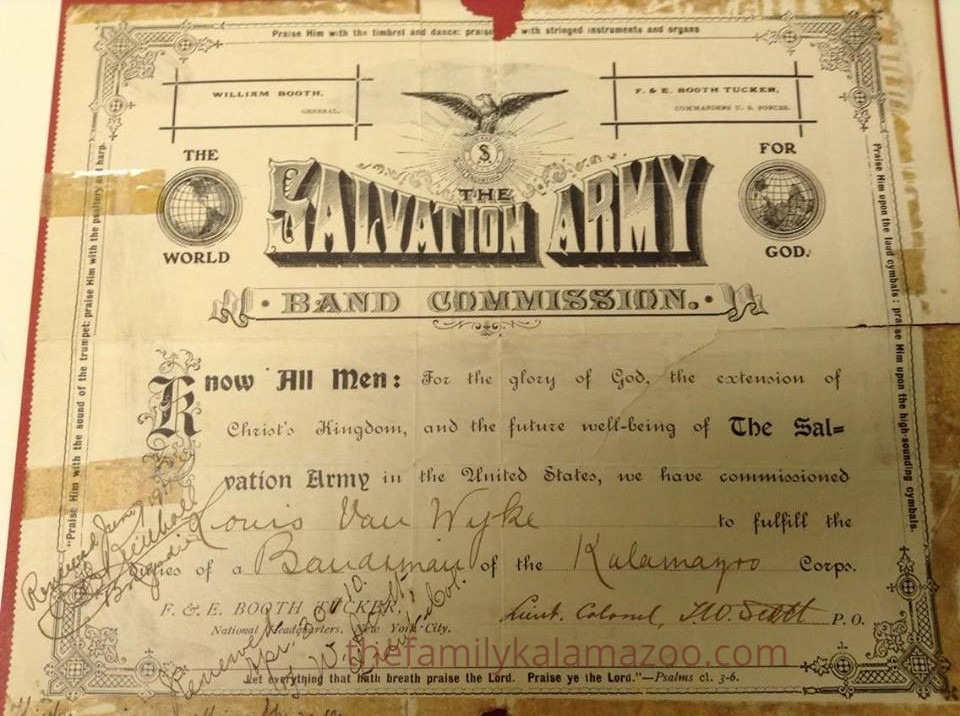
I came across the actual Band Commission for Louis VanWyke Jr.(Wyck is misspelled on the document) in our local SA archives from 1909. I have a picture of it but don’t know how to present it here. It has renewal comments written on it, renewing it until 1910, 1911, and 1912. Also, on the certificate is printed the name of the current General; William Booth. After Booth’s death in 1912 all subsequent SA documents say, “William Booth, Founder”, and would also list the current General.
I also have other anecdotal information regarding Louis’s sister, Mary A. Fortune, from my wife. In the 1960-70’s Mary and Neil Fortune lived next door to my wife’s parents, Richard and Shirley Aukes . . .  in Portage, MI. The Aukes’s and Mary were members of The Salvation Army of Kalamazoo, like Louis VW. Neil helped Richard build a garage. Later after Richard’s death in 1968 and Mary’s death in 1976, Neil gave Shirley Mary’s cedar hope chest. The hope chest was given to my wife, who in turn has given it to our daughter Betsy. Besides the hope chest, Shirley received the books chronicling Louis’s premature death.

At this point it became clear that Joel is the brother-in-law of my junior high classmate, Chris Aukes. We were in almost all our classes together for the three years of junior high school.

Note that Mary Fortune who Joel refers to is Louis’ older sister Mary.

Here is the 1909 Band Commission for Louis Van Wyck that Joel found in the local Salvation Army archives.


What talent Louis must have had. I’m so pleased to know more about Louis and hope to find out even more.

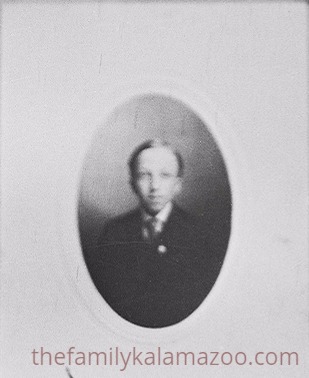
I tried to blow up the photo that rests against the first headstone. Though it is faded, it does give an idea of what Louis looked like.


Although Louis was not my relative, I enjoy finding out more about the history of the people who lived in Kalamazoo over 100 years ago.

Read Full Post »

My father’s mother used to love Christmas. She celebrated it on Christmas Eve, in the German tradition. Her favorite Christmas carol was “Silent Night,” also from the German tradition.

In this photo, Grandma sits with Aunt Marge.

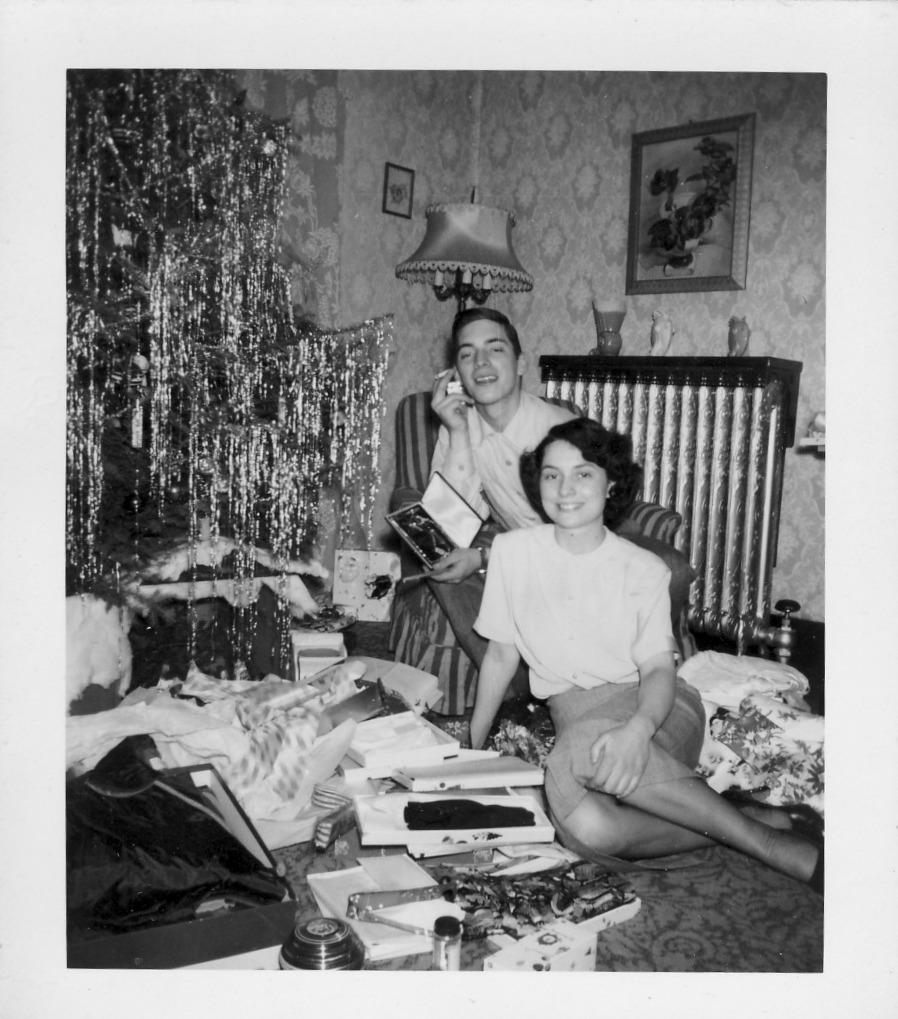
And here Aunt Marge is with a silly young man. (Yup, that looks like Dad!)


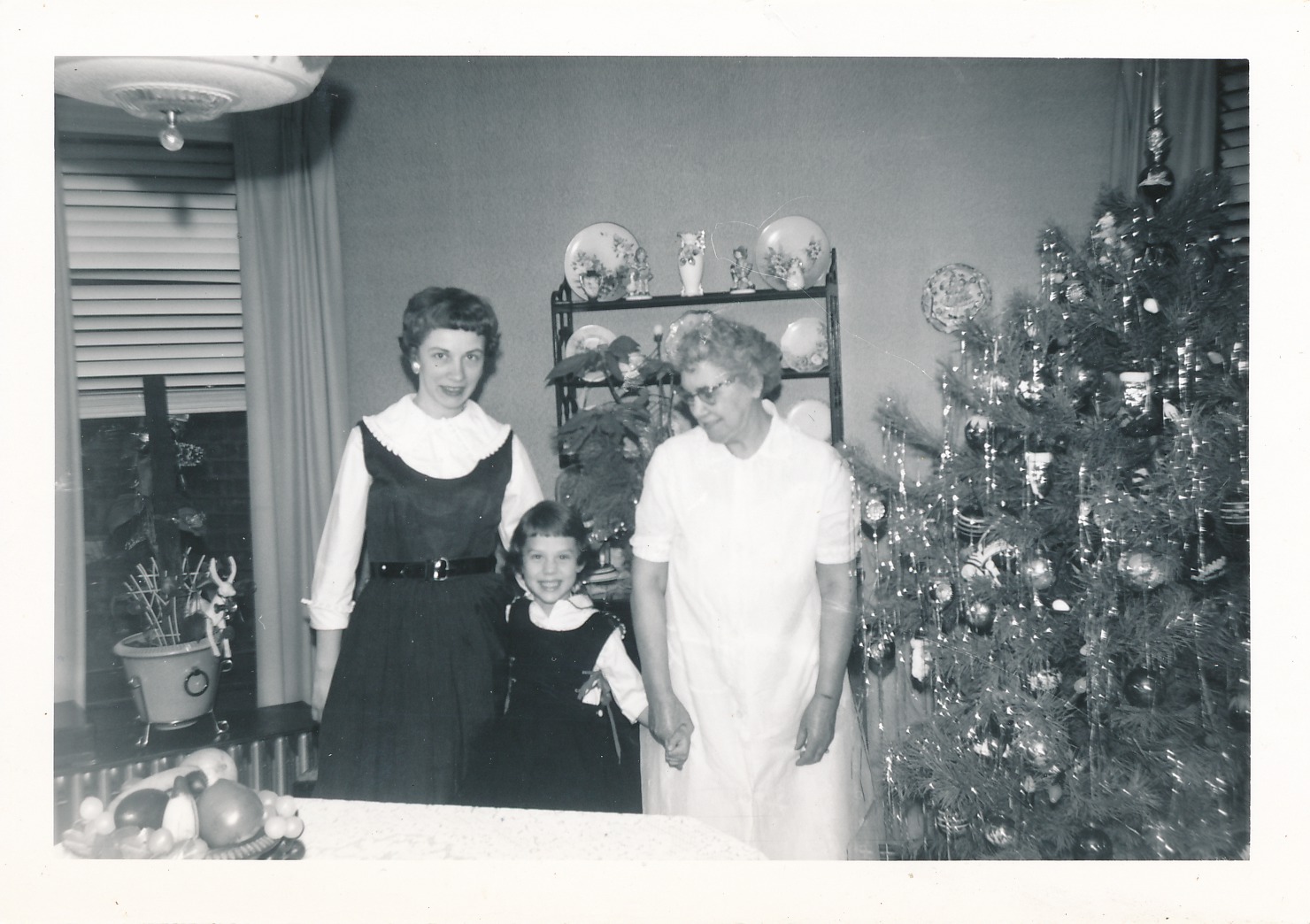
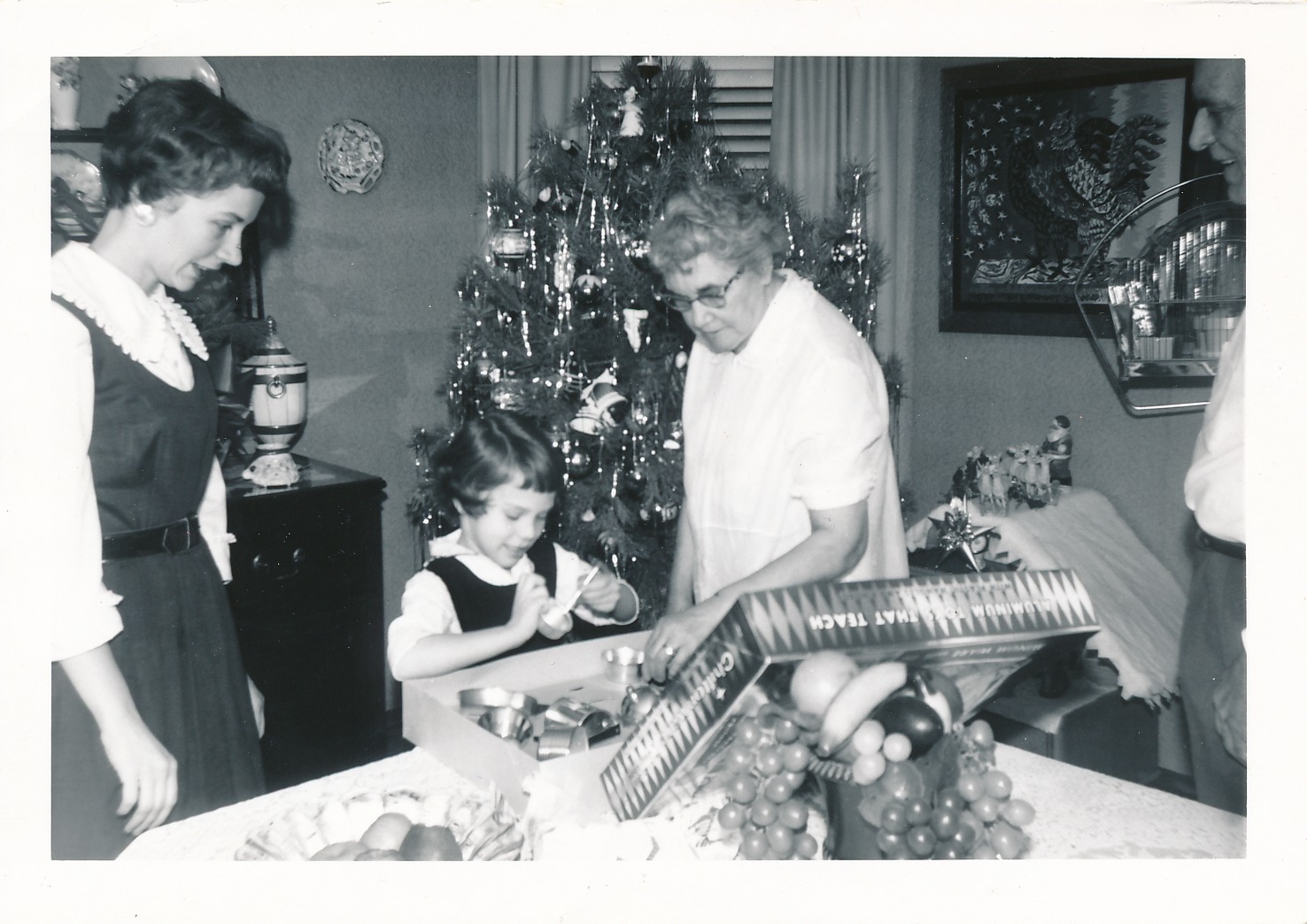
In Chicago, she kept a traditional Christmas tree (yes, also the German tradition) that she decorated with glass ornaments (mainly made in, wait for it, Germany) and strands of tinsel. In this photo, I must be around five and stand between Grandma and my mother.

Look what I got from Grandma!


When I was still young, Grandma changed her tree to a silver aluminum that changed color when a light wheel shone different colors on the tree. She decorated it in all pink balls. That’s the tree I remember from her duplex in Michigan. I looked, but couldn’t find a photo of it.

Another German tradition Grandma continued was putting electric candles in the window. I wish you could see the candles in this pic, but they might have been in the kitchen window. This is the picture window in Grandma’s duplex. She has a wreath up, and the nativity scene with the gifts below. It looks as if she didn’t have a tree this year. Judging by this fabulous hair (Mom, you let me go out like this?!), I was in junior high.

I think she gave my parents at least some of her old ornaments.

Read Full Post »

When Joost “George” Paak*  lost his wife in 1900 and then his mortgaged home in 1902, he must have been distraught and wondered how he would take care of five children. He was a laborer who was not even working at the time of the fire.

I know that he lost a mortgaged home because of the newspaper article (see post links below for the rest of the story) and because the 1900 census shows that he owned a mortgaged home. At that time, he worked as a farm laborer, but had been unemployed 3 months the previous year. I am guessing that this was a hard physical job and if he was sick he wouldn’t be able to work. I also think he had been unemployed for 3 months the previous year because of the winter. So he didn’t have a very stable job. He had immigrated to the United States at age 18 with his family. He was the oldest–he had 4 younger sisters. There was also a young brother who either died in the Netherlands or came here and would probably be known as William. Still checking into this.

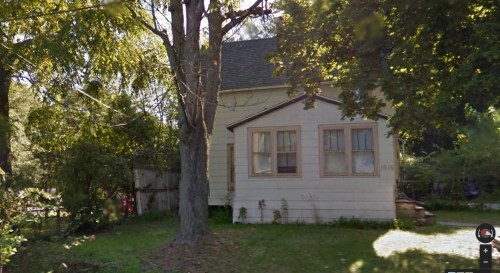
In 1908, six years after the fire, George married Addie Amelia Gifford Wilder. This shows up on the 1910 census. At this time, George was listed as Joseph G. Peake (Joost could easily be Joseph or George, I guess), and he now had a stable job as a paper maker at the paper mill. He again owned a mortgaged home and guess where? At 1016 Trimble Avenue, the scene of the fire. So the house was rebuilt. And you know what? It still stands.

The 1920 census shows George still married to Addie. He owned his home free and clear. He was still a laborer for the paper company, earning wages, not salary. And he was 69 years old. Notice no retirement for George at that time!
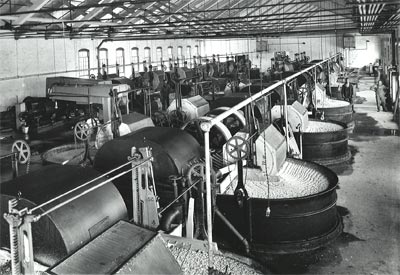
Paper mills were big business in Kalamazoo, by the way. The city was known as The Paper City. There is a great article published online by the Kalamazoo Public Library. Click the photo of the paper vats to go to the article.

PaperVats_400

All three censuses show George immigrating to the United States in 1868, although in one of them it looks like 1860. He was naturalized as a citizen in 1891.

What the census does not show is that George married Esther M. Fields in 1906, gaining a 4-year-old stepdaughter, Florence Wilder! But a year and a half after the wedding, Esther died! (Professor Lawrence heard that George might have been married as many as five times, but I do not have the documentation yet on the other two marriages–or the timeline).

In the 1910 census, George’s household includes Addie, Fannie, and George. These are the two youngest Paak children. And the household also includes Esther’s 7-year-old daughter Florence A. Wilder! So George kept her in the household, which must mean she had no other family to take her in. But his own children, Theresa (Tracy) who was 17, Jane who was 20, and Cora who was 22 were not living at home. Theresa, as we know, was living with the Pickards as their perhaps unofficial foster daughter and being sent to boarding school.

Why did Theresa not live at home with her father and stepmother while a stepdaughter of George continued to live there? Maybe after the upheaval in the household after her mother’s death, the fire, and then the death of her first stepmother it was determined it would be better for her to stay with the Pickards permanently?

Professor Lawrence did tell me that he had heard that the children were farmed out to people, especially relatives, after their mother died. But at the time of the fire two years later it seemed that they were living at home with their father. I do wonder if my own great-great-grandmother helped out when her sister-in-law died or after the fire. The clipping about the fire was saved in the family documents, so she (she died 6 years after the fire) or her daughter must have kept it.

Why did Jane who never did marry and lived to be 107 years old (there might be a connection there haha) not live at home? Maybe she had a job and was providing for herself already. Jane lived in a nursing home near the end. In the photo there is a sign for her 100th birthday. I do have a photo of her at her 107th with cake, but she is in bed and obviously not well, so I don’t want to share that one.

Where was Cora? Was she married yet? Her first child might have been born in 1915, although I have not done much research on Theresa’s siblings as of yet. If she wasn’t yet married, I wonder if she and Jane were living together. That would be something to search.

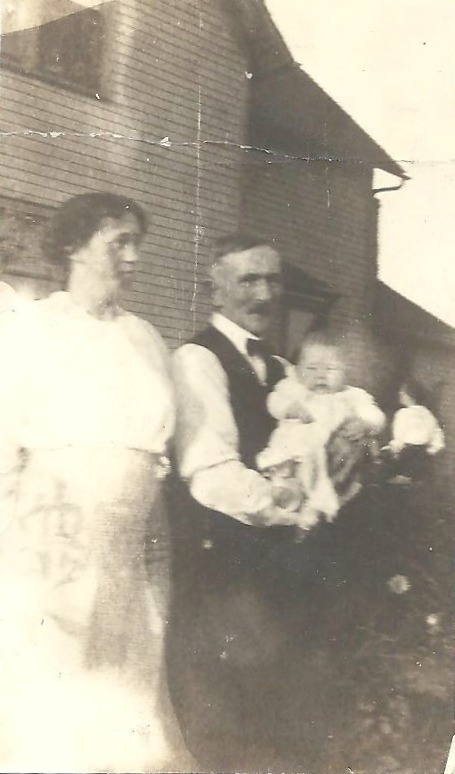
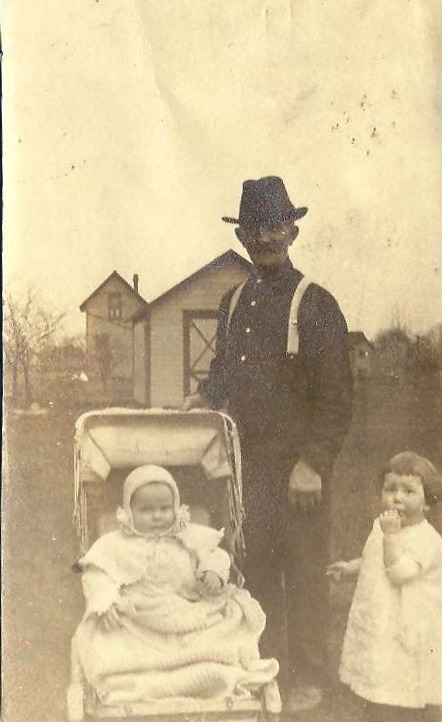
This photo was probably taken in 1925 when George was 76 years old and a happy grandfather. The woman is Cora, his oldest daughter with her son John Rankin. John was not her first child, but the first by her second husband, John Rankin, Sr.


Here is another photo of George with two children. As always, I appreciate any comments about date identification or other important information.

* I’ve changed his surname spelling to the one that my great-great-grandmother used because I see that he did also use that spelling in addition to other spellings.

Here are the other Pake/Paake /Paak //Peek posts:

A Series of Disasters

The Children After the Fire, 1902

Paak-a-boo

Saved from the Fire

Who is George Paak, Sr.?

Curious about George

George Paak’s Legacy, Part I

George Paak’s Legacy, Part II: Theresa’s Pre-Professional Education

George Paak’s Legacy, Part III: Theresa’s Professional Education

George Paak’s Legacy, Part IV: A Letter to His Daughter

George Paak’s Legacy, Part V: Theresa Gets Married

George Paak’s Legacy, Part VI: Who Were the Pickards


Read Full Post »

HAPPY

BIRTHDAY,

MOM!!!i

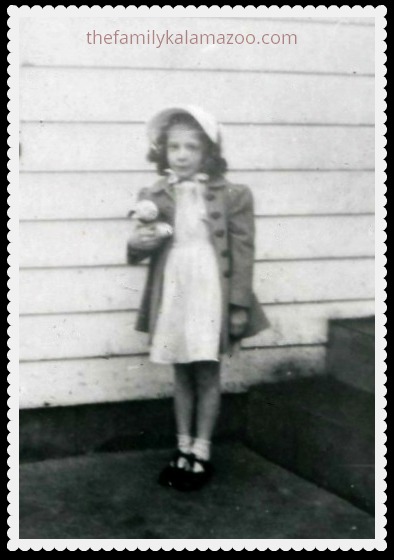
A beautiful lady and mom now and a beautiful girl then. Here she is by her house when she was a little girl:

I can’t help but wonder if this is a little Easter bonnet and an Easter toy in her arm.

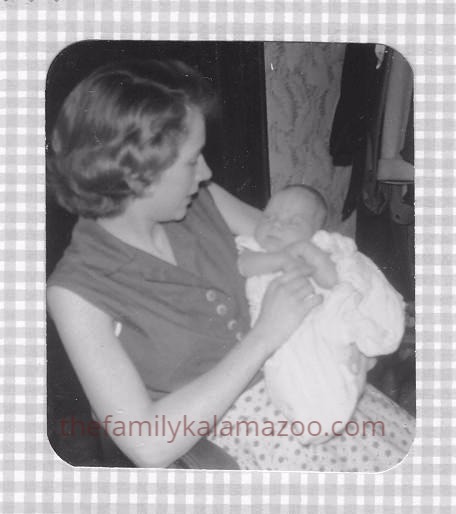
This is when I was a baby.

Have a beautiful day, Mom!!! xoxo

Read Full Post »

If you’ve been following along here for some time, you might remember my posts about Theresa Pake, the middle child (of five) of my great-great-grandmother’s brother, George Paak.

When we left off, Theresa had married Roy Lawrence.

I’d like to backtrack. Remember how her father’s house burned down two years after her mother passed away? It was 1902, and Theresa was only 8. The article in the newspaper showed how destitute the family was by the fire, George’s illness, and Lucy’s death. The paper emphasized that the oldest girl, Cora, had been running the household from the time she was 12 until the fire–when she was 14.

At some point after this, Theresa went to live as a foster child with Oliver and Una Pickard. It would have been hard to find this information strictly from documents, but I had a great lead in the form of Theresa’s son Professor Lawrence.

This is a quote from one of my earlier posts:

At some point Theresa lived with foster parents, Una Orline and Oliver Oratio Pickard.  Prof. Lawrence thinks she maybe have gone to live with them as early as age six, which would mean she wasn’t under the care of her older sister. However, the newspaper article about the fire in 1902 would show that she was still living at home at the time of the fire (nearly 8 years old). Regardless, at some point, the Pickards became the caregivers of Theresa. None of the other children in the family seem to have gone to live with the Pickards.

SO WHO WERE THE PICKARDS?

Professor Lawrence told me that Oliver was a postman and Una a nurse. He said he couldn’t find his mother with them in any of the censuses.

I did a little search myself to confirm and hopefully augment this information.

I found the Pickards in the 1900, 1920, 1930, and 1940 censuses.

1910 census Pickards

1900: living in a “home” with 74 other people. There is a couple that are the head of household and his wife. Then Oliver is listed as a nurse and Una as “wife” (incorrectly as the wife of the head of household). After that are 3 attendants, a cook, and a lot of patients. So were both Oliver and Una the nurses for the facility? I can’t find the address on the census document.

From there, I went to the previous page of the 1900 census. It’s a short page and this is how it ends after a listing of some patients: “Here rests the enumeration of that portion of the Michigan Asylum for the Insane situated in Kalamazoo township outside the City of Kalamazoo.”

But wait! the page with Oliver and Una is in Oshtemo Township. That gave me the idea to see if anything is written at the end of the Pickards’ “household on the page after the one listing Oliver and Una.”

Wow!!! Something was written and erased. I can barely make out anything, but it appears to say pretty much the same thing as the above quotation about the asylum but using Oshtemo instead of Kalamazoo!! Why was this information erased? So did the Michigan Asylum for the Insane have Kalamazoo Township AND Oshtemo Township facilities?!! I can’t go past that page because this section ends on page 36–and the Pickards are listed on page 35.

I looked up “Oshtemo township” with the Kalamazoo State Hospital, and I found that the hospital owned a farm in that township since 1888: Colony Farm Orchard. Some patients lived on and farmed the property. Could this be where Oliver and Una first worked together?

1920: living at 1846 Maple Street in Kalamazoo. They owned their own mortgaged home. Una’s parents lived with them. Oliver was a mail carrier and Una was a nurse at the State Hospital. At this point, Theresa was finishing up her education, still under the guidance of the Pickards. THERE! The State Hospital IS the Michigan Asylum for the Insane. The name was changed in 1911. So it looks like maybe Oliver quit nursing and became a mail carrier–and maybe they moved to their own home that way.

1930: living at 1844 Oakland Drive in Kalamazoo. They owned their home, worth $15,000. Notice that 1844 address here is similar to the address in the 1920 census. I wonder if it’s the same house and there is an error in the number and the street? Or are they two different “owned” homes?

1940: living at 1846 Oakland Drive in Kalamazoo. So it probably was 1846 Oakland Drive all along. Una is a registered nurse in “private work.” That makes sense because she is listed as 67, and she couldn’t possibly be providing care at the State Hospital at that age. Oliver said he worked 52 weeks in 1939, but his income from this work is listed as zero–but he has income from “other sources.”By now the house only valued at $8,000.

A look at the neighbors in the 1940 census does not show that preponderance of Dutch names that I’ve seen in the neighborhoods where my relatives lived. The surnames seem to be of English origin, for the most part. But in the 1920 census, the same neighborhood had more Dutch surnames. Maybe this reflects a change in the neighborhood–or in the demographics of Kalamazoo.

Professor Lawrence told me that Una was Theresa’s Sunday School teacher. She must have taken a liking to the girl. I think Theresa was an intelligent and hard-working child, so that may have appealed to Una who took her on either from affection or religious conviction or a mixture of both.

So who are these people who married young (she was 18 and he was 23) and worked and lived at the State Hospital until he left for a job as a mail carrier? Who never had their own children, but managed to provide a quality education and a religious upbringing to one of the Paake children? That would have been very hard work being a nurse at the “asylum.” It could also be dangerous. In approximately 1904, a resident doctor was stabbed to death.

I also think the Pickards were most likely Methodists as they chose to send Theresa out of state to a Methodist school.

What was it like for Theresa to live with the Pickards?

Here are the other Pake/Paake/Paak/Peek posts:

A Series of Disasters

The Children After the Fire, 1902

Paak-a-boo

Saved from the Fire

Who is George Paake, Sr.?

Curious about George

George Paake’s Legacy, Part I

George Paake’s Legacy, Part II: Theresa’s Pre-Professional Education

George Paake’s Legacy, Part III: Theresa’s Professional Education

George Paake’s Legacy, Part IV: A Letter to His Daughter

George Paake’s Legacy, Part V: Theresa Gets Married


Read Full Post »

I’ve mentioned before that my great-grandfather, Adrian Zuidweg, Sr. (Adriaan Zuijdweg) owned a fish market when Grandpa was young.  In this photo he stands with an unidentified young employee.

Fish Market on Eleanor Street

Fish Market on Eleanor Street

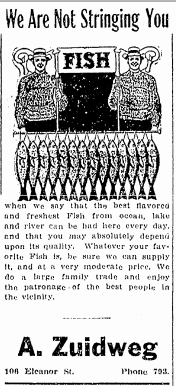
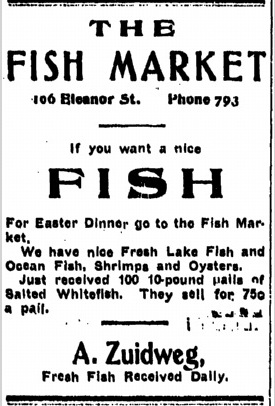
I found some ads he ran in the Kalamazoo Gazette on Genealogy Bank. This one is from September 16, 1910.

This is a pretty fancy ad for a little market like he had. Some of the time he did a more simple ad like this one at Easter time–April 6, 1904.

Most of his ads, like those of many small businesses at that time, were a mere sentence or two in the JOTTINGS. I underlined his little ad so you could find it easily amidst the other “jotted” notes. This one is from December 24, 1907. Note the date and the hours listed.

That means my great-grandfather not only worked Christmas Eve until 9PM, but Christmas Morning as well!

Read Full Post »

As I’ve mentioned before, my great-great-grandfather, Richard DeKorn, was a brick mason who worked on many public buildings in the Kalamazoo area.  He was a brick mason on the beautiful Ladies’ Library Association in 1878-79 and lead brick mason on the Kalamazoo Psychiatric Hospital Water Tower  in 1895. According to his obituary he was the contractor for the Pythian building and the Merchants Publishing Company building.

The asylum water tower was slated for demolition in 1974. Here is the story of how it came to be saved (from http://www.kpl.gov/local-history/health/kph-water-tower.aspx):

In spite of being on the National Register of Historic Buildings and endorsed by the Michigan Historical Commission and the Kalamazoo County Bi-Centennial Commission, the structure was earmarked by the State of Michigan for demolition in 1974. A local committee that called itself the Committee to Save the Tower launched a campaign to raise public funds to restore the building to its original grandeur and save it from the wrecking ball. A year later, Mrs. William John (Penny) Upjohn announced that $208,000 was successfully raised for this purpose. The money came from federal, state, and city contributions to the effort. Contributions also came from such disparate groups as school children, former state hospital patients, current hospital patients and employees, a hospital auxiliary, service clubs and concerned citizens. The campaign to save the structure was not without controversy. Some residents felt that the monies needed to repair the structure could better be spent on local service needs. Sen. Jack R. Welborn, R-Kalamazoo, pointed out, however, that taxpayers would be spending at least $150,000 to tear down the tower.

I recently visited Kalamazoo and went on a tour of Henderson Castle, a mansion built the same year as the water tower.


From a rooftop viewpoint, I was able to see the water tower in the distance.


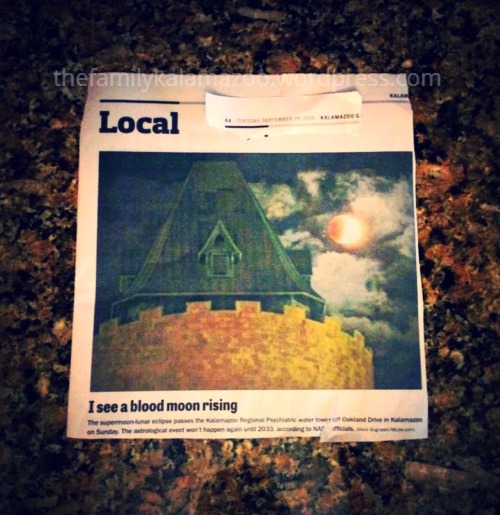
And then my mother showed me a photograph that was in the local newspaper of the blood moon near the tower.


I’m off preparing for a poetry reading this weekend. Have a lovely weekend!

Read Full Post »

I’ve written before about my great-great-grandmother’s sister, Carrie Paak Waruf, and her husband Henry Waruf: Who Was Hank Waruf, Kalamazoo Gunsmith, Tennyson’s Words for Henry Waruf’s Funeral, and All the Peek Girls (note that Paak can be spelled Peek, Paake, etc.).

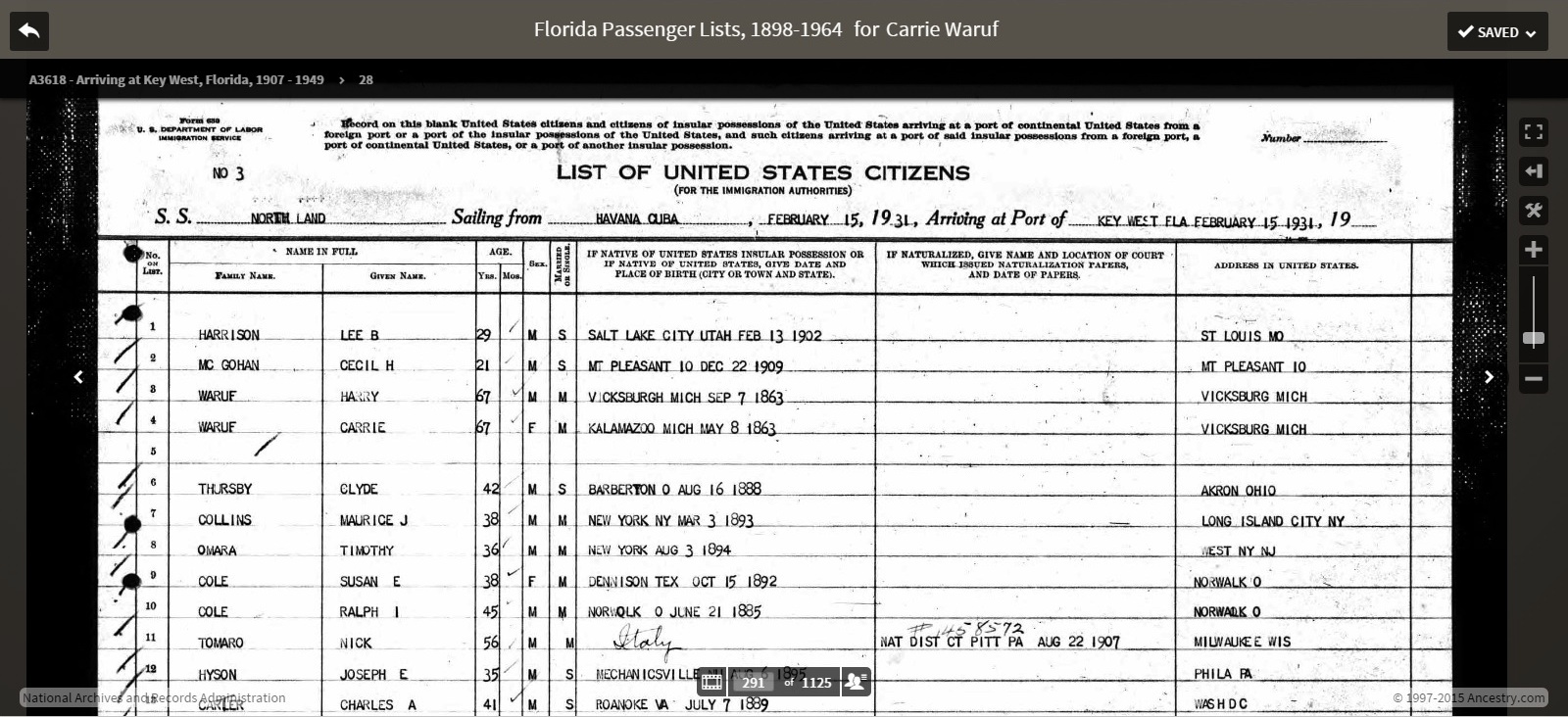
The other day I received one of those little Ancesty leaves on Carrie’s profile. The leaf led me to a Florida Passenger List for 1931. It shows that Carrie and “Harry” Waruf traveled on the S. S. North Land from Havana, Cuba, to Key West, Florida. They arrived on February 15, 1931.

Warufs come back from Cuba 1931 print screen

I started thinking about this trip. Undoubtedly this means that they vacationed in Cuba, to get away from the Michigan winter. Beginning in the late 1920s (or earlier), the twenty-seven-year-old 3,282-ton North Land, owned by Eastern Steamship Corporation, ran between Key West and Havana in the winter (and Boston and Yarmouth NS by summer). The North Land was a steamship and just short (in overall size) of the new luxury cruise ship that had recently become available (over 3,700 tons) that shipped out of Miami.

I wonder how long they vacationed in Cuba, where they stayed, and what they did there.

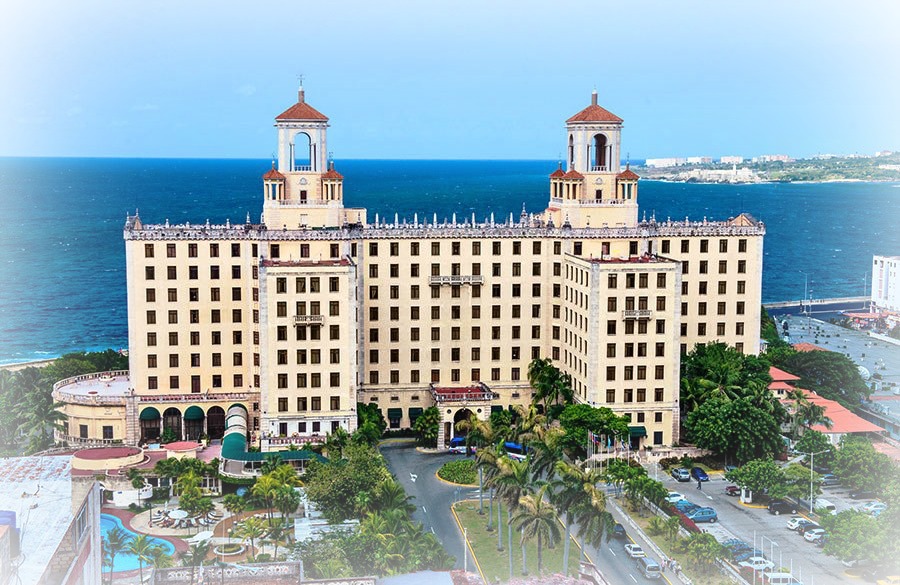
In 1930 the brand new Hotel Nacional de Cuba was built, so it’s very likely that they stayed there.

Poolside . . . . Trying to imagine Carrie and Henry/Hank/Harry by the pool with rum drinks.

This is what the Paseo de Prado looked like in the Warufs’ time:

Did Henry Waruf bring back boxes of cigars when they sailed into the Port at Key West?

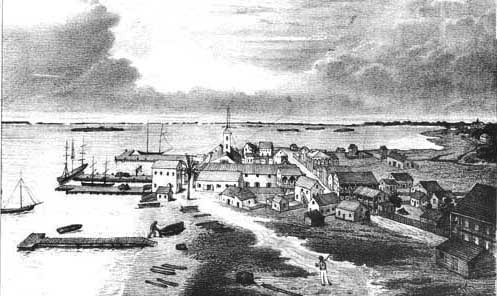
This photo is how they would have seen Key West in those days. Did they pay a duty on the cigars? Was there a limit on how many he could bring home? Remember that this was barely a year after the Stock Market Crash. Cigar factories were hurting in Cuba, just as companies and workers were hurting everywhere.

Did Henry and Carrie sneak back rum? It was still Prohibition when the Warufs traveled to Cuba!

It’s hard to imagine what an exciting place Cuba must have been for a couple from Kalamazoo in 1931.


Read Full Post »

Just back from a trip to Michigan, Ontario, New York, Pennsylvania, Ohio, and Indiana.

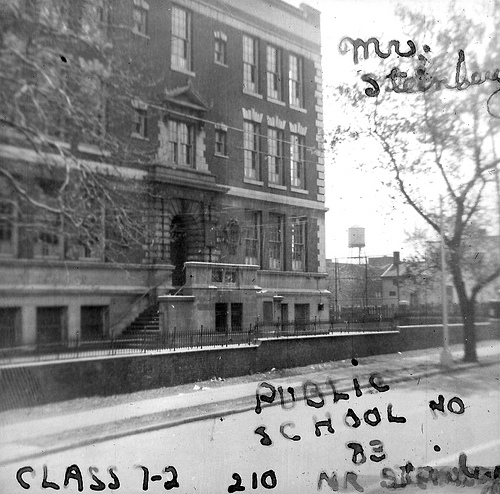
Now I know hubby and I are getting older because we tried to find his “roots” in Queens in NYC. We tracked down his school, P.S. 83, which was part of the Ravenswood area of what he thinks of as Astoria and what appears on some documents as Long Island City (they are adjacent). The old brown brick school, which was built in 1902, has been demolished and replaced by a new building.

The old school looked like this:

The new building (photo thanks to Google maps) looks like this:

From brown brick to . . . brown brick. According to Google, a residential treatment center called Phoenix House has its main location here, but I can’t confirm this for sure. The address numbers are quite confusing.

Rainey Park is next to the property. Hubby doesn’t remember the park, but rather a big playground. I wonder what it looked like when he went there. Today it is clearly a park. I looked up the history, and the park was acquired and named by the city in 1912! Maybe it seemed to extend the playground? Or maybe they used it as a playground?

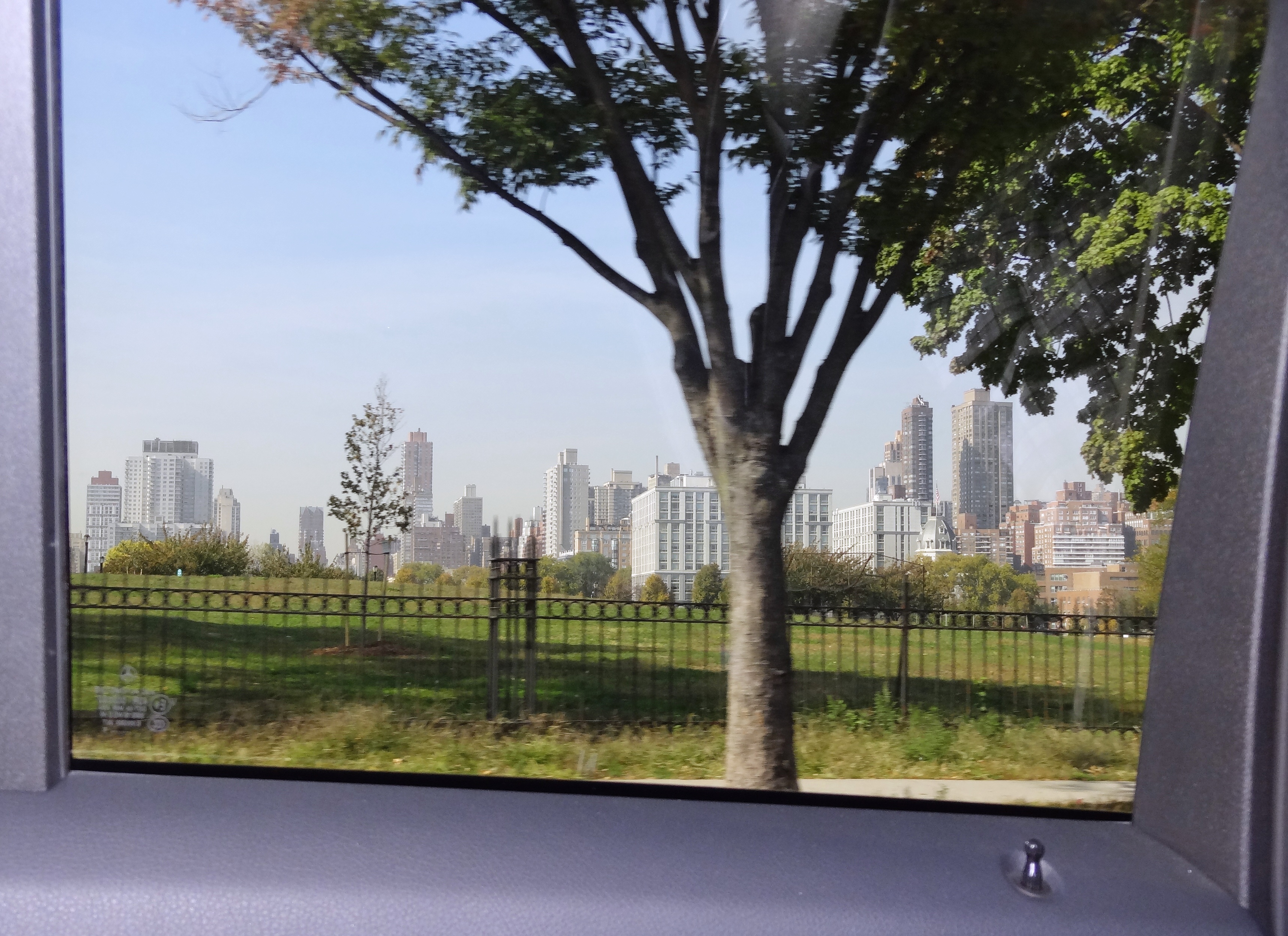
I took this pic of the park looking out of the car window.

According to Google, as you look across the park you are looking across the East River to Roosevelt Island and beyond to Manhattan.

Hubby first attended school at PS 83 in 1960 and was only there a few years before his family moved to Michigan.

The more he saw places and thought about his childhood, the more my husband remembered. I started to wonder if it’s easier to remember your childhood if you lived in the same town for your whole childhood than if you experienced one or more dramatic moves. Or the other way around.

Hubby always said he grew up in a project, which was not something I saw growing up in Kalamazoo, so he wanted to see where the buildings were located. Lo and behold, they are still there–and people still live in the buildings.

There are 31 buildings of 6 and 7 stories. From here, hubby used to walk to school at PS 83 with the “big kids.” They stopped for candy on the way home at a little store.

If anybody knows anything about the history of the area, Ravenswood Houses, or P.S. 83, I would love to hear about it!


Read Full Post »

« Newer Posts - Older Posts »