Feeds:
Posts
Comments

Archive for the ‘Paak’ Category

I’ll be taking a blogging break for the holidays, so I’ll leave you with this gift (that I first posted three years ago)  from Alice Paak (Richard) DeKorn to one of her children, possibly her daughter Cora, my great-grandmother. What a family and genealogy treasure–now 109 years old.

1907

Merry Xmas

from

MOTHER

In case you’re wondering about the use of the word “Xmas” instead of “Christmas,” this is what Wikipedia has to say:

There is a common belief that the word Xmas stems from a secular attempt to remove the religious tradition from Christmas by taking the “Christ” out of “Christmas”, but its use dates back to the 16th century.

I’m sure that this was just a way to fit it all on the tiny shell. What a lot of work to paint and letter this shell. I wonder if she made three, one for each of her children.

Happy holidays to you and yours! See you in the new year!

Read Full Post »

I originally started this blog because of the wealth of photographs and glass negatives I had in my possession that once belonged to my grandfather’s uncle, Joseph Peter DeKorn. This post is a revision and update of the 2nd post on this blog.Joseph Peter DeKorn

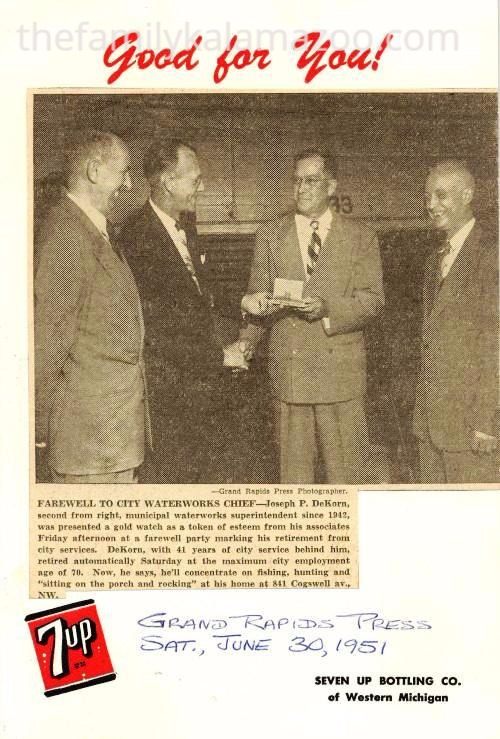
“Uncle Joe” was born to Richard DeKorn, local building contractor and brick mason, and Alice Paak DeKorn June 30, 1981, in Kalamazoo, Michigan. When he lived in Kalamazoo, he was an enthusiastic photographer, capturing scenes and people in Kalamazoo in the very early 1900s. Most of the photographs by Joseph which I have were taken between 1903 and 1918.  His draft registration for WWI is dated September 12, 1918.  He graduated from Kalamazoo College and the University of Michigan Engineering School in 1909.  Joe was a hydraulic engineer and worked for the City of Grand Rapids for over 30 years.  He retired as Superintendent of the Grand Rapids Water and Light Company.

gr-press-sat-6-30-51-joe-dekorn-retiring-city-waterworks-chief-001-1

Here is a commendation letter from the City Manager upon his retirement.

joe-dekorn-commendation-city-mgr-retirement-001-2

Personal life

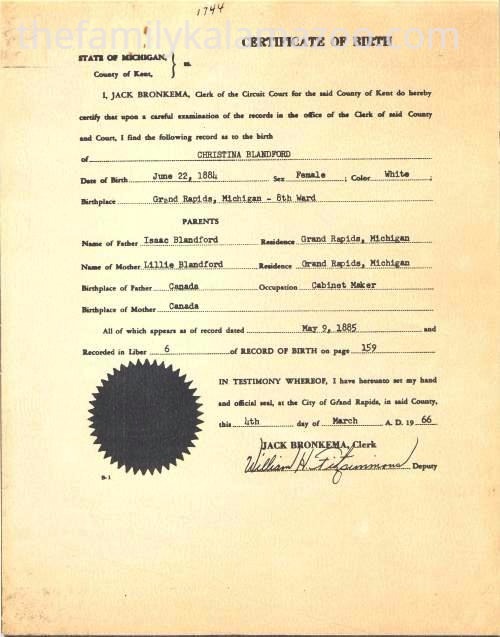
Joe married Christina Blandford on December 9, 1919 in Kalamazoo.  He was 38 and Christina was 35.  She was born June 22, 1884 in Grand Rapids, Michigan.  Christina’s parents were Isaac Blandford and Lily Kemp, both born in Ontario, Canada.   She graduated from Western Michigan Normal College (now Western Michigan University in Kalamazoo).  She was a school teacher and taught at Walker Township School, District #1 (later known as Fairview School) and Godfrey School in Grand Rapids.

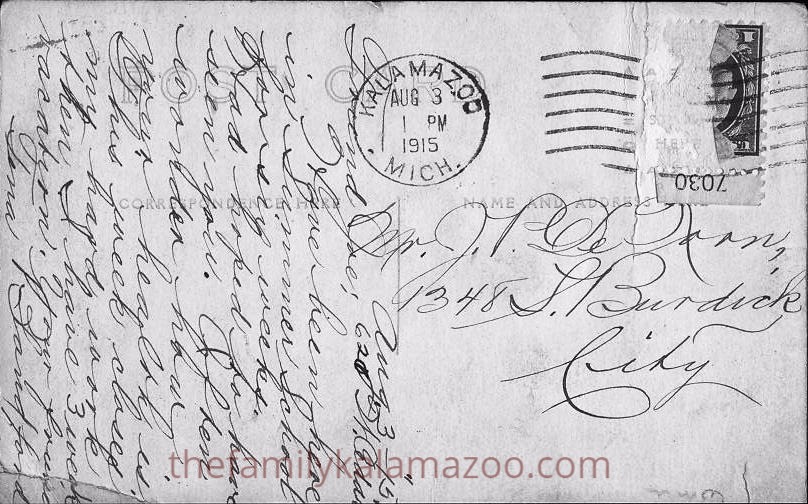
Aunt Tena, when Uncle Joe was still “Friend Joe” to her, wrote him this postcard in 1915:

Tena sent this postcard to Joe on August 3, 1915

Tena sent this postcard to Joe on August 3, 1915

Aunt Tena wrote from summer school in Lansing in her beautiful handwriting

Aunt Tena wrote from summer school in Lansing in her beautiful handwriting

Tena and Joe resided during their lifetime at 841 Cogswell Street, NW, Grand Rapids, Michigan, just three houses from the Blandford family homestead.  The couple raised their two sons, Richard and Phillip in Grand Rapids, Michigan. Richard was born on January 29, 1920, and Philip Eugene was born on August 4, 1922. Joe worked as a hydraulic engineer or filter engineer for the City Water & Light Department, Grand Rapids.  He passed away on March 24, 1962.

Joseph died March 24, 1967 in Grand Rapids and Tena died October 11, 1979 again in Grand Rapids, Michigan.

Unfortunately, I don’t remember Uncle Joe as I was too young, but I remember Aunt Tena as an elderly widow. She was memorable for her intelligence, kindness, fine china teacups, and her elegant and decorative old-fashioned handwriting (see postcard above).


The header photo (above) of the Kalamazoo flood in 1904 and the photos of downtown Kalamazoo from this post are some samples of Uncle Joe’s photographs.


Read Full Post »

I’ve written about the Leeuwenhoeks, and in particular, my great grandmother’s brother-in-law, Lambertus Leeuwenhoek. He was called Uncle Lou by my grandfather, so he’s still called Uncle Lou by me today, although I never met him. I did know his wife, Aunt Jen, who survived him by decades.

Uncle Lou and Aunt Jen owned a general store. They had a store in Kalamazoo for a time and one in Vicksburg for a time, as well. In the 1910 and 1920 censuses, he and Aunt Jen are living at 110 Balch Street in Kalamazoo. His Kalamazoo store sold Gold Medal flour.

may-19-1910-leeuwenhoek-ad


In the 1930 census, they live at 111 East Prairie Street in Vicksburg. In the 1940 census I find them with Lou’s first name mangled into Laonbatius. They are living with their daughter Alice and her husband, Clarence Moerdyk, at 1014 Gerdan Street in Kalamazoo. Could that be GARDEN Street? Because that would be a real house in Kalamazoo. One still existing, most likely.

I looked for city directory entries, and I found these–all date jumbled:

Leeuwenhock Lambertus (Jennie) household 110 Balch, 1926 City Directory: See Page
Leeuwenhoek Alice M, dressrnkr, boards 110 Balch, Kalamazoo City 1915: See Page
Leeuwenhoek Lambertus (Jennie) resides at 1014 Garden, City Directory 1935: See Page
Leeuwenhoek Lambertus (Jennie), grocer 110 Balch, residence same, Kalamazoo City 1915: See Page
Leeuwenhoek Lambertus (Jennie), grocer 110 Balch, residence same, Kalamazoo City, 1905: See Page
Leeuwenhoek Lambertus, compositor, 306 Wall., Kalamazoo City 1895: See Page

Compositor means that Lou was working on the Dutch newspaper. See here. But he had a grocery store in his house?

And if he lived in Vicksburg in 1930, but lived in Kalamazoo in 1926 and 1935, he couldn’t have lived in and owned a store in Vicksburg for very long. Unfortunately, I haven’t found a source for Vicksburg advertising yet.

I found this photo of Uncle Lou standing out in the front of the store, but I’m not sure which city this is:

Any ideas on the years, judging by the cars? Any idea if that looks like Kalamazoo or Vicksburg in the distance?

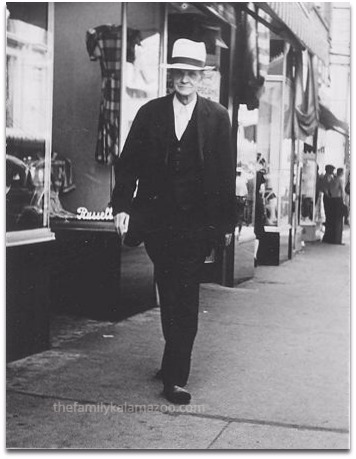
Likewise, I’m not sure which city Uncle Lou is in as he walks down the sidewalk? Does that window say “Russell” on it? In the city directories, there are many Russells, including ones owning businesses. There is one on Burdick Street, for instance, in my family’s neck o’ the woods, that is a variety store.

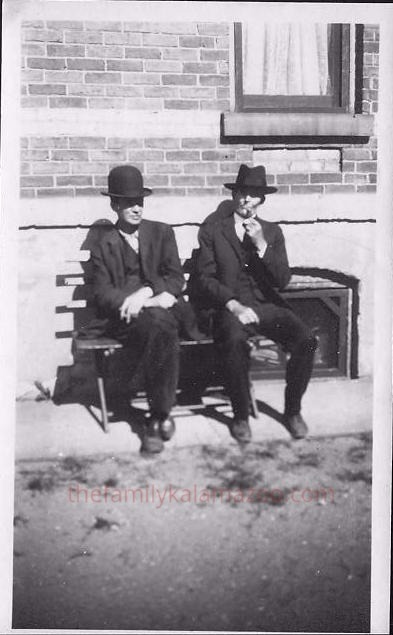
Here he is on a bench:

I wouldn’t be surprised to find this bench outside Richard DeKorn’s (his father-in-law) house on the corner of Burdick and Balch, judging by the design of the light colored stripe through the brick.

Here the photo is again–yes, it’s the same house. It’s hard to see Lou’s face up close. Below he is with his father-in-law, Richard DeKorn.

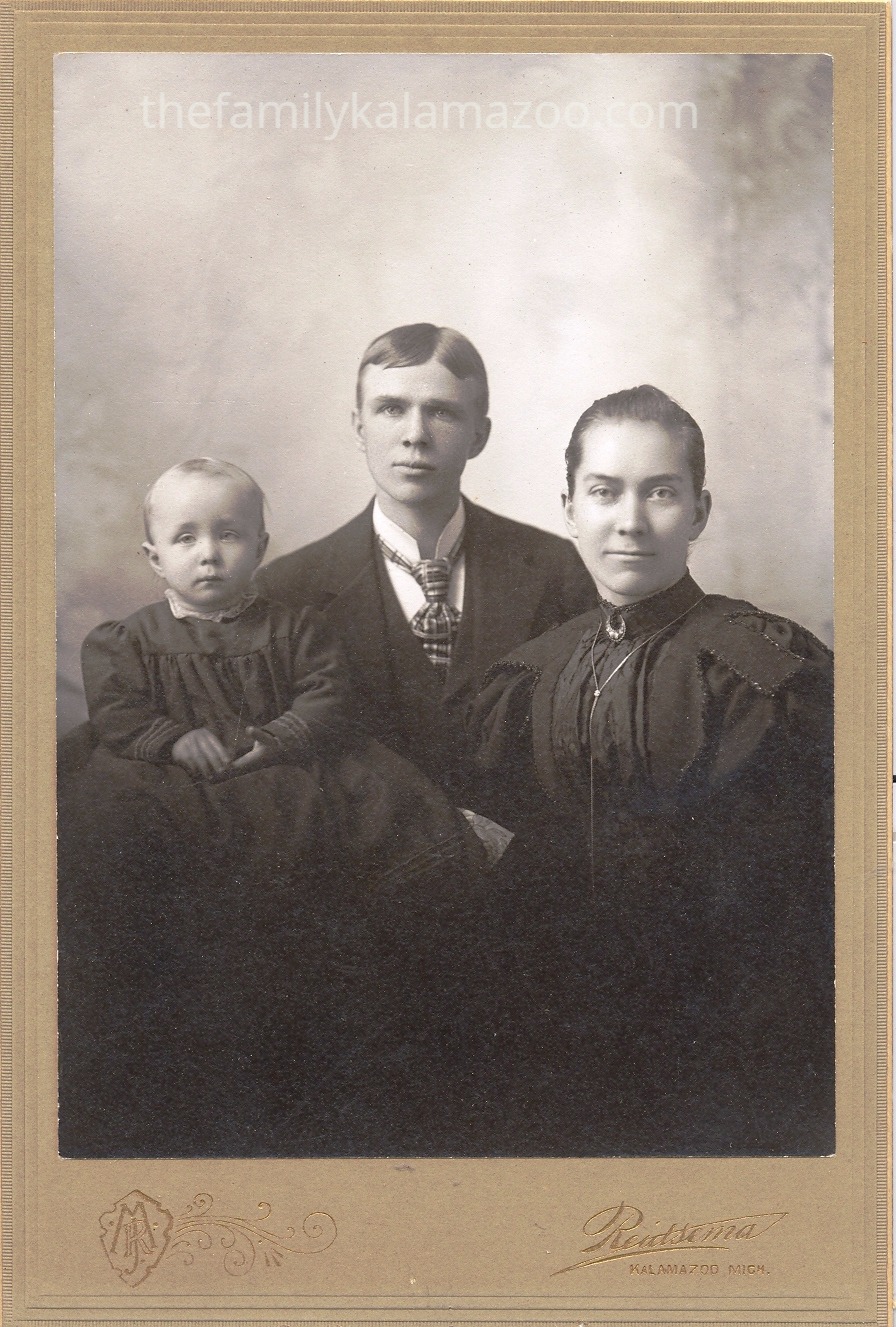
Uncle Lou with Aunt Jen and their only child, Alice:

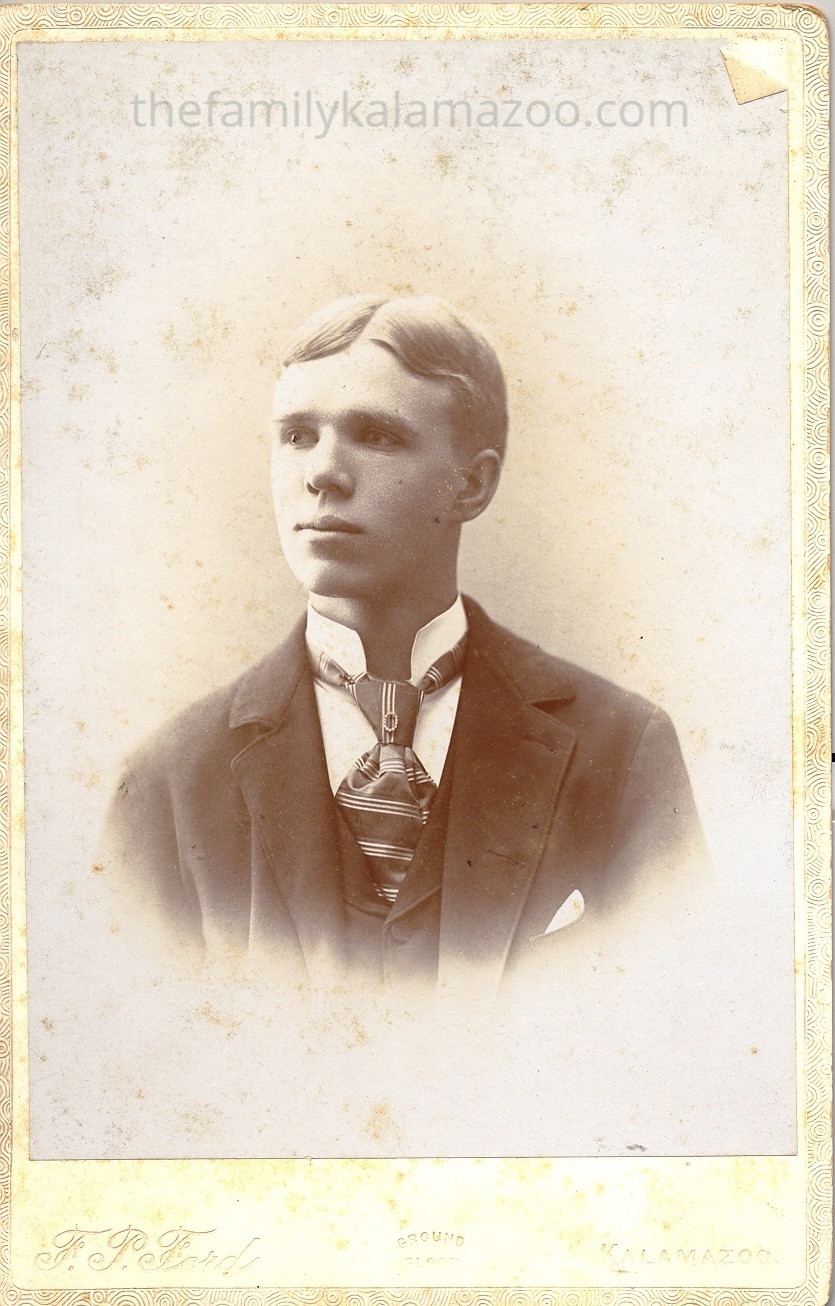
Here is a closeup of young Uncle Lou.

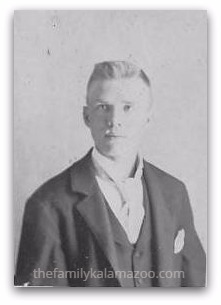
And now this is a curiosity. This photo is labelled Lou Leeuwenhoek by the same person who knew that the man walking down the street was Lou, that that was Lou standing out in front of his store, etc. But IS it Lou?

This is not his brother, for sure. While it’s not the same hairstyle as the photos above, the features seem to be the same–except for the eyes which, in the other photos, seem to be deep-set. Is the difference aging (the style of tie is the same) or lighting?  Or is the photo mislabeled?

***

You can check out the Bibles Uncle Lou brought with him from the Netherlands here.

Read Full Post »

I have updated and am reposting this information about Therese Remine’s house in Detroit (new info in italics):

Harold Remine’s sister Therese lived a double life, you might say. For most of her life, and with homes in both cities, she switched off between Kalamazoo and Detroit. Therese worked as a teacher in Detroit. I found information in a 1930 city directory that Therese worked at Campbell School / Webster Hall (uncertain of this exact meaning, but there was a Campbell School and a Webster Hall). Then I was aided by my friend José who can found at his blog Enhanced News Archive. He discovered a 1957 city directory which gave important information about the house, but also mentioned that she worked as a teacher at Von Steuben School. I find it interesting that census reports give occupations and the industry the occupation is in, but not specifics of school names or company names. 

Although we usually visited her at her home in Kalamazoo (by the time I knew Therese, she was retired), I do remember traveling to Detroit, entering her home, and some of our time spent chatting with her. This is her house:

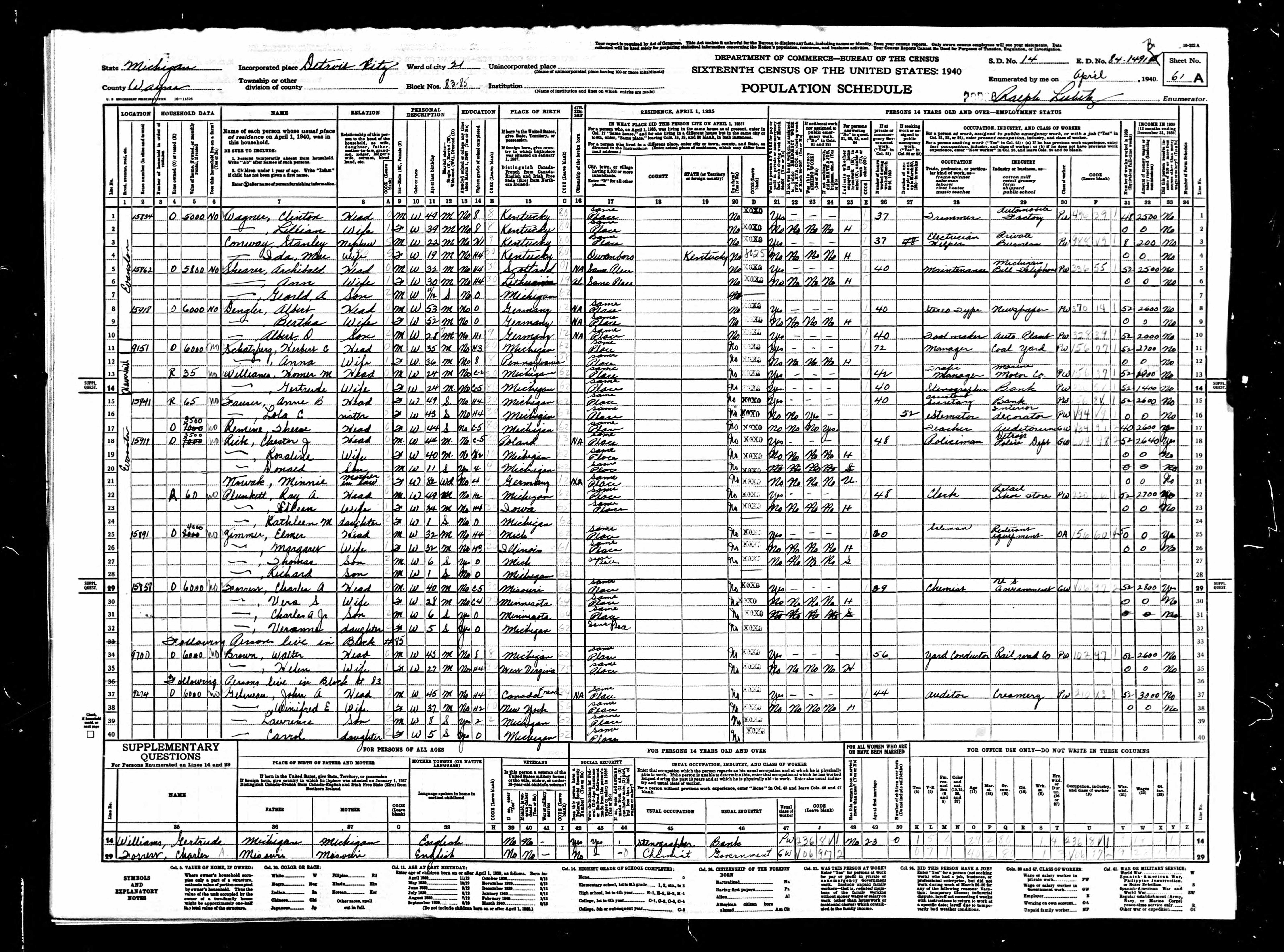
The house seems to be on Haverhill, although the cross street is not visible.  Doesn’t it look here as if the front door faces Haverhill? I checked out the 1940 census, and both Haverhill and Evanston residents are on the page with Therese. Her house number is not given, so I can’t be sure which street she was on. Any ideas on this census for Therese’s address? These questions are answered below!

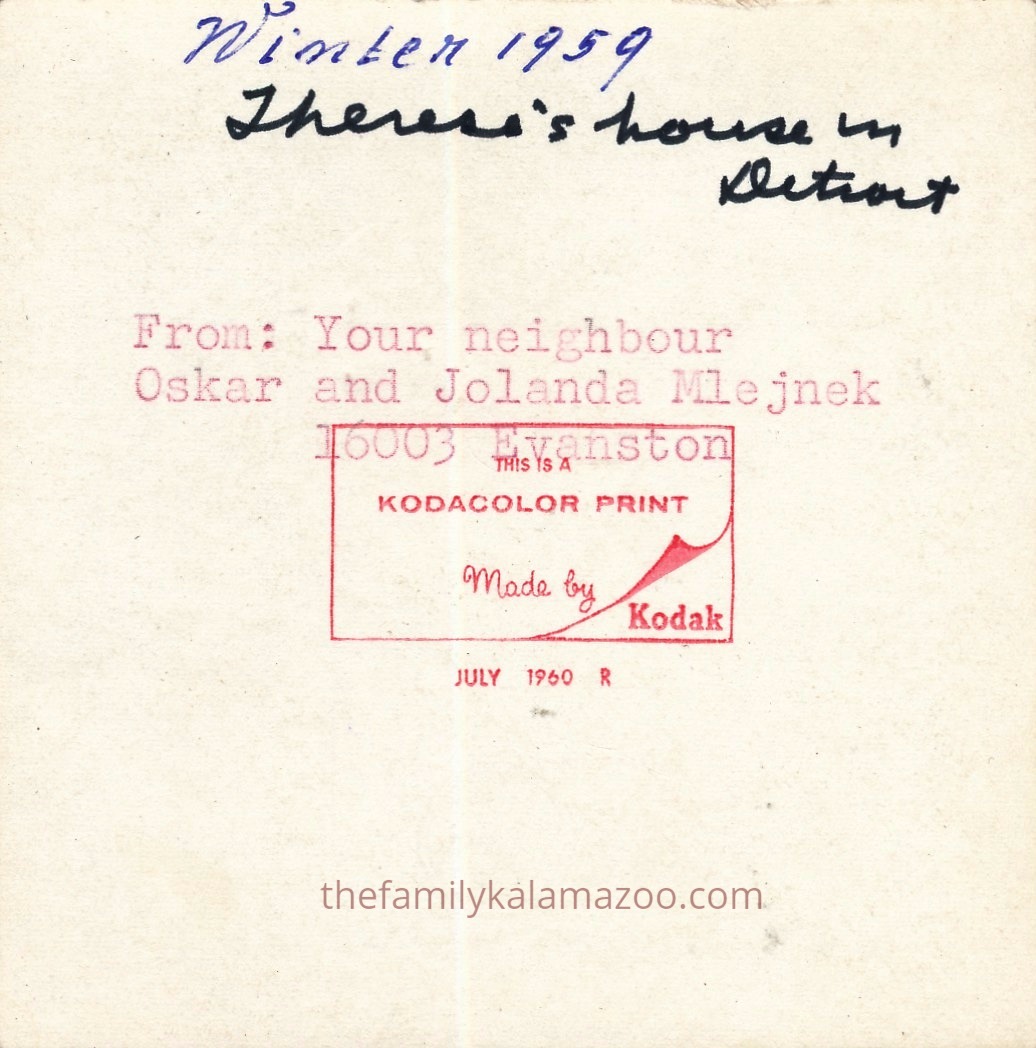
The back of the photo gives another clue to the location of Therese’s house.

The neighbor who took the photo kindly left his (and her) name and address. Oskar and Jolanda Mlejnek, 16003 Evanston. I love that the date was given, too: Winter 1959.

According to information I found about Oskar Mlejnek on Ancestry, he ended up moving to Grosse Pointe. These were beautiful houses on Evanston and Haverhill, straight out of 1930s and 40s movie “casting,” but the neighborhood changed over the years. According to what I see on Google maps many of the older houses are still there, but the vegetation is overgrown. It’s not even possible to see what 16003 Evanston looks like, although the upper level has been for sale, because the yard is so overgrown.

Where was Therese’s beautiful home?

I was able to pinpoint the location of Therese’s house, thanks to my outstanding blogger buddies: Karen MacArthur Grizzard, Amy, and José at Enhanced News Archive. Karen first noticed that on the 1940 census, the two women listed above Therese appeared to be lodgers who rented from Therese who clearly owned the house. This gave me the address for the house: 15941 Evanston. Amy confirmed that she also read it the same way Karen did. And José did more research where he found the 1957 city directory which did, in fact, verify that the house was located at that address.

From there, José located the correct address on the contemporary Google map. The house has been torn down, the yard is overgrown with vegetation, but as José point out to me, the other houses on the block are still there as he lined up the roof peaks from the old photo above with the new Google image.

Thanks to these smart and experienced researchers, I now know the address of Therese’s house and that it no longer exists, although the other houses do.

Read Full Post »

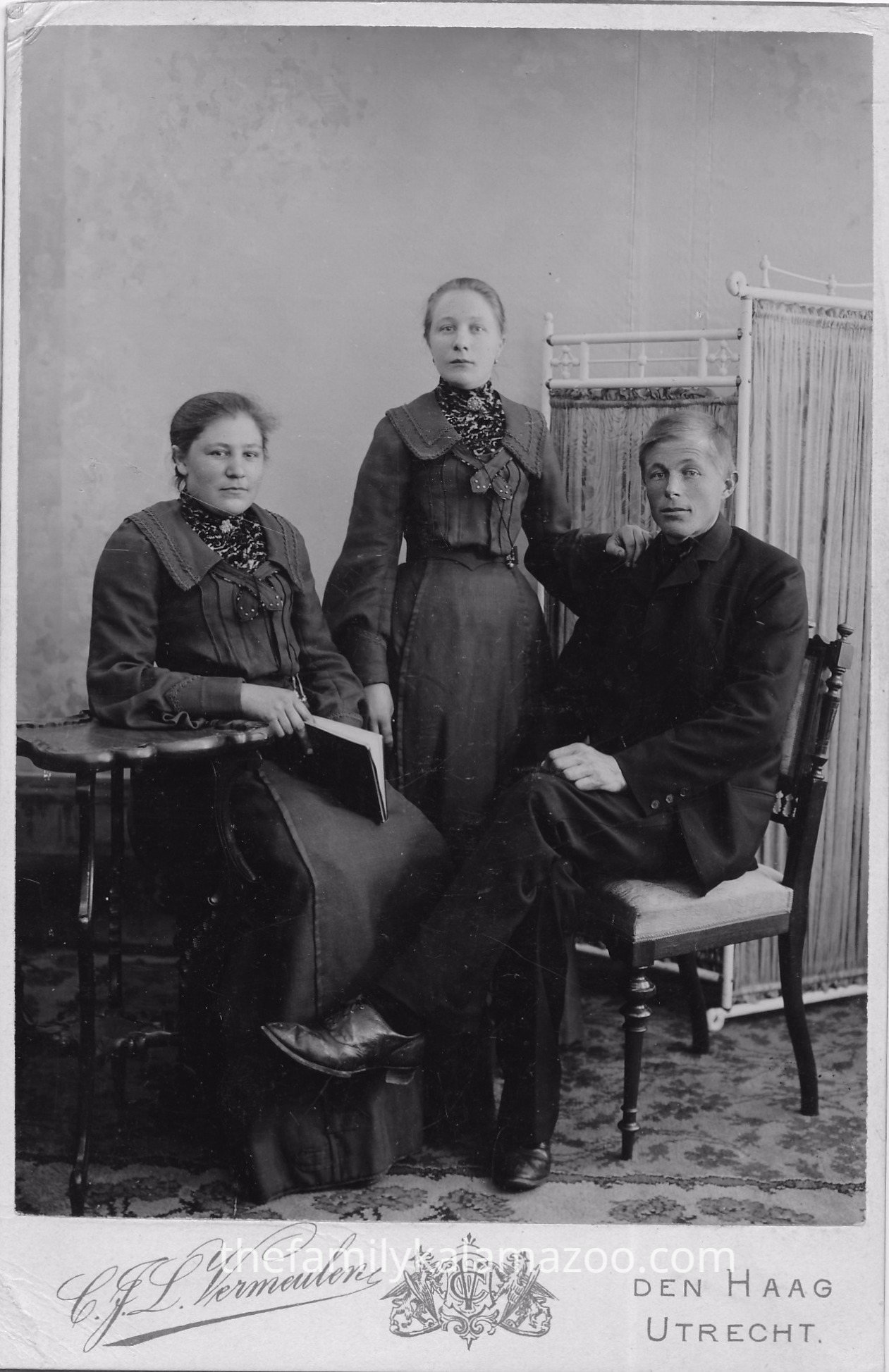
Last year I posted two unidentified photographs that I wished to identify. The photographer was based in the Dutch towns of Utrecht and Den Haag (The Hague).  Both photographs seemed to have the same props, so it was likely that they were taken around the same time at the same photography studio.

But they sure looked different. One looked as if the subject could have lived three hundred years ago. The other looked more turn-of-the-century.

Thanks to a Dutch reader, Hubert Theuns, I learned much information about the photos. In particular, he discovered that the older style outfit was the traditional costume of Cadzand, a small town in the Dutch province of Zeeland. In 2007 Cadzand had about 800 inhabitants. He told me that the photographer, Cornelis Johannes Lodewicus Vermeulen, was born in Utrecht 18.11.1861 and died in Hilversum 05.01.1936. Photographs from the period 1886-1915 can be found athttps://rkd.nl/nl/explore/portraits#query=cjl+vermeulen&start=0&filters%5Bcollectienaam%5D%5B%5D=RKD%20%28Collectie%20Iconografisch%20Bureau%29

Here are the two photos–first the more “modern” looking one and then the “traditional costume” photo.


Look at this amazing costume. It looks so Puritan to me.


Here are the backs of the photos:


Note that they both have the 3 digit telephone numbers. According to the research of Hubert Theuns:

The telephone was introduced at The Hague on July 1, 1883, and at Utrecht in February 1883. There used to be local telephone directories, but I have not (yet) found any on the internet. National telephone directories were published as from 1901. The collection of national telephone directories from 1901 till 1950 are being digitalised by the dutch national library, but unfortunately this process has found delays. Only the national directory of 1915 is available on the internet, and shows that the photographer in 1915 in Utrecht had the same three digit number as mentioned on the photograph, but that his number in The Hague already had four digits.

Hubert narrowed down the time period to pre WWI.

Now he has been able to get these photos published in a newsletter of the city of Goes, as well as its website! Check it out: IDENTIFY THESE PHOTOS.

Eventually these photos WILL be identified!  I am so grateful to Hubert. He is a reminder that genealogy is a collaboration of many people. It’s not a a selfish interest.

Thank you to everyone who has helped me with my research! I think of you all with fondness!

Read Full Post »

I’ve written before about my great-great-grandmother’s sister, Carrie Paak Waruf, and her husband Henry Waruf: Who Was Hank Waruf, Kalamazoo Gunsmith, Tennyson’s Words for Henry Waruf’s Funeral, and All the Peek Girls (note that Paak can be spelled Peek, Paake, etc.). And when they traveled to Cuba.

But I’d like you to look at some photos I have that Grandpa had me mark Aunt Carrie.

The first one is a favorite. Carrie and Henry Waruf were well-off merchants. They had no children. And Aunt Carrie did like to spend money on her outfits. Is that a fur piece or a feather boa around her neck here? And what about this hat? On what planet was this popular? I assume it was expensive. That almost looks like a Minnie Pearl price tag on it. Is that a ribbon? Overall the hat mystifies me. I’d place her at around 40 in this photo. What do you think? By the way, she was born in 1862, so that would make the year of this photo around 1902.

Photo #1

Here is another photo of Aunt Carrie.

Photo #2

These are obviously the same woman, although the 2nd photo seems to be a much younger photo. This brings up the mystery of her age that arose in the post What Can the Photographer Tell Me When He’s No longer Here. The evidence on the 2nd photo about the photographer made it seem as if this photo was also around 1900. So now I am more confused than before. But it makes me wonder if that successor craziness went on more than once. I still think she looks under 35 in the 2nd photo, maybe even much younger than that.  Look at the differences in wrinkles with the first photo.

Now, if anybody has an idea on the date of that peculiar hat, it would help assign dates to these photos!

I’m very satisfied with the identity of the woman in photos one and two because I have another photo or two of her with her husband. There is no doubt.

Here is the bigger mystery. Grandpa also told me that this next photo was Aunt Carrie. I don’t see how that is possible. What do you think?

Photo #3

Is this Aunt Carrie? Or is it one of her sisters? There were Alice, Anna, Mary, and Carrie. This is not my great-great-grandmother Alice. But could it be Mary or Anna?

Here is Mary:

Photo #4

Mary Paak Remine

Mary Paak Remine

Here is Anna:

Photo #5

Annie Paak

Annie Paak

And here is Alice:

Photo #6

Alice Paak DeKorn

Can you hear me screaming? She almost looks like a sister. She looks enough like them that Grandpa called her Carrie. But who is she?


Read Full Post »

My last post Is it Live or is it Memento Mori? relied on information about the dates of the photographer of the photograph in question (whether the lady is dead or alive in the photo).  I used information from a listing of late 19th and early 20th century Kalamazoo photographers on Bushwacking Genealogy.

I started wondering if I approached my photos from this perspective if I could add information to my identification of photos and dates.

For example, this photograph of Carrie Paak Waruf was taken by Evans. Evans is not on Bushwacking’s list, but notice how the photo says “Successor to Packard 120 E. Main St.” So I looked when Packard seems to have stopped being a photographer at that address: 1887. But wait. Mary H. Packard seems to have been in business at that address in 1899. (The lesson here is to pay attention to the photographer’s address if it’s on the photo–they moved around quite a bit and it can help identify a year). Her husband committed suicide in 1898. So who was Evans? And what year was this photo of Carrie taken?

Carrie was born 8 May 1862 in Lexmond, Netherlands. She was my great-great-grandmother’s sister. That means that if Mary Packard was out of business by 1900, Carrie would have been 38 years old. And even older if it was sometime after that point.

That is not possible. This photograph is of a young woman. This is confusing. I might have learned something, but now I have still more questions (is this The Family Kalamazoo refrain or what? more questions, more questions)

Here is another one:

This woman is Jennie Remine Meyer (Meijer, married to Klaas Meijer who became Carlos Meyer).  She’s my first cousin, 4x removed. How old do you think she looks in this photo?

She was born 12 April 1860 in Kalamazoo. Just for the record, she passed away in Kalamazoo on 20 September 1940.

This photographer also bills him or herself as a successor to C. C. Packard, the photographer who died in 1898.  You are correct if you are guessing that Kidney is also not on Bushwacking’s list of photographers.

This is where I wish I had a Kalamazoo city directory for every year right at my fingertips.

If this photo was taken in 1900 or after she would have to be 40 or older.  I think she looks pretty good for 40. No botox, no makeup, no hair dye. But she could be 40, whereas I don’t see how Carrie could be 38 or older.

Then there are the clothes to consider. My instincts tell me Jennie’s clothing and hair is from an older period than Carrie’s, but that would be impossible because she is older than Carrie in the photos, but these two women are only two years apart in age.

There is much work to be done on solving the mystery of these two “successors” to photographer Packard.

Let’s just spot check a couple and see if the information on Bushwacking seems to correspond with the information I have about my photos.

This is Gertrude, Richard, and Adrian DeSmit, the children of John DeSmit and Mary DeKorn DeSmit. Gertrude was born in 1889, Richard 1887, and Adrian in 1891. If we assume that the children are about 6, 8, and 4 in this photo, the year it was taken would be 1895. The photographer Wood was Thomas E. Wood (also went by T.E. Wood) who was in business at least from 1887 to 1895, according to Bushwacking. She says he was not in the city directory in 1899. From 1887-88 he was at 316 E. Main St. From 1889-1895, he was at 134 S. Burdick St. The address on this photo is 134 S. Burdick St. (way up the street from the neighborhood where my relatives lived).


OH WAIT, what does that say in the middle of the bottom of the photo? 1895!!!!!!!! So my calculations about their ages was correct, plus it means that my grandfather was correct when he identified exactly which DeSmit children are pictured (there were many, but these were the youngest).  This verifies my info about the photo, as well as the info provided by Bushwacking.

Here is one more. Gerrit Leeuwenhoek:

Photographer Philley is not a common one in my albums, but he is on Bushwacking’s list. Silas Philley, Jr. In 1895, he was in business at 303 E. Main, and in 1899 at 305 E. Main. This photo says 303 East Main Street.

Gerrit died in the service of our military 23 July 1898. If you want to break your heart, read this: he only immigrated to the United States on in April 1897.  I’ve written about him previously in several posts–his death, his life in an orphanage, and the court case he brought against a teacher. You can search his name in my blog’s search bar.

But look at these dates. Since this photograph had to be taken in 1897 or 1898, it means that Philley was still operating out of 303 E. Main Street through that period. This helps narrow down the Bushwacking information a bit more.

I wonder why this photograph was taken and who paid for it. Since Gerrit was a young immigrant, I wonder if his older brother Lou paid for the photo. And I also wonder if it was taken because he was leaving for Cuba for the Spanish-American War. Would the government have taken photographs of new enlistees? If this were true, there might be more photos of young soon-to-be soldiers taken by Philley at this time period.

Read Full Post »

More tintypes! In Mysterious Antique Photographs I shared a beautiful tintype that I own.

Yesterday I opened the box of unscanned Remine photos. I haven’t had time to scan so many photos–or to organize either–but I thought I should just start doing a few a day because when WILL I ever have the time?

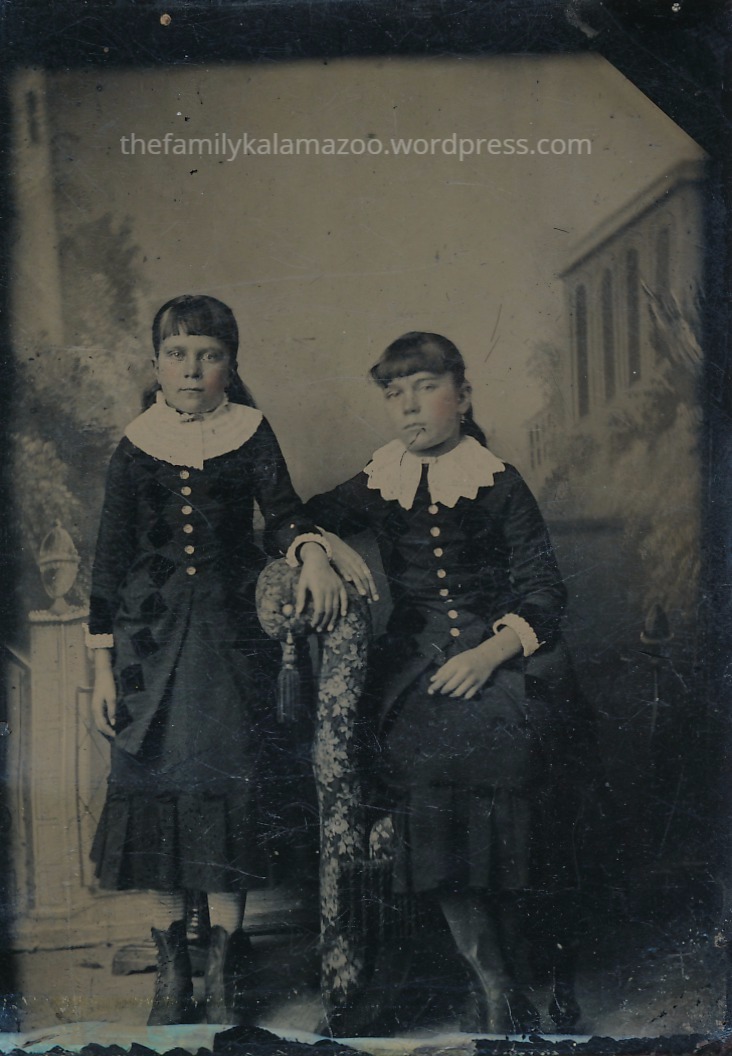
And I discovered these beautiful tiny tintypes. The one on the other post is large and painted. These are only 2.25 x 3.5 inches in size–and unpainted.

Because they are in the Remine box I can guess they might be Remines. Judging by the faces, I am ready to conclude they probably are Remines.

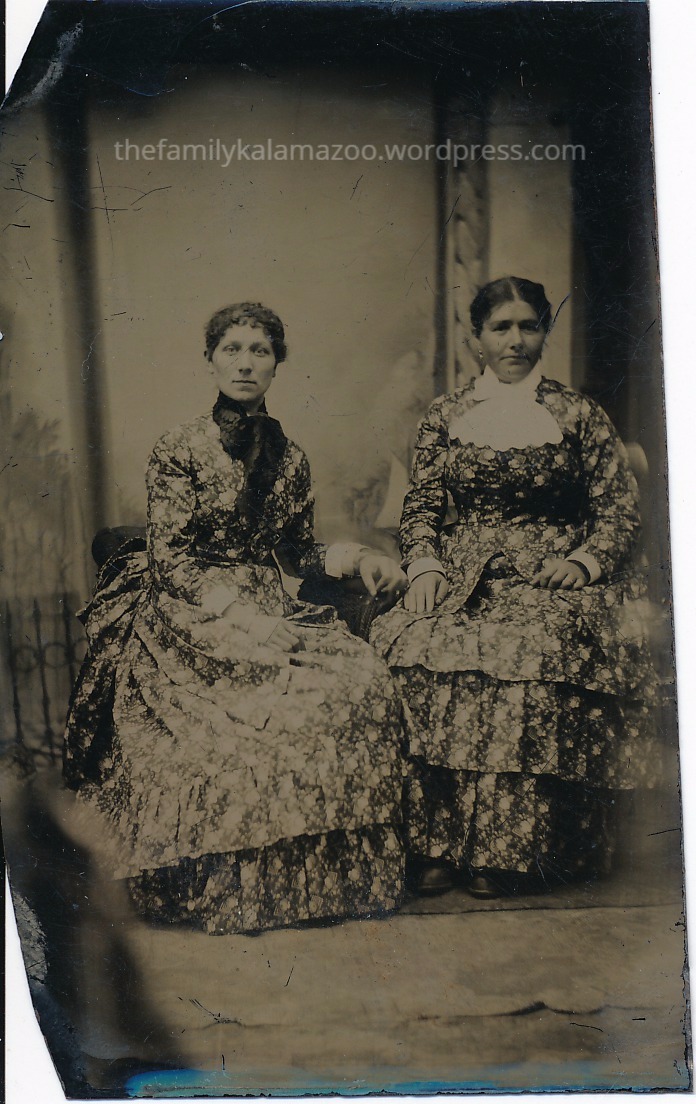
Because these girls and women were photographed full length (standing and seated), we can examine their entire outfits to try to guess a time period.

Therese was born in 1891. Could this photo be from around 1900?

I am having trouble identifying the correct information about Therese’s sisters. When I figure it out, this might help in identifying this tintype. For instance, if there were sisters born in 1880 and 1881 as might have been, this photo could, I suppose, be those sisters. If so, one of them is Genevieve Remine Tazelaar and the tintypes would be in the early 1890s.

I suppose the hair and collars could be 1900. But what about the fitted jackets with all the buttons? I can’t find anything like that in photos of 1900. Odd, too, that it would be a tintype if it was as late as 1900.

Here is the other tintype. I’m sorry it’s kind of crooked and uneven. It was difficult to scan it.

What about these outfits? They are not leg o’mutton sleeves, so does that rule out the 1890s?

I guess I am not very good at taking the nuances of change in fashion and extrapolating to what my relatives would have worn (generally a much more conservative version of the fashion).

The woman on our left looks a lot like Mary Paak Remine, Therese’s mother. She was born in 1859. But the woman doesn’t look terribly young in this photo. And then who would the other woman be? She looks NOTHING like the Paak sisters. She is not Mary’s mother because Jacoba Bassa had passed away long before this.

Were these photos taken in the Netherlands or the United States? The Remines were from Kapelle and the Paaks were from Lexmond. Notice the wallpaper/painted background. I’m pretty sure that these photos were taken in the same studio, perhaps near the same time period.

I’m afraid I have more questions now than I did before.


Read Full Post »

In my stack of anonymous family photos, I have two that are different from the others.

In the first one, the image is imprinted on metal and then painted with colored paint.


In the other, a couple appear to be drawn, rather than photographed.


It’s likely that the photographs came from Grandpa’s family: Paak, DeKorn, Zuidweg, Remine, Bomhoff, or his other branches. Or they could be friends or neighbors.

UPDATE: My daughter thinks the tintype woman looks like Grandma in the eyes and mouth. “Grandma” would be my mother, Grandpa’s daughter.

Any thoughts on type of photographs or on dating of these images?

Read Full Post »

When Joost “George” Paak*  lost his wife in 1900 and then his mortgaged home in 1902, he must have been distraught and wondered how he would take care of five children. He was a laborer who was not even working at the time of the fire.

I know that he lost a mortgaged home because of the newspaper article (see post links below for the rest of the story) and because the 1900 census shows that he owned a mortgaged home. At that time, he worked as a farm laborer, but had been unemployed 3 months the previous year. I am guessing that this was a hard physical job and if he was sick he wouldn’t be able to work. I also think he had been unemployed for 3 months the previous year because of the winter. So he didn’t have a very stable job. He had immigrated to the United States at age 18 with his family. He was the oldest–he had 4 younger sisters. There was also a young brother who either died in the Netherlands or came here and would probably be known as William. Still checking into this.

In 1908, six years after the fire, George married Addie Amelia Gifford Wilder. This shows up on the 1910 census. At this time, George was listed as Joseph G. Peake (Joost could easily be Joseph or George, I guess), and he now had a stable job as a paper maker at the paper mill. He again owned a mortgaged home and guess where? At 1016 Trimble Avenue, the scene of the fire. So the house was rebuilt. And you know what? It still stands.
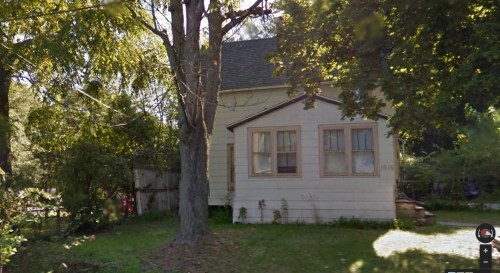
The 1920 census shows George still married to Addie. He owned his home free and clear. He was still a laborer for the paper company, earning wages, not salary. And he was 69 years old. Notice no retirement for George at that time!

Paper mills were big business in Kalamazoo, by the way. The city was known as The Paper City. There is a great article published online by the Kalamazoo Public Library. Click the photo of the paper vats to go to the article.
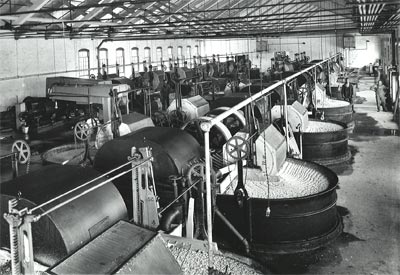
PaperVats_400

All three censuses show George immigrating to the United States in 1868, although in one of them it looks like 1860. He was naturalized as a citizen in 1891.

What the census does not show is that George married Esther M. Fields in 1906, gaining a 4-year-old stepdaughter, Florence Wilder! But a year and a half after the wedding, Esther died! (Professor Lawrence heard that George might have been married as many as five times, but I do not have the documentation yet on the other two marriages–or the timeline).

In the 1910 census, George’s household includes Addie, Fannie, and George. These are the two youngest Paak children. And the household also includes Esther’s 7-year-old daughter Florence A. Wilder! So George kept her in the household, which must mean she had no other family to take her in. But his own children, Theresa (Tracy) who was 17, Jane who was 20, and Cora who was 22 were not living at home. Theresa, as we know, was living with the Pickards as their perhaps unofficial foster daughter and being sent to boarding school.

Why did Theresa not live at home with her father and stepmother while a stepdaughter of George continued to live there? Maybe after the upheaval in the household after her mother’s death, the fire, and then the death of her first stepmother it was determined it would be better for her to stay with the Pickards permanently?

Professor Lawrence did tell me that he had heard that the children were farmed out to people, especially relatives, after their mother died. But at the time of the fire two years later it seemed that they were living at home with their father. I do wonder if my own great-great-grandmother helped out when her sister-in-law died or after the fire. The clipping about the fire was saved in the family documents, so she (she died 6 years after the fire) or her daughter must have kept it.

Why did Jane who never did marry and lived to be 107 years old (there might be a connection there haha) not live at home? Maybe she had a job and was providing for herself already. Jane lived in a nursing home near the end. In the photo there is a sign for her 100th birthday. I do have a photo of her at her 107th with cake, but she is in bed and obviously not well, so I don’t want to share that one.

Where was Cora? Was she married yet? Her first child might have been born in 1915, although I have not done much research on Theresa’s siblings as of yet. If she wasn’t yet married, I wonder if she and Jane were living together. That would be something to search.

This photo was probably taken in 1925 when George was 76 years old and a happy grandfather. The woman is Cora, his oldest daughter with her son John Rankin. John was not her first child, but the first by her second husband, John Rankin, Sr.
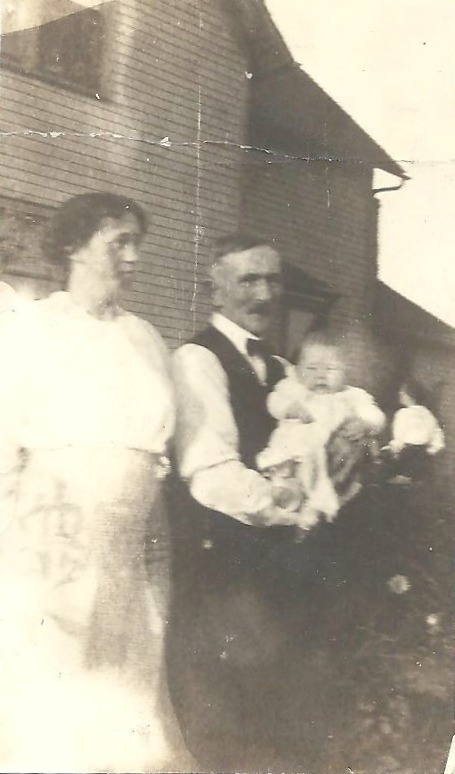
 

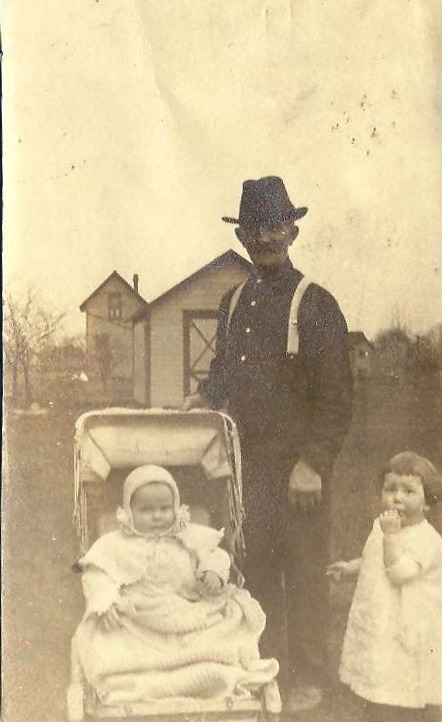
Here is another photo of George with two children. As always, I appreciate any comments about date identification or other important information.
* I’ve changed his surname spelling to the one that my great-great-grandmother used because I see that he did also use that spelling in addition to other spellings.

Here are the other Pake/Paake /Paak //Peek posts:

A Series of Disasters

The Children After the Fire, 1902

Paak-a-boo

Saved from the Fire

Who is George Paak, Sr.?

Curious about George

George Paak’s Legacy, Part I

George Paak’s Legacy, Part II: Theresa’s Pre-Professional Education

George Paak’s Legacy, Part III: Theresa’s Professional Education

George Paak’s Legacy, Part IV: A Letter to His Daughter

George Paak’s Legacy, Part V: Theresa Gets Married

George Paak’s Legacy, Part VI: Who Were the Pickards


Read Full Post »

« Newer Posts - Older Posts »