Feeds:
Posts
Comments

Archive for the ‘Michigan history’ Category

Last year I wrote here about my great-great-grandfather Richard DeKorn’s second family. After the death of my great-great-grandmother Alice Paak DeKorn in 1908, he married Jantje (Jennie) Jansen Sootsman in 1910. It was a second marriage for them both.

Jennie had two daughters, Marion and Marjorie (Marge), by Oscar Sootsman who had passed away in 1907. Richard became their stepfather.

Marge and Marion Sootsman

Marge and Marion Sootsman

The younger daughter, Marge, married George Bernard Owens on December 9, 1916, in Kalamazoo.

This slideshow requires JavaScript.

When I wrote the post, I wasn’t sure, but believed she had one son.

I now know that son was David Owens.

Eventually I was contacted by the ex-wife of David after she read the blog post.

Rochelle Owens wrote me that she had been married to David for about three years. The marriage was the 2nd of David’s three marriages. She said that he was born March 1, 1929 or 1930.

Apparently Marge divorced George at some point. Rochelle believes it was before or soon after David’s birth.

In 1948, at the time that her mother passed away, Marge and David both lived in Ann Arbor, Michigan. David attended the University of Michigan.

What I particularly love hearing from Rochelle is that Marge was a gifted woman, an occupational therapist.

Rochelle Owens is a poet and experimental playwright who has taught at Brown University, the University of California, San Diego, the University of Oklahoma, and the University of Southwestern Louisiana (now the University of Louisiana at Lafayette).

On her website, rochelleowens.org, Rochelle has posted some “recollections” in a section titled Autobiograpy. Here is a passage where she describes David Owens, as well as her reminiscences about some famous writers, including her friendship with poet Amiri Baraka. She creates the atmosphere of the disenfranchised artists of the time period–and David Owens considered himself an artist.

          I did not personally know of any young women who wrote poetry then. When I stepped out of the subway and headed towards Christopher Street, I imagined myself as a poet. I felt adventurous and idealistic. A few years ago it occurred to me that during that period of my life I hadn’t been aware of the value of money. I think it’s a little strange. I was after all simply a poor working girl who was not even a graduate of Brooklyn college or C.C.N.Y. I did not have the luxury of having prosperous parents give me an allowance while I played out the role of being a poet searching for “authentic experience” while receiving an education at an expensive institution of higher learning. I did clerical work for a living and was innocently blind to the added disadvantages of being poor and female. Naively, I committed myself to art as ideology. It was in Pandora’s Box that my glance first rested on the animated face of David Owens. He had noticed me while he was engaged in conversation with a young painter by the name of AI Held, who has since become very successful. David was good-looking in a romantic English way. His personality was mercurial and seductive. He feigned an English accent and loved punctuating his obsessive speech with a French expression, raison d’etre, while railing against “bourgeois values.” He considered himself an artist while working as a salesman and doing carpentry. At the Peacock Café, The Lime-light, and the Cedar Bar, we met our friends and acquaintances who were painters, sculptors, photographers, poets and musicians. I came to know some of the leading personalities whose creative contributions have shaped avant-garde theatre, literature, and art in America during the last twenty-five years: Alexander Calder, Jack Gelber, Judith Malina, Julian Beck, Lee Strasberg, Ronald Bladen, Rod Steiger, Leo Castelli, and Tambimuttu.


David’s charisma and style impressed all. He resembled Richard Burton and was society’s ideal version of an angry young man, whose baritone voice skittered through the air and banged against the walls like giant hornets. He reveled in certain names and periods of history like, “Malraux’s Man’s Fate, the Renaissance, the French Impressionists, Franz Kline, abstract expressionism.” Etc.


I was perceived as an attractive and a bit zany girl who sometimes laughed hysterically. My background and upbringing had left me anxious and nervous. At times I imagined myself to be in disguise. On other occasions I felt like an irrepressible poet-philosopher. One evening after reading some of my poems, Peter Ritner, a former editor at Macmillan, bombastically stated that a mere girl should not have it in her to write such rich and cerebral work. He screamed that I must be a freak. “What experience could you ever have had! You’re just a goldfish swimming around in a bowl.” He died a suicide years ago. He invited David and me to dinner a few times, and I recall that he always prepared delicious mashed potatoes with lots of butter and garlic.


In the winter of 1955 David and I discovered old New York together. We visited the financial district; the buildings were strange and wonderful. We were the observers of an environment. Although we had no hope in its very structure, we saw our appreciation of the line, form, and color of the area as an act of faith in our ability to draw beautiful observations in a disintegrating time and an unbearable society. It was America during the Eisenhower years. The Man in the Gray Flannel Suit hung suspended over the rapidly growing artistic and political consciousness of the young like a bloated advertising zeppelin ready to explode.
It was the beginning of radical artistic experimentation. The poets, playwrights, film-makers, painters, sculptors, and performing artists were inventing, finding, producing, gathering, analyzing, and selecting the groundwork for those who came later, including the pop culture heroes of the billion dollar rock music business. The place to be was in New York or San Francisco. Later I would meet playwrights Adrienne Kennedy, Megan Terry, Roslyn Drexler, Sam Shepard, Ken Bernard, and Leonard Melfi.
In March, two days before my twentieth birthday, I was married to David. We moved into a small apartment on the upper west side. I was working for the Poetry Society of America and became a member after submitting some poems to the committee of jurors.

I wanted to add this paragraph although it’s not about David as it is about the famous poet Amiri Baraka:

One of my earliest friends had been the young poet and playwright LeRoi Jones who later changed his name to Amiri Baraka. Jones published a poetry magazine called Yugen; I remember how happy I was to be included among the contributors: Charles Olson, Tristan Tzara, Daisy Aldan, Jack Kerouac, Frank O’Hara, and Paul Blackburn, who later became a good friend. In 1962 Jones published a group of my poems in an anthology titled Four Young Lady Poets. It was not surprising that when I edited an anthology of plays ten years later called Spontaneous Combustion, a play of LeRoi’s was included.

Finally, she writes this about the period of her life when she and David separated:

In 1959 David and I separated and the marriage was annulled. I had finally recognized that he was too unstable and self-absorbed to alleviate my own dissatisfaction. For further insights into my relationship with David I would suggest reading the introduction to my collection of plays, The Karl Marx Play and Others. I decided to retain the name Owens because I had already been published under it. I wrote about David in my play Chucky’s Hunch. It was produced by George Bartinieff and Crystal Field at the Theatre for the New City in 1981 and by Jack Garfein at the Harold Clurman Theatre in 1982. The play won a Village Voice Obie and The Villager Award. The critical response was excellent, the New York Times describing it as “Hilarious! Wonderful!” The Village Voice said, “A triumph of verbal fireworks! Not to be missed.” Clive Barnes of the New York Post stated, “Rochelle Owens’ comic flame has never burnt so bright, but like the eye of the tiger, it is savage.” The play is published in an anthology, Wordplays 2, and is included in the Samuel French catalogue. Years ago, George Bartinieff and Crystal Field had appeared in the premiere production of my plays Beclch and Istanboul. I knew them both in the early period of off-off-Broadway.

David sounds like a character–I hope to find these passages about David in Rochelle’s books. I’m thrilled that Rochelle discovered my blog and made her connection with my family.

Read Full Post »

In a previous post called What Went On at Ramona Palace, the photograph that was marked Ramona that actually was the Summer Home Place sparked the question if the Ramona pavilion had windows on the lake side. By the sixties, when I saw it, the lake windows either didn’t exist or had been blocked off behind the bandstand.

The other day my father found a postcard of the Ramona pavilion–a view from the lake. Clearly, the structure was built with windows facing the lake.


On the left side of this photograph are the windows at the end of the building that face the lake. The bandstand was just inside those windows. And see the steps leading down to the lake? They would lead you right into the . . . bottomless drop-off! That was such a scary part of the lake by the sixties! I imagined all kinds of underwater beasts living in that mysterious section of the lake.

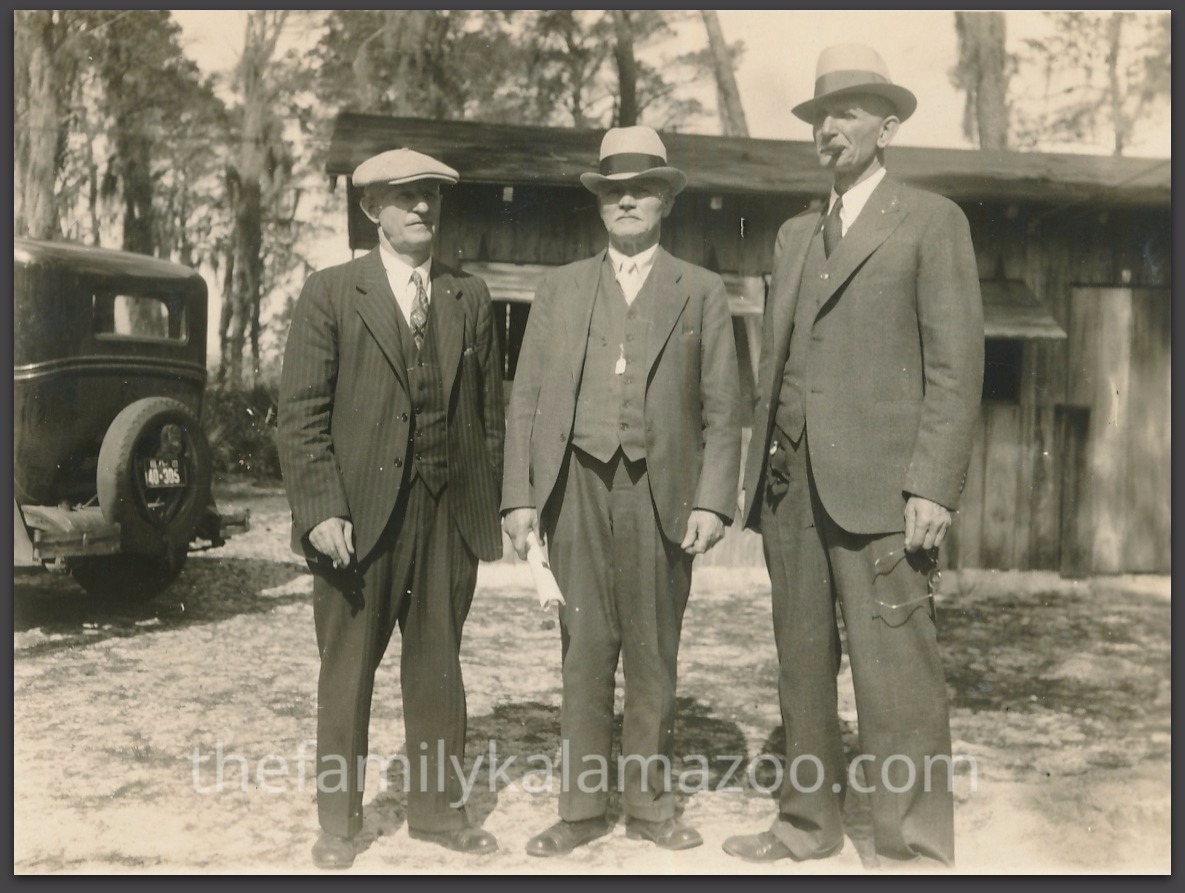
The property was originally owned by Henry and Carrie (Paak) Waruf. Carrie was my great-great-grandmother’s sister.  What do you think is the material of his hat in this photo?

This is a photograph marked “Hank Waruf (cigar in mouth). He’s definitely much older in this photo than the one above.

More posts about Ramona:

The Park with a Literary Name
A Re-telling of Ramona: The Park with a Literary Name
What Went On at Ramona Palace


Read Full Post »

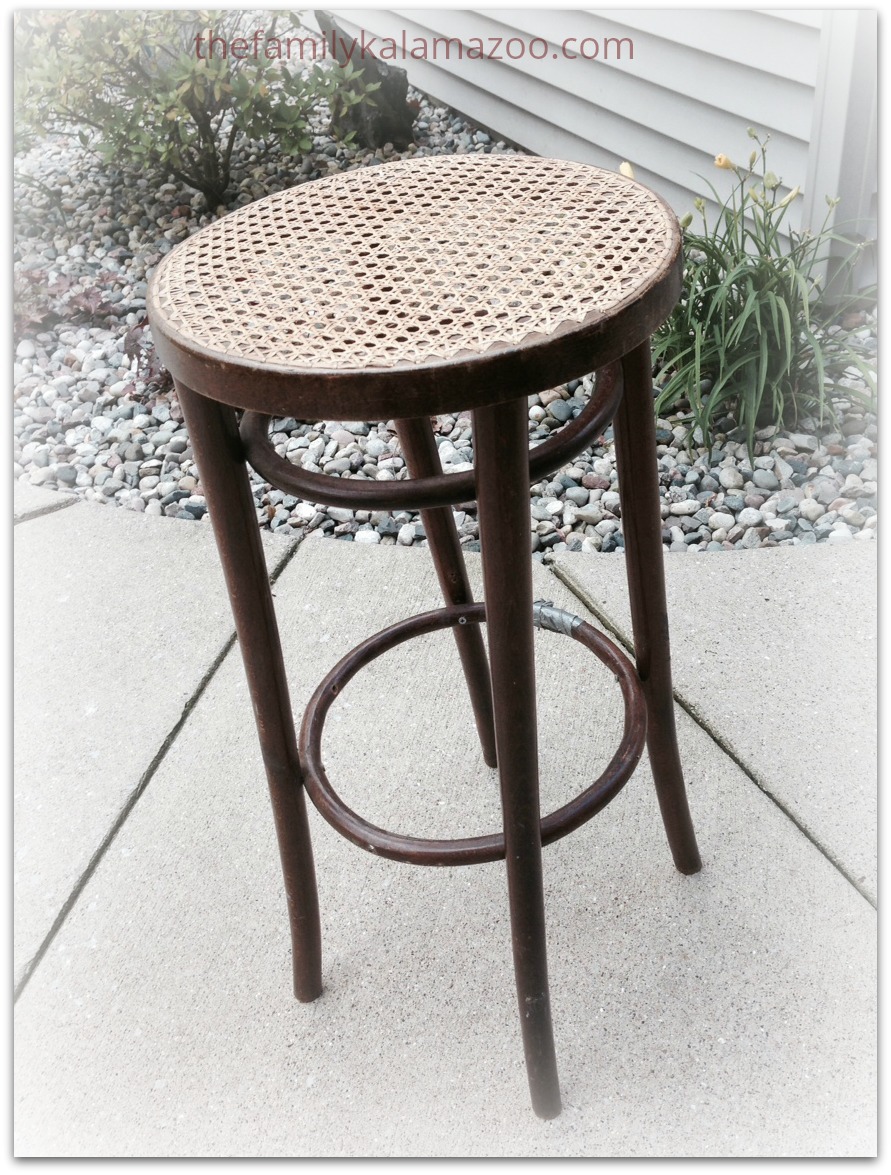
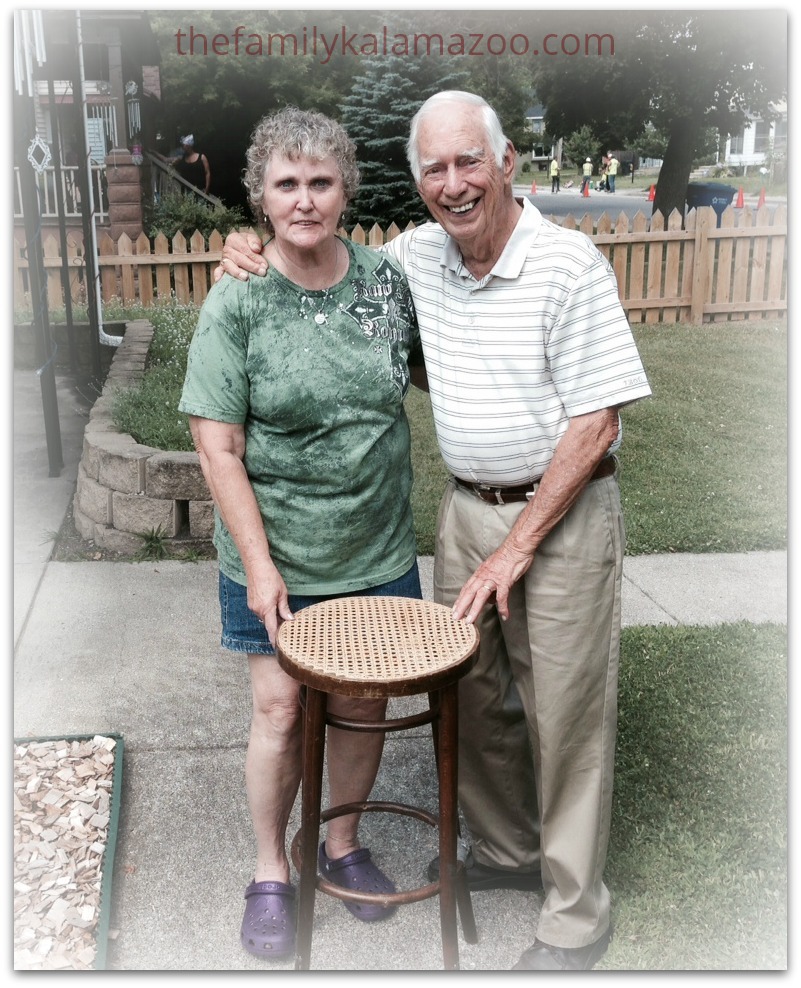
When my father ran Ramona Park, he used to sit on a ticket taker stool to admit dance patrons. He still had the stool until recently.


The other day, he gave it to Paula Taylor, who is writing a history of Ramona and Long Lake.


Update on why the Ramona/Long Lake photos say Vicksburg:

Maggie Snyder for Vicksburg Historical Society says this:

Vicksburg never included Ramona Park, which was at Long Lake. However, at that time Portage as a town was much smaller than Vicksburg, so it would have been the closest “big” town. Also, the Grand Rapids & Indiana Railroad had a flag stop at Ramona Park, and their closest depot was in Vicksburg.

On another note: here are a couple of online articles about Long Lake:

Long Lake: from sinking houses to sea serpents

Portage Couple Has Spent a Lifetime on Long Lake


More posts about Ramona:

The Park with a Literary Name
A Re-telling of Ramona: The Park with a Literary Name


Read Full Post »

When I was a kid my father used to bring me (and sometimes my friend, Jill, a reader of this blog) to Ramona Park. We explored and played while he worked–maintaining and refurbishing the pavilion, the grounds, and the shore of Long Lake that ran along the property.

I’ve written before about this park, located in Portage, Michigan here:

The Park with a Literary Name
A Re-telling of Ramona: The Park with a Literary Name

I remember trying to imagine what the pavilion, which was called Ramona Palace, was like back in its heyday, when people came to listen to live music and dance in the ballroom.

Notice that this old photograph locates the park in Vicksburg, but it is now Portage, Michigan. This is the ballroom as I remember it–big and empty.  The lake was just outside those windows.

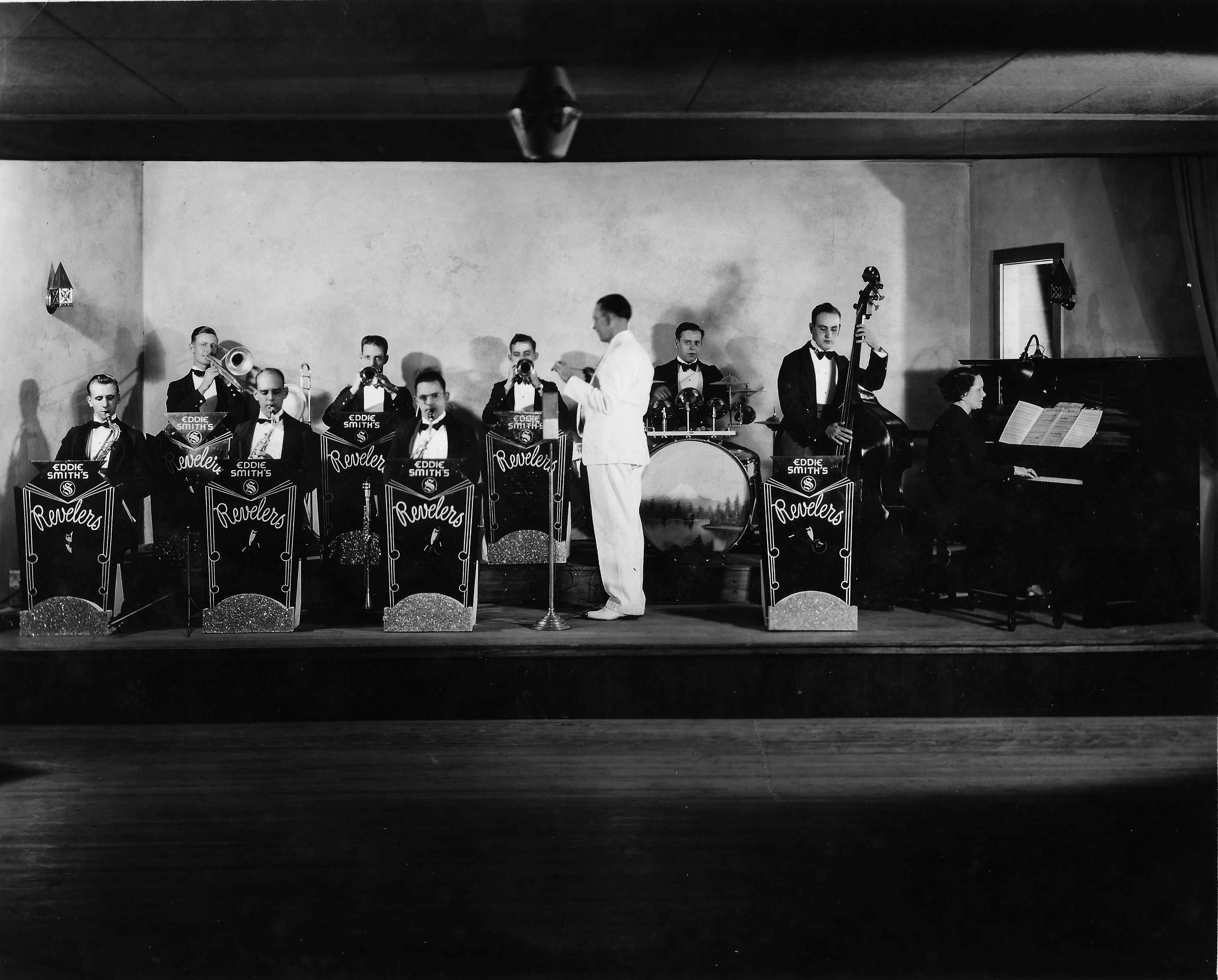
A while back I was contacted by Shawna (Smith) Raymond about those days. Her grandfather, Eddie Smith, and his Big Band used to play at Ramona Palace.

Eddie Smith and the Revelers courtesy of Shawna (Smith) Raymond

Eddie Smith and the Revelers
courtesy of Shawna (Smith) Raymond

Shawna passed on a story from her aunt about those days.

When Mom, whose name was Margene, would walk into the Ramona Palace ballroom where Dad was playing, he’d always stop whatever song they were playing and play ‘My Little Margie.’

Shawna’s aunt has a framed collage of the sheet music to “My Little Margie” and Shawna’s grandfather’s conducting baton. According to Wikipedia:

Margie“, also known as “My Little Margie“, is a 1920 popular song composed in collaboration by vaudeville performer and pianist Con Conrad and ragtime pianist J. Russel Robinson, a member of the Original Dixieland Jazz Band. Lyrics were written by Benny Davis, a vaudeville performer and songwriter. The song was introduced by the Original Dixieland Jazz Band in 1920 as Victor 78, 18717-A, in a medley paired with “Singin’ the Blues”. The B side was “Palesteena”.The Rega Dance Orchestra recorded the song in October, 1920 for Okeh Records, 4211. The ODJB recorded their instrumental version on December 1, 1920. The song was published in 1920 and was named after the five-year-old daughter of singer and songwriter Eddie Cantor. Cantor is credited with popularizing the song with his 1921 recording that stayed at the top of the pop charts for five weeks.

Here is a Benny Goodman version from 1938:


Read Full Post »

I shared a couple of photographs of my artist mother-in-law the other day. They were from the 60s and early 70s and had turned yellow. I was very frustrated with the damage to the photos.


Paula Taylor saved the day by converting them to black and white photos. Here you can see the changes:

This slideshow requires JavaScript.

And here:


This slideshow requires JavaScript.

I’m really happy with them. Thanks, Paula!Enhanced by Zemanta

Read Full Post »

Although I’m in such a busy period that I can’t work on genealogy, I do have my daughter’s help right now to scan some old photos, so I will post some of them while I am too busy for research.

On the back of this photo it says Frank Tazelaar (near Whistle Stop).

Frank Tazelaar near Whistle Stop Kalamazoo

Frank Tazelaar
near Whistle Stop
Kalamazoo

So I looked up Frank Tazelaar on my family tree. Sure enough, he’s on there. He was born January 17, 1876 in the Netherlands, to Pieter Tazelaar and Adriana Bek. The family immigrated to the United States when he was 12, in 1888. On July 9, 1906, he married Genevieve Remine in Chicago. Genevieve was my first cousin 3x removed. Frank died in 1950.

So what is “Whistle Stop”? It’s the train station. But when I tried to figure out if it was the same Whistle Stop where my friends and I used to go to eat and drink (and a building that my father owned) or if it was the other train depot (where we owned a concession stand with my father), I discovered that there were actually seven train stations in Kalamazoo. Here is a fascinating article that says that Kalamazoo may have had more train depots than any other city. I am going to tentatively assume that this photo was taken near what I knew as the Whistle Stop.

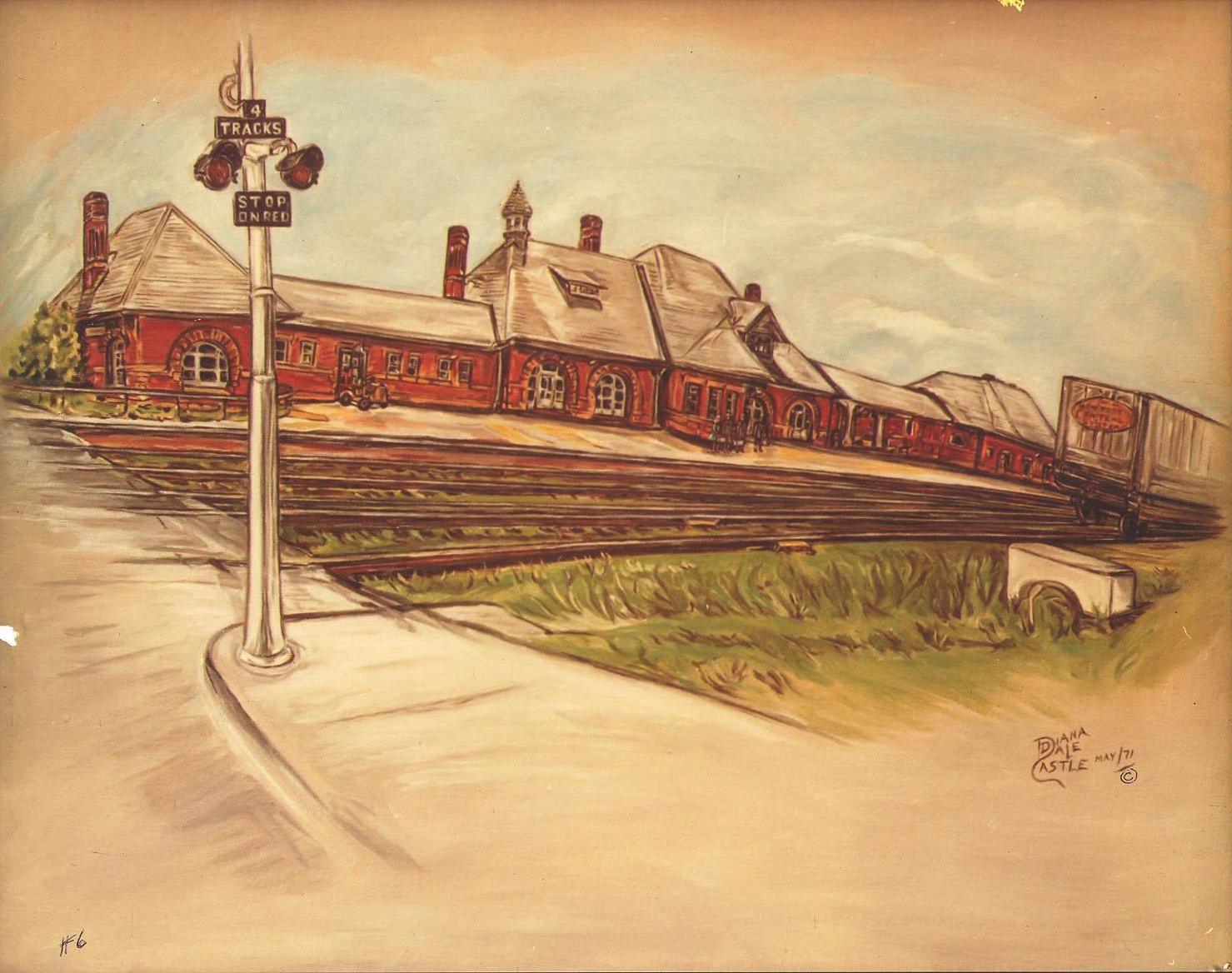
Here is a painting my mother-in-law did of the Whistle Stop. I apologize for the flaws in my copies on the computer for the next two photos.

The Whistle Stop  Kalamazoo

The Whistle Stop
Kalamazoo

And here is one she painted of the other train depot:

Train depot Kalamazoo

Train depot
Kalamazoo

OK, dad correct me if I made any mistakes!

What does the date on the photo of Frank Tazelaar say? Is it 1904 or 1914?

Be sure to note the type of rig he was driving, the dog, and his clothing compared with the men up on the roof. What is that pole thing coming down from up there? What do you think Gaslight means? The mark (pencil or crayon?) going through the photo wasn’t noticeable until my daughter scanned it. And thanks to Amberly at The Genealogy Girl she is scanning into .tif files.

Enhanced by Zemanta

Read Full Post »

In the past few months I’ve been so busy with work that I haven’t had time to work at genealogy the way I wish. I have a lot of wonderful material on the Paak family, which has been given to me by Professor Edgar Lawrence. I also have some interesting material to share from Elmhurst research about the Klein and Van Gessel families.

But am I sharing any of it in this post? No. I want to do a good job of pulling it together, and I can’t do that now, as overworked busy as I am. Instead, I thought I would share a photo from the Kalamazoo of my youth.  On the right side, you can see my mother-in-law, the artist Diana Dale Castle. I wrote about her in my post The Todd House.

She’s at Bronson Park, which is the town square of Kalamazoo. When I was growing up, the park was surrounded by the “First Churches” of Kalamazoo (First United Methodist, etc.) and City Hall. Its enormous oak trees had sheltered Abraham Lincoln when he gave a speech in Kalamazoo.  The park had the best Christmas decorations every year, and everything from political rallies to art fairs were held there.

My mother-in-law used to show her art at the art fairs.

Here is my MIL painting in her New York City apartment in the 1950s. Look at how horribly yellow the photograph has turned! Do you know if this can be fixed–and how to fix it?

###
Enhanced by Zemanta

Read Full Post »

Cora Wilhelmina DeKorn Zuidweg and her son Adrian Zuidweg Kalamazoo, Michigan circa 1910

Cora Wilhelmina DeKorn Zuidweg and her son Adrian Zuidweg
Kalamazoo, Michigan
circa 1910

Read Full Post »

My grandmother, Lucille Edna Mulder (Zuidweg), was born April 17, 1912. If she hadn’t passed away in 2000, she would be 102 today. I miss her every day.

Grandma holding me

Grandma holding me 1955

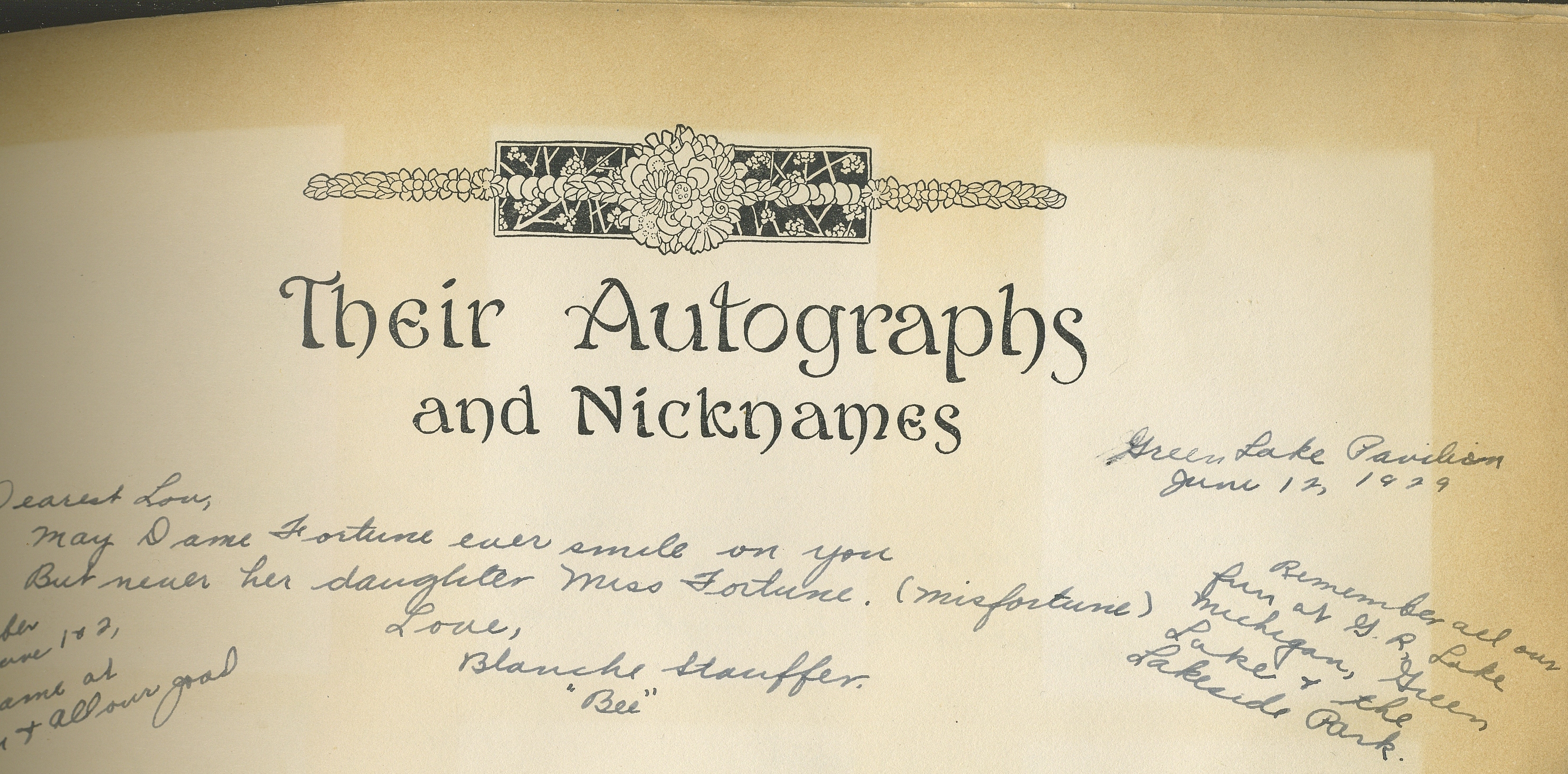
Last year I posted about Grandma’s high school graduation scrapbook. Here is the link. There are a lot of photos in that book; in most of them Grandma is hanging out with her friends and classmates.

Below, Grandma is in all but the lower right photo. One of the girls is her best friend, Blanche Stauffer. Grandma and Blanche are in the upper right photo together–that’s Grandma in front. Blanche has the straight dark bangs. In the lower left Grandma is with another friend.


The scrapbook has an autograph page, and the words from Blanche are front and center:

Grandma and I have a lot in common. One thing is that a best friend was very important to us growing up. I looked up Blanche on Ancestry, and I was amazed to learn that she, like my grandmother, was the second child in the family. Blanche’s older sister was one year older. That was the same with Grandma: her older sister Dorothy was one year older.

Blanche was class valedictorian, Dorothy was salutatorian, and Grandma–with the 3rd highest GPA–was class historian. I read a list of Grandma’s classmates, and Blanche’s older sister was not in their class. At least Blanche didn’t have the sisterly competition that Grandma had to put up with ;).

Writing is another commonality between Grandma and me. When she was elderly and had just gotten sprung from a very negative experience with a rehabilitation nursing center, she made me promise I would never give up writing. I promised her, and I have kept my word. I remember Grandma submitting funny stories and occasionally getting them published when I was very young.

Recently, my mother told me an anecdote that made me realize that Grandma and I share another interest. When I was little and my mother worked full-time, Grandma babysat me. We sang Ethel Merman songs like “Anything You Can Do.”  I could always manage to sing louder and higher than Grandma.

Any note you can reach
I can go higher.
I can sing anything
Higher than you.
No, you can’t. (High)
Yes, I can. (Higher) No, you can’t. (Higher)
Yes, I CAN! (Highest)

What I didn’t realize is that when my mother and her siblings were little, my grandmother (who was always with my grandfather, to my memory) went to New York City with her sister Dorothy. They saw Ethel Merman in Annie Get Your Gun.  She actually saw this song performed live by Merman. My mother says it was one of the highlights of her life, and I believe it because I remember this music around Grandma often when it was “just us.”  I still love musicals and so does my daughter, who performs in professional productions.

Grandma and I shared other songs, too. She used to hold me on her lap while we sang “She’ll Be Coming Around the Mountain” and “This Old Man (Knick Knack Paddy Whack).” My memories of my grandmother are treasured heirlooms.

Happy birthday, Grandma.

Read Full Post »

Answer to my title question: the townfolk got their meat from a butcher!

Occasionally, in my collection, I find a photograph of someone who isn’t family. Quite some time ago, I posted a photograph my family saved of the local saloon keeper, the famous Dutch Arnold. I’m pretty sure there is a story there that didn’t get passed on–at least not to me.

I also have a photograph of the local butcher, Tom Richmond, and his family.

Tom Richmond and family Butcher and slaughterhouse Balch Street, Kalamazoo circa 1900

Tom Richmond and family
Butcher and slaughterhouse
Burdick and Balch area, Kalamazoo circa 1900

Apparently, he had a slaughterhouse and butcher shop close to where my relatives lived. Grandpa told me it was on Balch Street. But maybe it was just close to Balch Street.

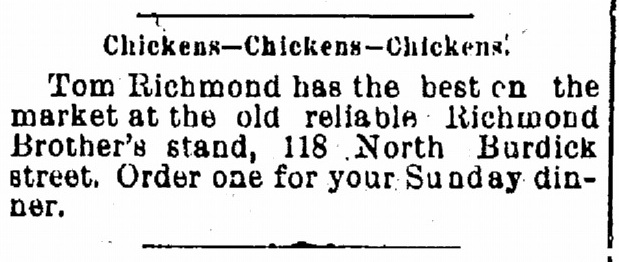
I did find one of Tom’s ads in the Kalamazoo Gazette. It appeared April 9, 1898.

Kalamazoo Gazette ad April 9, 1898

Kalamazoo Gazette ad
April 9, 1898

Notice that this ad gives a North Burdick address. My relatives’ homes and businesses were mainly congregated near the intersection of Burdick and Balch in Kalamazoo. Maybe as a small boy, Grandpa thought the shop was on Balch, but it was on Burdick. Or maybe he remembered incorrectly (unlikely–his memory was amazing). Or maybe the shop moved.

Someday when I have all the time in the world ;), I’ll try to put together a map of the area with my relatives’ homes and businesses, as well as the surrounding ones. Create a little village on paper, in a way. At that point, I’ll have to use the City Directories to figure out precisely where Tom Richmond’s butcher shop was. What makes it hard, though, is that the address numbers have been changed since that time.

This is what I don’t really understand: what kind of custom would be responsible for my family winding up with portraits of neighbors, friends, or merchants they frequented? I am entertaining the thought that maybe somebody’s somebody married into this family. I’ll have to keep searching.

If your family has old photographs, do they have portraits of non-family in the collection?

Read Full Post »

« Newer Posts - Older Posts »