Feeds:
Posts
Comments

Archive for the ‘DeKorn’ Category

I’ve mentioned before that my great-grandfather, Adrian Zuidweg, Sr. (Adriaan Zuijdweg) owned a fish market when Grandpa was young.  In this photo he stands with an unidentified young employee.

Fish Market on Eleanor Street

Fish Market on Eleanor Street

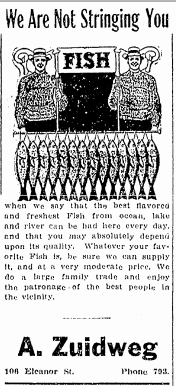
I found some ads he ran in the Kalamazoo Gazette on Genealogy Bank. This one is from September 16, 1910.

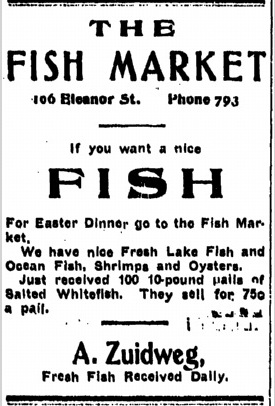
This is a pretty fancy ad for a little market like he had. Some of the time he did a more simple ad like this one at Easter time–April 6, 1904.

Most of his ads, like those of many small businesses at that time, were a mere sentence or two in the JOTTINGS. I underlined his little ad so you could find it easily amidst the other “jotted” notes. This one is from December 24, 1907. Note the date and the hours listed.

That means my great-grandfather not only worked Christmas Eve until 9PM, but Christmas Morning as well!

Read Full Post »

As I’ve mentioned before, my great-great-grandfather, Richard DeKorn, was a brick mason who worked on many public buildings in the Kalamazoo area.  He was a brick mason on the beautiful Ladies’ Library Association in 1878-79 and lead brick mason on the Kalamazoo Psychiatric Hospital Water Tower  in 1895. According to his obituary he was the contractor for the Pythian building and the Merchants Publishing Company building.

The asylum water tower was slated for demolition in 1974. Here is the story of how it came to be saved (from http://www.kpl.gov/local-history/health/kph-water-tower.aspx):

In spite of being on the National Register of Historic Buildings and endorsed by the Michigan Historical Commission and the Kalamazoo County Bi-Centennial Commission, the structure was earmarked by the State of Michigan for demolition in 1974. A local committee that called itself the Committee to Save the Tower launched a campaign to raise public funds to restore the building to its original grandeur and save it from the wrecking ball. A year later, Mrs. William John (Penny) Upjohn announced that $208,000 was successfully raised for this purpose. The money came from federal, state, and city contributions to the effort. Contributions also came from such disparate groups as school children, former state hospital patients, current hospital patients and employees, a hospital auxiliary, service clubs and concerned citizens. The campaign to save the structure was not without controversy. Some residents felt that the monies needed to repair the structure could better be spent on local service needs. Sen. Jack R. Welborn, R-Kalamazoo, pointed out, however, that taxpayers would be spending at least $150,000 to tear down the tower.

I recently visited Kalamazoo and went on a tour of Henderson Castle, a mansion built the same year as the water tower.


From a rooftop viewpoint, I was able to see the water tower in the distance.


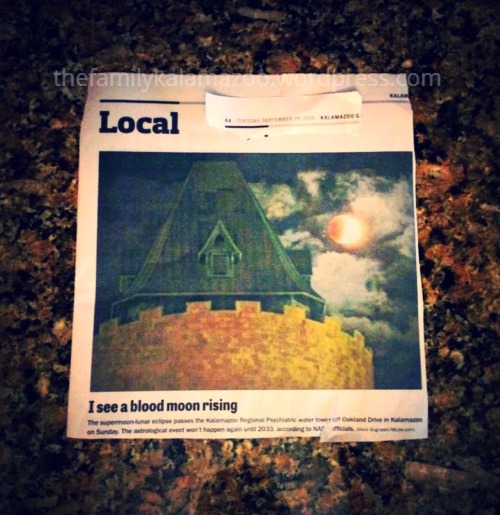
And then my mother showed me a photograph that was in the local newspaper of the blood moon near the tower.


I’m off preparing for a poetry reading this weekend. Have a lovely weekend!

Read Full Post »

I lost my oldest cat, Mac. He passed away a week ago last Sunday. His actual name was Macavity, and he was named after T.S. Eliot’s “Mystery Cat” (in the poem and the Broadway musical). I’m a dedicated animal lover, so I always like to see evidence of animals in the lives of my ancestors. I wrote a post called Dogs in the Family that showcases some photos of pets from 100 years ago, as well as my own four cats.

I found a postcard from 105 years ago that features a type of tabby cat. My cat Mac was an orange and white tabby, so this caught my attention. It’s part of a collection of cards received by Alice Leeuwenhoek.

This card was mailed from Grand Rapids, Michigan, in 1910. Alice was my grandfather’s first cousin–their mothers were sisters–and she was born in Kalamazoo in 1897.

I wish I knew what the inside joke about eating well means! Alice was a very slender woman.

Notice that the postcard isn’t signed. So frustrating! Does it sound like a good friend or a relative?  Does the handwriting give a clue? Alice was 13 years old when she received this card.

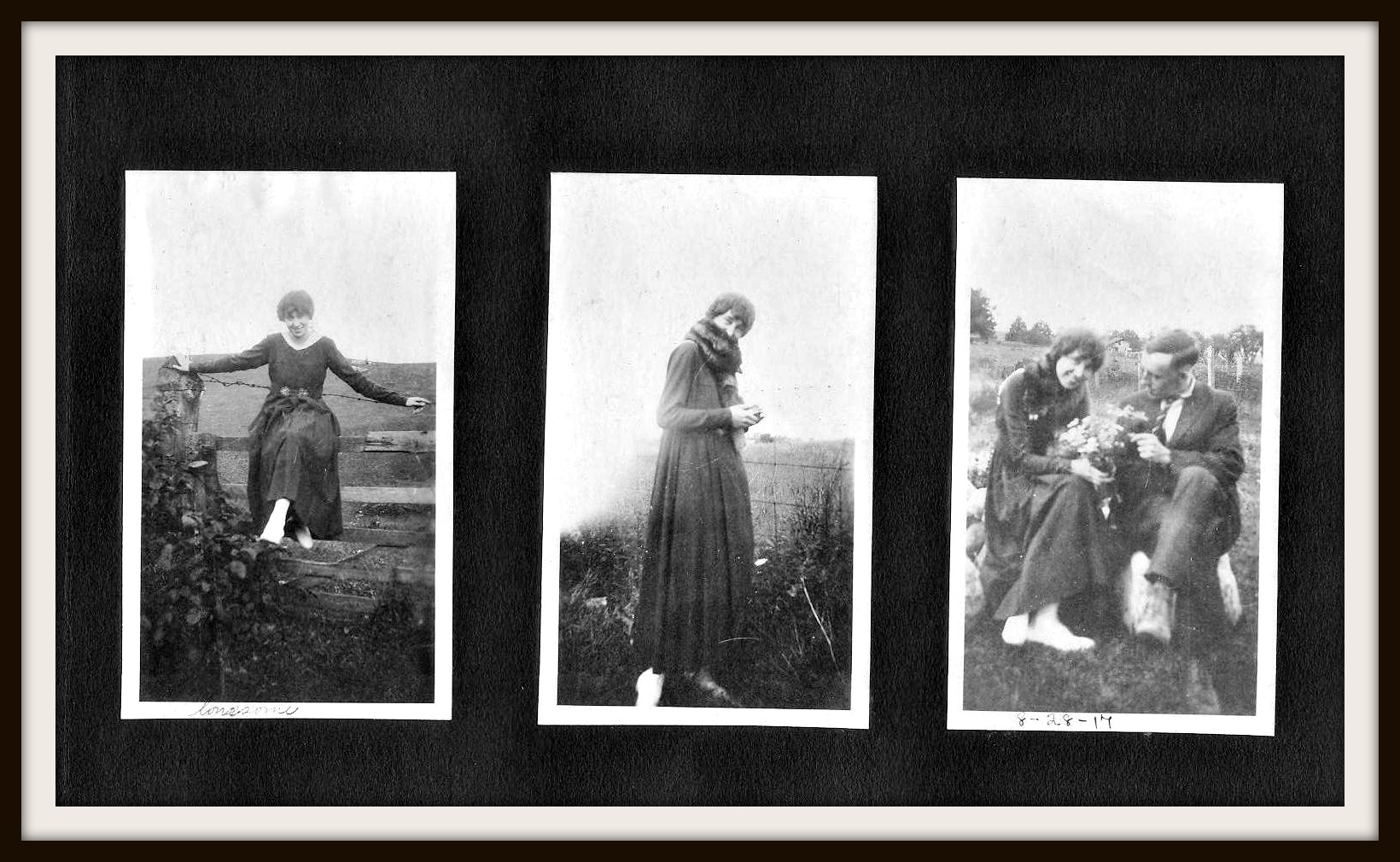
Here she is seven years later (age 20)–dressing fashionably, posing, and with a young man!

Alice wouldn’t marry until 1923, at age 26, and it wasn’t to the man in this photo.

If you go to Dogs in the Family, you will see a photo of Alice as a child with her aunt, my great-grandmother Cora DeKorn Zuidweg, and my grandfather, Adrian Zuidweg–with the family dogs.

I’ll leave you with photo of Alice and moi when I was 3 years old. Alice was 61. I knew Alice quite well when I was a child. She passed away when I was 8 years old, in 1963.

Read Full Post »

I recently found this photograph in a group of photos. Because of a clue on one of the other pix, I narrowed the date to between 1928 and 1931.

I know who the man is because he has a very distinctive look. This is my great-grandfather, born Adriaan Zuijdweg and called Adrian Zuidweg in the United States. I’ve written about him many times, but the best posts would be My Great-Grandfather Reinvented Himself as a Business Owner in the U.S. and My Grandfather’s Story, Part V and Back to the Dutch-American Newspaper.

Adrian died in 1929, according to my grandfather–of kidney disease. But I have not been able to find a death certificate or a grave. Maybe it’s because his name was mangled, but keeping that in mind, I still haven’t found him yet. It is so frustrating. Also, the newspapers from that year are not on Genealogy Bank. Nevertheless, I would put this photo at 1928 or 1929. Because other photos show him more fit than in his photo, I think he might have been ill (or close to it) by the time this photograph was taken.

But who are the women in this photo?

Adriaan Zuijdweg

Could the woman on the left be my Great-Grandmother Cora DeKorn Zuidweg? She looks a lot taller than he does, but maybe she was taller. I will post a known photo of her so you can compare.

Cora DeKorn at her father Richard DeKorn's cottage on Long Lake

Cora DeKorn at her father Richard DeKorn’s cottage on Long Lake

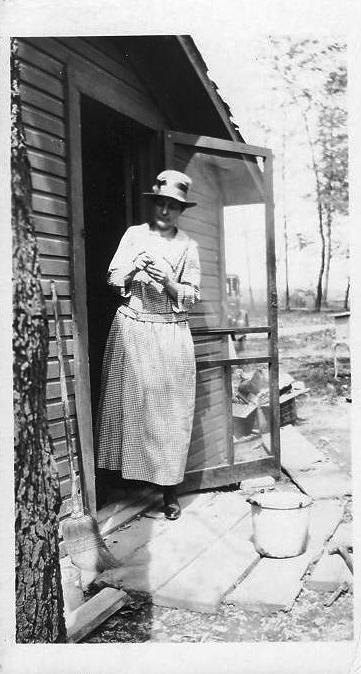
Similar hats, for sure! If that is Cora in the first photo, then she would have been about 53 years old. She herself passed away in 1932 from cancer.

Do you think that is Cora in the photo with Adrian?

Who is the shorter woman? Is this another photo of her?

The only child of Adrian and Cora was my grandfather. Cora’s only sister was Jennie–and this is not Jennie. However, she had two younger step-sisters, Marion and Marge Sootsman. They would have been in their 30s at this time. This woman does not look like one of them. She actually looks more like one of the Culver sisters, but we figured out that they moved to Seattle before this period.

The only thing is . . . there are a lot of photos of this woman. Was she a girlfriend of my grandfather?


Kinda looks like it. After a series of these photos, there is a series of him with my grandmother.

Do any family members know the answer to this mystery?


Read Full Post »

Remember the Culver family: my great-great grandfather’s sister, Jenny DeKorn Culver, and her daughters, Lela and Rhea, who moved from Kalamazoo to Seattle 100 years ago.

In the scrapbook which I received from a blog reader I found this photograph. Any ideas on the type of uniform? Since this would have been around the time of the end of WWI, does the uniform have to do with the war?

I don’t know who the man is. Most of the Culver photos are of women.

But the clues would leave me to believe the photo was taken in Seattle in or around 1918. But did Seattle have old elegant buildings like this at that time?


What about the building? My first inclination was a church, but I don’t see any crosses. Are those rosettes for ornamentation?


Related articles

Read Full Post »

I often wonder why more documents and photographs aren’t passed down in families. After I received that beautiful scrapbook that belonged to the Culver sisters (you can read about it here), I realized that sometimes it is because branches of families die out. There is nobody left who cares about the history of the family.

But what happens in so many other families? Sometimes someone moves and loses a box of photographs. Or they pass away and leave documents in the care of a descendant who hates “stuff” and throws it away.

Sometimes, though, it is in the hands of nature. A tornado, hurricane, fire, or flood carries away these valuable family treasures. I’ve tried to protect as much as possible against these possibilities. A fire safe and a supply of acid-free envelopes and boxes helps with that.

Nevertheless, I had a little taste of the damage that can occur from nature the other day. Well, maybe not nature–more like repairman error.

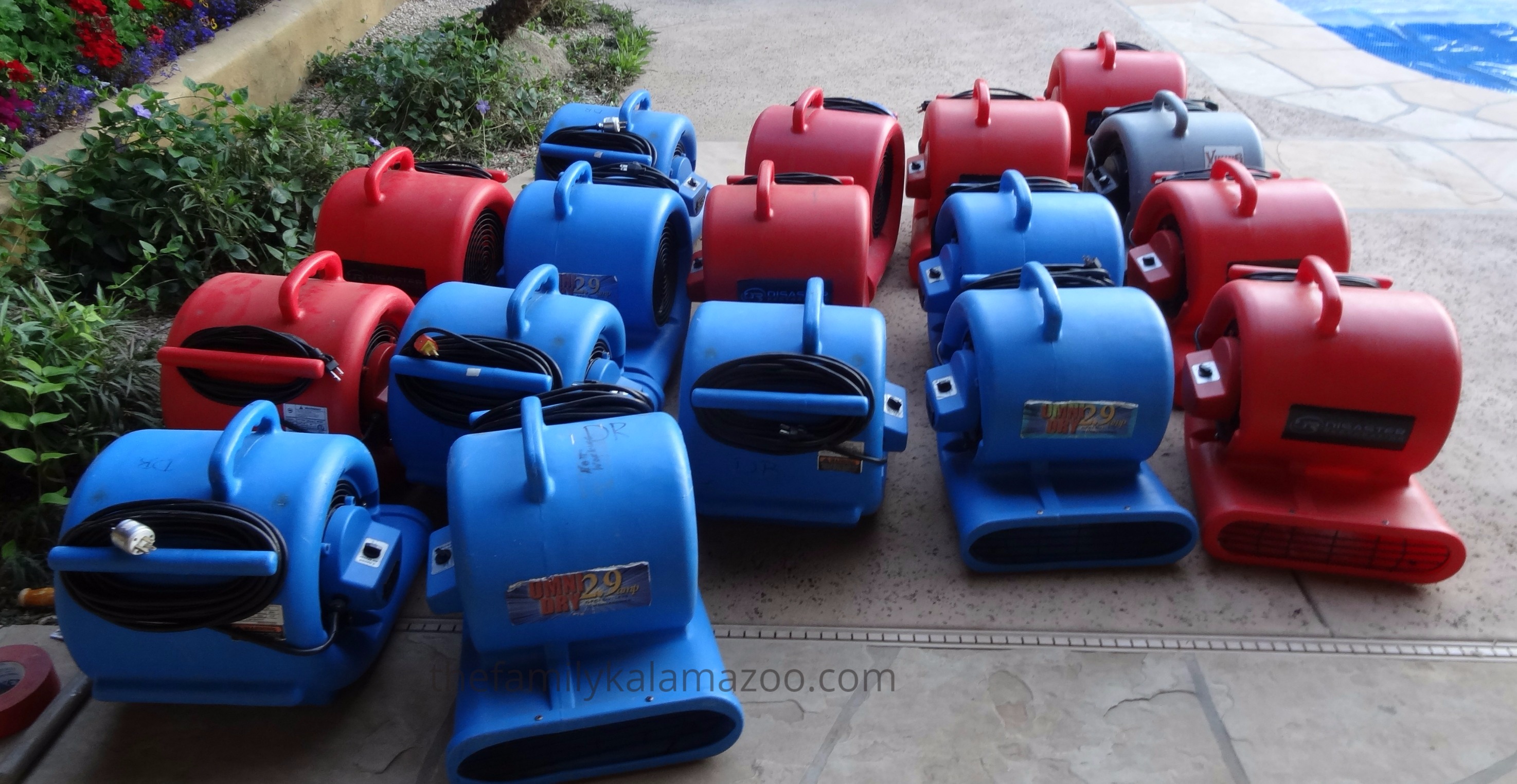
Last spring I walked around the corner of the house and heard a raging fountain. Water poured into the hall, on my beautiful alder wood floor.  Our hot water heater had burst. We discovered that the repairman had set it down, covering the drain, so the water had nowhere to go but out into my house. Ultimately the entire large-sized heater contents poured into my house, flooding the hall and downstairs bedrooms. The only reason it didn’t get into the living room is that the hallway and bedrooms are three steps lower than the living room.

Professional dryers lined up by my pool

We got help cleaning up the mess, and because we live in Arizona, where it is dry, everything seemed fine.

Until Tuesday that is.

I keep a plastic mat in the walk-in closet where I store my scrapbooks, books, and old writing. That’s because, to make more room, I have a library cart full of books and need to be able to move it from in front of the file cabinet. Because it’s so weighted down with books, it sinks into the carpet and needs a mat to roll on. I keep another plastic mat under my desk for my chair. Well, what I didn’t know was that although the carpet was dry, the slab (no basement in Arizona) had absorbed moisture from the flood. So when I put the plastic mats down, over these ten months, moisture collected underneath. The carpet developed rust spots. And at the edge of the closet mat, on the wall hidden behind the file cabinet, black mold developed. It didn’t grow on my wall or in the carpet, but on the baseboard and on the scrapbook I had leaning between the cabinet and the wall. You see, that scrapbook was not a treasured heirloom, but something that belonged to me.

It was from 1989 and 1990, when I graduated from grad school (Western Michigan University). Because I have an iPhone and a camera, I was able to take photographs of the “treasures” in the scrapbook and throw them away. But years ago, that would have been very unlikely. Film was expensive and everyone didn’t have a camera.


I added the “My Graduation” ribbon to this photograph to cover up something I had written in my bad handwriting on that page ;). But I still have the photograph of the original page.


In the following photo you can see the black mold a bit better. It is a flyer advertising subscriptions to a literary magazine. The flyer featured a poem by yours truly, as well as one by another poet.  Look at the mold! I was wearing latex gloves to handle it.


Years ago, my mother-in-law’s basement flooded. She had a wonderful collection of antiques and childhood keepsakes that belonged to her and some to my husband. All gone in a flash. Every once in a while my husband remembers something else that was in the basement and is lost forever.

Have you lost photographs, documents, or heirlooms?

Read Full Post »

I wondered when I could ever get back to Theresa Pake. Since I couldn’t make time, I thought I would share something about her anyway!

On January 20, 1928, Theresa married Roy Lawrence. I’m posting this late on January 20, 2015, so that it’s the date of their anniversary.  Roy was born 5 November 1884, about 9 years before his bride.


Roy was a cigar smoker, but he quit when he married Theresa.

Is Theresa’s hair marcelled here? And what is the corsage she is wearing?


A Series of Disasters

The Children After the Fire, 1902

Paak-a-boo

Saved from the Fire

Who is George Paake, Sr.?

Curious about George

George Paake’s Legacy, Part I

George Paake’s Legacy, Part II: Theresa’s Pre-Professional Education

George Paake’s Legacy, Part III: Theresa’s Professional Education

George Paake‘s Legay, Part IV: A Letter to His Daughter


Read Full Post »

How’s that for a weird title?! If you didn’t notice I’ve been on a break, please don’t tell me or I’ll feel bad ;). I am back, but only on a limited basis because of all these things like work and life that keep intruding on my genealogy research and blog reading! I wanted to stop in today to say:

HAPPY NEW YEAR!!!!

Let’s make 2015 the best yet!!

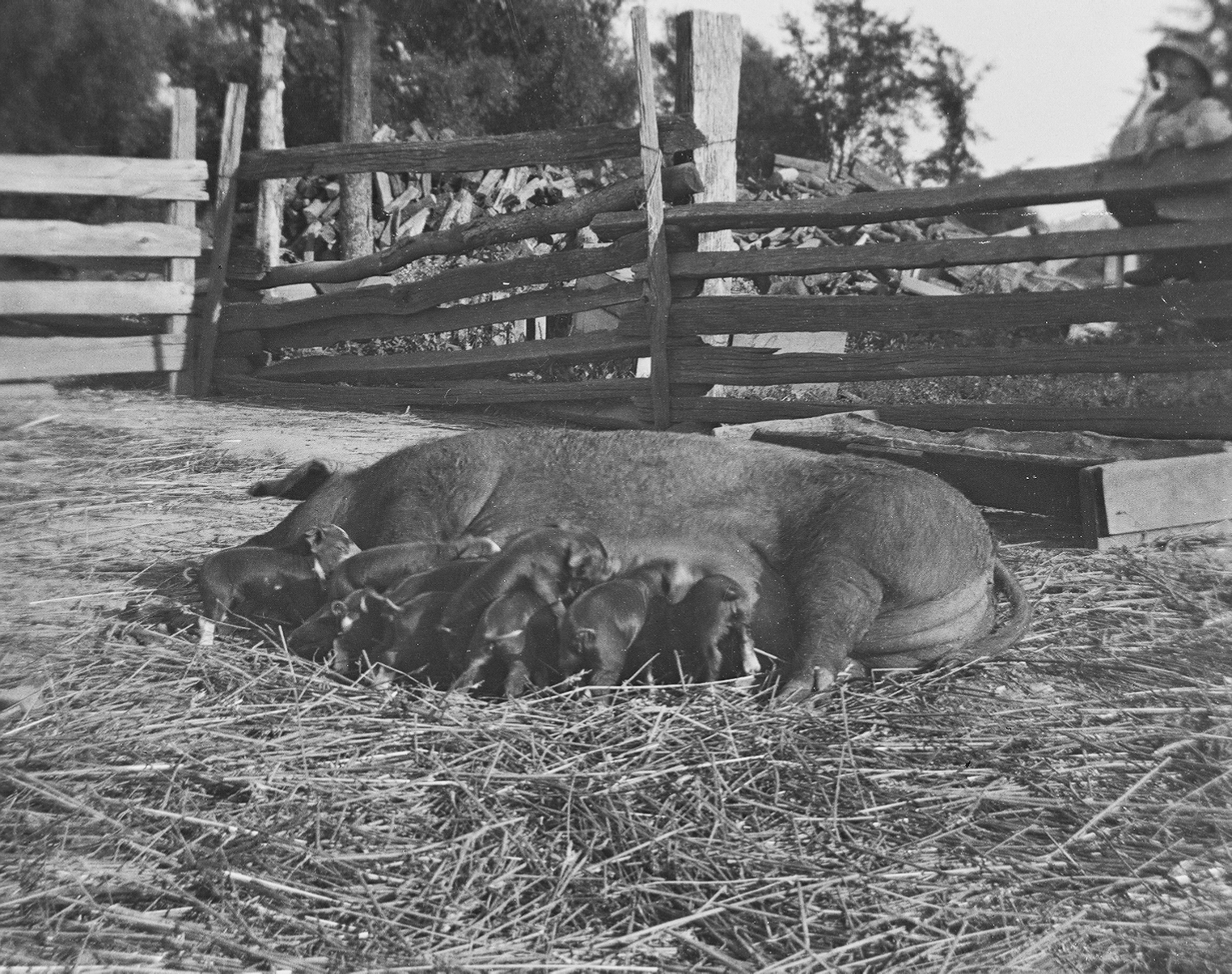
I have a set of old glass negatives that have been digitized. I’ve shared a few on this blog. Here is one I have not shared. At first I thought it was a photo of a pig (hog? what is the difference?) with her very cute babies. I am quite certain this was taken by Joseph DeKorn at Brook Lodge in southwestern Michigan (I’ve written about the place here).

But when I looked more carefully I saw Grandpa sitting in the upper right corner! I wonder what he was thinking and if he was tired. He seemed to be visiting the resort with his cousin and uncle.

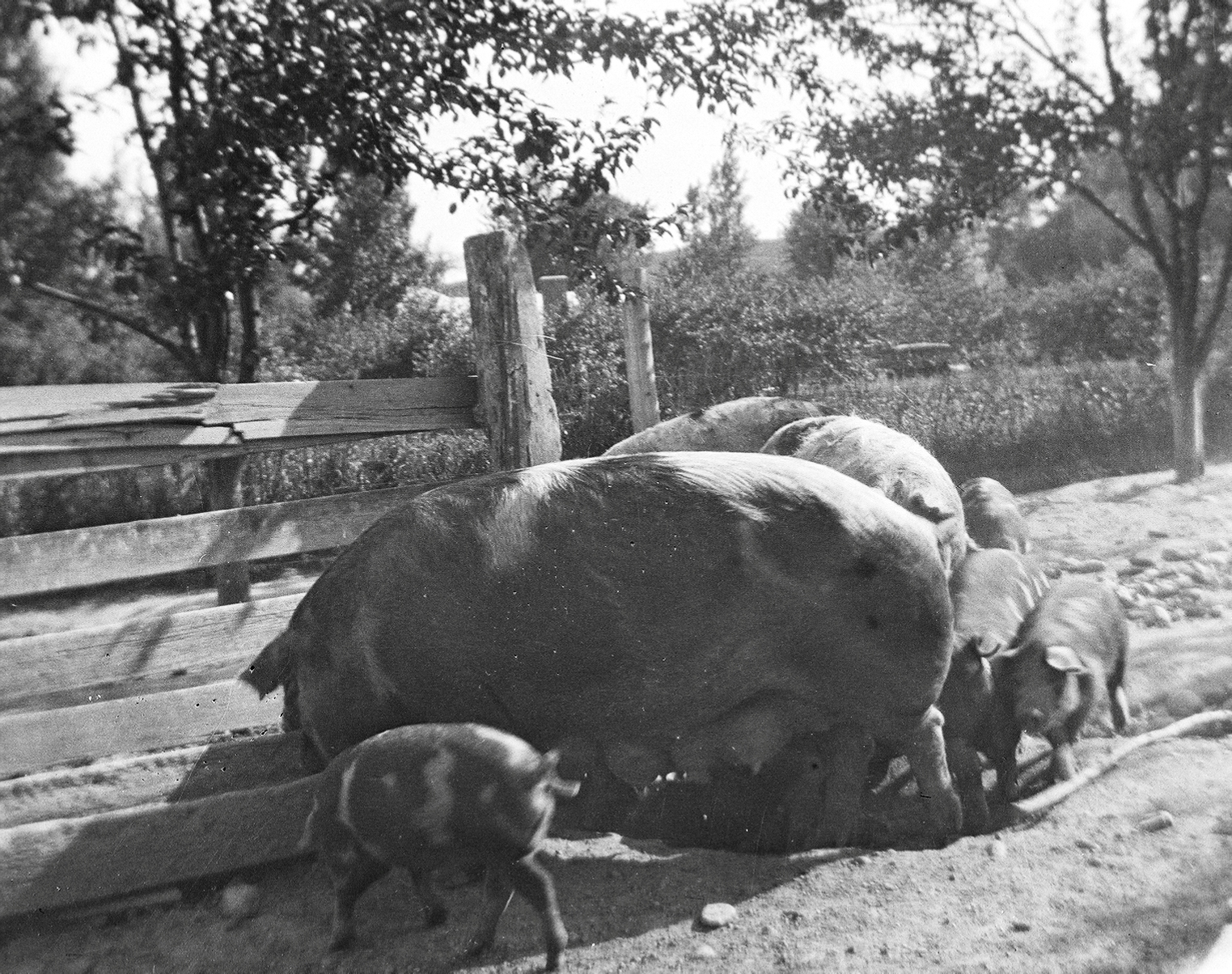
Here are some more pig photos from Uncle Joe.

These photos are 100 years old. What remnants of our lives will there be in 100 years? Maybe too many!


Read Full Post »

I’ve traveled to California, Sedona, and Michigan in the past few weeks.  Needless to say, I am behind in my work even more than usual. I want to continue Theresa Pake’s story and to explore the Jennie DeKorn Culver photos more, but these projects take a good deal of time.

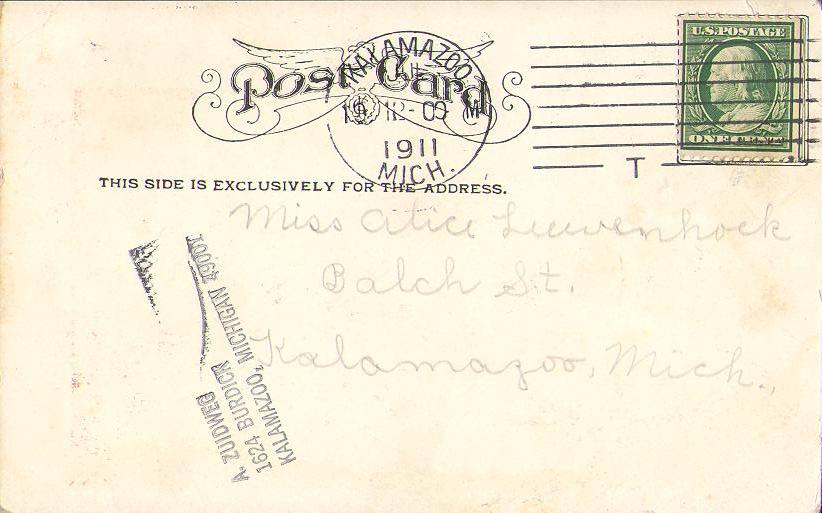
Instead, I decided to take a look at an old postcard postmarked 1911. The postcard is to Alice Leewenhoek, Richard DeKorn’s granddaughter through his daughter Jennie. Alice was an only child who lived with her mother Jennie and her father who Grandpa always called “Uncle Lou”–Lambertus Leewenhoek.

In the photo below, Alice is sitting with a friend, neighbor, or relative against the exterior wall of Richard DeKorn’s house. She holds a doll in her lap and is petting Tom or Carlo (if I had to guess, I would say it’s Tom).
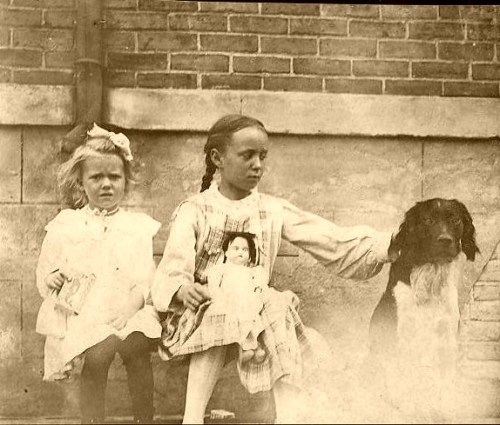
 

Alice Leeuwenhoek with doll

On this postcard, Nellie Bradt is thanking Alice for her “postal.” Nellie’s address is marked as 1130 S. Burdick Street.  The photograph is Bronson Park, which is the beautiful “town square” of Kalamazoo.

Bronson park front postcard


After seeing that the mailing address is listed as Balch St. and doesn’t include Alice’s street number (not uncommon for that time period in Kalamazoo), I went to my family tree on Ancestry and discovered that I had never found the Leewenhoek family on the 1910 census.  So I tried something different and looked for the 1910 census on Family Search. Bingo.  Instead of Lambertus Leewenhoek, I found Lamburtos Leenwenhock, at 110 Balch Street, Kalamazoo, Michigan. Uncle Lou was living with his wife Jennie and his daughter Alice who was 13 years old in that year–and therefore around 14 at the time of the postcard in 1911. New info: According to Uncle Don, they lived in the wooden house just behind the Richard DeKorn brick house.

Can you read anything more on the postmark besides the city, state, and year?  Is it December 9? Or does it say something else?

Bronson park back postcard


Grandpa and Alice were first cousins, their mothers were sisters.

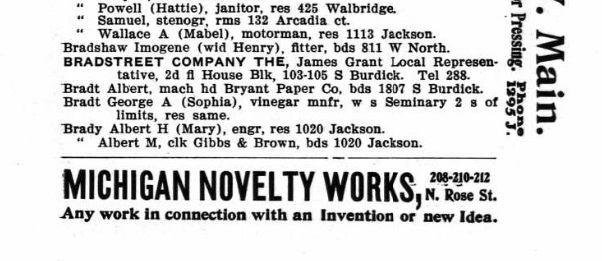
I haven’t been able to find Nellie Bradt in the 1910 census, but I did find her in an 1899 city directory. I then found her parents in a 1905 directory. I think I can find them more years, too. But I don’t understand how to read these entries. The 1899 entries are entirely different from the 1905, but neither one really gives me the address.

Here is the 1899 that lists Nellie with her parents, Mr. and Mrs. George A. Bradt. I understand they lived in the City of Kalamazoo. And I know “a” means acreage, but not how to interpret what any of this means or how it connects with an address.
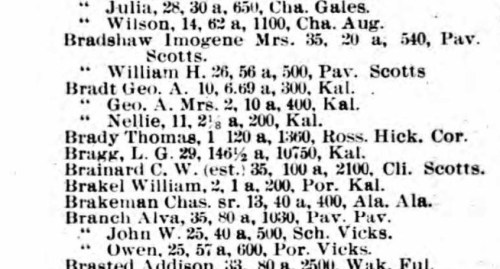
Nellie Bradt 1899 city directory


Here is the 1905 directory entry. Nellie isn’t mentioned, but her parents are. What in the world does it mean?

Nellie Bradt's parents 1905 city directory

Is there a way to search for Nellie in the 1910 census using the 1130 S. Burdick Street address she gives? Can I search the census by address?

Note that many of my relatives lived in this Burdick/Balch neighborhood. When I look at the census records from late 19th and early 20th century, I see that almost everyone, if not everyone, who lived there was Dutch.

My grandfather’s gas station was at the corner of Burdick and Balch, across the street from the Richard DeKorn house. Grandpa lived in that house for part of his childhood, with his parents and grandfather, Richard. When he built his house down the block on Burdick, he was staying in the same general area his family had lived in for decades. He continued to work at his station and live in his house until he retired and moved to Portage.

I remember as a child meeting Mrs. Bradt Braat who lived next door to the gas station. The name is pronounced, by the way, like the sausages that go with beer. I wonder if she was related to the Nellie Bradt who wrote this postcard. Mom? Uncle Don? New info: no, she must not be as they were a Belgian family (see comments below).

Alice Leewenhoek was my grandfather’s cousin. Note that the postcard is stamped with the name and address of Grandpa’s father, A. Zuidweg. I wonder why?

One postcard. So many questions!

Read Full Post »

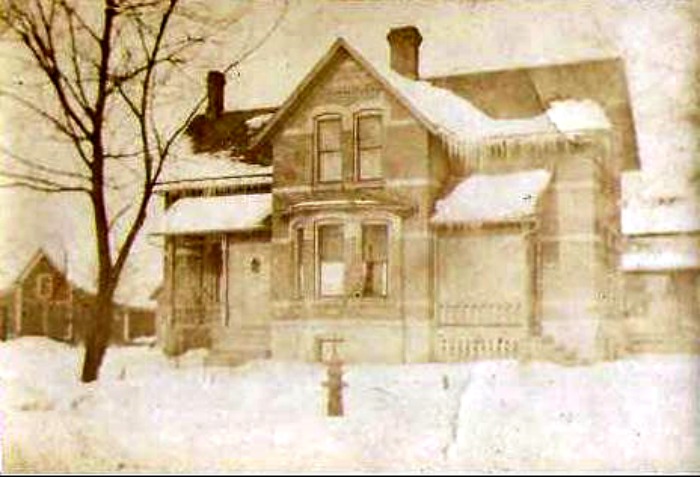
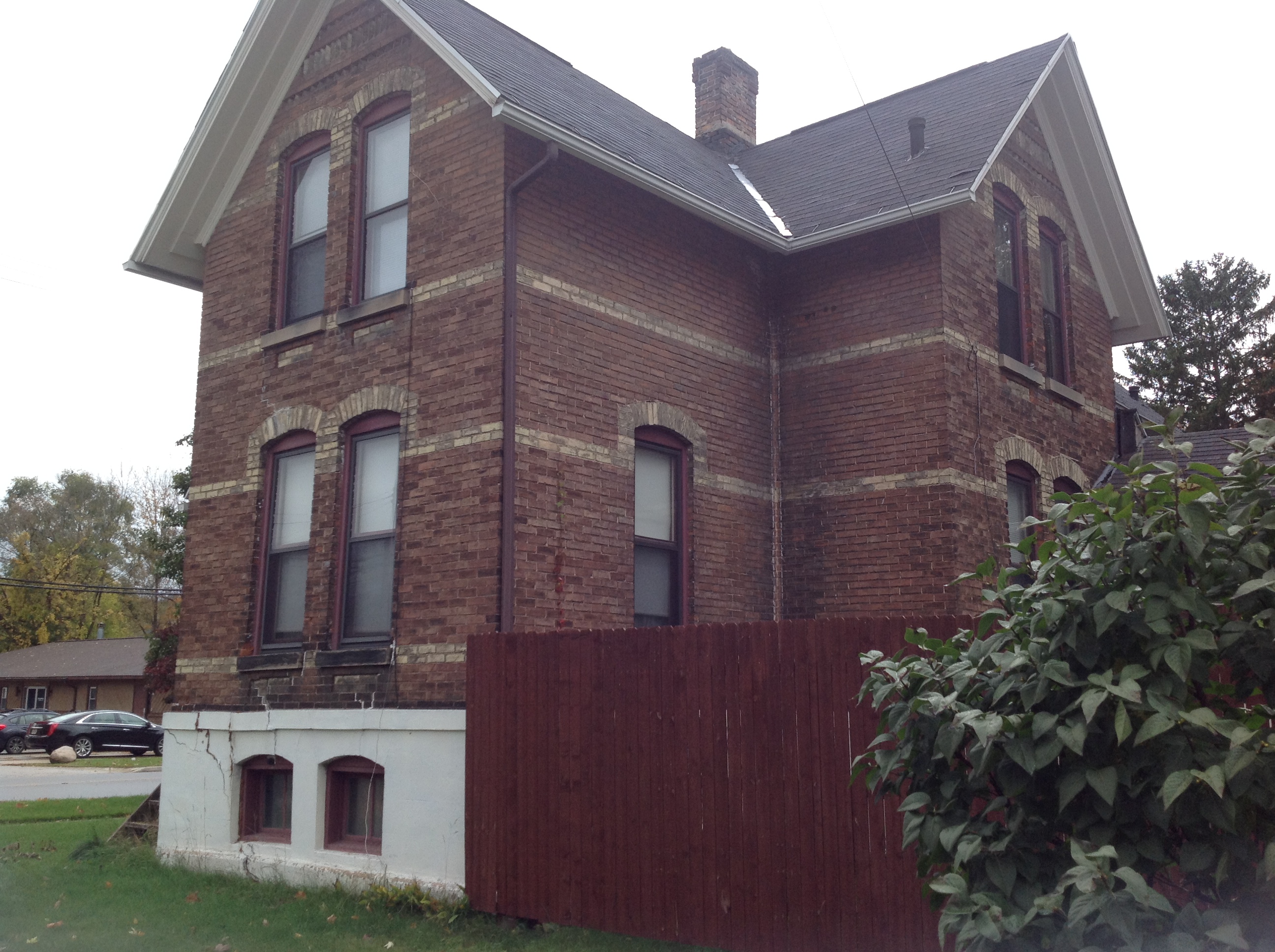
Richard DeKorn’s house is still standing, at the corner of Burdick and Balch Streets in Kalamazoo. Someone lives there, but the house needs some TLC, in my opinion. I wonder if the owner knows who built the house–or is interested. I love the distinctive light brick stripes on the dark brown brick. The house was most likely built in the 1880s. I would love to know the exact year.

Although the basic house hasn’t changed, the property has. In the old photographs, the house looks set back from the street. The house number is now different.

It looks like a barn to the left, doesn’t it? Notice that the above photo is the same view as the first photo. Is that a fire hydrant in the same spot? Did they have fire hydrants in those days? Or is it something else?

Here is a photo of the area where the barn was. I wonder if the garage has the same footprint as the barn. And you can see the house that is next door. How old do you think the gray house is?

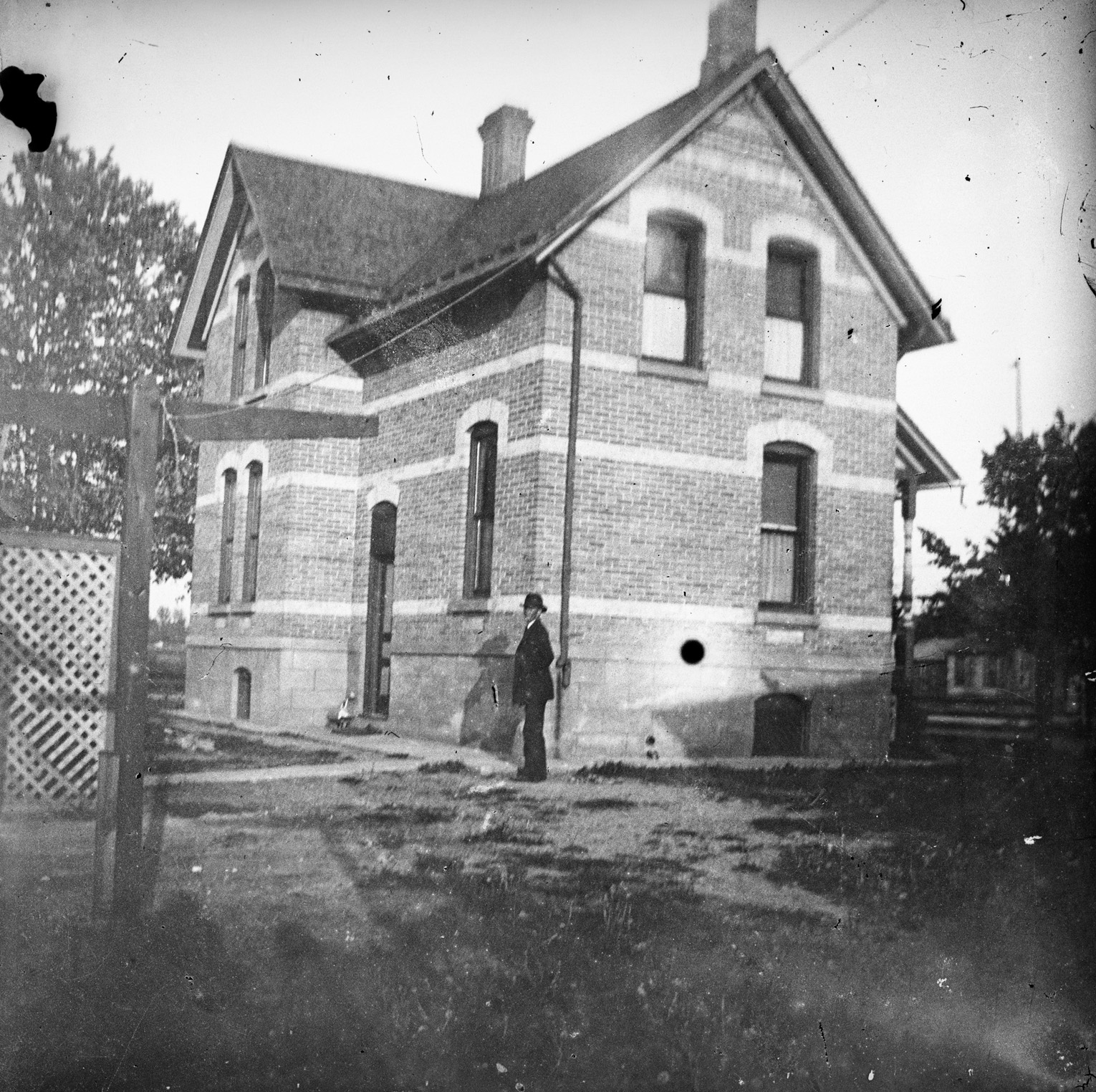
In the following photograph, Richard DeKorn stands by the house he built.

Richard DeKorn's home at the corner of Burdick and Balch, Kalamazoo, Michigan

Richard DeKorn’s home at the corner of Burdick and Balch, Kalamazoo, Michigan


Here is another angle of the house today:


In the above photo, the right side (two windows in 2nd story, 1st floor, and basement) faces Burdick Street. The left side (two windows 2nd story and three windows on the 1st floor and basement) faces Balch Street. In the old photo, where is Richard standing? Is he at the opposite corner from the Burdick-Balch corner–at the back of the house?

Here’s a view from the opposite side of Balch. I think it shows that Richard has his back to Balch Street in the old photo.

Read Full Post »

« Newer Posts - Older Posts »