Feeds:
Posts
Comments

Posts Tagged ‘history of The Netherlands’

Maureen Taylor, photo detective, helped me with a couple of photos a few years ago. The other day I bought her book, Family Photo Detective.

The book gives a good overview of many topics associated with identifying old family photographs. I haven’t read it all yet, but I did read certain sections because of various questions I already have in my mind.

In my post Mysterious Antique Photographs I posted a painted metal photograph which is unidentified. I believe it is from the Remine family. Although it can seem that the Remines are very distantly related, in fact, Richard DeKorn’s mother was a Remine:


Johanna Remijinse

1817–1864

BIRTH 15 JUL 1817 Kapelle, Zeeland, Netherlands

DEATH 1864 Kalamazoo City, Kalamazoo, Michigan

* my 3rd great-grandmother *

The consensus seems to be that the photo below (of an unidentified Remine female) is a tintype.


However, according to Taylor, a painted photo like this would be a daguerreotype which is painted on its metal surface with colored powders which are brushed or gently blown.

One of the characteristics of a daguerreotype over a tintype is that the image needs to be viewed from an angle. Another important characteristic is a mirror-like surface. I had to pull out the original to examine it for these traits.

It’s impossible to tell if the image needs to be viewed from an angle because the image is so thoroughly painted. But the background is not mirror-like, but rather a matte dark gray with a slight texture.

I went to the internet about this mystery and discovered a site that showcases some hand-painted tintypes. Unfortunately, after 45 years, The Ames Gallery in Berkeley is closing this year. I wonder what will happen to their photographs. Click the name of the gallery to see the painted tintypes.

I think we were right that this is a tintype that has been painted. In fact, the painting is so well done that her face is very realistic. Years ago, I used to work with gold leaf, embossing leather and vinyl products, and I suspect that the jewelry has been painted with gold-leaf.

It’s frustrating that I have not had the time to work on the photos and genealogy for many months (for the most part), but I like to keep moving along, getting one little thing after another accomplished so I don’t lose my touch haha.

Without a doubt, this is the most beautiful photograph in the whole collection.


Read Full Post »

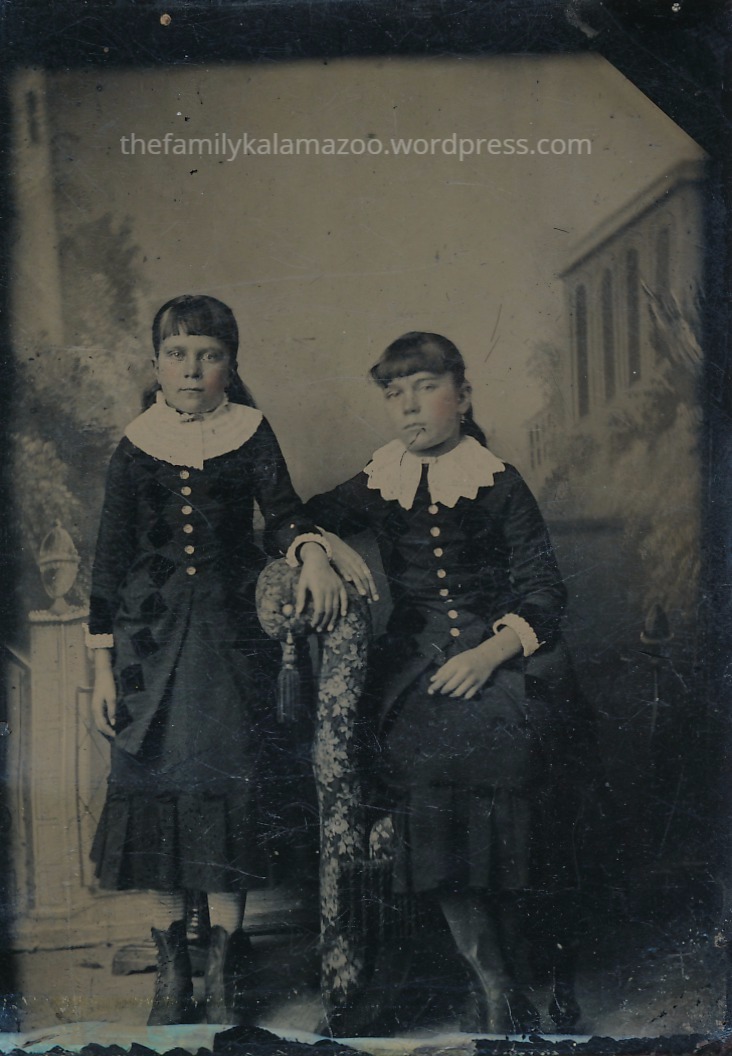
More tintypes! In Mysterious Antique Photographs I shared a beautiful tintype that I own.

Yesterday I opened the box of unscanned Remine photos. I haven’t had time to scan so many photos–or to organize either–but I thought I should just start doing a few a day because when WILL I ever have the time?

And I discovered these beautiful tiny tintypes. The one on the other post is large and painted. These are only 2.25 x 3.5 inches in size–and unpainted.

Because they are in the Remine box I can guess they might be Remines. Judging by the faces, I am ready to conclude they probably are Remines.

Because these girls and women were photographed full length (standing and seated), we can examine their entire outfits to try to guess a time period.

Therese was born in 1891. Could this photo be from around 1900?

I am having trouble identifying the correct information about Therese’s sisters. When I figure it out, this might help in identifying this tintype. For instance, if there were sisters born in 1880 and 1881 as might have been, this photo could, I suppose, be those sisters. If so, one of them is Genevieve Remine Tazelaar and the tintypes would be in the early 1890s.

I suppose the hair and collars could be 1900. But what about the fitted jackets with all the buttons? I can’t find anything like that in photos of 1900. Odd, too, that it would be a tintype if it was as late as 1900.

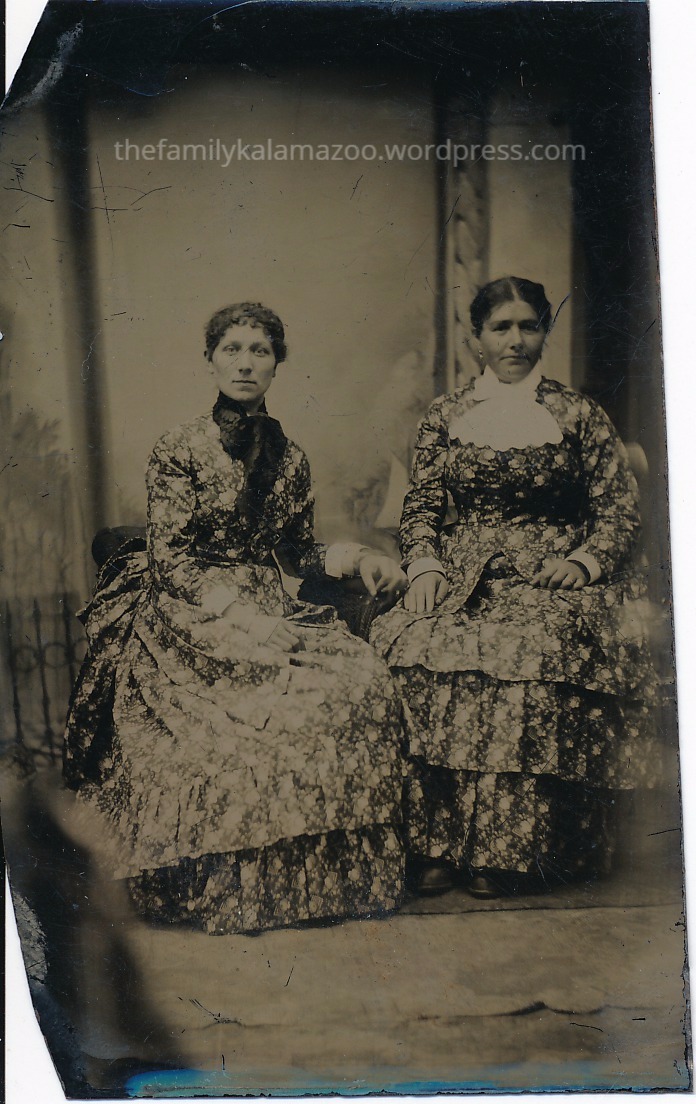
Here is the other tintype. I’m sorry it’s kind of crooked and uneven. It was difficult to scan it.

What about these outfits? They are not leg o’mutton sleeves, so does that rule out the 1890s?

I guess I am not very good at taking the nuances of change in fashion and extrapolating to what my relatives would have worn (generally a much more conservative version of the fashion).

The woman on our left looks a lot like Mary Paak Remine, Therese’s mother. She was born in 1859. But the woman doesn’t look terribly young in this photo. And then who would the other woman be? She looks NOTHING like the Paak sisters. She is not Mary’s mother because Jacoba Bassa had passed away long before this.

Were these photos taken in the Netherlands or the United States? The Remines were from Kapelle and the Paaks were from Lexmond. Notice the wallpaper/painted background. I’m pretty sure that these photos were taken in the same studio, perhaps near the same time period.

I’m afraid I have more questions now than I did before.


Read Full Post »

One of the branches of my family from the Netherlands was the Reminse branch.

On 26 August 1810, my 4th great-grandfather, Dirk Reminse, a bread baker, married Adriana Kriger (Krijger) in Kapelle, Zeeland, the Netherlands. Dirk was born 22 November 1786 in Kruiningen, Zeeland, Netherlands. At some point before his marriage he must have relocated to Kapelle, but Adriana also came from a different town. She was born 11 June 1787 in Biggekerke, Zeeland, Netherlands.

Houses on the Kerkplein (church square), Kapelle, Netherlands

The couple had the following children:
Gillis Remijinse 1811–1868

Jan Remijinse 1813–1837

Hendrika Remijinse 1814–1893

Johanna Remijinse 1817–1864

Johannis Remijinse 1819–1846

Adriaan Remijinse 1821–1849

Pieter Remijinse 1822–1830

Frans Remijinse 1823–1860

Gerard Remynse 1825–1910

Marinus Remijinse 1826–1863

Note the difference in the spelling of the surname. It is seen both ways. In this country it became REMINE.

Their daughter Johanna was born 15 July 1817 in Kapelle. She married Boudewijn DeKorne 21 May 1847 in Kapelle. Boudewijn had been born in Kapelle on 11 June 1816.

The couple had one daughter who died as an infant, then a son Richard and daughter Maria were born. Richard, my great-great grandfather, would end up being a well-known brick mason and contractor in Kalamazoo, Michigan, but first the family had to immigrate to the United States.

Johanna’s parents had both died. Dirk died 9 September 1840 in Kapelle. On 14 April 1845, Adriana passed away.

Boudewijn and Johanna arrived in this country in 1856 and first settled in Zeeland, Michigan. The following year their 4th and last child, Jennie was born. Jennie eventually became Jennie Culver who divorced her husband and moved to Seattle with her two teen daughters. I have posted about the magnificent photo album that belonged to one of Jennie’s daughters that a blog reader mailed to me.

Johanna Remijinse DeKorne was my last direct ancestor in the Remine line, although my grandfather stayed close to the family that continued that surname in Michigan.

I found a photograph of this branch of the family in the Netherlands. The photograph is not marked with a photography studio or any other identifying information. Someone, possibly my grandmother, wrote on the back “Remine family in Holland.” In order to figure out who is in the photograph I would need to know the approximate date of the photo. Since Johanna immigrated in 1857, this must be from a line of the family that ran parallel to her line. Would it be the family of one of her siblings?

I went back and examined the other Remine cousins in the United States. They stem from Johanna’s brother Gerard.  He seems to have immigrated to the United States between 1855 and 1857. Maybe he and his family even came over with his sister and hers? NOTE TO SELF: CHECK INTO THIS.

Why did the families remain close? Johanna’s son Richard’s wife Alice’s sister Mary married Richard Remine, son of Johanna’s brother Gerard! What does that make them? First cousin’s by marriage?

So the photo can’t be of Gerard’s family. That leaves eight other siblings to check into. And the children of all these siblings . . . . NOTE TO SELF: MORE WORK NEEDED HERE

CAN YOU GUESS A TIME PERIOD FOR THIS PHOTO?


Read Full Post »

In my stack of anonymous family photos, I have two that are different from the others.

In the first one, the image is imprinted on metal and then painted with colored paint.


In the other, a couple appear to be drawn, rather than photographed.


It’s likely that the photographs came from Grandpa’s family: Paak, DeKorn, Zuidweg, Remine, Bomhoff, or his other branches. Or they could be friends or neighbors.

UPDATE: My daughter thinks the tintype woman looks like Grandma in the eyes and mouth. “Grandma” would be my mother, Grandpa’s daughter.

Any thoughts on type of photographs or on dating of these images?

Read Full Post »

In my post, Mulders Everywhere, I wrote about finding Merry, my 2nd cousin, 1x removed. I mentioned that Merry is the granddaughter of my great-grandfather Charles Mulder’s younger brother, Henry (born Hendrik). We are all descended from Pieter Philippus and Neeltje (Peter and Nellie) Mulder who arrived in Grand Rapids with two babies.

Great-grandpa was the oldest child. Henry was in the middle of the family, born April 19, 1897, in Grand Rapids, Michigan. He was a stonecutter who engraved monuments.

Henry married Hettie Mae Simpson. I think Hettie was known as Mae. Merry, please let me know where I’m wrong and what I should add!! By the way, do you know his middle name? Did it begin with a J?

Here are photos of Henry and Mae from Merry.


More photos of Henry and Mae:


A very cute couple!

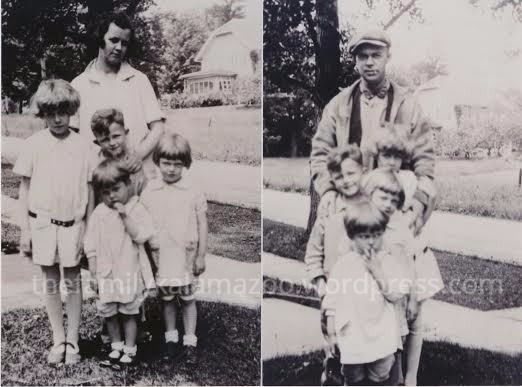
Henry and Mae had four lovely children: Eloise/Fern, James, Mary Ellen, and Judith. All four children were born in the 1920s.

Henry and Mae: each with their four children

 Henry passed away from tuberculosis in a sanitarium on May 27, 1947. According to Merry:

He is buried at Greenwood Cemetery in Grand Rapids. I was 2 years old when he died so I do not remember him at all. I do know that my mom took me to the sanitariium so he could see me but she had to stand across the room at a distance for this. A few years ago I had my mom write about both of her parents and this is what she said. “My dad, Henry, was a very gifted man. He had a beautiful singing voice, played the violin and could draw beautifully. Dad only got to see 2 or 3 of his grandchildren as he spent the last 4 years in a hospital with TB. He loved children. Dad was a good father. He wanted the best for his children. Dad died at the age of 50, too young.”

My great-grandfather also had TB and sometimes had to spend time at a sanitarium. I remember visiting him there.

It means a lot to me that Merry and I have found each other because my great-grandfather was very overtaken with grief when Henry passed away far too early. They must have been quite close.

Read Full Post »

After my last post was published, Elly and I conferred again about our Mulder family. We discovered that of the six children of Adriaan and Johanna (Mulder) Zuijdweg, we had two differences. First of all, Elly didn’t have a record of the first child, Kornelis, born in 1837. And I did not have another child who died at a very young age. Although I had on my tree, Johanna, born 1847, I did not know that there was an earlier Johanna, born in 1845, who died on 5 March, 1847. She passed away two months before her Grandfather Mulder died, and less than two years after her father applied for emigration.

Now we know why the newspaper account said there were 5 children and not 6–or 4. At the time of the application for emigration there were five Zuijdweg children. But afterwards, one died and two more were born.

So it seems likely that there really were seven in total, with one dying as a baby.

But that ain’t all, folks. There are two other exciting discoveries made by Elly.

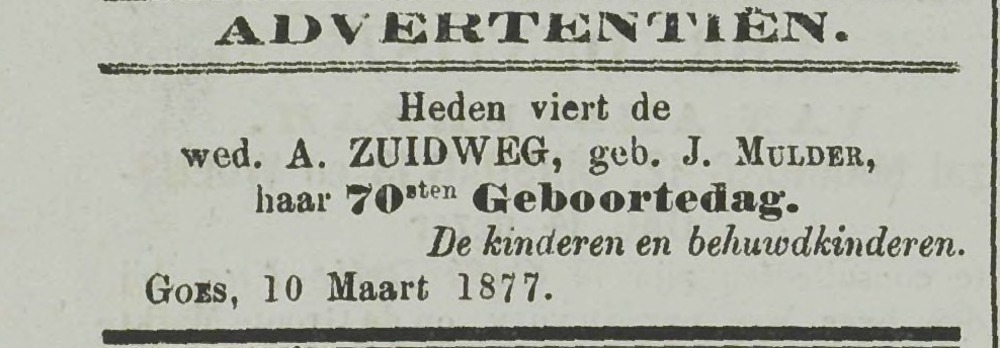
First, she found an advertisement for Johanna Mulder Zuijdweg’s 70th birthday! Johanna’s family must have been proud of her living to that age. Elly says it is customary in the Netherlands, even today for some people, to advertise 50th, 60th, 70th, etc. birthdays. It might mean that her family and friends had a small party for Johanna’s birthday.

Look at that ad. Very very interesting. It says ZUIDWEG. Not Zuijdweg. What is up with that? I thought the boundary between the two spellings was the Atlantic Ocean. But now I see this spelling used in the Netherlands! ***

Second, Elly noticed a “coincidence” when we saw the name Hogesteger in more than one place and she checked it out. I noticed it and just assumed (you know what they say about that word, right?) that it was a coincidence. But it’s no coincidence.

Adriaan Zuijdweg and his wife, Johanna Mulder Zuijdweg, wanted to emigrate to the United States in 1845. He might have been part of the group seceding from the Reformed Church. His wife’s brother, Johannes Mulder was married to Henderika Johanna Hogesteger. Johannes and Henderika emigrated to Holland, Michigan, in 1857 with their three children. But ten years before that, Henderika’s brother Johannes Hogesteger emigrated in 1847 for religious reasons. He actually was one of the leaders of the movement that seceded from the Reformed Church.

In fact, you can read here in Michigan History about how Johannes Hogesteger, a Mulder in-law, figured into the history of Michigan.

The city of Zeeland has a rich history of Christianity, beginning with the first settlers who emigrated from the Netherlands due to persecution from the State Church.

The First Reformed Church of Zeeland was formed before the city of Zeeland was founded; it was organized in the Netherlands before the 457 immigrants sailed to the United States. It is thought that this was the only other group of people besides the Pilgrims that immigrated to the U.S. as an organized church.

Reverend Cornelius Vander Meulen

Reverend Cornelius Vander Meulen

The first church service as a congregation was held three months after the arrival of the settlers, in the home of Jan Steketee. Many Sundays found the settlers worshipping outside, though in inclement weather they held services in one of the larger homes in the village. Rev. Vander Meulen was asked to be the pastor. Jannes Van de Luyster, who played an influential role in facilitating the immigration movement, was elected as elder, along with Johannes Hogesteger. Jan Steketee and Adrian Glerum were elected deacons.

In May 1848 the first church building was dedicated, but by the end of the year so many immigrants had arrived that it was necessary to build a new church. In 1849, the church recorded 175 families in the congregation.


What I get out of this is that my relatives were involved in the only other group besides the Pilgrims that moved an entire church to the United States. It seems that the Mulders (Johannes and Henderika) came ten years later than Henderika’s brother, but their 14-year-old son Karel arrived earlier. And Adriaan and Johanna never did make it to Michigan to join their fellow worshipers.

***

Info on Johanna from Zeeuw Archief

Birtday registers Zeewuws Archief


25.GOE-G-1845 Goes geboorteakten burgerlijke stand

Geboorteakte Johanna Maria Zuidweg, 10-05-1845
Soort akte:
Geboorteakte
Aktedatum:
10-05-1845
Aktenummer:
89
Geboortedatum:
10-05-1845
Geboorteplaats:
Goes
Kind:
Johanna Maria Zuidweg

Geslacht: Vrouwelijk
Vader:
Adriaan Zuidweg
Moeder:
Johanna Mulder
Gemeente:
Goes
Toegangsnummer:
25 Burgerlijke Stand Zeeland (1796) 1811-1980, (1796) 1811-1980
Inventarisnummer:
GOE-G-1845
Owner:
Zeeuws Archief


Death registers Zeeuws Archief


25.GOE-O-1847 Goes overlijdensakten burgerlijke stand
Overlijden Johanna Maria Zuidweg, 5-3-1847
Soort akte:
Overlijdensakte
Aktenummer:
74
Aktedatum:
1847
Gemeente:
Goes
Overlijdensdatum:
5-3-1847
Overlijdensplaats:
Goes
Overledene:
Johanna Maria Zuidweg

Geboorteplaats: Goes
Geslacht: Vrouwelijk
Leeftijd: 2 jaar
Vader:
Adriaan Zuidweg

Leeftijd: 42
Beroep: Kleermaker
Moeder:
Johanna Mulder

Leeftijd: 39
Beroep: Zonder
Toegangsnummer:
25 Burgerlijke Stand Zeeland (1796) 1811-1980, (1796) 1811-1980
Inventarisnummer:
GOE-O-1847
Owner:
Zeeuws Archief

Read Full Post »

My new friend (and Xth Mulder cousin) Elly sent me something she found in the Goes archives that I think is quite special.

Let me give a little context first. My grandfather, Adrian Zuidweg, was the son of Adriaan Zuijdweg who immigrated to the United States in 1893. Adriaan’s father and mother, Johannes and Jennie, also immigrated after their son–in 1901.

Johannes’ father was Adriaan Zuijdweg, 1805-1851. He only lived to be 46 years old.

I also want to “remind” you that both my maternal grandparents are descended from Carel Mulder, the jailer’s hand. So while Elly was researching the Mulders she came across information about not only a descendent of Carel in the form of Johanna, his daughter, but also her husband Adriaan Zuijdweg, my 3rd great-grandfather through my grandfather’s line.

Elly says:
I found a quote in the archives of Goes, that Adriaan Zuidweg (born in 1805 and married [to] Johanna Mulder, daughter of Carel Mulder) made a request at the town-councelors to make it possible ( to emigrate with his family –5 children) to the USA.
Apparently it was denied, because 6 years later he died in Goes.
 !!! He wanted to bring his branch of the family to the United States long before the family actually did come here!
Here is the text:
Landverhuizers
Als gevolg van de misoogst en armoede, maar ook vanwege de tegenwerking van de afgescheidenen van de Hervormde kerk, verlaten de zogenaamde ‘landverhuizers’ ons land en emigreren naar Amerika en Canada. Op de 26e juli 1845 verzoeken twee ingezetenen van de stad om in de gelegenheid gesteld te worden buiten hun kosten te vertrekken naar Noord Amerika omdat ze zich buiten staat bevinden hier in hun levensonderhoud te voorzien. Het betreft de ongehuwde 39-jarige Adriaan Johannes de Wolff, timmerman, metselaar en schilder, en de 40-jarige Adriaan Zuidweg, kleermaker, gehuwd en vijf kinderen.
Elly continues:
It was an article about emigration.
Translated it says:
Because of crop failure and poverty, but also because of the opposition against the members of the separated Reformed church , many people leave the Netherlands and emigrate to the US and Canada.
On 26 July 1845 two citizens of Goes made a request to be enabled to emigrate, with the costs of this emigration paid by the town, because they are not able to support their means of living in this town.
It concerns A.J.de Wolff ( 39 years old, not married), carpenter, bricklayer and painter, and Adriaan Zuidweg, tailor, married and 5 children.
Of course, my mind went off in many directions. I wondered if the family was very poor and if they were even hungry. I thought that Adriaan had absolutely no resources. That he had to essentially beg to leave. That he was denied that opportunity, which seems cruel, like imprisoning someone without food. That here was confirmation that Adriaan was a tailor as I had already learned.
Then it dawned on me that I didn’t know what “separated Reformed church” means. I had vaguely known that most of my Dutch ancestors were adherents to the Reformed religion (a branch of Calvinism), at least until they came to the United States. But what did this “separated” thing mean?
I tried to Google the information, but it got more and more confusing to me, so I asked Elly if she could help. She sent me some sources. A Google translation of a passage from http://encyclopedievanzeeland.nl/Emigratie_van_Afgescheidenen goes this way:

As the Pilgrim Fathers in 1620 as a community have migrated to America, so are also left the secessionists of South Beveland in the spring of 1847 and she settled in Michigan as a congregation.

Apparently for a short time in the mid-19th century, there were people seceding from the Reformed Church–and these people must have included my 3rd great-grandfather, Adriaan Zuijdweg. Apparently they were from Zeeland, and this was not a big “wave” all over the Netherlands.

According to Elly, this period lasted from approximately 1830-1850, and the people were not persecuted but did find a lot of opposition. The movement must have been very small and confined to the region because apparently it is not taught in history classes in the Netherlands.

According to Wikipedia:

During the early nineteenth century, large numbers of Dutch farmers, forced by high taxes and low wages, started immigrating to America. They mainly settled down in the Midwest, especially Michigan, Illinois and Iowa. In the 1840s, Calvinist immigrants desiring more religious freedom immigrated. West Michigan in particular has become associated with Dutch American culture, and the highly conservative influence Dutch Reformed Church, centering on the cities of Holland and (to a lesser extent)Grand Rapids.

Waves of Catholic Dutch emigrants, initially encouraged in the 1840s by Father Theodore J. Van den Broek, emigrated from southern Netherlands to form communities in Wisconsin, primarily to Little Chute, Hollandtown, and the outlying farming communities. Whole families and even neighborhoods left for America. Most of these early emigrants were from villages nearUden, including Zeeland, Boekel, Mill, Oploo and Gemert. By contrast, many Protestant agrarian emigrants to Michigan and Iowa were drawn from Groningen, Friesland, and Zeeland; areas known for their clay soils.[4]

The Dutch economy of the 1840s was stagnant and much of the motivation to emigrate was economic rather than political or religious. The emigrants were not poor, as the cost of passage, expenses and land purchase in America would have been substantial. They were not, however, affluent and many would have been risking most of their wealth on the chance of economic improvement. There were also political pressures at the time that favored mass emigrations of Catholics.[4][5][6] Yda Schreuder, Dutch Catholic Immigrant Settlement in Wisconsin, 1850-1905 (New York: Garland, 1989); and H. A. V. M. van Stekelenburg, Landverhuizing als regionaal verschijnsel: Van Noord-Brabant naar Noord-Amerika 1820-1880 (Tilburg: Stichting Zuidelijk Historisch Contact, 1991).

It’s true that many of my Dutch ancestors did come from Zeeland and perhaps one branch from Groningen, although one branch came from Zwolle. So was Adriaan really that poor or was he rather temporarily economically “flat” because of the worsening economy in his country? I’d say the latter.

I do feel bad that the family had this hardship and wonder how it affected the children, especially Johannes, Grandpa’s grandfather. Although his father Adriaan couldn’t get him to America, apparently his son Adriaan did so.

As an aside, when I was a kid I used to love the folk and fairy tales that featured tailors and shoemakers, so I find it charming when I hear that so many of my ancestors were tailors and shoemakers, as well as merchants.

Here’s another tangent. Why do the men have occupations like that so often, but the women are usually maids or servants? Is that because those were their jobs when they got married and then they generally quit work after getting married? Did the daughters of tailors and shoemakers become maids when they were old enough to work but still unmarried? Or did they remain maids throughout their lives? What did it mean to be a maid in Zeeland in the 1800s? And, most importantly, did they wear white pinafore aprons?

Elly and I both wonder what happened to Johanna after Adriaan’s death. I checked out my family tree to see what chronology I could see.

Johanna was 29 when she married Adriaan. Then she had four children in a row (Kornelis, Karel, Geertrui, Johannes). On 26 July, 1845, when Adriaan made his application for emigration, the children were 8, 7, 5, and 3. That’s quite a handful. Less than two years after the application, Johanna’s father, Carel Mulder, died. He is the one who got sick and his prison guard job was awarded to another son-in-law, NOT to Adriaan. Seven months after Carel’s death, Johanna gave birth to yet another child, Johanna. The sixth child, Willem, was born in 1849.

It’s no wonder that in 1869, when Johanna was 62 years old, she was working as a laborer in Goes. She must have had to go to work after Adriaan’s death, if not before. Did she work when she was pregnant? Who took care of her children? Her own father was undergoing his own problems before his death, so he couldn’t help her. First he was suspended from his job for insubordination, then he became ill and eventually passed away.

What of Adriaan’s parents? The other grandparents of the children . . . .   Adriaan’s father, a fish inspector, passed away in 1841, five years before the application to emigrate was made. His mother died in 1838 after seeing only one of her grandchildren by Adriaan born.

Where does some of this information about Adriaan and Johanna (Mulder) Zuijdweg come from? The Goes archives.  Elly says that this archives is linked to the archives in Zeeland.

Zeeuws Archief


Read Full Post »

In the midst of researching the Waldecks, I’ve been in contact with Elly, as you know, and Merry, who I haven’t told you about yet, from the Mulder branch of the family.

Elly found me through this blog, as I’ve mentioned. I found Merry through a DNA match. We both had our results stored at 23andme, and there it was, a fairly close match of 2nd-3rd cousin. When a match is that close, if both individuals have an idea of their family trees, you can usually find a match. It didn’t take us long at all.

Merry’s grandfather Henry (Heinrich Mulder) and my great-grandfather Charles were brothers! We are both descended from Pieter Philippus and Neeltje (Peter and Nellie) Mulder who arrived in Grand Rapids with two babies. One was Charles and the other was a baby named Jan who passed away shortly after the young couple arrived in the U.S. Henry was born in this country.

Peter and Nellie traveled on the ship Zaandam, which arrived in New York on August 29, 1887. They were able to immigrate because Peter had received a bequest when his grandmother Rosalie Melanie Bataille passed away.

I promise to get back to Elly’s findings in a later post. Today I want to share with you the photos of Peter and Nellie that Merry shared with me. And by putting them in the blog to share them with Elly and others as well!


In this formal portrait, how old do you think they are? Note that Nellie was 63 when she died. Mom says that Peter was a very small man, so it seems that Nellie herself must have been very short. I recently read an article trying to answer the question of how the Dutch became the tallest people in the world. My own relatives were sometimes, but not always, on the short side, so I was curious. What I learned is that in the past 150 years the heighth of Dutch people has dramatically increased. Until this growth spurt they were the shortest in Europe!

As to why the Dutch grew, the article makes a case for eating a lot of dairy (among other causes). My husband says he thinks it also has to do with the Netherlands claiming more land from the sea and being able to eat meat instead of relying on fish for a large portion of their diet. I’m sure there are many ideas on this subject!

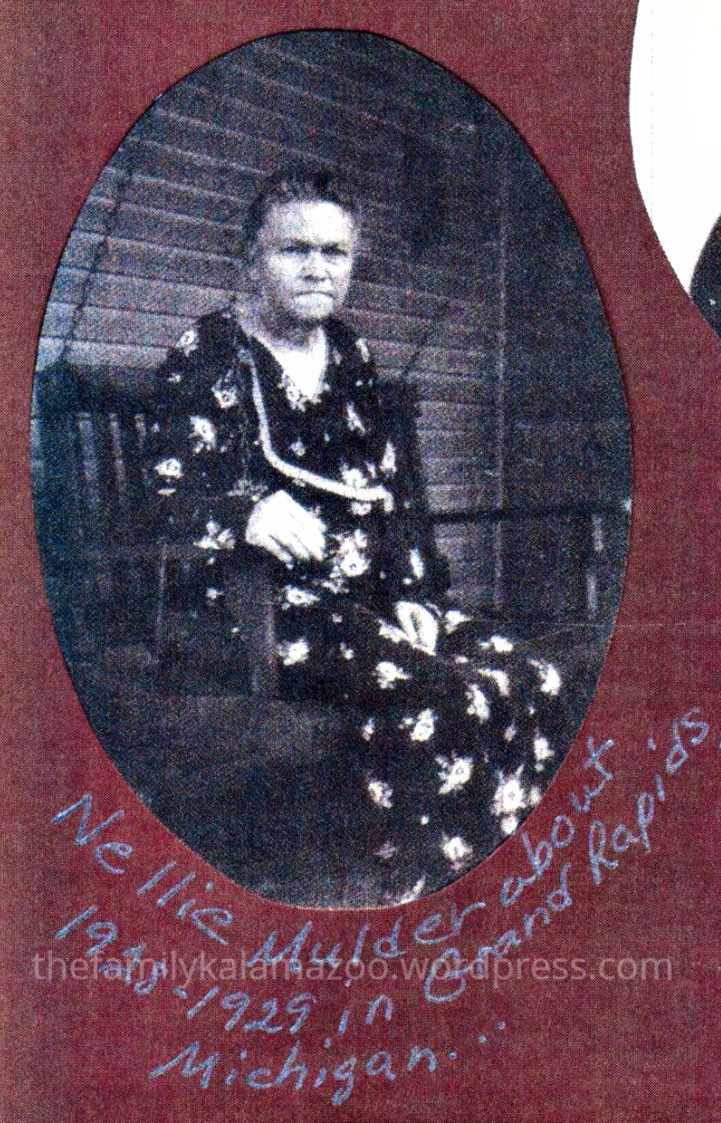
In the next photo, Nellie’s dress is very long.  While Peter (born 1865) was 3 years older than Nellie (born 1868), she passed away in 1932 and Peter lived until 1953, two years before I was born. After his wife’s death, Peter traveled around to his children’s homes, living with one then another. I wonder whose cooking he liked best (I hope it was my great-grandmother Clara who died the same year as Peter)!


Merry says that this photo of Nellie taken in a porch rocker should be dated somewhere between 1925 and 1929. Since it’s the same dress as above, I’ll assume these photos were taken around the same time.

Here is a formal portrait of Peter:


In this photo he looks like he could be related to Colonel Potter (MASH), in my opinion. Or the shopkeeper on Green Acres (Frank Cady as Mr. Drucker).

More to come about the Mulders, both those in Netherlands and those in Michigan!


Read Full Post »

As you know, I get sidetracked by a lot of subjects. In 2016, I would like to focus on 3 family branches. No telling how many tangents I’ll go off on though. I’ve met some wonderful distant relatives and other new friends through the blog and my genealogical research, and I would like to incorporate some of the information I’ve gotten as well as sharing some of my research.

Today I’d like to mention the Mulders. I’ve written of them before, and you can find the other posts from the “Individuals and Topics” section on the right: Mulders link. This is my maternal grandmother’s father’s family from Caledonia, Michigan; Grand Rapids, Michigan; and Goes, Zeeland, the Netherlands.

One Mulder I’ve (virtually) met is Elly, who lives in the Netherlands. She is descended from the same Karel Mulder, the jailor’s hand, that both my maternal grandparents were.  As she puts it, she is a descendant of Karel Mulder (1837-1881), the eldest son of Karel Mulder and Rosalie (Rose Melanie) Bataille.

Elly found a death announcement for Rose Melanie in the old local newspaper, de Goessche Courant.  It says that she died in the house of her son, Andries Mulder. Rose Melanie was a rather wealthy widow when she died. She had several houses and pieces of land in her possession.There is a statement of inheritance tax.
Let’s take a look at my genealogy results for this family from Yvette Hoitink.

Karel Mulder was born on 3 December 1812 at C 85 in Goes, Zeeland, the Netherlands.20 On 5 May 1836 he was a
shoemaker in Goes, Zeeland, the Netherlands.21 8 On 21 February 1837 he was a shoemaker in Goes, Zeeland, the
Netherlands.8 Karel died on 3 January 1870 at the age of 57 in Goes, Zeeland, the Netherlands.22 He owned 3/8 of a house
and yard in the “Papegaaistraatje [Parrot Street]” district C nr. 97 on 3 January 1870 at section D nr. 278 in Goes, Zeeland,
the Netherlands.5 Rose Melanie Bataille and Karel Mulder were married on 5 May 1836 in Goes, Zeeland, the Netherlands.21
Rose Melanie Bataille was born about 1810 in Etaples, France.21 On 5 May 1836 she was a servant in Goes, Zeeland, the
Netherlands.21 She lived in Goes, Zeeland, the Netherlands on 22 April 1881.11 Rose died on 10 July 1887 at the age of 77 in
Goes, Zeeland, the Netherlands.23

Karel Mulder and Rose Melanie Bataille had the following children:
8 i. Karel Mulder, born 21 February 1837, Goes, Zeeland, the Netherlands; died 22 April 1881, Goes,
Zeeland, the Netherlands. NOTE THAT KAREL IS ELLY’S ANCESTOR. HE IS ALSO MY ANCESTOR.
ii. Pieter Philip Mulder was born on 29 August 1838 in Goes, Zeeland, the Netherlands.24
iii. Kornelis Mulder was born on 4 September 1840 in Goes, Zeeland, the Netherlands.25 He died on 3 June
1887 at the age of 46 in Goes, Zeeland, the Netherlands.26 On 3 June 1887 he was a shoemaker in Goes,
Zeeland, the Netherlands.26
iv. Melanie Mulder was born on 21 January 1842 in Goes, Zeeland, the Netherlands.27 She died on 23 June
1884 at the age of 42 in Goes, Zeeland, the Netherlands.28
v. Johannes Mulder was born on 12 November 1843 in Goes, Zeeland, the Netherlands.29 He died on 7
January 1849 at the age of 5 in Goes, Zeeland, the Netherlands.30
vi. Andries Mulder was born on 23 January 1846 in Goes, Zeeland, the Netherlands.31 THE SON WHO ROSE MELANIE LIVED WITH WHEN SHE DIED AT AGE 77.
vii. Jan Mulder was born on 9 December 1848 in Goes, Zeeland, the Netherlands.32 On 22 April 1881 he was
a shopkeeper in paint and colonial goods in Goes, Zeeland, the Netherlands.5
viii. Johannes Mulder was born on 10 February 1851 in Goes, Zeeland, the Netherlands.33 He died on 26
June 1876 at the age of 25 in Goes, Zeeland, the Netherlands.34 On 26 June 1876 he was a shoemaker in
Goes, Zeeland, the Netherlands.34
ix. Jacobus Mulder was born on 13 May 1856 in Goes, Zeeland, the Netherlands.35 He died on 17 June 1874
at the age of 18 in Goes, Zeeland, the Netherlands.36 On 17 June 1874 he was a shopkeeper’s assistant in
Goes, Zeeland, the Netherlands.36

NOTE that Elly discovered that Rose Melanie was quite wealthy when she passed away. See above that when she was married she was a servant. It appears that Karel was a shopkeeper and must have done well for his family.

When Rose Melanie died, her son Karel (born 1837) had already been dead for 6 years and his youngest children, thanks to the 2nd wife ;), had been sent to an orphanage. You can read that sad tale here. With the bequest that Karel’s son Pieter received from his grandmother’s death, he took his wife and two babies (including my great-grandfather) to the United States.

So, Elly, if you’re reading, which child of Karel (born 1837) are you descended from? See below. Perhaps Karel or Izaak?

i. Karel Pierre Philippe Mulder was born on 8 May 1862 in Goes, Zeeland, the Netherlands.13
ii. Izaak Mulder was born on 20 July 1863 in Goes, Zeeland, the Netherlands.14
iii. Rose Melanie Mulder was born on 12 August 1864 in Goes, Zeeland, the Netherlands.15 She died on 1
December 1864 at the age of 0 in Goes, Zeeland, the Netherlands.16 DIED AS AN INFANT
iv. Pieter Philippus Mulder, born 10 October 1865, Goes, Zeeland, the Netherlands. My 2great grandfather.
v. Adrianus Cornelis Mulder was born on 7 October 1866 in Goes, Zeeland, the Netherlands.17 He lived at
the city orphanage in Goes, Zeeland, the Netherlands on 2 August 1881. He died on 15 March 1891 at
the age of 24 in Goes, Zeeland, the Netherlands.18 On 15 March 1891 Adrianus was a shopkeeper’s
assistant in Goes, Zeeland, the Netherlands.10 DIED AT AGE 24
vi. stillborn child Mulder was born on 5 October 1867 in Goes, Zeeland, the Netherlands.19 He died on 5
October 1867 at the age of 0 in Goes, Zeeland, the Netherlands.19 STILLBORN
10.

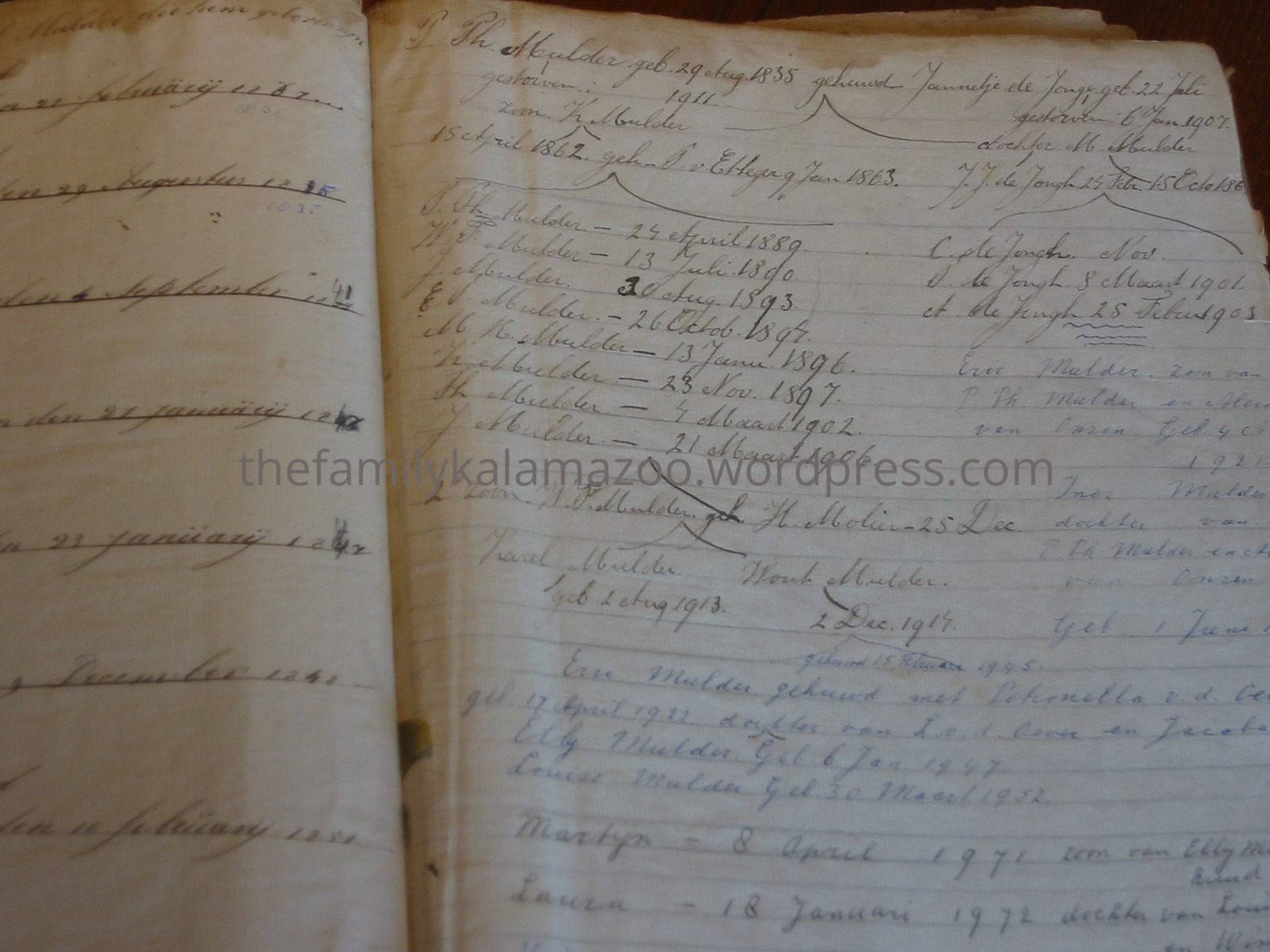
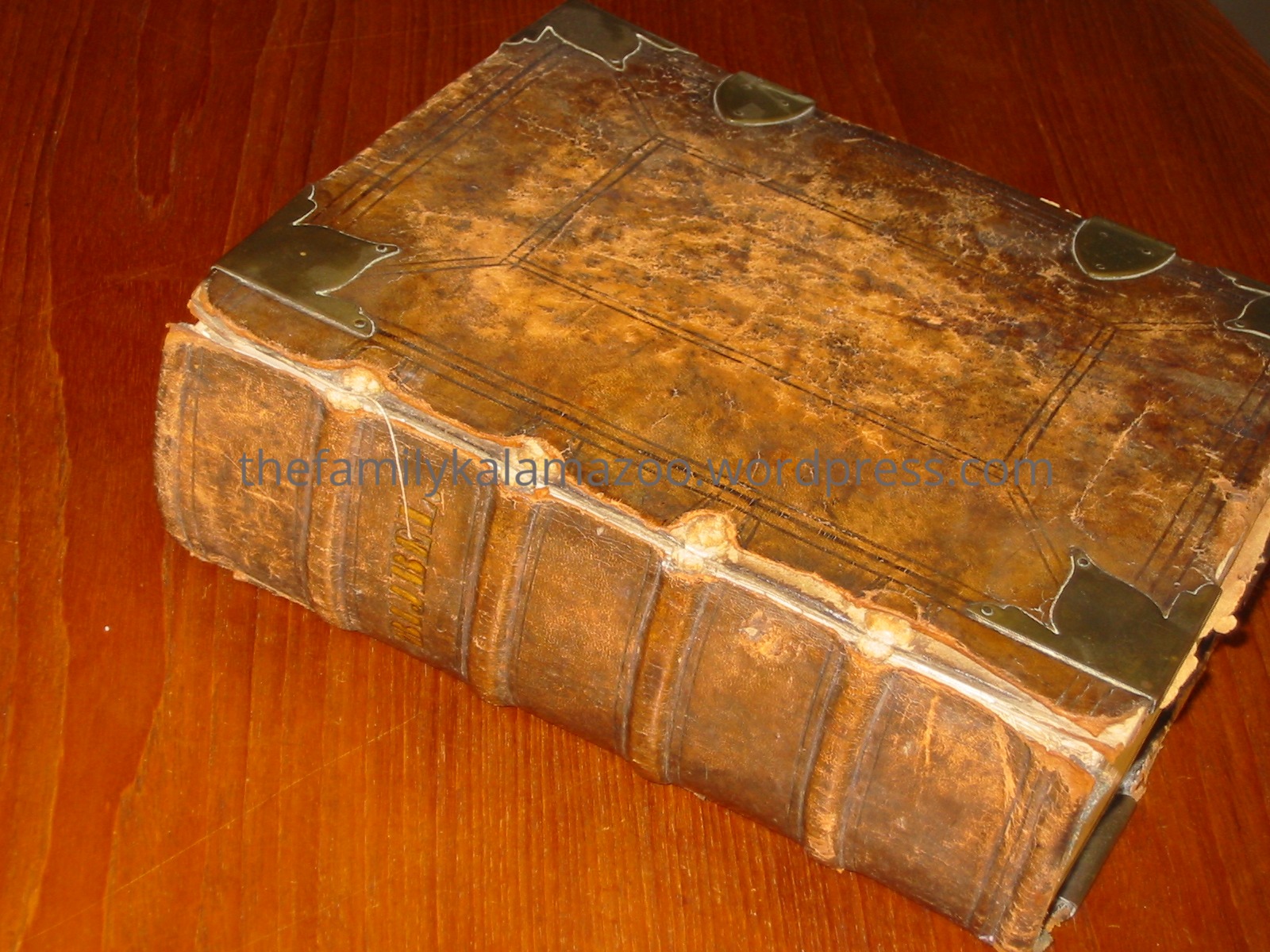
The best news so far from Elly, besides meeting her, is that she sent me photos of the family Bible!

The family history was written in this Bible, according to tradition. It was begun by Karel Mulder who was born in 1812. He started it in 1867, three years before he died.
I hope that Elly and I can continue to share information about the Mulder family!

Read Full Post »

I haven’t written much about my grandfather’s paternal grandparents. I wrote about his aunt’s family, the Van Lieres, but we know very little about the parents of Grandpa’s father and his aunt.

His paternal grandmother was Jennegien (Jennie) Bomhoff. She was born 5 March, 1838 in Zwolle, Overjissel, the Netherlands. She passed away on 16 December 1924 in Kalamazoo.

She married Grandpa’s grandfather, Johannes (John)  Zuidweg, in Goes, the Netherlands on 4 November 1869, when she was 31 years old and working as a maid.

Grandpa told me that she wore many layers of skirts and they all had pockets in them.  Can you tell below that she was wearing layers of clothing? What do you think she carried in those pockets? He did tell me that he saw her pull an apple out from an under skirt.

The following photos were identified to me as Jennie.  How old do you think she is in each one?


What style bonnet is she wearing? And how many decades did she wear that same bonnet?!


In the next photograph, she is the woman on the side, in the dark dress.

Here is some research Yvette Hoitink provided about this family:

In 1869, Jennegien married Johannes Zuijdweg in Goes, Zeeland, about 150 miles away. That is an uncommonly large distance for somebody to travel in the 19th century, especially for an unmarried woman from the working class. Further investigation showed that her brother Albert Bomhoff was married in Goes in 1867. It must be through this connection that Jennegien moved to Goes, where she worked as a maid prior to her marriage. A rich and easy to retrieve source of information for ancestors in the 19th century are the marriage supplements: the documents a bride and groom had to submit when they got married. Unfortunately, the Goes marriage supplements for the period 1811-1877 got lost in 1877. Since several marriages on the Zuidweg side took place in Goes, these records could not be obtained. Digital images of the marriage supplements of Lucas Bomhof and Jeuntien Dansser, the parents of Jennegien Bomhof, were retrieved from Familysearch.org. Lucas Bomhof was born as Nijentap, but his family took the name Bomhof around 1812. In the province of Overijssel, it was common to be named after the farm you lived on. It was only with the French occupation that people were obliged to take a hereditary surname. Nijentap may be the name of the farm that the family lived at.


Read Full Post »

« Newer Posts - Older Posts »