Feeds:
Posts
Comments

Posts Tagged ‘Adrian Zuidweg’

Click this link for Part I

Click this link for Part II

Click this link for Part III

Part IV

Grandpa always enjoyed watching and following sports.  Reading his story I now understand that his love of sports began when he was young.  We used to eat Thanksgiving dinner before the game, and I first learned about sports scores in the newspaper when he showed them to me.

It’s not surprising to me that Grandpa “was a good student and athlete.”  What I enjoy reading are the details.  That he played something called “soccer (rugby)” and was on the track team.  I was never an athlete, but I did enjoy track and tennis–especially track.  Maybe when I was in high school he told me he used to be on the track team, but I don’t remember .  I wonder what his events were.  I favored low hurdles and 100 yard dash.  Other than square dancing, it was the only PE activity I had talent at, but I didn’t have the guts to pursue it outside of class.  Other than that, I was always the 2nd to the last girl chosen for the team. However, other grandchildren were talented athletes, and at least three of his great-grandchildren are very accomplished athletes.

Curious about how rugby is parenthetical to soccer, I had to look it up.  Here is an interesting history of soccer in the United States which explains the rugby connection, as well as how soccer had come to very popular at the time Grandpa would have entered high school, in the early 1920s.

From 1875-1894

After the demise of college soccer in 1876, working class communities in the US adopted the game, taking on the rugby/gridiron form of soccer. It is interesting to note that this trend took place at the same time in Europe and the US. The development could be seen in New Jersey, Philadelphia and New York City, also spreading rapidly to Fall River and New Redford (MA) by 1870s. The game also clashed with the popular sport of baseball in the US, considered as American past time.

Beginning in early 1890s, soccer witnessed an average growth in Denver, Cincinnati, Cleveland and even San Francisco and Los Angeles by the end of the century. Owing to corporate sponsorships, some leagues attained semi-pro statistics. The American League of Professional Football collapsed owing to heavy financial losses during its first season.

In 1904, FIFA was established and was seen as lack of any national organizing association in the US. After FIFA refused an American application for membership during their 1912 congress, the speedily growing AAFA members formed the United States Football Association, which was accepted by FIFA. The main aim of the association was to end the struggle between amateur and professional soccer organizations.

Three of the early dynasties of American Soccer were,

  •  The Fall River Rovers- winners of the American Cup in 1888 and 1889,
•  Bethlehem Steel, who won the American Cup in 1914, 1916, 1917, 1918, and 1919
•  And winners of the National Challenge Cup in 1915, 1916, 1918, and 1919

The 1920s are popularly known as the golden era in the history of American soccer. The establishment of American Soccer League in 1921 was a mark as there was now a league that could compete with European players.

Grandpa must have had quite a walk to get to the track meets. I wonder where on campus they were held in those years.  Read Fieldhouse didn’t exist until 1957. Waldo Football Stadium wasn’t constructed until 1939, across from the baseball stadium. However, football had been on that particular property since 1914.   Since the school began as Western Normal School in 1903, only five years before Grandpa was born, I believe that at the time he was walking there, everything was located in that area off Oakland Drive (Known as Asylum Road).  It’s still quite a hike from his home on Burdick Street.

I had no idea that Grandpa had another major injury while he was still a child. A spike lodging near his spine?! That would be so frightening–for him and for his parents.  He was an only child, so his parents doted on him very much. Then to think that he missed a year and a half of school because of the injury makes me wonder what he did for that time. Was he around his mother a lot or was she at the shop? Did his grandfather still live there?  I know that his grandfather remarried when he was two, so I need to piece together addresses to see where all the family members lived each year. It seems that Grandpa’s grandfather may have moved next door when he remarried, but I can’t yet be sure.

I’m not surprised he joined the baseball team after that as he would have been “rarin” to  go, and baseball was another very popular sport.

Finally, don’t think that his comment about his teacher, Mrs. Dilts, is just an “aside.”  Grandpa loved finance.  He loved everything about money and how it worked–finance, economics, accounting.  Therefore, I suspect that he first got bitten by the love bug of finance in Mrs. Dilts’ class.  Every night, after his Sunoco station closed, Grandpa closed himself in the bedroom that served as an office and counted the money.

I hope you’ll stay tuned for Part V of Grandpa’s story . . . .

Read Full Post »

Click this link for Part I

Click this link for Part II

Part III

As I grew up there were two ways I knew my grandfather was blind in one eye. One way was that I was sometimes warned, “Be careful. You don’t want to lose your eye like Grandpa.” Mom and Dad will probably disagree that Grandpa was used as a warning to me, but I know the truth in this respect . . . .  The other way I knew was that he had one blue eye, just like mine, and he had one green eye.

Everybody else I knew had two eyes of the same color.

In this next part of Grandpa’s story he tells Connie what happened to his eye.

In 1911, Grandpa’s eye was treated at the University of Michigan hospital in Ann Arbor, about 100 miles away from his home.  I imagine the worried parents and the frightened boy travelling all that way on “streetcar, train and horse-drawn carriages.”  What would that trip be like today?  A visit in the car or ambulance to the nearest hospital, then perhaps a drive of an hour and a half to the medical center?  In an ambulance or a car, depending on the urgency.  The car would have the boy’s car seat in it.  What was it like for him? Was he carried as they moved from one mode of transportation to the next?

I believe it’s likely that he was seen at the old hospital in Ann Arbor on Catherine Street.  It is no longer there as it was replaced by the 700-bed University Hospital in 1925.

Photo by Wystan

Photo by Wystan

Today it’s hard to imagine letting your three-year-old play with a needle, but in those days children learned how to perform daily chores and trades at their parents’ sides.

The description of Grandpa bouncing off the table from being shocked by the X-ray machine is frightening. When I looked up the history of X-rays on Wikipedia, it was even more frightening. Although a lot of research led up to the moment, X-rays were not actually “discovered” until 1895. The site states, “The first use of X-rays under clinical conditions was by John Hall-Edwards in Birmingham, England on 11 January 1896, when he radiographed a needle stuck in the hand of an associate.” Since Grandpa’s injury was in 1911 and UM had only had the machine for twelve years, that means that they bought one of the first machines in 1899.

1899 X-ray machine

1899 X-ray machine

I understand that Grandpa’s medical records from 1911 are still stored at the University of Michigan. I hope I will be privileged to see a copy of them some day.

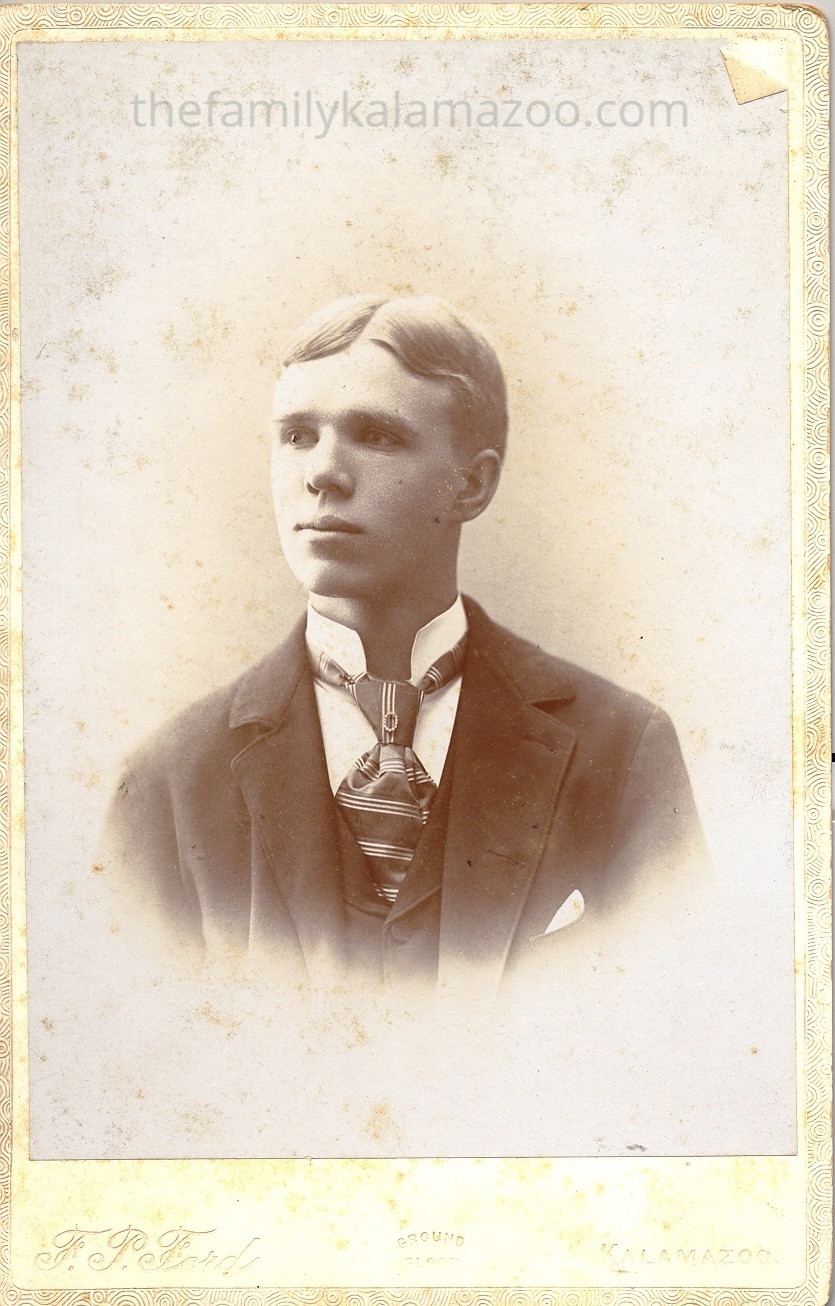
Here is a photo of the cute little boy who got a needle stuck in his eye:

Adrian Zuidweg, 1908-2000

Adrian Zuidweg, 1908-2000

Grandpa’s stoic attitude about his blind eye was typical of his personality. He didn’t show emotion very often, and he was quite practical. He loved his routines. His talent with routines and his prodigious memory proved invaluable when he became completely blind.

I hope you’ll stay tuned for Part IV of Grandpa’s story . . . .

Read Full Post »

Click here for Part I.

In my post of July 16, I shared the beginning of the story pieced together by Connie Jo Bowman in 1994, when she interviewed my grandfather Adrian Zuidweg.  Here is the next part.  Today I am going to focus on just one paragraph–to try to unpack it.

Here is what Connie wrote:

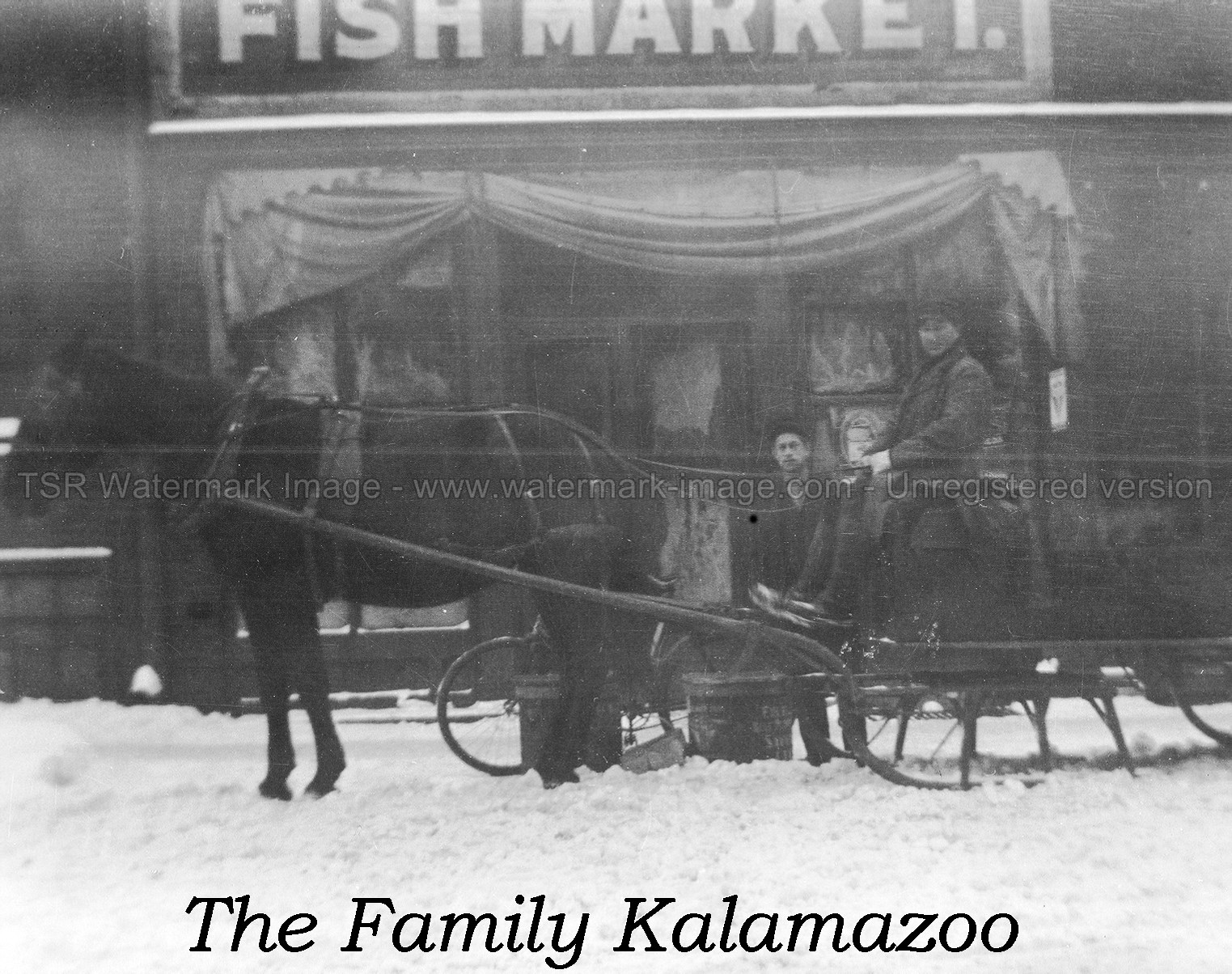
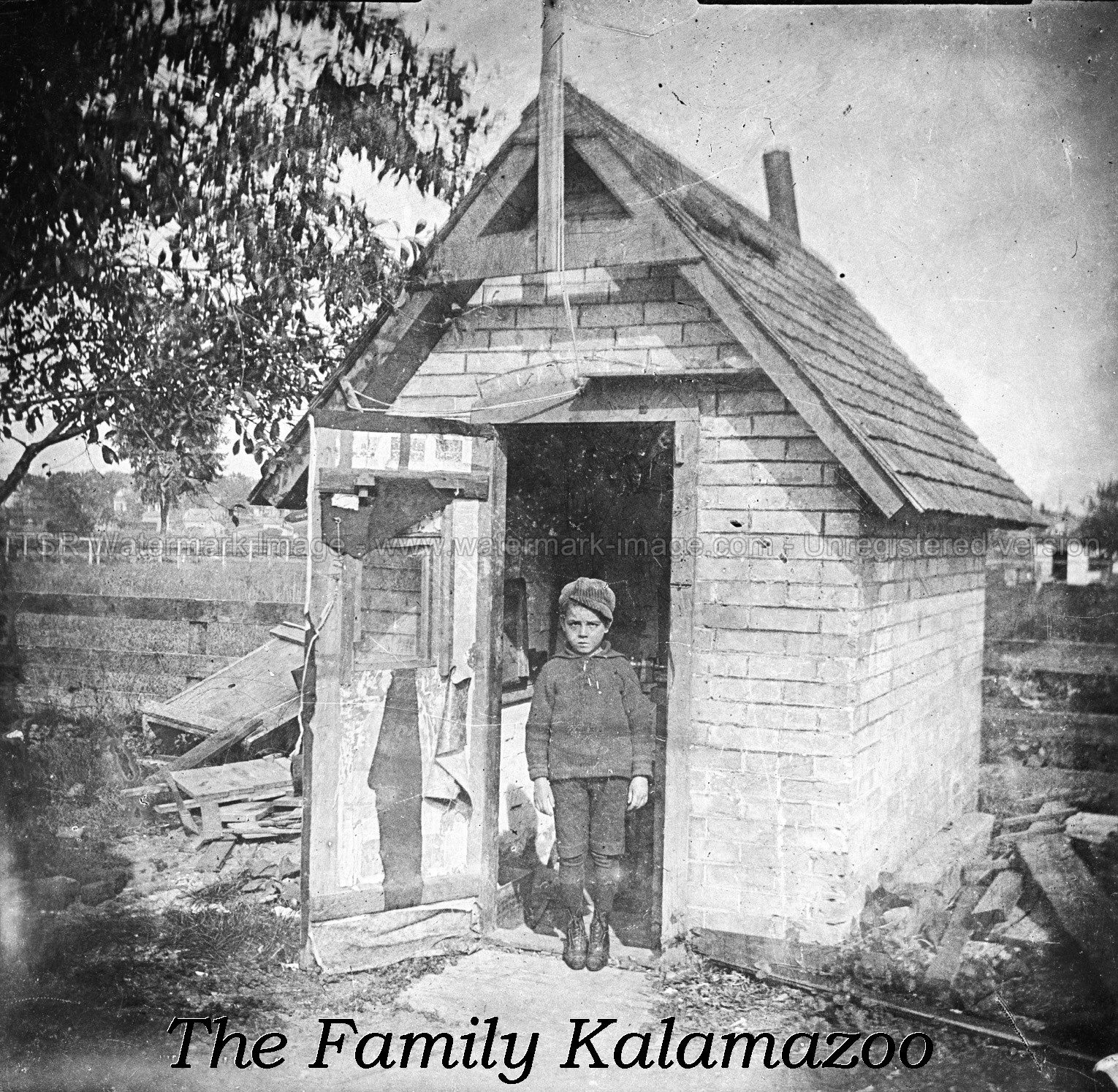
His father owned a fish market and Adrian’s earliest memories were of going to his aunt’s house while his mother helped out at the market. He remembers playing with his cousins around the big woodburning stove and the “outside toilet.” This was before 1911 because that was the year gas and sewer lines were brought up the street to their house.

I’ve written before about Grandpa’s father’s fish market in the post “My Great-Grandfather Reinvented Himself as a Business Owner in the U.S.” I share photos in that post of the interior of the fish market and the interior of the ice cream parlor Adriaan Zuijdweg (Grandpa’s father) owned after the fish market.

Adriaan Zuijdweg, Proprietor, standing

Adriaan Zuijdweg, Proprietor, standing

So that’s where Grandpa’s mother Cora went to “help out” at the market.  But Grandpa himself stayed at his aunt’s. There are two possibilities. One is his Aunt Jen, Cora’s sister. The other is his Aunt Johanna, his father’s sister.  Before 1911, Grandpa was a toddler–maybe two years old. Some people don’t have memories from that age, but I also have memories from when I was two years old.

Let’s say the year was 1910.  In 1910, Johanna Zuijdweg Van Liere had been in the United States for six years. She married her husband Marinus Van Liere in Goes, the town in the Netherlands they were both from. Johanna had two baby boys when she immigrated here, and by 1910 may have had six, seven, or eight boys. I’m not sure if they all survived infancy, but she was evidently quite busy.

Grandpa’s mother’s sister Jen, on the other hand, had one 13-year-old daughter in 1910.

If Grandpa played with his cousins around the stove and the outhouse in the yard, it would be Johanna’s children.  This led to me to search out where Johanna and Marinus were living in 1910.

Shed or outhouse?

Shed or outhouse?

The 1910 U.S. Census shows Grandpa living with both his parents, Adriaan and Cora, his grandfather Richard DeKorn, and his uncle Joseph DeKorn in the Richard DeKorn house at the corner of Burdick and Balch: 1324 S. Burdick Street. Since the house still stands today, if it wasn’t moved, the address numbers have been changed on Burdick. The VanLieres, Johanna and Marinus, and their six boys lived at 1338 S. Burdick Street. It looks like another family lived between them. About four houses down from the VanLieres lived John and Mary DeSmit and their children. Mary DeSmit was Richard DeKorn’s sister.

I found it interesting that the census shows Johanna and Marinus speaking English, although they had only been in this country for six years. A few of the neighbors spoke Dutch, but most of them spoke English.

Johanna Zuijdweg VanLiere and Marinus VanLiere with son Jacob

Johanna Zuijdweg VanLiere and Marinus VanLiere with son Jacob

In this section of Grandpa’s story, he remembers that gas and sewer lines were brought up to their house in 1911. It must have made a monumental difference in the quality of their lives. Because his grandfather, Richard DeKorn, was a building contractor, would they have been quicker to get connected or was it something they had to wait their turn for, like everybody else?

On a personal note, I was surprised that Grandpa’s family was as close with his father’s sister and her family as this research shows.  I knew that the family was often with Aunt Jen, as many of the family photos are of Jen and her husband Lou.  But there aren’t as many photos of Johanna, nor do I know the history of that branch of the family as the children all grew up.

I hope you’ll stay tuned for Part III of Grandpa’s story . . . .

Read Full Post »

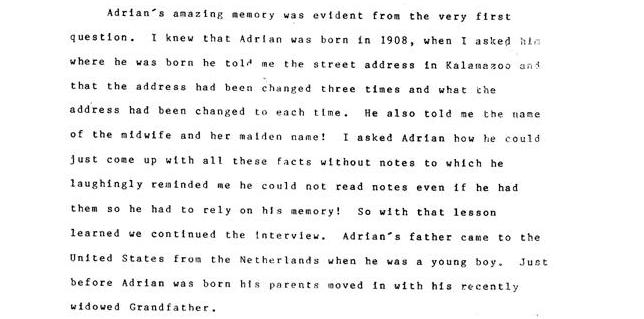
In 1994, five and a half years before he passed away, my grandfather, Adrian Zuidweg, was interviewed by Connie Jo Bowman, the head of residents at Crossroads Village, a retirement community in Portage, Michigan. Connie was taking a course about the elderly at Western Michigan University and chose Grandpa as her subject.  I’ve written about Grandpa in a post about our left-handed connection.

The entire interview is eight typed pages, so I’ll divide it among a few blog posts.

Adrian Zuidweg 1908-2000

Adrian Zuidweg 1908-2000

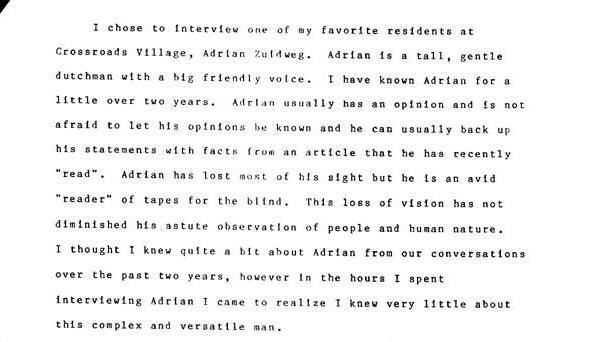
Connie begins by introducing my grandfather, Adrian Zuidweg.  To read the excerpts of Connie’s report, you can click them for a better view (I hope):

Connie identifies my grandfather here as a “tall, gentle dutchman with a big friendly voice.” That would probably be how Grandpa thought of himself. He identified strongly with his Dutch heritage.  He had a lot of jokes, but one of his favorites was to say, “If you ain’t Dutch, you ain’t much.” He didn’t really mean it, which you will see by the end of the interview, but he was very proud of being Dutch.

She also notes here how after talking with Grandpa for two years it wasn’t until she began interviewing him that she realized how much there was to know about Grandpa. Grandpa’s powers of observation were impressive to her, especially in light of his blindness. He only became completely blind in his old age, but he had been blind in one eye since he was a small child.

Connie was right–Grandpa had an amazing memory. He also loved to tell stories, especially stories about the past. As the oldest grandchild, I was privy to more of them than the other kids, but I still only know a few from his vast store.

Now that I realize that Grandpa knew the name of the midwife who delivered him, I wish Connie had put that information into her report, but perhaps it didn’t fit with the class assignment.

Here she mentions how Grandpa’s father came to the U.S. from the Netherlands when he was a child. This was Adriaan Zuijdweg, who I have written about in the past. He owned a fish market and then a candy and soda shop.  You can find a story about his retail businesses here.

When Grandpa was a baby his parents moved in with “his recently widowed grandfather,” Richard DeKorn, the brick mason and contractor. You can read more about Richard in the following posts:

Richard DeKorn: Brick Mason and General Contractor

More Mighty Kalamazoo Buildings from Richard DeKorn

Richard DeKorn and His Bride Tied the Knot in Kalamazoo

By the way, a big thank you to Linda at Living with My Ancestors for her help with watermarking my photograph.

I hope you’ll stay tuned for Part II of Grandpa’s story . . . .

Read Full Post »

Photo by Rudy Hanson

After reading another post on Wednesday about Grandma’s high school graduation scrapbook, I thought you might like to see the Mulder family from Caledonia. Remember that in Edna’s scrapbook she memorialized the graduation of herself and her sister Dorothy. This photo must be from the 1980s.

From left to right, standing:

  • Conrad Plott
  • Edna Zuidweg
  • Ruth Ann Mulder
  • Chuck Mulder
  • Adrian Zuidweg
  • Alton Stimson
  • Dorothy Plott

From left to right, sitting:

  • Ruby Mulder
  • Pete Mulder
  • Vena Stimson

The five Mulder siblings in order:

Dorothea Rosa Mulder (1910-1996) who married Conrad Plott (1905-1889)

Lucille Edna Mulder (1912-2000) who married Adrian Zuidweg (1908-2000) [my grandparents]

Alvena Mulder (1913-2000) who married Alton W. Stimson (1911-1996)

Peter Godfrey Mulder (1915-1986) who married Ruby Elizabeth Ayers (1920-2007)

Charles Peter Mulder (1917-1989) who married Ruth Ann Holton (born 1924)

Ruth Ann, a very special lady, is the youngest of the group, and she lives near her daughter.

Read Full Post »

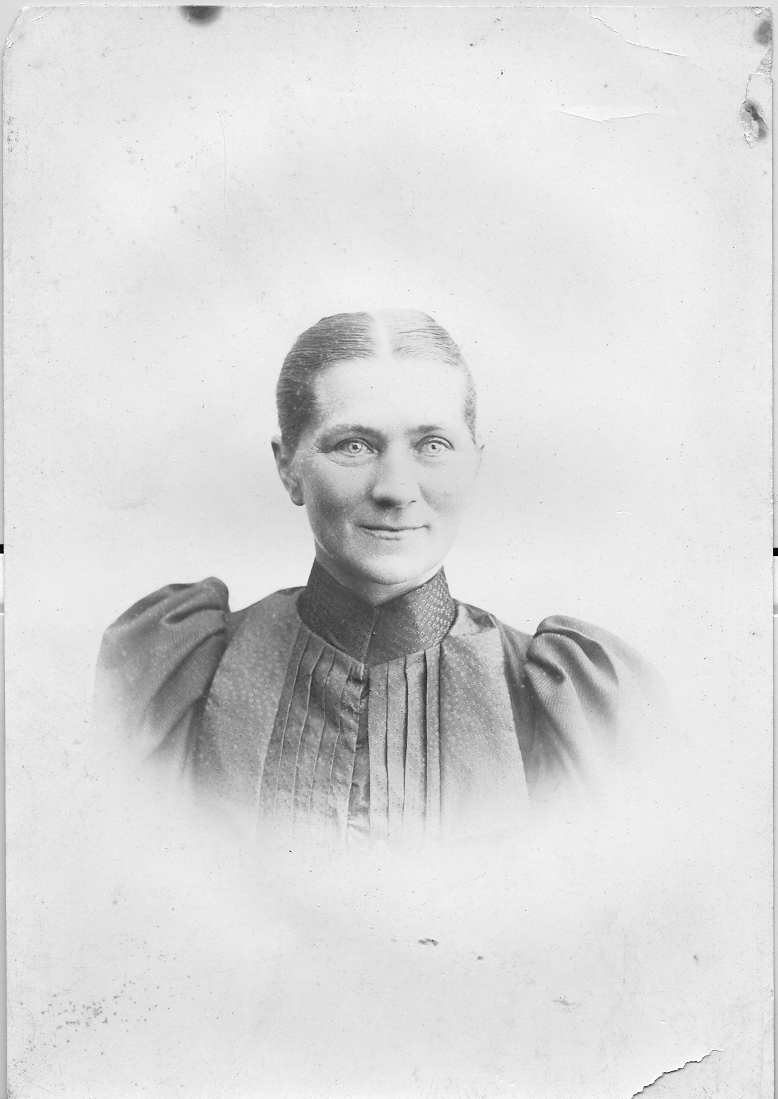
Alice Paak DeKorn

Alice Paak DeKorn (Aaltje Peek)

This lady was my great great grandmother, Alice Paak DeKorn.

She died May 5, 1908.  My grandfather, her grandson, was born October 31, 1908, so she never even saw him.  I think she has a kind face, but I don’t know any stories about her.

Yvette Hoitink observed that Alice’s marriage certificate states that she was born in Leymond.

Yvette says that this is “presumably Lexmond in Zuid-Holland. The Lexmond birth records are indexed on Genlias.nl. A search for Peek children born between 1850 and 1855 showed one candidate for Aleye Peek: Aaltje Peek b. 9 September 1852, daughter of Teunis Peek and Jacoba Bassa. The birth month and year match perfectly with Alice’s listing in the 1900 census.”

I noticed that Alice lived for 55 years.  Her daughter Cora, my great grandmother, died at the age of 57, so I can’t help but wonder if they both died of the same cause.  Cora died of leukemia or “cancer of the brain.”  Alice’s other daughter, Jennie, who was in last week’s post died at the age of 95.  Alice’s own mother died at the age of 41.

If you are working on your own family history, you might have noticed that you are interested in the age at death of your ancestors–for reasons of self-interest.

Although she was known as Alice for most of her life in the U.S., her American marriage certificate shows Alice as Aleye, which would have been Aaltje in the Netherlands.  I’m going to guess that some of the people filling out the documents in Kalamazoo were not Dutch.

Growing up in Kalamazoo, I had no idea that one of the family lines of my ancestry was Paak/Peek.  I went to school with kids with names like Peek and Peake, and I wonder if there is a connection.

Yvette discovered that Alice’s father, Teunis Peek, was found in the lists of emigrants at the National Archives website and that he left Lexmond for the U.S. in 1868.  She shows Alice emigrating in 1869, but it’s possible that they came together.

Jacoba had passed away in 1865, before her family emigrated.  Alice was one of six children, and I am guessing that Teunis brought all his children to the U.S.–or at least most of them.  The eldest was Joost, and he was 19 when the family moved.  It’s possible he stayed behind.

I’ll pick up the story of the Peeks in a future post.

Read Full Post »

My grandfather was left-handed.  And so am I.  I get it from him because my parents are both right-handed.

Grandpa holding me

Grandpa holding me, his first grandchild, 1955

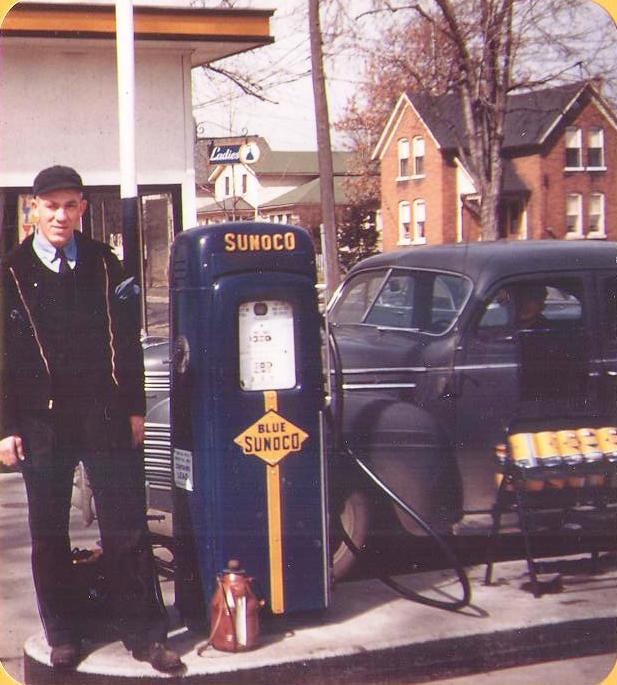
I’ve written about both Adriaan Zuijdweg/Adrian Zuidweg (the elder) and Cora DeKorn Zuidweg, my great grandparents.  They had one son, my grandfather, Adrian Zuidweg (1908-2000).  He owned a Sunoco “filling station” on the corner of Burdick and Balch in Kalamazoo where his father had previously owned the soda shop.  In the photos above and below, he’s wearing his Sunoco uniform.

When I was a kid, I loved the fold-out maps Grandpa carried inside the station. Out back, he planted a strip of petunias and vegetables.  He knew how to make use of a small space for gardening.  When I visited, he would climb out of the pit where he worked under a car.  The most memorable part of the station for me was the lettering on the front door:

Adrian Zuidweg, Proprietor

A – Z Lubrication

I loved how it played off his initials A.Z.

"Adie" "Zuidy" by the pump

“Adie” “Zuidy” by the pump

Read Full Post »

When I was a kid, the oldest person in our family was “Aunt Jen.”  After the death of her only child, Aunt Jen went to live in a group home for elderly ladies run by the mother of one of the 4th grade teachers at Haverhill Elementary School (Portage, Michigan), Mr. Sweringer.  My fourth grade class was directly opposite that of Mr. S who made kids put a penny in a jar if they cussed.

My daughter’s middle name is Jennifer, and I gave her this name in honor of Aunt Jen.

Aunt Jen was born Jennie DeKorn in Kalamazoo, on March 8, 1873, to Richard and Alice (Paak) DeKorn.  She was the oldest of the three siblings, which included Cora (my great grandmother) and Joseph (the photographer).

At age 23, on May 20, 1896, Jennie married Lambertus Leeuwenhoek.

Lambertus, known to everyone in the family as Uncle Lou, was born in the Netherlands  on May 3, 1972.  He passed away April 20, 1949 in Kalamazoo.  Uncle Lou’s parents were Arie Leeuwenhoek and Mary Hoogedoom.  The story I was told by Grandpa is that Uncle Lou and his brother Gerard were orphans.   He told me that Uncle Lou was a very intelligent man.

Additional info added later:  I discovered a letter from Phil DeKorn, son of Joseph, to my parents, which says that Uncle Lou was a wizard at chess and checkers.

Gerard or Garret Leeuwenhoek

He also said that Uncle Lou was a direct descendent of Antony van Leeuwenhoek, the inventor of the microscope.

Uncle Lou and his brother-in-law, my great grandfather Adrian Zuidweg, spent a lot of time together.

Aunt Jen and Uncle Lou had one child, Alice Leeuwenhoek Moerdyke.  She was born in Kalamazoo on April 16, 1897.  I suspect she was quite spoiled because:

a.  I have so many photos of her!

b.  She had a lot of pretty clothes–much nicer than the rest of the family.

c.  My grandfather once told me so ;).

And look how cute she was:

Aunt Jen and Uncle Lou lived the rest of their lives in Kalamazoo.  They celebrated their 50th anniversary in 1946 and the Kalamazoo Gazette ran their photo.

When I was little, she attended our family get-togethers, and she wasn’t a mother or aunt of anyone from my generation or my mother’s.  I couldn’t grasp that she was my grandfather’s aunt, as that seemed to me impossible.   My parents took me to visit her regularly, and I always respected them for their attention to her.

On March 15, 1968, at the age of 95, Aunt Jen passed away.

Read Full Post »

This is another post which I dedicate to Yvette Hoitink at Dutch Genealogy.

I described in other posts that  Yvette Hoitink, a Dutch genealogist, quickly and easily found a wealth of information about the Zuidweg family–my grandfather’s Dutch ancestors. 

Where in the heck is Kalamazoo

I grew up hearing that expression (or a more direct variation of it which reminds with “bell”).  When Kalamazooans travel outside Michigan, they tend to hear people ask some version of the phrase.  Even today, living out west, I find myself being asked the same thing.  I do what I have always done:  open my right palm and point to the fleshy lower outside section.  “Right there.  That’s where Kalamazoo is.”

With the help of Yvette’s genealogical research, I can now say that approximately 3/8 of my more recent ancestors come from Zeeland, a Dutch province–and most significantly from the town of Goes.  When I was young my grandmother taught me how to say it.  With an H sound, instead of a G, and a double O (rhymes with “goose”), as if you’re blowing out air from the diaphragm.  I have no idea if that is the correct Dutch pronunciation, but that has been our pronunciation.  I never knew where it was located.  I didn’t even bother to look or to ask “where in the heck is Goes?”

I’m not sure I trust pronunciations which are passed on through the family.  My grandparents were “Grandma and Grandpa Zuidweg,” pronounced like Zould (as in “should”) and weg (as in . . . “weg”).  At some point my uncle and his family started pronouncing their own name to rhyme with the name “Ludweg.”  That sounds wrong to me, but then it’s their name and not mine.

Once you start looking back into the generations, my ancestors are a little more spread out.  This is what Yvette wrote in her report:

All the Dutch immigrant ancestors of Adrian Zuidweg were found in Dutch records. Using birth, marriage and death records from the civil registration, four generations of his ancestors were traced. For three ancestors, the family was traced one generation further. In total, all 16 great-great-grandparents and 6 g-g-g-grandparents of Adrian Zuidweg were traced. His ancestors came from different provinces in the Netherlands: Zeeland, Zuid-Holland and Overijssel.

Don’t forget:  Adrian Zuidweg, my grandfather, is two generations before me, so this is actually going back pretty far.

English: Map of The Netherlands (including the...

You can see from the map that Zeeland and Zuid-Holland are the two southernmost provinces along the North Sea.  According to Lonely Planet, these provinces are the areas that give rise to our stereotypical ideas of “Holland.”

These two provinces are home to some of the strongest imagery – and biggest clichés –

associated with the Netherlands. You want dykes? Uh-huh. Windmills? Yeah. Tulips? OK.

Well, alright fellas, let’s gooooo…

The Keukenhof gardens are a place of pilgrimage for lovers of the lancelike leaves and

bell-shaped, varicoloured flower of the tulip, and the Zuid (South) Holland area is great for

biking and hiking, with trails and paths everywhere. Meanwhile, the built-up beaches of

Noordwijk aan Zee and south to Scheveningen are popular with locals.

Further south, Zeeland (Sea Land) is the dyke-protected province that people often associate

with the Netherlands when they’re not thinking of tulips, cheese and windmills.

Middelburg is the centre, with a serenity belying its proximity to the tragedies that spawned

the Delta Project.

Zuid Holland’s major cities are the biggest attractions: there’s Leiden, with its university

culture and old town (and proximity to the bulb fields); Den Haag, with its museums, stately

air and kitsch beach; charming, beautiful Delft, the home of Jan Vermeer; and mighty Rotterdam,

blessed with an edgy urban vibe, gritty cultural scene, and innovative architecture.

Several smaller places are also worth your time: Gouda is a perfect old canal town, while

Dordrecht has its own surprises – for humans and sheep alike. Just east and south of Dordrecht

is Biesbosch National Park, a sprawling natural area along the border with Noord Brabant.

What I want to know is if Spiced Leyden cheese comes from Leiden.  It’s my favorite cheese.  My husband’s is Gouda.  And what do you know, but I have family photos taken in Gouda, including this one of a beautiful baby:

Read Full Post »

« Newer Posts