Feeds:
Posts
Comments

Archive for the ‘Remine’ Category

I have updated and am reposting this information about Therese Remine’s house in Detroit (new info in italics):

Harold Remine’s sister Therese lived a double life, you might say. For most of her life, and with homes in both cities, she switched off between Kalamazoo and Detroit. Therese worked as a teacher in Detroit. I found information in a 1930 city directory that Therese worked at Campbell School / Webster Hall (uncertain of this exact meaning, but there was a Campbell School and a Webster Hall). Then I was aided by my friend José who can found at his blog Enhanced News Archive. He discovered a 1957 city directory which gave important information about the house, but also mentioned that she worked as a teacher at Von Steuben School. I find it interesting that census reports give occupations and the industry the occupation is in, but not specifics of school names or company names. 

Although we usually visited her at her home in Kalamazoo (by the time I knew Therese, she was retired), I do remember traveling to Detroit, entering her home, and some of our time spent chatting with her. This is her house:

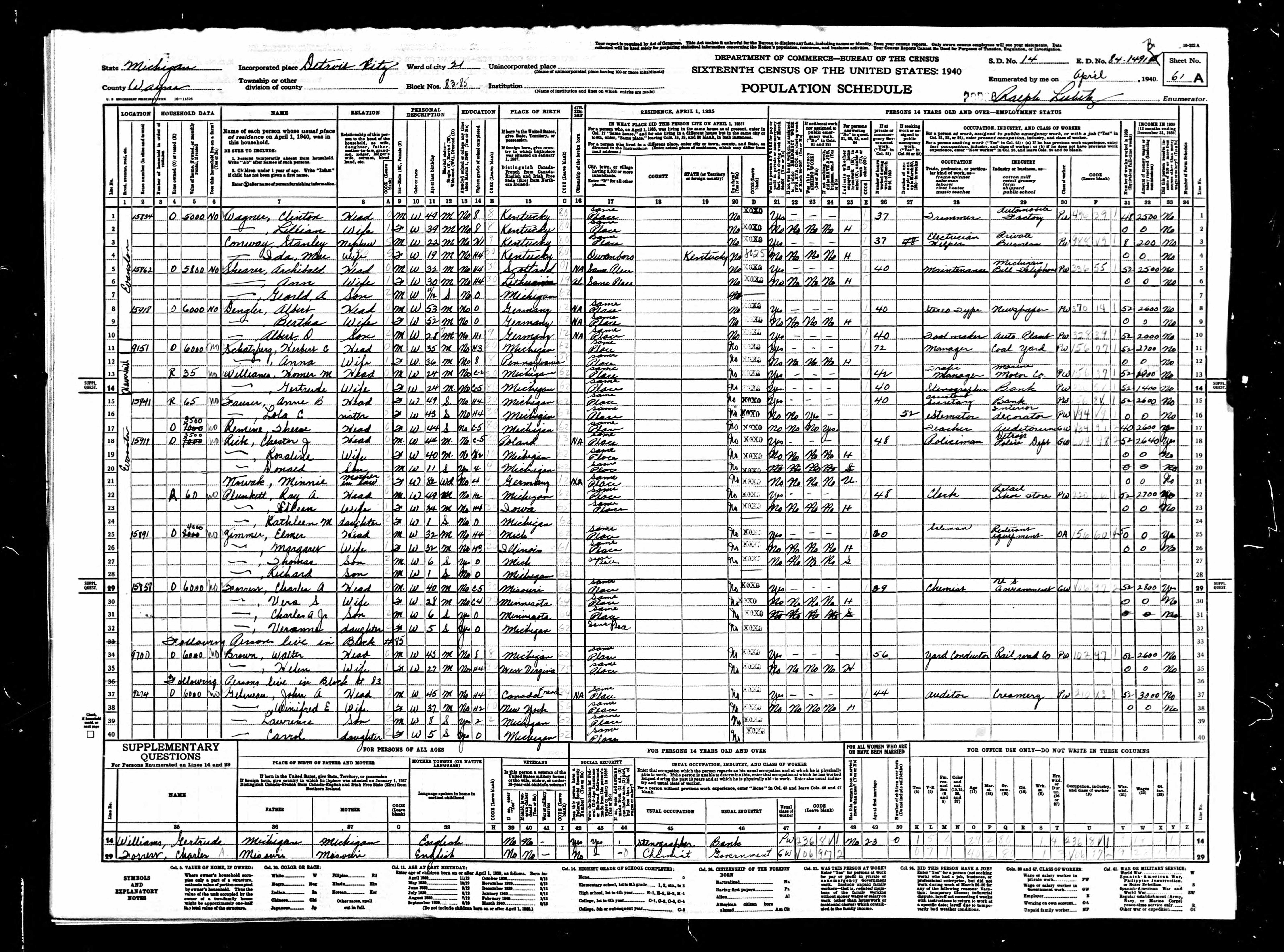
The house seems to be on Haverhill, although the cross street is not visible.  Doesn’t it look here as if the front door faces Haverhill? I checked out the 1940 census, and both Haverhill and Evanston residents are on the page with Therese. Her house number is not given, so I can’t be sure which street she was on. Any ideas on this census for Therese’s address? These questions are answered below!
The back of the photo gives another clue to the location of Therese’s house.
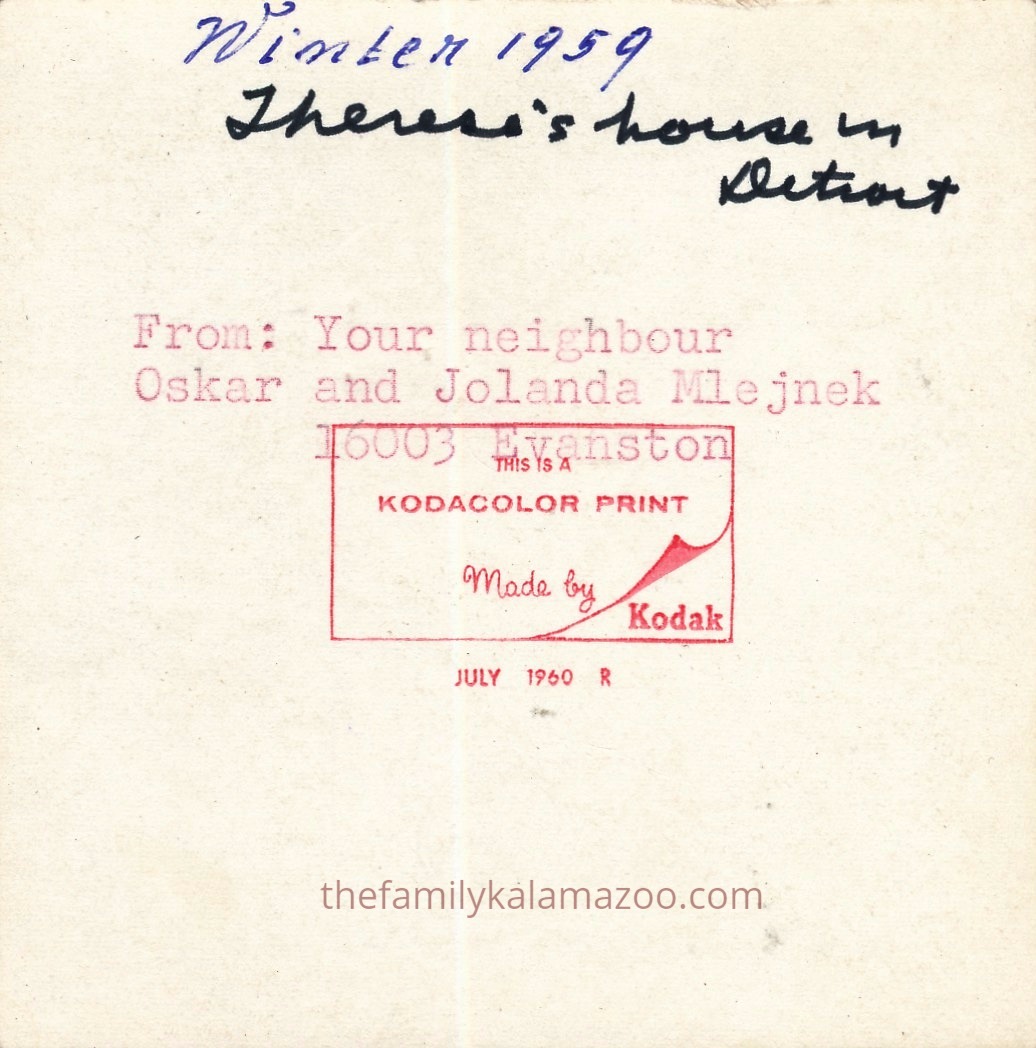
The neighbor who took the photo kindly left his (and her) name and address. Oskar and Jolanda Mlejnek, 16003 Evanston. I love that the date was given, too: Winter 1959.

According to information I found about Oskar Mlejnek on Ancestry, he ended up moving to Grosse Pointe. These were beautiful houses on Evanston and Haverhill, straight out of 1930s and 40s movie “casting,” but the neighborhood changed over the years. According to what I see on Google maps many of the older houses are still there, but the vegetation is overgrown. It’s not even possible to see what 16003 Evanston looks like, although the upper level has been for sale, because the yard is so overgrown.

Where was Therese’s beautiful home?

I was able to pinpoint the location of Therese’s house, thanks to my outstanding blogger buddies: Karen MacArthur Grizzard, Amy, and José at Enhanced News Archive. Karen first noticed that on the 1940 census, the two women listed above Therese appeared to be lodgers who rented from Therese who clearly owned the house. This gave me the address for the house: 15941 Evanston. Amy confirmed that she also read it the same way Karen did. And José did more research where he found the 1957 city directory which did, in fact, verify that the house was located at that address.

From there, José located the correct address on the contemporary Google map. The house has been torn down, the yard is overgrown with vegetation, but as José point out to me, the other houses on the block are still there as he lined up the roof peaks from the old photo above with the new Google image.

Thanks to these smart and experienced researchers, I now know the address of Therese’s house and that it no longer exists, although the other houses do.

Read Full Post »

A hundred years ago it seems to have been commonplace to have postcards made from personal photos. I found this example of an “occasional postcard,” meaning it was made on the occasion of Harold Remine sitting on the moon.

The two men with Harold are his brother-in-law Frank Tazelaar on the left and his father Richard Remine on the right (the taller man).

Here is what it says on the back:

The postcard is addressed to Harold’s sister, Therese Remine or Genevieve Remine Tazelaar. He was the youngest of three children, the only boy, and Therese was the youngest girl–six years older than Harold. I think it might have been Therese. Apparently, at this young age, Harold didn’t believe in basic punctuation, such as periods and commas–or know how to spell “rode”–(and you thought only kids today are lazy), although he went on to graduate from the University of Michigan and become the Chief Engineer of the Quebec Hydro Electrical Commission.

Well sister how do you like the picture we got this taken on Burdick Street after leaving you at the train papas broke one plate so we had to pose twice before we could get a good one we told ma we had road out to Otsego and back on the moon isn’t that a _____ for you life ___ me. YHE Harold Remine

Can you read that last line? I can’t quite make it out. Also, what does YHE mean? I tried Googling it, but came up empty-handed. I assume the Y means Your or Yours. What do you think?

When he refers to Papa breaking a plate, he means a glass plate or negative of the image.

Do you think Harold is about 14 or 15 here? If so, that would make this photo from about 1911-1912. Genevieve and Frank Tazelaar were married in 1906, so the timing on that is correct, as well. Harold seems big, but he could even be a bit younger, I suppo

Harold Henry Remine

1897–1975

BIRTH 7 SEPTEMBER 1897 Kalamazoo City, Kalamazoo, Michigan

DEATH DECEMBER 1975 Montreal, Quebec, Canada

1st cousin 3x removed


Read Full Post »

I’ve written before about my great-great-grandmother’s sister, Carrie Paak Waruf, and her husband Henry Waruf: Who Was Hank Waruf, Kalamazoo Gunsmith, Tennyson’s Words for Henry Waruf’s Funeral, and All the Peek Girls (note that Paak can be spelled Peek, Paake, etc.). And when they traveled to Cuba.

But I’d like you to look at some photos I have that Grandpa had me mark Aunt Carrie.

The first one is a favorite. Carrie and Henry Waruf were well-off merchants. They had no children. And Aunt Carrie did like to spend money on her outfits. Is that a fur piece or a feather boa around her neck here? And what about this hat? On what planet was this popular? I assume it was expensive. That almost looks like a Minnie Pearl price tag on it. Is that a ribbon? Overall the hat mystifies me. I’d place her at around 40 in this photo. What do you think? By the way, she was born in 1862, so that would make the year of this photo around 1902.

Photo #1

Here is another photo of Aunt Carrie.

Photo #2

These are obviously the same woman, although the 2nd photo seems to be a much younger photo. This brings up the mystery of her age that arose in the post What Can the Photographer Tell Me When He’s No longer Here. The evidence on the 2nd photo about the photographer made it seem as if this photo was also around 1900. So now I am more confused than before. But it makes me wonder if that successor craziness went on more than once. I still think she looks under 35 in the 2nd photo, maybe even much younger than that.  Look at the differences in wrinkles with the first photo.

Now, if anybody has an idea on the date of that peculiar hat, it would help assign dates to these photos!

I’m very satisfied with the identity of the woman in photos one and two because I have another photo or two of her with her husband. There is no doubt.

Here is the bigger mystery. Grandpa also told me that this next photo was Aunt Carrie. I don’t see how that is possible. What do you think?

Photo #3

Is this Aunt Carrie? Or is it one of her sisters? There were Alice, Anna, Mary, and Carrie. This is not my great-great-grandmother Alice. But could it be Mary or Anna?

Here is Mary:

Photo #4

Mary Paak Remine

Mary Paak Remine

Here is Anna:

Photo #5

Annie Paak

Annie Paak

And here is Alice:

Photo #6

Alice Paak DeKorn

Can you hear me screaming? She almost looks like a sister. She looks enough like them that Grandpa called her Carrie. But who is she?


Read Full Post »

My last post Is it Live or is it Memento Mori? relied on information about the dates of the photographer of the photograph in question (whether the lady is dead or alive in the photo).  I used information from a listing of late 19th and early 20th century Kalamazoo photographers on Bushwacking Genealogy.

I started wondering if I approached my photos from this perspective if I could add information to my identification of photos and dates.

For example, this photograph of Carrie Paak Waruf was taken by Evans. Evans is not on Bushwacking’s list, but notice how the photo says “Successor to Packard 120 E. Main St.” So I looked when Packard seems to have stopped being a photographer at that address: 1887. But wait. Mary H. Packard seems to have been in business at that address in 1899. (The lesson here is to pay attention to the photographer’s address if it’s on the photo–they moved around quite a bit and it can help identify a year). Her husband committed suicide in 1898. So who was Evans? And what year was this photo of Carrie taken?

Carrie was born 8 May 1862 in Lexmond, Netherlands. She was my great-great-grandmother’s sister. That means that if Mary Packard was out of business by 1900, Carrie would have been 38 years old. And even older if it was sometime after that point.

That is not possible. This photograph is of a young woman. This is confusing. I might have learned something, but now I have still more questions (is this The Family Kalamazoo refrain or what? more questions, more questions)

Here is another one:

This woman is Jennie Remine Meyer (Meijer, married to Klaas Meijer who became Carlos Meyer).  She’s my first cousin, 4x removed. How old do you think she looks in this photo?

She was born 12 April 1860 in Kalamazoo. Just for the record, she passed away in Kalamazoo on 20 September 1940.

This photographer also bills him or herself as a successor to C. C. Packard, the photographer who died in 1898.  You are correct if you are guessing that Kidney is also not on Bushwacking’s list of photographers.

This is where I wish I had a Kalamazoo city directory for every year right at my fingertips.

If this photo was taken in 1900 or after she would have to be 40 or older.  I think she looks pretty good for 40. No botox, no makeup, no hair dye. But she could be 40, whereas I don’t see how Carrie could be 38 or older.

Then there are the clothes to consider. My instincts tell me Jennie’s clothing and hair is from an older period than Carrie’s, but that would be impossible because she is older than Carrie in the photos, but these two women are only two years apart in age.

There is much work to be done on solving the mystery of these two “successors” to photographer Packard.

Let’s just spot check a couple and see if the information on Bushwacking seems to correspond with the information I have about my photos.

This is Gertrude, Richard, and Adrian DeSmit, the children of John DeSmit and Mary DeKorn DeSmit. Gertrude was born in 1889, Richard 1887, and Adrian in 1891. If we assume that the children are about 6, 8, and 4 in this photo, the year it was taken would be 1895. The photographer Wood was Thomas E. Wood (also went by T.E. Wood) who was in business at least from 1887 to 1895, according to Bushwacking. She says he was not in the city directory in 1899. From 1887-88 he was at 316 E. Main St. From 1889-1895, he was at 134 S. Burdick St. The address on this photo is 134 S. Burdick St. (way up the street from the neighborhood where my relatives lived).


OH WAIT, what does that say in the middle of the bottom of the photo? 1895!!!!!!!! So my calculations about their ages was correct, plus it means that my grandfather was correct when he identified exactly which DeSmit children are pictured (there were many, but these were the youngest).  This verifies my info about the photo, as well as the info provided by Bushwacking.

Here is one more. Gerrit Leeuwenhoek:

Photographer Philley is not a common one in my albums, but he is on Bushwacking’s list. Silas Philley, Jr. In 1895, he was in business at 303 E. Main, and in 1899 at 305 E. Main. This photo says 303 East Main Street.

Gerrit died in the service of our military 23 July 1898. If you want to break your heart, read this: he only immigrated to the United States on in April 1897.  I’ve written about him previously in several posts–his death, his life in an orphanage, and the court case he brought against a teacher. You can search his name in my blog’s search bar.

But look at these dates. Since this photograph had to be taken in 1897 or 1898, it means that Philley was still operating out of 303 E. Main Street through that period. This helps narrow down the Bushwacking information a bit more.

I wonder why this photograph was taken and who paid for it. Since Gerrit was a young immigrant, I wonder if his older brother Lou paid for the photo. And I also wonder if it was taken because he was leaving for Cuba for the Spanish-American War. Would the government have taken photographs of new enlistees? If this were true, there might be more photos of young soon-to-be soldiers taken by Philley at this time period.

Read Full Post »

Two posts ago, in What I Discovered in the Box of Unscanned Remine Photos, I posted a photo of two girls circa 1870s or 1880s. One reader wondered if one of the girls could be deceased. She saw the wooden stand behind the girl. While I didn’t think this particular girl was deceased, and photographers mainly used stands behind people to help them hold still for the 15-20 minutes required to take the photo, it is true that photos of the dead, called Memento Mori, were quite common.

In fact, I have a Pinterest board devoted to the subject.

Of all the antique photos that I have in my collection, I don’t think I have any memento mori. Apparently, the style did not catch on with my relatives. By the beginning of the 20th century, most of the Victorian form of photographing the dead had (sorry) died out.

However, there is one photo that sometimes I wonder about . . . .

This particular photo might, in fact, be too late. The photographer was in business from at least 1899-1915. I found researched information on the site Bushwacking Genealogy.

Dornbush, Henry G.: Lived 1878-1962. In business at least 1899-1915. Not a photographer in 1920 census.
1899-1915:  120 E. Main

But maybe he was in business a bit before 1899. Or maybe this photo is from 1899 or 1900 and was on the tail end of the fashion.

Why do I wonder about this photograph? Notice the rose the man is wearing. It is upside down. In the 19th century, flowers were a language between people. This photograph has the general feeling of a wedding portrait because of the flowers, but because his flower is upside down, it likely means he is in mourning.

Notice how her body leans into and behind him, but is stiff in appearance. Her gaze is directed off somewhere, while he looks into the camera.

I would like to identify this couple. It’s very possible they are on my family tree. Just in case she is deceased here, any ideas for how to compile a search on Ancestry of death dates? After all, I have a couple thousand people to sort through.

What do you think? Is this photograph memento mori or can all the clues be explained away?

Read Full Post »

More tintypes! In Mysterious Antique Photographs I shared a beautiful tintype that I own.

Yesterday I opened the box of unscanned Remine photos. I haven’t had time to scan so many photos–or to organize either–but I thought I should just start doing a few a day because when WILL I ever have the time?

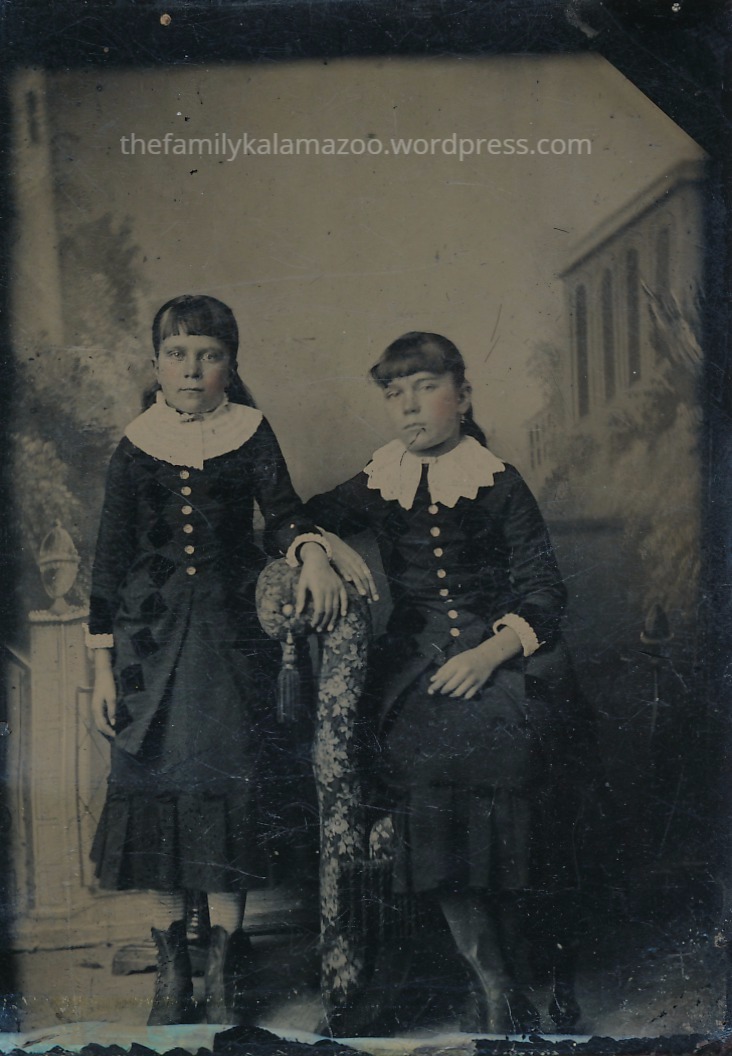
And I discovered these beautiful tiny tintypes. The one on the other post is large and painted. These are only 2.25 x 3.5 inches in size–and unpainted.

Because they are in the Remine box I can guess they might be Remines. Judging by the faces, I am ready to conclude they probably are Remines.

Because these girls and women were photographed full length (standing and seated), we can examine their entire outfits to try to guess a time period.

Therese was born in 1891. Could this photo be from around 1900?

I am having trouble identifying the correct information about Therese’s sisters. When I figure it out, this might help in identifying this tintype. For instance, if there were sisters born in 1880 and 1881 as might have been, this photo could, I suppose, be those sisters. If so, one of them is Genevieve Remine Tazelaar and the tintypes would be in the early 1890s.

I suppose the hair and collars could be 1900. But what about the fitted jackets with all the buttons? I can’t find anything like that in photos of 1900. Odd, too, that it would be a tintype if it was as late as 1900.

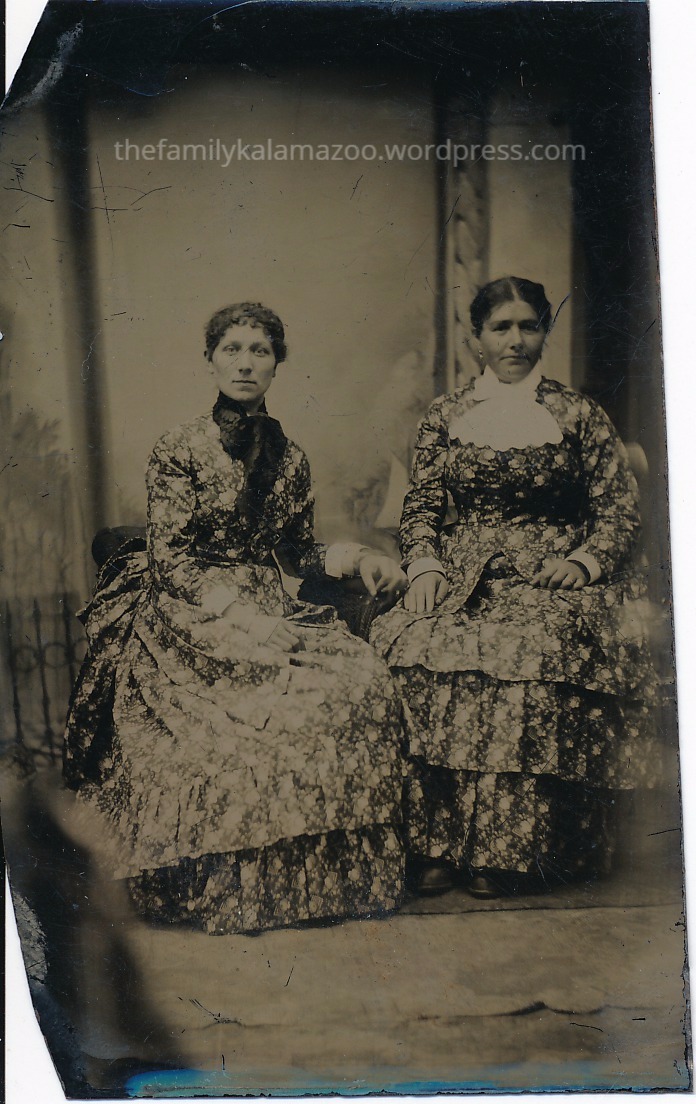
Here is the other tintype. I’m sorry it’s kind of crooked and uneven. It was difficult to scan it.

What about these outfits? They are not leg o’mutton sleeves, so does that rule out the 1890s?

I guess I am not very good at taking the nuances of change in fashion and extrapolating to what my relatives would have worn (generally a much more conservative version of the fashion).

The woman on our left looks a lot like Mary Paak Remine, Therese’s mother. She was born in 1859. But the woman doesn’t look terribly young in this photo. And then who would the other woman be? She looks NOTHING like the Paak sisters. She is not Mary’s mother because Jacoba Bassa had passed away long before this.

Were these photos taken in the Netherlands or the United States? The Remines were from Kapelle and the Paaks were from Lexmond. Notice the wallpaper/painted background. I’m pretty sure that these photos were taken in the same studio, perhaps near the same time period.

I’m afraid I have more questions now than I did before.


Read Full Post »

Harold Remine, the brother of Therese Remine, married Lillian Heddle on 7 July 1925 in Port Huron, Michigan.


Pretty snazzy outfit and a pretty girl.

What I remember of her was when she was white-haired and living with Harold in a beautiful brownstone in Montreal with fine china and in a lovely lakeside home outside the city. Harold had done quite well for himself (and for her). That was 1967, when I went with my parents to Expo 67, the World’s Fair. (That was a fabulous experience BTW).

In a University of Michigan alumni book (Michigan Alumnus 54 1947) I learned:

Harold H. Remine, ’21, has been promoted from Superintendent of Electrical Distribution to Assistant Chief Engineer of the Quebec Hydro Electrical Commission.

Thank you to Uncle Don for pointing me in the direction to find this.

Harold was a big curling fan. That trip is when I first learned of the existence of the sport.

What do you think of Lillian’s dress? Check out the bottom of the photo . . . .


Read Full Post »

One of the branches of my family from the Netherlands was the Reminse branch.

On 26 August 1810, my 4th great-grandfather, Dirk Reminse, a bread baker, married Adriana Kriger (Krijger) in Kapelle, Zeeland, the Netherlands. Dirk was born 22 November 1786 in Kruiningen, Zeeland, Netherlands. At some point before his marriage he must have relocated to Kapelle, but Adriana also came from a different town. She was born 11 June 1787 in Biggekerke, Zeeland, Netherlands.

Houses on the Kerkplein (church square), Kapelle, Netherlands

The couple had the following children:
Gillis Remijinse 1811–1868

Jan Remijinse 1813–1837

Hendrika Remijinse 1814–1893

Johanna Remijinse 1817–1864

Johannis Remijinse 1819–1846

Adriaan Remijinse 1821–1849

Pieter Remijinse 1822–1830

Frans Remijinse 1823–1860

Gerard Remynse 1825–1910

Marinus Remijinse 1826–1863

Note the difference in the spelling of the surname. It is seen both ways. In this country it became REMINE.

Their daughter Johanna was born 15 July 1817 in Kapelle. She married Boudewijn DeKorne 21 May 1847 in Kapelle. Boudewijn had been born in Kapelle on 11 June 1816.

The couple had one daughter who died as an infant, then a son Richard and daughter Maria were born. Richard, my great-great grandfather, would end up being a well-known brick mason and contractor in Kalamazoo, Michigan, but first the family had to immigrate to the United States.

Johanna’s parents had both died. Dirk died 9 September 1840 in Kapelle. On 14 April 1845, Adriana passed away.

Boudewijn and Johanna arrived in this country in 1856 and first settled in Zeeland, Michigan. The following year their 4th and last child, Jennie was born. Jennie eventually became Jennie Culver who divorced her husband and moved to Seattle with her two teen daughters. I have posted about the magnificent photo album that belonged to one of Jennie’s daughters that a blog reader mailed to me.

Johanna Remijinse DeKorne was my last direct ancestor in the Remine line, although my grandfather stayed close to the family that continued that surname in Michigan.

I found a photograph of this branch of the family in the Netherlands. The photograph is not marked with a photography studio or any other identifying information. Someone, possibly my grandmother, wrote on the back “Remine family in Holland.” In order to figure out who is in the photograph I would need to know the approximate date of the photo. Since Johanna immigrated in 1857, this must be from a line of the family that ran parallel to her line. Would it be the family of one of her siblings?

I went back and examined the other Remine cousins in the United States. They stem from Johanna’s brother Gerard.  He seems to have immigrated to the United States between 1855 and 1857. Maybe he and his family even came over with his sister and hers? NOTE TO SELF: CHECK INTO THIS.

Why did the families remain close? Johanna’s son Richard’s wife Alice’s sister Mary married Richard Remine, son of Johanna’s brother Gerard! What does that make them? First cousin’s by marriage?

So the photo can’t be of Gerard’s family. That leaves eight other siblings to check into. And the children of all these siblings . . . . NOTE TO SELF: MORE WORK NEEDED HERE

CAN YOU GUESS A TIME PERIOD FOR THIS PHOTO?


Read Full Post »

In my stack of anonymous family photos, I have two that are different from the others.

In the first one, the image is imprinted on metal and then painted with colored paint.


In the other, a couple appear to be drawn, rather than photographed.


It’s likely that the photographs came from Grandpa’s family: Paak, DeKorn, Zuidweg, Remine, Bomhoff, or his other branches. Or they could be friends or neighbors.

UPDATE: My daughter thinks the tintype woman looks like Grandma in the eyes and mouth. “Grandma” would be my mother, Grandpa’s daughter.

Any thoughts on type of photographs or on dating of these images?

Read Full Post »

Henry (Hank) Waruf and his wife Carrie (Paak) Waruf owned the resort Ramona Palace and Ramona Park, as well as many cottages and their own home, at Long Lake in Portage, Michigan.

Since Carrie is one of the Paak sisters, and her sister Alice Paak DeKorn was my great-great-grandmother, I’ve focused more on the Paaks. But Henry Waruf is a very interesting character in Kalamazoo’s early history.

Adri van Gessel was so kind to do some research on the Waruf family. Henry himself appeared to be a bit of a dead end because the name Waruf seemed to come out of nowhere. But Adri broke through that brick wall and discovered Henry’s origins.

Who Was Hank?

Henry was born Hendrik Walraven on September 7, 1863 at Kloetinge, the Netherlands. Apparently Koetinge is part of Goes. Big shock there since the majority of my mom’s ancestors seem to have come from Goes.

He was married on June 2, 1882 at Kalamazoo (MI) to Cornelia Peek (Carrie Paak), daughter of Teunis Peek and Jacoba Bassa.  Cornelia was born on May 8, 1862 at Lexmond and died in January 1957 at Kalamazoo (MI).  Henry died on November 29, 1945 at Orlando (FL).

I don’t know if Henry was on vacation in Florida, living there part of the year, or if the couple (who had no children) had moved there and Carrie went back to Kalamazoo after his death. I could try to research this through city directories, phone books, etc. The research I have done was mainly through newspapers, and I discovered that, although Henry (or Hank) usually spelled his last name “Waruf,” sometimes it shows up as “Warruf.” Still, it looks to me as if Joseph is the one who changed the family surname to Warruf/Waruf in the United States from the original Walraven.

Henry had one sister,  Maria Walraven, born March 3, 1866 at Goes, but she died before 1870 in the Netherlands.

Henry and Maria were born to Joseph Walraven (Joseph Warruf), son of Hendrikus Walraven and Elisabetha Resch, who was born on October 13, 1837 at Goes, died on December 11, 1910 at Kalamazoo (MI).

Joseph was married on May 21, 1863 at Goes to Melanie de Munck (Mary), daughter of Jan de Munck and Maria Joseph Bataille.  Melanie was born on October 16, 1840 at Goes and died on March 18, 1914 at Kalamazoo (MI). Joseph, Melanie, and Henry immigrated to the U.S. in 1868, when Henry was 5 years old.

A Bataille Connection

Notice the name Bataille. I’ve previously written about a Bataille ancestor in these posts:

An Update on the Bataille Family

A Familial Occupation

How Did Etaples, France, Show Up in My Family Tree?

Hank Went into Business

As I mentioned, “Hank” (Henry) and Carrie (Cornelia) were married in 1882, when he was 19 and she was 20. By 1885, he was advertising a business selling guns in the Kalamazoo Gazette, where it’s noted that he took over the gun shop of W. Blanchard.

Sept 17, 1885 Click the link and scroll to the bottom for the ad. By September 1886, Hank added “gunsmith” to his name on the ads.

I was astonished to discover, in an 1897 Polk Directory, that Henry Waruf owned the gun shop in partnership with Richard “Ro-mine” who I take to be Richard Remine. Richard “Dick” Remine was Hank’s brother-in-law. He was married to Carrie’s sister, Mary, another sister of my great-great-grandmother. Richard was born in 1857 and so was six years older than Hank. I’ve written before that the person who inherited the Long Lake resort was Therese Remine, Richard’s daughter. So there might have been another reason that she was the sole inheritor of that property–because her father had been in business with Waruf. How long were they partners? I am going to guess that Waruf was the true businessman of the two–and an ambitious man.


Richard Remine

Hank Was a Man of Many Talents

Hank shows up often in the Gazette, and I was able to see that he became a talented shooter, a prize-winning breeder of English Spaniels (no wonder my grandfather’s family always had this breed of dogs), and a collector of real estate. He reported regularly to the State Board of Fish Commissioners on the fish in Long Lake.

Here is an article where he literally won all the prizes at a shoot. Sept 7, 1899. There are many articles about the shoots he attended and referreed. He also represented Kalamazoo at a state shoot in Bay City.

The award-winning dogs owned by Henry show up in publications by the American Kennel Club, The Field Dog Stud Book, and The Fanciers’ Journal. I traced the beginnings of this sideline to a Gazette article that mentions that Hank was going into the business of raising hunting dogs and had brought in a fine pointer from Lowell with a pedigree going “way back.”  Click the link for the article–right side about 1/3 down.Feb 28, 1899.

In 1919, there is a newspaper article about the houses that Waruf was selling. These houses were all on the north side of Kalamazoo. I know that he also owned all the cottages near the resort at Long Lake, so he was used to being a landlord. I wonder if he had been renting out all these houses or if he was flipping them. I suspect he had been renting the houses. Here is the article. April 2, 1919

Finally, on August 30, 1904, Kalamazoo Gazette published a cute story. A Gazette reporter climbed the water tower at the asylum. This is the tower that my great-great-grandfather Richard DeKorn built (click here). From that vantage point he was able to see all the way to Gull Lake in one direction and Long Lake in another. He mentions a great many notable people and what he claims he saw them doing at the time. About Waruf, he wrote, “‘Hank’ Waruf shining up his guns at Long Lake for the duck season.” The details in the article conjure up a Breughel painting, so I find it a little impossible, but definitely amusing. Here is the article: Aug 30, 1904


***

Here are some images I have previously published on The Family Kalamazoo:

Carrie (Paak) and Henry Waruf

Home of Hank and Carrie Waruf, Sprinkle Road

Home of Hank and Carrie Waruf, Sprinkle Road

I’ve written about the place and the people here:

Read Full Post »

« Newer Posts - Older Posts »