Feeds:
Posts
Comments

Archive for the ‘Michigan history’ Category

The other day I posted a photo of a couple I had not yet been able to identify. Once I got it posted and readers started pointing things out to me, I began to wonder if it could be George Paak.

On the advice of some readers, I pulled the original photograph out of storage and looked at the back and at the sleeve. The back is blank, but the sleeve itself says this:

PATENTED MCH 271917

I still have a lot of work to do on the research, but I thought I’d post the photo with a concentration on the man’s face along with photos of the women I suspect could be his sisters. See what you think.

What I want to eventually find out is if this is George Paak.
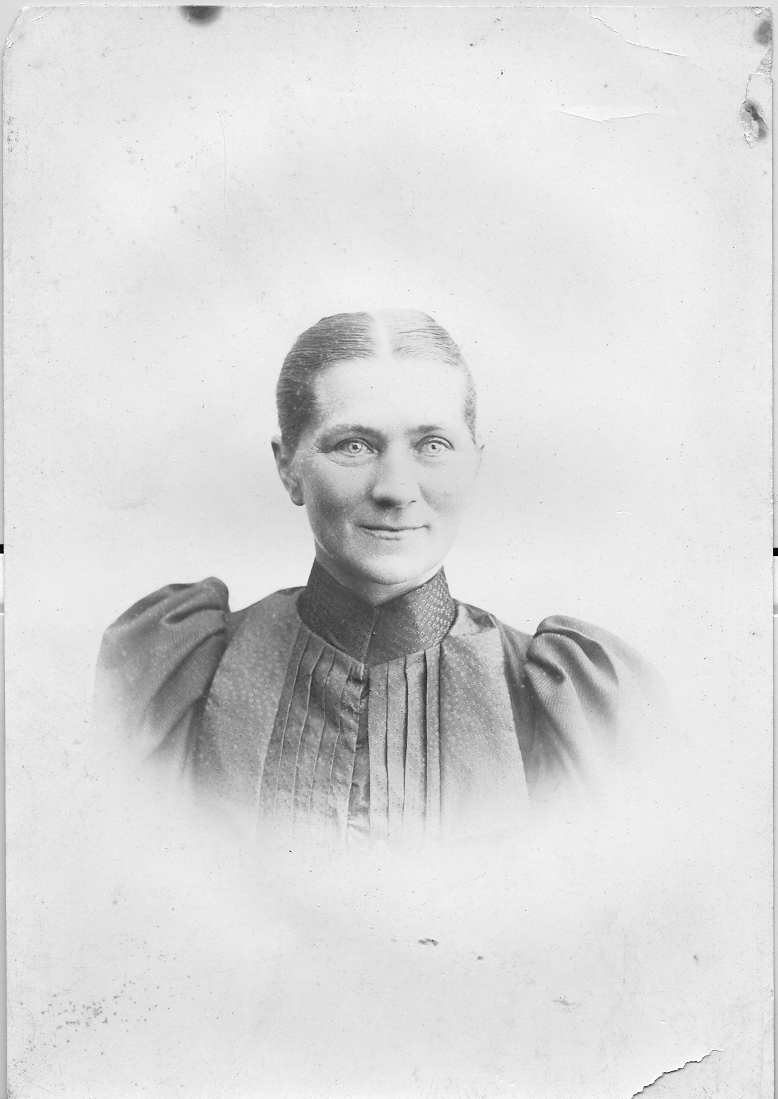
Alice Paak DeKorn

Alice Paak DeKorn

Alice is my great-great-grandmother. Look at their mouths. The hairline, forehead, and sparkling eyes. Don’t they look alike?

Carrie Paak Waruf

Carrie Paak Waruf

Mary Paak Remine

Mary Paak Remine

The ones above are sisters Carrie and Mary. They don’t look quite like Alice or the man. Or do they?

Annie Paak

Annie Paak


There’s another look alike. I think Alice and Annie look a lot like each other–and they look equally as much like the man.  What do you think?

PAAK / PEEK FAMILY


Teunis Peek immigrated to the United States from the Netherlands with his children.

He was the son of Joost Peek and Annigjen den Besten, born on June 5, 1822 at Zijderveld. (He died on April 24, 1893, in Kalamazoo, Michigan).

Teunis was married on December 21, 1848 at Lexmond to Jacoba Bassa, daughter of Dirk Bassa and Aaltje van Nek.  Jacoba was born on June 18, 1824. She died on November 23, 1865 at Lexmond, before Teunis took the kids and left the country.

From the marriage of Teunis and Jacoba:

1  Joost Peek (George Joseph Paak) was born on August 25, 1850 at Lexmond. He died December 9, 1925, in Kalamazoo, Michigan.*

2  Aaltje Peek (Alice Paak) was born on September 9, 1852 at Lexmond. She died in Kalamazoo, Michigan, May 5, 1908, a few months before her grandson, my grandfather, was born.

3  Anna Catharina Peek (Anna or Annie Paak) was born on January 6, 1855 at Lexmond and died on October 6, 1933 at Kalamazoo (MI). She married Jacob Salomon Verhuist.

Anna was married on March 20, 1890 at Kalamazoo (MI) to Jacob Salomon Verhulst, son of Jacob Verhulst and Cornelia Strijd.  Jacob was born on May 1, 1848 at Kortgene, died on June 20, 1923 at Kalamazoo (MI).

4  Willempje Peek was born on September 17, 1856 at Lexmond (alive in 1870, as William ??).

5  Maaike Peek (Mary Paak) was born on July 28, 1859 at Lexmond. Mary married Richard Remine. She died in 1954 in Kalamazoo, Michigan.

6  Cornelia Peek (Carrie Paak) was born on May 8, 1862 at Lexmond, died in 1957 at Kalamazoo (MI).  Cornelia was 95 years old. Cornelia was married on June 2, 1882 at Kalamazoo (MI) to Hendrik Waruf (Henry).  Hendrik was born in 1863, died in 1945 at Kalamazoo (MI).

Later, Teunis was married on January 8, 1869 at Kalamazoo (MI) (2) to Prina Adriana Schoonaard (Perena), daughter of Jan Schoonaard and Tannetje Servaas.  Prina was born on August 1, 1814 at Borssele.

The other day another Paak descendent found this blog. I am looking forward to comparing notes with him about the family.  He is the grandson of George Joseph Paak (Pake).
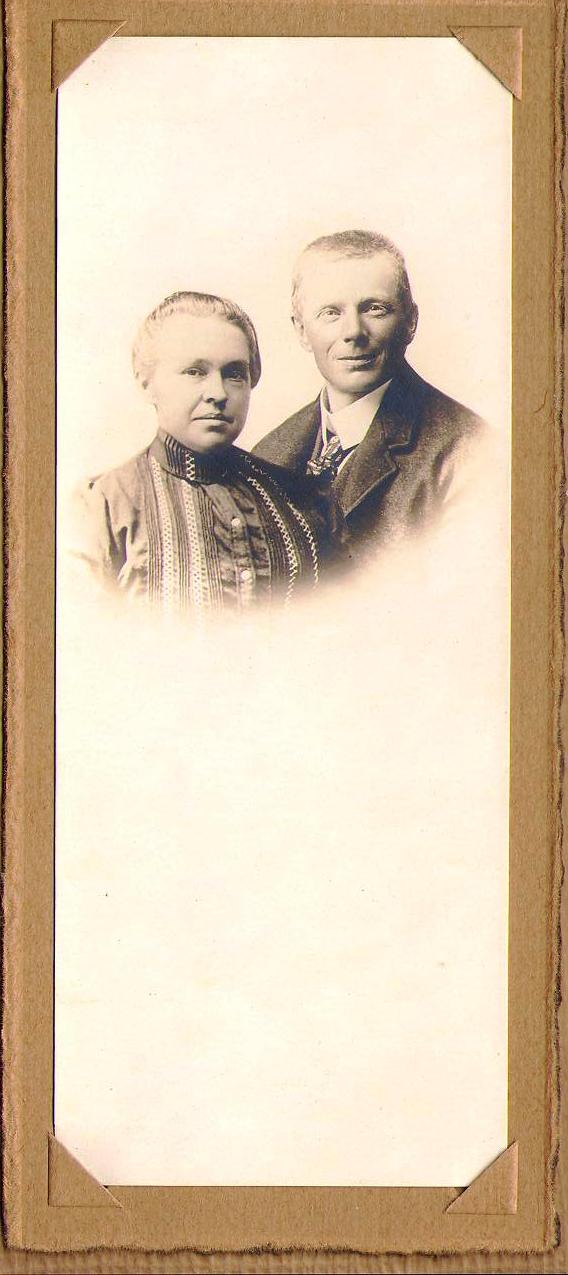
 * Joost Peek, or George Joseph Paak (Pake): could he be the man in the photo?

Read Full Post »

One of the most frustrating aspects of this whole family photo/genealogy project is not being able to identify some of the photos. It’s bad enough to see the names and not know what the people looked like, but to actually have a photo in hand and not know which person or persons it represents is just maddening.

Take this one, for example.

This photo is from my the photographs my grandfather gave me, so these people were part of the Zuidweg/DeKorn/Paak family. But who were they? Is there a way to collect clues from the photo?

What do you notice about the photo?

And what could I investigate to learn more about it?

Read Full Post »

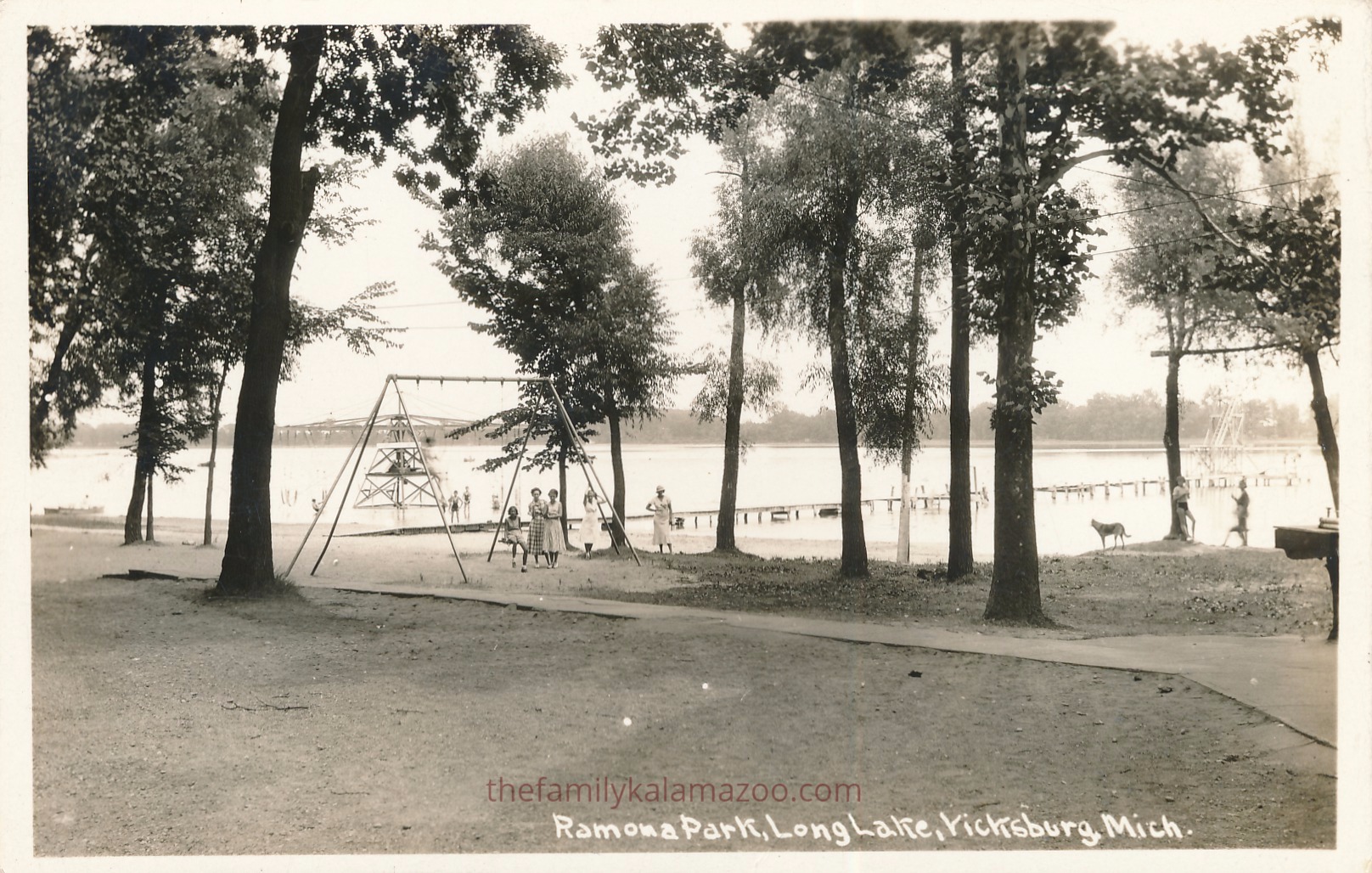
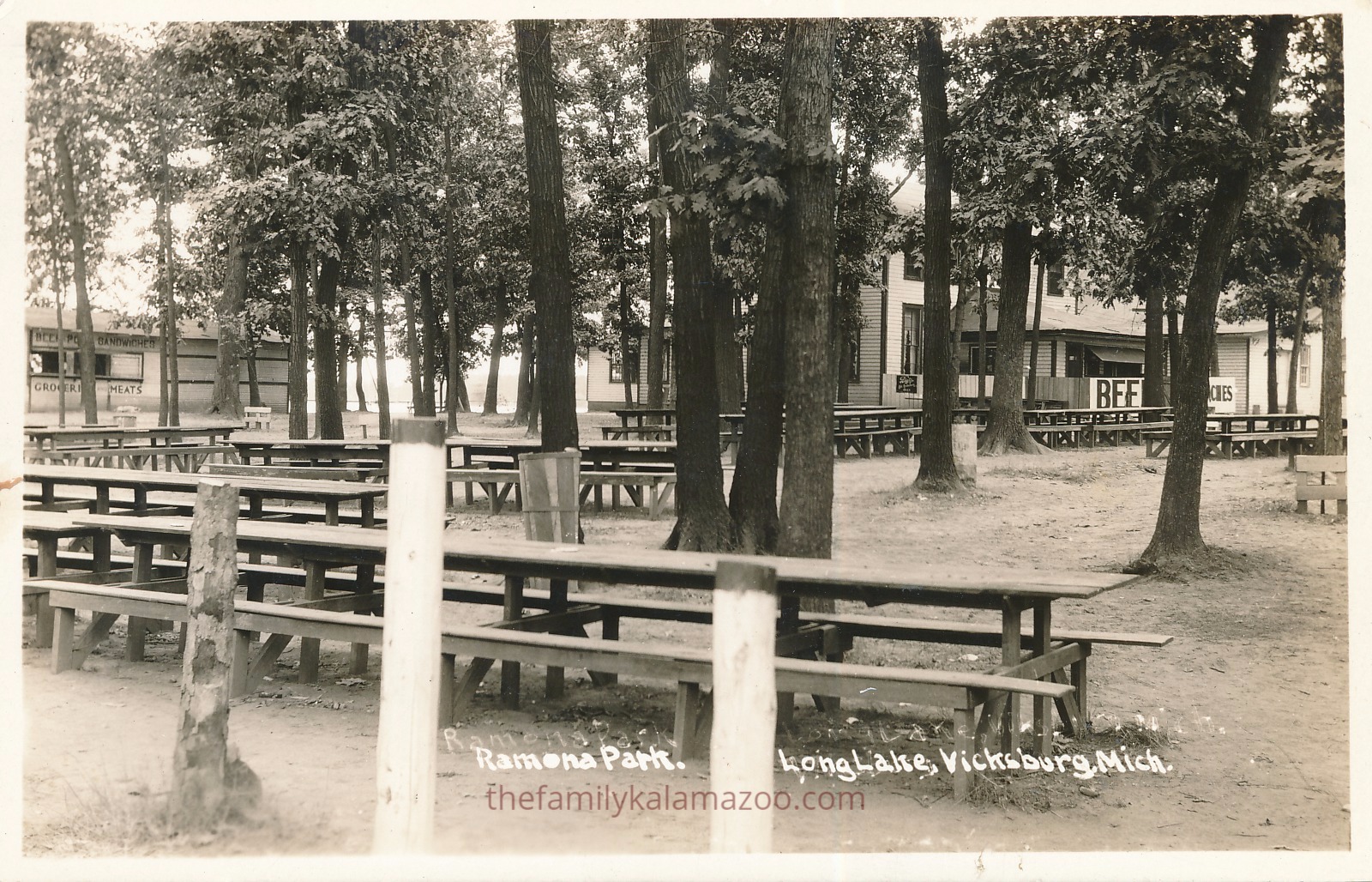
Last year, I published a post about a park that once belonged to family members and that had an inpact on me when I was growing up. Ramona Park, on Long Lake, outside of Kalamazoo, Michigan, featured a pavilion called Ramona Palace.  Ramona was named after the “Indian Princess” in Helen Hunt Jackson’s popular novel Ramona, which was published in 1884.

When I was growing up, the property was owned by a relative named Therese Remine.  Therese’s mother was Mary Paak (Peek), the sister of my great great grandmother, Alice Paak DeKorn.

Therese had inherited the property from Henry and Carrie Waruf, who had owned it for years.

Here are some photos of the pavilion and property that I inherited from the Waruf/Remine family:

Although these photos were taken before my time, not that much had changed by the time I hung out there–except that things had slowed down considerably. There were fewer picnic tables and fewer people.

You see that long dock in the 3rd photo? It’s so long it needs to be called a pier, I think! I don’t remember that either.

Read Full Post »

My last post was about the Todds–a family that, unfortunately, I am not related to ;). One last thing about them. My mother-in-law, an artist, painted the Todd House for a man named Paul H. Todd in 1970.

Todd House Kalamazoo, Michigan

Todd House
Kalamazoo, Michigan
Artist: Diana Dale Castle

So I did a little research. Paul H. Todd was one of the sons of Albert May Todd, the founder of the A.M. Todd Company. He, and his brother Albert J., both served as mayors and city commissioners of Kalamazoo. Paul’s son, Paul H. Todd, Jr., later filled his seat in Congress from 1965 to 1967.

Which Paul Todd did my MIL paint for?

In the 1960 city directory, Paul Jr. lived at 3713 West Main Street. His business was the Kalamazoo Spice Extraction Company (now called Kalsec). Paul Sr.’s business was Farmer’s Chemical Company. He lived at 3715 West Main Street. Next door neighbors! Paul Sr. was born around 1884, so he would have been around 76 years old in 1960.

Ten years later, Paul Sr. would have been 86. So I asked my husband. He says the Paul Todd who commissioned the painting was middle-aged, so it must have been Paul Jr. Searching a little farther, it appears that Paul Sr. died in 1969.

On the bottom right corner of this print (because I only have a print, of course), my MIL wrote that this building was Paul Todd’s house (but is that possible?), and that it was located on the corner of Kalamazoo and Rose Streets. I found the intersection of W. Kalamazoo and N. Rose on Google Maps. The building is no longer there.

It seems likely that, in 1970, the business was operated in this inner city area, but that the family didn’t live there. Nevertheless, in a family discussion, others thought that Mr. Todd lived in the same building that the company was operated from.

Back to my MIL’s paintings: she painted many locations in the Kalamazoo area.

Here is another one she painted in the very early 70s. It’s known as the Gourdneck Prairie-Webber Schoolhouse, Schoolcraft Township. It still stands today. Here is a link to check it out.

Gourdneck Prairie-Webber Schoolhouse, Schoolcraft Township

Gourdneck Prairie-Webber Schoolhouse, Schoolcraft Township
Artist: Diana Dale Castle

Enhanced by Zemanta

Read Full Post »

I posted a copy of a graduation announcement last week. I didn’t know who it belonged to, but it turns out it belonged to Uncle Joe DeKorn. A reader posted a link to the answer. It turns out that Uncle Joe graduated from Kalamazoo High School in a class of 26. One of his classmates was an Upjohn son, William Harold Upjohn, and one was a Todd daughter, Ethel May Todd.

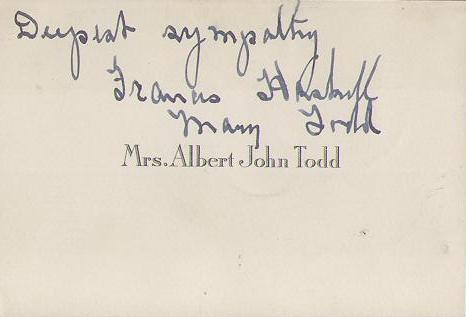
When Uncle Lou (Lambertus) Leeuwenhoek passed away on April 20, 1949, another Todd–Mary Todd–sent flowers and a sympathy notecard. You can read about Uncle Lou and his wife, my Aunt Jen, if you click on the following links: a post about Uncle Lou’s hero brother who died at war, a post about Uncle Lou’s Bible collection, and one which focuses on my Aunt Jen, Uncle Lou’s wife. When I was growing up, she was the oldest person I knew. A post I still need to write is about the store Uncle Lou and Aunt Jen owned.

I don’t know how Aunt Jen knew Mary Todd, but maybe it was at church or maybe it was through the store.

Sent with a vase of mixed flowers

Sent with a vase of mixed flowers

Mary Todd was Ethel’s sister-in-law, the wife of Albert John Todd, the President of the A.M. Todd Company. Mary’s husband was a son of the company founder. In 1950, Albert and Mary lived at 2344 Midvale Terrace in Kalamazoo. The house was in the middle of a section known as Westnedge Hill, where the houses are all large and custom and the lots large for city lots.

The 1920 census indicates that Albert and Mary lived with their four children and two servants, an “Englishman” and a local girl. According to the 1930 census, they had one servant, a different girl from ten years earlier. It’s hard to tell about the 1940 census because Albert and Mary are at the bottom of the page, and I am not sure how to find the next page. Any ideas?

When people think of the A.M. Todd Company, they think of mint. According to the company website, the history is summed up this way:

Quality. Purity. Integrity. An unwavering belief in these principles inspired Albert May Todd, then a teenager, to found A. M. Todd Company in 1869. It was an era when mint essential oil from Michigan had a poor reputation thanks to widespread adulteration by unscrupulous vendors. Albert May’s initiatives brought credibility to Michigan essential oils and early success to the A. M. Todd Company, now the world’s oldest and largest supplier of American peppermint and spearmint oil.

Maybe Uncle Lou and Aunt Jen were customers, through their store, of the A.M. Todd Company.  This company was sold a little over two years ago. You can find an article here which describes the company, the sale, and the influence of the company on the Kalamazoo area.

This is a passage from a book entitled Vanilla: Travels in Search of the Ice Cream Orchid by Tim Ecott:

Notice that the notecard also has the name Frances Haskell. Maybe that indicates that the flowers were, in fact, from women who knew Aunt Jen through a women’s group? Frances Haskell seems to be a middle-aged single daughter of Gertrude Haskell. The Haskells lived in the beautiful area near Kalamazoo College and the Henderson Castle.

Once again, this item and the information I’ve found leads to more questions than I had originally!

Enhanced by Zemanta

Read Full Post »

Remember that genealogy research “to do” list I made back in December?

Good, I’ll forget about it, too.

I’ve been so busy at work lately that I am behind in everything. But readers are so helpful, that I will post something that is a bit of a mystery to me (what isn’t?!).

This “Class Day Exercises” announcement for the Kalamazoo High School Class of 1902 was with some other papers and clippings my grandparents held for years.

But who did it originally belong to? Who in the family graduated from high school in 1902?

My first guess was Joseph DeKorn because he seemed about the right age. Joseph Peter DeKorn: June 30, 1881. Look at that! He was born under the astrological sign of Cancer, just like me.

How old would he have been in 1902? My advanced math skills tell me he would have been 21.  Hmm, that seems a little old for graduating from high school. Especially for a very smart young man like Uncle Joe.

Grandpa wasn’t born until 1908. I wondered about Alice Leeuwenhoek, but she was born in 1897. The daughters of Richard DeKorn’s second wife were born in the 1890s, as well. The first VanLiere boy wasn’t born until 1902 (in Goes, the Netherlands). It is possible that it could belong to a child of Mary DeKorn DeSmit and John DeSmit, but that seems unlikely.

It could have belonged to a friend, but then why would the family have held onto it all these years?

Any ideas on how I get a list of 1902 graduates of Kalamazoo High School from the comfort of my computer chair?

Another thing I wonder about is exactly what Class Day Exercises are. I believe they are still held today, but what role does it play in the graduation process that includes commencement, baccalaureate service, etc.?

Enhanced by Zemanta

Read Full Post »

My great-great-grandmother Alice Paak (the brave woman who survived a horrific near-tragedy that I wrote about last spring) gave her middle child Cora a gift for Christmas 1907. Perhaps she gave one to each of her three children.

You can see from the photo that it’s a hand-painted genealogy shell.

My grandfather and grandmother inherited it, and my grandmother gave it to me.

Let’s take a look at what she wrote over one hundred years ago, and how it relates to the information I have received more recently.

Alice Paak

If you remember my story about Alice’s near tragedy, you might also remember the post I wrote about her beautiful handmade shawl. Or the post I wrote about Alice and all her sisters.

On the shell, she names herself “Alice Paak ,” which is the name Grandpa had told me.  But genealogical research in the Netherlands shows that she was born Aaltje Peek. The source used for that name was this:

Lexmond, Zuid-Holland, the Netherlands, birth record, 1852, 36, Aaltje Peek, 9 September 1852; digital images,
Familysearch (https://familysearch.org/pal:/MM9.3.1/TH-1-159370-202016-19?cc=1576401&wc=6426532 : accessed 23
December 2012)

Apparently, she accepted the American name “Alice.” Her granddaughter, Alice Leeuwenhoek, the daughter of Jennie and Lou Leeuwenhoek, was named after her. Later, my own aunt, the granddaughter of Alice’s daughter Cora, was given the name Alice.

Alice Paak’s birth date is given on the shell as 17 September 1852.  But my genealogical information (the source I listed above) shows that she was born on that same month and year, but on the 9th, not the 17th. Wouldn’t she know her own birth day? That confuses me.

On the shell, she lists her birth place as Leksmond, Nederland. That sounds right, and I think it’s the same place as Lexmond, Zuid-Holland, Netherlands.

Richard DeKorn

My great-great-grandfather Richard DeKorn was born Dirk de Korne.  But he clearly changed both his first name (Americanized it) and the spelling of his last name (maybe to make it easier for others).

He was born on 21 Aug 1851.  The shell corroborates the date.

However, his birth place is listed on the shell as Goes, Zeeland, Nederland. But wait!  In another post I mentioned that I had always thought he was born in Goes, but the genealogical documentation shows that was born in Kapelle, Zeeland, the Netherlands! This is the documentation:

Kapelle, Zeeland, the Netherlands, birth record, Dirk de Korne, 21 August 1851

Jennie DeKorn

Born March 18, 1873. That’s according to the shell. But my information is March 8, 1873. I have to check on this!

Cora DeKorn

Born January 2, 1875. That’s according to the shell and to my records.

Joseph Peter DeKorn

Born June 30, 1881. That’s according to the shell and to my records.

The treasure itself

The design is beautiful with holly branches. The berries are raised to look like real berries. Originally there was a gold leaf paint trim around the shell, but it has worn off in many places.

Her use of “Xmas” because it fit better on the small surface seems astonishingly modern, as does the use of metallic gold and red and green for Christmas.

What I find particularly poignant, though, about this family heirloom is the date. She gave this gift to her daughter on Christmas 1907, and on May 5, 1908, a little over four months later, she passed away.

Read Full Post »

When I posted my genealogy to-do list, I asked if you could guess what occupation I found a few of my Mulder relatives engaged in during the 19th century in Holland. I said it was one I have had–and so have my parents, grandparents, and great-grandparents.  Emily Ann at Child Out of Time wondered if it was teaching, which was a very good guess, based on our family history, but isn’t correct.

What I am talking about is retail.  My family was engaged in retail business for a long time.  My husband and I owned stores, and so did my parents. My grandfather owned a gas station. His father owned a fish market and a soda shop.

My 3rd great-grandfather, Karel Mulder, was born 21 February 1837 in Goes, Zeeland, the Netherlands. He married Johanna Maria Boes on November 1861, also at Goes. On 27 August 1868, he married Klazina Otte at Goes. He died on 22 April 1881 in Goes.

His parents were Karel Mulder and Rose Melanie Bataille (remember the Bataille family?).  These are the children of Karel and Rose Melanie–namely, Karel and his siblings:

  • Karel Mulder, born 21 February 1837, Goes, Zeeland, the Netherlands (Witnesses: Carel Mulder and Adriaan Zuijdweg). On 7 November 1861 he was an apothecary’s assistant in Goes. On 27 August 1868 he was an apothecary’s assistant in Goes. On 22 April 1881 he was a shopkeeper in Goes.Karel died on 22 April 1881.
  • Pieter Philip Mulder was born on 29 August 1838 in Goes, Zeeland, the Netherlands.
  • Kornelis Mulder was born on 4 September 1840 in Goes, Zeeland, the Netherlands.25 He died on 3 June 1887 at the age of 46 in Goes, Zeeland, the Netherlands.26 On 3 June 1887 he was a shoemaker in Goes, Zeeland, the Netherlands.
  • Melanie Mulder was born on 21 January 1842 in Goes, Zeeland, the Netherlands.27 She died on 23 June 1884 at the age of 42 in Goes, Zeeland, the Netherlands.
  • Johannes Mulder was born on 12 November 1843 in Goes, Zeeland, the Netherlands.29 He died on 7 January 1849 at the age of 5 in Goes, Zeeland, the Netherlands. [died at age 5]
  • Andries Mulder was born on 23 January 1846 in Goes, Zeeland, the Netherlands. [shop’s financial partner]
  • Jan Mulder was born on 9 December 1848 in Goes, Zeeland, the Netherlands.32 On 22 April 1881 he was a shopkeeper in paint and colonial goods in Goes, Zeeland, the Netherlands.5
  • Johannes Mulder was born on 10 February 1851 in Goes, Zeeland, the Netherlands.33 He died on 26 June 1876 at the age of 25 in Goes, Zeeland, the Netherlands.34 On 26 June 1876 he was a shoemaker in Goes, Zeeland, the Netherlands.
  • Jacobus Mulder was born on 13 May 1856 in Goes, Zeeland, the Netherlands.35 He died on 17 June 1874 at the age of 18 in Goes, Zeeland, the Netherlands.36 On 17 June 1874 he was a shopkeeper’s assistant in Goes, Zeeland, the Netherlands.

My 3rd great-grandfather owned a “paint and colonial goods” store.

According to genealogist Yvette Hoitink:

Karel Mulder had a company in paint and colonial goods together with his brother Jan, called the “Gebroeders Mulder [Mulder brothers]”. This company owned a house at the Korte Kerkstraat (property tax registration section D nr. 377). The most important financer of this company was Andries Mulder in Goes, for a total of fl. 4000 (1/3 of the value of the company). This Andries is probably their brother Andries Mulder, son of Karel Mulder and Rose Melanie Bataille.

Here is a map of where the Mulder Brothers shop was located:

That means that at least 3 of the brothers were involved in the paint and colonial goods shop: Karel, Jan, and Andries. Two other brothers are shoemakers, one died at age five, and the professions of Pieter Philip (we don’t have a death date, so I’m not sure if he lived to maturity) and Melanie, the only girl.

Here are some photos taken by Yvette Hoitink of the building at the location of the Mulder Brothers shop. We don’t know if this is the original building or not. The houses adjacent to the building are original.

This slideshow requires JavaScript.

What do you imagine a “paint and colonial goods” shop would have sold?

Finally, do you remember (from this blog post) what happened to Karel’s son, my great-great-grandfather Pieter?  He ended up in an orphanage!

Read Full Post »

I have a lot of genealogy projects I need to work on and posts I want to write, but it’s a busy time of the year, and so I am going to use today’s post to make my list and to show you what will be coming up here as well (bolded will be blog posts):

  • I have more results from Yvette Hoitink to share. One is about the Mulder family and how they made their living in Goes, the Netherlands.  This also relates to me and an occupation I have had in my life. So have my parents and my grandparents and great-grandparents. Any guesses?
  • Work on the occupations of my family in the Netherlands.
  • Check into the location of Etaples.
  • Work on my tree branch that connects to the Van Gessel family.
  • Write a post about my (Klein) connections with the Van Gessel family.
  • Update my tree with all the new information I have gotten from many sources.
  • Go through new information from Grady.
  • Write a post on the Flipse update and the DeSmits (one or two posts)
  • I plan to reorganize the pages of this blog (not the posts, but the pages, which are tabbed at the top of the page). I want to organize pages by family branch: DeKorns, Zuidwegs, Mulders, etc. 
  • Brook Lodge
  • Harold Remine
  • Alice Leeuwenhoek Moerdyk
  • Organize newspaper clippings and photos and eventually prepare posts

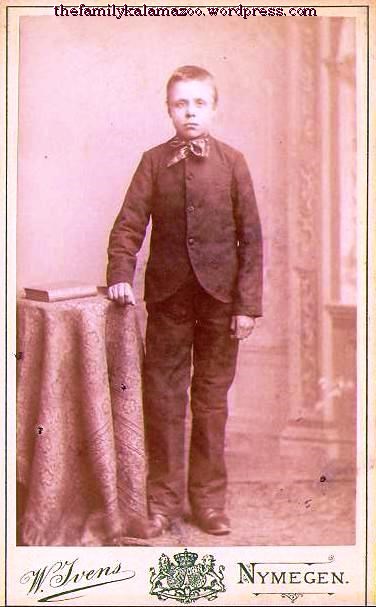
After I do all the above, there will be plenty more to do, including finding out more about some of these photos I have. Here is one of a boy in “Nymegen,” according to the name on the photo. W. Ivens is the photographer.  But so many mysteries. Who is W. Ivens? When was the photograph taken? Is Nymegen the same city as Nijmegen? If so, it’s a city on the opposite (eastern) side of the Netherlands than my relatives came from. Nijmegen is almost to the German border. It’s on the Waal River, which is the main distributary branch of the Rhine River and flows through the Netherlands. Who is the boy? Why is he so far from Goes?

Read Full Post »

Since I haven’t had time to work on any of my larger genealogical projects, I thought I’d share a smaller one today.  This photo is from the Joseph DeKorn collection. He was my great-grandmother’s brother, and he took a great number of our family photos during the very early 1900s.

Because someone took the time to write on the back, I felt that this photo was important to someone in the family. In fact, I believe the handwriting belongs to Uncle Joe.

Timber trestle bridge over the Huron River at Ann Arbor was designed and built by Professor Charles Ezra Greene.

Timber trestle bridge over the Huron River at Ann Arbor was designed and built by Professor Charles Ezra Greene.

Here is what is written on the back:

This is the bridge across the Huron R. It was designed by the late Prof. Greene. The place where the posts are close together is where the [?] fell through. The track in the foreground is the Michigan Central. The Ann Arbor crosses the bridge.

Where the WHAT fell through?

Does that say “where the car fell through”? Did someone’s car fall between the posts into the river?

I looked on the internet and all I found was that in the Detroit River, during Prohibition, this happened, according to Wikipedia:

There was no limit on the methods used by rum-runners to import alcohol across the river. Government officials were unable or unwilling to deter the flow of alcohol coming across the Detroit River. In some cases, overloaded cars fell through the ice, and today, car parts from this illegal era can still be seen on the bottom of the river.

But that’s not the Huron River. And what time period are we talking about for this photo?

On the back, it says “the late Prof. Greene.” Here is biographical and obituary information about Professor Charles Ezra Greene. He died in 1903. So the photo was taken at some point after that.  A steel bridge eventually replaced this bridge, and it might have happened in 1924.

In this bio, we learn this about Professor Greene’s credentials:

[Professor Greene] entered the Massachusetts Institute of Technology. Here he was graduated Bachelor of Science in Civil Engineering in 1868. From this time until 1870 he was Assistant Engineer on location and construction of the   and   Railroad in Maine. The next year he was United States Assistant Engineer on River and Harbor Improvements in Maine and New Hampshire, and was then appointed City Engineer of, where he also carried on a general practice until the summer of 1872. In that year he was appointed Professor of Civil Engineering at the University of Michigan, a position which he held to the time of his death, October 16, 1903. When the Department of Engineering was established as a separate organization in 1895, he was made its first dean. In 1884 he received the honorary degree of Civil Engineer from the University of Michigan. In addition to his duties as professor he carried on an extensive consulting practice. He was Chief Engineer of the Toledo, Ann Arbor, and Northern Railroad from 1879 to 1881; Superintending and Consulting Engineer of the Wheeling and Lake Erie Railroad bridge at Toledo in 1881-1882; designer and Superintendent of the construction of the Ann Arbor water-works in 1885; and designer of the Ann Arbor sewerage system in 1890. He paid special attention to the invention and development of graphical methods of analysis of frames, bridges, and arches. He published several works which were well received by the profession and which have been used in designing important structures: “Graphical Analysis of Bridge Trusses” (1874); “Trusses and Arches, Part I, Roof Trusses (1876), Part  , Bridge Trusses (1878), Part  , Arches (1879) “; “Structural Mechanics” (1897). He was a member of the American Society of Civil Engineers; also of the Michigan Engineering Society, of which he was president for three terms. In 1872 he was married to Florence Emerson, of  , Maine, who with their two children survives him, – Albert Emerson (Ph.B. 1895, B.S. [ ] 1896) and Florence   (A.B. 1903).

Joseph DeKorn attended the University of Michigan at Ann Arbor. I’ll make a guess he took the photo when he was a student at Michigan. This helps narrow down the date of the photo because Uncle Joe was born in 1881, so he would have been studying at the university in the first few years of the 20th century.

Joseph Peter DeKorn (photography by Marion Studio)

Joseph Peter DeKorn (photography by Marion Studio)

What is perhaps very telling is that Uncle Joe studied Civil Engineering, so perhaps he was a student of Professor Greene before the man died.  It does sound as thought Professor Greene taught up to the last. It also sounds as if he was an amazing teacher. At the least, Joe would have learned of Greene’s influence in the classroom.

Joseph DeKorn stayed true to his studies and went on to become Chief or Supervisor of City Light and Water for the City of Grand Rapids, Michigan.

Additional information provided by my uncle in a comment to this post: Charles E. Greene was indeed Joe DeKorn’s prof. He learned both what to do and what not to do from him! Joe DeKorn was in charge of building the Grand Rapids water system which to this day draws it’s primary water from Lake Michigan.  As Uncle Don says, it was a big project!

What do you think that he writes on the back of the photo? Does it say car or cars? Or something else?

FABULOUS CLUE BY MY FRIEND WANDA WHO POINTED OUT THAT THE CAR OR CARS IN QUESTION WOULD BE TRAIN CARS LED TO THE SOLUTION TO THE MYSTERY

This article is from the January 29, 1904 Kalamazoo Gazette.

There is a long article in the Ann Arbor Argus-Democrat on the same day. It indicates a dispute over the cause of the accident and says that actually 13 cars were destroyed.  But the bottom line is that it was NOT a defect in the bridge that caused the accident, but a broken flange on a coal car.

Read Full Post »

« Newer Posts - Older Posts »