Feeds:
Posts
Comments

Archive for the ‘Lucille Edna Mulder Zuidweg’ Category

Part VI

Today’s passage is about a sad and difficult time in Grandpa’s life.  Connie wrote, Adrian was

Grandpa, an only child, grew up living with his parents and his widowed grandfather. Yet, by the time he was 23 years old, he was alone in the world, except for his new wife, my grandmother.

He had lost both parents and his grandfather. Yet, at the interview, he told Connie that it “didn’t bother” him that much. He said his father prepared him ahead of time for his death and for taking care of the household affairs.

Grandpa’s mother Cora DeKorn Zuidweg’s obituary

Since Grandpa’s father died in 1929, of kidney failure, and his mother died three years later in 1932, of leukemia, I suspect that his father prepared him to take over the family affairs so that his ailing mother didn’t have to do so. It was probably taken to be a man’s work, and since Grandpa was an adult, he would be expected to take care of his mother. He did take care of her, and towards the end had the help of Grandma. Grandpa and Grandma were married in May of 1932, and Grandpa’s mother died in December of that year. So for seven months, newlywed Grandma helped Grandpa to take care for her ailing mother-in-law.

Grandma and Grandpa formed a strong bond, which lasted their entire lives. It’s no surprise that Grandma interrupted the interview to explain why Grandpa would say he wasn’t “bothered” by losing his family at such a young age. She knew that he was raised not to show emotion and that he was very good at showing a “stiff upper lip.” But being married to him all those years, she knew that it was very difficult for him to experience such loss.

Grandpa saying “I guess that’s why there’s Valium” sounds just like his sense of humor, another way of deflecting from deep emotion.

Grandma and Grandpa in later years

Grandma and Grandpa in later years

I hope you’ll stay tuned for Part VII of Grandpa’s story . . . .

Here are the first parts of the story:

Click this link for Part I

Click this link for Part II

Click this link for Part III

Click this link for Part IV

Click this link for Part V

Read Full Post »

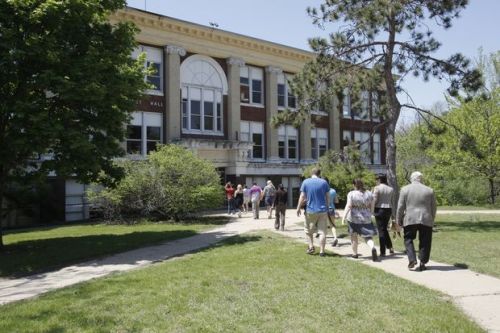
The National Trust for Historic Preservation is begging Western Michigan University not to destroy history–its own, that of the Kalamazoo area, and that of higher education. There are four old buildings which represent the origins of the university which those who head up the school want to demolish.  Here‘s an article that Mom clipped and mailed me. It was printed in the Kalamazoo Gazette on June 27, 2013.

Click here for the Kalamazoo Gazette article

Click here for the Kalamazoo Gazette article

Click here for the Kalamazoo Gazette article

Click here for the Kalamazoo Gazette article

I keep asking myself  the question, “What kind of people want to destroy history?”

My family has graduated from Western Michigan University for four generations. As I explained in a previous post “Western State Normal School, Kalamazoo, Michigan: A Personal View,” my grandmother, L. Edna Mulder Zuidweg, graduated from the school when it was Western State Normal School, a teacher training school. Both my parents, my aunt, my brother, and yours truly also graduated from WMU.  In addition, my husband graduated with a BBA degree, as well.  And at least one member of the most recent generation–my cousin’s daughter– has graduated from Western.

Because my husband and I both got business degrees (I also majored in history and he did so in political science) in the late 70s, we spent a lot of time on the oldest section of the university–East Campus, which housed the business school.

If you follow this link you will read a good history of the old campus.  They have some beautiful photos posted, too.

State Normal Kalamazoo front

HERE’S WHAT YOU CAN DO TO HELP FROM THE FRIENDS OF HISTORIC EAST CAMPUS WEBSITE:

1.  Be an advocate for smart adaptive re-use!  Tweet, display yard signs, display bumper stickers,write letters, TELL YOUR FRIENDS and ASK THEM TO HELP!  ACT NOW.  Click here for  Action Plan

2.  Join our “cast of thousands!” 
     Click here for details of our quest to post pix of you holding the Save East Campus sign for Youtube

3.  Click here to get your printable pix-poster for Youtube video

4.   Express your concerns to WMU’s Board of Trustees [go HERE to email the Board]

5. Express your concerns to elected officials:
Governor Rick Snyder
P.O. Box 30013
Lansing, Michigan 48909
https://somgovweb.state.mi.us/GovRelations/ShareOpinion.aspx
517-335-7858

State Senator Tonya Schuitmaker
mailto:SenTSchuitmaker@senate.michigan.gov

State Representative Margaret O’Brien
mailto:MargaretOBrien@house.mi.gov

State Representative Sean McCann
mailto:seanmccann@house.mi.gov

Mayor Bobby Hopewell
mailto:bobbyhopewell@borgess.com

6.  Express your concerns to WMU’s Board of Trustees [go
 HERE to email the Board]

7. Sign a petition here 

8. Write to news media in support of the FOHEC request for a moratorium and community input.

9. ASK:  How much will taxpayers/students have to pay to demolish the buildings?  How much will taxpayers/students have to pay to transport resulting debris to landfills?  How much will taxpayers/students have to pay to pave over historic East Campus to create the proposed parking lot?  How much does it all add up to?  

10. ASK:  How much will it cost to save the buildings and make a serious survey of ways they could be used to serve and educate students?

Read Full Post »

I wrote about my great-grandmother Clara Waldeck Mulder in The Lost Bracelet. At the time I posted about her, I didn’t really have a lot of facts about her, other than that I lost her bracelet because the clasp didn’t hold while I was at work.  Ironically, I was selling costume jewelry at Jacobson’s, in downtown Kalamazoo.

Since then my mother gave me some notes about her grandma:

  • She regularly did heavy farm chores, especially after her children were old enough to stay in the house alone. She was a big strong woman.
  • She cooked without recipes, but the food tasted very good.
  • In the evening she served us homemade ice cream that she and Grandpa made.
  • She cared for the chickens, including slaughtering them to cook and eat.
  • Along with family help, she kept a large vegetable garden.
  • She let us go wildflower picking in the “woods” across the road from their farmhouse and barn.
  • She let us play the player piano as much as we wanted. It used the perforated paper rolls.
  • Her family, both sides, seemed to carry a glaucoma gene; many experienced at least some loss of vision.
  • Some of her relatives were farmers.
  • Her family met for a family reunion with extended family every summer–it went on for many years.
  • When she got sick in her sixties and died, I felt a great loss.

###

Although I never got to meet my great-grandmother Clara, I did visit her farm and even stayed there for a week once with my great-grandfather and his second wife Margaret.  I remember my grandmother, Clara’s daughter, taking me wildflower picking in the woods across the street from the farmhouse.

By this time you might wonder what the clue could be about the Waldecks.  Well, the information I had been given was that Clara’s father was Godfrey (probably Gottfried) Waldeck and her mother’s maiden name was Alvena Neffka.

I had met a brick wall trying to trace these people back to Germany. I even talked to a German genealogist who has helped me in the past. He said Neffka couldn’t be a German name.  He questioned if that was really the name.

The only clue I’d found was on Alvena’s death certificate which indicated that her father was Louis Koffler and her mother Dora Couch.

So I started picking and probing at the name Neffka (on Ancestry), trying to figure out what else it could be.  That’s when names like Gniffke, Koffler, Knoffka started showing up all over the place.

Then suddenly I started getting hits on Noffke right and left, especially in Caledonia, Michigan, where my great-grandmother was from.  I changed the name to Noffke on my tree and I was showered with little green leaf hints from Ancestry.

For the first time, I found tons of Noffke relatives right in southwestern Michigan, where they ought to be.  I am still going through this treasury of information.

I’m a little closer to breaking through that brick wall.

Also, I had a DNA match at Ancestry with a verifiable relative—we are both 2nd great-granddaughters of Godfrey and Alvena.  She and I inexplicably showed up with eastern European DNA.  That, and some documents which say “Prussia,” seem to indicate that my grandmother’s Noffke family—and probably the Waldecks as well—are actually from Prussia, not Germany proper.

Onward in my search.  Polishing up my Nancy Drew microscope for the Noffke leaves.

Leaving you with a photo of old Caledonia, Michigan:

Read Full Post »

In my last post I wrote about my great-grandmother Clara Waldeck Mulder, of Caledonia, Michigan.

Today I have a confession to make.  The Waldecks are my most unknown branch of the family.

And why?  Waldeck is a fairly common name.  There are two Castle Waldecks. Lots of places share the name Waldeck.  There are many Waldecks listed on Wikipedia, including the first Waldeck, who was a count, and some Waldeck princesses.  I bet there are a lot of paupers named Waldeck, too.

But so far I can’t find the town or region in Germany where my Waldeck family came from.

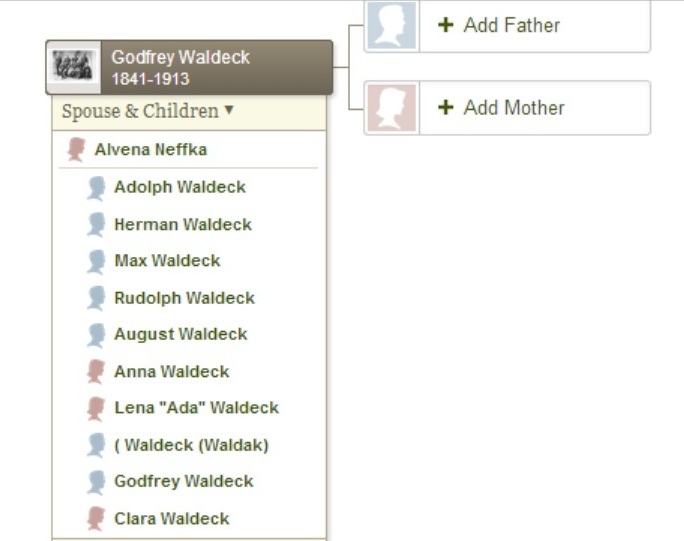
Look at the sorry state of the family tree:

Godfrey Waldeck family treeeGodfrey (Gottfried) and his wife Alvena (Alvina) immigrated to the United States with their family and then had more children. I don’t even know if all those children listed on this tree are theirs! Clara is.

And so is Godfrey (junior) because I remember him when I was young.  He managed a grain elevator or something like that, but he also farmed his own land.  He was blind from glaucoma when I met him, and he still walked down the road each day and drove his tractor in the fields.  As an aside, glaucoma runs rampant in their family.

I know that Grandma used to like to go to the Waldeck family reunions, and I went to at least one myself, at a lake (of course).

Look at Alvina Waldeck above.  The tree lists her as Alvina Neffka, as if that is her maiden name.  But is it?  I’ve also seen it listed as Noffke and on her death certificate her father was listed as Louis Koffler.  Her mother was listed as Dora Couch.

Noffke is a German name, and so is Koffler.  Neffka is not German.  Neither is Couch.

One person I’ve spoken with has wondered if the family was more Polish than German, but I have no proof of that either.

I need some help with this and hope that somebody reads this blog and gives me some clues about the family!


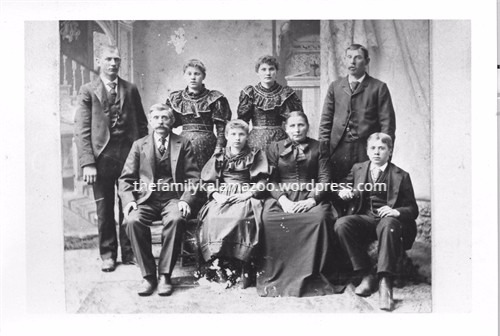
I am going to take a stab at identifying the people in the photo.

Back row:  Fred (according to a rumor, he was in a terrible accident), Ada Steeby (who had a daughter Ruth), Anna (did she marry a Stewart or Christianson or both), August (died in WWI, a bachelor)

Front row: Gottfried, Clara (my great-grandmother), Alvina, Godfrey

Looking at this photo and the names, can we write off Adolph, Rudolph, Max, Herman? Are they not part of our family?  Or were they older, born in Germany, and already living their own adult lives when this photo was taken?  And why isn’t Fred even on the family tree?!

You can see that I am going to need some help with this project!

Read Full Post »

My maternal grandmother, Lucille Edna Mulder (Zuidweg), who was born in 1912 at the time of the Titanic disaster, was raised on a farm in Caledonia, Michigan.  If you’ve read my blog for any length of time you know that I have a beautiful scrapbook which she made to commemorate her high school graduation in 1929.

You’ve met her parents, Charles and Clara (née Waldeck) Mulder.

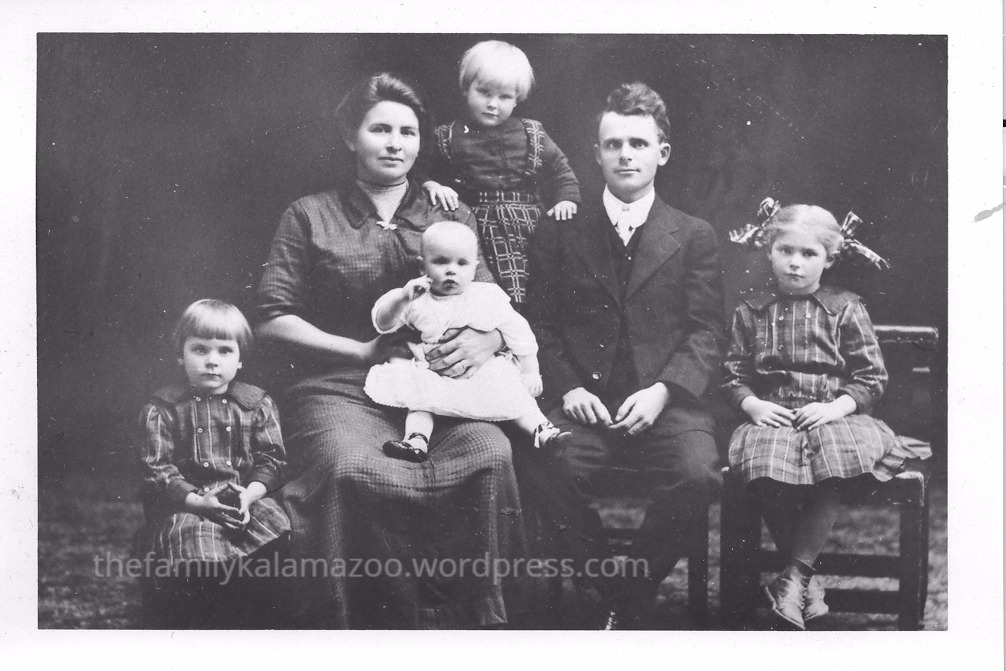
Charles and Clara (Waldeck) Mulder Marion Studio pic

I’ve shared with you the book collection and gavel which belonged to my great-grandfather Charles.  I have not said much about my great-grandmother Clara.

What I know about her is that she raised five children on a farm in Caledonia.

Clara’s parents and older siblings were born in Germany (and perhaps at least one sibling in Kentucky, but don’t quote me on that).  She was born August 31, 1884, in Michigan.  She died September 6, 1953, of uterine cancer.  I was born less than two years later.

I have an Eastern Star ring which belonged to her, so I know she belonged to that organization. I had a sapphire bracelet, which I lost at my first job and was heartsick over, and a couple of other small items.

Here is Clara’s calling card, which my grandmother placed in her scrapbook along with the graduation cards of her classmates:

Clara's calling cardI wish I knew more about Clara and her life.  I think if I keep researching I will find more and maybe I will be able to put some pieces together.

Maybe my mother and her siblings and cousins remember their grandmother and can add to my paltry information!  Hint hint.

Read Full Post »

I just found a photo which goes with one I posted last week.  Last week was the anniversary of my grandmother’s birthday and I posted a page from her high school graduation scrapbook.  Then I posted a photo my father had taken in the eighties of her with her four siblings and all their spouses–the whole Mulder family.

Here is a beautiful image of the four oldest Mulder children (Dorothy, Edna, Vena, and Pete) with their parents, my great-grandparents, Charles and Clara Mulder.

This photo would be before 1917 as Charles wasn’t yet born. Notice how Dorothy and Edna have matching plaid dresses on.  Although they were a year apart in age, they graduated high school at the same time.  It looks like they were almost treated as twins.  Vena (Alvena), the youngest daughter, is wearing an outfit which matches the older girls’ dresses, but appears to be a skirt with straps.  How do you like those “Dutch boy” hair cuts from almost 100 years ago?!

Read Full Post »

Photo by Rudy Hanson

After reading another post on Wednesday about Grandma’s high school graduation scrapbook, I thought you might like to see the Mulder family from Caledonia. Remember that in Edna’s scrapbook she memorialized the graduation of herself and her sister Dorothy. This photo must be from the 1980s.

From left to right, standing:

  • Conrad Plott
  • Edna Zuidweg
  • Ruth Ann Mulder
  • Chuck Mulder
  • Adrian Zuidweg
  • Alton Stimson
  • Dorothy Plott

From left to right, sitting:

  • Ruby Mulder
  • Pete Mulder
  • Vena Stimson

The five Mulder siblings in order:

Dorothea Rosa Mulder (1910-1996) who married Conrad Plott (1905-1889)

Lucille Edna Mulder (1912-2000) who married Adrian Zuidweg (1908-2000) [my grandparents]

Alvena Mulder (1913-2000) who married Alton W. Stimson (1911-1996)

Peter Godfrey Mulder (1915-1986) who married Ruby Elizabeth Ayers (1920-2007)

Charles Peter Mulder (1917-1989) who married Ruth Ann Holton (born 1924)

Ruth Ann, a very special lady, is the youngest of the group, and she lives near her daughter.

Read Full Post »

Today would be the birthday of (Lucille) Edna Mulder Zuidweg, my wonderful grandmother, born April 17, 1912. We lost her on September 21, 2000.

In honor of Grandma, I’ll share more from her high school graduation scrapbook, which has quite a few goodies in it.  I wrote about it before in the post Who Put the Ring Stain on the ScrapbookToday I’d like to share one page of the scrapbook.

This page is my favorite because I learn more about my grandmother here.  In the upper left is a photo of my grandparents, which means that they were dating by the point she glued that photo in the book.  Aren’t they cute?  When and where did they meet?

In the upper middle is a photo of Grandma’s best friend Blanche Stauffer, Class Valedictorian.  Grandma was Class Historian and her older sister Dorothy was Salutatorian.  The newspaper clipping on the upper right explains all that.

The congratulations note by Elsa looks treasured.  At the bottom left is a newspaper clipping which is from April 1920:

Miss Edna Mulder celebrated her eighth birthday anniversary with a party Saturday.  Twenty little people were present.

In the bottom right corner is another clipping.  This one is also from 1920:

The first of the spring flowers again comes to our desk through the thoughtful kindness of little Edna Mulder.  Flowers while we live to enjoy them are far sweeter than those at death for does not some one tell us that “Flowers on the casket can cast no fragrance backward over life’s rugged way.”

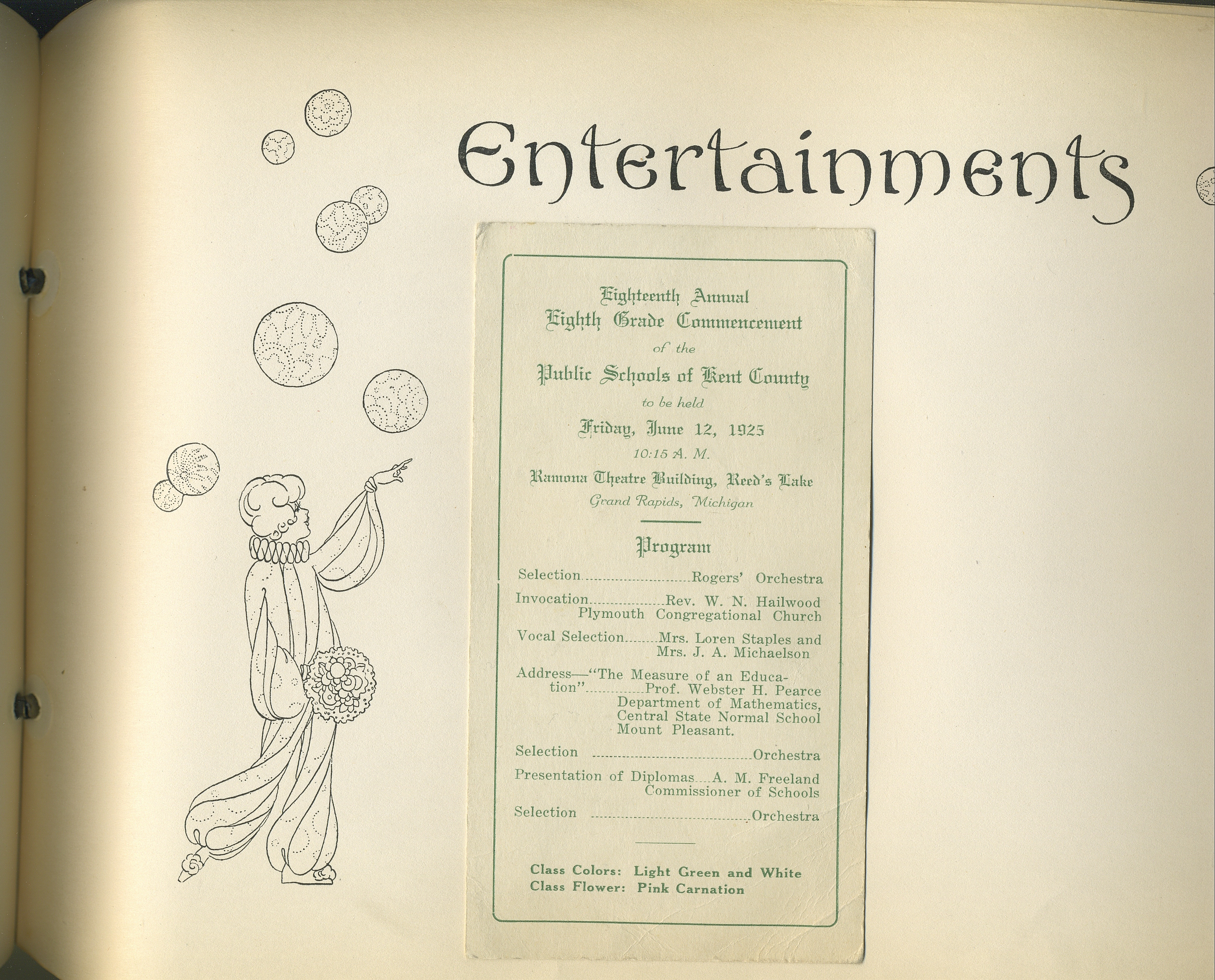
One more scrapbook treat is the “entertainment” for Grandma’s 8th grade graduation, which took place  in Grand Rapids, Michigan, on June 12, 1925:

Happy birthday, Grandma.  I miss you! xo

Read Full Post »

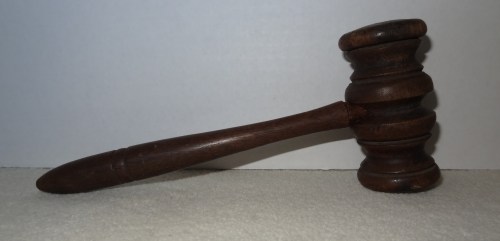
This gavel belonged to my great-grandfather Charles Mulder of Caledonia, Michigan.

He was my maternal grandmother‘s father and his name at birth, in 1885 in Goes, Zeeland, the Netherlands, was Karel Pieter Phillipus Mulder.  His great-great-grandfather was Carel Mulder, born March 8, 1780 in Goes, the Netherlands.  His occupation was a jailor’s hand.

This same Carel Mulder is also an ancestor of my maternal grandfather.  I wrote about the discovery of this coincidence in an earlier post.

Great Grandpa was a working farmer for many years.  I remember his farm with great affection because it had a rope swing from an apple tree, a barn, a chicken coop, outhouse, and fields where we once went on a hayride. Across the country road, a the thick woods nurtured a colorful assortment of wild flowers.
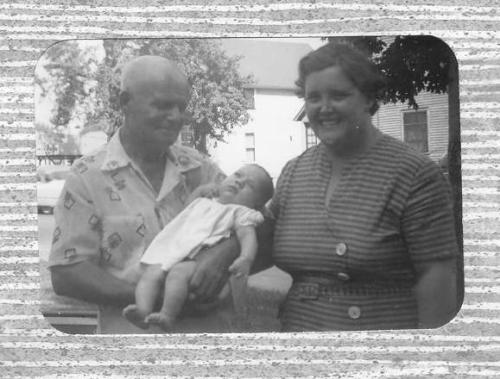
Great Grandpa, me (the first great grandchild), and Margaret

Great Grandpa, me (the first great-grandchild), and Margaret

In the above photo, Great Grandpa is with the only “great-grandmother” I knew, his second wife, Margaret, a very sweet lady.  My great-grandmother Clara passed away from uterine cancer two years before I was born.

Charles and Clara (Waldeck) Mulder

Charles and Clara (Waldeck) Mulder

My father told me that Great Grandpa held the position of Township Supervisor years ago and that is where he used this gavel.

On pages 252-256 of Ernest B. Fisher’s 1918 book, Grand Rapids and Kent County, Michigan: historical account of …, Volume 1I discovered more specific information about Great Grandpa and Caledonia.

Fisher explains that Caledonia was a “wilderness” with narrow trails by the local Native Americans (“red men,” according to Fisher) when Europeans first arrived there.  He states:

At the mouth of Coldwater river was a great Indian camping ground and burial place. The Indians did not leave there entirely until a comparatively recent date. One of them, old Soh-na-go, or “Squirrel,” was seen at quite a late day visiting the burial place and the hunting grounds of his fathers, but the “white man’s axe” had been there and it was no longer a home for him.

He goes on to say:

Caledonia, situated on Section 29, is a prosperous village of 600 people. It was settled in 1850, the first plat was made in 1870, and it reached the dignity of an incorporated municipality in 1888. It is situated on the Michigan Central railroad and hence has good shipping facilities which make it the center of trade for a wide extent of fertile country. It has one Methodist and two United Brethren churches, a bank, and a weekly newspaper, the News, and the requisite number of mercantile establishments and general industries.

The township of Caledonia is one of the best agricultural districts in Kent county, and the thrifty farmers are profitably engaged in all classes of diversified farming.

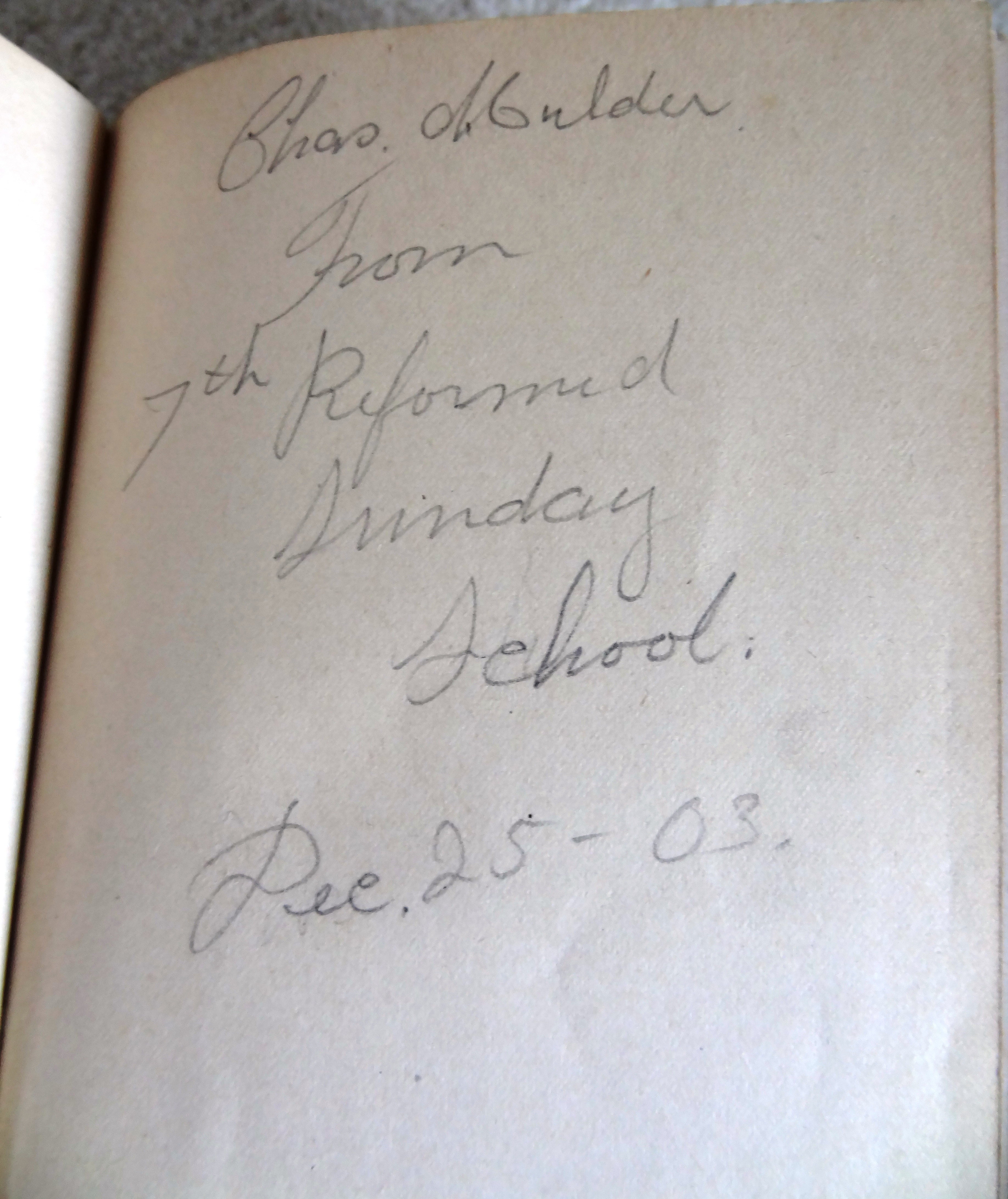
What interested me is that I saw that inside one of Great Grandpa’s books he went to a (Dutch) Reformed Church in 1903.  He was so ensconced in life in Caledonia by 1915 that he was Township Supervisor (and Grandma was born in 1912 in Caledonia).  The quote above says that there was one Methodist and two United Brethren churches, and I do know that my grandmother was a Methodist and that we used to have family reunions in the basement of the Methodist Church in Caledonia when I was a kid.  So where did he go to the Reformed Church?

According to records I found through ancestry.com, he immigrated to the United States with his family when he was two or three and grew up in Grand Rapids, not out in the country on a farm, after all.

Back to what Mr. Fisher had to tell me about my great-grandfather:

Below is given a list of the supervisors of the township from its organization down to the present time: 1840, John P. McNaughton; 1842, Norman Foster; 1844, Roswell F. Tyler and William Gibson; 1845, John A. Cornell; 1846, Justus G. Beach; 1848, Reuben H. Smith; 1849, William H. Brown; 1854, Lyman Gerould; 1857, Zabin Williams; 1858, William H. Brown; 1860, Warren S. Hale; 1861, William H. Brown; 1863, William J. Wood; 1865, Adam B. Sherk; 1868, William J. Wood; 1869, Marcus Buell; 1870, Adam B. Sherk; 1871, Robert S. Jackson; 1872, William J. Wood; 1873, Martin Whitney; 1877, Austin W. Hill; 1878, Marcus Buell; 1879, Sherman T. Colson; 1889, Alfred W. Stow; 1891, Sherman T. Colson; 1895, Eugene Ward; 1900, Joseph E. Kennedy; 1901, Alfred Newman; 1904, EugeneWard; 1906, Alfred Newman; 1907, Frederick W. Ruehs; 1912, Merrill M. Kriger; 1914, John J. Luneke; 1915, Charles R. Mulder, present incumbent.

Great Grandpa was the Supervisor of the Township of Caledonia.  He used this gavel to call the meetings to order.  Maybe this desire for order comes to him from his great-great-grandfather, the jailor’s hand.

Read Full Post »

00000001This is the scrapbook which my parents gave to me.  In it my grandmother (Lucille) Edna Mulder (later Edna Zuidweg) recorded the events of her high school graduation from Caledonia High School (Michigan), as well as a few clippings from her first year at Western Normal School in Kalamazoo.

In 1929, my grandmother graduated a year early, at age seventeen, along with her older sister Dorothy Mulder (later Dorothy Plott).  Grandma earned the 3rd highest GPA at 93.85% and thus was honored with the title “class historian.” Her sister was salutatorian. Grandma’s best friend Blanche Stauffer was valedictorian. Clearly, grades were not inflated in those days at Caledonia High School.

Grandma was the 2nd oldest girl in her family of three girls and two boys. When I was young and reading my mother’s copy of Little Women, Grandma told me she always thought that she was just like Jo, the 2nd oldest and the writer of the family.  Her sister Dorothy was Meg, and her younger sister Alvena (called Vena, later Vena Stimson) was Amy.  It makes sense to me that “Jo” would have been placed a year ahead so she could go to school with “Meg,” and that she would earn class historian to her sister’s salutatorian.

Salutatory

Dorothy Mulder’s Salutatory (beginning portion)

Edna Mulder’s high school transcript

Edna Mulder’s class history (beginning portion)

The scrapbook contains wonderful photos of Grandma, her friends, classmates, and teachers, but it doesn’t solve the mystery of who put that drinking glass ring on the cover.

Read Full Post »

« Newer Posts - Older Posts »