Feeds:
Posts
Comments

Posts Tagged ‘Peek family’

Let’s continue the Paake/Paak/Peek/Pake family saga.

I grew up not knowing that great-great-grandmother Alice had had a brother named George. When I discovered him, it was, in part, because of a newspaper clipping I found among the family papers. I’ve already written about George’s family here:

A Series of Disasters

The Children After the Fire, 1902

Paak-a-boo

Saved from the Fire

In the Paak-a-Boo post, I contemplated whether an unidentified photo I owned could be George Paake, based on the resemblance to great-great-grandmother Alice.

It turns out we still don’t know who is in that photo, but I now know what George looked like!


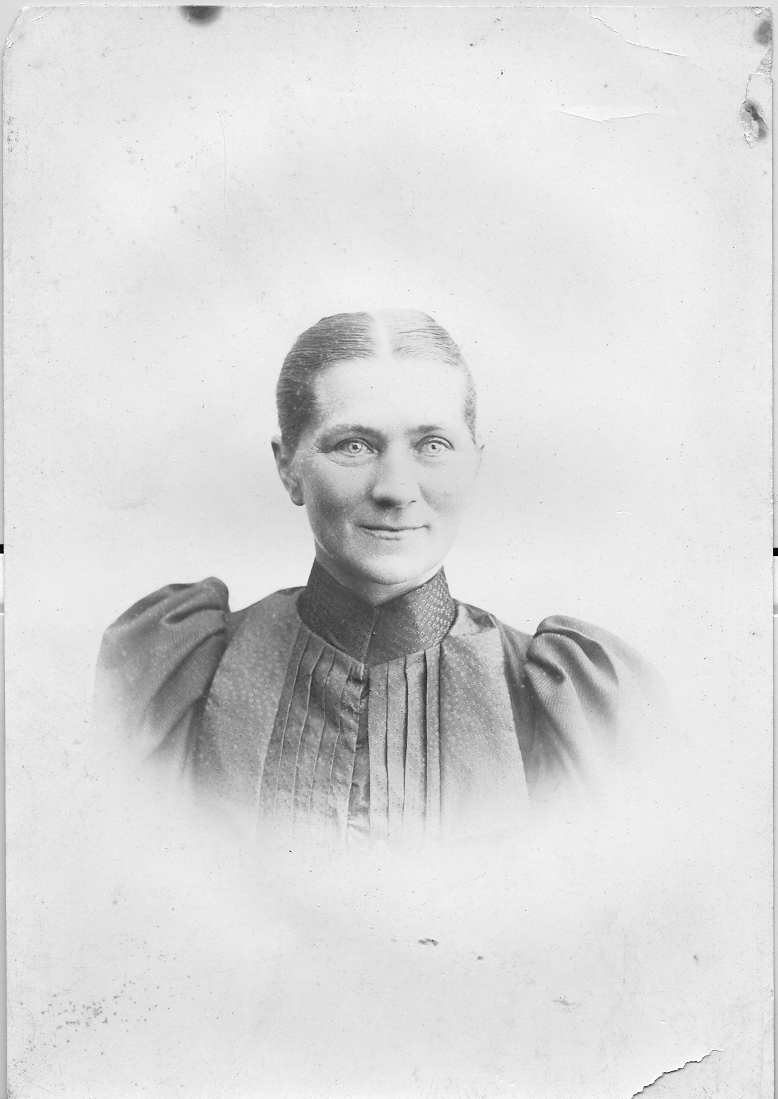
Here is a photo of Lucy Kliphouse (her name was Anglicized from the original Dutch: Lukkien Kliphuis ), the mother of George’s five children.

This is his first wife. After she passed away in 1900 (two years before the fire), George went on to marry a few other women. It’s said he might have had five wives.

Stay tuned for more information about the leaves and blossoms of George’s branch of the family!

Read Full Post »

Here is another follow-up to my post about the newspaper clipping I found tucked in with the family photos. If you missed it, you can find it in A Series of Disasters or read the clipping below. Since then I have learned a lot about the George Paake (born Joost Peek and also known as George Pake) family of widowed father and five children.

In addition to learning about the children, which I will explore more in future posts, I was told that a piece of furniture that was rescued from the fire is still in the hands of the family. Since I thought you might like to see a sample of what was in that house in 1902, I asked for a photograph of the dresser.


I am not an antiques expert by any means, but it struck me as different from most of the pieces I’ve seen from that period. Since the fire was in 1902, the dresser was most likely from the late 1800s.

Teunis Peek and his wife Jacoba Bassa had six children while living in Lexmond, the Netherlands. In 1865, Jacoba passed away at the age of 41. A few years later (1868 or 1869), Teunis brought the children to the United States, where he settled in Michigan.

Therefore, when the fire occurred at the home of Teunis’ son George,  the family had been living in Michigan for over 30 years. Because of the style of the dresser and the length of time in this country, I would assume that the dresser was purchased in the United States.

From a little Google research, I am guessing that this dresser is of the “Eastlake” style. The straight lines were meant to vary from the norm of Victorian curlicues, and the ridges on the corner columns and the stylized branch with leaves carving are typical of that style of furniture.

Do you agree or disagree about the style and age of this piece? and why?


###


Enhanced by Zemanta

Read Full Post »

Just over a year ago, in A Series of Disasters, I posted a newspaper clipping that I found tucked in with the family photos. This is the copy of the article:

The residence of George Paake at 1016 Trimble Avenue was burned this morning about 10:30 o’clock and a worthy family which has had a series of disasters, left without a home.  The house which Mr. Paake was paying for in the Building and Loan Association was entirely ruined although most of the contents of the home were saved. Mr. Paake receives no insurance whatever and the little which had been accumulated by the family was lost.

The fire is only an incident in the history of the family. Mrs. Paake died a short time ago leaving five children, the oldest being fourteen years old. Since the mother’s death the little girl has had entire charge of the house and the four little children and has had all the responsibility of the family except the support which Mr. Paake gave as a laborer.  Recently he has been unable to work and was ill this morning when the fire occurred.

The neighbors have taken in the little ones and are doing all that is possible to alleviate the sufferings of the family. Mrs. Carrier has been responsible for raising a sum of money to which the neighbors have liberally contributed.

At the end of this post I will re-post the newspaper clipping for documentation. I want to apologize for spelling the surname every which way, but at every turn the name is spelled differently. Family members changed the spelling, and different documents recorded it differently. Paak-Peek-Paake-Pake: they are all the same.

Eventually, I discovered that this man was George Joseph Paak, Sr.,  the brother of my great-great-grandmother Alice Paak DeKorn and that the fire occurred on Wednesday, September 3, 1902.

George’s wife Lucy Kliphouse passed away in 1900, leaving 5 young children in their father’s care.  George (born Joost) was 50 at the time he was left a widower. At some point he had changed the surname to Pake.

The five children were Cora, the eldest mentioned in the article, Jennie, Theresa (also called Tracy), Fanny (also called Frances), and George Jr. Cora was born in 1888; Jennie (who later changed her name to Jane) in 1890; Theresa in 1893; Fannie in 1896, and George in 1898.  George was only four when the fire occurred. Imagine Cora, at 14, taking care of the others–ages 12, 9, 6, and 4. What a burden on such a young girl. And when her mother died, she was only twelve and young George was two!

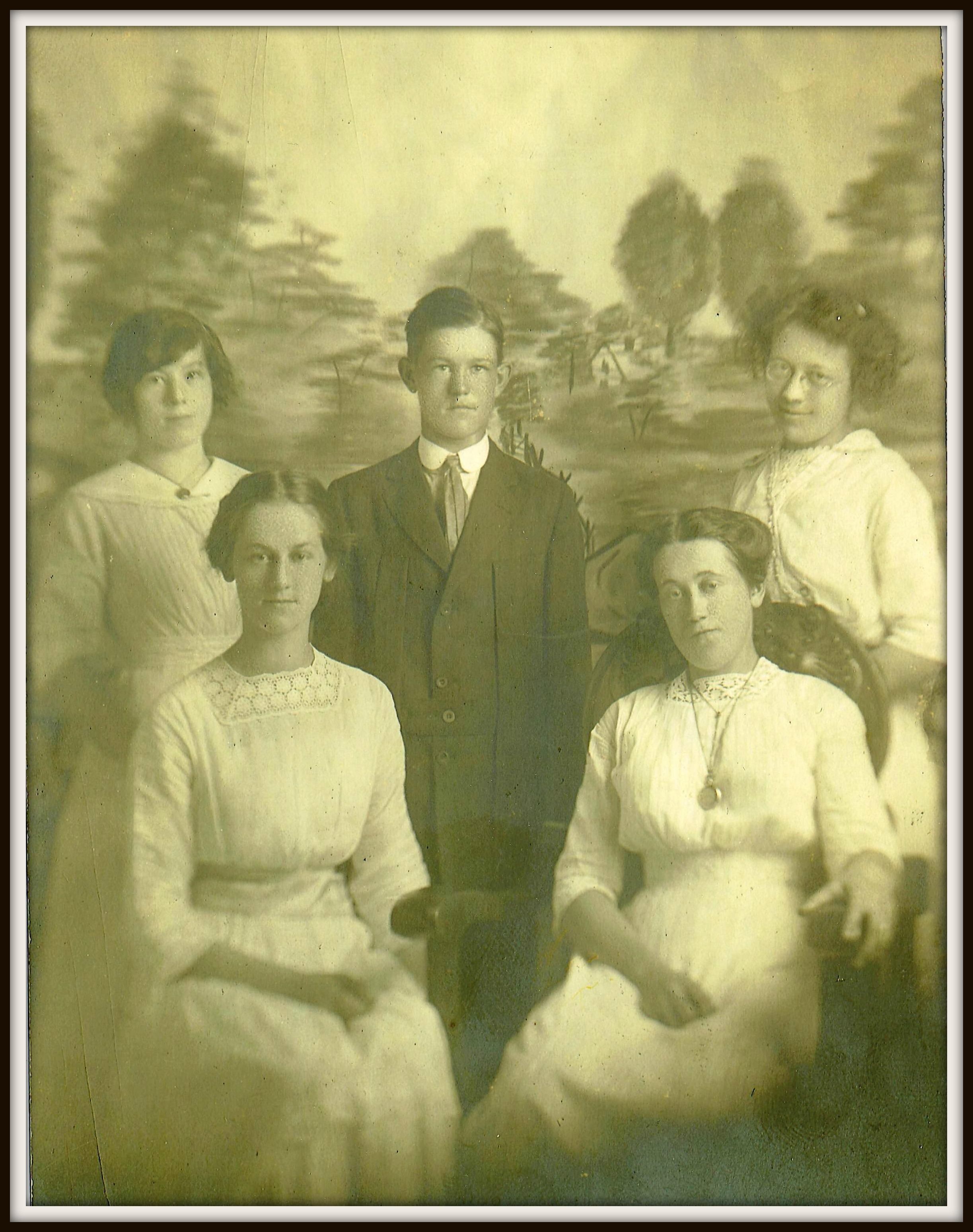
Since the time of that post, George’s grandson, Professor Edgar Lawrence, discovered this blog. He’s been able to fill in many of the missing pieces about this branch of my family. His mother was Theresa, the middle child.  Here is a photo, taken at least a decade after the fire, showing all five Pake children.

Front row: Theresa and Cora Back row: Frances, George Jr., Jennie (Jane)

Front row: Theresa and Cora
Back row: Frances, George Jr., Jennie (Jane)


###


Read Full Post »

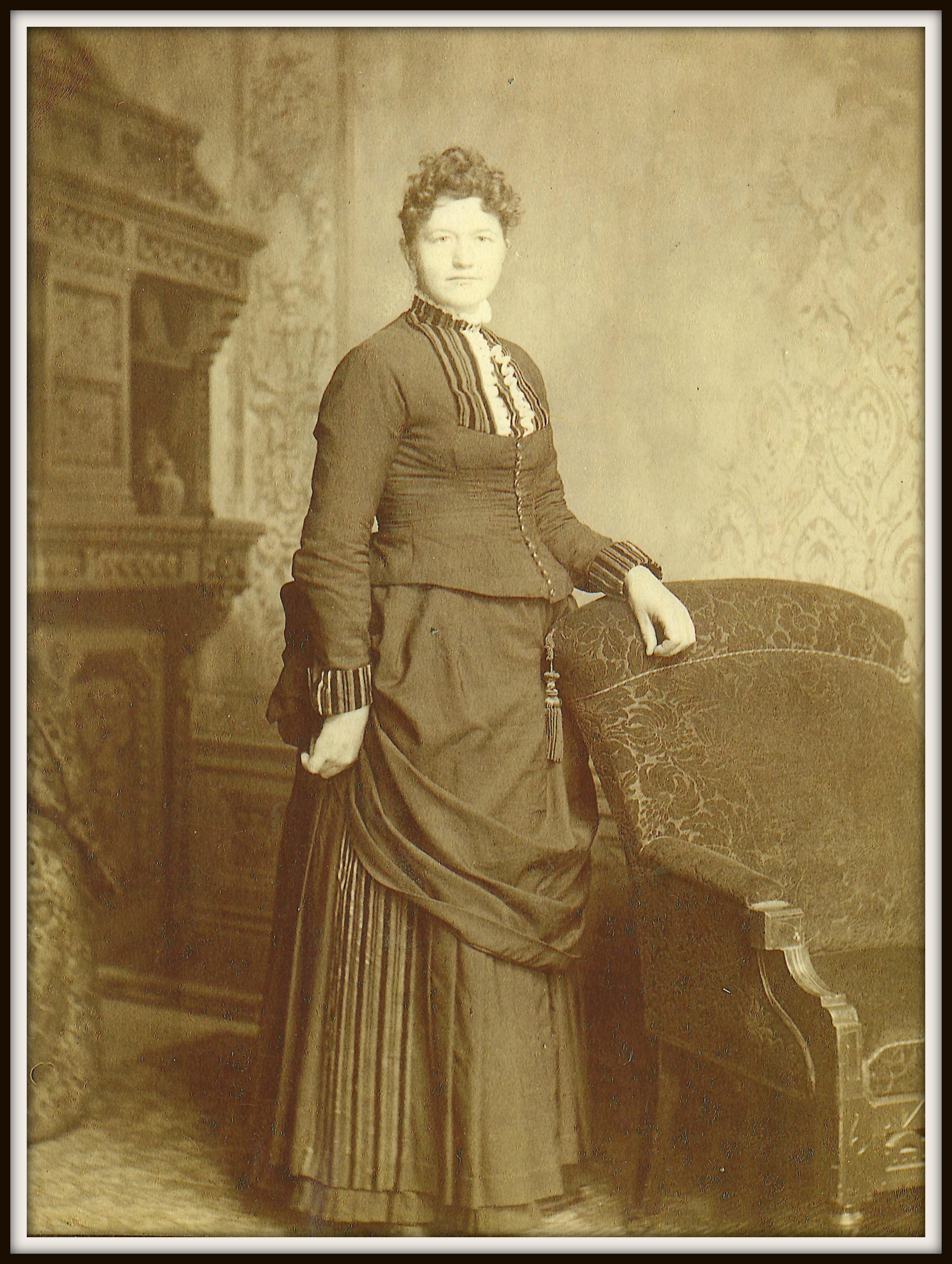
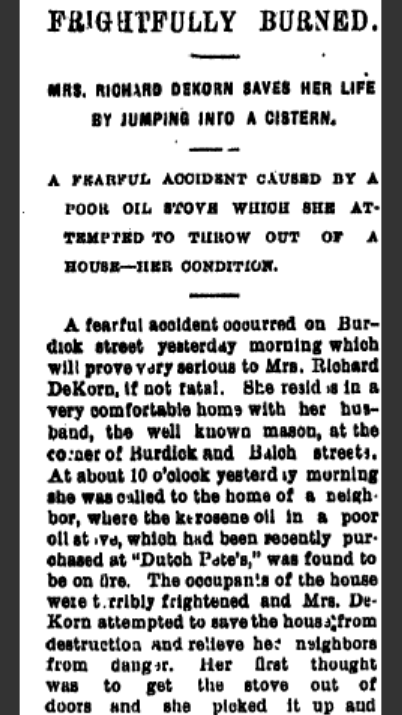
In the last two posts, I told you about the series of disasters that befell the Paak (Peek/Paake/Pake) family.  As I started researching for more information, I came across a worse and more horrific family disaster.  And this one happened to my very own great-great-grandmother, Alice Paak DeKorn, Mrs. Richard DeKorn (born Aaltje Peek in the Netherlands), on May 26 1891.

Alice Paak DeKorn

Alice Paak DeKorn

If you remember the post with the pretty shawl, that was her shawl.  She’s the one with the 3 Peek sisters; Alice was  the prettiest one.  Poor George was her brother. She was also the mother of my great-grandmother Cora DeKorn Zuidweg.

Read it and weep:

At the time this happened, Alice’s children were 18 (Jennie), 16 (Cora), and 10 (Joseph).  For the next week, the local newspaper provides updates about Alice’s condition, which seems to be improving.  Alice did live another 17 years after the accident.

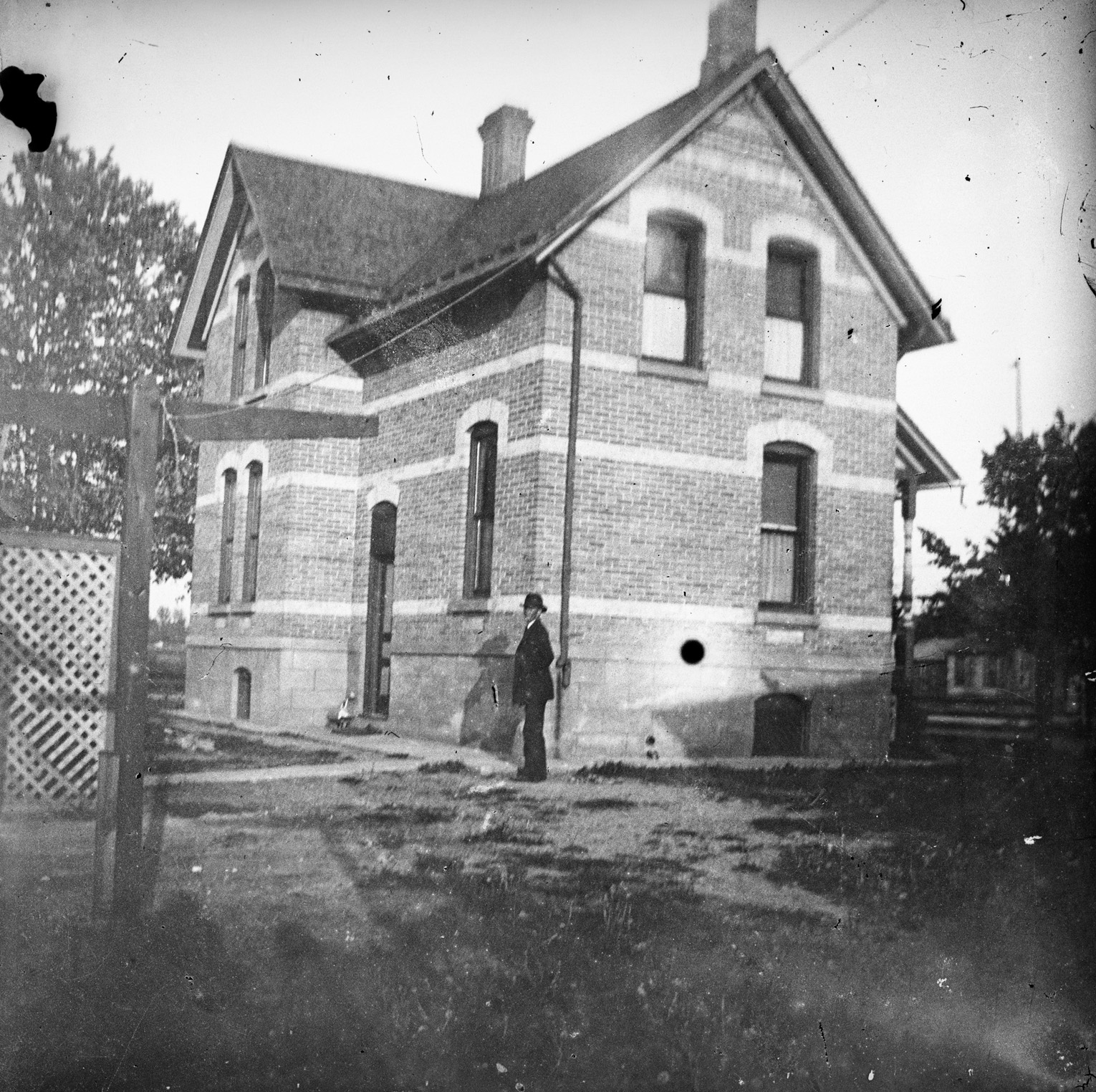
The “comfortable house” she lived in is said to be at Burdick and Balch.  That would be this house, built by her husband Richard DeKorn who stands in front:

Richard DeKorn's home at the corner of Burdick and Balch, Kalamazoo, Michigan

Richard DeKorn’s home at the corner of Burdick and Balch, Kalamazoo, Michigan

I would like to know more about “Dutch Pete’s,” where the oil stove was purchased.  What happened in those days with an accident like this?  Would there have been an investigation to see if there was a culprit responsible for the stove or if it was human error that caused the fire in the first place?

Notice how Alice was being a hero, trying to help out the neighbors so that they didn’t lose their house and belongings and so that they were safe.  I always had a good feeling about her.

Finding this accident in the newspaper archives did shake me up somewhat. After all, she looks like such a sweet lady, and I can only imagine how horrifically painful her injuries must have been–and what a frightening experience.

Strangely, my favorite contemporary children’s book (and one I taught several times) is Out of the Dust by Karen Hesse.  At the beginning of the book, the book’s protagonist Billie Jo loses her mother by an accident which is very similar. I remember that Hesse said in an interview that she found the accident in a newspaper article and put it in her book.  There are differences as in the book the cause seems to be an accident where the family confused kerosene with water, and in this newspaper account it seems to hint at a defective oil stove. I imagine there were far too many of these kinds of accidents in those days.

Alice’s terrible accident must have left her family very shaken up. I’m sure it made an impact on her children’s lives.

Read Full Post »

The other day I posted a photo of a couple I had not yet been able to identify. Once I got it posted and readers started pointing things out to me, I began to wonder if it could be George Paak.

On the advice of some readers, I pulled the original photograph out of storage and looked at the back and at the sleeve. The back is blank, but the sleeve itself says this:

PATENTED MCH 271917

I still have a lot of work to do on the research, but I thought I’d post the photo with a concentration on the man’s face along with photos of the women I suspect could be his sisters. See what you think.

What I want to eventually find out is if this is George Paak.

Alice Paak DeKorn

Alice Paak DeKorn

Alice is my great-great-grandmother. Look at their mouths. The hairline, forehead, and sparkling eyes. Don’t they look alike?

Carrie Paak Waruf

Carrie Paak Waruf

Mary Paak Remine

Mary Paak Remine

The ones above are sisters Carrie and Mary. They don’t look quite like Alice or the man. Or do they?

Annie Paak

Annie Paak


There’s another look alike. I think Alice and Annie look a lot like each other–and they look equally as much like the man.  What do you think?

PAAK / PEEK FAMILY


Teunis Peek immigrated to the United States from the Netherlands with his children.

He was the son of Joost Peek and Annigjen den Besten, born on June 5, 1822 at Zijderveld. (He died on April 24, 1893, in Kalamazoo, Michigan).

Teunis was married on December 21, 1848 at Lexmond to Jacoba Bassa, daughter of Dirk Bassa and Aaltje van Nek.  Jacoba was born on June 18, 1824. She died on November 23, 1865 at Lexmond, before Teunis took the kids and left the country.

From the marriage of Teunis and Jacoba:

1  Joost Peek (George Joseph Paak) was born on August 25, 1850 at Lexmond. He died December 9, 1925, in Kalamazoo, Michigan.*

2  Aaltje Peek (Alice Paak) was born on September 9, 1852 at Lexmond. She died in Kalamazoo, Michigan, May 5, 1908, a few months before her grandson, my grandfather, was born.

3  Anna Catharina Peek (Anna or Annie Paak) was born on January 6, 1855 at Lexmond and died on October 6, 1933 at Kalamazoo (MI). She married Jacob Salomon Verhuist.

Anna was married on March 20, 1890 at Kalamazoo (MI) to Jacob Salomon Verhulst, son of Jacob Verhulst and Cornelia Strijd.  Jacob was born on May 1, 1848 at Kortgene, died on June 20, 1923 at Kalamazoo (MI).

4  Willempje Peek was born on September 17, 1856 at Lexmond (alive in 1870, as William ??).

5  Maaike Peek (Mary Paak) was born on July 28, 1859 at Lexmond. Mary married Richard Remine. She died in 1954 in Kalamazoo, Michigan.

6  Cornelia Peek (Carrie Paak) was born on May 8, 1862 at Lexmond, died in 1957 at Kalamazoo (MI).  Cornelia was 95 years old. Cornelia was married on June 2, 1882 at Kalamazoo (MI) to Hendrik Waruf (Henry).  Hendrik was born in 1863, died in 1945 at Kalamazoo (MI).

Later, Teunis was married on January 8, 1869 at Kalamazoo (MI) (2) to Prina Adriana Schoonaard (Perena), daughter of Jan Schoonaard and Tannetje Servaas.  Prina was born on August 1, 1814 at Borssele.

The other day another Paak descendent found this blog. I am looking forward to comparing notes with him about the family.  He is the grandson of George Joseph Paak (Pake).

 * Joost Peek, or George Joseph Paak (Pake): could he be the man in the photo?

Read Full Post »

Mystery solved!!!!

Yvette Hoitink at Dutch Genealogy has done it again!  She led me to the answer of whose house burned down and when.   I first wrote about this in my post A Series of Disasters.

A newspaper clipping, saved by my family, reported the story of a house fire.  A George Paake of Trimble Street in Kalamazoo, Michigan, lost his house.  He was ill, his wife had recently died, and he had 5 children ages 14 and under at home.  The unidentified paper called their recent lives a “series of disasters.”

I wasn’t sure if this was Teunis Peek, the father of my great-great-grandmother Alice Paak DeKorn (are you confused yet by Paake/Peek/Paak?  I am!!  Oh, and there is Pake, too. They are all the same name . . .) or someone else as I had no idea when the fire took place.

Through Yvette’s research, she was able to determine that George Paake who lost his house was actually Joost, the “missing” son of Teunis and brother of my great-great-grandmother.

His wife Lucy passed away in 1900, leaving 5 young children.  George/Joost was 50 at the time he was left a widower.

With Yvette’s research results, I was able to get a better notion of George who had married a Dutch woman Lucy Kliphouse and had five children with her and was buying the house with a mortgage with the Building and Loan Association.

In Genealogy Bank I had not been able to locate a Kalamazoo Gazette article about the fire, but after Yvette narrowed the fire down to just past 1900, I used the search terms “fire” “Kalamazoo” and “Trimble,” rather than using George’s name.  In that way I did find the Gazette article, which deems Mr. Paake “a worthy man.”

The fire happened on Wednesday, September 3, 1902, and the Gazette reported it the next day.

Within two years (1900-1902) George lost his wife and then his house.

Is it any wonder that in 1906 he married Ester Cook?  Unfortunately, after living in Kalamazoo for one year with George, Ester too passed away.  One more disaster in the series for George (and for Ester).

In 1908 he married Addie Amelia Giffos (probably Gifford) Wilder.  When he married Addie his children were ages 10-20.  I have no idea if this was a love marriage or a marriage of convenience, but it would be understandable that he would have liked some help raising these children.  Also, it appears that Addie had at least a 5-year-old daughter at the time of her marriage to George.

One last comment: if you have family history trails that run back to the Netherlands, you will want to contact Yvette.  She can break down those research barriers you think will never open to you.

Read Full Post »

One of the most frustrating aspects of this whole family photo/genealogy project is not being able to identify some of the photos. It’s bad enough to see the names and not know what the people looked like, but to actually have a photo in hand and not know which person or persons it represents is just maddening.

Take this one, for example.

This photo is from my the photographs my grandfather gave me, so these people were part of the Zuidweg/DeKorn/Paak family. But who were they? Is there a way to collect clues from the photo?

What do you notice about the photo?

And what could I investigate to learn more about it?

Read Full Post »

My great-great-grandmother Alice Paak (the brave woman who survived a horrific near-tragedy that I wrote about last spring) gave her middle child Cora a gift for Christmas 1907. Perhaps she gave one to each of her three children.

You can see from the photo that it’s a hand-painted genealogy shell.

My grandfather and grandmother inherited it, and my grandmother gave it to me.

Let’s take a look at what she wrote over one hundred years ago, and how it relates to the information I have received more recently.

Alice Paak

If you remember my story about Alice’s near tragedy, you might also remember the post I wrote about her beautiful handmade shawl. Or the post I wrote about Alice and all her sisters.

On the shell, she names herself “Alice Paak ,” which is the name Grandpa had told me.  But genealogical research in the Netherlands shows that she was born Aaltje Peek. The source used for that name was this:

Lexmond, Zuid-Holland, the Netherlands, birth record, 1852, 36, Aaltje Peek, 9 September 1852; digital images,
Familysearch (https://familysearch.org/pal:/MM9.3.1/TH-1-159370-202016-19?cc=1576401&wc=6426532 : accessed 23
December 2012)

Apparently, she accepted the American name “Alice.” Her granddaughter, Alice Leeuwenhoek, the daughter of Jennie and Lou Leeuwenhoek, was named after her. Later, my own aunt, the granddaughter of Alice’s daughter Cora, was given the name Alice.

Alice Paak’s birth date is given on the shell as 17 September 1852.  But my genealogical information (the source I listed above) shows that she was born on that same month and year, but on the 9th, not the 17th. Wouldn’t she know her own birth day? That confuses me.

On the shell, she lists her birth place as Leksmond, Nederland. That sounds right, and I think it’s the same place as Lexmond, Zuid-Holland, Netherlands.

Richard DeKorn

My great-great-grandfather Richard DeKorn was born Dirk de Korne.  But he clearly changed both his first name (Americanized it) and the spelling of his last name (maybe to make it easier for others).

He was born on 21 Aug 1851.  The shell corroborates the date.

However, his birth place is listed on the shell as Goes, Zeeland, Nederland. But wait!  In another post I mentioned that I had always thought he was born in Goes, but the genealogical documentation shows that was born in Kapelle, Zeeland, the Netherlands! This is the documentation:

Kapelle, Zeeland, the Netherlands, birth record, Dirk de Korne, 21 August 1851

Jennie DeKorn

Born March 18, 1873. That’s according to the shell. But my information is March 8, 1873. I have to check on this!

Cora DeKorn

Born January 2, 1875. That’s according to the shell and to my records.

Joseph Peter DeKorn

Born June 30, 1881. That’s according to the shell and to my records.

The treasure itself

The design is beautiful with holly branches. The berries are raised to look like real berries. Originally there was a gold leaf paint trim around the shell, but it has worn off in many places.

Her use of “Xmas” because it fit better on the small surface seems astonishingly modern, as does the use of metallic gold and red and green for Christmas.

What I find particularly poignant, though, about this family heirloom is the date. She gave this gift to her daughter on Christmas 1907, and on May 5, 1908, a little over four months later, she passed away.

Read Full Post »

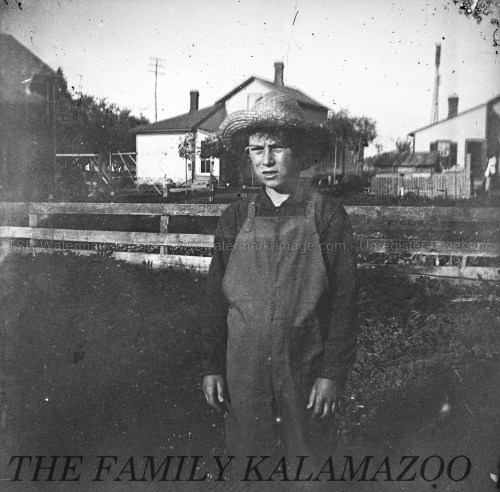
A couple of years ago we digitized the glass negatives of photos taken by Joseph DeKorn. In those photographs I found many children who remain unidentified. Because children change their looks rapidly–some kids more than others–they are harder to pin down than adults.

Here are a few:

This is just a sampling, but it’s important to concentrate on the details, so three is enough for now.  All of these would have been taken in or around Kalamazoo, Michigan. I am fairly certain they were taken on DeKorn property on Burdick Street.

I looked through my family tree, as it stands right now, and the kids who are closest in age would be the youngest DeSmit children (children of John and Mary DeKorn DeSmit).  Could it be Frances herself or a younger sister? Or are they unrelated neighbor children? Because the bottom two photos seem to be the same girl, at least, I suspect they are family.

Why would the boy in the top photo be wearing overalls and a straw hat? This seems more casual than the kids usual dress. Was he ready to go fishing?  If so, wouldn’t he have a pole in his hand?

The Van Lieres, another branch of the family, had a bus load of kids, starting in 1902, but from everything I can find they were all boys, and I think this photo is too early for them.

Any details which speak to you?

Read Full Post »
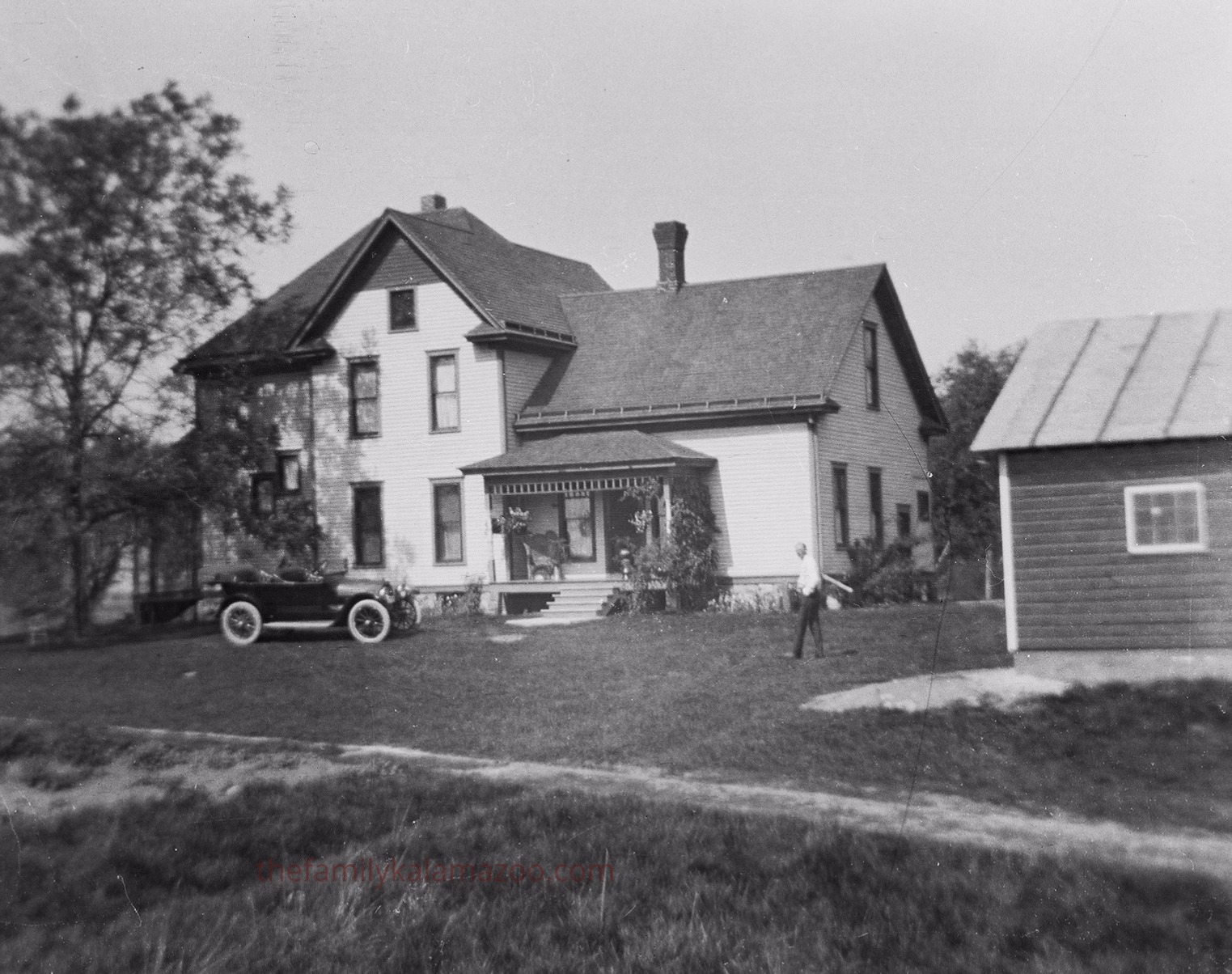
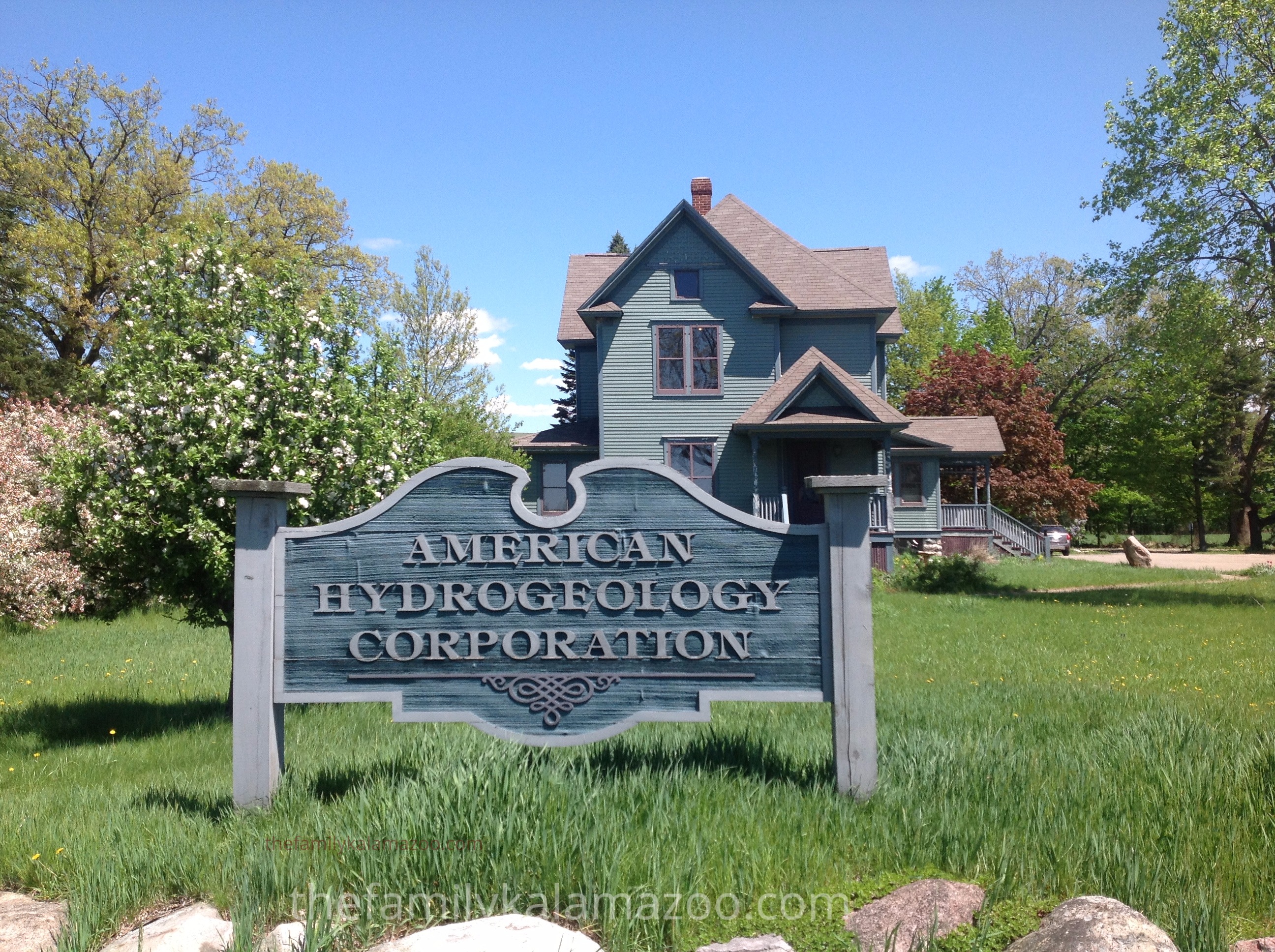
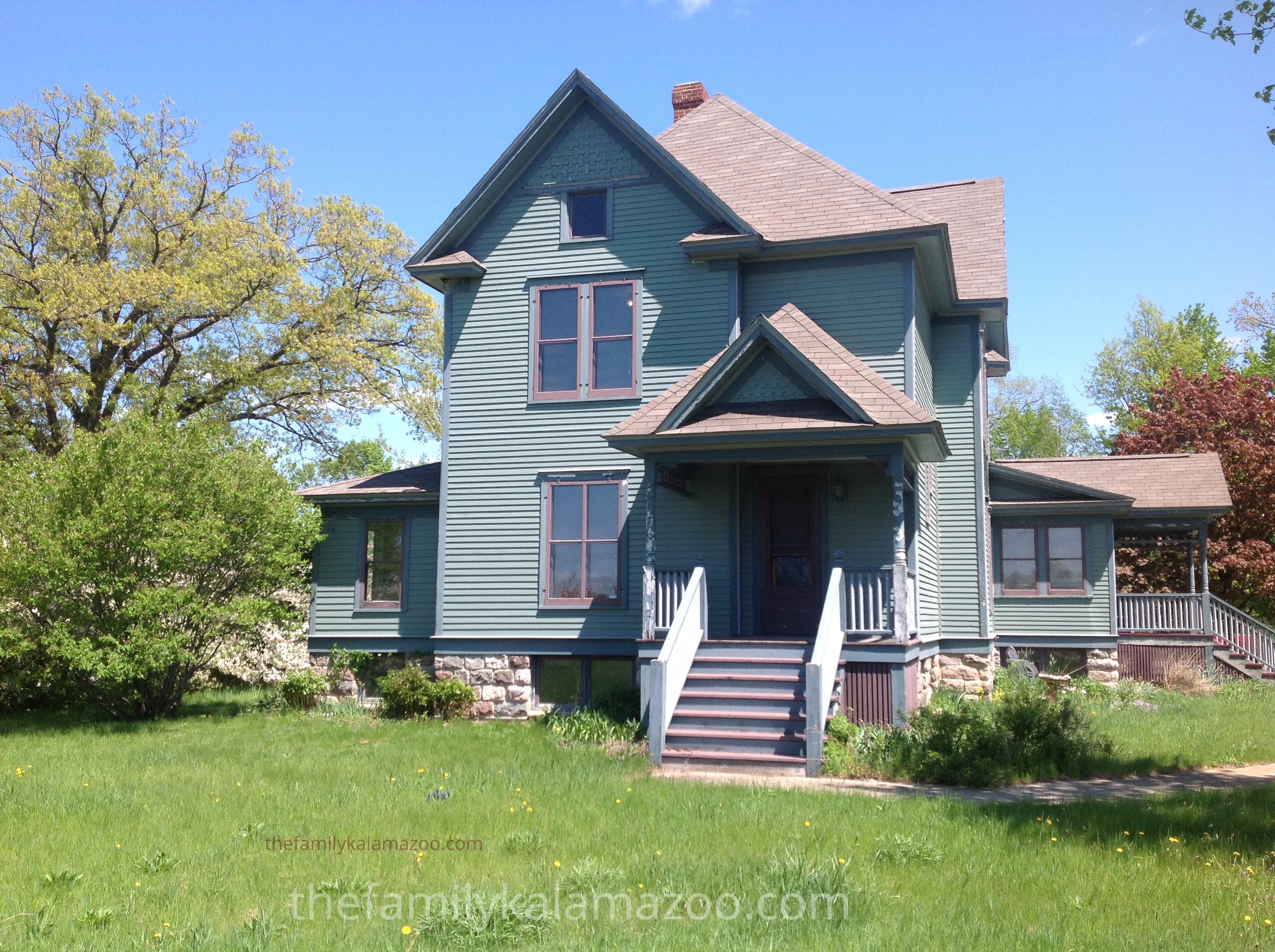
Some time ago I posted about a house which I remembered from my childhood. The house had been built on Sprinkle Road in Portage, about a block from the Long Lake shore. It was originally owned by Carrie Paak/Peek Waruf and her husband Henry Waruf.

When Therese Remine inherited Ramona Park from them (her aunt and uncle), she also inherited their house.  She divided her time between this house and a house she owned in Detroit.

I had heard that the house was relocated and mentioned that I had set my Kalamazoo sleuths on its trail.

Today I am happy to report that my detectives (Mom and Dad, also known as Janet and Rudy Hanson) have done their legwork.  They discovered that, in 1990, the house was moved much farther south on Sprinkle–past Bishop road.  It was replaced by a fire station.  The new owner took the house apart “brick by brick” to move it.  He enclosed the porch and put in an elevator.

Here are the new photos, taken by my father just as the current owner was trying to mow the lawn!

The house is now owned by Patrick “Mick” Lynch and is inhabited by his company, American Hydrogeology Corporation.  They are an environmentally friendly company which helps with the clean up of water.

Mick has plans to re-roof the house and paint it white, which as you can see was the color in the old photo.

The other posts where you can read about Ramona Park, Long Lake, and the Waruf/Remine house can be found at Living by Long Lake, Portage, Michigan and The Park with a Literary Name .

Read Full Post »
« Newer Posts - Older Posts »