Feeds:
Posts
Comments

Posts Tagged ‘history of Kalamazoo’

I shared a couple of photographs of my artist mother-in-law the other day. They were from the 60s and early 70s and had turned yellow. I was very frustrated with the damage to the photos.


Paula Taylor saved the day by converting them to black and white photos. Here you can see the changes:

This slideshow requires JavaScript.

And here:


This slideshow requires JavaScript.

I’m really happy with them. Thanks, Paula!Enhanced by Zemanta

Read Full Post »

Let’s go back to George Paake/Paak/Peek/Pake today.

I mentioned that George was married at least three times–possibly as many as five times. It was pointed out to me that it would be very unlikely that George was married more than three times.

Take a look at the timeline:

George immigrated to the United States when he was ten or eighteen years old. I have conflicting sources on this. Either way, he married his first wife, Lucy Kliphouse, in Kalamazoo, on December 17, 1886, when he was 36 years old. The couple had five children, named after the grandparents. George was married to Lucy for fourteen years, when she passed away.

In 1902, at the time of the fire, George was a widower.

On April 15, 1906, George married Esther M. Cook. Adri van Gessel mentioned to me that by February 14, 1906,  the oldest daughter Cora (who, according to the newspaper article about the fire, was taking care of the household) was already married, so there was no one to take charge of the house. On Nov 21, 1907, Esther died of pneumonia.

On July 11, 1908 George was married to Addie Amelia Gifford (Wilder). Addie seems to have outlived George.

  • According to the 1910 Census, George (listed as Joseph G. Peake) was still married to Addie. He was listed with his wife Addie, his daughter Fanny, his son George, and Addie’s daughter Florence Wilder (from her previous marriage).
  • According to the 1920 Census, George (listed as George J. Pake) was still married to Addie. He was listed with his wife Addie, his son George, and Addie’s daughter Florance D. Wilder.

George died on December 9, 1925 after being married to Addie for seventeen years.

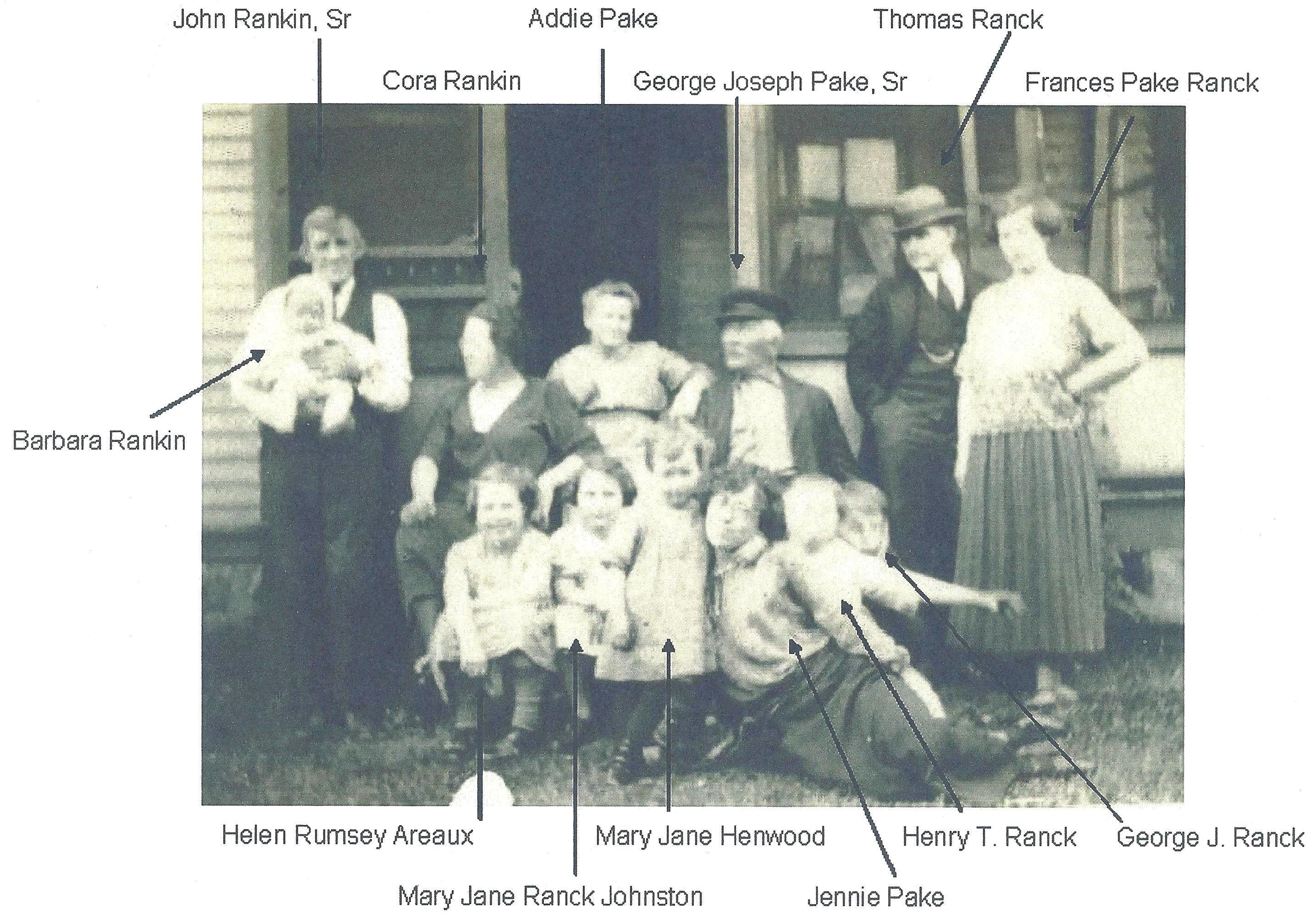
This photo of George (using the spelling Pake) and Addie and their family was taken not long before he passed away.


 ###

A Series of Disasters

The Children After the Fire, 1902

Paak-a-boo

Saved from the Fire


Read Full Post »

In the past few months I’ve been so busy with work that I haven’t had time to work at genealogy the way I wish. I have a lot of wonderful material on the Paak family, which has been given to me by Professor Edgar Lawrence. I also have some interesting material to share from Elmhurst research about the Klein and Van Gessel families.

But am I sharing any of it in this post? No. I want to do a good job of pulling it together, and I can’t do that now, as overworked busy as I am. Instead, I thought I would share a photo from the Kalamazoo of my youth.  On the right side, you can see my mother-in-law, the artist Diana Dale Castle. I wrote about her in my post The Todd House.

She’s at Bronson Park, which is the town square of Kalamazoo. When I was growing up, the park was surrounded by the “First Churches” of Kalamazoo (First United Methodist, etc.) and City Hall. Its enormous oak trees had sheltered Abraham Lincoln when he gave a speech in Kalamazoo.  The park had the best Christmas decorations every year, and everything from political rallies to art fairs were held there.

My mother-in-law used to show her art at the art fairs.

Here is my MIL painting in her New York City apartment in the 1950s. Look at how horribly yellow the photograph has turned! Do you know if this can be fixed–and how to fix it?

###
Enhanced by Zemanta

Read Full Post »

Cora Wilhelmina DeKorn Zuidweg and her son Adrian Zuidweg Kalamazoo, Michigan circa 1910

Cora Wilhelmina DeKorn Zuidweg and her son Adrian Zuidweg
Kalamazoo, Michigan
circa 1910

Read Full Post »

This post is dedicated to my mother. I grew up in the same town she did–Kalamazoo, Michigan. The Zuidwegs and Mulders and DeKorns and Paaks and Waldecks and Noffkes and Gorsses and Bomhoffs are her relatives and ancestors. I “inherited” them from her.

But I always assumed that my interest in local and family history came from my father who enjoys history and always has been a magnet for “old stuff.”  He’s also a collector, whereas my mother (other than collecting her beautiful bells) prefers to start fresh with new and not keep  a lot of “old stuff” hanging around the house.

As I’ve gotten older, I see that it’s not quite that simple. But I still didn’t realize where my interest actually originated until last week. Suddenly, I knew: Aha!

My interest in vintage American culture, local history, and my family (and by extension, this blog) developed when my grandmother babysat me. My mother’s bedroom still had her books, miniature collection, hope chest treasures, and the little “dickies” she wore with her sweaters. Dickies were collars that made it look as if she were wearing white blouses under her sweaters.

Mom's dickies were like the style in the upper right

Mom’s dickies were like the style in the upper right

So while my love of history was nurtured by my father, what really triggered my love of the old was finding the scrapbooks my mother had made when she lived at home with her mom and dad.

Born in 1934, she was an inveterate scrapbooker. Her scrapbooks collected American culture of the 1940s, as seen by a middle-class girl. I learned about Shirley Temple and Frank Sinatra. About what color lipstick and nail polish to wear for my complexion. If I’d found the original teen magazines that her clippings came from, it wouldn’t have been as interesting. This was the culture through the prism of my mother’s perspective. That made it closer to how I would have seen the world if I had been born in 1934.

Many of the scrapbooks made it to my house, and I remember being eleven and looking at them stacked on the shelf of my closet, happy that I had these mementos.

Of course, eventually my mother, true to her nature, got rid of the scrapbooks ;). I don’t remember when or how, but I don’t think they exist any longer.

My mother’s love of scrapbooking didn’t disappear with the old scrapbooks, thank goodness. One by one, she’s made scrapbooks for each of her children and grandchildren.  Our lives as prismed through Mom’s perspective. Pretty neat.

Happy Mother’s Day, Mom!

Mom, the oldest, with her two siblings

Mom, the oldest, with her two siblings

Read Full Post »

Let’s continue the Paake/Paak/Peek/Pake family saga.

I grew up not knowing that great-great-grandmother Alice had had a brother named George. When I discovered him, it was, in part, because of a newspaper clipping I found among the family papers. I’ve already written about George’s family here:

A Series of Disasters

The Children After the Fire, 1902

Paak-a-boo

Saved from the Fire

In the Paak-a-Boo post, I contemplated whether an unidentified photo I owned could be George Paake, based on the resemblance to great-great-grandmother Alice.

It turns out we still don’t know who is in that photo, but I now know what George looked like!


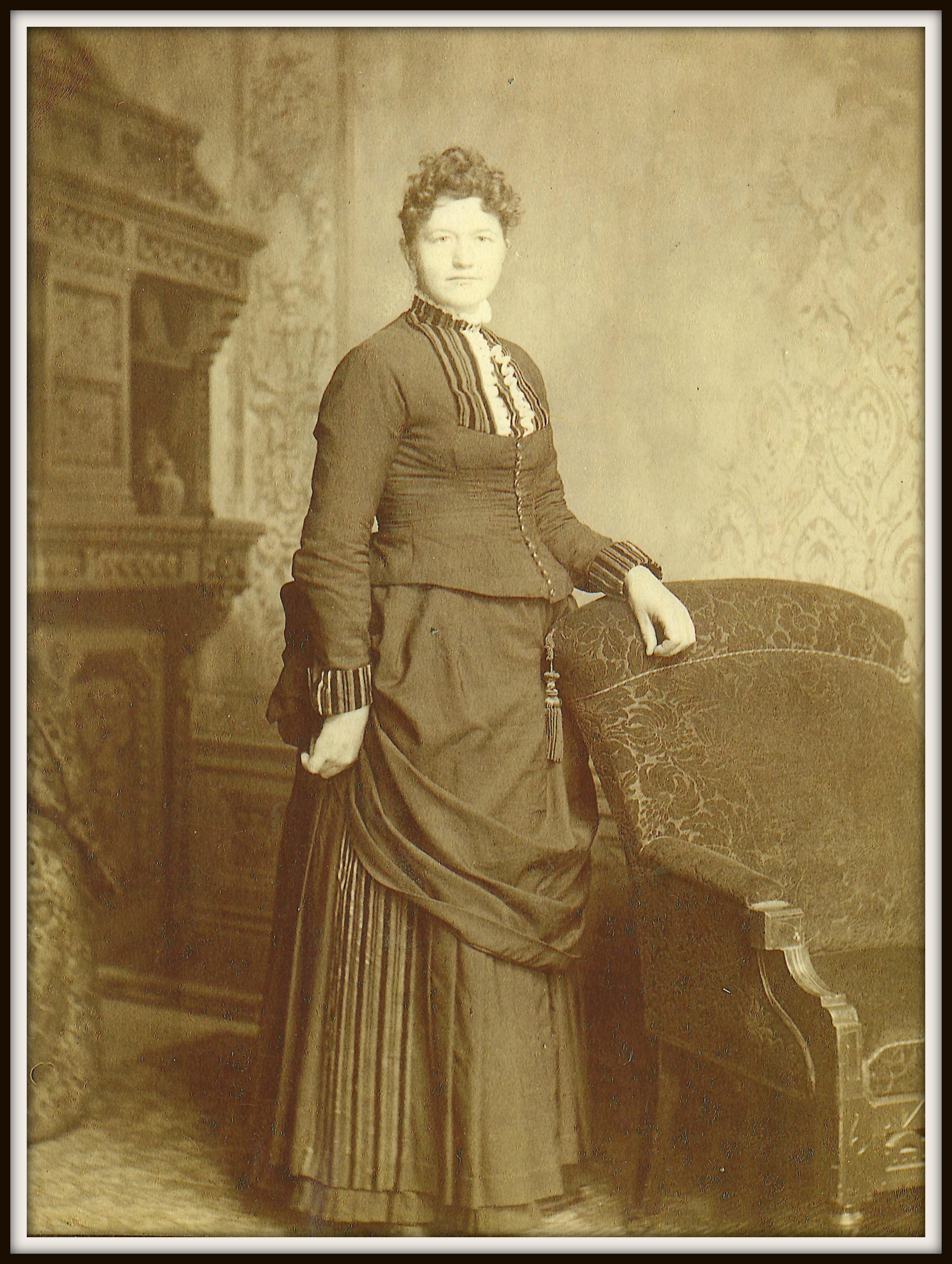
Here is a photo of Lucy Kliphouse (her name was Anglicized from the original Dutch: Lukkien Kliphuis ), the mother of George’s five children.

This is his first wife. After she passed away in 1900 (two years before the fire), George went on to marry a few other women. It’s said he might have had five wives.

Stay tuned for more information about the leaves and blossoms of George’s branch of the family!

Read Full Post »

Here is another follow-up to my post about the newspaper clipping I found tucked in with the family photos. If you missed it, you can find it in A Series of Disasters or read the clipping below. Since then I have learned a lot about the George Paake (born Joost Peek and also known as George Pake) family of widowed father and five children.

In addition to learning about the children, which I will explore more in future posts, I was told that a piece of furniture that was rescued from the fire is still in the hands of the family. Since I thought you might like to see a sample of what was in that house in 1902, I asked for a photograph of the dresser.


I am not an antiques expert by any means, but it struck me as different from most of the pieces I’ve seen from that period. Since the fire was in 1902, the dresser was most likely from the late 1800s.

Teunis Peek and his wife Jacoba Bassa had six children while living in Lexmond, the Netherlands. In 1865, Jacoba passed away at the age of 41. A few years later (1868 or 1869), Teunis brought the children to the United States, where he settled in Michigan.

Therefore, when the fire occurred at the home of Teunis’ son George,  the family had been living in Michigan for over 30 years. Because of the style of the dresser and the length of time in this country, I would assume that the dresser was purchased in the United States.

From a little Google research, I am guessing that this dresser is of the “Eastlake” style. The straight lines were meant to vary from the norm of Victorian curlicues, and the ridges on the corner columns and the stylized branch with leaves carving are typical of that style of furniture.

Do you agree or disagree about the style and age of this piece? and why?


###


Enhanced by Zemanta

Read Full Post »

Just over a year ago, in A Series of Disasters, I posted a newspaper clipping that I found tucked in with the family photos. This is the copy of the article:

The residence of George Paake at 1016 Trimble Avenue was burned this morning about 10:30 o’clock and a worthy family which has had a series of disasters, left without a home.  The house which Mr. Paake was paying for in the Building and Loan Association was entirely ruined although most of the contents of the home were saved. Mr. Paake receives no insurance whatever and the little which had been accumulated by the family was lost.

The fire is only an incident in the history of the family. Mrs. Paake died a short time ago leaving five children, the oldest being fourteen years old. Since the mother’s death the little girl has had entire charge of the house and the four little children and has had all the responsibility of the family except the support which Mr. Paake gave as a laborer.  Recently he has been unable to work and was ill this morning when the fire occurred.

The neighbors have taken in the little ones and are doing all that is possible to alleviate the sufferings of the family. Mrs. Carrier has been responsible for raising a sum of money to which the neighbors have liberally contributed.

At the end of this post I will re-post the newspaper clipping for documentation. I want to apologize for spelling the surname every which way, but at every turn the name is spelled differently. Family members changed the spelling, and different documents recorded it differently. Paak-Peek-Paake-Pake: they are all the same.

Eventually, I discovered that this man was George Joseph Paak, Sr.,  the brother of my great-great-grandmother Alice Paak DeKorn and that the fire occurred on Wednesday, September 3, 1902.

George’s wife Lucy Kliphouse passed away in 1900, leaving 5 young children in their father’s care.  George (born Joost) was 50 at the time he was left a widower. At some point he had changed the surname to Pake.

The five children were Cora, the eldest mentioned in the article, Jennie, Theresa (also called Tracy), Fanny (also called Frances), and George Jr. Cora was born in 1888; Jennie (who later changed her name to Jane) in 1890; Theresa in 1893; Fannie in 1896, and George in 1898.  George was only four when the fire occurred. Imagine Cora, at 14, taking care of the others–ages 12, 9, 6, and 4. What a burden on such a young girl. And when her mother died, she was only twelve and young George was two!

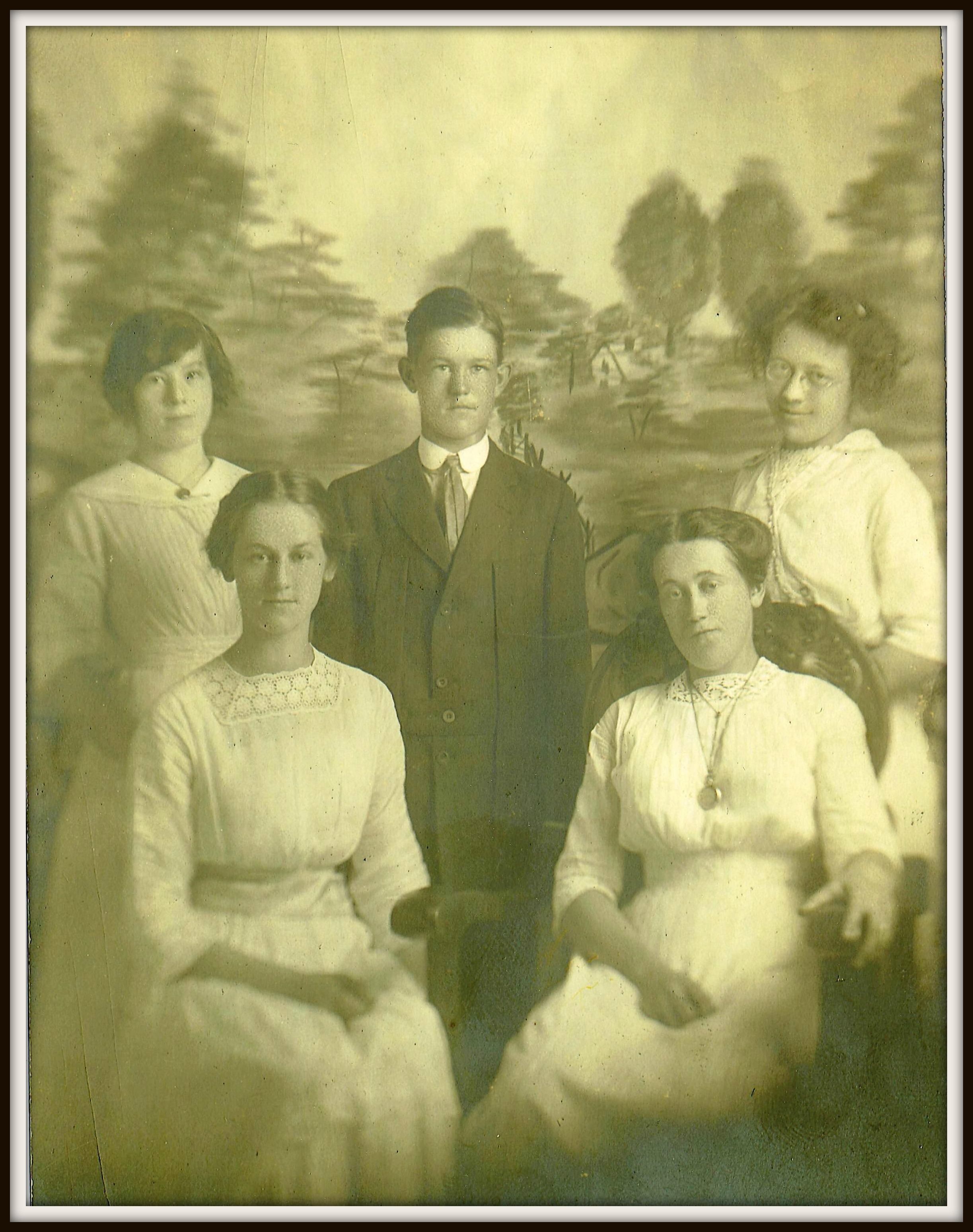
Since the time of that post, George’s grandson, Professor Edgar Lawrence, discovered this blog. He’s been able to fill in many of the missing pieces about this branch of my family. His mother was Theresa, the middle child.  Here is a photo, taken at least a decade after the fire, showing all five Pake children.
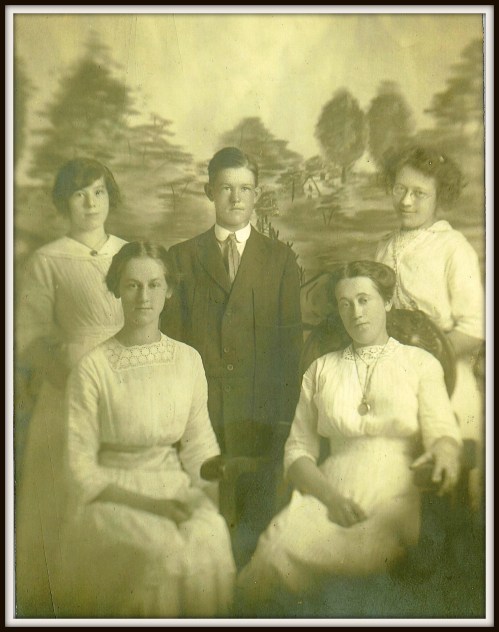
Front row: Theresa and Cora Back row: Frances, George Jr., Jennie (Jane)

Front row: Theresa and Cora
Back row: Frances, George Jr., Jennie (Jane)


###


Read Full Post »

Answer to my title question: the townfolk got their meat from a butcher!

Occasionally, in my collection, I find a photograph of someone who isn’t family. Quite some time ago, I posted a photograph my family saved of the local saloon keeper, the famous Dutch Arnold. I’m pretty sure there is a story there that didn’t get passed on–at least not to me.

I also have a photograph of the local butcher, Tom Richmond, and his family.

Tom Richmond and family Butcher and slaughterhouse Balch Street, Kalamazoo circa 1900

Tom Richmond and family
Butcher and slaughterhouse
Burdick and Balch area, Kalamazoo circa 1900

Apparently, he had a slaughterhouse and butcher shop close to where my relatives lived. Grandpa told me it was on Balch Street. But maybe it was just close to Balch Street.

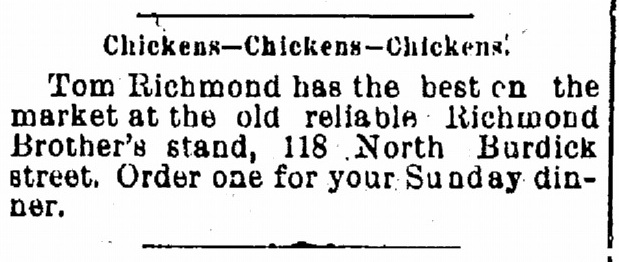
I did find one of Tom’s ads in the Kalamazoo Gazette. It appeared April 9, 1898.

Kalamazoo Gazette ad April 9, 1898

Kalamazoo Gazette ad
April 9, 1898

Notice that this ad gives a North Burdick address. My relatives’ homes and businesses were mainly congregated near the intersection of Burdick and Balch in Kalamazoo. Maybe as a small boy, Grandpa thought the shop was on Balch, but it was on Burdick. Or maybe he remembered incorrectly (unlikely–his memory was amazing). Or maybe the shop moved.

Someday when I have all the time in the world ;), I’ll try to put together a map of the area with my relatives’ homes and businesses, as well as the surrounding ones. Create a little village on paper, in a way. At that point, I’ll have to use the City Directories to figure out precisely where Tom Richmond’s butcher shop was. What makes it hard, though, is that the address numbers have been changed since that time.

This is what I don’t really understand: what kind of custom would be responsible for my family winding up with portraits of neighbors, friends, or merchants they frequented? I am entertaining the thought that maybe somebody’s somebody married into this family. I’ll have to keep searching.

If your family has old photographs, do they have portraits of non-family in the collection?

Read Full Post »

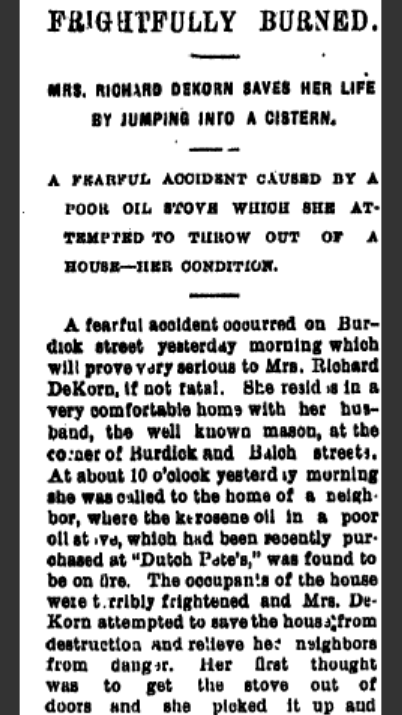
In the last two posts, I told you about the series of disasters that befell the Paak (Peek/Paake/Pake) family.  As I started researching for more information, I came across a worse and more horrific family disaster.  And this one happened to my very own great-great-grandmother, Alice Paak DeKorn, Mrs. Richard DeKorn (born Aaltje Peek in the Netherlands), on May 26 1891.

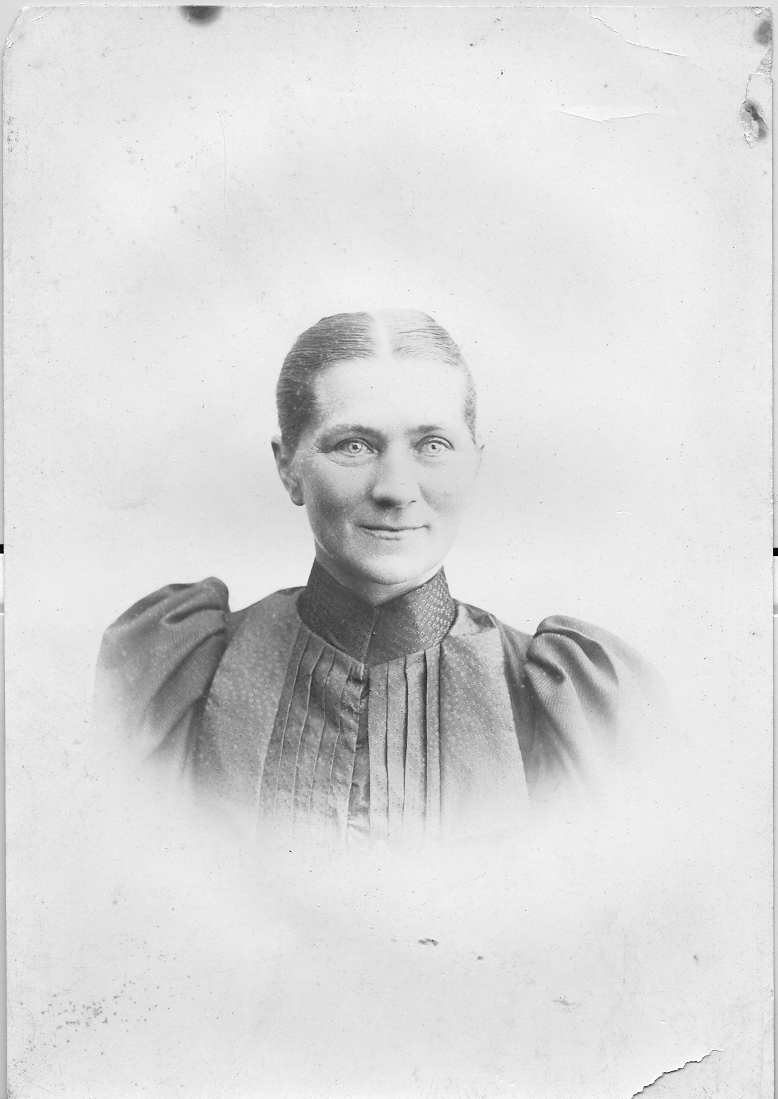
Alice Paak DeKorn

Alice Paak DeKorn

If you remember the post with the pretty shawl, that was her shawl.  She’s the one with the 3 Peek sisters; Alice was  the prettiest one.  Poor George was her brother. She was also the mother of my great-grandmother Cora DeKorn Zuidweg.

Read it and weep:

At the time this happened, Alice’s children were 18 (Jennie), 16 (Cora), and 10 (Joseph).  For the next week, the local newspaper provides updates about Alice’s condition, which seems to be improving.  Alice did live another 17 years after the accident.

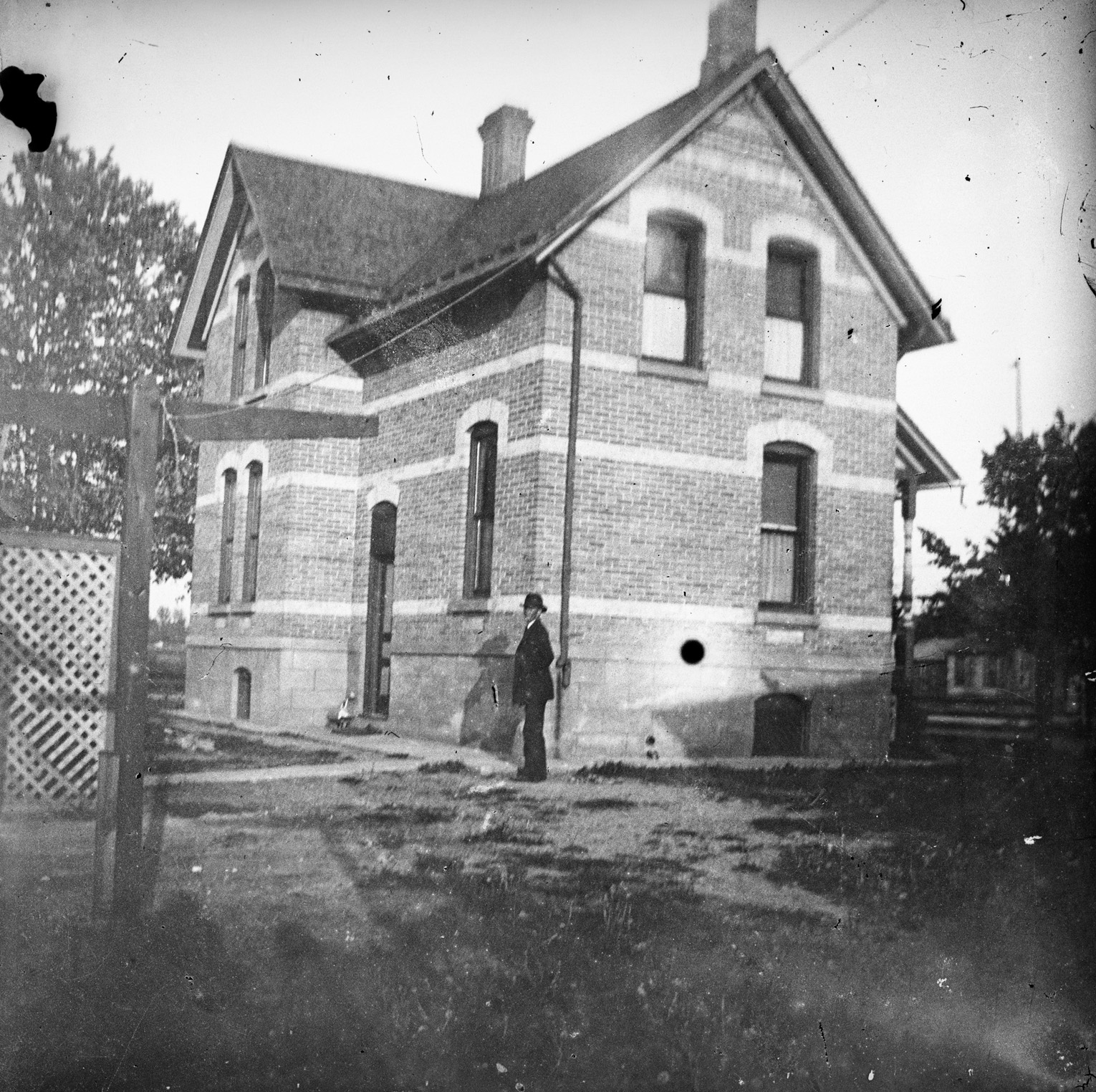
The “comfortable house” she lived in is said to be at Burdick and Balch.  That would be this house, built by her husband Richard DeKorn who stands in front:

Richard DeKorn's home at the corner of Burdick and Balch, Kalamazoo, Michigan

Richard DeKorn’s home at the corner of Burdick and Balch, Kalamazoo, Michigan

I would like to know more about “Dutch Pete’s,” where the oil stove was purchased.  What happened in those days with an accident like this?  Would there have been an investigation to see if there was a culprit responsible for the stove or if it was human error that caused the fire in the first place?

Notice how Alice was being a hero, trying to help out the neighbors so that they didn’t lose their house and belongings and so that they were safe.  I always had a good feeling about her.

Finding this accident in the newspaper archives did shake me up somewhat. After all, she looks like such a sweet lady, and I can only imagine how horrifically painful her injuries must have been–and what a frightening experience.

Strangely, my favorite contemporary children’s book (and one I taught several times) is Out of the Dust by Karen Hesse.  At the beginning of the book, the book’s protagonist Billie Jo loses her mother by an accident which is very similar. I remember that Hesse said in an interview that she found the accident in a newspaper article and put it in her book.  There are differences as in the book the cause seems to be an accident where the family confused kerosene with water, and in this newspaper account it seems to hint at a defective oil stove. I imagine there were far too many of these kinds of accidents in those days.

Alice’s terrible accident must have left her family very shaken up. I’m sure it made an impact on her children’s lives.

Read Full Post »

« Newer Posts - Older Posts »