Feeds:
Posts
Comments

Posts Tagged ‘family history’

Click here for Part I.

In my post of July 16, I shared the beginning of the story pieced together by Connie Jo Bowman in 1994, when she interviewed my grandfather Adrian Zuidweg.  Here is the next part.  Today I am going to focus on just one paragraph–to try to unpack it.

Here is what Connie wrote:

His father owned a fish market and Adrian’s earliest memories were of going to his aunt’s house while his mother helped out at the market. He remembers playing with his cousins around the big woodburning stove and the “outside toilet.” This was before 1911 because that was the year gas and sewer lines were brought up the street to their house.

I’ve written before about Grandpa’s father’s fish market in the post “My Great-Grandfather Reinvented Himself as a Business Owner in the U.S.” I share photos in that post of the interior of the fish market and the interior of the ice cream parlor Adriaan Zuijdweg (Grandpa’s father) owned after the fish market.
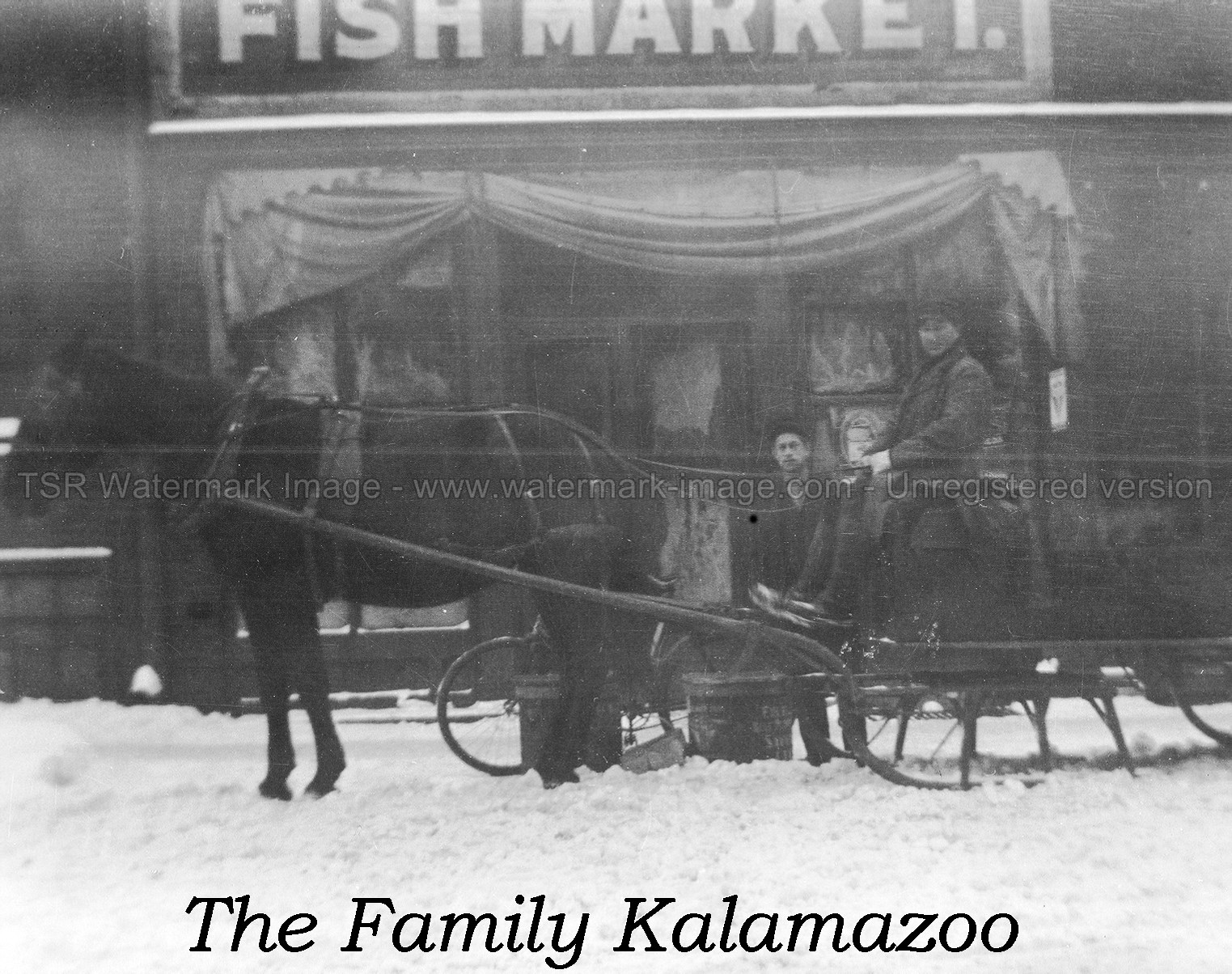
Adriaan Zuijdweg, Proprietor, standing

Adriaan Zuijdweg, Proprietor, standing

So that’s where Grandpa’s mother Cora went to “help out” at the market.  But Grandpa himself stayed at his aunt’s. There are two possibilities. One is his Aunt Jen, Cora’s sister. The other is his Aunt Johanna, his father’s sister.  Before 1911, Grandpa was a toddler–maybe two years old. Some people don’t have memories from that age, but I also have memories from when I was two years old.

Let’s say the year was 1910.  In 1910, Johanna Zuijdweg Van Liere had been in the United States for six years. She married her husband Marinus Van Liere in Goes, the town in the Netherlands they were both from. Johanna had two baby boys when she immigrated here, and by 1910 may have had six, seven, or eight boys. I’m not sure if they all survived infancy, but she was evidently quite busy.

Grandpa’s mother’s sister Jen, on the other hand, had one 13-year-old daughter in 1910.

If Grandpa played with his cousins around the stove and the outhouse in the yard, it would be Johanna’s children.  This led to me to search out where Johanna and Marinus were living in 1910.
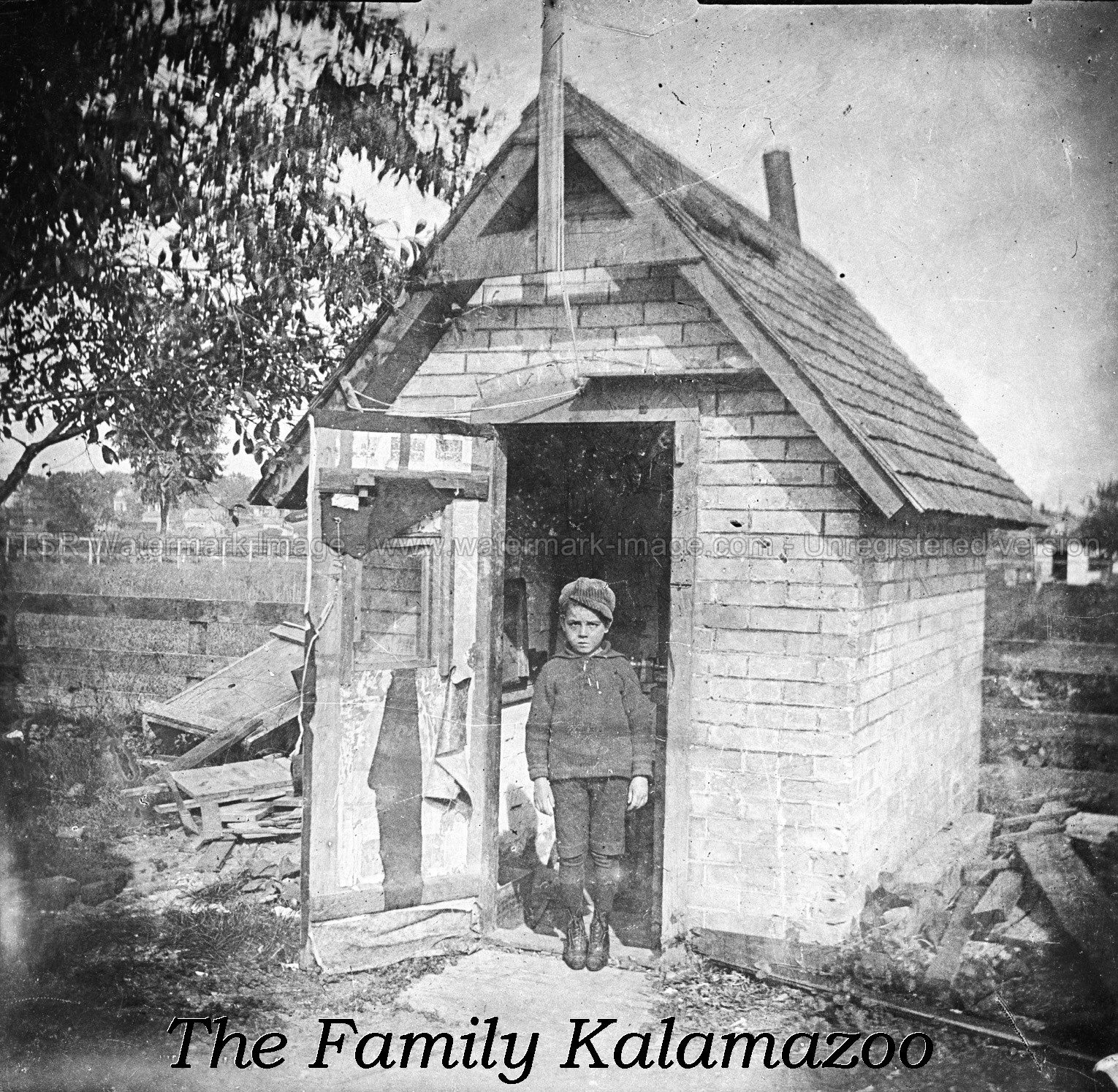
Shed or outhouse?

Shed or outhouse?

The 1910 U.S. Census shows Grandpa living with both his parents, Adriaan and Cora, his grandfather Richard DeKorn, and his uncle Joseph DeKorn in the Richard DeKorn house at the corner of Burdick and Balch: 1324 S. Burdick Street. Since the house still stands today, if it wasn’t moved, the address numbers have been changed on Burdick. The VanLieres, Johanna and Marinus, and their six boys lived at 1338 S. Burdick Street. It looks like another family lived between them. About four houses down from the VanLieres lived John and Mary DeSmit and their children. Mary DeSmit was Richard DeKorn’s sister.

I found it interesting that the census shows Johanna and Marinus speaking English, although they had only been in this country for six years. A few of the neighbors spoke Dutch, but most of them spoke English.

Johanna Zuijdweg VanLiere and Marinus VanLiere with son Jacob

Johanna Zuijdweg VanLiere and Marinus VanLiere with son Jacob

In this section of Grandpa’s story, he remembers that gas and sewer lines were brought up to their house in 1911. It must have made a monumental difference in the quality of their lives. Because his grandfather, Richard DeKorn, was a building contractor, would they have been quicker to get connected or was it something they had to wait their turn for, like everybody else?

On a personal note, I was surprised that Grandpa’s family was as close with his father’s sister and her family as this research shows.  I knew that the family was often with Aunt Jen, as many of the family photos are of Jen and her husband Lou.  But there aren’t as many photos of Johanna, nor do I know the history of that branch of the family as the children all grew up.

I hope you’ll stay tuned for Part III of Grandpa’s story . . . .

Read Full Post »

I’ll pick up Grandpa’s story again in my next post.

Today I’m doing a little detour away from Kalamazoo, heading toward Japan, Chicago, and Elmhurst, Illinois.

My parents gave me a pair of matching and beautiful Japanese vases which are family heirlooms. I used to see them in my paternal grandmother’s home when I was little. In later years, my parents displayed them in their home. I had assumed (you know about that word, right?) that my father or my uncle had brought them back from Korea or Japan when they were in the military.

Look closely at the fine gold leaf design in the solid black. Vase is hand-painted.

In my birthday card was a note which explained that these vases had belonged to my grandmother’s mother. Her son, my father’s Uncle Frank, had brought them back from Japan in 1920 and given them to his mother.

Frank Klein was a merchant mariner who travelled the world, including to Japan, during the years right after WWI.  Maybe this is where my Uncle Frank, Great Uncle Frank’s namesake, got his idea of sailing when he enlisted in the U.S. Navy.

I believe Great Uncle Frank may have been on a ship called the Eastern Queen as we have several family photos of that ship. This ship does show up in online lists of ships.

I also have information that he travelled on a ship called the Altamahan in 1922. I tried to find this ship, but all I could find was the Altamaha, which was built in 1941.

Until I saw his picture a few years ago, I didn’t realize Great Uncle Frank existed. After I learned about him, I wanted to know more, so I wrote to both the U.S. Coast Guard and the National Archives and Records Administration, searching for his Merchant Marines record. The Coast Guard couldn’t help, but the NARA found a record for Frank. They gave me some preliminary information and then suggested I do more research on the premises in Washington D.C. Here are a few things I learned from the records they sent me:

  • He was issued a license for “steam. 2d Ass’t.Eng.,3000 G.T., 3d Ass’t.Eng., any tons, condg.” at Cleveland, Ohio, on September 5, 1918, for “Ocean” waters.
  • He was issued another on September 5, 1919.
  • He was 22 on June 14, 1918.
  • I have a headshot and thumbprint of Uncle Frank.
  • He was a citizen and born in the U.S.
  • A vessel he was on was the “Altamahan” with a U.S. Flag, which arrived on 3/5/19. His next vessel wasn’t yet known.
  • He was 5’9 with a dark complexion, brown hair, and gray eyes.
  • He had a physical mark: “Sc palm rt hd”–I take this to be that he had a scar on the palm of his right hand. On another page it is noted as 1/2 inch.
  • He was a 2d Engr.
  • On his application he marked his mother “Mrs. F. Klein” as his nearest kin. He gave 3 references, and one was his brother-in-law, Peter Van Gessel.
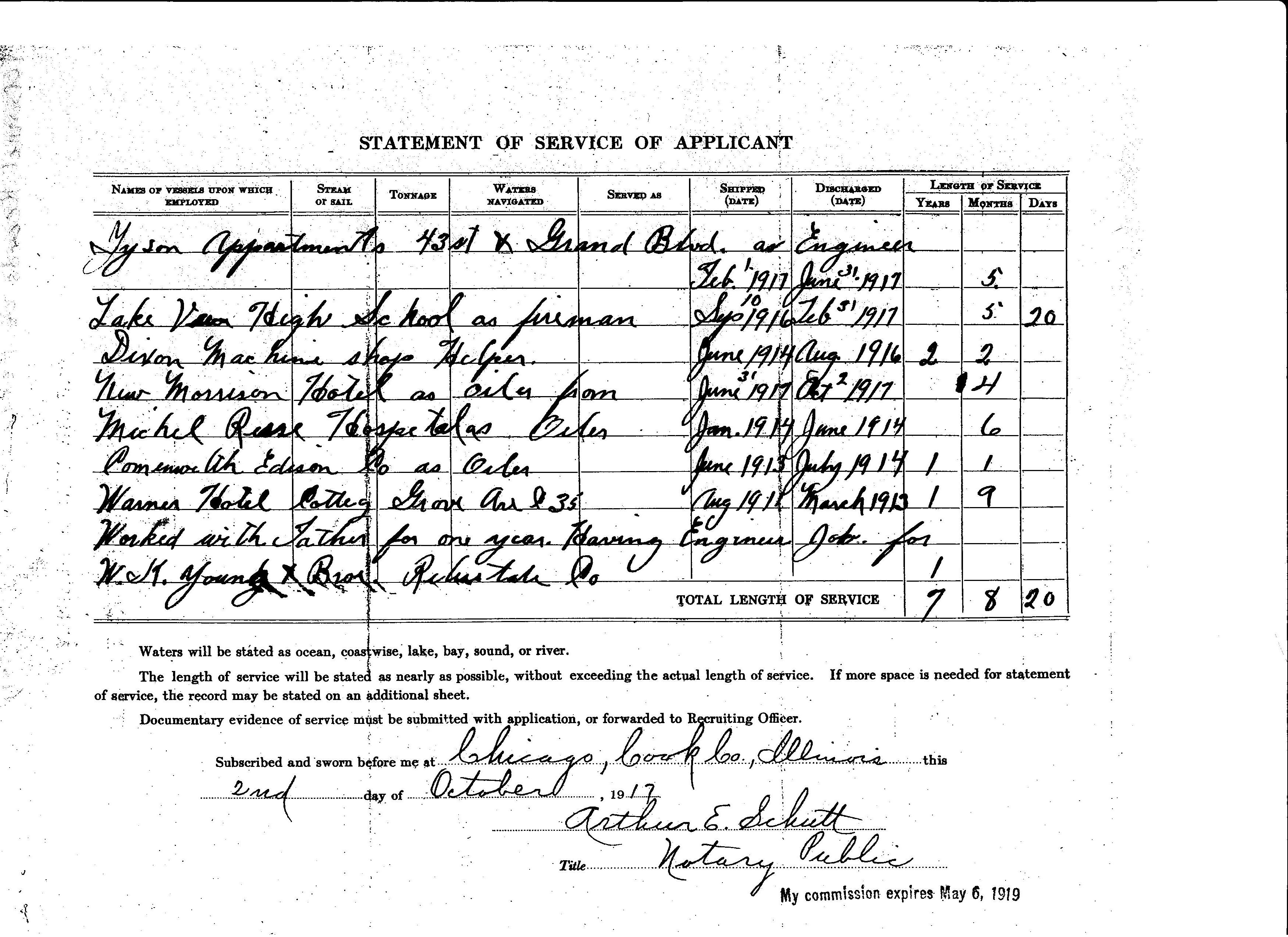
  • Best of all, he gave a work history for himself, which I will post here. Several jobs were as an “oiler.” According to Wikpedia, an oiler is a worker whose job is to oil machinery.

Here is a picture of Great Uncle Frank when he was home on leave:

Uncle Frank and Grandma Marie Klein c. 1920

Uncle Frank and Grandma Marie Klein c. 1920

Frank Anthony Klein on born in Chicago on June 14, 1896.  He grew up in Elmhurst and was the only boy. He had four sisters, including my grandmother.  Frank never married, but he was living with my grandmother and her family in Chicago when he was killed in a car accident in 1931.

According to his death certificate, this is how he died: “Fractured left mandible, compound fracture of left tibia and fibula, hemorrhage and shock  Deceased was driving his auto and suffered an attack of epilepsy seizure and struck a tree.” I suspect his parents were devastated by his death as he was the only boy and the second youngest. He was 34 years old. Fifteen months later, his mother passed away from cancer.

His death date is noted in official records as February 24, 1931, but his gravestone is marked with the date February 23, 1931.  Because he was buried in Elmhurst on February 25, I would deduce that February 23 was the correct date of death.

Read Full Post »

Today, on July 20, 2013, my Great Aunt Ruthann passed away.  You might remember the celebration of her 89th birthday on June 7. After her birthday, she became ill and her health deteriorated rapidly.  I am posting to let you know since you shared with my family her birthday.  She was the last of her generation in the Waldeck-Mulder family–the spouse of the youngest child of Clara and Charles, Charles Jr. Aunt Ruthann was a wonderful lady who was very loved by her close and extended family. She will be missed very much.

Ruthann and Charles (Chuck) Mulder

Ruthann and Charles (Chuck) Mulder

Read Full Post »

In 1994, five and a half years before he passed away, my grandfather, Adrian Zuidweg, was interviewed by Connie Jo Bowman, the head of residents at Crossroads Village, a retirement community in Portage, Michigan. Connie was taking a course about the elderly at Western Michigan University and chose Grandpa as her subject.  I’ve written about Grandpa in a post about our left-handed connection.

The entire interview is eight typed pages, so I’ll divide it among a few blog posts.

Adrian Zuidweg 1908-2000

Adrian Zuidweg 1908-2000

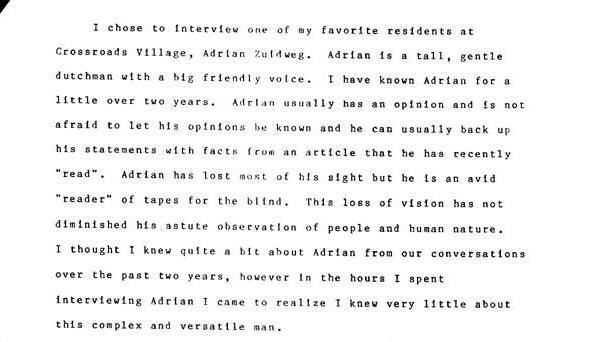
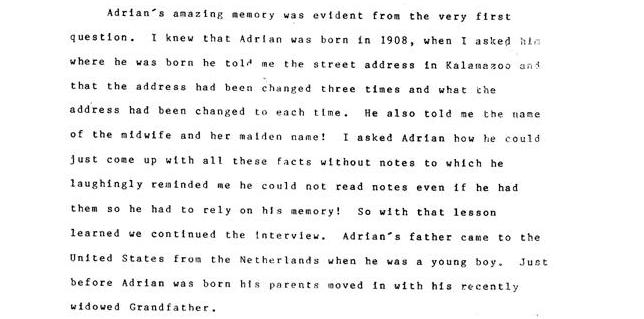
Connie begins by introducing my grandfather, Adrian Zuidweg.  To read the excerpts of Connie’s report, you can click them for a better view (I hope):

Connie identifies my grandfather here as a “tall, gentle dutchman with a big friendly voice.” That would probably be how Grandpa thought of himself. He identified strongly with his Dutch heritage.  He had a lot of jokes, but one of his favorites was to say, “If you ain’t Dutch, you ain’t much.” He didn’t really mean it, which you will see by the end of the interview, but he was very proud of being Dutch.

She also notes here how after talking with Grandpa for two years it wasn’t until she began interviewing him that she realized how much there was to know about Grandpa. Grandpa’s powers of observation were impressive to her, especially in light of his blindness. He only became completely blind in his old age, but he had been blind in one eye since he was a small child.

Connie was right–Grandpa had an amazing memory. He also loved to tell stories, especially stories about the past. As the oldest grandchild, I was privy to more of them than the other kids, but I still only know a few from his vast store.

Now that I realize that Grandpa knew the name of the midwife who delivered him, I wish Connie had put that information into her report, but perhaps it didn’t fit with the class assignment.

Here she mentions how Grandpa’s father came to the U.S. from the Netherlands when he was a child. This was Adriaan Zuijdweg, who I have written about in the past. He owned a fish market and then a candy and soda shop.  You can find a story about his retail businesses here.

When Grandpa was a baby his parents moved in with “his recently widowed grandfather,” Richard DeKorn, the brick mason and contractor. You can read more about Richard in the following posts:

Richard DeKorn: Brick Mason and General Contractor

More Mighty Kalamazoo Buildings from Richard DeKorn

Richard DeKorn and His Bride Tied the Knot in Kalamazoo

By the way, a big thank you to Linda at Living with My Ancestors for her help with watermarking my photograph.

I hope you’ll stay tuned for Part II of Grandpa’s story . . . .

Read Full Post »

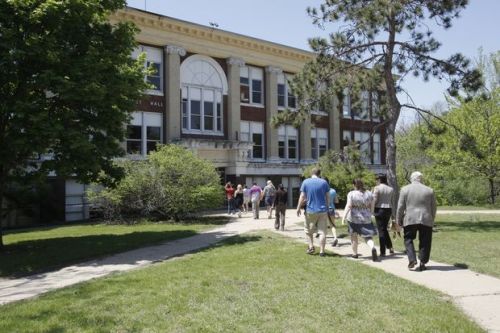
The National Trust for Historic Preservation is begging Western Michigan University not to destroy history–its own, that of the Kalamazoo area, and that of higher education. There are four old buildings which represent the origins of the university which those who head up the school want to demolish.  Here‘s an article that Mom clipped and mailed me. It was printed in the Kalamazoo Gazette on June 27, 2013.

Click here for the Kalamazoo Gazette article

Click here for the Kalamazoo Gazette article

Click here for the Kalamazoo Gazette article

Click here for the Kalamazoo Gazette article

I keep asking myself  the question, “What kind of people want to destroy history?”

My family has graduated from Western Michigan University for four generations. As I explained in a previous post “Western State Normal School, Kalamazoo, Michigan: A Personal View,” my grandmother, L. Edna Mulder Zuidweg, graduated from the school when it was Western State Normal School, a teacher training school. Both my parents, my aunt, my brother, and yours truly also graduated from WMU.  In addition, my husband graduated with a BBA degree, as well.  And at least one member of the most recent generation–my cousin’s daughter– has graduated from Western.

Because my husband and I both got business degrees (I also majored in history and he did so in political science) in the late 70s, we spent a lot of time on the oldest section of the university–East Campus, which housed the business school.

If you follow this link you will read a good history of the old campus.  They have some beautiful photos posted, too.

State Normal Kalamazoo front

HERE’S WHAT YOU CAN DO TO HELP FROM THE FRIENDS OF HISTORIC EAST CAMPUS WEBSITE:

1.  Be an advocate for smart adaptive re-use!  Tweet, display yard signs, display bumper stickers,write letters, TELL YOUR FRIENDS and ASK THEM TO HELP!  ACT NOW.  Click here for  Action Plan

2.  Join our “cast of thousands!” 
     Click here for details of our quest to post pix of you holding the Save East Campus sign for Youtube

3.  Click here to get your printable pix-poster for Youtube video

4.   Express your concerns to WMU’s Board of Trustees [go HERE to email the Board]

5. Express your concerns to elected officials:
Governor Rick Snyder
P.O. Box 30013
Lansing, Michigan 48909
https://somgovweb.state.mi.us/GovRelations/ShareOpinion.aspx
517-335-7858

State Senator Tonya Schuitmaker
mailto:SenTSchuitmaker@senate.michigan.gov

State Representative Margaret O’Brien
mailto:MargaretOBrien@house.mi.gov

State Representative Sean McCann
mailto:seanmccann@house.mi.gov

Mayor Bobby Hopewell
mailto:bobbyhopewell@borgess.com

6.  Express your concerns to WMU’s Board of Trustees [go
 HERE to email the Board]

7. Sign a petition here 

8. Write to news media in support of the FOHEC request for a moratorium and community input.

9. ASK:  How much will taxpayers/students have to pay to demolish the buildings?  How much will taxpayers/students have to pay to transport resulting debris to landfills?  How much will taxpayers/students have to pay to pave over historic East Campus to create the proposed parking lot?  How much does it all add up to?  

10. ASK:  How much will it cost to save the buildings and make a serious survey of ways they could be used to serve and educate students?

Read Full Post »

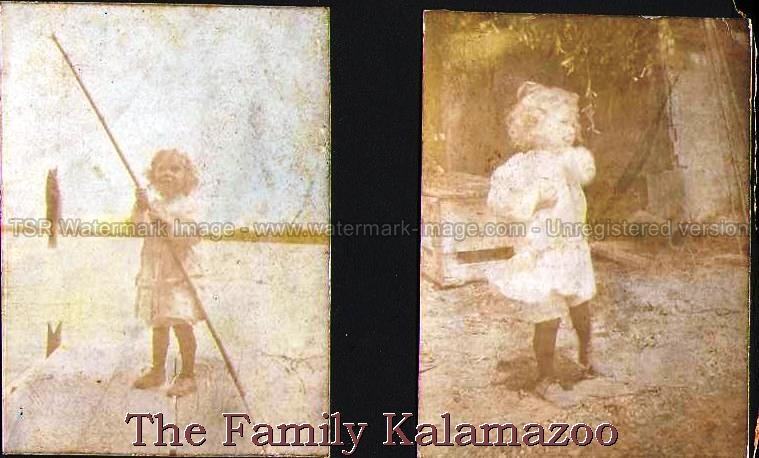
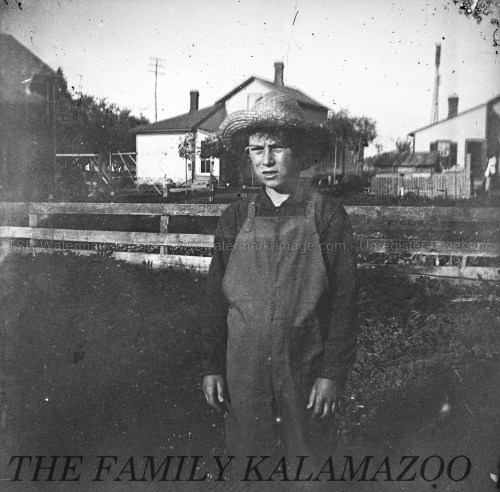
A couple of years ago we digitized the glass negatives of photos taken by Joseph DeKorn. In those photographs I found many children who remain unidentified. Because children change their looks rapidly–some kids more than others–they are harder to pin down than adults.

Here are a few:

This is just a sampling, but it’s important to concentrate on the details, so three is enough for now.  All of these would have been taken in or around Kalamazoo, Michigan. I am fairly certain they were taken on DeKorn property on Burdick Street.

I looked through my family tree, as it stands right now, and the kids who are closest in age would be the youngest DeSmit children (children of John and Mary DeKorn DeSmit).  Could it be Frances herself or a younger sister? Or are they unrelated neighbor children? Because the bottom two photos seem to be the same girl, at least, I suspect they are family.

Why would the boy in the top photo be wearing overalls and a straw hat? This seems more casual than the kids usual dress. Was he ready to go fishing?  If so, wouldn’t he have a pole in his hand?

The Van Lieres, another branch of the family, had a bus load of kids, starting in 1902, but from everything I can find they were all boys, and I think this photo is too early for them.

Any details which speak to you?

Read Full Post »

My senior year of college and first year of grad school, I studied history.  I had two specialties.  One was Reformation history. I have no idea why that period captured my interest, but I spent months working on a long paper about John Knox.  One reason it took so long was that in those days we typed papers with a typewriter.  We followed the Chicago Manual of Style, which I detested, and had to use footnotes at the bottom of most pages for our citations. I’d start out a page determined to remember when to stop typing paragraphs and when to start the footnotes, but by the time I got to that point I would always forget and just keep typing.  Over and over I repeated the same mistake.

Is it any wonder that I switched to my second specialty, local and family history?  I didn’t have a lot of textbooks to cite for that research. It was fun to check out the local cemeteries and talk to local people, when possible.

During that period, my grandparents took me to visit a woman relative named Mrs. Flipse. Her family owned a florist shop closer to downtown, but on the same street as my grandparents’ house. She lived behind the shop.

I already knew this family was somehow related to us, but it seemed like a myth or a fairy tale. When I was little Grandma would point out the store as we passed by.

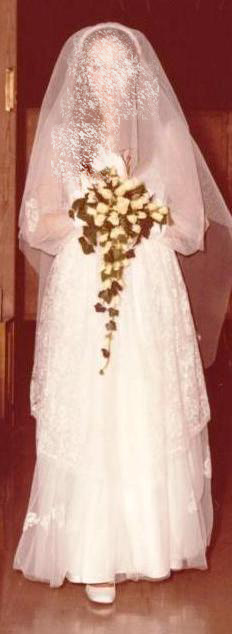
A couple of years before, my sophomore year of college, I had planned my wedding. Mom suggested I get my flowers from the relatives, so I ordered traditional rose bouquets for myself and my bridesmaids. I wanted roses to match my rose point lace dress which had been designed and sewn for my mother by my paternal grandmother twenty-two years before. Grandma was Head Fitter of the very exclusive 28 Shop at Marshall Field’s flagship store on State Street in Chicago, so she knew how to handle a needle.

Grandma had passed away a year before I was married, so we had a tailor add fabric at the waist because I was two inches taller than my mother. She added long sleeves because I was married in January, not June as my mother had. 

In the photo you can see the beautiful dress and my bouquet, but you can’t see me.  I learned to scratch out my face in my junior high yearbooks, so you can see that I still have that skill.  The florist did a beautiful job on the flowers.

Mrs. Flipse seemed ancient to me.  Her house seemed ancient, too, much older than the house my grandparents built when they were a young couple. We entered the kitchen eating area from the back of the house and sat at the table with her. Grandma asked her some questions about family history, but I don’t remember her answering a lot of the questions. She had forgotten much and what she remembered was more specific to her own life.

Until I started working on my family tree on Ancestry, I didn’t really “get” how Mrs. Flipse was related to me.

Her name at birth was Frances DeSmit, and her mother, Mary DeKorn DeSmit, was Richard DeKorn’s sister. Richard is my 2nd great grandfather, so that makes Frances my first cousin 3x removed.

What is clear from looking at her Ancestry profile is that Frances was near the end of her life when I met her; she died at the age of 97.

She married her first husband, Charles Reeves, in 1902, and had a son, Edwin, with Charles.  The marriage license lists Charles as a cigar maker; he was 23 and Frances was 20. According to the newspaper archives, Frances secured a divorce from Charles in 1911 because he wouldn’t support his family. She said, “He would rather go fishing, and he spends most of his time at it,” indicating he was in debt from tobacco and liquor bills.

Jacob Flipse was her second husband, and she married him on September 17, 1914, at the age of 30. I notice that she is listed in documents from that period on as working as a florist.

I went back through newspaper articles, looking for an obituary, but what I found instead was that Mrs. Jacob Flipse had died February 18, 1914 (another article listed February 15, and I think that might be accurate). I thought, wow, she married him pretty quickly after that.  Then I noticed something strange. The deceased Mrs. Jacob Flipse was the daughter of John DeSmit of 1017 S. Burdick. Well, so was Frances. Did she marry her sister’s widower? No, she married the widower of her Aunt Christina.

Mrs. Jacob (Christina) Flipse died in 1914 at age 48 of a stroke which paralyzed her, according to one obituary.  She was born in 1864.


Read Full Post »

I wrote about my great-grandmother Clara Waldeck Mulder in The Lost Bracelet. At the time I posted about her, I didn’t really have a lot of facts about her, other than that I lost her bracelet because the clasp didn’t hold while I was at work.  Ironically, I was selling costume jewelry at Jacobson’s, in downtown Kalamazoo.

Since then my mother gave me some notes about her grandma:

  • She regularly did heavy farm chores, especially after her children were old enough to stay in the house alone. She was a big strong woman.
  • She cooked without recipes, but the food tasted very good.
  • In the evening she served us homemade ice cream that she and Grandpa made.
  • She cared for the chickens, including slaughtering them to cook and eat.
  • Along with family help, she kept a large vegetable garden.
  • She let us go wildflower picking in the “woods” across the road from their farmhouse and barn.
  • She let us play the player piano as much as we wanted. It used the perforated paper rolls.
  • Her family, both sides, seemed to carry a glaucoma gene; many experienced at least some loss of vision.
  • Some of her relatives were farmers.
  • Her family met for a family reunion with extended family every summer–it went on for many years.
  • When she got sick in her sixties and died, I felt a great loss.

###

Although I never got to meet my great-grandmother Clara, I did visit her farm and even stayed there for a week once with my great-grandfather and his second wife Margaret.  I remember my grandmother, Clara’s daughter, taking me wildflower picking in the woods across the street from the farmhouse.

By this time you might wonder what the clue could be about the Waldecks.  Well, the information I had been given was that Clara’s father was Godfrey (probably Gottfried) Waldeck and her mother’s maiden name was Alvena Neffka.

I had met a brick wall trying to trace these people back to Germany. I even talked to a German genealogist who has helped me in the past. He said Neffka couldn’t be a German name.  He questioned if that was really the name.

The only clue I’d found was on Alvena’s death certificate which indicated that her father was Louis Koffler and her mother Dora Couch.

So I started picking and probing at the name Neffka (on Ancestry), trying to figure out what else it could be.  That’s when names like Gniffke, Koffler, Knoffka started showing up all over the place.

Then suddenly I started getting hits on Noffke right and left, especially in Caledonia, Michigan, where my great-grandmother was from.  I changed the name to Noffke on my tree and I was showered with little green leaf hints from Ancestry.

For the first time, I found tons of Noffke relatives right in southwestern Michigan, where they ought to be.  I am still going through this treasury of information.

I’m a little closer to breaking through that brick wall.

Also, I had a DNA match at Ancestry with a verifiable relative—we are both 2nd great-granddaughters of Godfrey and Alvena.  She and I inexplicably showed up with eastern European DNA.  That, and some documents which say “Prussia,” seem to indicate that my grandmother’s Noffke family—and probably the Waldecks as well—are actually from Prussia, not Germany proper.

Onward in my search.  Polishing up my Nancy Drew microscope for the Noffke leaves.

Leaving you with a photo of old Caledonia, Michigan:

Read Full Post »

In my last post I wrote about my great-grandmother Clara Waldeck Mulder, of Caledonia, Michigan.

Today I have a confession to make.  The Waldecks are my most unknown branch of the family.

And why?  Waldeck is a fairly common name.  There are two Castle Waldecks. Lots of places share the name Waldeck.  There are many Waldecks listed on Wikipedia, including the first Waldeck, who was a count, and some Waldeck princesses.  I bet there are a lot of paupers named Waldeck, too.

But so far I can’t find the town or region in Germany where my Waldeck family came from.

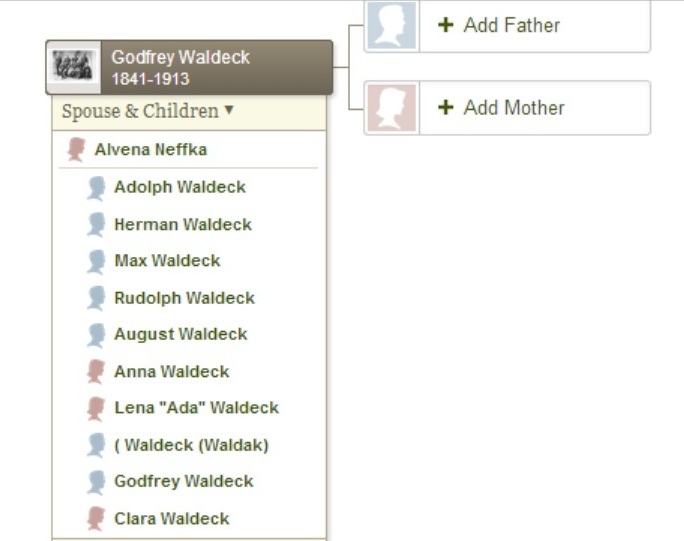
Look at the sorry state of the family tree:

Godfrey Waldeck family treeeGodfrey (Gottfried) and his wife Alvena (Alvina) immigrated to the United States with their family and then had more children. I don’t even know if all those children listed on this tree are theirs! Clara is.

And so is Godfrey (junior) because I remember him when I was young.  He managed a grain elevator or something like that, but he also farmed his own land.  He was blind from glaucoma when I met him, and he still walked down the road each day and drove his tractor in the fields.  As an aside, glaucoma runs rampant in their family.

I know that Grandma used to like to go to the Waldeck family reunions, and I went to at least one myself, at a lake (of course).

Look at Alvina Waldeck above.  The tree lists her as Alvina Neffka, as if that is her maiden name.  But is it?  I’ve also seen it listed as Noffke and on her death certificate her father was listed as Louis Koffler.  Her mother was listed as Dora Couch.

Noffke is a German name, and so is Koffler.  Neffka is not German.  Neither is Couch.

One person I’ve spoken with has wondered if the family was more Polish than German, but I have no proof of that either.

I need some help with this and hope that somebody reads this blog and gives me some clues about the family!


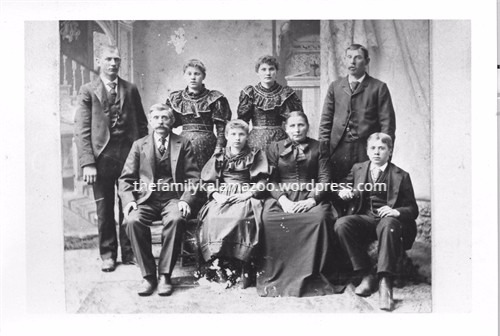
I am going to take a stab at identifying the people in the photo.

Back row:  Fred (according to a rumor, he was in a terrible accident), Ada Steeby (who had a daughter Ruth), Anna (did she marry a Stewart or Christianson or both), August (died in WWI, a bachelor)

Front row: Gottfried, Clara (my great-grandmother), Alvina, Godfrey

Looking at this photo and the names, can we write off Adolph, Rudolph, Max, Herman? Are they not part of our family?  Or were they older, born in Germany, and already living their own adult lives when this photo was taken?  And why isn’t Fred even on the family tree?!

You can see that I am going to need some help with this project!

Read Full Post »

My maternal grandmother, Lucille Edna Mulder (Zuidweg), who was born in 1912 at the time of the Titanic disaster, was raised on a farm in Caledonia, Michigan.  If you’ve read my blog for any length of time you know that I have a beautiful scrapbook which she made to commemorate her high school graduation in 1929.

You’ve met her parents, Charles and Clara (née Waldeck) Mulder.

Charles and Clara (Waldeck) Mulder Marion Studio pic

I’ve shared with you the book collection and gavel which belonged to my great-grandfather Charles.  I have not said much about my great-grandmother Clara.

What I know about her is that she raised five children on a farm in Caledonia.

Clara’s parents and older siblings were born in Germany (and perhaps at least one sibling in Kentucky, but don’t quote me on that).  She was born August 31, 1884, in Michigan.  She died September 6, 1953, of uterine cancer.  I was born less than two years later.

I have an Eastern Star ring which belonged to her, so I know she belonged to that organization. I had a sapphire bracelet, which I lost at my first job and was heartsick over, and a couple of other small items.

Here is Clara’s calling card, which my grandmother placed in her scrapbook along with the graduation cards of her classmates:

Clara's calling cardI wish I knew more about Clara and her life.  I think if I keep researching I will find more and maybe I will be able to put some pieces together.

Maybe my mother and her siblings and cousins remember their grandmother and can add to my paltry information!  Hint hint.

Read Full Post »

« Newer Posts - Older Posts »