Feeds:
Posts
Comments

Posts Tagged ‘DeKorn’

Click this link for Part I

Click this link for Part II

Click this link for Part III

Part IV

Grandpa always enjoyed watching and following sports.  Reading his story I now understand that his love of sports began when he was young.  We used to eat Thanksgiving dinner before the game, and I first learned about sports scores in the newspaper when he showed them to me.

It’s not surprising to me that Grandpa “was a good student and athlete.”  What I enjoy reading are the details.  That he played something called “soccer (rugby)” and was on the track team.  I was never an athlete, but I did enjoy track and tennis–especially track.  Maybe when I was in high school he told me he used to be on the track team, but I don’t remember .  I wonder what his events were.  I favored low hurdles and 100 yard dash.  Other than square dancing, it was the only PE activity I had talent at, but I didn’t have the guts to pursue it outside of class.  Other than that, I was always the 2nd to the last girl chosen for the team. However, other grandchildren were talented athletes, and at least three of his great-grandchildren are very accomplished athletes.

Curious about how rugby is parenthetical to soccer, I had to look it up.  Here is an interesting history of soccer in the United States which explains the rugby connection, as well as how soccer had come to very popular at the time Grandpa would have entered high school, in the early 1920s.

From 1875-1894

After the demise of college soccer in 1876, working class communities in the US adopted the game, taking on the rugby/gridiron form of soccer. It is interesting to note that this trend took place at the same time in Europe and the US. The development could be seen in New Jersey, Philadelphia and New York City, also spreading rapidly to Fall River and New Redford (MA) by 1870s. The game also clashed with the popular sport of baseball in the US, considered as American past time.

Beginning in early 1890s, soccer witnessed an average growth in Denver, Cincinnati, Cleveland and even San Francisco and Los Angeles by the end of the century. Owing to corporate sponsorships, some leagues attained semi-pro statistics. The American League of Professional Football collapsed owing to heavy financial losses during its first season.

In 1904, FIFA was established and was seen as lack of any national organizing association in the US. After FIFA refused an American application for membership during their 1912 congress, the speedily growing AAFA members formed the United States Football Association, which was accepted by FIFA. The main aim of the association was to end the struggle between amateur and professional soccer organizations.

Three of the early dynasties of American Soccer were,

  •  The Fall River Rovers- winners of the American Cup in 1888 and 1889,
•  Bethlehem Steel, who won the American Cup in 1914, 1916, 1917, 1918, and 1919
•  And winners of the National Challenge Cup in 1915, 1916, 1918, and 1919

The 1920s are popularly known as the golden era in the history of American soccer. The establishment of American Soccer League in 1921 was a mark as there was now a league that could compete with European players.

Grandpa must have had quite a walk to get to the track meets. I wonder where on campus they were held in those years.  Read Fieldhouse didn’t exist until 1957. Waldo Football Stadium wasn’t constructed until 1939, across from the baseball stadium. However, football had been on that particular property since 1914.   Since the school began as Western Normal School in 1903, only five years before Grandpa was born, I believe that at the time he was walking there, everything was located in that area off Oakland Drive (Known as Asylum Road).  It’s still quite a hike from his home on Burdick Street.

I had no idea that Grandpa had another major injury while he was still a child. A spike lodging near his spine?! That would be so frightening–for him and for his parents.  He was an only child, so his parents doted on him very much. Then to think that he missed a year and a half of school because of the injury makes me wonder what he did for that time. Was he around his mother a lot or was she at the shop? Did his grandfather still live there?  I know that his grandfather remarried when he was two, so I need to piece together addresses to see where all the family members lived each year. It seems that Grandpa’s grandfather may have moved next door when he remarried, but I can’t yet be sure.

I’m not surprised he joined the baseball team after that as he would have been “rarin” to  go, and baseball was another very popular sport.

Finally, don’t think that his comment about his teacher, Mrs. Dilts, is just an “aside.”  Grandpa loved finance.  He loved everything about money and how it worked–finance, economics, accounting.  Therefore, I suspect that he first got bitten by the love bug of finance in Mrs. Dilts’ class.  Every night, after his Sunoco station closed, Grandpa closed himself in the bedroom that served as an office and counted the money.

I hope you’ll stay tuned for Part V of Grandpa’s story . . . .

Read Full Post »

Click this link for Part I

Click this link for Part II

Part III

As I grew up there were two ways I knew my grandfather was blind in one eye. One way was that I was sometimes warned, “Be careful. You don’t want to lose your eye like Grandpa.” Mom and Dad will probably disagree that Grandpa was used as a warning to me, but I know the truth in this respect . . . .  The other way I knew was that he had one blue eye, just like mine, and he had one green eye.

Everybody else I knew had two eyes of the same color.

In this next part of Grandpa’s story he tells Connie what happened to his eye.

In 1911, Grandpa’s eye was treated at the University of Michigan hospital in Ann Arbor, about 100 miles away from his home.  I imagine the worried parents and the frightened boy travelling all that way on “streetcar, train and horse-drawn carriages.”  What would that trip be like today?  A visit in the car or ambulance to the nearest hospital, then perhaps a drive of an hour and a half to the medical center?  In an ambulance or a car, depending on the urgency.  The car would have the boy’s car seat in it.  What was it like for him? Was he carried as they moved from one mode of transportation to the next?

I believe it’s likely that he was seen at the old hospital in Ann Arbor on Catherine Street.  It is no longer there as it was replaced by the 700-bed University Hospital in 1925.

Photo by Wystan

Photo by Wystan

Today it’s hard to imagine letting your three-year-old play with a needle, but in those days children learned how to perform daily chores and trades at their parents’ sides.

The description of Grandpa bouncing off the table from being shocked by the X-ray machine is frightening. When I looked up the history of X-rays on Wikipedia, it was even more frightening. Although a lot of research led up to the moment, X-rays were not actually “discovered” until 1895. The site states, “The first use of X-rays under clinical conditions was by John Hall-Edwards in Birmingham, England on 11 January 1896, when he radiographed a needle stuck in the hand of an associate.” Since Grandpa’s injury was in 1911 and UM had only had the machine for twelve years, that means that they bought one of the first machines in 1899.

1899 X-ray machine

1899 X-ray machine

I understand that Grandpa’s medical records from 1911 are still stored at the University of Michigan. I hope I will be privileged to see a copy of them some day.

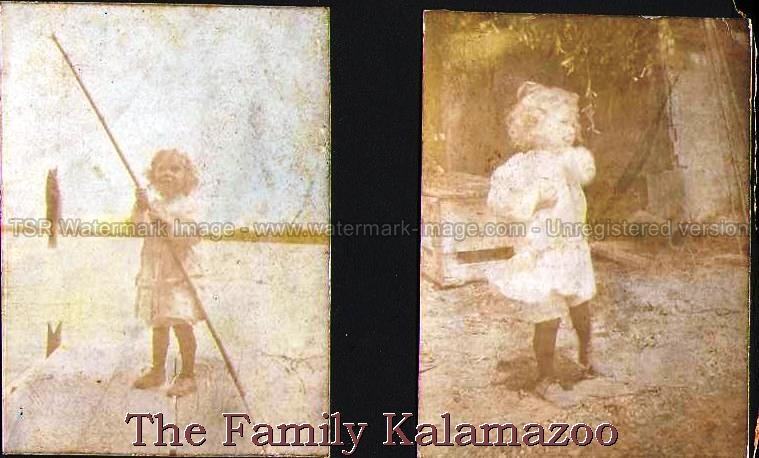
Here is a photo of the cute little boy who got a needle stuck in his eye:

Adrian Zuidweg, 1908-2000

Adrian Zuidweg, 1908-2000

Grandpa’s stoic attitude about his blind eye was typical of his personality. He didn’t show emotion very often, and he was quite practical. He loved his routines. His talent with routines and his prodigious memory proved invaluable when he became completely blind.

I hope you’ll stay tuned for Part IV of Grandpa’s story . . . .

Read Full Post »

Click here for Part I.

In my post of July 16, I shared the beginning of the story pieced together by Connie Jo Bowman in 1994, when she interviewed my grandfather Adrian Zuidweg.  Here is the next part.  Today I am going to focus on just one paragraph–to try to unpack it.

Here is what Connie wrote:

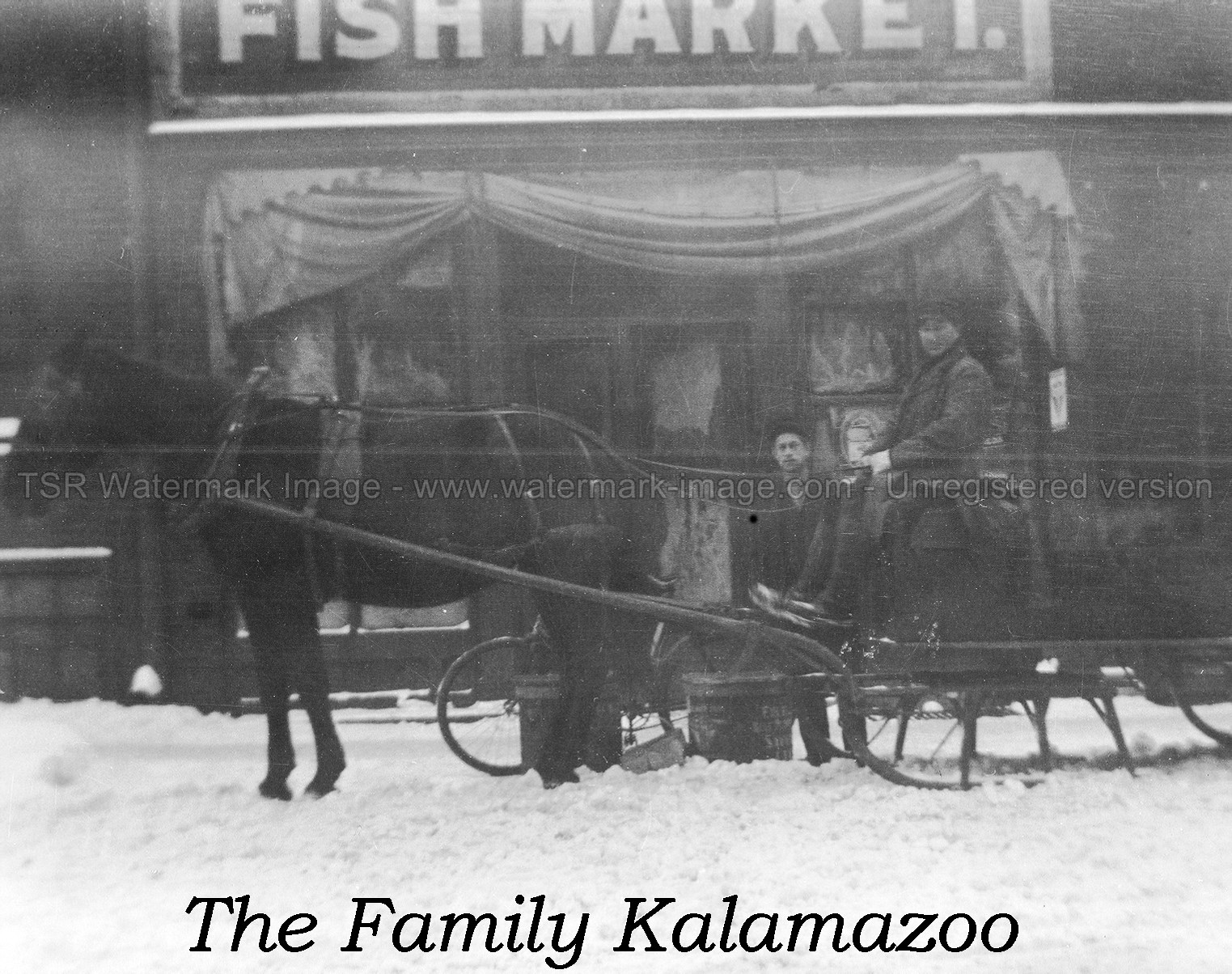
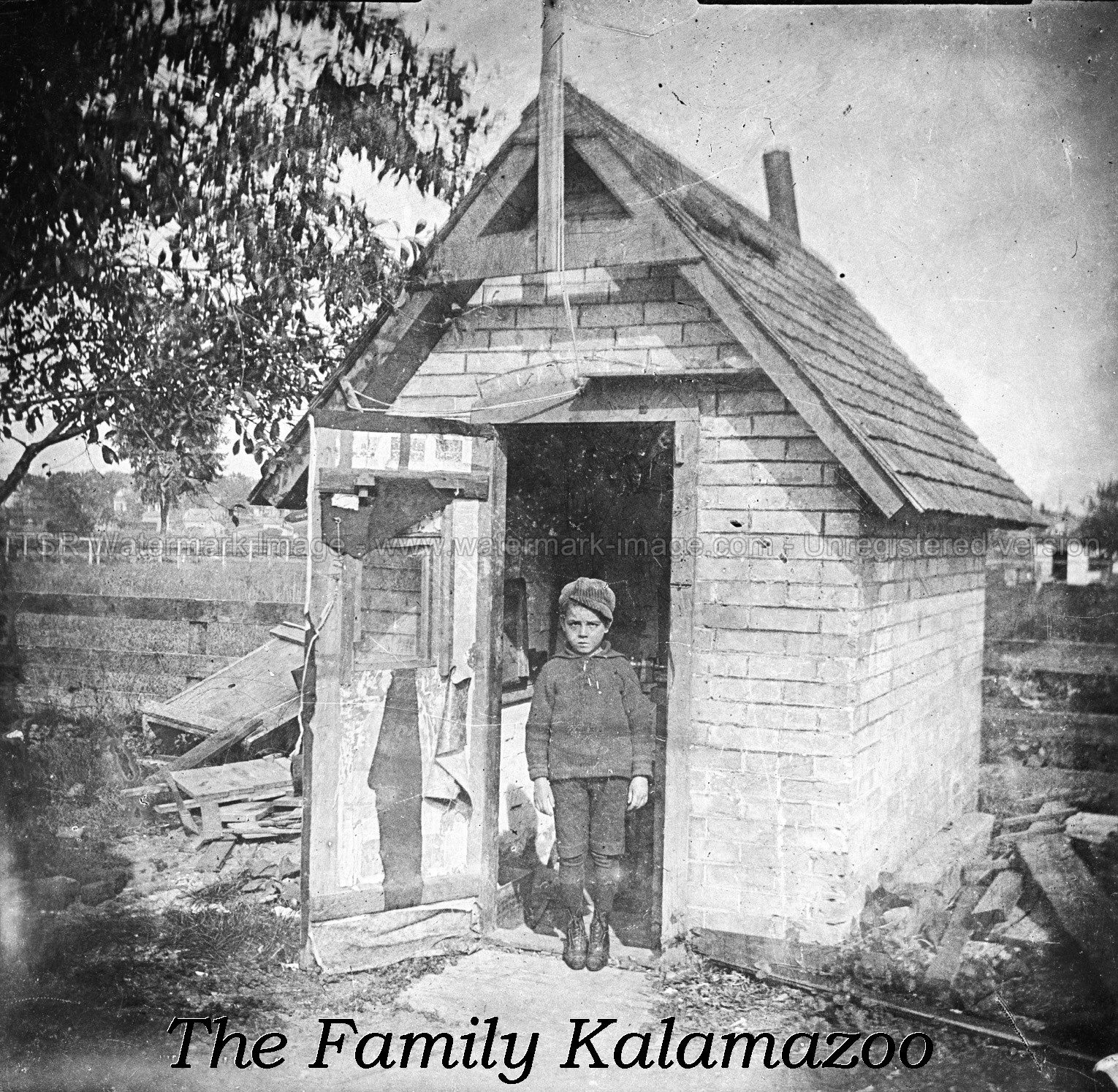
His father owned a fish market and Adrian’s earliest memories were of going to his aunt’s house while his mother helped out at the market. He remembers playing with his cousins around the big woodburning stove and the “outside toilet.” This was before 1911 because that was the year gas and sewer lines were brought up the street to their house.

I’ve written before about Grandpa’s father’s fish market in the post “My Great-Grandfather Reinvented Himself as a Business Owner in the U.S.” I share photos in that post of the interior of the fish market and the interior of the ice cream parlor Adriaan Zuijdweg (Grandpa’s father) owned after the fish market.

Adriaan Zuijdweg, Proprietor, standing

Adriaan Zuijdweg, Proprietor, standing

So that’s where Grandpa’s mother Cora went to “help out” at the market.  But Grandpa himself stayed at his aunt’s. There are two possibilities. One is his Aunt Jen, Cora’s sister. The other is his Aunt Johanna, his father’s sister.  Before 1911, Grandpa was a toddler–maybe two years old. Some people don’t have memories from that age, but I also have memories from when I was two years old.

Let’s say the year was 1910.  In 1910, Johanna Zuijdweg Van Liere had been in the United States for six years. She married her husband Marinus Van Liere in Goes, the town in the Netherlands they were both from. Johanna had two baby boys when she immigrated here, and by 1910 may have had six, seven, or eight boys. I’m not sure if they all survived infancy, but she was evidently quite busy.

Grandpa’s mother’s sister Jen, on the other hand, had one 13-year-old daughter in 1910.

If Grandpa played with his cousins around the stove and the outhouse in the yard, it would be Johanna’s children.  This led to me to search out where Johanna and Marinus were living in 1910.

Shed or outhouse?

Shed or outhouse?

The 1910 U.S. Census shows Grandpa living with both his parents, Adriaan and Cora, his grandfather Richard DeKorn, and his uncle Joseph DeKorn in the Richard DeKorn house at the corner of Burdick and Balch: 1324 S. Burdick Street. Since the house still stands today, if it wasn’t moved, the address numbers have been changed on Burdick. The VanLieres, Johanna and Marinus, and their six boys lived at 1338 S. Burdick Street. It looks like another family lived between them. About four houses down from the VanLieres lived John and Mary DeSmit and their children. Mary DeSmit was Richard DeKorn’s sister.

I found it interesting that the census shows Johanna and Marinus speaking English, although they had only been in this country for six years. A few of the neighbors spoke Dutch, but most of them spoke English.

Johanna Zuijdweg VanLiere and Marinus VanLiere with son Jacob

Johanna Zuijdweg VanLiere and Marinus VanLiere with son Jacob

In this section of Grandpa’s story, he remembers that gas and sewer lines were brought up to their house in 1911. It must have made a monumental difference in the quality of their lives. Because his grandfather, Richard DeKorn, was a building contractor, would they have been quicker to get connected or was it something they had to wait their turn for, like everybody else?

On a personal note, I was surprised that Grandpa’s family was as close with his father’s sister and her family as this research shows.  I knew that the family was often with Aunt Jen, as many of the family photos are of Jen and her husband Lou.  But there aren’t as many photos of Johanna, nor do I know the history of that branch of the family as the children all grew up.

I hope you’ll stay tuned for Part III of Grandpa’s story . . . .

Read Full Post »

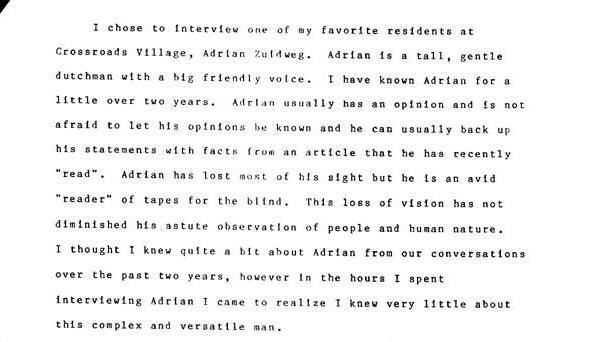
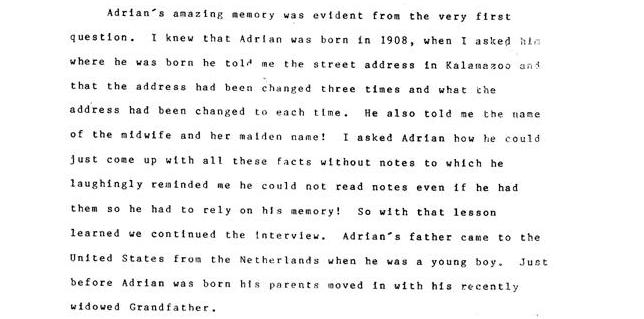
In 1994, five and a half years before he passed away, my grandfather, Adrian Zuidweg, was interviewed by Connie Jo Bowman, the head of residents at Crossroads Village, a retirement community in Portage, Michigan. Connie was taking a course about the elderly at Western Michigan University and chose Grandpa as her subject.  I’ve written about Grandpa in a post about our left-handed connection.

The entire interview is eight typed pages, so I’ll divide it among a few blog posts.

Adrian Zuidweg 1908-2000

Adrian Zuidweg 1908-2000

Connie begins by introducing my grandfather, Adrian Zuidweg.  To read the excerpts of Connie’s report, you can click them for a better view (I hope):

Connie identifies my grandfather here as a “tall, gentle dutchman with a big friendly voice.” That would probably be how Grandpa thought of himself. He identified strongly with his Dutch heritage.  He had a lot of jokes, but one of his favorites was to say, “If you ain’t Dutch, you ain’t much.” He didn’t really mean it, which you will see by the end of the interview, but he was very proud of being Dutch.

She also notes here how after talking with Grandpa for two years it wasn’t until she began interviewing him that she realized how much there was to know about Grandpa. Grandpa’s powers of observation were impressive to her, especially in light of his blindness. He only became completely blind in his old age, but he had been blind in one eye since he was a small child.

Connie was right–Grandpa had an amazing memory. He also loved to tell stories, especially stories about the past. As the oldest grandchild, I was privy to more of them than the other kids, but I still only know a few from his vast store.

Now that I realize that Grandpa knew the name of the midwife who delivered him, I wish Connie had put that information into her report, but perhaps it didn’t fit with the class assignment.

Here she mentions how Grandpa’s father came to the U.S. from the Netherlands when he was a child. This was Adriaan Zuijdweg, who I have written about in the past. He owned a fish market and then a candy and soda shop.  You can find a story about his retail businesses here.

When Grandpa was a baby his parents moved in with “his recently widowed grandfather,” Richard DeKorn, the brick mason and contractor. You can read more about Richard in the following posts:

Richard DeKorn: Brick Mason and General Contractor

More Mighty Kalamazoo Buildings from Richard DeKorn

Richard DeKorn and His Bride Tied the Knot in Kalamazoo

By the way, a big thank you to Linda at Living with My Ancestors for her help with watermarking my photograph.

I hope you’ll stay tuned for Part II of Grandpa’s story . . . .

Read Full Post »

My senior year of college and first year of grad school, I studied history.  I had two specialties.  One was Reformation history. I have no idea why that period captured my interest, but I spent months working on a long paper about John Knox.  One reason it took so long was that in those days we typed papers with a typewriter.  We followed the Chicago Manual of Style, which I detested, and had to use footnotes at the bottom of most pages for our citations. I’d start out a page determined to remember when to stop typing paragraphs and when to start the footnotes, but by the time I got to that point I would always forget and just keep typing.  Over and over I repeated the same mistake.

Is it any wonder that I switched to my second specialty, local and family history?  I didn’t have a lot of textbooks to cite for that research. It was fun to check out the local cemeteries and talk to local people, when possible.

During that period, my grandparents took me to visit a woman relative named Mrs. Flipse. Her family owned a florist shop closer to downtown, but on the same street as my grandparents’ house. She lived behind the shop.

I already knew this family was somehow related to us, but it seemed like a myth or a fairy tale. When I was little Grandma would point out the store as we passed by.

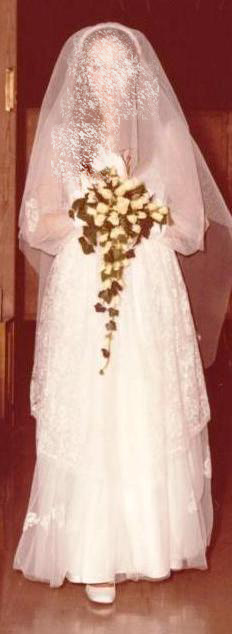
A couple of years before, my sophomore year of college, I had planned my wedding. Mom suggested I get my flowers from the relatives, so I ordered traditional rose bouquets for myself and my bridesmaids. I wanted roses to match my rose point lace dress which had been designed and sewn for my mother by my paternal grandmother twenty-two years before. Grandma was Head Fitter of the very exclusive 28 Shop at Marshall Field’s flagship store on State Street in Chicago, so she knew how to handle a needle.

Grandma had passed away a year before I was married, so we had a tailor add fabric at the waist because I was two inches taller than my mother. She added long sleeves because I was married in January, not June as my mother had. 

In the photo you can see the beautiful dress and my bouquet, but you can’t see me.  I learned to scratch out my face in my junior high yearbooks, so you can see that I still have that skill.  The florist did a beautiful job on the flowers.

Mrs. Flipse seemed ancient to me.  Her house seemed ancient, too, much older than the house my grandparents built when they were a young couple. We entered the kitchen eating area from the back of the house and sat at the table with her. Grandma asked her some questions about family history, but I don’t remember her answering a lot of the questions. She had forgotten much and what she remembered was more specific to her own life.

Until I started working on my family tree on Ancestry, I didn’t really “get” how Mrs. Flipse was related to me.

Her name at birth was Frances DeSmit, and her mother, Mary DeKorn DeSmit, was Richard DeKorn’s sister. Richard is my 2nd great grandfather, so that makes Frances my first cousin 3x removed.

What is clear from looking at her Ancestry profile is that Frances was near the end of her life when I met her; she died at the age of 97.

She married her first husband, Charles Reeves, in 1902, and had a son, Edwin, with Charles.  The marriage license lists Charles as a cigar maker; he was 23 and Frances was 20. According to the newspaper archives, Frances secured a divorce from Charles in 1911 because he wouldn’t support his family. She said, “He would rather go fishing, and he spends most of his time at it,” indicating he was in debt from tobacco and liquor bills.

Jacob Flipse was her second husband, and she married him on September 17, 1914, at the age of 30. I notice that she is listed in documents from that period on as working as a florist.

I went back through newspaper articles, looking for an obituary, but what I found instead was that Mrs. Jacob Flipse had died February 18, 1914 (another article listed February 15, and I think that might be accurate). I thought, wow, she married him pretty quickly after that.  Then I noticed something strange. The deceased Mrs. Jacob Flipse was the daughter of John DeSmit of 1017 S. Burdick. Well, so was Frances. Did she marry her sister’s widower? No, she married the widower of her Aunt Christina.

Mrs. Jacob (Christina) Flipse died in 1914 at age 48 of a stroke which paralyzed her, according to one obituary.  She was born in 1864.


Read Full Post »

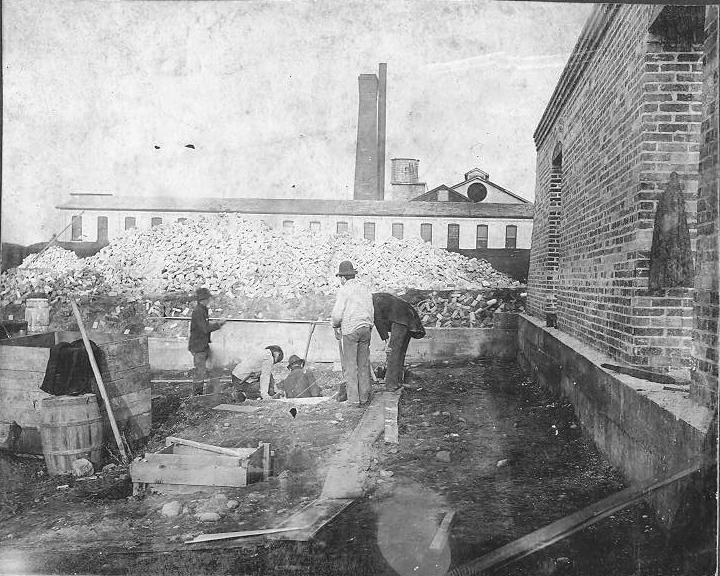
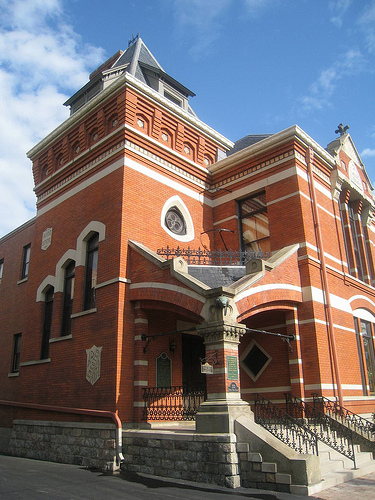
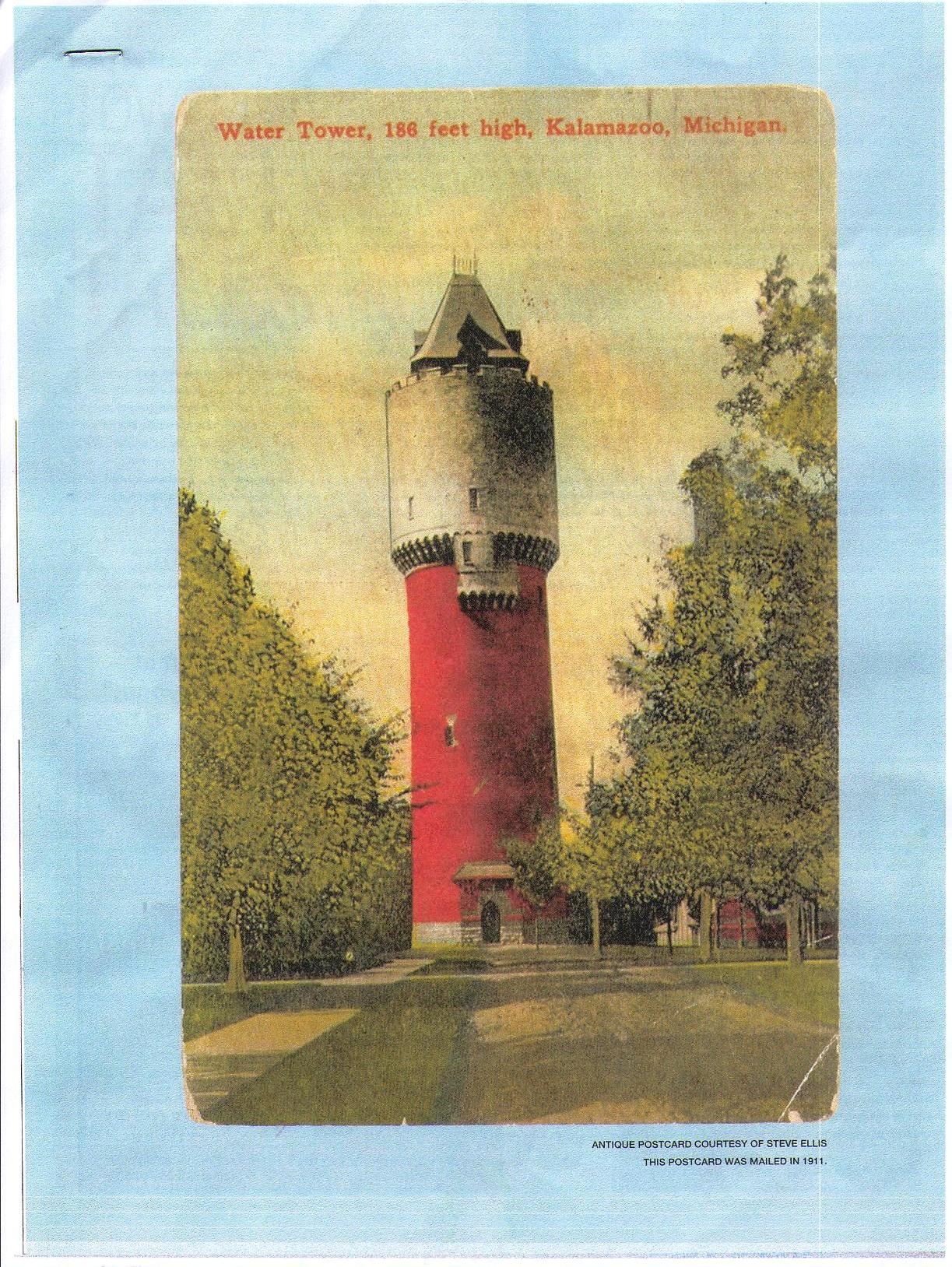
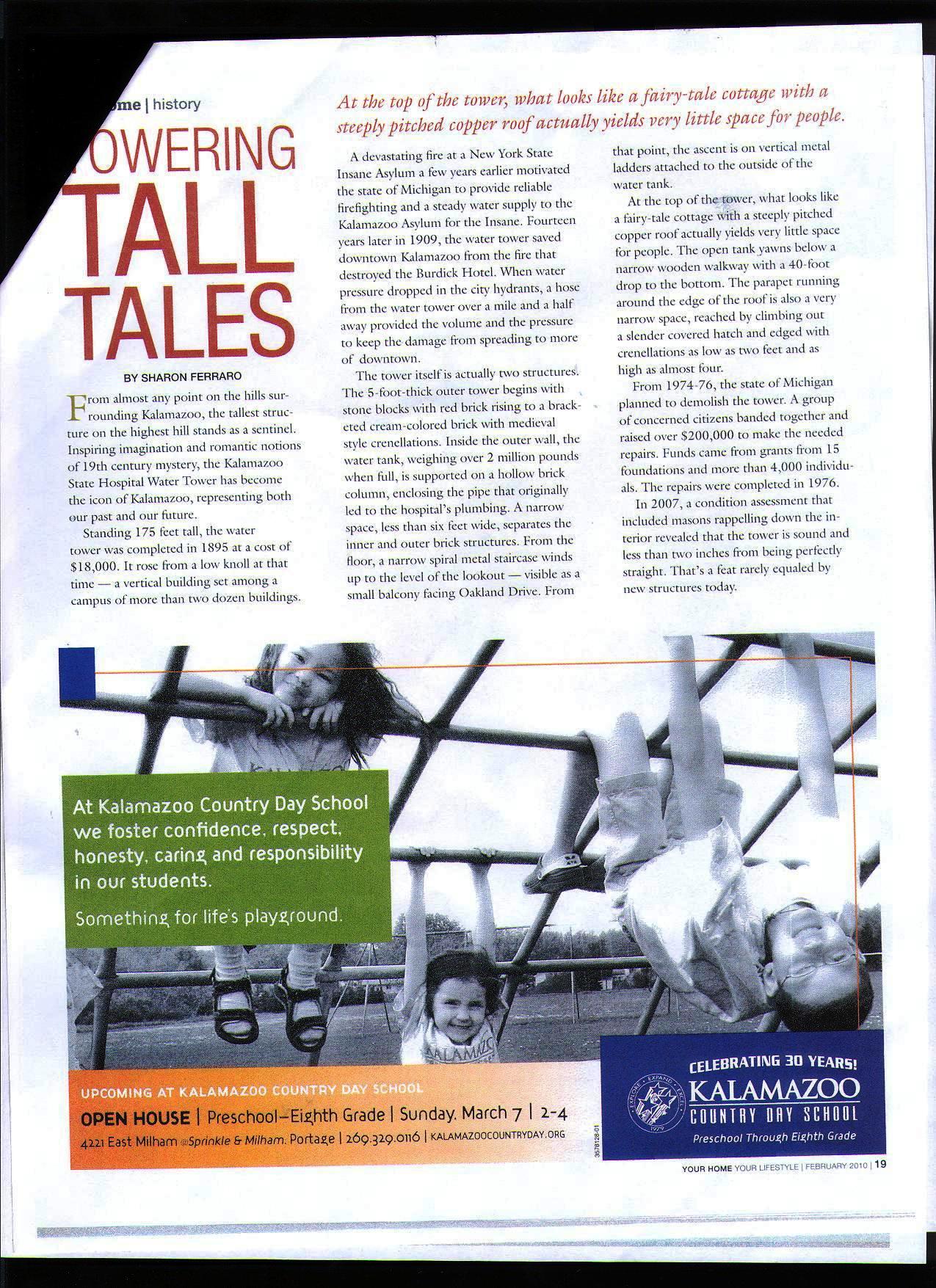
My great-great-grandfather, Richard DeKorn, was a brick mason who worked on many public buildings in the Kalamazoo area.  He was a brick mason on the beautiful Ladies’ Library Association in 1878-79 and lead brick mason on theKalamazoo Psychiatric Hospital Water Tower  in 1895. According to his obituary he was the contractor for the Pythian building and the Merchants Publishing Company building.

Richard was born on August 21, 1851* in Goes, Zeeland, the Netherlands to Boudewijn and Johanna (Remijinse) DeKorn.  When he was four or five years old, the family immigrated to Zeeland, Michigan.  I have not yet discovered when or why Richard moved to Kalamazoo.

Richard was sometimes called Dick or Dirk, but more importantly, his birth name was Derrick and it’s likely that Richard was actually his middle name.

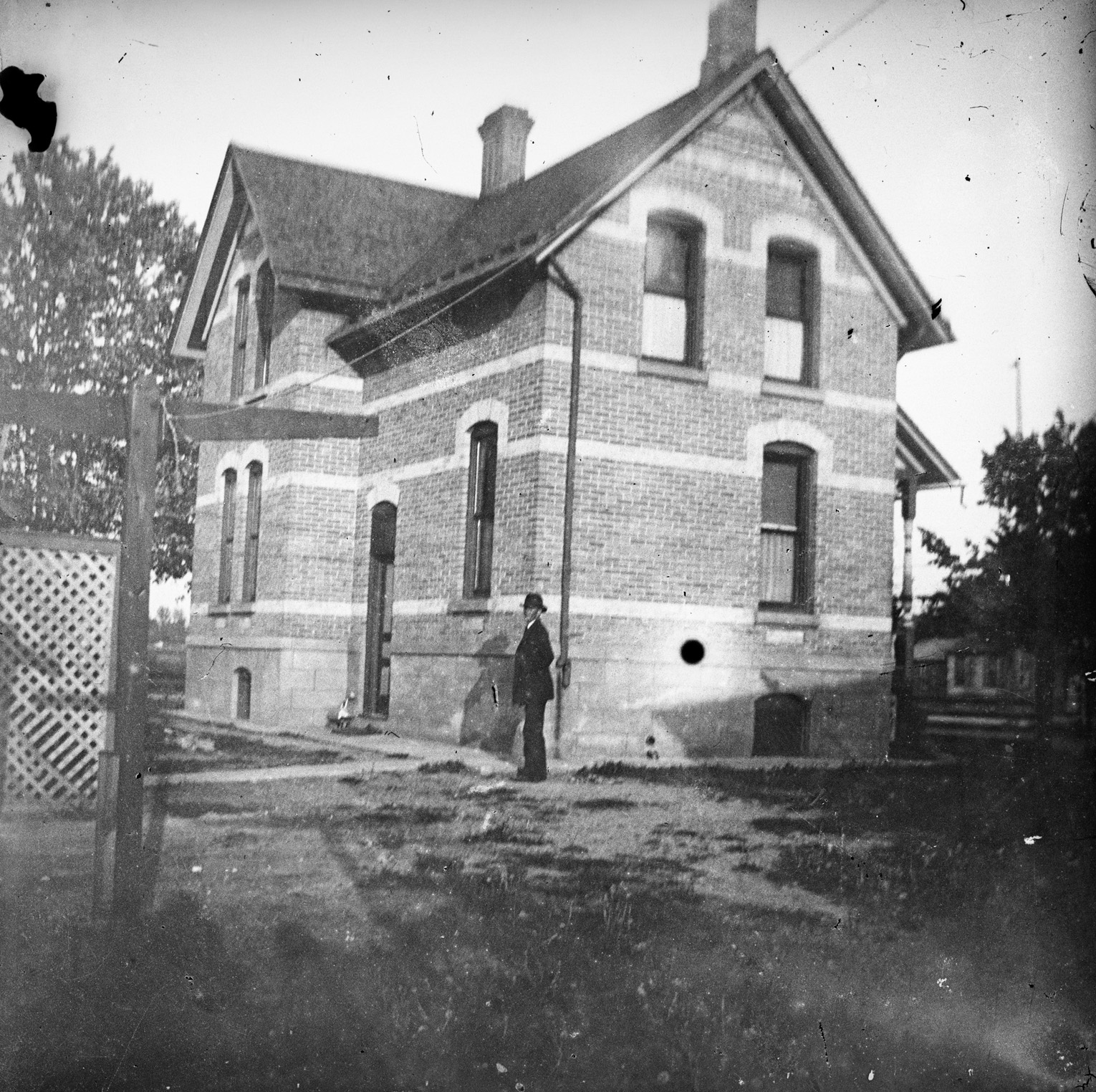
On May 10, 1872, at the age of 20, Richard married Alice Paak in Kalamazoo.  They lived in Kalamazoo, in the Burdick and Balch Street area, for the rest of their lives.  For much of the time, they lived in a house which Richard built with his characteristic style:  dark brown brick with stripes of light brick or stone.

Richard and Alice had three children: Joseph, Cora, and Jennie.  After Alice’s death in 1908, he married Jennie Sootsman who had two daughters, Marian and Marge.

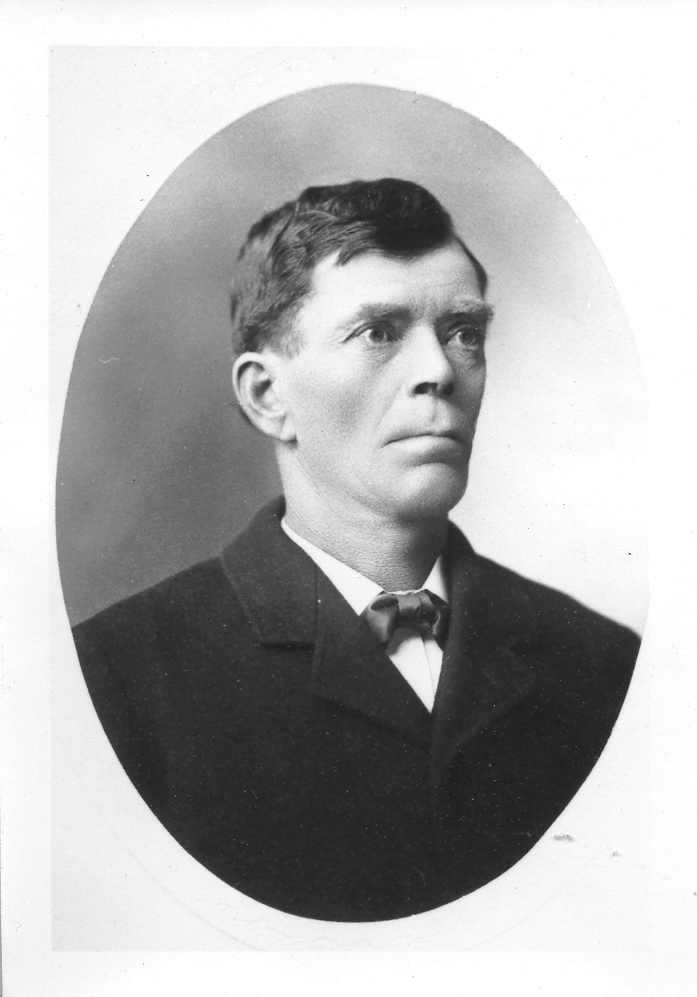
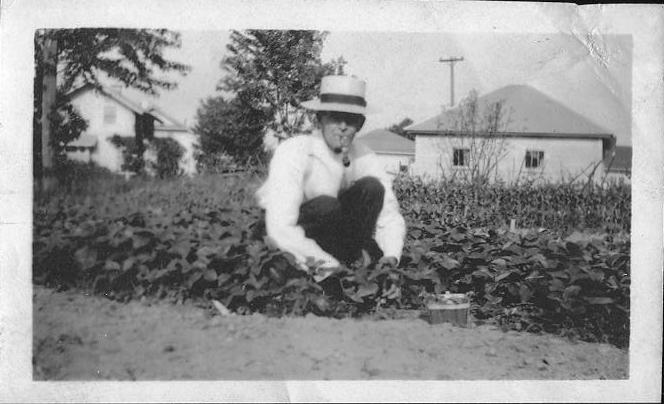
The family refers to him as “Richard DeKorn” with great respect for the reputation he achieved as a wonderful craftsman and contractor.  Richard did a little gardening on the property, but he really enjoyed relaxing with a pipe and spending time with his family.  His door was open to any friend or family member and he was a good stepfather to his 2nd wife’s daughters.

*

*On his marriage document, Richard’s birth date is given as 1852, not 1851, and it states that he was born in Kapelle, not Goes.

Richard DeKorn’s home at the corner of Burdick and Balch, Kalamazoo, Michigan

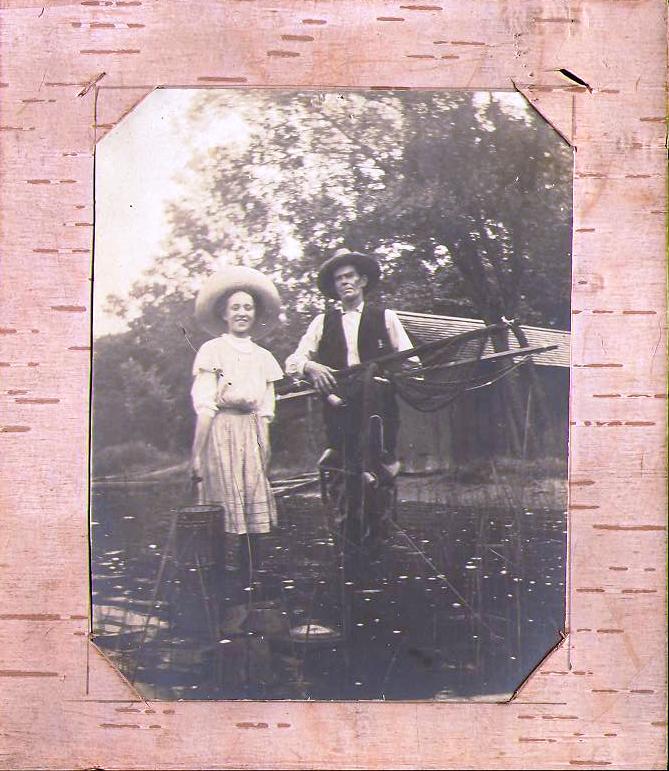
Richard surrounded by family, including son-in-law Lou Leeuwenhoek (L), daughter Jennie (to Richard’s right), wife Alice in front.

Richard picking strawberries

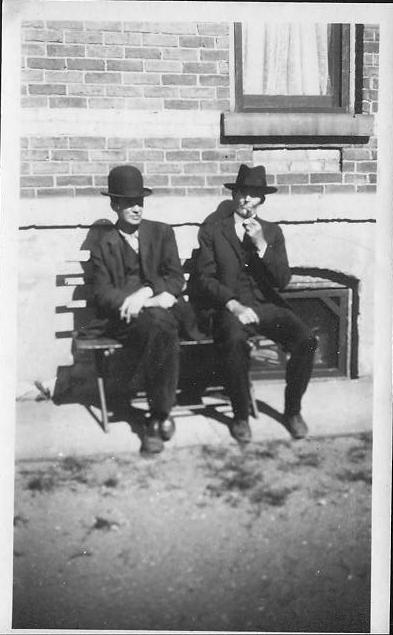
Richard with his beloved pipe

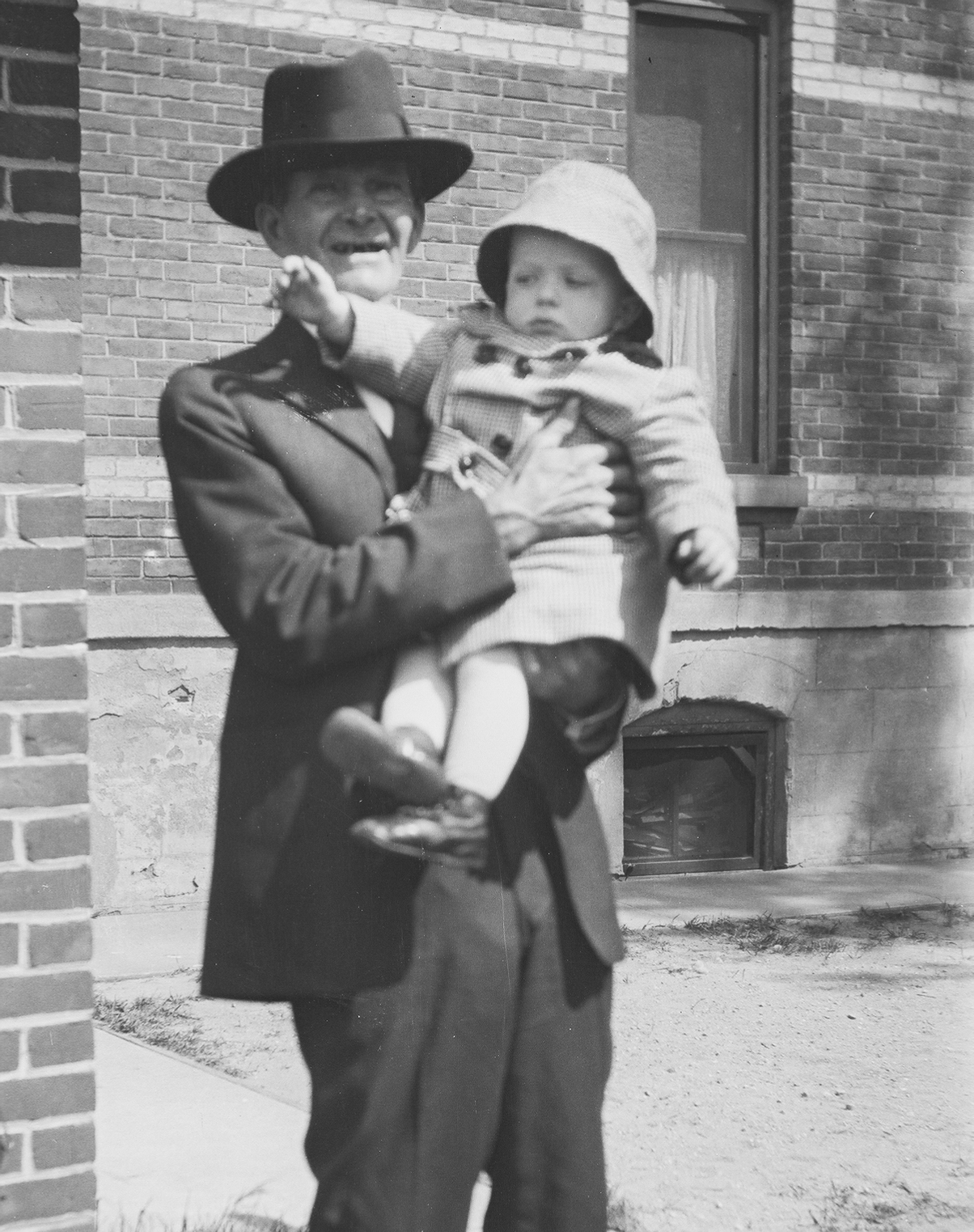
Richard holding unidentified baby

Richard with his granddaughter Alice Leeuwenhoek (Moerdyke)

Richard DeKorn crew at work in an area which would become The Kalamazoo Mall

Lou Leeuwenhoek and Richard DeKorn

Ladies’ Library Association, Kalamazoo, MI
Photo from LLA website

KPH Water Tower, Oakland Drive, Kalamazoo, MI

KPH Water Tower article, February 2010

Here’s a video which shows a climb up the inside of the tower!

Read Full Post »

« Newer Posts