Feeds:
Posts
Comments

In 1994, five and a half years before he passed away, my grandfather, Adrian Zuidweg, was interviewed by Connie Jo Bowman, the head of residents at Crossroads Village, a retirement community in Portage, Michigan. Connie was taking a course about the elderly at Western Michigan University and chose Grandpa as her subject.  I’ve written about Grandpa in a post about our left-handed connection.

The entire interview is eight typed pages, so I’ll divide it among a few blog posts.

Adrian Zuidweg 1908-2000

Adrian Zuidweg 1908-2000

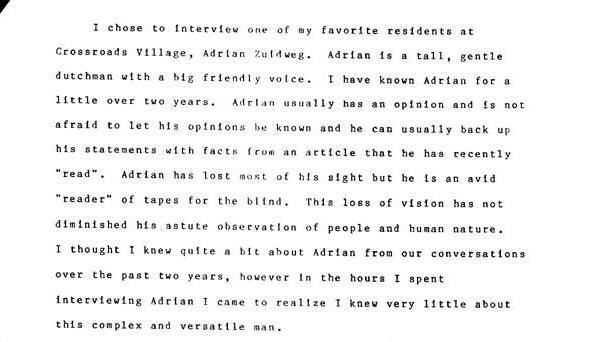
Connie begins by introducing my grandfather, Adrian Zuidweg.  To read the excerpts of Connie’s report, you can click them for a better view (I hope):

Connie identifies my grandfather here as a “tall, gentle dutchman with a big friendly voice.” That would probably be how Grandpa thought of himself. He identified strongly with his Dutch heritage.  He had a lot of jokes, but one of his favorites was to say, “If you ain’t Dutch, you ain’t much.” He didn’t really mean it, which you will see by the end of the interview, but he was very proud of being Dutch.

She also notes here how after talking with Grandpa for two years it wasn’t until she began interviewing him that she realized how much there was to know about Grandpa. Grandpa’s powers of observation were impressive to her, especially in light of his blindness. He only became completely blind in his old age, but he had been blind in one eye since he was a small child.

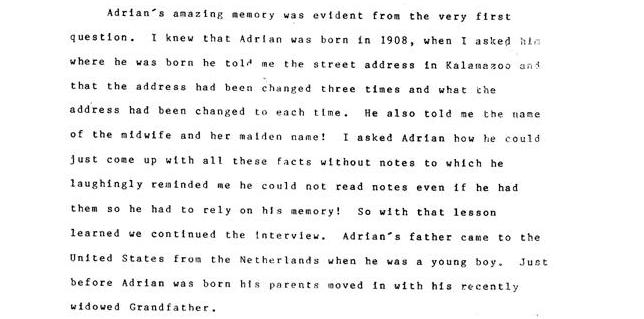
Connie was right–Grandpa had an amazing memory. He also loved to tell stories, especially stories about the past. As the oldest grandchild, I was privy to more of them than the other kids, but I still only know a few from his vast store.

Now that I realize that Grandpa knew the name of the midwife who delivered him, I wish Connie had put that information into her report, but perhaps it didn’t fit with the class assignment.

Here she mentions how Grandpa’s father came to the U.S. from the Netherlands when he was a child. This was Adriaan Zuijdweg, who I have written about in the past. He owned a fish market and then a candy and soda shop.  You can find a story about his retail businesses here.

When Grandpa was a baby his parents moved in with “his recently widowed grandfather,” Richard DeKorn, the brick mason and contractor. You can read more about Richard in the following posts:

Richard DeKorn: Brick Mason and General Contractor

More Mighty Kalamazoo Buildings from Richard DeKorn

Richard DeKorn and His Bride Tied the Knot in Kalamazoo

By the way, a big thank you to Linda at Living with My Ancestors for her help with watermarking my photograph.

I hope you’ll stay tuned for Part II of Grandpa’s story . . . .

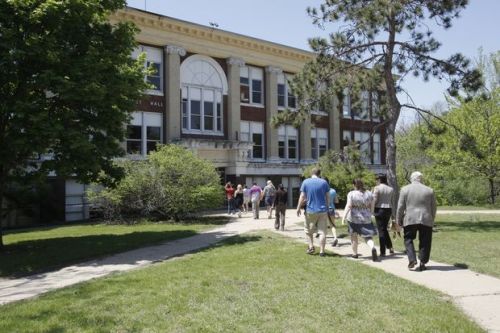
The National Trust for Historic Preservation is begging Western Michigan University not to destroy history–its own, that of the Kalamazoo area, and that of higher education. There are four old buildings which represent the origins of the university which those who head up the school want to demolish.  Here‘s an article that Mom clipped and mailed me. It was printed in the Kalamazoo Gazette on June 27, 2013.

Click here for the Kalamazoo Gazette article

Click here for the Kalamazoo Gazette article

Click here for the Kalamazoo Gazette article

Click here for the Kalamazoo Gazette article

I keep asking myself  the question, “What kind of people want to destroy history?”

My family has graduated from Western Michigan University for four generations. As I explained in a previous post “Western State Normal School, Kalamazoo, Michigan: A Personal View,” my grandmother, L. Edna Mulder Zuidweg, graduated from the school when it was Western State Normal School, a teacher training school. Both my parents, my aunt, my brother, and yours truly also graduated from WMU.  In addition, my husband graduated with a BBA degree, as well.  And at least one member of the most recent generation–my cousin’s daughter– has graduated from Western.

Because my husband and I both got business degrees (I also majored in history and he did so in political science) in the late 70s, we spent a lot of time on the oldest section of the university–East Campus, which housed the business school.

If you follow this link you will read a good history of the old campus.  They have some beautiful photos posted, too.

State Normal Kalamazoo front

HERE’S WHAT YOU CAN DO TO HELP FROM THE FRIENDS OF HISTORIC EAST CAMPUS WEBSITE:

1.  Be an advocate for smart adaptive re-use!  Tweet, display yard signs, display bumper stickers,write letters, TELL YOUR FRIENDS and ASK THEM TO HELP!  ACT NOW.  Click here for  Action Plan

2.  Join our “cast of thousands!” 
     Click here for details of our quest to post pix of you holding the Save East Campus sign for Youtube

3.  Click here to get your printable pix-poster for Youtube video

4.   Express your concerns to WMU’s Board of Trustees [go HERE to email the Board]

5. Express your concerns to elected officials:
Governor Rick Snyder
P.O. Box 30013
Lansing, Michigan 48909
https://somgovweb.state.mi.us/GovRelations/ShareOpinion.aspx
517-335-7858

State Senator Tonya Schuitmaker
mailto:SenTSchuitmaker@senate.michigan.gov

State Representative Margaret O’Brien
mailto:MargaretOBrien@house.mi.gov

State Representative Sean McCann
mailto:seanmccann@house.mi.gov

Mayor Bobby Hopewell
mailto:bobbyhopewell@borgess.com

6.  Express your concerns to WMU’s Board of Trustees [go
 HERE to email the Board]

7. Sign a petition here 

8. Write to news media in support of the FOHEC request for a moratorium and community input.

9. ASK:  How much will taxpayers/students have to pay to demolish the buildings?  How much will taxpayers/students have to pay to transport resulting debris to landfills?  How much will taxpayers/students have to pay to pave over historic East Campus to create the proposed parking lot?  How much does it all add up to?  

10. ASK:  How much will it cost to save the buildings and make a serious survey of ways they could be used to serve and educate students?

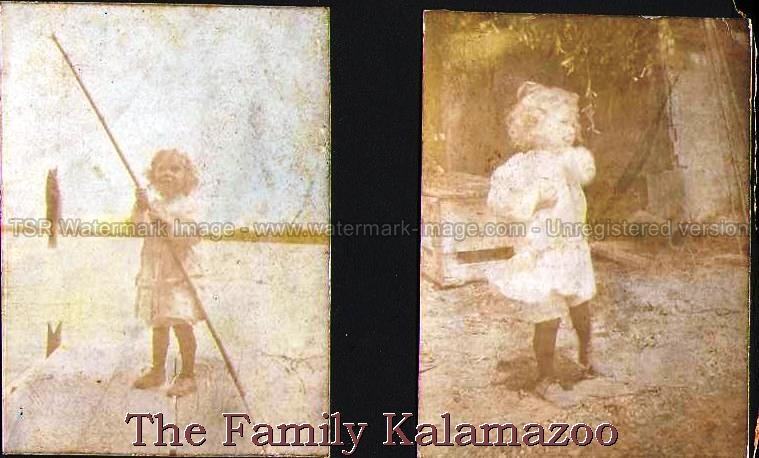
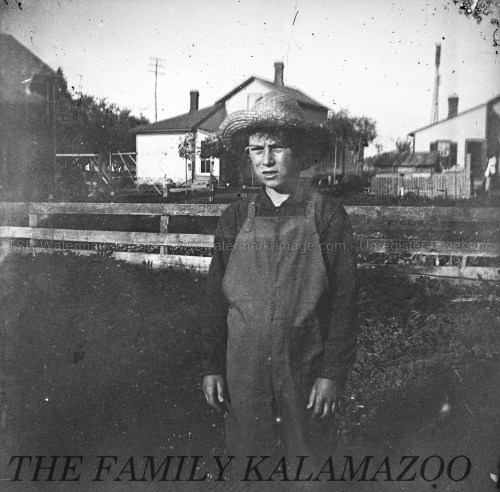
A couple of years ago we digitized the glass negatives of photos taken by Joseph DeKorn. In those photographs I found many children who remain unidentified. Because children change their looks rapidly–some kids more than others–they are harder to pin down than adults.

Here are a few:

This is just a sampling, but it’s important to concentrate on the details, so three is enough for now.  All of these would have been taken in or around Kalamazoo, Michigan. I am fairly certain they were taken on DeKorn property on Burdick Street.

I looked through my family tree, as it stands right now, and the kids who are closest in age would be the youngest DeSmit children (children of John and Mary DeKorn DeSmit).  Could it be Frances herself or a younger sister? Or are they unrelated neighbor children? Because the bottom two photos seem to be the same girl, at least, I suspect they are family.

Why would the boy in the top photo be wearing overalls and a straw hat? This seems more casual than the kids usual dress. Was he ready to go fishing?  If so, wouldn’t he have a pole in his hand?

The Van Lieres, another branch of the family, had a bus load of kids, starting in 1902, but from everything I can find they were all boys, and I think this photo is too early for them.

Any details which speak to you?

My senior year of college and first year of grad school, I studied history.  I had two specialties.  One was Reformation history. I have no idea why that period captured my interest, but I spent months working on a long paper about John Knox.  One reason it took so long was that in those days we typed papers with a typewriter.  We followed the Chicago Manual of Style, which I detested, and had to use footnotes at the bottom of most pages for our citations. I’d start out a page determined to remember when to stop typing paragraphs and when to start the footnotes, but by the time I got to that point I would always forget and just keep typing.  Over and over I repeated the same mistake.

Is it any wonder that I switched to my second specialty, local and family history?  I didn’t have a lot of textbooks to cite for that research. It was fun to check out the local cemeteries and talk to local people, when possible.

During that period, my grandparents took me to visit a woman relative named Mrs. Flipse. Her family owned a florist shop closer to downtown, but on the same street as my grandparents’ house. She lived behind the shop.

I already knew this family was somehow related to us, but it seemed like a myth or a fairy tale. When I was little Grandma would point out the store as we passed by.

A couple of years before, my sophomore year of college, I had planned my wedding. Mom suggested I get my flowers from the relatives, so I ordered traditional rose bouquets for myself and my bridesmaids. I wanted roses to match my rose point lace dress which had been designed and sewn for my mother by my paternal grandmother twenty-two years before. Grandma was Head Fitter of the very exclusive 28 Shop at Marshall Field’s flagship store on State Street in Chicago, so she knew how to handle a needle.

Grandma had passed away a year before I was married, so we had a tailor add fabric at the waist because I was two inches taller than my mother. She added long sleeves because I was married in January, not June as my mother had. 
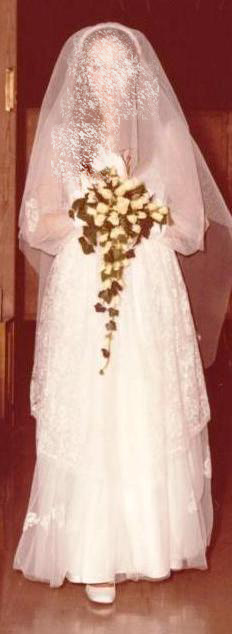
In the photo you can see the beautiful dress and my bouquet, but you can’t see me.  I learned to scratch out my face in my junior high yearbooks, so you can see that I still have that skill.  The florist did a beautiful job on the flowers.

Mrs. Flipse seemed ancient to me.  Her house seemed ancient, too, much older than the house my grandparents built when they were a young couple. We entered the kitchen eating area from the back of the house and sat at the table with her. Grandma asked her some questions about family history, but I don’t remember her answering a lot of the questions. She had forgotten much and what she remembered was more specific to her own life.

Until I started working on my family tree on Ancestry, I didn’t really “get” how Mrs. Flipse was related to me.

Her name at birth was Frances DeSmit, and her mother, Mary DeKorn DeSmit, was Richard DeKorn’s sister. Richard is my 2nd great grandfather, so that makes Frances my first cousin 3x removed.

What is clear from looking at her Ancestry profile is that Frances was near the end of her life when I met her; she died at the age of 97.

She married her first husband, Charles Reeves, in 1902, and had a son, Edwin, with Charles.  The marriage license lists Charles as a cigar maker; he was 23 and Frances was 20. According to the newspaper archives, Frances secured a divorce from Charles in 1911 because he wouldn’t support his family. She said, “He would rather go fishing, and he spends most of his time at it,” indicating he was in debt from tobacco and liquor bills.

Jacob Flipse was her second husband, and she married him on September 17, 1914, at the age of 30. I notice that she is listed in documents from that period on as working as a florist.

I went back through newspaper articles, looking for an obituary, but what I found instead was that Mrs. Jacob Flipse had died February 18, 1914 (another article listed February 15, and I think that might be accurate). I thought, wow, she married him pretty quickly after that.  Then I noticed something strange. The deceased Mrs. Jacob Flipse was the daughter of John DeSmit of 1017 S. Burdick. Well, so was Frances. Did she marry her sister’s widower? No, she married the widower of her Aunt Christina.

Mrs. Jacob (Christina) Flipse died in 1914 at age 48 of a stroke which paralyzed her, according to one obituary.  She was born in 1864.


Update:

On the Ancestry Facebook page, somebody posted this information about using your raw data from Ancestry to compare outside their site:

On your DNA page top right is an option to download your raw data. You need to select and then they will email a link with the address on file. Once you have that, you can go to GEDmatch and follow the instructions to upload. Unfortunately, they are not accepting new data until on or about August 15th. FamilyTreeDNA also has the transfer function. Go to their page and scroll down to almost the bottom. FTDNA charges, GEDmatch is free.

Click this link to get to my DNA post.

Before I took a DNA test, I didn’t know anything about DNA. Now that I’ve taken two DNA tests, maybe I know even less than nothing.

First I took 23andme, as it had been recommended to me. When I got the results, I was tickled to get some health information, but I didn’t take it too seriously. After all, it was fairly general, and it wouldn’t catch any of the thousands of rare diseases lurking out there in some of our genes. It certainly didn’t predict that rare tumor discovered in my foot eight years ago. Nor did it foretell the hereditary lymphedema I have (thanks, Grandma). Then I also found out that even if you have a particular gene, it often takes a certain “something” to happen to trigger an illness.

So I turned the virtual page on the health information and looked at the information which shows what areas of the world my genes come from. A few genes were identified as coming from particular places, such as one gene that 23andme insists is a Polish gene. I also learned that a lot of my genes are “unidentified Northern European.”

They identified my Haplogroup, which is the mitochondrial DNA I inherited through the maternal line, meaning from my mother and her mother and my grandmother’s mother, all the way back. Interesting, but what do I do with that info? The exact classification they gave me I can’t even find online.  Am I the only person with this mitochondrial DNA–well, are my mother and I the only people with it?

Should I order this from 23andme?

Should I order this from 23andme?

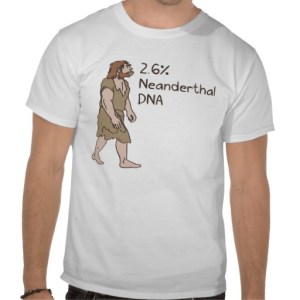
Remember how we thought Neanderthal were a totally unrelated species that died out? Apparently they didn’t really die out. I was told that I am 2.6% Neanderthal. The average European is 2.7%. Kind of hard to put your mind around that. I don’t have a lot of Neanderthal traits, having a high, rather than low, forehead, a narrow frame, and am not particularly strong. I’m sure my husband has some joke in this somewhere. But he doesn’t have the guts to take the test himself.

After I got the results of this test, I realized that it wouldn’t “mesh” with the Ancestry.com test results other people have taken. I didn’t know why they couldn’t be meshed, but I accepted that as fact. It seems that it’s because different companies test for different things. I decided to take the Ancestry test as well because I wanted it as part of my family tree on Ancestry in case I had any DNA matches with people whose trees could provide me with leads.

When I got the results of the Ancestry test I was really disappointed. It doesn’t provide anything except general regions your ancestors came from. Not even any specific countries. No medical information.

And the areas my genes come from are quite different according these two different tests. Ancestry claims a large percentage of my genes are from eastern Europe and about a quarter from Britain. Um, no. Their explanation is that this analysis might represent the location of my ancestors thousands of years ago. So what good is that then?

The one good thing that came from my very overpriced Ancestry test was finding an actual Waldeck relative through our matching DNA. Pretty cool, yes? And the fact that we both have a big chunk of eastern European DNA coming up on the Ancestry test points us in the direction of Prussia, so that was helpful. Unless I spend too much time looking back at my 23andme test, which shows a tiny percentage from eastern Europe. Confusing?

Something interesting about both DNA tests: the results continue to change as the companies get more and more information. They collect knowledge from people. This seems pretty hit or miss to me. But it’s kind of cool to watch things change every so often.

Finally, both test results netted me hits from 4-6th cousins, and most of them have absolutely no surnames in common on their family trees. So how is it possible that they are 4th-6th cousins?

Hmm, this science is still in its infancy, methinks.

###

Update:

On the Ancestry Facebook page, somebody posted this information about using your raw data from Ancestry to compare outside their site:

On your DNA page top right is an option to download your raw data. You need to select and then they will email a link with the address on file. Once you have that, you can go to GEDmatch and follow the instructions to upload. Unfortunately, they are not accepting new data until on or about August 15th. FamilyTreeDNA also has the transfer function. Go to their page and scroll down to almost the bottom. FTDNA charges, GEDmatch is free.

I wrote about my great-grandmother Clara Waldeck Mulder in The Lost Bracelet. At the time I posted about her, I didn’t really have a lot of facts about her, other than that I lost her bracelet because the clasp didn’t hold while I was at work.  Ironically, I was selling costume jewelry at Jacobson’s, in downtown Kalamazoo.

Since then my mother gave me some notes about her grandma:

  • She regularly did heavy farm chores, especially after her children were old enough to stay in the house alone. She was a big strong woman.
  • She cooked without recipes, but the food tasted very good.
  • In the evening she served us homemade ice cream that she and Grandpa made.
  • She cared for the chickens, including slaughtering them to cook and eat.
  • Along with family help, she kept a large vegetable garden.
  • She let us go wildflower picking in the “woods” across the road from their farmhouse and barn.
  • She let us play the player piano as much as we wanted. It used the perforated paper rolls.
  • Her family, both sides, seemed to carry a glaucoma gene; many experienced at least some loss of vision.
  • Some of her relatives were farmers.
  • Her family met for a family reunion with extended family every summer–it went on for many years.
  • When she got sick in her sixties and died, I felt a great loss.

###

Although I never got to meet my great-grandmother Clara, I did visit her farm and even stayed there for a week once with my great-grandfather and his second wife Margaret.  I remember my grandmother, Clara’s daughter, taking me wildflower picking in the woods across the street from the farmhouse.

By this time you might wonder what the clue could be about the Waldecks.  Well, the information I had been given was that Clara’s father was Godfrey (probably Gottfried) Waldeck and her mother’s maiden name was Alvena Neffka.

I had met a brick wall trying to trace these people back to Germany. I even talked to a German genealogist who has helped me in the past. He said Neffka couldn’t be a German name.  He questioned if that was really the name.

The only clue I’d found was on Alvena’s death certificate which indicated that her father was Louis Koffler and her mother Dora Couch.

So I started picking and probing at the name Neffka (on Ancestry), trying to figure out what else it could be.  That’s when names like Gniffke, Koffler, Knoffka started showing up all over the place.

Then suddenly I started getting hits on Noffke right and left, especially in Caledonia, Michigan, where my great-grandmother was from.  I changed the name to Noffke on my tree and I was showered with little green leaf hints from Ancestry.

For the first time, I found tons of Noffke relatives right in southwestern Michigan, where they ought to be.  I am still going through this treasury of information.

I’m a little closer to breaking through that brick wall.

Also, I had a DNA match at Ancestry with a verifiable relative—we are both 2nd great-granddaughters of Godfrey and Alvena.  She and I inexplicably showed up with eastern European DNA.  That, and some documents which say “Prussia,” seem to indicate that my grandmother’s Noffke family—and probably the Waldecks as well—are actually from Prussia, not Germany proper.

Onward in my search.  Polishing up my Nancy Drew microscope for the Noffke leaves.

Leaving you with a photo of old Caledonia, Michigan:

For Father’s Day, I am reblogging a post my father wrote for the adoption blog my daughter and I write. It also fits with my last post about my father and his military service.

This post is dedicated to my father, Rudy Hanson.

When I was a little kid, I hung out in my dad’s basement workshop, watching him work. He kept army green sleeping bags there, and when I asked about them, he told me about trying to sleep in the freezing cold of Alaska and Korea.  He explained that he had been in the Korean War.  In the U.S. Army. I didn’t understand too much, although he shared some apocryphal stories about ears being bitten off and seeing it rain fish.

I’m not sure I understand too much more today, but I have the deepest respect for my father serving in the United States Army.

Dad looks so young in his official Army portrait. And below.

Thank you for your service, Dad! xo

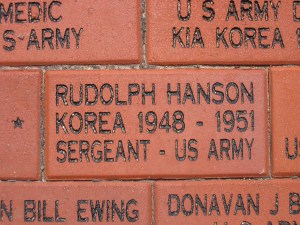
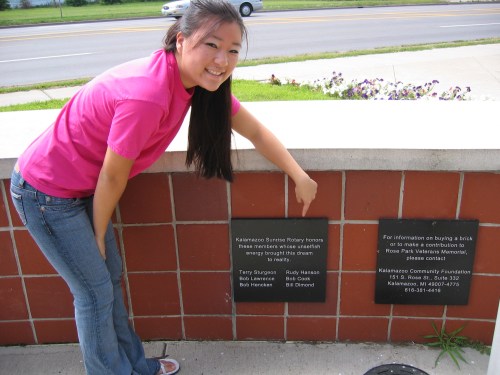
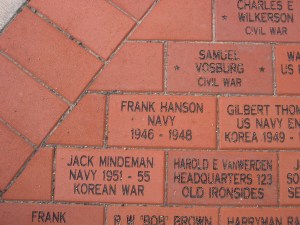
My father and other veterans are honored with bricks with their names at the Rose Park Veterans Memorial Park–a memorial park which my father and the Kalamazoo Sunrise Rotary Club were instrumental in bringing to the city.

My daughter points toward her grandpa’s name on the park plaque.

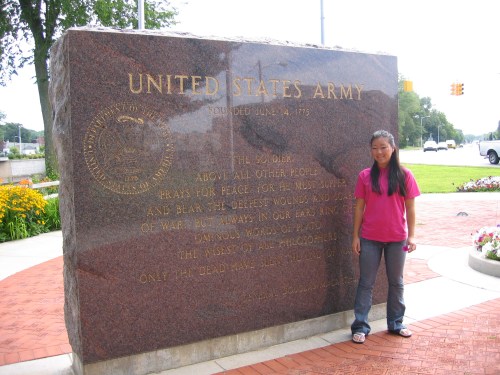
And here she is by the beautiful U.S. Army memorial at the park.

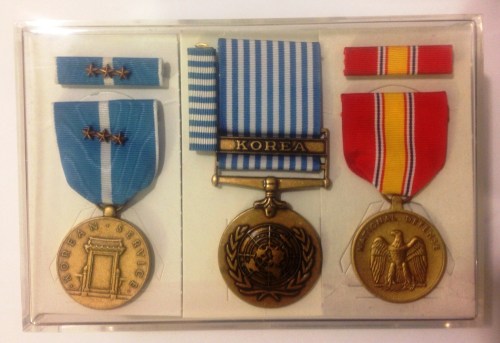
At long last, my dad has the medals he earned from serving our country in the Korean War.


HAPPY FATHER’S DAY, DAD!!!!

Dad has a twin brother, too–my Uncle Frank Hanson. He was in the U.S. Navy.

I hope Uncle Frank has a good Father’s Day, as well.

We’re coming up on the twins’ half birthday.  Since their birthdays are the day after Christmas, they like to celebrate in June.  I thought this was a phenomenon unique to my family, until I just this moment discovered that the event warrants a Wikipedia entry!

HAPPY BIRTHDAY, AUNT RUTHANN

We hope your day is as lovely

as you are.

Count the candles:  89 of them!!!

Ruthann and Charles (Chuck) Mulder

Ruthann and Charles (Chuck) Mulder

For a circa 1980s photo of that whole Mulder (Waldeck) generation, my father took a lovely photo I shared here.  As far as I know, Aunt Ruthann was the last secretary of the Waldeck family reunion “club.”  (Thanks to Michelle for that info!)