Feeds:
Posts
Comments

Archive for the ‘Richard DeKorn’ Category

If you’ve been following along here for some time, you might remember my posts about Theresa Pake, the middle child (of five) of my great-great-grandmother’s brother, George Paak.

When we left off, Theresa had married Roy Lawrence.

I’d like to backtrack. Remember how her father’s house burned down two years after her mother passed away? It was 1902, and Theresa was only 8. The article in the newspaper showed how destitute the family was by the fire, George’s illness, and Lucy’s death. The paper emphasized that the oldest girl, Cora, had been running the household from the time she was 12 until the fire–when she was 14.

At some point after this, Theresa went to live as a foster child with Oliver and Una Pickard. It would have been hard to find this information strictly from documents, but I had a great lead in the form of Theresa’s son Professor Lawrence.

This is a quote from one of my earlier posts:

At some point Theresa lived with foster parents, Una Orline and Oliver Oratio Pickard.  Prof. Lawrence thinks she maybe have gone to live with them as early as age six, which would mean she wasn’t under the care of her older sister. However, the newspaper article about the fire in 1902 would show that she was still living at home at the time of the fire (nearly 8 years old). Regardless, at some point, the Pickards became the caregivers of Theresa. None of the other children in the family seem to have gone to live with the Pickards.

SO WHO WERE THE PICKARDS?

Professor Lawrence told me that Oliver was a postman and Una a nurse. He said he couldn’t find his mother with them in any of the censuses.

I did a little search myself to confirm and hopefully augment this information.

I found the Pickards in the 1900, 1920, 1930, and 1940 censuses.

1910 census Pickards

1900: living in a “home” with 74 other people. There is a couple that are the head of household and his wife. Then Oliver is listed as a nurse and Una as “wife” (incorrectly as the wife of the head of household). After that are 3 attendants, a cook, and a lot of patients. So were both Oliver and Una the nurses for the facility? I can’t find the address on the census document.

From there, I went to the previous page of the 1900 census. It’s a short page and this is how it ends after a listing of some patients: “Here rests the enumeration of that portion of the Michigan Asylum for the Insane situated in Kalamazoo township outside the City of Kalamazoo.”

But wait! the page with Oliver and Una is in Oshtemo Township. That gave me the idea to see if anything is written at the end of the Pickards’ “household on the page after the one listing Oliver and Una.”

Wow!!! Something was written and erased. I can barely make out anything, but it appears to say pretty much the same thing as the above quotation about the asylum but using Oshtemo instead of Kalamazoo!! Why was this information erased? So did the Michigan Asylum for the Insane have Kalamazoo Township AND Oshtemo Township facilities?!! I can’t go past that page because this section ends on page 36–and the Pickards are listed on page 35.

I looked up “Oshtemo township” with the Kalamazoo State Hospital, and I found that the hospital owned a farm in that township since 1888: Colony Farm Orchard. Some patients lived on and farmed the property. Could this be where Oliver and Una first worked together?

1920: living at 1846 Maple Street in Kalamazoo. They owned their own mortgaged home. Una’s parents lived with them. Oliver was a mail carrier and Una was a nurse at the State Hospital. At this point, Theresa was finishing up her education, still under the guidance of the Pickards. THERE! The State Hospital IS the Michigan Asylum for the Insane. The name was changed in 1911. So it looks like maybe Oliver quit nursing and became a mail carrier–and maybe they moved to their own home that way.

1930: living at 1844 Oakland Drive in Kalamazoo. They owned their home, worth $15,000. Notice that 1844 address here is similar to the address in the 1920 census. I wonder if it’s the same house and there is an error in the number and the street? Or are they two different “owned” homes?

1940: living at 1846 Oakland Drive in Kalamazoo. So it probably was 1846 Oakland Drive all along. Una is a registered nurse in “private work.” That makes sense because she is listed as 67, and she couldn’t possibly be providing care at the State Hospital at that age. Oliver said he worked 52 weeks in 1939, but his income from this work is listed as zero–but he has income from “other sources.”By now the house only valued at $8,000.

A look at the neighbors in the 1940 census does not show that preponderance of Dutch names that I’ve seen in the neighborhoods where my relatives lived. The surnames seem to be of English origin, for the most part. But in the 1920 census, the same neighborhood had more Dutch surnames. Maybe this reflects a change in the neighborhood–or in the demographics of Kalamazoo.

Professor Lawrence told me that Una was Theresa’s Sunday School teacher. She must have taken a liking to the girl. I think Theresa was an intelligent and hard-working child, so that may have appealed to Una who took her on either from affection or religious conviction or a mixture of both.

So who are these people who married young (she was 18 and he was 23) and worked and lived at the State Hospital until he left for a job as a mail carrier? Who never had their own children, but managed to provide a quality education and a religious upbringing to one of the Paake children? That would have been very hard work being a nurse at the “asylum.” It could also be dangerous. In approximately 1904, a resident doctor was stabbed to death.

I also think the Pickards were most likely Methodists as they chose to send Theresa out of state to a Methodist school.

What was it like for Theresa to live with the Pickards?

Here are the other Pake/Paake/Paak/Peek posts:

A Series of Disasters

The Children After the Fire, 1902

Paak-a-boo

Saved from the Fire

Who is George Paake, Sr.?

Curious about George

George Paake’s Legacy, Part I

George Paake’s Legacy, Part II: Theresa’s Pre-Professional Education

George Paake’s Legacy, Part III: Theresa’s Professional Education

George Paake’s Legacy, Part IV: A Letter to His Daughter

George Paake’s Legacy, Part V: Theresa Gets Married


Read Full Post »

As I’ve mentioned before, my great-great-grandfather, Richard DeKorn, was a brick mason who worked on many public buildings in the Kalamazoo area.  He was a brick mason on the beautiful Ladies’ Library Association in 1878-79 and lead brick mason on the Kalamazoo Psychiatric Hospital Water Tower  in 1895. According to his obituary he was the contractor for the Pythian building and the Merchants Publishing Company building.

The asylum water tower was slated for demolition in 1974. Here is the story of how it came to be saved (from http://www.kpl.gov/local-history/health/kph-water-tower.aspx):

In spite of being on the National Register of Historic Buildings and endorsed by the Michigan Historical Commission and the Kalamazoo County Bi-Centennial Commission, the structure was earmarked by the State of Michigan for demolition in 1974. A local committee that called itself the Committee to Save the Tower launched a campaign to raise public funds to restore the building to its original grandeur and save it from the wrecking ball. A year later, Mrs. William John (Penny) Upjohn announced that $208,000 was successfully raised for this purpose. The money came from federal, state, and city contributions to the effort. Contributions also came from such disparate groups as school children, former state hospital patients, current hospital patients and employees, a hospital auxiliary, service clubs and concerned citizens. The campaign to save the structure was not without controversy. Some residents felt that the monies needed to repair the structure could better be spent on local service needs. Sen. Jack R. Welborn, R-Kalamazoo, pointed out, however, that taxpayers would be spending at least $150,000 to tear down the tower.

I recently visited Kalamazoo and went on a tour of Henderson Castle, a mansion built the same year as the water tower.


From a rooftop viewpoint, I was able to see the water tower in the distance.


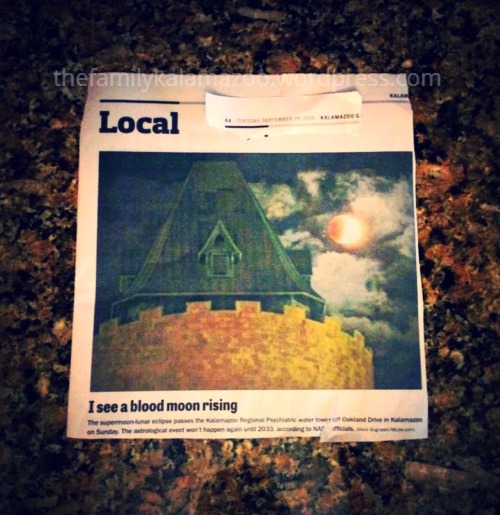
And then my mother showed me a photograph that was in the local newspaper of the blood moon near the tower.


I’m off preparing for a poetry reading this weekend. Have a lovely weekend!

Read Full Post »

Remember the Culver family: my great-great grandfather’s sister, Jenny DeKorn Culver, and her daughters, Lela and Rhea, who moved from Kalamazoo to Seattle 100 years ago.

In the scrapbook which I received from a blog reader I found this photograph. Any ideas on the type of uniform? Since this would have been around the time of the end of WWI, does the uniform have to do with the war?

I don’t know who the man is. Most of the Culver photos are of women.

But the clues would leave me to believe the photo was taken in Seattle in or around 1918. But did Seattle have old elegant buildings like this at that time?


What about the building? My first inclination was a church, but I don’t see any crosses. Are those rosettes for ornamentation?


Related articles

Read Full Post »

I wondered when I could ever get back to Theresa Pake. Since I couldn’t make time, I thought I would share something about her anyway!

On January 20, 1928, Theresa married Roy Lawrence. I’m posting this late on January 20, 2015, so that it’s the date of their anniversary.  Roy was born 5 November 1884, about 9 years before his bride.


Roy was a cigar smoker, but he quit when he married Theresa.
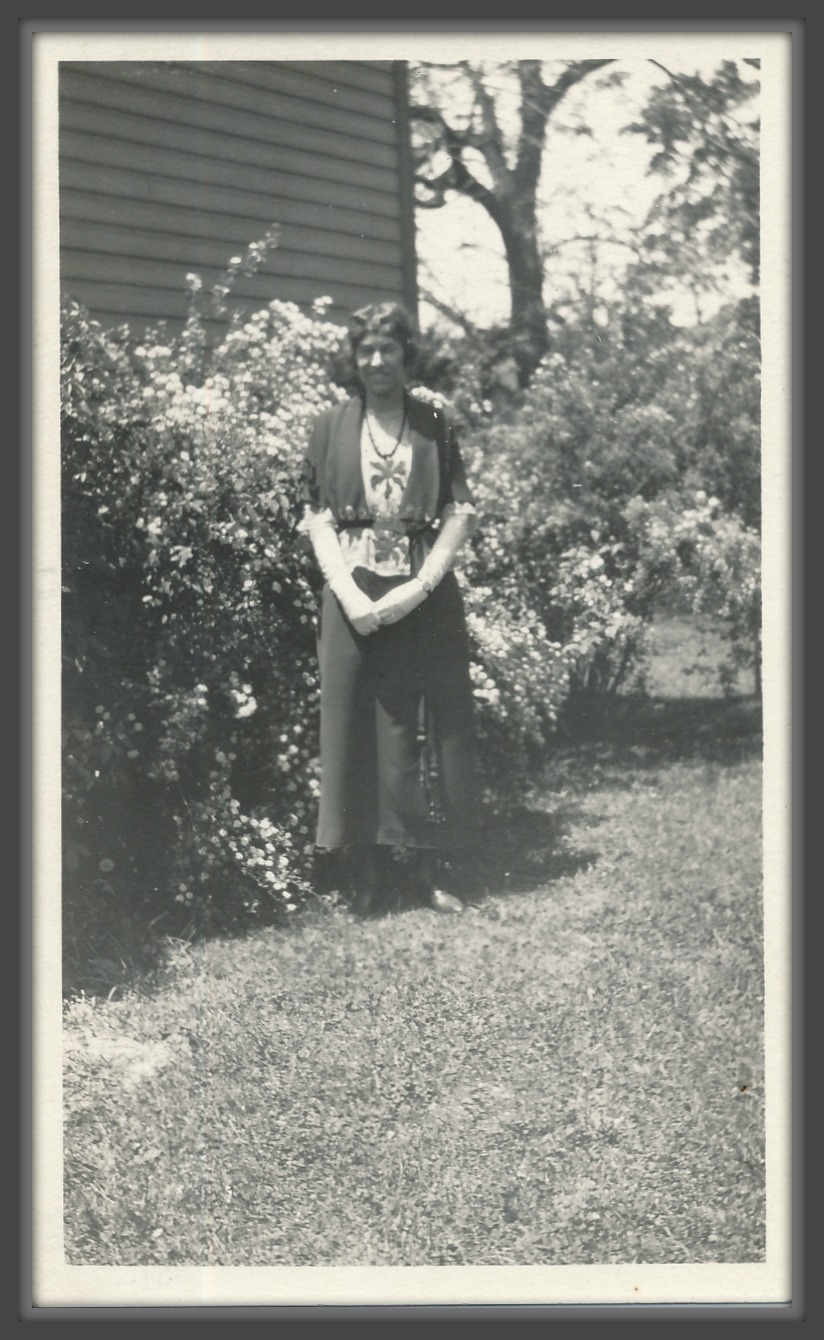
Is Theresa’s hair marcelled here? And what is the corsage she is wearing?


A Series of Disasters

The Children After the Fire, 1902

Paak-a-boo

Saved from the Fire

Who is George Paake, Sr.?

Curious about George

George Paake’s Legacy, Part I

George Paake’s Legacy, Part II: Theresa’s Pre-Professional Education

George Paake’s Legacy, Part III: Theresa’s Professional Education

George Paake‘s Legay, Part IV: A Letter to His Daughter


Read Full Post »

I’ve traveled to California, Sedona, and Michigan in the past few weeks.  Needless to say, I am behind in my work even more than usual. I want to continue Theresa Pake’s story and to explore the Jennie DeKorn Culver photos more, but these projects take a good deal of time.

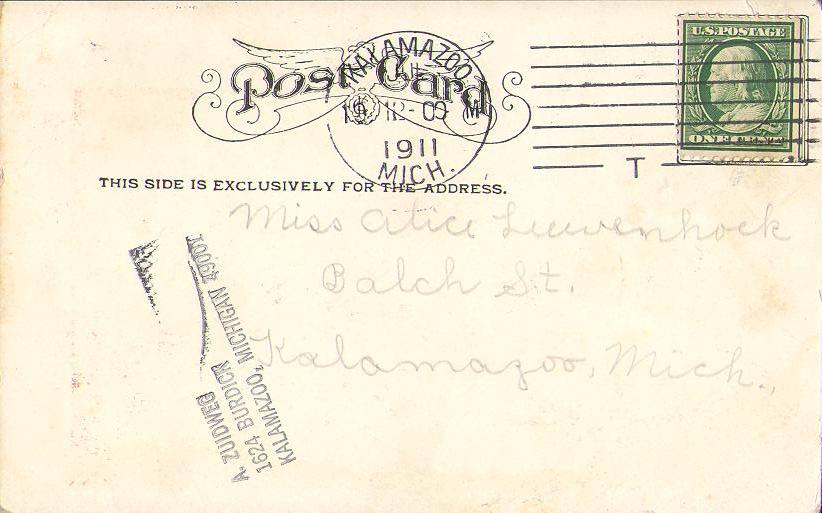
Instead, I decided to take a look at an old postcard postmarked 1911. The postcard is to Alice Leewenhoek, Richard DeKorn’s granddaughter through his daughter Jennie. Alice was an only child who lived with her mother Jennie and her father who Grandpa always called “Uncle Lou”–Lambertus Leewenhoek.

In the photo below, Alice is sitting with a friend, neighbor, or relative against the exterior wall of Richard DeKorn’s house. She holds a doll in her lap and is petting Tom or Carlo (if I had to guess, I would say it’s Tom).


Alice Leeuwenhoek with doll

On this postcard, Nellie Bradt is thanking Alice for her “postal.” Nellie’s address is marked as 1130 S. Burdick Street.  The photograph is Bronson Park, which is the beautiful “town square” of Kalamazoo.

Bronson park front postcard


After seeing that the mailing address is listed as Balch St. and doesn’t include Alice’s street number (not uncommon for that time period in Kalamazoo), I went to my family tree on Ancestry and discovered that I had never found the Leewenhoek family on the 1910 census.  So I tried something different and looked for the 1910 census on Family Search. Bingo.  Instead of Lambertus Leewenhoek, I found Lamburtos Leenwenhock, at 110 Balch Street, Kalamazoo, Michigan. Uncle Lou was living with his wife Jennie and his daughter Alice who was 13 years old in that year–and therefore around 14 at the time of the postcard in 1911. New info: According to Uncle Don, they lived in the wooden house just behind the Richard DeKorn brick house.

Can you read anything more on the postmark besides the city, state, and year?  Is it December 9? Or does it say something else?

Bronson park back postcard


Grandpa and Alice were first cousins, their mothers were sisters.

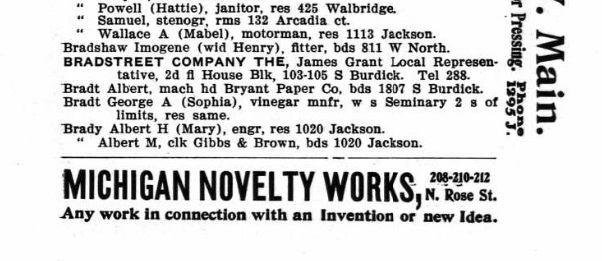
I haven’t been able to find Nellie Bradt in the 1910 census, but I did find her in an 1899 city directory. I then found her parents in a 1905 directory. I think I can find them more years, too. But I don’t understand how to read these entries. The 1899 entries are entirely different from the 1905, but neither one really gives me the address.

Here is the 1899 that lists Nellie with her parents, Mr. and Mrs. George A. Bradt. I understand they lived in the City of Kalamazoo. And I know “a” means acreage, but not how to interpret what any of this means or how it connects with an address.

Nellie Bradt 1899 city directory


Here is the 1905 directory entry. Nellie isn’t mentioned, but her parents are. What in the world does it mean?

Nellie Bradt's parents 1905 city directory

Is there a way to search for Nellie in the 1910 census using the 1130 S. Burdick Street address she gives? Can I search the census by address?

Note that many of my relatives lived in this Burdick/Balch neighborhood. When I look at the census records from late 19th and early 20th century, I see that almost everyone, if not everyone, who lived there was Dutch.

My grandfather’s gas station was at the corner of Burdick and Balch, across the street from the Richard DeKorn house. Grandpa lived in that house for part of his childhood, with his parents and grandfather, Richard. When he built his house down the block on Burdick, he was staying in the same general area his family had lived in for decades. He continued to work at his station and live in his house until he retired and moved to Portage.

I remember as a child meeting Mrs. Bradt Braat who lived next door to the gas station. The name is pronounced, by the way, like the sausages that go with beer. I wonder if she was related to the Nellie Bradt who wrote this postcard. Mom? Uncle Don? New info: no, she must not be as they were a Belgian family (see comments below).

Alice Leewenhoek was my grandfather’s cousin. Note that the postcard is stamped with the name and address of Grandpa’s father, A. Zuidweg. I wonder why?

One postcard. So many questions!

Read Full Post »

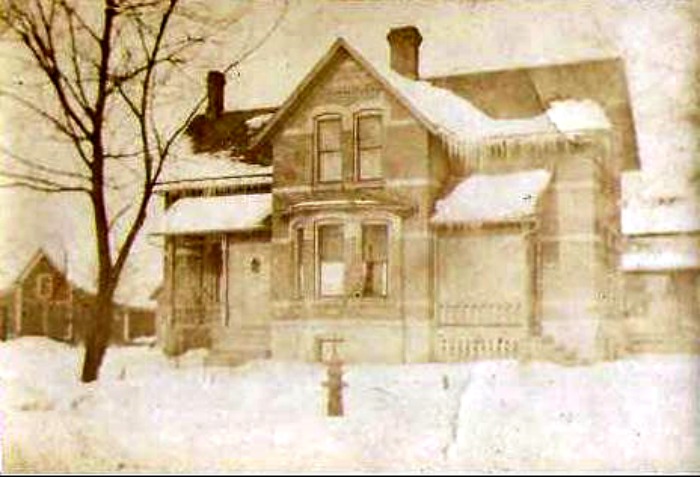
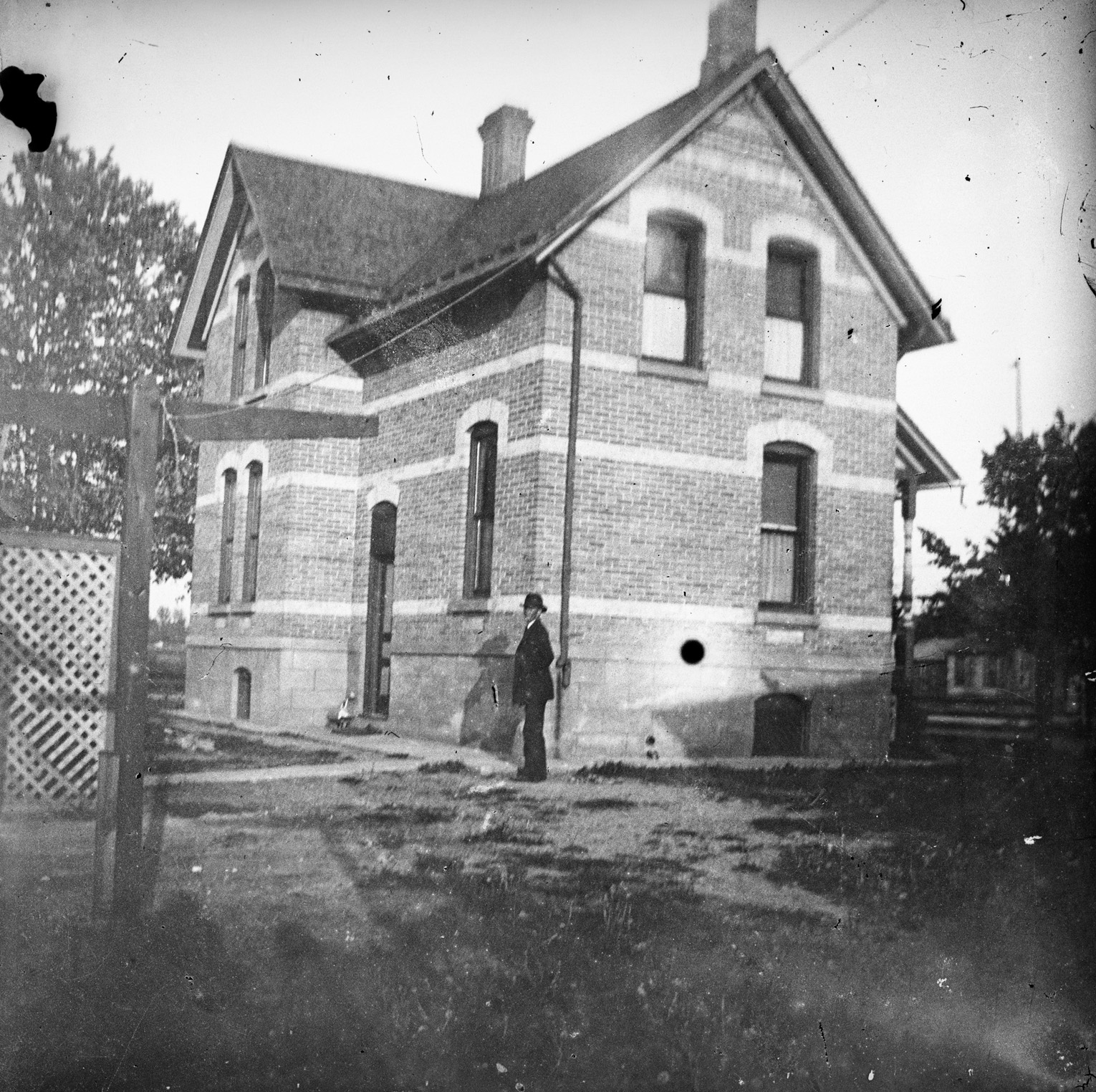
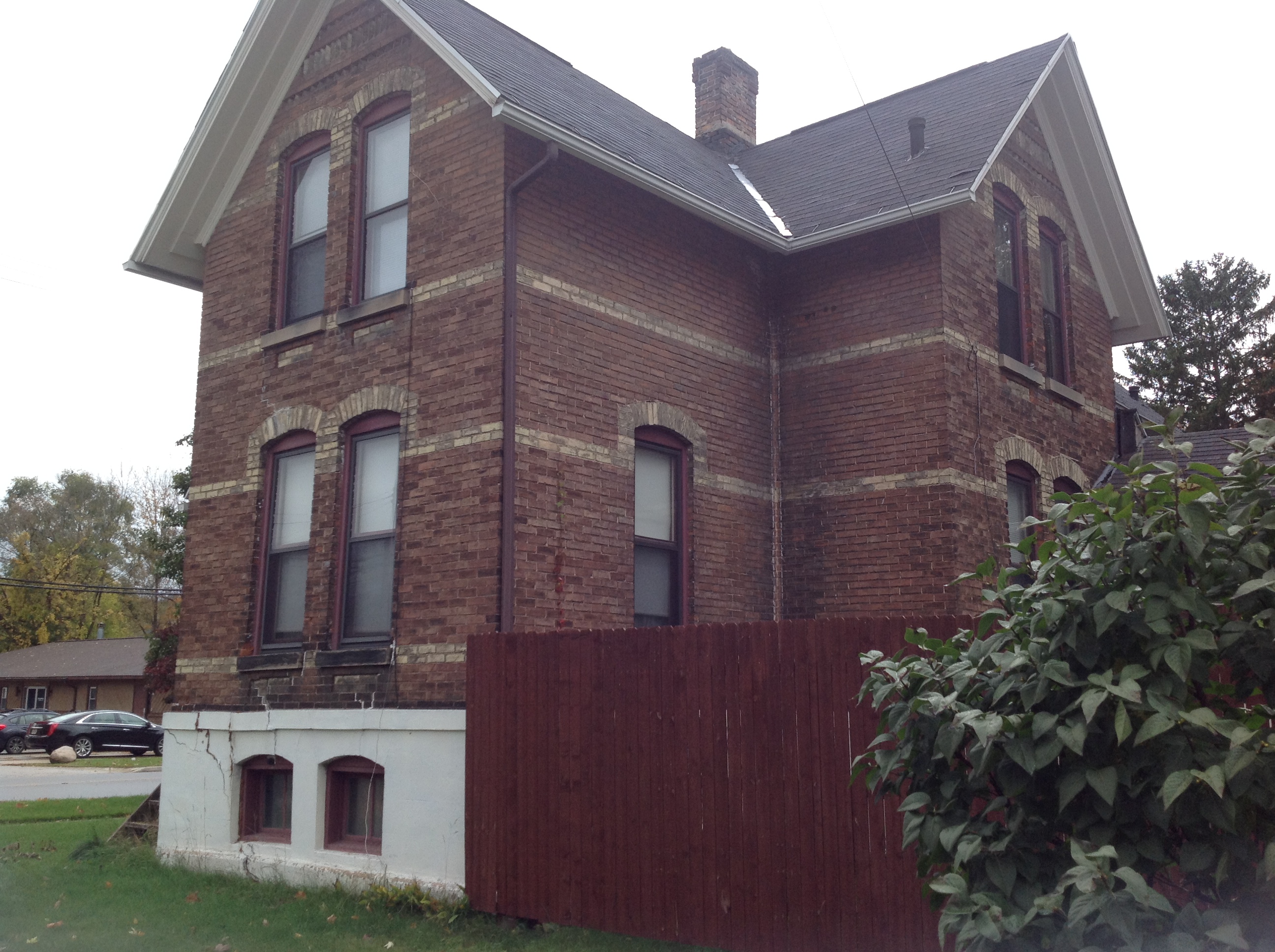
Richard DeKorn’s house is still standing, at the corner of Burdick and Balch Streets in Kalamazoo. Someone lives there, but the house needs some TLC, in my opinion. I wonder if the owner knows who built the house–or is interested. I love the distinctive light brick stripes on the dark brown brick. The house was most likely built in the 1880s. I would love to know the exact year.

Although the basic house hasn’t changed, the property has. In the old photographs, the house looks set back from the street. The house number is now different.

It looks like a barn to the left, doesn’t it? Notice that the above photo is the same view as the first photo. Is that a fire hydrant in the same spot? Did they have fire hydrants in those days? Or is it something else?

Here is a photo of the area where the barn was. I wonder if the garage has the same footprint as the barn. And you can see the house that is next door. How old do you think the gray house is?

In the following photograph, Richard DeKorn stands by the house he built.

Richard DeKorn's home at the corner of Burdick and Balch, Kalamazoo, Michigan

Richard DeKorn’s home at the corner of Burdick and Balch, Kalamazoo, Michigan


Here is another angle of the house today:


In the above photo, the right side (two windows in 2nd story, 1st floor, and basement) faces Burdick Street. The left side (two windows 2nd story and three windows on the 1st floor and basement) faces Balch Street. In the old photo, where is Richard standing? Is he at the opposite corner from the Burdick-Balch corner–at the back of the house?

Here’s a view from the opposite side of Balch. I think it shows that Richard has his back to Balch Street in the old photo.

Read Full Post »

This post follows the posts I’ve written about Richard DeKorn’s step-daughter Marge and her son David Owens. See links below.

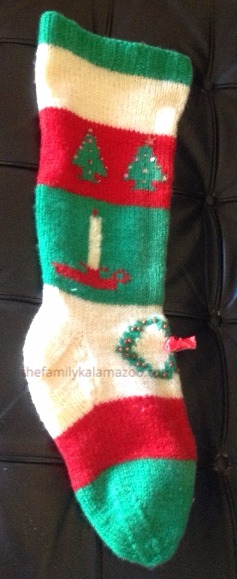
I thought I would share some photos of beautiful objects made by Marge and David, two very creative individuals. Thanks to Rochelle Owens for sharing these photographs.

Marge knitted the Christmas stocking (look at those small stitches), and she also made the agate necklace.

Agate and silver pendant created by Marge Sootsman Owens

This mosaic was designed and made by David Owens.

Read Full Post »

Reminder: Jennie DeKorn Culver, 1857-1947, moved to Seattle from Kalamazoo with her two adult daughters, Lela and Rhea, around 1915

Since I did not have any photographs of Lela and Rhea Culver as adults until I received the scrapbook, I have had to make guesses on the identity of people in the scrapbook photos. I did have a good photograph of Jennie’s face as a young woman, so that does help.

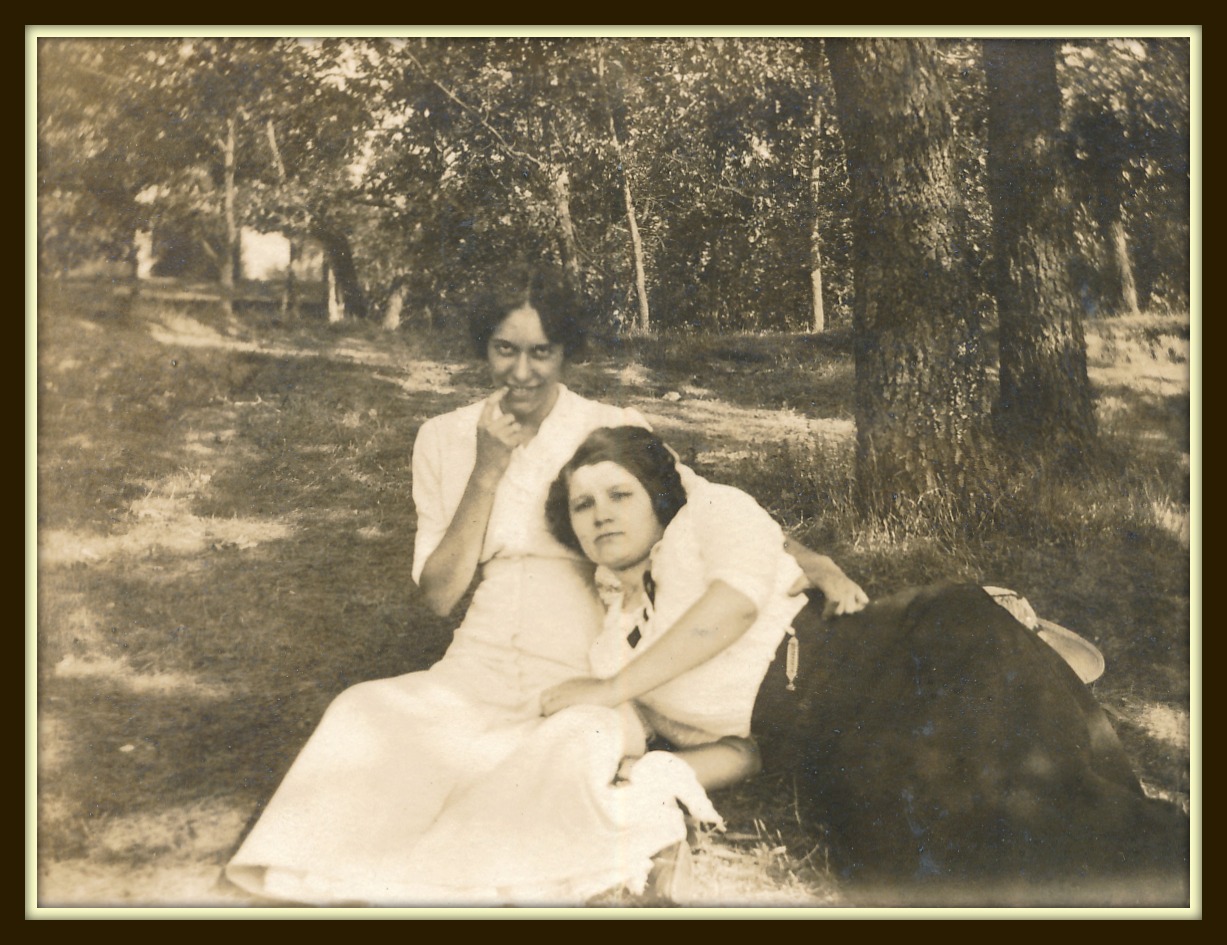
I’m hoping you can help me decide which photos do have Jennie, Lela, and/or Rhea in them. After the new photos, I’ll repost a couple I’ve posted before for comparison.

Because the photos were all in the scrapbook together–and some of them were loose–it would help to know what year fashion the clothing is in each photograph (since the years may be all mixed up). Clothes, hair, background, compare faces: whatever ideas you have, lemme have ’em, please! I’ve numbered the new photos. Also, you can click on each photo to enlarge.


From Scrapbook (haven’t posted before)

Photo 1


Photo 2 (I feel fairly certain this is Jennie and her daughters)


Photo 3

Photo 4

Photo 5

Photo 6

Photo 7


From scrapbook (posted in earlier posts)

Photo 8

Lela and Rhea Culver Seattle, WA

Lela and Rhea Culver
Seattle, WA

Rhea and Lela Culver Kalamazoo, Michigan

Rhea and Lela Culver
Kalamazoo, Michigan

Jenny DeKorn Culver 1857-1947

Jenny DeKorn Culver
1857-1947

Related articles

Read Full Post »

I wrote that the Jennie DeKorn Culver’s daughters Lela and Rhea were at the Children’s Home in Kalamazoo during the divorce proceedings of their parents.

According to articles in The Kalamazoo Gazette, they were there from at least December 1896 to May 1897.

Here is an article about a Christmas program Lela performed in:

I find it curious that the backup singers or performers (Lela was one of them) are called “Nineteenth Century Children.” There were still three full years of the 19th century left at this point.

I’d love to know what gifts the children received–and if they were from the community. Would children like Lela and Rhea with living parents have also received gifts from their parents? Or would that have been against the rules?

1896 Christmas Tree

1896 Christmas Tree

Since I had proof through the Kalamazoo Gazette articles that the girls were at the Children’s Home in 1896 and 1897, I contacted Lakeside Academy, the current name of what was the Children’s Home during the Culver girls’ time. I had heard through another blogger that they still had records from the late 1800s. Don Nitz, the CEO of Lakeside for Children, was so kind to search for me. Unfortunately, there are gaps in the records, and he could not find any documentation of Lela and Rhea’s stay with them.

Read Full Post »


I wrote about this coat here.

Here it is again.

Isn’t this the same coat? And isn’t it fur? NOT VELVET.

And, if so, what changed Jennie’s fortunes from having her children in an orphanage 20 years earlier to wearing a full length fur coat? Note that the earlier photo has no snow, whereas this photo is obviously winter.

The Mystery of Jennie D. Culver deepens.

P.S. Do you think the other woman in this photo is one of Jennie’s daughters or another woman?  Here is the photo I posted last week of the daughters:

Lela and Rhea Culver Seattle, WA

Lela and Rhea Culver
Seattle, WA

Read Full Post »

« Newer Posts - Older Posts »