Feeds:
Posts
Comments

Archive for June, 2020

My next fill-in-the-gaps couple is Grandpa’s 4th and final set of great-grandparents–my 3x greats, Lukas Bomhof and Jeuntien Dansser Bomhof.

Here are the Ancestry-created bios:

When Lukas Bomhof was born on December 9, 1788, in Windesheim, Overijssel, Netherlands, his father, Albert, was 32 and his mother, Zwaantje, was 31. He married Jeuntien Dansser on October 13, 1825, in Zwolle, Overijssel, Netherlands. At that time, Lukas was a kastelein (inkeeper) in Zwolle. On 5 March 1838, Lukas was a shoemaker in Zwolle. They had five children in 10 years. He died on September 16, 1847, in Zwolle, Overijssel, Netherlands, at the age of 58.

Jeuntien Dansser was born on April 26, 1806, in Zwolle, Overijssel, Netherlands, the daughter of Maria and Johannes. She married Lukas Bomhof on October 13, 1825, in her hometown. They had five children in 10 years. She died on January 31, 1842, at the age of 35.

Let’s take that apart. Lukas was born 200 years before my daughter!!! He was 18 years older than Jeuntien. There might be a reason for that delay in his marriage, so hold on to that thought. When the couple married, Jeuntien was 19 years old, but Lukas was 37. From the ages of 23 and 33, Jeuntien, who I believe was also called Johanna, gave birth to five children. All these children survived to adulthood. One of them was my great-great-grandmother who immigrated to the U.S. in middle age and lived far longer than any of her siblings.

Two years after the birth of her children, Johanna died at age 35. Very sad, but a story that is just too familiar in family history.

Keep in mind that this is my fourth 3x great grandmother named Johanna!

So where was Lukas before he met Johanna? And what documents am I missing from their lives?

I do have the marriage record and supplements. What are marriage supplements? According to Yvette Hoitink’s website:

Since the introduction of the civil registration in 1811, a bride and groom had to submit several documents to prove they were eligible to get married. Not only do these records tell you when your ancestors were born, but they may also provide information about their physical appearance, death dates of parents and previous spouses or even of their grandparents.  These documents are known as the ‘Huwelijksbijlagen‘ and most of them still exist and can be found online.

Read more about these supplements here.

I have the index for Johanna’s death, although I have not gained access to the death record itself.

I also have the index record, but not the death record for Lukas’ death:

I do not have birth records for either Lukas or Johanna, although I have the basic information of dates and places.

So I really need both death and birth records. Lukas was born with the surname Nijentap, but in 1812, his father Albert changed the family name, which included the surnames of his three adult sons, Lukas and his brothers. So his birth/baptism records will be under the name Nijentap.

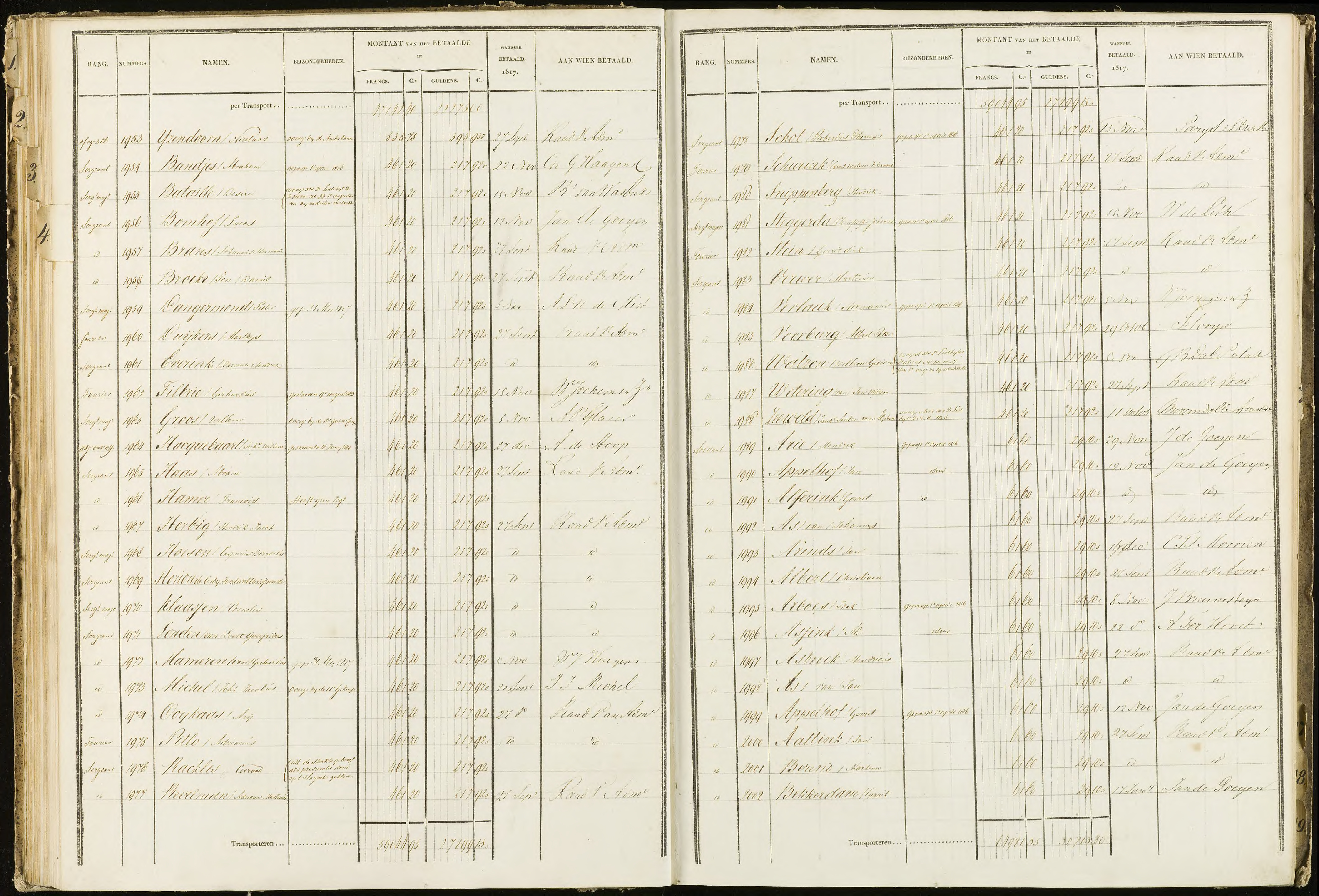
What I do have for Lukas, though, is pretty cool. Yvette found his military records. I am copying the summation from Yvette, followed by the records themselves.

You will see that Lukas, a musketeer under the command of the Duke of Wellington, helped to defeat Napoleon, most likely at Waterloo. He served in the army from 1814-1817. He was 26-29 years old.

LUKAS BOMHOF b. 9 December 1788, Windesheim m. 13 October 1825, Zwolle  His marriage supplements do not include proof of military service.3 Since he would have reached the age of 19 in 1807, during the French occupation, he would not have been required to show proof of service.

A Lucas Bomhof, sergeant, is on a list of Waterloo gratifications: Lucas Bomhof as recipient of Waterloo gratification Source: Foundation of the encouragement and support of servicemen in the Netherlands, gratifications, 1817-1817, vol. F, infantry National Militia, entry 1956, Lucas Bomhof; call no. 718, Foundation of the encouragement and support of servicemen in the Netherlands, record group 355, consulted “Indexen,” index and images, Gemeente Amsterdam Stadsarchief (https://archief.amsterdam/indexen/deeds/fc874cd5-df5a-4a2f-b7d894f8533f4f95?person=95a7409f-829b-4a53-e053-b784100ad337 : accessed 10 March 2020).  Abstract: Batallion Infantry National Militia no. 4 Sergeant, no. 1956 Lucas Bomhof, received 461 francs, 20 centimes – 217 guilders and 92.5 cents. Paid 27 September 1817 to council of Amsterdam. Military record of Lucas Bomhoff Source: Batallion Infantry National Militia no. 4,muster rolls, Lucas Bomhof, no. 2469; imaged as film 008341006, FamilySearch (https://www.familysearch.org/ark:/61903/3:1:3Q9M-CSTP-97RH-C : accessed 10 March 2020). Abstract: No. 2469 (corrected from 493): Lucas Bomhof Father: Albert Bomhof Mother: Swintein Jansen Born Winsen, 14 December 1788 Last residence: Zwolle Physical description: 5’ 4”, round face, round forehead, blue eyes, wide nose, ordinary mouth, round chin, blond hair and eyebrows, poxy complexion. Where and how arrived in the batallion:  Called to the land militia in 1814 from the militia district Overijssel from the region Zwolle, municipality Zwolle. During the lottery drew lot no. 810. Arrived in service as “fusilier” [musketeer]  on 26 April 1814. Where served previously: [blank]

This shows he served in the Dutch army from 26 April 1814 to May 1817.  This was the time when the Dutch army was fighting Napoleon. The gratification was given to all soldiers who were under command of the Duke of Wellington during the battles of 15 to 18 June 1815, who were involved with blockades and sieges in France, or who joined the allied army in France prior to 7 July 1815.4  The 4th battalion had an important role during the battle of Waterloo. The battalion, under command of captain Van Hemert, flanked the French cavalry to halt their advance.5 Given the regulations for the gratification and the known actions by the battalion he was a member of, it seems most likely that Lucas Bomhof was indeed at the battle of Waterloo. If he was not at Waterloo, he at least contributed to Napoleon’s defeat.

No Lucas Bomhof found in (partial) indexes of military records in French period at Nationaal Archief website.6 He was not found in the database of Dutch soldiers who were part of the army of Napoleon.7


4 “Waterloogratificaties 1815,” Gemeente Amsterdam Stadsarchief (https://archief.amsterdam/uitleg/indexen/17waterloogratificaties : accessed 13 May 2020).  5 Marc Geerdink-Schaftenaar, “De Waterloo Campagne,” PDF, Grenadier Compagnie (http://www.grenadiercompagnie.nl/Bestanden/2.9%20Waterloo.pdf : accessed 13 March 2020).  6 “Indexen,” indexes, Nationaal Archief (https://www.nationaalarchief.nl/onderzoeken/zoeken?activeTab=nt_legacy : accessed 10 March 2020).  7 “Nederlandse militairen in het leger van Napoleon,” index, Ministerie van Defensie (https://www.archieven.nl : accessed 10 March 2020).

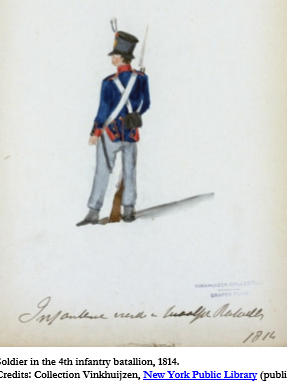
Soldier


3 Civil Registration (Zwolle), marriage supplements 1825 no. 75, Bomhof-Dansser (13 October 1825); “Netherlands, Overijssel Province, Civil Registration,, 1811-1960,” browsable images, FamilySearch (https://www.familysearch.org/ark:/61903/3:1:939J-99YY-P : accessed 10 March 2020).


Yvette found this image for me.
Read Full Post »

My next fill-in-the-gaps couple is one that merged the Mulder and the Zuijdweg families—and the reason my grandparents, a Mulder and a Zuidweg, were distant cousins because it grafted the Zuijdwegs onto the Mulder tree. Note: even in the Netherlands, the surname is sometimes spelled Zuijdweg and sometimes Zuidweg.

Adriaan Zuijdweg was born in 3 February 1805 in Goes, Netherlands. Adriaan was a tailor, so I found this image online to represent him. Unfortunately, I can’t locate anyone to credit for it, but would love to do so.

Apparently this seated position was common to tailors.

Johanna Mulder was born 10 March 1807, also in Goes. She was baptized on 29 March. The couple married 5 May 1836. Johanna worked as a maid at the time of the marriage.

In 1846, facing economic and religious pressures, Adriaan applied for the town of Goes to pay for he and his family to emigrate to the US, but he must have been denied. I suspect he was part of the separatist movement within the Reformed Church and wanted to join the group in Zeeland, Michigan. He must have been very disappointed that he couldn’t emigrate. You can read about the documentation for this on the old post: My Dutch Family Almost Arrived in the U.S. Decades Earlier.

Five years later, on 2 April 1951, he was dead at the age of 46.

The couple had six children. One of them was my 2x great-grandfather, Johannes Zuijdweg.

The youngest child, Willem, was a baby when his father died. Life must have been hard for Johanna after that. The economy in Goes at the time was not good and now she had six children, even a baby, to support by herself.

Many years later, Willem immigrated to Michigan in 1889 with his wife and two sons (a baby girl died in the Netherlands). The older brother, Adrian, was named for his grandfather, as was my great-grandfather. He lived in Cascade in Kent County.  The younger brother, James William, changed his surname to Southway which is what Zuijdweg means. He lived in Detroit. Willem and his family were the first Zuijdwegs to live in the United States. Willem managed to fulfill his father’s dream of living in the United States. Willem’s brother Johannes, my great-great-grandfather, did not immigrate until he was much older–he followed his own son to the U.S.

On 11 June 1878, Johanna passed away at the age of 71. There is documentation that she was working as a “laborer” when she was in her early sixties. I suppose it’s possible she worked until she died.

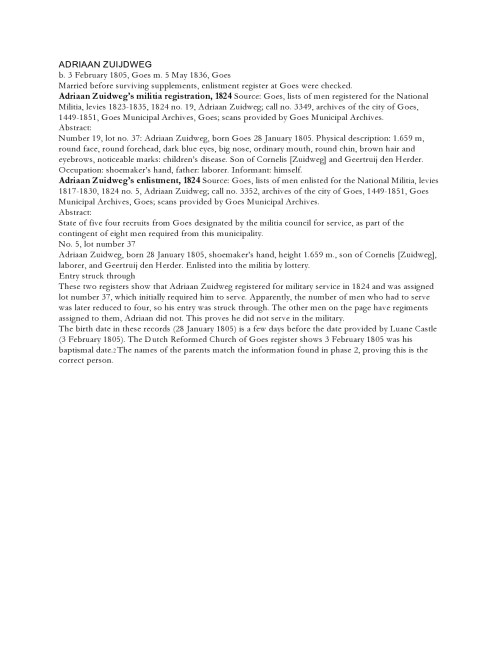
I have the marriage and death records for both husband and wife. I also have the documention of Adriaan’s denied request to leave the Netherlands. I was able to get Adriaan’s military records from Yvette Hoitink.

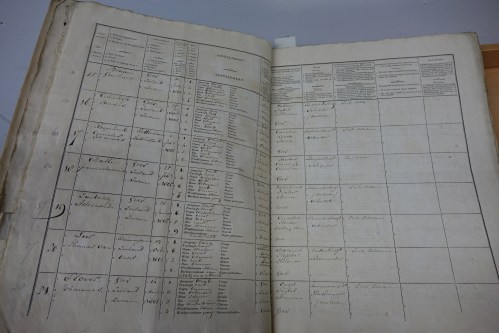
According to Yvette’s research Adriaan did not serve in the military. Here is the military record (part of it):


I am missing both birth records for Johanna and Adriaan. And I sure wish I had photos, but considering that they were born in 1805 and 1807, I suppose that hope is unrealistic!

In general, now that I am back with an early generation in the Netherlands, this is what I can look for:

  • birth record
  • marriage record (including if there was more than one marriage)
  • death record

These are what I can generally find, but not always, through Wiewaswie and other online sources. Yvette was able to search military records for me. And sometimes I have been blessed with information from Dutch cousins and readers, such as newspaper information. Because I can’t read Dutch if I want a less haphazard method of obtaining newspaper articles, I would need to hire a genealogist, such as Yvette, to search. Yvette’s expertise means that she knows how to find certain information that is not readily available–and where there are gaps of records because of fire, etc.

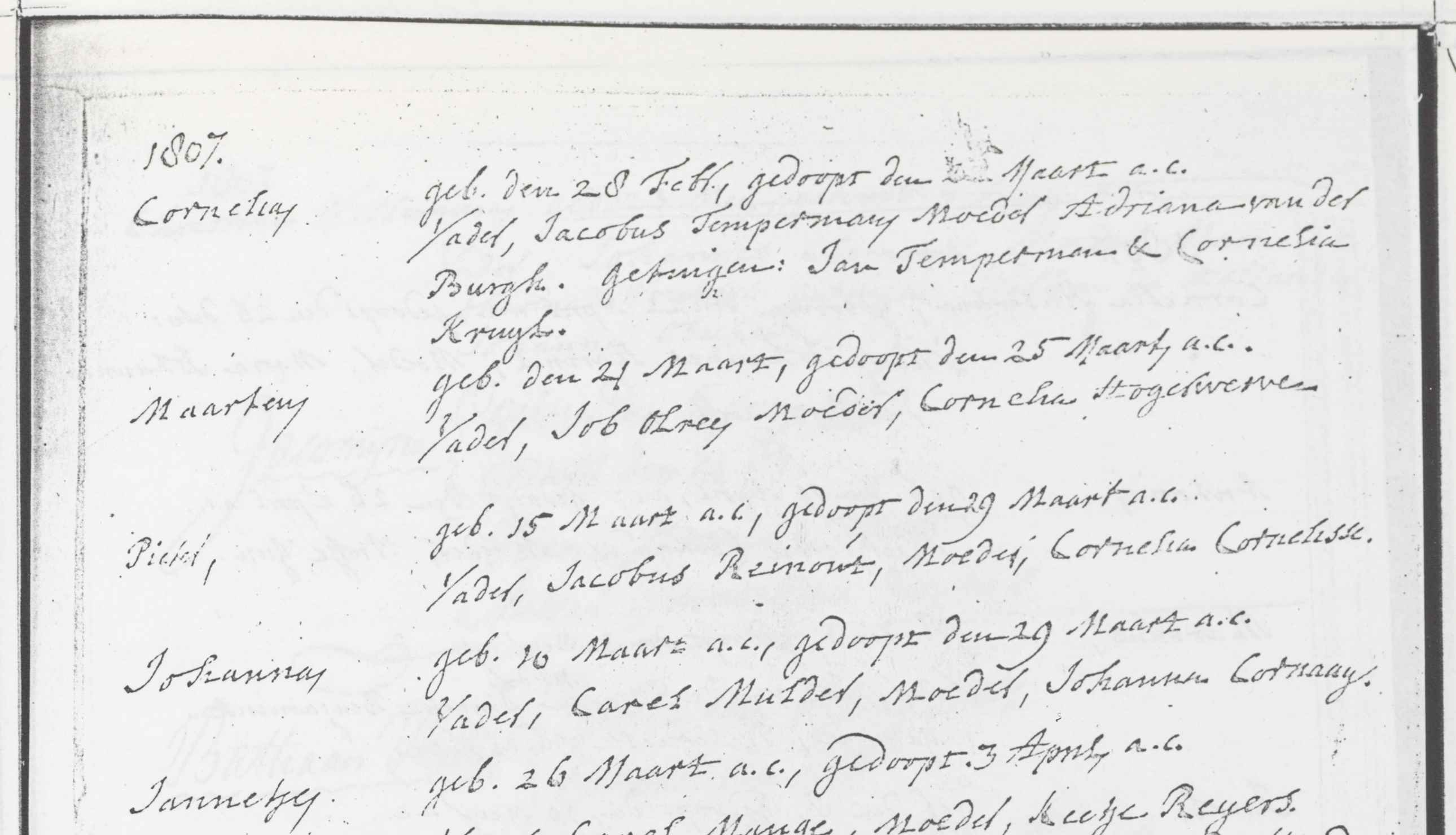
I had been frustrated that I have not been able to find birth records for Adriaan and Johanna as of yet.  BUT maybe that was because I should have been looking for baptismal records instead! When I searched for those, I found Johanna’s baptismal record dated 29 March 1807. Her religion at birth was “Low German Reformed,” which simply means Dutch Reformed. “High German” is Lutheran. I had to order this record for a cost, but it got to me yesterday, in time for this post. Here is the cropped page for 1807. Johanna is at the bottom of the image.

1 – Zeeuws Archief

Maybe one day I will find Adriaan’s birth or baptismal record. I wonder if there is a spelling discrepancy either on the record itself or in the indexing.


Read Full Post »

The last fill-in-the-gaps couple I wrote about was Teunis and Jacoba Paak, the parents of Alice Paak DeKorn. Today I am writing about the parents of Alice’s husband, Richard DeKorn. He was born to Boudewijn and Johanna (Remine) DeKorn in the Netherlands.

Richard’s father Boudewijn (Dutch for Benjamin) DeKorn was born on June 11, 1816, in Kapelle, Zeeland, Netherlands, to Jan DeKorne, 23 years old, and Geertruijd Engelse, who was 27. Boudewijn married Johanna Remine on May 21, 1847, in their hometown. Johanna was born in Kapelle to Dirk Gillesz Remijnse, 30 years old, and Adriana Krijger, also 30.

The couple had four children in 11 years: first born Geertruit died as an infant, but then Richard was born in 1851 and Maria in 1855. The fourth, Adriana, called Jennie, was not born in the Netherlands.

The family of four traveled to America on a sailing vessel which left April 13, 1856 and arrived at Kalamazoo June 22, 1856. The voyage was bad and long, and Richard and Mary, their children, stated it took 90 days. They located in Zeeland, Michigan, for a few years.

Eventually, the family moved to Kalamazoo, although I am not sure when they made that move. They were in Ottawa County (Zeeland) in the 1860 census, but when Johanna passed away in 1864, they may have been living in Kalamazoo because she is buried there.

Now we come to a big gap. I do not have a death record for Johanna because 1864 was a little before Kalamazoo started recording deaths. I don’t know exactly when she died, and I am using her headstone to give me a date. Maddeningly, it doesn’t even give her name! Just “MOTHER” and “WIFE OF B. DEKORN.” Good grief.

You know what else would be nice to have on Johanna? An obituary. I don’t have one for Boudewijn either, and I suspect that there might not be one. After all, Boudewijn was a laborer when he lived in the Netherlands. He didn’t live long enough in Zeeland to have built up a business. Then in Kalamazoo I’m not sure what he did. Since his son Richard became a very successful contractor, though, it is possible that he got his start from his father. So if Boudewijn did have a business in Kalamazoo, there might be an obituary for him, although not necessarily for Johanna since she obviously died soon after their move to Kalamazoo.

Boudewijn died on 1 July 1875 in Kalamazoo. I know this because Wayne Loney found the death record although the name was severely mangled. And the condition of the record is very faded. I tried to enhance it as much as possible. His entry is the 8th from the bottom. On the right page his son Richard’s name is clearly visible. Also his age at death of 59 and his job as laborer. But I really cannot read the cause of death, unfortunately.

I am hoping to get immigration and naturalization information on the couple from Amberly at some point. That will be very helpful as it will also provide the immigration for Richard and possibly a clue about his naturalization.

According to Yvette Hoitink, there was a fire in Kapelle in 1877 that destroyed the military records for that town, so there is no practical way to find out if Boudewijn served in the military.

So I will always be missing his military, and I am missing obits for both husband and wife. And hoping for the I&N. I have something on Boudewijn that I do not have for Johanna. A photo!

Pretty cool to have a pic of your 3x great! Is that some sort of plaid I am seeing on his shirt or am I imagining that? I was thinking that this was a reprint made a few decades after the original was made. Or even a reprint of a reprint. Could the original have been a tintype?

I keep going back to look through the photo album of Remine/Paak photos, thinking that if there was a photo of Johanna it would be in there, but nobody seems to be the right age In the right time period. It’s possible that in this portrait Boudewijn had already lost Johanna, in fact, since she died when he was 48.

I’ve started using paintings as portraits on my Ancestry tree for direct ancestors that I do not have photos for. I am also using a photo of baby feet for children who died before age five, and a photo of the back of a girl’s head with braids for girls who died before age 18. I haven’t had to find one for boys yet. Any ideas what to use?

Read Full Post »

In April I shared that I had found an Ancestry hint on my great-grandmother Margarethe Klein’s Ancestry page. The hint directed me to the index of the birth of a little boy in 1906. George Joseph Klein was born 21 August 1906 in Chicago. I had never heard about this brother of my grandmother, and I don’t think my father or uncle had known about him either.

At the time, I quickly did a search for a death record and found the index. George passed away 22 March 1909.

I didn’t believe that I could get a copy of his death certificate because of Covid-19. However, my 2nd cousin who I have met through genealogy managed to obtain the copy. What he found made me so teary for George. This is one of the saddest situations I’ve encountered.

When George was born, his brother Frank, Jr. was ten years old. His three sisters were teenagers. The family must have been thrilled to have another boy that his older sisters could dote upon.

This certificate says George was over three years old, but I don’t see that from his birth and death dates. Death date: 22 March 1909 as I mention above and as it is on the certificate. Birth date: 21 August 1906. That is only two years old, by my count. Two years, seven months.

But what killed George? According to this death certificate he died from Tubercular Basal Meningitis, a horrible disease. The symptoms include headaches, behavioral changes, fever, a stiff neck, and vomiting. Look how long George was in the hospital: One year and four months! Imagine being sick with those symptoms for that long–and only being a toddler! That breaks my heart. You have to wonder how he got this disease at such a young age.

Then the most heartbreaking fact on this certificate of all: he died without the names of his parents listed and in an orphanage.

So how did George end up in an orphanage? This is what my cousin and I believe happened. Tuberculosis is a highly contagious disease. With four other healthy children living in the home, no doubt the parents wanted to protect them and would need to quarantine George. Also, it is possible that his symptoms made it difficult to care for him–especially because this disease affects the brain. His mother Margarethe wasn’t a nurse. The nuns at the orphanage hospital would have been skilled at caring for a sick child, and they probably had the facilities for quarantining contagious patients.

Did this mean that Frank Sr. and Margarethe couldn’t see their son once they turned him over to the sisters at Angel Guardian Orphan Asylum? That I don’t know. What I know is that George effectively died an orphan. The pain must have been terrible for the family. Perhaps that is why they never talked about George.

George is buried in Saint Boniface Cemetery, and I have put in a request on Findagrave for a photo of his grave.

What was Angel Guardian Orphan Asylum like?

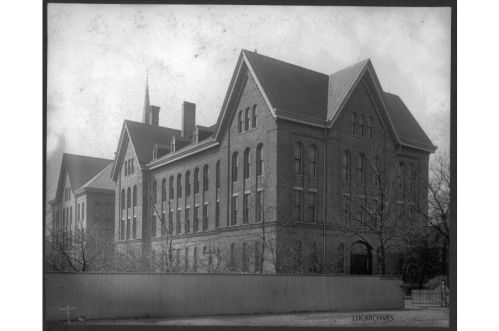
Angel Guardian Orphan Asylum

First line: The charitable care initiative that would become Angel Guardian Orphanage illustrates how immigrant German religious women were able to succeed in America. The Poor Handmaids of Jesus Christ (PHJC), an order of German sisters newly arrived in the United States, mentored and inspired other German immigrants through their work at the German Catholic Orphanage of the Holy Guardian Angels, which would later be known more simply as Angel Guardian Orphanage. This asylum existed in West Ridge for over 100 years. The orphanage’s founding and its first 35 years of existence set the stage for its later development into a major mission for the Poor Handmaids of Jesus Christ and a source of pride for Chicago’s German Catholic community.

Archdiocese of Chicago Archives

First line: Angel Guardian Orphanage began as an alternative to the separate boys and girls orphanages that the diocese of Chicago operated to ensure the health, faith, and cultural heritage of German children.

Loyola University Chicago–link through image


What happened to the orphanage?
Today, most of the cottages are gone, Misericordia Heart of Mercy occupies the old A.G.O. grounds.  Misericordia cares for children and adults with mild to profound developmental disabilities.  If you would like to take a tour of what is left of A.G.O., Misericordia has always been very accommodating when it comes to allowing formers to visit.  History of Misericordia

from Angel Guardian Orphanage Alumni

Read Full Post »