September 24, 2013 by Luanne
At this point in the interview of Grandpa, a time warp occurs. The interviewer writes:
Once the children were in school, Edna went back to work. She worked in Western Michigan [University]’s print shop. She told Adrian that they were doing fine on his earnings so she was going to invest hers so they could travel. And travel they did. Between 1964 and 1988 they toured Europe (twice), Scandinavia, Spain and Portugal, North Africa, Australia, New Zeeland, Fiji Islands, Hawaii (twice), all the continental United States and Canada! After 1988 illnesses and surgery prevented them from traveling but this past summer [1994] they were again able to travel to Minnesota and Georgia.
In fact, it wasn’t until around the time that a few of us grandchildren were in school that Grandma went “back” into the work force full-time. I used to visit her on campus in the tiny old building where the print shop was housed. In there, she worked the mimeograph and xerox machines. It was fun to see Grandma in her work element with her co-workers–and at the college she had graduated from, as well as so many other family members (including, eventually, me). The only other time I had seen this was when she worked Christmas season at the J.C. Penney,in the basement of the downtown store. In an earlier post, I wrote about Grandma working as a teacher her first year out of college, but then she had gotten married and raised a family.
I remember when they first went to Europe in 1964. They brought me back an Eiffel tower charm for my charm bracelet, a signed book called Ludmila, from Liechtenstein, and a doll in a native Swiss costume.
Grandpa set up a projector in our living room and showed his children and grandchildren their slides from Europe. I remember the glory of the tulips in the country of his ancestors, The Netherlands.

I just bought this book to read about the tulip craze that swept the world and brought wealth to The Netherlands.
Travel abroad was so special in those days. Grandma and Grandpa spread their belongings to be packed out on a long table in the basement, showing us how they were bringing American toilet paper because the toilet paper was like sand paper in Europe. They were so excited to share all the little details they had learned about travelling out of the country.
When Grandma and Grandpa travelled to California, they took the train. At one point a little boy decided that Grandpa was James Arness, the star of Gunsmoke, or Peter Graves, the star of Mission Impossible (I can’t remember right now which one; the actors were brothers). He refused to be told anything different. That wasn’t the only time Grandpa was mistaken for a movie actor.
Because I was so young when my grandparents started travelling, I think they helped expand my view of the world–and of them.
I hope you’ll stay tuned for Part XI of Grandpa’s story . . . .
Here are the first parts of the story:
Click this link for Part I
Click this link for Part II
Click this link for Part III
Click this link for Part IV
Click this link for Part V
Click this link for Part VI
Click this link for Part VII
Click this link for Part VIII
Click this link for Part IX
Posted in Adriaan Zuijdweg/Adrian Zuidweg Sr., Adrian Zuidweg, Cora DeKorn Zuidweg, DeKorn, Family History, Genealogy, Kalamazoo history, Kalamazoo late 1800s - early 1900s, Lucille Edna Mulder Zuidweg, Photography early 20th century, Richard DeKorn, Zuidweg | Tagged Adrian Zuidweg, Baron von Falz-Fein, DeKorn, DeKorn family, DeKorn genealogy, family history, genealogy, history of Kalamazoo, James Arness, Kalamazoo history, Liechtenstein, Michigan history, Richard DeKorn, Zuidweg surname | 13 Comments »
September 17, 2013 by Luanne
My grandfather was an individualist and an independent thinker. But he was also a bit of a contradiction because he was dependent on my grandmother (and she on Grandpa) and liked to talk to other people. Grandpa was a born storyteller and storytellers need audiences.
The next passage in Grandpa’s story illustrates his individualism:

Grandma and Grandpa attended First United Methodist Church in downtown Kalamazoo (known for many years as First Methodist before the denomination merged with United Brethren). Although his relatives had belonged to the (Dutch) Reformed Church, that stopped after Grandpa’s mother had gotten angry at someone. She had given a quilt to the church for a White Elephant sale (or something similar), and then she saw it hanging from someone else’s clothesline. The implication was that she discovered someone had “appropriated” the quilt for herself. That caused my great-grandmother not to go back to her own church. Like many of the family stories that have been told and re-told until I learned them, this could be the reason–or there could be another reason.
Grandma was brought up in Caledonia, and the Methodist Church was part of her upbringing. So it was natural that my grandparents attended the big English Gothic church. The building was brand new when my grandparents were starting out their lives as a married couple.
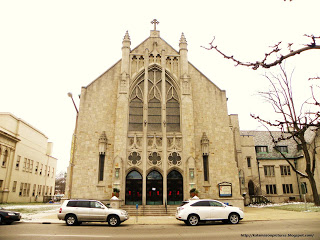
First United Methodist Church, Kalamazoo
A lot of my mother’s extended family went to this church and it’s seen my family at baptisms, weddings, and funeral receptions. I attended Sunday School there at least one year and Bible School at least one summer and have gone to services, most notably many Christmas Eves.
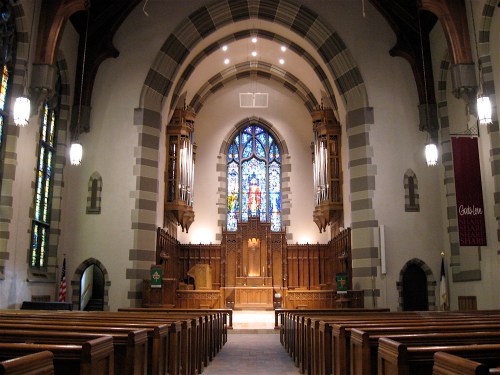
Photo by Chad Boorsma
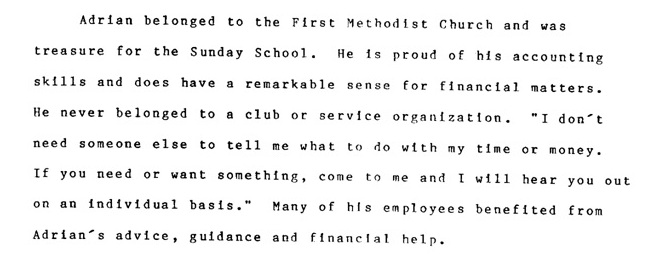
I remember looking for Grandpa after the service one Sunday. He was in the “treasury.” On other occasions, I remember trying to get him to come to service with us, but he never would.
Why? He said he couldn’t sit still.
And I think that’s true. Wherever Grandpa was with family, no matter what we were in the middle of, he would suddenly stand up and say, “Time to go, Edna.” He had what we used to call “ants in his pants” and had to be on the move.
I hope you’ll stay tuned for Part X of Grandpa’s story . . . .
Here are the first parts of the story:
Click this link for Part I
Click this link for Part II
Click this link for Part III
Click this link for Part IV
Click this link for Part V
Click this link for Part VI
Click this link for Part VII
Click this link for Part VIII
Posted in Adriaan Zuijdweg/Adrian Zuidweg Sr., Adrian Zuidweg, Cora DeKorn Zuidweg, DeKorn, Family History, Genealogy, Kalamazoo history, Kalamazoo late 1800s - early 1900s, Lucille Edna Mulder Zuidweg, Photography early 20th century, Richard DeKorn, Zuidweg | Tagged Adrian Zuidweg, DeKorn, DeKorn family, DeKorn genealogy, early 1900s, family history, First United Methodist Church Kalamazoo, genealogy, history of Kalamazoo, Kalamazoo history, Michigan history, Richard DeKorn, scrapbooking, Zuidweg surname | 15 Comments »
September 10, 2013 by Luanne
In the last post I told you how Grandpa owned the Sunoco gas station. He actually ran it for fifty years. In the middle of the passage about the business, Connie mentioned the following:
They [Adrian and Edna] built a new house (Adrian can still recite all the specs and dimensions for that house) and their son was born in 1936. They had two daughters, one 2 and one 7 years later.
I’d like to clarify what Connie wrote there. Grandma and Grandpa got married in 1932, then built their new house in 1934, the same year their first child, my mother was born. Two years later, her brother was born, and in 1940, her sister was born.
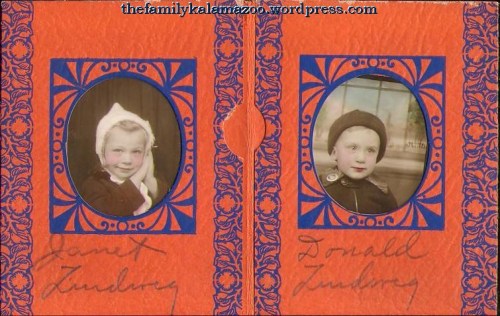
Mom and Uncle Don
According to Google maps, the house Grandpa built is still there. Here is a photo of it from 1947:
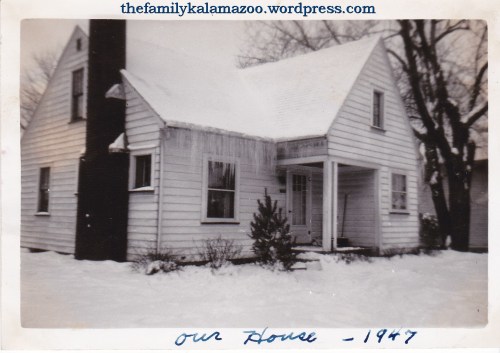
Grandma and Grandpa’s house on Burdick Street
Eventually ivy grew up the chimney side of the house.
This is the house where my mom and her siblings grew up. It’s where we went for Christmas and Thanksgiving. It’s where I stayed every weekday in kindergarten while Grandma babysat me.
When you walked in that front door, their living room was to the left and the kitchen to the right. Straight ahead took you to the two back bedrooms. Upstairs there were three bedrooms. The window over the front porch was the tiny room in front. In there they kept an iron crib and I found my uncle’s books. The bedroom on the side by the chimney was the big bedroom. In there I found the chest with my mother’s treasures and the little corner shelf. The mirrored shadowbox hung on the wall with the miniatures displayed on the shelves. I slept in the bedroom which was really a hallway, tucked under the eaves, but right by the stairway and therefore closest to the only bathroom, which was around the corner from the bottom of the stairs.
This house is also where I read the books of my mother and uncle and aunt (Zane Gray, the Bobbsey Twins, Black Beauty, all the Louisa May Alcott books) and played with their toys, such as my mom’s miniature collection. I pored over all the scrapbooks my mother had made out of newspaper and popular magazine clippings. Scrapbooks about grooming and beauty, Frank Sinatra, Shirley Temple. I studied the photo albums, especially the pictures of my mom with her light brown braids pinned up on top of her head.
Eventually my grandparents sold the house and bought one in Portage, the suburb their kids lived in. Though the house left the family, I doubt the house ever really left any of us.
I hope you’ll stay tuned for Part IX of Grandpa’s story . . . .
Here are the first parts of the story:
Click this link for Part I
Click this link for Part II
Click this link for Part III
Click this link for Part IV
Click this link for Part V
Click this link for Part VI
Click this link for Part VII
Posted in Adriaan Zuijdweg/Adrian Zuidweg Sr., Adrian Zuidweg, Cora DeKorn Zuidweg, DeKorn, Family History, Genealogy, Kalamazoo history, Kalamazoo late 1800s - early 1900s, Lucille Edna Mulder Zuidweg, Photography early 20th century, Richard DeKorn, Zuidweg | Tagged Adrian Zuidweg, DeKorn, DeKorn family, DeKorn genealogy, early 1900s, family history, genealogy, history of Kalamazoo, Kalamazoo history, Michigan history, Richard DeKorn, scrapbooking, Zuidweg surname | 11 Comments »
September 3, 2013 by Luanne
When we left off, Grandpa had lost his parents and grandfather.
According to Connie:
Adrian and Edna were married just before Adrian’s mother passed away in 1932. That same year he bought back the family market. The following year he tore down the market and built a gas station on the corner of Burdick and Balch. He ran that station for the next 50 years.
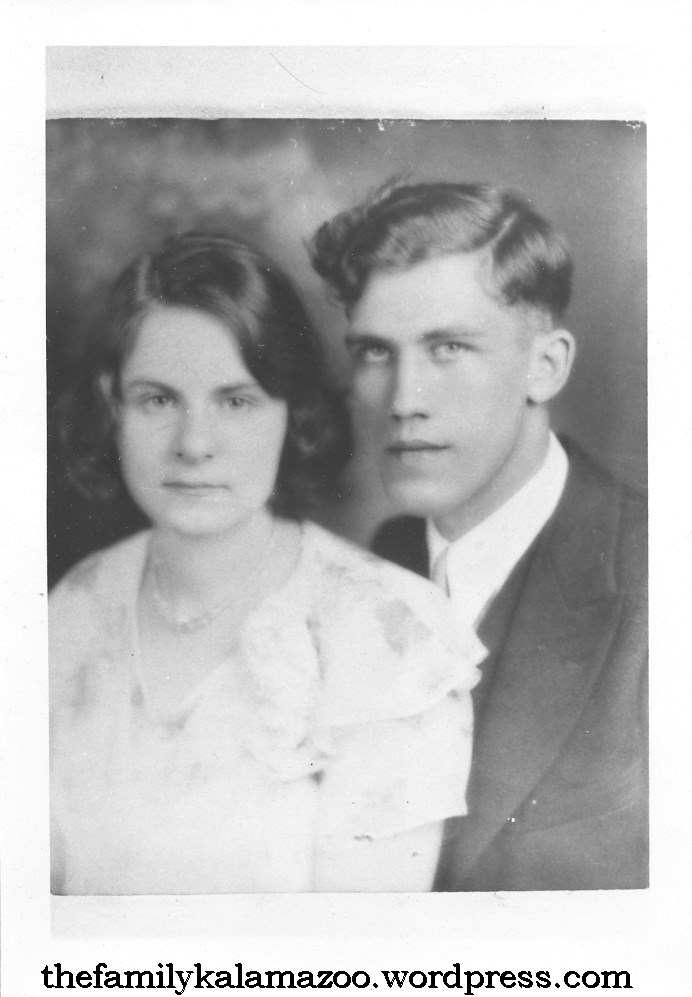
As the story goes, Adrian and his sweetheart, Edna, married a few months before his mother passed away. They got married in May of 1932 in South Bend, Indiana, without a big wedding. This is their wedding portrait:

Adrian Jr. and Edna (Mulder) Zuidweg, 1932
What I hadn’t realized was that Grandpa bought back the “family market.” I hadn’t even known the store was sold! After his father got ill, Adriaan (sr.) sold the soda shop along with, I presume, the beautiful marble countertop. I don’t know who purchased it, but Grandpa bought it back–and instead of running the same sort of shop as his father, he turned it into a gas station.

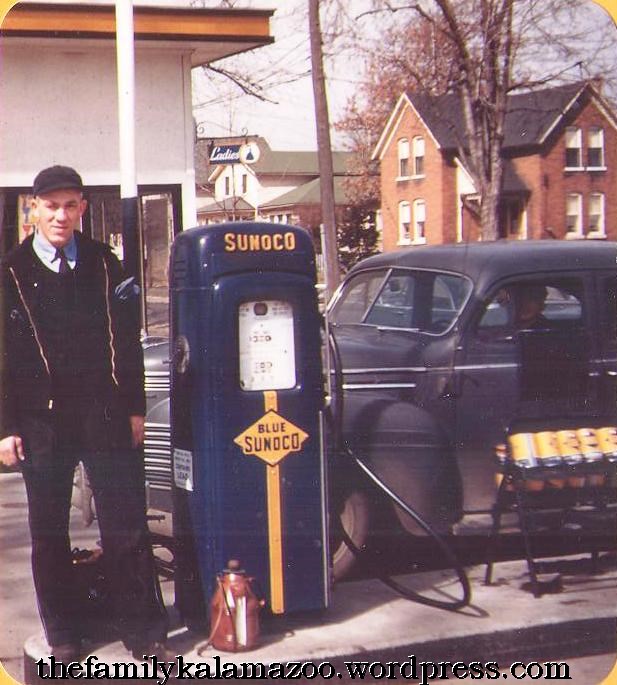
Grandpa by the pump at his Sunoco station
In this photo of Grandpa by the pump, we are facing the station, which was at the SW corner of Burdick and Balch in Kalamazoo. On the NW corner, just across the street stood, and still stands, the Richard DeKorn house, built in 1885 by my great-great-grandfather. The brick house in the background of the photo is not the Dekorn house, but a different house, a bit farther down Balch Street.
Connie writes that Grandpa said that although he worked 12-14 hours a day at the station, he spent plenty of time with his kids.
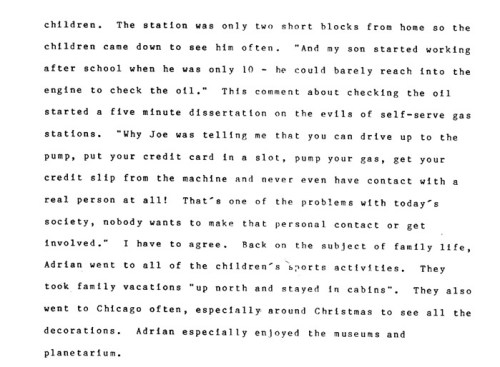 When I was five Grandma babysat me every school day, and I saw that Grandpa had his own routine down. Early in the morning he would leave the house and pick up a newspaper at Michigan News Agency. It was still dark outside. Then he would leave for work while it was still early. However, the station was only three lots down from the house so he didn’t go far. And we could go down and see him whenever we liked–and always to bring him a home-cooked lunch.
When Grandpa came home from work at suppertime, his work uniform was covered with grease from working on cars down in the “pit.” He’d go straight downstairs to the basement and take a shower under the shower head he had rigged up over the drain in the floor. That way when he came upstairs to greet us, he would be squeaky clean and ready for his dinner.
Grandpa’s shock here at the loss of “personal contact” is emblematic of his practical and logical thinking, as well as his homespun philosophies. I can’t help but feel that he was so right in what he said. If he knew that today people sit with each other and interact only with their cell phones, he would be appalled.
It’s true that Grandpa loved to take his family on vacations. My mother has good memories of the family road trips. When I stayed at Grandma and Grandpa’s house, I discovered a cedar chest filled with my mother’s treasures, and one of them was a very pretty silver and turquoise bracelet she had gotten on a family trip. I still have that bracelet.
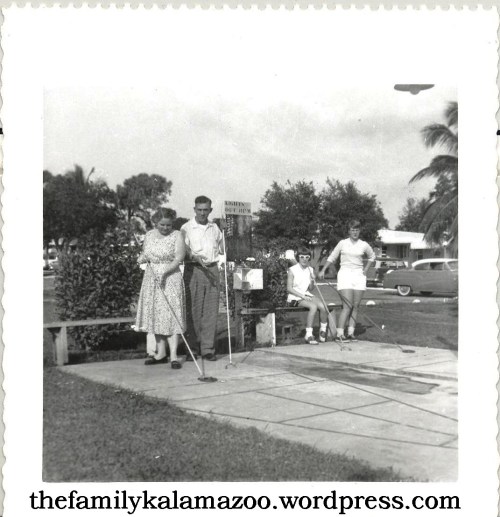
Grandma and Grandpa playing shuffleboard in Florida
I hope you’ll stay tuned for Part VIII of Grandpa’s story . . . .
Here are the first parts of the story:
Click this link for Part I
Click this link for Part II
Click this link for Part III
Click this link for Part IV
Click this link for Part V
Click this link for Part VI
Posted in Adriaan Zuijdweg/Adrian Zuidweg Sr., Adrian Zuidweg, Cora DeKorn Zuidweg, DeKorn, Family History, Genealogy, Kalamazoo history, Kalamazoo late 1800s - early 1900s, Lucille Edna Mulder Zuidweg, Photography early 20th century, Richard DeKorn, Zuidweg | Tagged Adrian Zuidweg, DeKorn, DeKorn family, DeKorn genealogy, early 1900s, family history, genealogy, history of Kalamazoo, Kalamazoo history, Michigan history, Richard DeKorn, Zuidweg surname | 22 Comments »
August 27, 2013 by Luanne
Part VI
Today’s passage is about a sad and difficult time in Grandpa’s life. Connie wrote, Adrian was
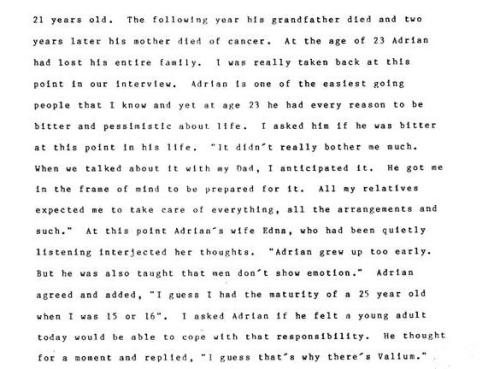
Grandpa, an only child, grew up living with his parents and his widowed grandfather. Yet, by the time he was 23 years old, he was alone in the world, except for his new wife, my grandmother.
He had lost both parents and his grandfather. Yet, at the interview, he told Connie that it “didn’t bother” him that much. He said his father prepared him ahead of time for his death and for taking care of the household affairs.
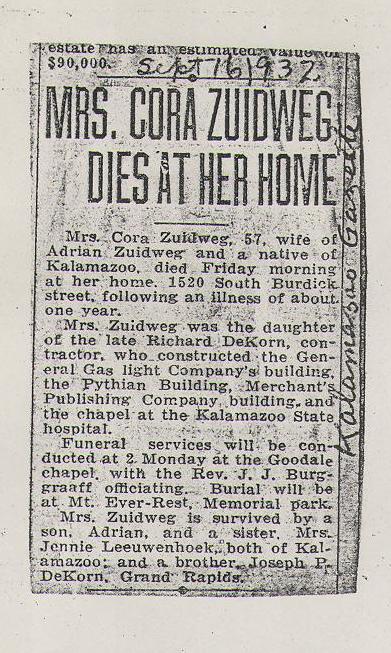
Grandpa’s mother Cora DeKorn Zuidweg’s obituary
Since Grandpa’s father died in 1929, of kidney failure, and his mother died three years later in 1932, of leukemia, I suspect that his father prepared him to take over the family affairs so that his ailing mother didn’t have to do so. It was probably taken to be a man’s work, and since Grandpa was an adult, he would be expected to take care of his mother. He did take care of her, and towards the end had the help of Grandma. Grandpa and Grandma were married in May of 1932, and Grandpa’s mother died in December of that year. So for seven months, newlywed Grandma helped Grandpa to take care for her ailing mother-in-law.
Grandma and Grandpa formed a strong bond, which lasted their entire lives. It’s no surprise that Grandma interrupted the interview to explain why Grandpa would say he wasn’t “bothered” by losing his family at such a young age. She knew that he was raised not to show emotion and that he was very good at showing a “stiff upper lip.” But being married to him all those years, she knew that it was very difficult for him to experience such loss.
Grandpa saying “I guess that’s why there’s Valium” sounds just like his sense of humor, another way of deflecting from deep emotion.

Grandma and Grandpa in later years
I hope you’ll stay tuned for Part VII of Grandpa’s story . . . .
Here are the first parts of the story:
Click this link for Part I
Click this link for Part II
Click this link for Part III
Click this link for Part IV
Click this link for Part V
Posted in Adriaan Zuijdweg/Adrian Zuidweg Sr., Adrian Zuidweg, Cora DeKorn Zuidweg, DeKorn, Family History, Genealogy, Kalamazoo history, Kalamazoo late 1800s - early 1900s, Lucille Edna Mulder Zuidweg, Photography early 20th century, Richard DeKorn, Zuidweg | Tagged Adrian Zuidweg, DeKorn, DeKorn family, DeKorn genealogy, early 1900s, family history, genealogy, history of Kalamazoo, Kalamazoo history, Michigan history, Richard DeKorn, Zuidweg surname | 17 Comments »
August 20, 2013 by Luanne
Click this link for Part I
Click this link for Part II
Click this link for Part III
Click this link for Part IV
Part V
I remember my grandmother telling me about Grandpa’s father, my great-grandfather, Adriaan Zuijdweg. She said he worked all day at the store without a day off, and during the day he wouldn’t eat. He would go hungry for hours and then come home and eat a steak the size of a dinner plate. Not much else. But a giant steak.I can’t remember for sure if he put horseradish or hot mustard on it, but I’ll bet he did. Grandpa always liked to add the hot stuff to his meats, and I think he probably learned it from his dad.

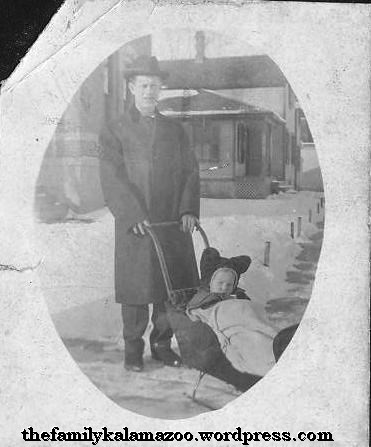
Adriaan Zuijdweg with son Adrian Zuidweg
Grandpa brings up his father at this point in his story:
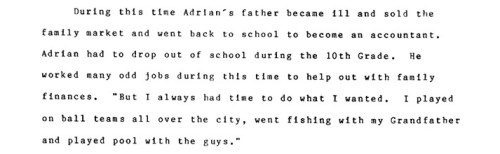
The story continues that, in 1929, Grandpa’s father died, at age 58, of kidney failure. Grandma thought maybe that eating pattern contributed to or caused his death. I do wonder how they knew it was his kidneys or if they would have done an autopsy.
The rest of the information in this passage was new to me. I didn’t realize when Adriaan became ill, the family had to sell their store. Nor did I know that he went back to school to become an accountant. This kind of blew my mind for a couple of reasons. First, I didn’t realize that the idea of re-educating oneself at midlife was considered an option in those days! My goodness, that is something to consider . . . . I’m proud of him for taking that step. I wonder where he went to school.
Second, I love that he went to become an accountant because it shows that Grandpa also got his love of accounting and finance from his father (or was it the other way around?!). My Uncle Don then followed in their footsteps by going into the field.
I was sorry to see that Grandpa had to quit school because of his father’s poor health. Although I knew he left school early, I thought it was because his blind eye made studying difficult. But from reading this story it’s become clear that his eyesight didn’t affect his school work in that way. Knowing he quit for financial reasons made me more sad for him.
I’m glad he was still able to have a good time as a teen. The mention of playing pool was astounding as my grandfather was not a party type at all, and I think of The Music Man:
Oh, we got trouble
Right here in River City
    Right here in River City
With a capital 'T' and that rhymes with 'P'
And that stands for 'pool'
    That stands for pool
Imagining Grandpa at the poolhall . . . . 😉
It’s much easier to imagine him fishing with his grandfather. I’ve already posted two photos of Grandpa with a fishing pole and one of his grandfather, Richard DeKorn, fishing. Here they are in a slide show.
This slideshow requires JavaScript.
I hope you’ll stay tuned for Part VI of Grandpa’s story . . . .
Posted in Adriaan Zuijdweg/Adrian Zuidweg Sr., Adrian Zuidweg, DeKorn, Family History, Genealogy, Kalamazoo history, Kalamazoo late 1800s - early 1900s, Photography early 20th century, Richard DeKorn, Zuidweg | Tagged Adrian Zuidweg, DeKorn, DeKorn family, DeKorn genealogy, early 1900s, family history, genealogy, history of Kalamazoo, Kalamazoo history, Michigan history, Richard DeKorn, Zuidweg surname | 12 Comments »
August 13, 2013 by Luanne
Click this link for Part I
Click this link for Part II
Click this link for Part III
Part IV
Grandpa always enjoyed watching and following sports. Reading his story I now understand that his love of sports began when he was young. We used to eat Thanksgiving dinner before the game, and I first learned about sports scores in the newspaper when he showed them to me.
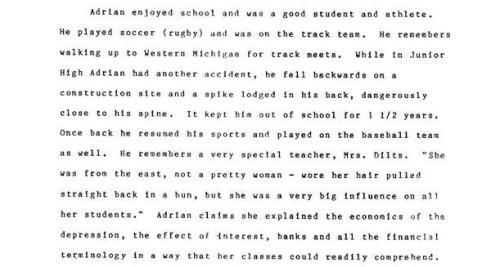
It’s not surprising to me that Grandpa “was a good student and athlete.” What I enjoy reading are the details. That he played something called “soccer (rugby)” and was on the track team. I was never an athlete, but I did enjoy track and tennis–especially track. Maybe when I was in high school he told me he used to be on the track team, but I don’t remember . I wonder what his events were. I favored low hurdles and 100 yard dash. Other than square dancing, it was the only PE activity I had talent at, but I didn’t have the guts to pursue it outside of class. Other than that, I was always the 2nd to the last girl chosen for the team. However, other grandchildren were talented athletes, and at least three of his great-grandchildren are very accomplished athletes.
 Curious about how rugby is parenthetical to soccer, I had to look it up. Here is an interesting history of soccer in the United States which explains the rugby connection, as well as how soccer had come to very popular at the time Grandpa would have entered high school, in the early 1920s.
From 1875-1894
After the demise of college soccer in 1876, working class communities in the US adopted the game, taking on the rugby/gridiron form of soccer. It is interesting to note that this trend took place at the same time in Europe and the US. The development could be seen in New Jersey, Philadelphia and New York City, also spreading rapidly to Fall River and New Redford (MA) by 1870s. The game also clashed with the popular sport of baseball in the US, considered as American past time.
Beginning in early 1890s, soccer witnessed an average growth in Denver, Cincinnati, Cleveland and even San Francisco and Los Angeles by the end of the century. Owing to corporate sponsorships, some leagues attained semi-pro statistics. The American League of Professional Football collapsed owing to heavy financial losses during its first season.
In 1904, FIFA was established and was seen as lack of any national organizing association in the US. After FIFA refused an American application for membership during their 1912 congress, the speedily growing AAFA members formed the United States Football Association, which was accepted by FIFA. The main aim of the association was to end the struggle between amateur and professional soccer organizations.
Three of the early dynasties of American Soccer were,
• The Fall River Rovers- winners of the American Cup in 1888 and 1889,
• Bethlehem Steel, who won the American Cup in 1914, 1916, 1917, 1918, and 1919
• And winners of the National Challenge Cup in 1915, 1916, 1918, and 1919
The 1920s are popularly known as the golden era in the history of American soccer. The establishment of American Soccer League in 1921 was a mark as there was now a league that could compete with European players.
Grandpa must have had quite a walk to get to the track meets. I wonder where on campus they were held in those years. Read Fieldhouse didn’t exist until 1957. Waldo Football Stadium wasn’t constructed until 1939, across from the baseball stadium. However, football had been on that particular property since 1914. Since the school began as Western Normal School in 1903, only five years before Grandpa was born, I believe that at the time he was walking there, everything was located in that area off Oakland Drive (Known as Asylum Road). It’s still quite a hike from his home on Burdick Street.
I had no idea that Grandpa had another major injury while he was still a child. A spike lodging near his spine?! That would be so frightening–for him and for his parents. He was an only child, so his parents doted on him very much. Then to think that he missed a year and a half of school because of the injury makes me wonder what he did for that time. Was he around his mother a lot or was she at the shop? Did his grandfather still live there? I know that his grandfather remarried when he was two, so I need to piece together addresses to see where all the family members lived each year. It seems that Grandpa’s grandfather may have moved next door when he remarried, but I can’t yet be sure.
I’m not surprised he joined the baseball team after that as he would have been “rarin” to go, and baseball was another very popular sport.
Finally, don’t think that his comment about his teacher, Mrs. Dilts, is just an “aside.” Grandpa loved finance. He loved everything about money and how it worked–finance, economics, accounting. Therefore, I suspect that he first got bitten by the love bug of finance in Mrs. Dilts’ class. Every night, after his Sunoco station closed, Grandpa closed himself in the bedroom that served as an office and counted the money.
I hope you’ll stay tuned for Part V of Grandpa’s story . . . .
Posted in Adriaan Zuijdweg/Adrian Zuidweg Sr., Adrian Zuidweg, DeKorn, Family History, Genealogy, Kalamazoo history, Kalamazoo late 1800s - early 1900s, Photography early 20th century, Richard DeKorn, Zuidweg | Tagged Adrian Zuidweg, DeKorn, DeKorn family, DeKorn genealogy, early 1900s, early 20th century sports, family history, genealogy, history of Kalamazoo, Kalamazoo history, Michigan history, Western Michigan University sports history, Zuidweg surname | 7 Comments »
Click this link for Part I
Click this link for Part II
Part III
As I grew up there were two ways I knew my grandfather was blind in one eye. One way was that I was sometimes warned, “Be careful. You don’t want to lose your eye like Grandpa.” Mom and Dad will probably disagree that Grandpa was used as a warning to me, but I know the truth in this respect . . . . The other way I knew was that he had one blue eye, just like mine, and he had one green eye.
Everybody else I knew had two eyes of the same color.
In this next part of Grandpa’s story he tells Connie what happened to his eye.

In 1911, Grandpa’s eye was treated at the University of Michigan hospital in Ann Arbor, about 100 miles away from his home. I imagine the worried parents and the frightened boy travelling all that way on “streetcar, train and horse-drawn carriages.” What would that trip be like today? A visit in the car or ambulance to the nearest hospital, then perhaps a drive of an hour and a half to the medical center? In an ambulance or a car, depending on the urgency. The car would have the boy’s car seat in it. What was it like for him? Was he carried as they moved from one mode of transportation to the next?
I believe it’s likely that he was seen at the old hospital in Ann Arbor on Catherine Street. It is no longer there as it was replaced by the 700-bed University Hospital in 1925.

Photo by Wystan
Today it’s hard to imagine letting your three-year-old play with a needle, but in those days children learned how to perform daily chores and trades at their parents’ sides.
The description of Grandpa bouncing off the table from being shocked by the X-ray machine is frightening. When I looked up the history of X-rays on Wikipedia, it was even more frightening. Although a lot of research led up to the moment, X-rays were not actually “discovered” until 1895. The site states, “The first use of X-rays under clinical conditions was by John Hall-Edwards in Birmingham, England on 11 January 1896, when he radiographed a needle stuck in the hand of an associate.” Since Grandpa’s injury was in 1911 and UM had only had the machine for twelve years, that means that they bought one of the first machines in 1899.
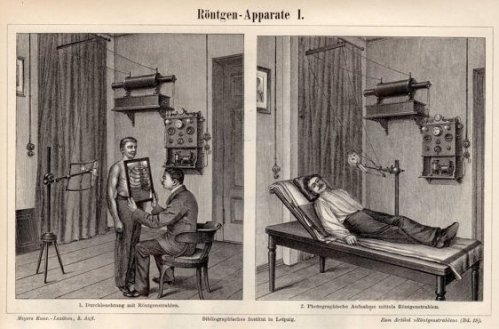
1899 X-ray machine
I understand that Grandpa’s medical records from 1911 are still stored at the University of Michigan. I hope I will be privileged to see a copy of them some day.
Here is a photo of the cute little boy who got a needle stuck in his eye:

Adrian Zuidweg, 1908-2000
Grandpa’s stoic attitude about his blind eye was typical of his personality. He didn’t show emotion very often, and he was quite practical. He loved his routines. His talent with routines and his prodigious memory proved invaluable when he became completely blind.
I hope you’ll stay tuned for Part IV of Grandpa’s story . . . .
Posted in Adriaan Zuijdweg/Adrian Zuidweg Sr., Adrian Zuidweg, DeKorn, Family History, Genealogy, Kalamazoo history, Kalamazoo late 1800s - early 1900s, Michigan history, Photography early 20th century, Richard DeKorn, Zuidweg | Tagged 1911 Ann Arbor, Adrian Zuidweg, DeKorn, DeKorn family, DeKorn genealogy, early 1900s, early diagnostic x-rays, family history, genealogy, history of Kalamazoo, Kalamazoo history, Michigan history, University hospital Ann Arbor 1911, Zuidweg surname | 12 Comments »
Click here for Part I.
In my post of July 16, I shared the beginning of the story pieced together by Connie Jo Bowman in 1994, when she interviewed my grandfather Adrian Zuidweg. Here is the next part. Today I am going to focus on just one paragraph–to try to unpack it.
Here is what Connie wrote:
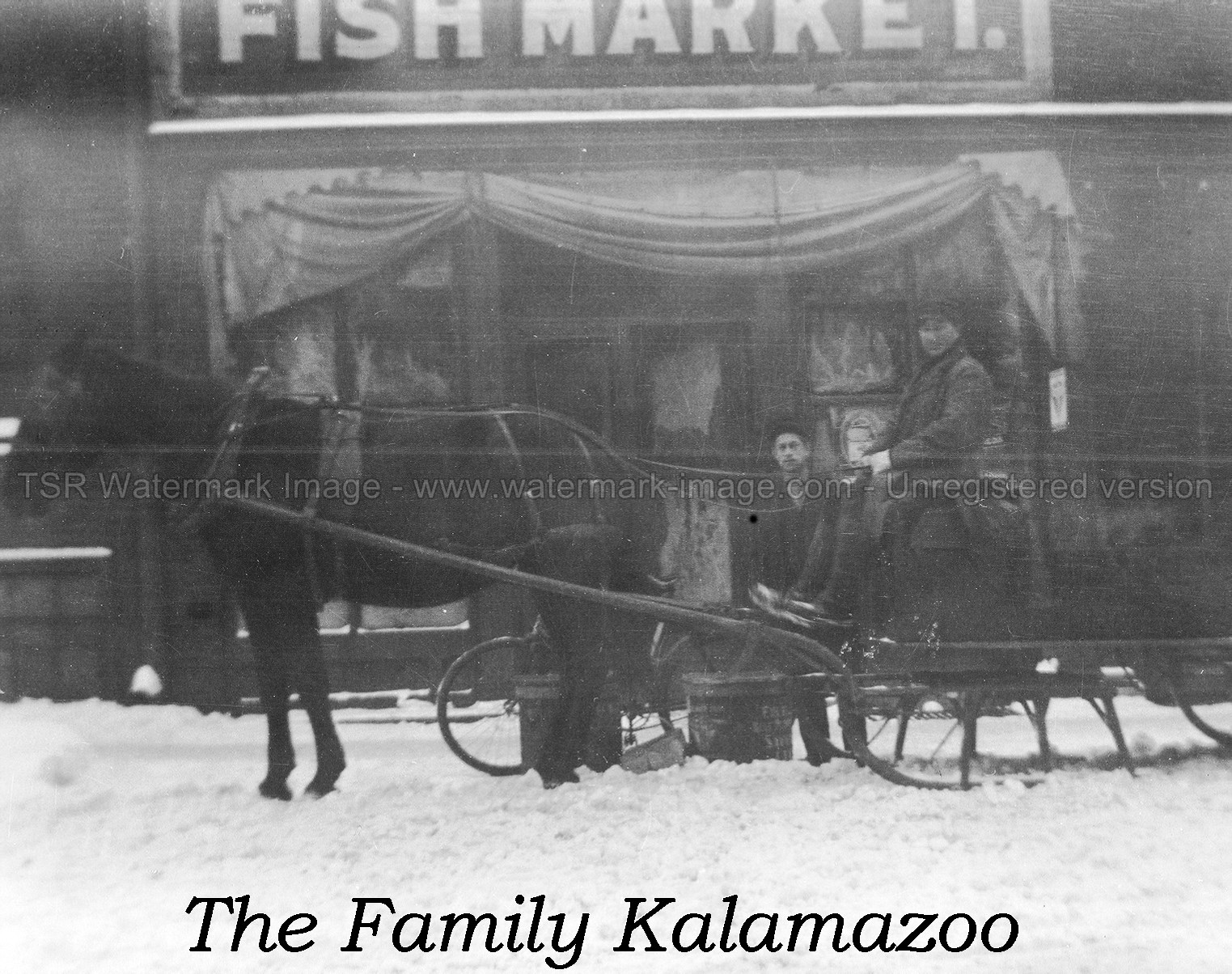
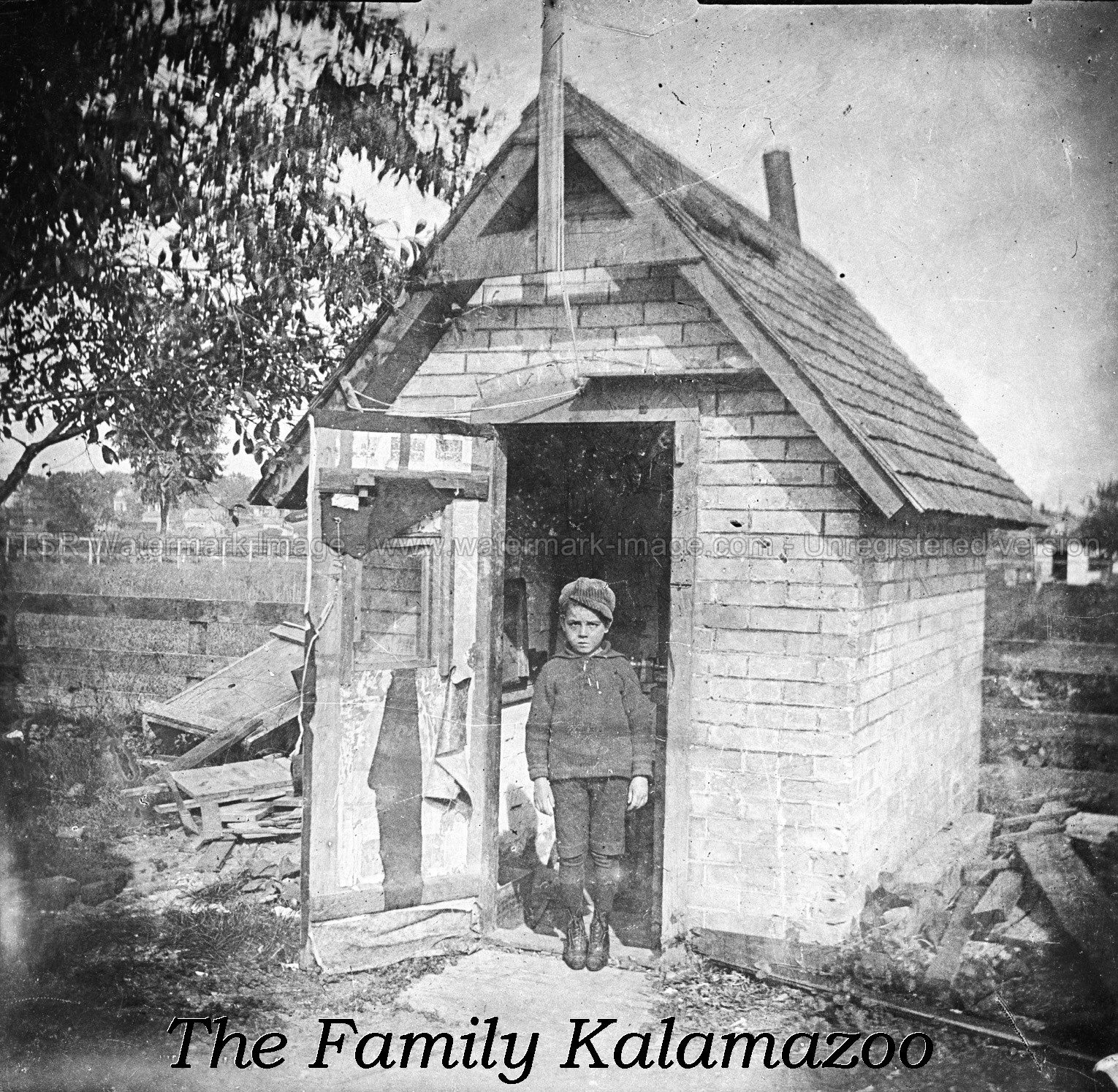
His father owned a fish market and Adrian’s earliest memories were of going to his aunt’s house while his mother helped out at the market. He remembers playing with his cousins around the big woodburning stove and the “outside toilet.” This was before 1911 because that was the year gas and sewer lines were brought up the street to their house.
I’ve written before about Grandpa’s father’s fish market in the post “My Great-Grandfather Reinvented Himself as a Business Owner in the U.S.” I share photos in that post of the interior of the fish market and the interior of the ice cream parlor Adriaan Zuijdweg (Grandpa’s father) owned after the fish market.
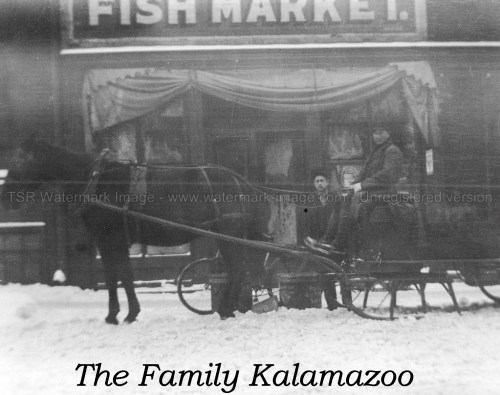
Adriaan Zuijdweg, Proprietor, standing
So that’s where Grandpa’s mother Cora went to “help out” at the market. But Grandpa himself stayed at his aunt’s. There are two possibilities. One is his Aunt Jen, Cora’s sister. The other is his Aunt Johanna, his father’s sister. Before 1911, Grandpa was a toddler–maybe two years old. Some people don’t have memories from that age, but I also have memories from when I was two years old.
Let’s say the year was 1910. In 1910, Johanna Zuijdweg Van Liere had been in the United States for six years. She married her husband Marinus Van Liere in Goes, the town in the Netherlands they were both from. Johanna had two baby boys when she immigrated here, and by 1910 may have had six, seven, or eight boys. I’m not sure if they all survived infancy, but she was evidently quite busy.
Grandpa’s mother’s sister Jen, on the other hand, had one 13-year-old daughter in 1910.
If Grandpa played with his cousins around the stove and the outhouse in the yard, it would be Johanna’s children. This led to me to search out where Johanna and Marinus were living in 1910.

Shed or outhouse?
The 1910 U.S. Census shows Grandpa living with both his parents, Adriaan and Cora, his grandfather Richard DeKorn, and his uncle Joseph DeKorn in the Richard DeKorn house at the corner of Burdick and Balch: 1324 S. Burdick Street. Since the house still stands today, if it wasn’t moved, the address numbers have been changed on Burdick. The VanLieres, Johanna and Marinus, and their six boys lived at 1338 S. Burdick Street. It looks like another family lived between them. About four houses down from the VanLieres lived John and Mary DeSmit and their children. Mary DeSmit was Richard DeKorn’s sister.
I found it interesting that the census shows Johanna and Marinus speaking English, although they had only been in this country for six years. A few of the neighbors spoke Dutch, but most of them spoke English.

Johanna Zuijdweg VanLiere and Marinus VanLiere with son Jacob
In this section of Grandpa’s story, he remembers that gas and sewer lines were brought up to their house in 1911. It must have made a monumental difference in the quality of their lives. Because his grandfather, Richard DeKorn, was a building contractor, would they have been quicker to get connected or was it something they had to wait their turn for, like everybody else?
On a personal note, I was surprised that Grandpa’s family was as close with his father’s sister and her family as this research shows. I knew that the family was often with Aunt Jen, as many of the family photos are of Jen and her husband Lou. But there aren’t as many photos of Johanna, nor do I know the history of that branch of the family as the children all grew up.
I hope you’ll stay tuned for Part III of Grandpa’s story . . . .
Posted in Adriaan Zuijdweg/Adrian Zuidweg Sr., Adrian Zuidweg, DeKorn, Family History, Genealogy, Kalamazoo history, Kalamazoo late 1800s - early 1900s, Photography early 20th century, Richard DeKorn, Zuidweg | Tagged Adrian Zuidweg, DeKorn, DeKorn family, DeKorn genealogy, early 1900s, family history, genealogy, history of Kalamazoo, Kalamazoo history, Michigan history, Richard DeKorn, Western Michigan University, Zuidweg surname | 9 Comments »
I’ll pick up Grandpa’s story again in my next post.
Today I’m doing a little detour away from Kalamazoo, heading toward Japan, Chicago, and Elmhurst, Illinois.
My parents gave me a pair of matching and beautiful Japanese vases which are family heirlooms. I used to see them in my paternal grandmother’s home when I was little. In later years, my parents displayed them in their home. I had assumed (you know about that word, right?) that my father or my uncle had brought them back from Korea or Japan when they were in the military.
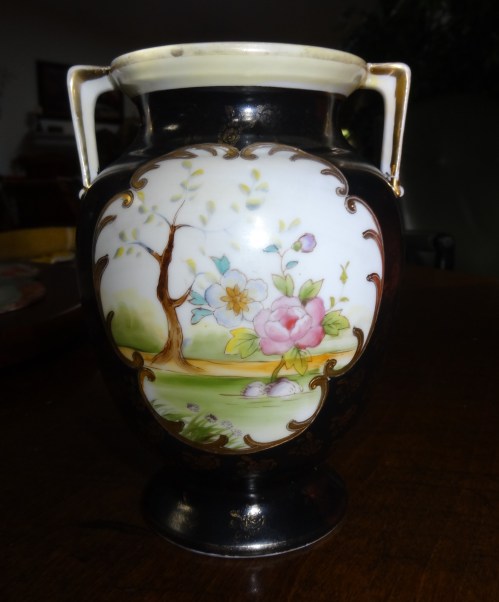
Look closely at the fine gold leaf design in the solid black. Vase is hand-painted.
In my birthday card was a note which explained that these vases had belonged to my grandmother’s mother. Her son, my father’s Uncle Frank, had brought them back from Japan in 1920 and given them to his mother.
Frank Klein was a merchant mariner who travelled the world, including to Japan, during the years right after WWI. Maybe this is where my Uncle Frank, Great Uncle Frank’s namesake, got his idea of sailing when he enlisted in the U.S. Navy.
I believe Great Uncle Frank may have been on a ship called the Eastern Queen as we have several family photos of that ship. This ship does show up in online lists of ships.
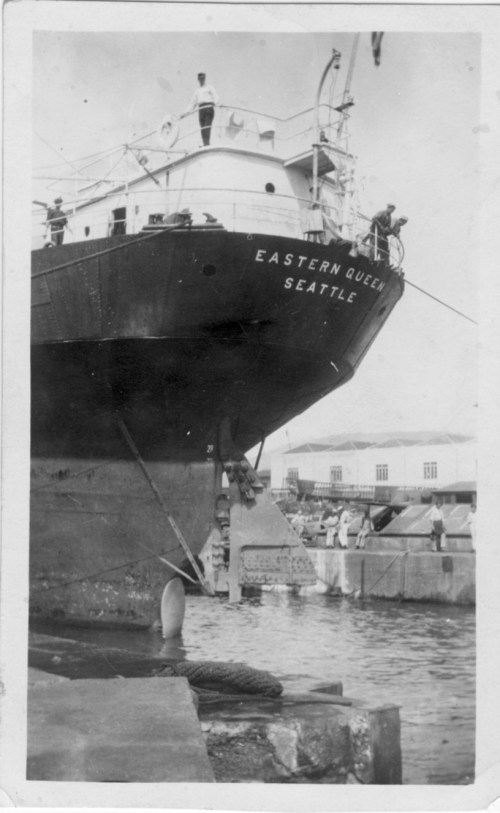
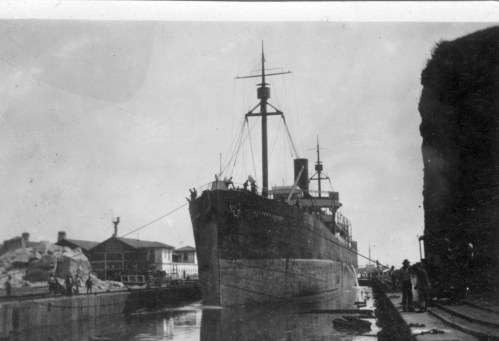
I also have information that he travelled on a ship called the Altamahan in 1922. I tried to find this ship, but all I could find was the Altamaha, which was built in 1941.
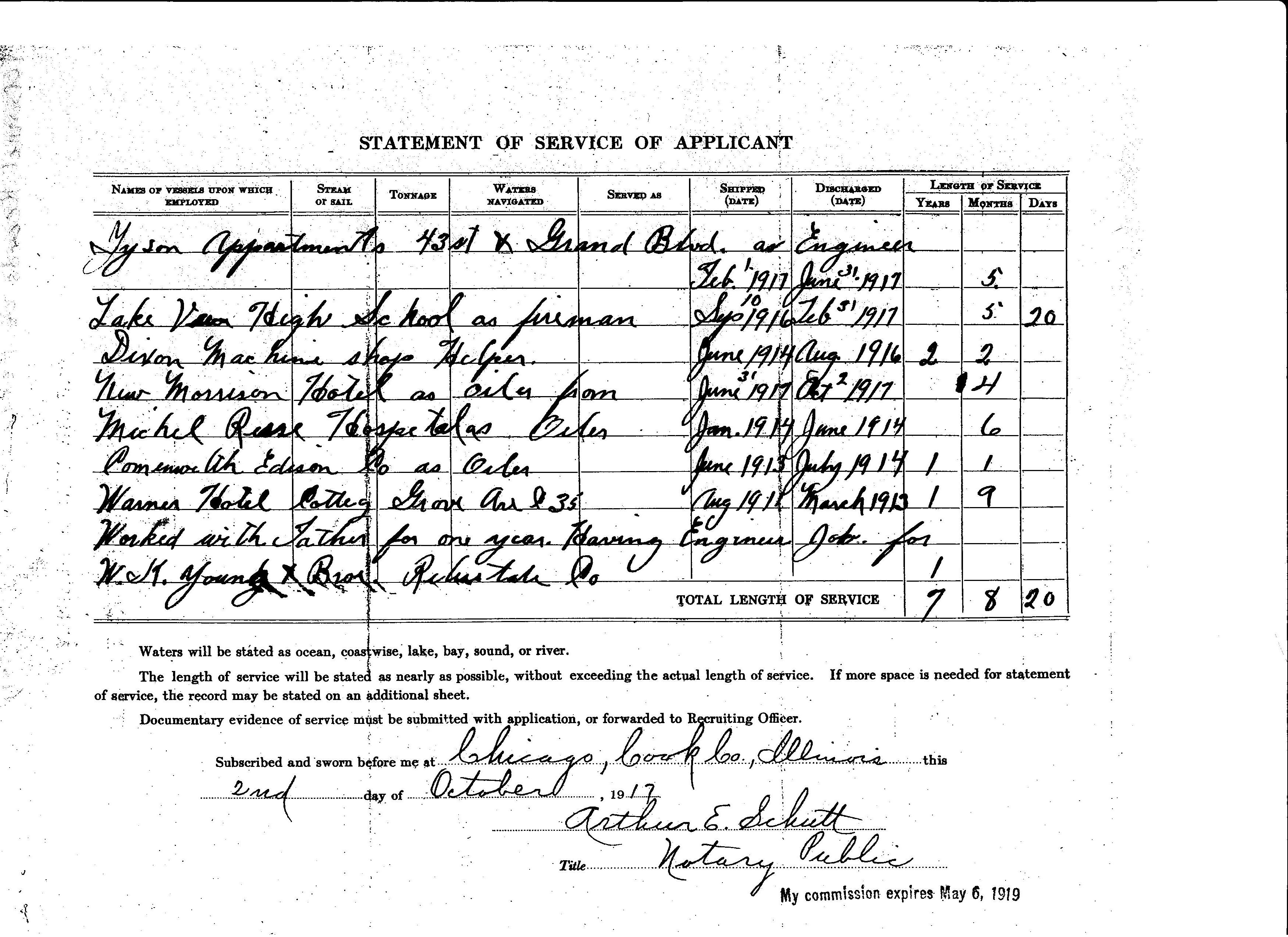
Until I saw his picture a few years ago, I didn’t realize Great Uncle Frank existed. After I learned about him, I wanted to know more, so I wrote to both the U.S. Coast Guard and the National Archives and Records Administration, searching for his Merchant Marines record. The Coast Guard couldn’t help, but the NARA found a record for Frank. They gave me some preliminary information and then suggested I do more research on the premises in Washington D.C. Here are a few things I learned from the records they sent me:
- He was issued a license for “steam. 2d Ass’t.Eng.,3000 G.T., 3d Ass’t.Eng., any tons, condg.” at Cleveland, Ohio, on September 5, 1918, for “Ocean” waters.
- He was issued another on September 5, 1919.
- He was 22 on June 14, 1918.
- I have a headshot and thumbprint of Uncle Frank.
- He was a citizen and born in the U.S.
- A vessel he was on was the “Altamahan” with a U.S. Flag, which arrived on 3/5/19. His next vessel wasn’t yet known.
- He was 5’9 with a dark complexion, brown hair, and gray eyes.
- He had a physical mark: “Sc palm rt hd”–I take this to be that he had a scar on the palm of his right hand. On another page it is noted as 1/2 inch.
- He was a 2d Engr.
- On his application he marked his mother “Mrs. F. Klein” as his nearest kin. He gave 3 references, and one was his brother-in-law, Peter Van Gessel.
- Best of all, he gave a work history for himself, which I will post here. Several jobs were as an “oiler.” According to Wikpedia, an oiler is a worker whose job is to oil machinery.

Here is a picture of Great Uncle Frank when he was home on leave:

Uncle Frank and Grandma Marie Klein c. 1920
Frank Anthony Klein on born in Chicago on June 14, 1896. He grew up in Elmhurst and was the only boy. He had four sisters, including my grandmother. Frank never married, but he was living with my grandmother and her family in Chicago when he was killed in a car accident in 1931.
According to his death certificate, this is how he died: “Fractured left mandible, compound fracture of left tibia and fibula, hemorrhage and shock Deceased was driving his auto and suffered an attack of epilepsy seizure and struck a tree.” I suspect his parents were devastated by his death as he was the only boy and the second youngest. He was 34 years old. Fifteen months later, his mother passed away from cancer.
His death date is noted in official records as February 24, 1931, but his gravestone is marked with the date February 23, 1931. Because he was buried in Elmhurst on February 25, I would deduce that February 23 was the correct date of death.

Posted in Chicago history, Family History, Genealogy, Klein, Photography early 20th century | Tagged Bingen am Rhein, Budesheim, Chicago, Chicago history, Elmhurst, Illinois, history, family history, Frank Klein, genealogy, Illinois, Merchant Marines, sailor, U.S. Merchant Marines | 12 Comments »
« Newer Posts - Older Posts »











 The Family Kalamazoo